Monthly Archives: January 2018

MSF operational update: Central Mediterranean & Libyan Operations: “It is not possible to provide meaningful medical care in a system of arbitrary detention that causes harm and suffering.”

MSF’s 29 January 2018 operational update.

Some key points:

  • The number of detainees [in Libyan detention centres] went down in December [2017] when thousands of people were mass repatriated to their countries of origin by the International Organisation for Migration (IOM).
  • The majority of physical and mental health problems requiring medical assistance still directly relate to the substandard conditions of detention.
  • It is not possible to provide meaningful medical care in a system of arbitrary detention that causes harm and suffering.
  • Italian ships have been deployed in Libyan territorial waters as part of a broader European strategy to seal off the coast of Libya and “contain” refugees, asylum-seekers and migrants in a country where they are exposed to extreme and widespread violence and exploitation.
  • The MSF team onboard Aquarius witnessed refugees and migrants aboard unseaworthy vessels being intercepted by the Libyan Coastguard in international waters as EU military assets at the scene looked on.
  • Although these interceptions are presented as “rescue operations” and are celebrated by the Libyan Coastguard and their EU partners, the reality is that migrants and refugees are not being returned to a port of safety.
  • [T]here are several entities operating along Libya’s vast coastline that claim to be the Libyan Coastguard. Contact points on land and at sea were unclear, as was the chain of command.

Excerpts from MSF operational update:

Libya: dismal conditions in detention centres hinders medical treatment

In Tripoli, a huge increase in the number of people detained in October and November [2017] resulted in extreme overcrowding and a dramatic deterioration of conditions inside the capital’s detention centres. In some locations, up to 2,000 men were crammed together in one cell without enough floor space to lie down. … From September to December 2017 the MSF team treated over 76 people for violence-related injuries including broken limbs, electrical burns and gunshot wounds.

Under these circumstances, the impact of MSF’s medical work was minimal. The team was able to help only a small percentage of all those in need of urgent treatment and it was not possible to follow up medical cases. … Most medical complaints were related to the conditions of detention, with overcrowding and inadequate latrine and drinking water provision resulting in acute upper respiratory tract infections, musculoskeletal pain and acute watery diarrhoea. …

The number of detainees went down in December [2017] when thousands of people were mass repatriated to their countries of origin by the International Organisation for Migration (IOM). Conditions inside detention centres in Tripoli improved and there was less mistreatment and violence against patients. In the detention centres that MSF visits, teams are now able to access cells to provide medical care to refugees and migrants that remain in arbitrary detention. The majority of physical and mental health problems requiring medical assistance still directly relate to the substandard conditions of detention.

Few international organisations are able to work in Libya due to widespread violence and insecurity. Those who do – including MSF – do not have full and unhindered access to all detention centres where refugees and migrants are being held. It is not possible to provide meaningful medical care in a system of arbitrary detention that causes harm and suffering. An overwhelming number of detainees have already endured alarming levels of violence and exploitation in Libya, and during harrowing journeys from their home countries. As such, MSF reiterates its call for an end to the arbitrary detention of refugees, asylum-seekers and migrants in Libya.

Aquarius continues sea rescues as numbers attempting Mediterranean crossing fall

In the central Mediterranean, the number of refugees, asylum-seekers and migrants rescued at sea and brought to safety in Italy has fallen since last year. Aquarius, a dedicated search and rescue vessel run by MSF in cooperation with SOS MEDITERRANEE, rescued 3,645 people in the period September – December 2017. This is fewer people compared to the same period in 2016 when 5,608 people were brought to a port of safety in Italy.

The fall in numbers appears to be due to fewer boats leaving Libya. Reasons for this are unclear, though likely factors include the weather and political developments on the ground in Libya. There have been media reports that local militias are being paid off by Italy to prevent departures. Italian ships have been deployed in Libyan territorial waters as part of a broader European strategy to seal off the coast of Libya and “contain” refugees, asylum-seekers and migrants in a country where they are exposed to extreme and widespread violence and exploitation….

Unclear future for refugees amid challenging rescue environment for Aquarius

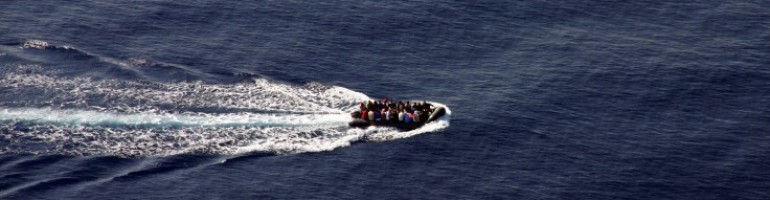
Carrying out search and rescue activities in the Mediterranean is becoming even more challenging and complex. People who manage to escape Libya are increasingly being turned back at sea with the EU-supported Libyan Coastguard active in international waters. The MSF team onboard Aquarius witnessed refugees and migrants aboard unseaworthy vessels being intercepted by the Libyan Coastguard in international waters as EU military assets at the scene looked on. On 31 October, 24 November and 8 December, Aquarius was instructed to standby and was forced to watch as hundreds of people were pushed back to Libya by the Libyan Coastguard.

Although these interceptions are presented as “rescue operations” and are celebrated by the Libyan Coastguard and their EU partners, the reality is that migrants and refugees are not being returned to a port of safety. The crimes committed against refugees and migrants in Libya are widely known and have generated international outrage. Under no circumstances should migrants and refugees aboard vessels in distress in international waters be returned to Libya, they must be brought to a port of safety.

In September, Aquarius was instructed to conduct three rescues in international waters under the coordination of the Libyan Coastguard. These unprecedented and highly unusual instructions from the Maritime Rescue Coordination Centre (MRCC) in Rome presented MSF with an impossible choice. Fortunately for each rescue, Aquarius was able to render the necessary assistance and took all rescued men, women and children to a port of safety in Italy. In that situation, it was not possible to verify who exactly was coordinating rescue operations as there are several entities operating along Libya’s vast coastline that claim to be the Libyan Coastguard. Contact points on land and at sea were unclear, as was the chain of command. As there have also been numerous violent incidents in recent months between the Libyan Coastguard and the few other remaining humanitarian organisations running dedicated search and rescue activities in the Mediterranean, the security of our team was paramount during these interactions.

It’s unclear what the future holds for refugees and migrants who find themselves along the Central Mediterranean route, but with Libya remaining riven by widespread violence and insecurity, with no unified government, a plethora of armed groups, and active fighting ongoing in several parts of the country, it does not look like an end to their suffering is in sight.

MSF operational update: Central Mediterranean here.

1 Comment

Filed under General

Libyan Coast Guard Migrant Interceptions (“Pull-Backs”) Steadily Increasing

Per UNHCR, the number of migrants being intercepted and subject to forcible return to Libya by the Libyan Coast Guard is steadily increasing:

UNHCR Flash Update, 26 Jan. 2018 – So far in 2018, over 1,430 refugees and migrants were disembarked in Libya by the Libyan Coast Guard (LCG). In January 2018, UNHCR has observed an increase in numbers of rescue/interception operations conducted by the LCG when compared to the same month in 2017 (1,025 individuals) and previous months such as November (1,214 individuals) and December 2017 (1,157 individuals). During January, departures were predominantly recorded in the area east of Tripoli, near Garabulli, and to a lesser extent in areas around Sabratha and Zwara. UNHCR partner International Medical Corps provided medical assistance and distributed core relief items at disembarkation points and detention centres.

UNHCR Flash Update here.

2 Comments

Filed under General

ECtHR chamber judgment in J.R. and Others v. Greece finding no violations of ECHR in regard to detention of Afghan nationals in Vial migrant centre in Greece

Court press release here.  Chamber judgment here (only available in French). (See also Court’s Fact Sheet “Migrants in Detention” here.)

Excerpt from Court’s press release:

25 January 2018 – In today’s Chamber judgment in the case of J.R. and Others v. Greece (application no. 22696/16) the European Court of Human Rights held, unanimously, that there had been:

no violation of Article 5 § 1 (right to liberty and security) of the European Convention on Human Rights, a violation of Article 5 § 2 (right to be informed promptly of the reasons for arrest); no violation of Article 3 (prohibition of inhuman or degrading treatment); and no violation of Article 34 (right of individual application).

The case concerned the conditions in which three Afghan nationals were held in the Vial reception centre, on the Greek island of Chios, and the circumstances of their detention.

The Court found in particular that the applicants had been deprived of their liberty for their first month in the centre, until 21 April 2016 when it became a semi-open centre. The Court was nevertheless of the view that the one-month period of detention, whose aim had been to guarantee the possibility of removing the applicants under the EU-Turkey Declaration, was not arbitrary and could not be regarded as “unlawful” within the meaning of Article 5 § 1 (f). However, the applicants had not been appropriately informed about the reasons for their arrest or the remedies available in order to challenge that detention.

As to the conditions of detention in the centre, the Court noted the emergency situation facing the Greek authorities after significant numbers of migrants had arrived and the ensuing material difficulties. It observed that several NGOs had visited the centre and had partly confirmed the applicants’ allegations, but found that the conditions were not severe enough for their detention to be characterised as inhuman or degrading treatment had not been reached.  [***]

Court press release here.  Chamber judgment here (only available in French). (See also Court’s Fact Sheet “Migrants in Detention” here.)

Leave a comment

Filed under General

IMIn Working Paper: Counting migrants’ deaths at the border: From civil society counter-statistics to (inter)governmental recuperation, C Heller, A Pécoud

International Migration Institute Network working paper by Charles Heller, Research Fellow at the Centre for Research Architecture, Goldsmiths, University of London and Antoine Pécoud, Professor of Sociology, University of Paris 13.  Article here.

Abstract: Migrant deaths in border-zones have become a major social and political issue, especially in the euro-Mediterranean region and in the context of the refugee/migrant crisis. While media, activists and policymakers often mention precise figures regarding the number of deaths, little is known about the production of statistical data on this topic. This paper explores the politics of counting migrant deaths in Europe. This statistical activity was initiated in the nineties by civil society organizations; the purpose was to shed light on the deadly consequences of ‘Fortress Europe’ and to challenge states’ control-oriented policies. In 2013, the International Organization for Migration also started to count migrants’ deaths, yet with a different political objective: humanitarian and life-saving activities become integrated in border management and the control of borders is expected to both monitor human mobility and save migrants’ lives. IOM thus depoliticises these statistics, while at the same time imitating an activity first associated with political contestation by civil society actors. Finally, the paper explores ways in which statistics on border deaths can be re-politicised to challenge states’ immigration policies in Europe.

Non‐technical summary: The deaths of migrants in the euro‐Mediterranean region constitute a major issue in the context of the migration crisis. Media regularly report of shipwrecks or of dead bodies found on Southern European shores, while European governments and the EU are under pressure, by civil society groups in particular, to find ways of ending a tragedy that is at odds with the continent’s commitment to peace and human rights. This paper explores the ways in which statistics on migrants’ deaths are collected. The first data on this topic came from NGOs in the nineties; their objective was to denounce the deadly consequences of European policies and to challenge control‐oriented policies. Today, however, statistics on border deaths are collected by an intergovernmental actor, the International Organization for Migration: rather than criticizing states, this organization aims at conciliating the control of human mobility with the prevention of deaths – thus moving towards a ‘humanitarian border’.

Article here.

1 Comment

Filed under General

Research shows lack of overarching coordination in criminal operations transporting people from the Horn of Africa into Northern Europe via Libya. Instead, transnational smuggling routes found to be highly segmented: each stage a competitive marketplace of “independent and autonomous” smugglers

Univ. of Cambridge press release here.  Dr Paolo Campana’s article in the European Journal of Criminology here.

University of Cambridge press release, 22 Jan. 2018:

Latest research shows a lack of overarching coordination or the involvement of any “kingpin”-style monopolies in the criminal operations illegally transporting people from the Horn of Africa into Northern Europe via Libya. Instead, transnational smuggling routes were found to be highly segmented: each stage a competitive marketplace of “independent and autonomous” smugglers – as well as militias and kidnappers – that must be negotiated by migrants fighting for a life beyond the Mediterranean Sea. […]

Dr Paolo Campana from Cambridge University’s Institute of Criminology conducted the research using evidence from the 18-month investigation by Italian prosecutors that followed the Lampedusa shipwreck, in which 366 people lost their lives. The work included data from wiretapped telephone conversations between smugglers at all stages, testimonies collected from migrants, interviews with police task force members, and background information on offenders.

“The smuggling ring moving migrants from the Horn of Africa to Northern Europe via Libya does not appear to have the thread of any single organisation running through it,” said Campana, whose findings are published today in the European Journal of Criminology. “This is a far cry from how Mafia-like organisations operate, and a major departure from media reports claiming that shadowy kingpins monopolise certain routes.” […]

“Authorities may wish to deliberately tarnish the reputation of smugglers in order to shut down their business,” said Campana.  “Criminal justice responses require the adoption of coordinated tactics involving all countries along the route to target these localised clusters of offenders simultaneously. “This is a market driven by exponential demand, and it is that demand which should be targeted. Land-based policies such as refugee resettlement schemes are politically difficult, but might ultimately prove more fruitful in stemming the smuggling tide than naval operations.”

Leave a comment

Filed under General