Category Archives: Frontex

Prof. Goodwin-Gill: ‘The Right to Seek Asylum: Interception at Sea and the Principle of Non-Refoulement’

On 16 February Professor Guy S. Goodwin-Gill presented the inaugural lecture of the Fondation Philippe Wiener – Maurice Anspach, Chaire W. J. Ganshof van der Meersch.  The lecture was entitled ‘The Right to Seek Asylum: Interception at Sea and the Principle of Non-Refoulement’.  The complete text of the lecture is available at this link: Goodwin-Gill: The Right to Seek Asylum-Interception at Sea and the Principle of Non-Refoulement.  The complete text also contains a helpful reference list.

I have reproduced several excerpts below:

“Looking at the interception and return measures adopted in the Mediterranean and off the west coast of Africa … one may rightly wonder what has happened to the values and principles considered fundamental to the Member States of the European Union….  [***]

… [I]t is all the more surprising when [European] governments, ministers and officials either pretend that the rules [- including Article 78(1) of the TFEU which requires the Union to develop a common asylum policy with regard to ‘any third country national requiring international protection and ensuring compliance with the principle of non-refoulement’ – policy which ‘must be in accordance with the Geneva Convention… and other relevant treaties’-] do not apply, or seek ways to avoid their being triggered.

In my view, the problems begin at the beginning, just as they commonly do also at the national level. A policy or goal is identified – in this case, reducing the number of irregular migrants, including asylum seekers, leaving the north African coast and heading for Europe – and then belatedly some attempt is made to bend implementation of the policy to fit in with principle and rule. A better approach, in my view, would be to begin with a clear understanding of the applicable law – the prohibition of discrimination, of refoulement, of inhuman or degrading treatment – and then to see what can be done by working within the rules.

Of course, this approach is premised on the assumption that States generally seek to work within the rule of law. It will not likely influence the State determined to deal with the migrant and the asylum seeker arbitrarily, and without reference to principle. Such cases must be confronted head-on, by way of judicial and political mechanisms of control.  [***]

… The problem, though, lies not in formal recognition of protection principles but, as ever, in operationalising the rules – in making protection a reality at the point of enforcement. On the plus side stands a substantial body of legislation: the Frontex regulation itself; the RABIT amendment, with its express insistence on compliance with fundamental rights and conformity with Member States’ protection and non-refoulement obligations; and the Schengen Borders Code, Article 3 of which requires the Code to be applied, ‘without prejudice to the rights of refugees… in particular as regards non-refoulement’. Add to this the April 2010 Council Decision supplementing the Code and dealing specifically with the surveillance of maritime borders and Frontex operations; it is currently being challenged by the Parliament on vires grounds, and it was also objected to by Malta and Italy, mainly for its proposal that in the last resort, rescue cases should be disembarked in the State hosting the Frontex operation. The Decision’s formulation of the applicable law in the matter of protection, however, is unremarkable, restating the principle of non-refoulement and the need to avoid indirect breach, but also providing for those intercepted to have an opportunity to set out reasons why they might be at risk of such a violation of their rights….  [***]

What do we know about either unilateral or Frontex-led interception operations so far? Not as much as we might expect as citizens of a democratic Union bounded by the rule of law and basic principles of good governance, such as transparency and accountability….  [***]

Exactly what Frontex does in an interception context has been questioned. Human Rights Watch has claimed that Frontex has been involved in facilitating interception, though this has been denied. Amnesty International and ECRE note that Frontex has stated that it does not know whether any asylum applications were submitted during interception operations, as it does not collect the data. How, then, should we approach what appears to be wilful ignorance? In the Roma Rights Case in 2004, discrimination on racial grounds was alleged in the conduct of immigration procedures by British officials at Prague Airport, which were intended to prevent potential asylum seekers leaving for the United Kingdom. There, too, the authorities did not keep any records of the ethnic origin of those they interviewed. Finding on the evidence that the government had acted in violation of relevant legislation, the House of Lords called attention to the importance of gathering information, ‘which might have helped ensure that this high-risk operation was not being conducted in a discriminatory manner…’

Given the secrecy attaching to interception operations, and the fact that no data are gathered or retained, it is reasonable to infer that some level of Frontex involvement has occurred, and that, absent evidence to the contrary, the relevant principles of international and EU law have not been observed.  [***]

… The object and purpose of EU operations in maritime areas, therefore, should be first and foremost to ensure protection, and secondarily to manage and prevent irregular migration….

In the absence of effective and verifiable procedures and protection in countries of proposed return, the responsibility to ensure protection remains that of the EU agency or Member State. In practice, this will require that they identify all those intercepted, and keep records regarding nationality, age, personal circumstances and reasons for passage. Given protection as the object and purpose of interception operations, an effective opportunity must be given for objections and fears to be expressed; these must then be subject to rational consideration, leading to the formulation of written reasons in explanation of the next steps. Where this entails return to or disembarkation in a non-EU State, a form of judicial control is required as a necessary safeguard against ill-treatment and the abuse of power – exactly what form of judicial control calls for an exercise of juristic imagination. In the nature of things, such oversight should be prompt, automatic, impartial and independent, extending ideally to the monitoring of interception operations overall….”

Click here or on the following link for complete text: Guy S. Goodwin-Gill, ‘The Right to Seek Asylum: Interception at Sea and the Principle of Non-Refoulement’

I thank Prof. Goodwin-Gill for permitting me to post the text of his lecture.


1 Comment

Filed under Aegean Sea, Analysis, Eastern Atlantic, European Union, Frontex, Mediterranean, UNHCR

“Non-Stop” Boat Arrivals Continue in Lampedusa; Maroni Says Libyan Smuggling Organisations Now Operating From Tunisia

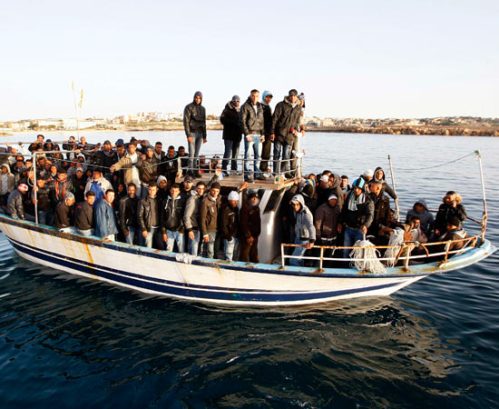
Boats containing over 1000 Tunisians arrived in Lampedusa on Monday.  The boats are reportedly leaving Tunisia from the southern coast from the port of Zarsis and the island of Djerba, an area near the border with Libya.

Interior Minister Roberto Maroni said on Monday that “we know that criminal organizations that operated by moving illegal immigrants from Libya have reappeared and are now repositioning themselves in the south of Tunisia.  (“Al ministro dell’Interno Roberto Maroni che parla di altre ‘migliaia e migliaia di persone pronte a partire’ e lancia un allarme: ‘abbiamo notizia – spiega – che sono riapparse le organizzazioni criminali che operavano prima in Libia facendo partire i clandestini e che adesso si stanno riposizionando nel sud della Tunisia’.)  Maroni said that “Italian intelligence had reported ‘thousands and thousands of young people’ heading for … Zarzis and Djerba, and that it would require a ‘significant commitment’ from EU countries to block their departure.”

Click here (IT), here (IT), here (IT), and here (EN) for articles.


Credit: Lampedusa, ancora sbarchi dalla Tunisia-FOTOGALLERY- LASTAMPA.it:


Leave a comment

Filed under European Union, Frontex, Italy, Libya, Mediterranean, News, Tunisia

Over 1000 New Migrants Reach Lampedusa

Migrant arrivals in Italy continue with over 1000 migrants reaching Lampedusa in at least 11 different boats on Sunday.

Click here (IT) and here (IT) for articles.

Leave a comment

Filed under European Union, Frontex, Italy, Mediterranean, News, Tunisia

Interactive Map: Deaths at Europe’s Borders

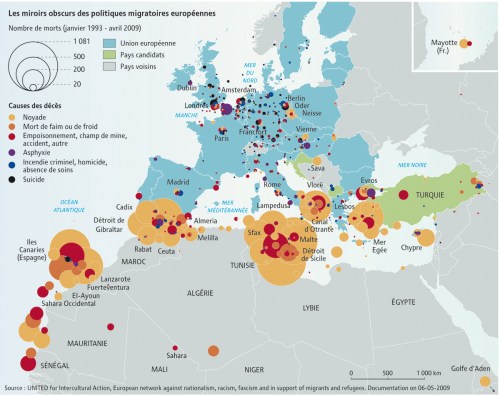
From OWNI.eu:  an interactive map showing the 14,000 persons who have died trying to reach Europe since 1988.  “[A]n interactive map as an electronic memorial for these tragedies.”

Click here for link.  The map copied below is not the new Interactive Map.  Click on link for the Interactive Map

Mourir aux portes de l’Europe (carte d’Olivier Clochard)

1 Comment

Filed under Aegean Sea, Data / Stats, Eastern Atlantic, English Channel / La Manche, European Union, Frontex, Mediterranean, News

Migrant Arrivals in Lampedusa Resume; 10 Boats–500 Migrants Arrive During 24 Hour Period

After a week or so without any migrants arriving in Lampedusa, ten boats carrying approximately 500 persons arrived in Lampedusa and nearby Italian islands over a 24 hour period 1st-2nd March.  Improved weather conditions are the most likely explanation for the new boat arrivals.  Highlighting the difficulties of maritime surveillance, one of the migrant boats with 22 migrants landed on the island of Linosa, roughly halfway between Lampedusa and Malta, without being detected.

According to Interior Minister Roberto Maroni, to date 2,000 Tunisians have applied for some form of protection; less than 400 asylum requests have been made.  According to Maroni, most of the Tunisians have expressed a desire to go to other European countries, generally France or Germany.

Maroni said that Italy’s agreement with Tunisia limits repatriation of Tunisians to four persons per day and Italy is therefore currently negotiating with Tunisia to increase the number of persons who may be repatriated.  If the daily limit is not changed it would take years to return the thousands who have arrived in Italy.

Click here (IT), here (IT), and here (EN) for articles.

Leave a comment

Filed under Frontex, Italy, Libya, Mediterranean, News, Tunisia

Laitinen in Malta Visit; Malta Still Not Willing to Host New Frontex Mission; Frontex Preparing Multiple Contingency Plans

Malta’s Home Affairs Minister Carm Mifsud Bonnici met with Frontex Executive Director Ilkka Laitinen.  Mifsud Bonnici said Malta is unwilling to host a new Frontex mission due to its fear that intercepted or rescued migrants would be taken to Malta.  During a press conference (click here for article and short video), Laitinen said that Frontex was not willing to give estimates of the numbers of migrants it believes may seek to leave Libya, but said it was preparing plans for seven different scenarios.  The plans “could include strengthening air and maritime surveillance, increased capacity to deal with those seeking protection at ports and airports and an improved repatriation mechanism for those who did not meet the criteria for humanitarian protection.”  Laitinen reiterated that “push backs and diversions are not an option for people seeking protection.”  Laitinen did not address the burden sharing question other than to say that it was a political question that did not involve Frontex.

Click here, here, and here for articles.

1 Comment

Filed under European Union, Frontex, Libya, Malta, Mediterranean, News

Human Rights First Backgrounder: States’ Obligations to Protect Refugees Fleeing Libya

Excerpts from the Backgrounder:

Currently, Tunisia and Egypt are experiencing an influx of people fleeing Libya. These persons include nationals of those two countries seeking to return home, as well as Libyans and smaller numbers of nationals of other countries in search of safety. Both Tunisia and Egypt, themselves emerging from turmoil, have kept their borders open and are receiving those fleeing Libya. …

All states affected by the ongoing crisis are bound to respect the following [core] principles governing the treatment of refugees….

Protection of refugees is a collective international responsibility. In practice, however, it is those countries that are closest to or most accessible from Libya and its neighbors that will be called upon to protect the majority of refugees who may seek international protection in the immediate term….

At a time when all countries in the region and their neighbors in the EU may see an increase in migration by people fleeing persecution and violence as well as worsening economic conditions, it is critically important that those who have a claim to international protection be given access to procedures to obtain it. The international community more broadly and the EU should assist those States that bear the brunt of this challenge in dealing with it in a way that is consistent with their international obligations. At the same time, Italy and other EU member states and institutions must refrain from pushing migrants back to Libya or any other country without identifying those in need of international protection and allowing those who need such protection to apply for it.

Click here for full document.

Leave a comment

Filed under Analysis, Egypt, European Union, Frontex, Italy, Libya, Malta, Mediterranean, Tunisia

Update from Today’s LIBE Committee’s Discussions re Central Mediterranean

The Hungarian Presidency and LIBE have released summaries regarding today’s LIBE Committee meeting.  Here are some points from the two summaries:

  • Commissioner Malmström emphasized that, so far, migrants had not started coming to Europe from Libya, but the EU had to prepare for this possibility;
  • Frontex Director Laitinen made it clear that the region should not be seen as a whole, but as separate countries with separate problems;
  • Laitinen underlined that from Tunisia only economic migration could be seen so far, but for the moment, as Tunisian authorities have regained control of the migration flow, this had stopped, as well. Since 26 February, no migrants had arrived to Lampedusa.
  • Laitinen also stressed that Italy was not the only entry point for migrants from North-Africa. Greece should not be forgotten in this context.  Low-cost flights from North-Africa to Istanbul were operating, bringing many migrants who then were trying to enter the Schengen area through the Greek-Turkish border;
  • Laitinen said that the possibility of extending Hermes to address Malta’s needs was being examined. More money and staff might be needed if the current emergency persists;
  • MEPs urged Member States to accelerate work on the “asylum package” and stressed the need for solidarity as regards relocating migrants;
  • Malmström said that most of the current migration from Tunisia to Lampedusa appears to be for economic reasons;
  • Malmström said that “Frontex and Member States may not push away people in need of international protection”;
  • MEP Simon Busuttil (EPP, MT) said the three main priorities in Libya are halting violence, sending humanitarian aid and planning for a possible immigration emergency. “What if a mass influx turns into Europe, is there a plan in the drawer to be pull out if this happens?” “Member States show no appetite for relocation.”

Click here and here for the two articles.

Leave a comment

Filed under European Union, Frontex, Greece, Hungary, Italy, Libya, Malta, Mediterranean, News, Tunisia, Turkey

Laitinen in Malta for Discussions

Frontex Director Ilkka Laitinen is in Malta today for discussions with Maltese officials about the situation in Libya and the possibility of a new migrant flow from Libya.  It seems that the discussions concern the expansion of Joint Operation Hermes Extension or the creation of a new joint operation based in Malta.  Before leaving Brussels earlier today, Laitinen said that “although the situation is fluid and until now no flows of asylum seekers to Europe has resulted, Frontex was preparing for such an eventuality.”

Click here (EN), here (IT) and here (IT) for articles.

Leave a comment

Filed under European Union, Frontex, Italy, Libya, Malta, Mediterranean, News, Tunisia

Live Coverage, 1 March, 09:00, LIBE Meeting re Situation in the Central Mediterranean

LIBE will reconvene today, 1 March, 09:00-10:30, to discuss “the situation in the central Mediterranean…. They will consider the democratisation process in the region and its impact on migration flows and EU immigration and asylum policy. In attendance: Hungarian Presidency representative, H.E. Peter Györkös, Cecilia Malmström, Commissioner for Home Affairs and Ilkka Laitinen, Executive Director of Frontex, the EU border security agency.”

Click here for live coverage.

Leave a comment

Filed under European Union, Frontex, Italy, Libya, Malta, Mediterranean, News, Tunisia

Blog du Monde Diplo: une démonstration de force navale; une petite armada converge en direction des côtes libyennes

Du blog de “Défense en ligne” écrit par Philippe Leymarie: “Guerre civile en Libye et options militaries.”

“Alors que le Conseil de sécurité de l’ONU réuni vendredi dernier a décidé d’un embargo sur les armes et de sanctions contre le régime Kadhafi, la violence de la répression en Libye a incité les pays européens, qui n’envisagent pas d’intervention militaire pour le moment, à entamer une démonstration de force… navale, qui a pris forme en quelques heures, avec une célérité inhabituelle. Une petite armada converge en direction des côtes libyennes, dans ce qui pourrait, à terme, devenir une véritable opération, mêlant la dissuasion à l’humanitaire. …

“Dans la pratique, le déploiement de cette petite armada pourrait également constituer un cordon de sécurité afin d’éviter une fuite en masse par la mer de Libyens ou d’immigrés africains vers l’Europe – donnant plus de consistance à l’opération de surveillance « Hermès », entamée (sous la pression notamment de l’Italie, en première ligne) par l’agence européenne Frontex….”

Cliquez ici pour l’article complet.

Leave a comment

Filed under Analysis, European Union, Frontex, Libya, Mediterranean, United Nations

Laitinen to Visit Malta to Discuss New Frontex Mission

The Malta Independent reported yesterday that Frontex Director Ilkka Laitinen will visit Malta shortly “with a view to organising a Frontex mission that would be hosted by Malta but, [Justice and Home Affairs Minister] Dr Mifsud Bonnici stresses, not under the infamous guidelines that are being disputed [before the European Court of Justice] by Malta, Italy and the European Parliament.”  Dr Mifsud Bonnici said “I have also made it a precondition that if we are to host this Frontex mission, it would not be under those guidelines and there is an agreement on that.”

Malta’s primary objection to the Frontex Sea Border Rule is likely due to provisions which require that intercepted migrants be taken to the country hosting the Frontex mission under certain circumstances.  The relevant provision provides:

“2. Disembarkation- 2.1. The operational plan should spell out the modalities for the disembarkation of the persons intercepted or rescued, in accordance with international law and any applicable bilateral agreements. The operational plan shall not have the effect of imposing obligations on Member States not participating in the operation.  Without prejudice to the responsibility of the Rescue Coordination Centre, and unless otherwise specified in the operational plan, priority should be given to disembarkation in the third country from where the ship carrying the persons departed or through the territorial waters or search and rescue region of which that ship transited and if this is not possible, priority should be given to disembarkation in the host Member State unless it is necessary to act otherwise to ensure the safety of these persons.”

Commissioner Cecilia Malmström has previously said that the Sea Border Rule guidelines can be negotiated by member states on a mission by mission basis and that before a mission starts participating member states can agree on different rules of engagement, which might include the sharing of responsibility where not all intercepted migrants would be brought to country hosting the mission.

Click here for Malta Independent article.

Click here for previous post regarding Malmström’s comments.

Leave a comment

Filed under European Union, Frontex, Libya, Malta, Mediterranean, News

More Assets Dedicated to Frontex Joint Operation “Hermes Extension”; More EU and NATO Naval Forces Present in Central Mediterranean

The assets dedicated to Joint Operation Hermes Extension continue to increase, although at present there are only two coastal patrol boats (Italian) participating in the Frontex  mission.  Ten surveillance aircraft will soon be deployed.  See the table with the list of resources below.

While the naval assets dedicated to JO Hermes Extension are minimal, there is a growing number of EU and NATO naval ships in the Central Mediterranean.  Nicolas Gros-Verheyde (writing on the Bruxelles2 blog (FR)) has counted 14 naval ships from EU states that are present in the waters near Libya; the ships consist of destroyers, frigates, electronic surveillance ships, and supply and support ships.   Additionally, Turkey has two naval ships in the area.

Some of the naval ships have already been used to evacuate European and other non-Libyan nationals from Libya.  What additional activity the EU ships may engage in remains to be seen.  They may become involved in military activities (presumably with UN authority (?)) and/or they may play a yet undetermined role should there be a sudden flow of migrants and asylum seekers from Libya.  If there is a sudden and significant migratory flow, the naval ships should function in a search and rescue manner, but there is always the possibility that if faced with large numbers of migrants, the navy vessels may be used to interdict, blockade, or otherwise to try to prevent migrants from leaving Libya.

Click here for link to Frontex update regarding deployed assets.

Click here and here for Bruxelles2 postings. (FR)

Table: Resources available to JO Hermes Extension 2011 as of February 25, 2011.

Italy (HMS) 2 Coastal Patrol Vessel, 1 aircraft, 5 experts, 2 cultural mediators
Austria 1 expert
Belgium 2 experts
Denmark 3-5 experts
France 10 experts, 1 aircraft
Germany 2 experts, 2 aircrafts
Hungary 2 experts
the Netherlands 1 aircraft, 2 experts
Portugal 7 experts, 1 aircraft
Romania 6 experts
Sweden 1 expert
Switzerland 2 experts
Spain 4 experts, 1 aircraft (at a later stage)

Leave a comment

Filed under Algeria, Data / Stats, European Union, Frontex, General, Italy, Libya, Malta, Mediterranean, News, Tunisia

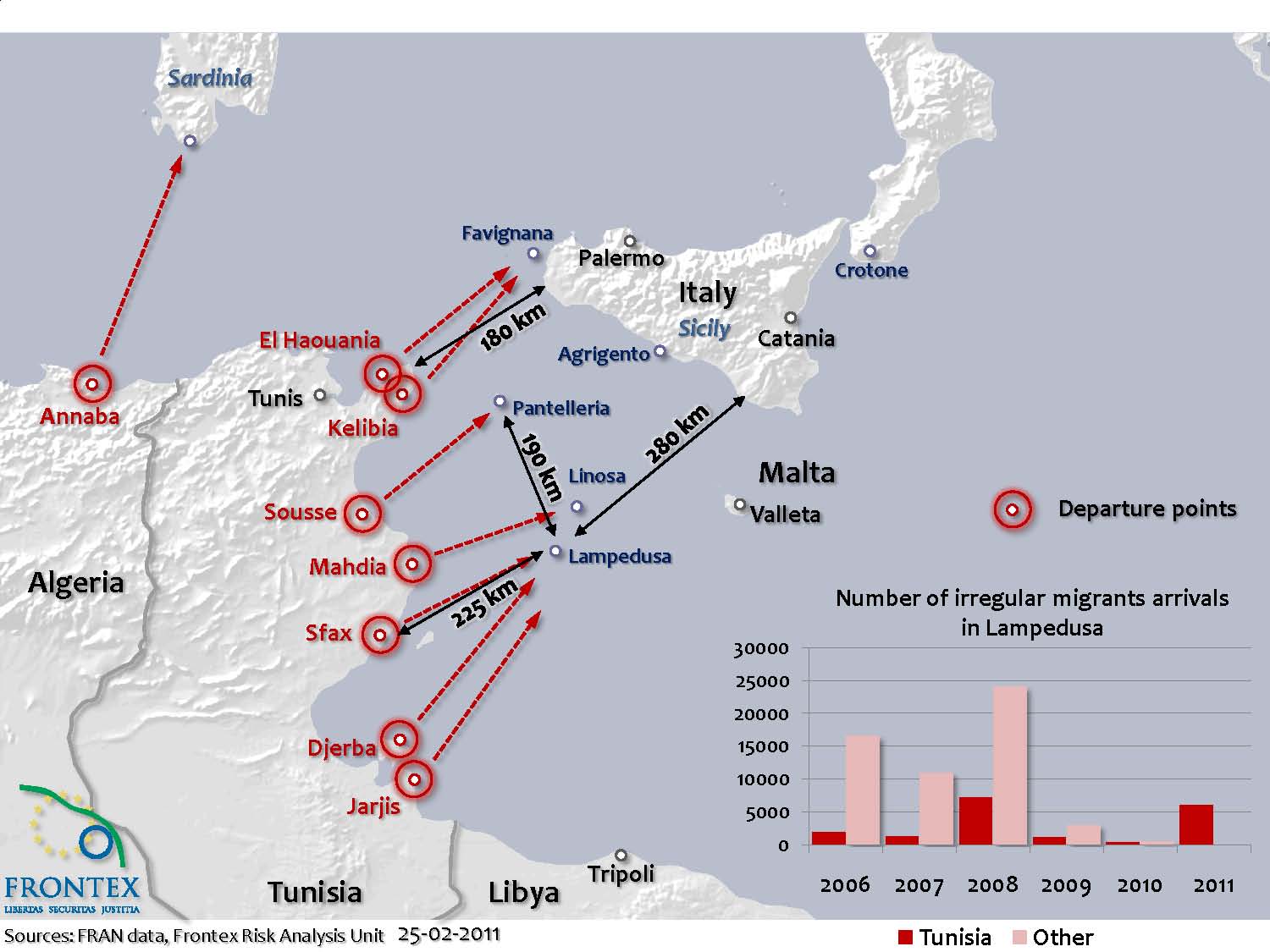
Frontex Lampedusa Situational Map

Frontex posted a situational map showing current and past information regarding migrant flows from Tunisia to Italy.  The map is dated 25 Feb. 2011.

1 Comment

Filed under Algeria, Data / Stats, European Union, Frontex, Italy, Malta, Mediterranean, News, Tunisia

Frontex Work Programme for 2011

Frontex’s 139 page work programme for 2011 is available on its web site.  I have not reviewed it yet.  It was presented to the JHA Council earlier in the week.

Click here for the document.

Leave a comment

Filed under European Union, Frontex, News, Reports