Category Archives: Mediterranean

Details from Frontex General Report 2009 (Post 2 of 2)

Last week I posted a summary of the first part of Frontex’s 2009 General Report.  This second post summarizes the portion of the Report pertaining to Frontex’s sea operations.

The General Report 2009 provides selective information regarding the six major Joint Operations conducted at the sea borders.  With only one exception, no information or data is provided regarding the specific numbers of intercepted migrants or vessels.

Instead of numbers, the Report provides various descriptive terms which could mean almost anything.  For example, Operation Hera led to a “drastic decrease of migrants,” during Operation Nautilus there was a “remarkable decrease” in migrants, and during Operation Hermes, the numbers of migrants arriving and dying at sea “decreased dramatically.” The one exception is for Operation Indalo where the Report states that 750 irregular migrants and 10 facilitators were detected.

When desired, the Report provides details and numbers.  For example, Operation Poseidon utilized 4 open sea vessels, 6 coastal patrol vessels, 13 coastal patrol boats, six airplanes, 4 helicopters, and 152 experts who delivered 2680 man days of operational activities, but no data regarding the total number of irregular migrants intercepted at sea is provided.

Here is a summary of the information provided in the Report for each of the six major Joint Operations:

Poseidon 2009, Eastern Mediterranean (365 Days)

Poseidon was conducted along land borders as well as at sea.  Interpreters were deployed on board ships to facilitate the identification process of intercepted migrants.  Less than 10% of the interviewed migrants claimed their original nationality.  There was an overall reduction in migrant flow of 16% (land and sea) compared to 2008.  “The main operational objectives of the joint operation were achieved but there is a clear need for closer cooperation between local authorities.”

Hera 2009, Atlantic Ocean waters between North Western African countries and Canary Islands (365 Days)

Due to the permanent implementation of Joint Operation Hera and better cooperation from “involved African countries”, there was a notable reduction in migrants reaching the Canary Islands, 2280 in 2009 compared with 9200 in 2008.  Aerial and maritime surveillance conducted close to the territory of Senegal and Mauritania and local cooperation from police led to the decrease in migrants.  “Despite these clear successes, participation of more member States would greatly increase effectiveness and outcomes.”  [NF- While the Report does provide migrant arrival data for the Canary Islands, it is silent on the number of migrants intercepted at sea or within Senegal or Mauritania.]

Nautilus 2009, Central Mediterranean (172 Days)

There was a remarkable decrease in migrant arrivals in Malta.  A “significant obstacle to the effectiveness of the Joint Operation lay in the contrasting interpretations of the International Law of the Sea by Member States….”  The effectiveness of the operation compared with 2008 was not improved.

Hermes 2009, Central Mediterranean (184 Days)

“Due to the bilateral agreement between Italy and Libya, the number of people arriving from Libya, as well as the number of migrants died at sea, decreased dramatically….”  “In addition, the first examples of co-operation with Algeria should also be considered as promising.”  As with Nautilus, “differing interpretations of the International Law of the Sea led to a limited contribution by the Member States to the joint operation by maritime surface means.”  The effectiveness of the operation compared with 2008 can be considered as increased.

Minerva 2009, Western Mediterranean (39 Days)

The launch of the operation was delayed in 2009.  Its effectiveness compared with 2008 has remained the same.

Indalo 2009, Western Mediterranean (50 Days)

The lack of cooperation from Algeria is an obstacle for operational activities.  10 Facilitators and 750 irregular migrants were identified.

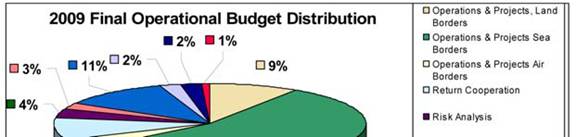
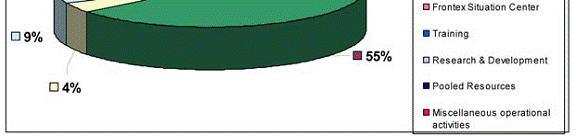
And as I noted in my earlier post, Frontex continued to devote the biggest single portion of its expenditures to maritime enforcement.  Almost 40% of Frontex’s total budget, over € 34 million, was spent on sea operations in 2009, constituting 55% of the operational budget.

This chart from the Report (p 23) shows the breakdown of expenditures within the 2009 Operational Budget (which was 71% of the total 2009 Frontex budget).
Click here for previous post.

Click here for the Frontex General Report 2009.

2 Comments

Filed under Aegean Sea, Algeria, Data / Stats, Eastern Atlantic, Frontex, Greece, Italy, Libya, Malta, Mauritania, Mediterranean, Reports, Senegal, Spain

1 Year Anniversary of Italy’s Push-Back Practice

This month marks the first anniversary of the implementation of Italy’s push-back practice with Libya.  The practice is based primarily on the Italy-Libya Treaty of Friendship, August 2008, and the Supplementary Protocol of 4 February 2009.

The first push-back operation occurred on 6 May.  As a reminder, here is the European Committee for the Prevention of Torture’s (CPT) description of the first operation:

Operation of 6 May 2009

According to data provided by the Italian authorities, 231 migrants (191 men and 40 women) were aboard three vessels in distress. The information collected from other sources indicates that among the migrants there were unaccompanied minors and four pregnant women. Following the interception of the boats by two Coast Guard vessels and one vessel of the Guardia di Finanza, the migrants were transferred onto the three Italian vessels and returned to Libya. The CISOM [Order of Malta Italian Relief Corps] personnel and a journalist, who was aboard the vessel of the Guardia di Finanza, indicated that they were not aware that the migrants would be pushed back to Libya, and that the captains of the Italian vessels only received an order to do so in the course of the operation.

The delegation was unable to interview the migrants pushed back to Libya or, given the authorities’ refusal to provide their names, the captains of the Italian vessels involved in the operation. However, reliable information collected by the delegation would indicate that, during the operation, which lasted around 12 hours, the 74 persons on the Guardia di Finanza vessel were provided insufficient water and no food or blankets; further, physical violence, in particular with kicks, punches and blows with an oar, was allegedly used against a number of migrants by Libyan police at the harbour in Tripoli, to force them to disembark from the two Coast Guard vessels.

Click here (IT) for article and podcast from AMISnet: “Un anno di respingimenti.”

Click here for earlier post.

Click here for the full CPT Report.

Click here for the Response of the Italian Government.

1 Comment

Filed under European Committee for the Prevention of Torture and Inhuman or Degrading Treatment or Punishment, Italy, Libya, Mediterranean, News

EU-Libya Association Agreement Negotiations

A Reuters article from 11 May reports that the EU and Libya may sign a cooperation pact known as an Association Agreement before the end of the year and that the pact would address matters such as trade and the control illegal immigration.   An EU mission will likely be opened in Libya before the end of the year according to Reuters.

Commissioner Cecilia Malmström during an interview with the Times of Malta several weeks ago referred to her efforts to begin immigration discussions with Libya:

“Libya is not exactly the easiest government to cooperate with and you know that much better being neighbours. It’s a complicated but important country and we will try to move forward. I’ve already written a letter to the Libyan Foreign Minister suggesting that we should sit together and identify areas where we can cooperate more in the field of migration.”

And Frontex’s 2009 General Report states that one of Frontex’s “overriding priorit[ies]” for 2010 is the development of “structured operational co-operation with neighbouring Mediterranean countries.”  Presumably Frontex desires such an agreement with Libya.

Click here and here for articles.

2 Comments

Filed under European Union, Frontex, Libya, Mediterranean, News

Mass Human Trafficking Trial in Libya

Over 450 defendants are being criminally tried in Libya, charged with human trafficking and facilitating illegal immigration.  The defendants are reportedly being jointly tried in groups of 30.  Among the defendants are members of the armed forces, public security, and Navy.  The trials are being conducted in special security courts.  ANSA reports that the special court proceedings are being used because the conduct has endangered Libyan national security.

According to an article in the Italian magazine Panorama (owned by Silvio Berlusconi (?)), this is the first such trial of its kind in Libya.  Apparently, only Oea, a Libyan newspaper (described by Panorama as a non-governmental paper) is being permitted to be present at the trials. An article in Oea describes a comment from a lawyer for one defendant saying that the case was difficult given the large number of defendants and the lack of adequate information.

Panorama describes the trials as a possible signal from Gaddafi and one which reveals what has always been suspected, that there has been complicity between traffickers and Libyan police.  Panorama concludes its article by asking whether the trials are genuine or merely propaganda.

Click here (IT) and here (Arabic) for articles.

2 Comments

Filed under Italy, Libya, Mediterranean, News

Maroni: Migration Agreement with Libya is a Success

During an interview yesterday, Italian Interior Minister Roberto Maroni again described the bi-lateral migration agreement between Italy and Libya as effective saying that 850 migrants were successfully intercepted and returned last year.  He contrasted the 850 intercepted migrants with the 37,000 migrants who reached Italian shores in the previous year.  He said that the thousands of would be migrants who have been prevented from reaching Italy have been stopped by Libyan authorities in Libya.  He described this as the “fruit of the cooperation agreement with Libya.” (E’ il frutto dell’accordo di cooperazione fra Italia e Libia.”)

Click here (IT) for article.

1 Comment

Filed under Data / Stats, Italy, Libya, Mediterranean, News

Italy Will Try to Convince Malta to Resume Frontex Patrols

A bi-lateral meeting between Italy and Malta is scheduled for Thursday, 13 May.  Italy’s Interior Minister Roberto Maroni reportedly has said that he will try to convince Malta to recommit to the Frontex sea patrols.  Maroni expressed concern that the lack of participation by Malta in the patrols will have negative consequences because it will create a break in what was a united front in the Mediterranean.

Click here (EN) and here (IT) for articles.

1 Comment

Filed under Frontex, Italy, Malta, Mediterranean, News

Details from Frontex General Report 2009 (Post 1 of 2)

There is nothing really unexpected in the Frontex General Report for 2009.  If anything, it disappoints with its limited information.

The number of illegal border crossings at EU borders was smaller by a third in 2009 compared to 2008 and Frontex’s budget increased by 25% to € 88.3 million.

Frontex continued to devote the biggest single portion of its expenditures to maritime enforcement.  Almost 40% of Frontex’s total budget, over € 34 million, was spent on sea operations in 2009.  This constitutes 55% of the operational budget.  The Report notes that this cost is due to the high operating costs of ships and surveillance aircraft.

Expenditures for Frontex facilitated return operations sharply increased by 500% in 2009 to almost € 5.5 million.

Limited Information in the Report – The Report explains that Frontex made a decision in 2008 to decrease the level of detail provided in the General Report.  Frontex’s justification is that the Report “is mainly directed towards the general public” and the reduced level of detail “is more suited to this audience.”  This practice was unfortunately continued in the 2009 Report.

General Statistics – Overall there were 106,200 “detections of illegal border-crossings” at EU external land and sea borders in 2009.  This represents a 33% decrease in overall detected crossings relative to 2008, with a 23% reduction of detections at sea and a 43% reduction at land borders.

The reductions are attributed by Frontex to the economic crisis and to bilateral “collaboration agreements with third countries of departure” such as Libya, Senegal, and Mauritania.

Applications for international protection within the EU were 2% fewer in number than in 2008 and were approximately 50% of the 2001-2002 peak when 420,000 applications for international protection were filed.

Cooperation with Non-EU / Non-Schengen Countries – The Report states that cooperation with third countries, including neighbouring countries and countries of origin, is the critical element in “integrated border management.”   It describes Operation HERA as Frontex’s most successful joint operation due to close cooperation with West African countries, particularly Senegal and Mauritania.  On other fronts, “considerable progress” was made with Turkey consisting of Turkey’s appointment of a “first point of contact for Frontex related coordination issues” and preparation of a draft text of a possible Working Arrangement agreement.  “Ad hoc operational co-operation” was pursued when a targeted country was not willing or able to enter into a formal Working Arrangement with Frontex.  An “overriding priority” for Frontex in 2010 is the development of “structured operational co-operation with neighbouring Mediterranean countries.”  The Report acknowledges the existence of the bilateral migration agreement between Italy and Libya, but says nothing about its provisions other than to say that there were “contrasting interpretations of the International Law of the Sea” between Member States.  There is no criticism in the Report whatsoever of the Italian push-back practice.  It is obviously difficult for Frontex to criticise Italy, but was it not possible to note that most people and organizations who have considered the push-back practice have concluded that the practice violates international law?

New Partner Organisations – Frontex formalised a co-operation plan with Europol in October, a Working Arrangement with Interpol in May, a co-operation plan with IOM in February, and made a tripartite agreement with the European Maritime Safety Agency (EMSA) and the Community Fisheries Control Agency (CFCA) relating to maritime surveillance.

More to follow: I will post a second summary with additional information from the General Report pertaining to the specific sea operations for which information is provided within the next day or two.

Click here for the Report.

2 Comments

Filed under Aegean Sea, Data / Stats, Eastern Atlantic, European Union, Frontex, Greece, Italy, Libya, Malta, Mauritania, Mediterranean, Reports, Senegal, Spain, Turkey

Publication of Council Decision re Rules for Sea Border Operations Coordinated by Frontex

The Council decision on the surveillance of  sea external borders has been published in the EU Official Journal: “COUNCIL DECISION of 26 April 2010 supplementing the Schengen Borders Code as regards the surveillance of the sea external borders in the context of operational cooperation coordinated by the European Agency for the Management of Operational Cooperation at the External Borders of the Member States of the European Union.”

Malta has strenuously objected to certain provisions within the new rule and has said that its decision not to host Frontex’s Central Mediterranean enforcement operation, Operation Chronos, was due to the disembarkation provisions contained in the new Frontex rule.  It should be noted that Malta has more recently said that its decision not to participate in Operation Chronos was due to the lack of need for the operation given the “success” of Italy’s push-back practice.

Malta’s objection to the guidelines is largely focused on the following provision in the rule for sea border operations:

“2. Disembarkation

2.1. The operational plan should spell out the modalities for the disembarkation of the persons intercepted or rescued, in accordance with international law and any applicable bilateral agreements. The operational plan shall not have the effect of imposing obligations on Member States not participating in the operation.  Without prejudice to the responsibility of the Rescue Coordination Centre, and unless otherwise specified in the operational plan, priority should be given to disembarkation in the third country from where the ship carrying the persons departed or through the territorial waters or search and rescue region of which that ship transited and if this is not possible, priority should be given to disembarkation in the host Member State unless it is necessary to act otherwise to ensure the safety of these persons.”

Commissioner Cecilia Malmström pointed out during her recent official visit to Malta that the rule could be interpreted by the member states participating in an operation so as to provide for disembarkation of migrants at a location other than the host state.

(HT to Steve Peers (Univ. of Essex) via Bernard Ryan on Migration and Law Network list serve.)

Click here for the Council Decision.

4 Comments

Filed under European Union, Frontex, Malta, Mediterranean, News

Int’l Law Observer: Italy’s Asylum Policy Violates Int’l Law

Some additional comments on the Council of Europe CPT’s condemnation of Italy’s push-back practice in the Mediterranean can be found in a post by Michèle Morel on International Law Observer.

The “conclusion of the CPT is highly important in the light of the coming decision of the European Court of Human Rights on Italy’s asylum policy. It is a powerful signal, not only towards Italy but also towards other European countries carrying out the practice of intercepting and returning migrants without human rights guarantees, such as Spain and Greece.”

Click here for the complete post.

1 Comment

Filed under Analysis, Council of Europe, European Committee for the Prevention of Torture and Inhuman or Degrading Treatment or Punishment, Italy, Libya, Mediterranean

LIBE Considering Legal Challenge to Council and Commission Over New Frontex Guidelines

Times of Malta reported on Monday that Maltese MEP and LIBE Committee member, Simon Busuttil, who is the EPP coordinator on LIBE, has received a positive legal response to his question regarding whether sufficient grounds exist to bring a legal challenge against the Council and the Commission in regard to the recently approved Frontex sea operation Guidelines.  This report follows by a few days Commissioner  Malmström’s first visit to Malta and the reaffirmation by Malta that it will not host Frontex’s Operation Chronos.

The Times of Malta states that “The EP’s legal unit advised there were enough grounds to take the EU Council and European Commission to court on the basis that the rules exceed the two institutions’ powers under the EU Treaties.”  MEP Busuttil was quoted as saying “I have already gone on record saying that I will not let this one go and this legal advice opens the way to court proceedings to invalidate these rules. I am reasonably confident that the European Parliament has a good case and the European Commission would do well to take this possibility into account and start thinking about Plan B.”

Click here for article.

1 Comment

Filed under European Union, Frontex, Malta, Mediterranean, News

Malmström: Frontex Sea Operation Guidelines May Be Re-Negotiated by Participating Member States

Commissioner Cecilia Malmström was in Malta on 30 April for meetings with Maltese officials.  Malta recently reaffirmed its decision not to host Frontex’s Operation Chronos.  Malmström trip was planned before Malta’s announcement.  There is no indication that Malta changed its position during Malmström’s visit.

Malmström was interviewed during her visit by the Times of Malta and said that the new guidelines governing Frontex enforcement operations at sea could be negotiated by member states on a mission by mission basis.  The new guidelines require that intercepted migrants be taken to the country hosting the Frontex mission, but  Malmström said there is the possibility before a mission starts that the participating member states agree on different rules of engagement, which might include the sharing of responsibility where not all intercepted migrants would be brought to country hosting the mission.

Presumably participating member states would not be permitted to negotiate substantive mission by mission changes to the guidelines so as to undercut the very reasons for which the guidelines were recently adopted.

Click here for Times of Malta article.

Click here for video of Times of Malta Interview.

Click here, here, and here for other articles regarding the visit.

1 Comment

Filed under European Union, Frontex, Malta, Mediterranean, News

Malmström: Right to Seek Asylum At Sea Should Be Respected

Commissioner Cecilia Malmström held meetings in Italy yesterday and has meetings in Malta today.  In her meeting with Italian Foreign Minister Franco Frattini she suggested that any possible future migration agreement between the EU and Tripoli ”would not follow the model of the [current migration] agreement between Italy and Libya.”  ANSA reported she said that while it is ”important to try and begin dialogue” with Tripoli, ”if there is an agreement, it is clear that the fundamental condition for Libya must be adherence to the Geneva Convention or the equivalent among African states ”on the rights of political refugees.”

In regard to current practices, Malmström said that the right to seek asylum should be respected even when one is already at sea. (”Bisogna comunque – ha concluso la Malmstrom – rispettare il diritto di chiedere asilo quando si e’ gia’ in mare”.)

Click here (IT), here (EN), and here (IT) for articles.

Leave a comment

Filed under European Union, Italy, Libya, Malta, Mediterranean, News

Council of Europe’s Committee for the Prevention of Torture Report is Highly Critical of Italy’s Push-Back Practice

The Council of Europe’s Committee for the Prevention of Torture and Inhuman or Degrading Treatment or Punishment (CPT) published on 28 April its report on its visit to Italy in July 2009 and the official response to the report from the Italian Government.

In the CPT’s view, “Italy’s [push-back] policy, in its present form, of intercepting migrants at sea and obliging them to return to Libya or other non-European countries, violates the principle of non-refoulement, which forms part of Italy’s obligations under Article 3 of the European Convention on Human Rights.”

“The so-called push-back policy, as pursued by the Italian authorities and described in this report, does not meet [the] requirements [ of the ECHR]. The CPT urges the Italian authorities to substantially review forthwith the current practice of intercepting migrants at sea, so as to ensure that all persons within Italy’s jurisdiction – including those intercepted at sea outside Italian territorial waters by Italian-controlled vessels – receive the necessary humanitarian and medical care that their condition requires and that they have effective access to procedures and safeguards capable of guaranteeing respect for the principle of non-refoulement.”

The CPT is also very critical of the lack of cooperation received from the Italian Government: “Regrettably, the co-operation received at the central level [of the Italian Government] was, in certain respects, unsatisfactory. The delegation was denied access to some documents and information it had requested, which did not facilitate its task. Other information requested by the delegation prior to and in the course of the visit was not provided in a timely manner and when eventually furnished was, moreover, incomplete.”

“For instance, information requested pertaining, inter alia, to the logbooks from each push-back operation and the names of personnel responsible for the operations, which the authorities undertook to provide to the delegation, was subsequently refused on grounds of confidentiality. Also, the Italian authorities denied the existence of a list/inventory of objects seized from migrants in the course of a push-back operation, a copy of which the delegation had requested, and yet certain representatives of the Navy had told the delegation that such a list had indeed been compiled.”

“Further, the CPT’s delegation learned from the press, and not from the Italian authorities, that during the visit, on 29-30 July 2009, a push-back operation took place. … In the Committee’s view, when a CPT delegation carries out a visit to a Party to the Convention focussing on a specific issue made known in advance, the State authorities should, in a spirit of co-operation, endeavour to keep the visiting delegation informed of significant events pertaining to that same issue.”

Click here for CPT Press Release.

Click here for the CPT Report.

Click here for the Response of the Italian Government.

1 Comment

Filed under European Committee for the Prevention of Torture and Inhuman or Degrading Treatment or Punishment, Italy, Libya, Mediterranean, Reports

Malta Says Frontex Chronos Mission Not Needed Due to Success of Italy-Libya Push-Back Agreement

Malta previously said that it would not host Operation Chronos, Frontex’s annual central Mediterranean enforcement operation, formerly known as Nautilus, due to the recently approved guidelines governing Frontex enforcement operations at sea which require that intercepted migrants be taken to the country hosting the mission under certain circumstances.

But the Times of Malta is reporting that a Maltese government spokesperson said that the decision not to host Frontex is not because of the new guidelines, but is due to Malta’s view that there is no longer a need for Operation Chronos because of the success of the Italy-Libya migration agreement. “The reason why we decided not to take part in this year’s mission is that we feel there is no need for this year’s EU patrol.  We have noticed that, following the introduction of joint patrols by Libya and Italy last year, the number of illegal immigrants reaching Malta has dropped significantly. We feel that, as long as this operation remains in place, there is no real need for another anti-migration mission on behalf of the EU.”

The Times article reports that 84 boats carrying 2,775 migrants arrived in 2008 and that this number was reduced in 2009 to 17 boats carrying 1,475, with the majority of arrivals occurring in the first half of 2009 before the Italian push-back policy was implemented.

Commissioner Cecilia Malmström travels to Rome and Malta this week for meetings with officials on asylum and migration issues.

Click here for article.

Click here, here, and here for earlier related posts.

4 Comments

Filed under Data / Stats, European Union, Frontex, Italy, Libya, Malta, Mediterranean, News

Thomas More Institute: Towards a Sustainable Security in the Maghreb – An Opportunity for the Region

The Thomas More Institute has released a report, “Towards a Sustainable Security in the Maghreb –  An Opportunity for the Region, a Commitment for the European Union.”  The report was released on 7 April at the “Maghreb and the European Union: Enhancing the partnership for a sustainable security” conference in Brussels.

From the Executive Summary:  “The relationship between Europe and the Maghreb is a complex, multidimensional and somewhat passionate one. The two areas share a common history and are bound by common interests. United against a number of joint challenges (economic development, regional stability, fight against terrorism, migration, sustainable development), it is time for the two shores of the Mediterranean to reconsider the basis for their cooperation. [***] The EU is well aware of what is at stake and must now look for ways of making a more active commitment in the region, particularly on sensitive issues such as human rights and migration. [***] The question of migration, which extends as far as the Sahelian area, is another area of cooperation which needs to be looked into in more depth, since the EU’s policy of limiting migratory flows can no longer be restricted to the northern border of the Maghreb. Reinforcing the role of the European agency FRONTEX throughout the area, for example by opening regional offices and assigning resources, is one possible solution. Intensifying efforts to coordinate development assistance policies between the EU and Maghreb countries to help Sub-Saharan African countries that represent sources of immigration is another solution that should not be ignored.”

A further excerpt: “A need for increased cooperation between the European Union and the Maghreb – Europe’s policy on migration is based on the principle that the great era of mass migrations is over, replaced by a new international division of labour, whereby a foreign workforce is substituted for the national workforce, and by policies that involve returning and rehabilitating non-Europeans in their countries of origin and internal mobility for Europeans within an area with no interior borders. European countries – and the Community, followed by the EU – concentrated their efforts on border control, in a securitarian view dictated by the migratory risk and concerns about the challenges of integration. Schengen relegated the countries of the Maghreb, and others, to the status of “outsider countries”, with which human circulation is restricted. This logic was maintained by the militarisation of borders which started in 1988 when barriers were built around the Spanish enclaves of Ceuta and Melilla, then as of 2002 by the installation of the Integrated System of External Vigilance (SIVE) around Gibraltar and later along the Spanish coasts – including the Canary isles – comprising twenty-five detection points, a dozen mobile radar and ten or so patrol units. The attacks perpetrated on September 11th reinforced the security component and, following the creation of FRONTEX (European Agency for the Management of Operational Cooperation at the External Borders) in 2005, other areas were militarised, with preventive sea and air patrols in the Mediterranean and even in the Atlantic, near the Canary isles. The EU also provides its members with technical assistance. [***] The Maghreb has made a real effort to contribute and cooperate with the EU in the fight against immigration.  In February 2004, Morocco and Spain started joint patrols and in 2008, cooperation was reinforced by improving controls in the ports of Tangier and Algeciras.  According to the Spanish authorities, the result was an overall drop of 60% in illegal immigration originating in Morocco between 2007 and 2008.  The decrease in illegal Moroccans was reportedly around 38%. However, reinforced controls caused a shift in migratory routes. According to the Italian Ministry of the Interior, the number of illegal immigrants arriving in Italy by sea rose by 75% between 2007 and 2008. 14 000 people arrived in Italy illegally in 2007, whereas the figure was in excess of 40 000 in 2008. Following the signature of the Benghazi treaty between Italy and Libya on 30th August 2008, Italy obtained greater assistance from Tripoli in the form of bilateral cooperation on illegal immigration and the application of the December 2007 agreement on joint patrols off the Libyan coasts, plus the installation of radars by Finmeccanica at Libya’s southern borders.”

Click here for full Report.

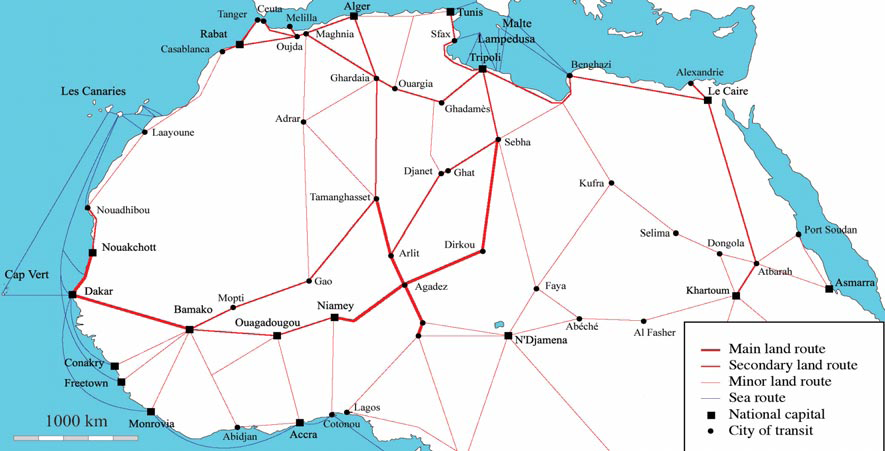
Main routes of present-day Trans-Saharan migrations

1 Comment

Filed under Algeria, Analysis, Data / Stats, Eastern Atlantic, European Union, Frontex, Italy, Libya, Malta, Mauritania, Mediterranean, Morocco, Spain