Category Archives: Malta

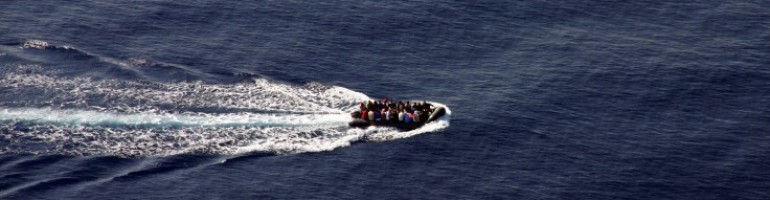
UNHCR Calls on EU to Improve Rescue at Sea Measures; NATO Should Also Actively Participate in Rescue at Sea in Regard to All Overcrowded Boats

UNHCR issued a statement on Friday, 8 April, calling “on the European Union to urgently put into place more reliable and effective mechanisms for rescue-at-sea” in the aftermath of last week’s disaster that saw “[m]ore than 220 Somali, Eritrean and Ivorian refugees drowned early on Wednesday morning when their boat capsized some 39 nautical miles south of the Italian island of Lampedusa. This is the worst such incident in the Mediterranean in recent years.  ‘It is hard to comprehend that at a time when tens of thousands are fleeing the Libyan conflict and pouring across the land borders into Tunisia and Egypt where they enjoy safety and receive shelter and aid, the protection of people fleeing via Libya’s maritime border does not appear to have the same priority’ said Assistant High Commissioner for Protection Erika Feller.” “‘We also appeal to shipmasters to continue to render assistance to those in distress at sea. Any overcrowded boat leaving Libya these days should be considered to be in distress’ [, said Feller.]”

While NATO was not mentioned in the UNHCR statement, the call for improved measures to save the lives of migrants who flee North Africa by boat should also be heard and considered by the NATO Maritime Command Naples which is conducting the maritime embargo of Libya known as Operation Unified Protector.   NATO has a significant naval force patrolling the area through which migrant boats leaving Libya are passing and this force should be actively engaged in protecting fleeing civilians.  (Click here for earlier post regarding NATO’s maritime embargo.)

While UN Security Council Resolution 1973 does not speak directly to this issue, it does call for the protection of civilians.  Relevant portions from Security Council Resolution 1973:

  • “Expressing [the Security Council’s] determination to ensure the protection of civilians and civilian populated areas and the rapid and unimpeded passage of humanitarian assistance and the safety of humanitarian personnel, [***];
  • Reiterating [the Security Council’s] concern at the plight of refugees and foreign workers forced to flee the violence in the Libyan Arab Jamahiriya, welcoming the response of neighbouring States, in particular Tunisia and Egypt, to address the needs of those refugees and foreign workers, and calling on the international community to support those efforts, [***];
  • Protection of civilians – 4. Authorizes Member States that have notified the Secretary-General, acting nationally or through regional organizations or arrangements, and acting in cooperation with the Secretary-General, to take all necessary measures, notwithstanding paragraph 9 of resolution 1970 (2011), to protect civilians and civilian populated areas under threat of attack in the Libyan Arab Jamahiriya,… [***].”

As with UNHCR’s call to EU states, NATO ships should also render assistance to any migrant boat detected by NATO forces – any overcrowded boat leaving Libya should be considered to be in distress.

Click here for UNHCR statement.

Click here for article.

Leave a comment

Filed under European Union, Italy, Libya, Malta, Mediterranean, News, UNHCR

Italy Criticises Malta Regarding Search and Rescue Response

Italian Interior Minister Maroni has criticised Malta for failing to immediately deploy rescue ships to assist the migrant boat that sank near Lampedusa.  The Armed Forces of Malta said that the migrant boat did not capsize until after two Italian coast guard boats had responded and were on scene attempting to render assistance.  The AFM said the first call for assistance was received Wednesday at 0025, the Rescue Co-ordination Centre of the AFM notified Italian Coast Guard headquarters in Rome and NATO headquarter in Naples at 0120, two Italian coast guard boats and an Italian fishing vessel, the Cartagine, were on scene by 0416, and the migrant boat capsized around 0535.  The migrant boat was closer to Italian territory than to Malta, but was located within Malta’s large Search and Rescue Area.  Italy and Malta have had past disputes over the boundaries of the SAR with Italy calling for the Maltese SAR to be reduced in size.

The Secretary-General of International Maritime Organization, Efthimios E. Mitropoulos, issued a statement saying that “[i]t was ironic that the devastating news of this latest tragedy reached us while we were holding a [Legal Committtee] meeting with representatives of Italy and Spain to consider what measures countries in the Mediterranean Basin should take to deal with the increasing number of persons leaving north African and eastern Mediterranean countries to seek refuge in Europe.”

The statement also said that “IMO is in contact with Italy, Malta and the UN High Commissioner for Refugees (UNHCR).  The [Legal Committee] meeting mentioned above was hosted by IMO and held against a background of increasing movement of persons by sea for political and socio-economic reasons or as a result of armed conflict.  It was part of an on-going process aimed at improving existing provisions for rescuing migrants at sea and disembarking them at a place of safety, in accordance with the International Convention on Maritime Search and Rescue (SAR Convention) and the International Convention for the Safety of Life at Sea (SOLAS Convention).”

Click, here, here, here, and here for articles. (EN)

Click here for article. (IT)

Click here for map the SARs.

Click here for IMO Statement.

1 Comment

Filed under Italy, Libya, Malta, Mediterranean, News

Former Libyan Minister Reaches Malta by Boat

A former Libyan minister, Omar Fathi bin Shatwan, who was Energy Minister from 2004-2006, fled with his family to Malta from Misrata on board a fishing boat.  According to Reuters, “Malta has been sending limited humanitarian aid to Misrata … on trawlers, but this was the first confirmation that any Libyan had used the boats to escape.”  His arrival in Malta last Friday had been kept secret by the Maltese government.

Click here and here for articles.

Leave a comment

Filed under Libya, Malta, Mediterranean, News

200 or More Now Feared Dead in Migrant Boat Sinking Off Lampedusa – Boat Was Likely Coming from Libya, Not Tunisia

It now appears that the boat that capsized earlier this morning off of Lampedusa was carrying Sub-Saharan Africans and that it had sailed from Libya not from Tunisia. The boat departed from Zuwarah in western Libya according to the Times of Malta.  Woman and children were on board and are likely among the victims.  The accident occurred around 4:00 AM local time in very rough seas.  A call for help was made by satellite phone to Malta SAR.  ANSA reported a short time ago that 48 people have been rescued and approximately 20 bodies have been recovered.  IOM said that based on interviews with survivors there may have been as many as 300 people on board the boat.

Click here (EN), here (IT), and here (IT) for articles.


3 Comments

Filed under Italy, Libya, Malta, Mediterranean, News

Nationalities of Migrants Who Arrived in Malta from Libya Last Week

From the Times of Malta (sources: Home Affairs Ministry and parliamentary replies) and as noted on EASO Monitor:

Nationalities of migrants who arrived last week

  • Somalia – 411
  • Eritrea – 250
  • Ethiopia – 87
  • Ivory Coast – 26
  • Mali – 16
  • Pakistan – 14
  • Sudan – 6
  • Nigeria – 6
  • Yemen – 2
  • Mauritania – 1
  • Total: 819

Migrants in Malta before Libya crisis

  • Held in detention: 79
  • Living in open centres: 2,224
  • Living in the community: 1,400
  • Total: 3,703

Migrant arrivals in previous years

  • 2007: 1,702
  • 2008: 2,775
  • 2009: 1,397
  • 2010: 27

Click here for article.

Leave a comment

Filed under Data / Stats, Eritrea, Ethiopia, European Union, Frontex, Libya, Malta, Mediterranean, News, Somalia

Maltese Conditions for Hosting Frontex Mission Not Accepted by Frontex

The Times of Malta has posted copies of an exchange of correspondence between Home Affairs Minister Carmelo Mifsud Bonnici and Frontex Director Ilkka Laitinen.   The Times of Malta article does not identify the source of the correspondence.  It appears likely that the posted correspondence does not include all of the recent communications between Malta and Frontex.  However, that which has been made available by the Times of Malta provides additional background information regarding Malta’s refusal to host a Frontex mission.

According to the posted correspondence, on 10 March, Mifsud Bonnici made an urgent request to Frontex for a new Joint Operation and deployment of a Rapid Border Intervention Team.  Malta’s request however was conditioned upon Frontex agreeing to the establishment of a joint processing centre outside of Malta and an agreement not to follow the non-binding Guidelines pertaining to the surveillance of the sea external borders contained in Part II of the Annex to Council Decision 2010/252/EU.

On 29 March, Director Laitinen responded.  Laitinen said that on 22 March he took the decision to deploy a RABIT team to Malta and that a fact-finding visit to Malta took place 24-25 March, but that during the visit, the Frontex delegation was informed that Malta would agree to accept a RABIT deployment only if Malta’s requests for the creation of the joint external processing centre and the Joint Operation were organised simultaneously with the RABIT deployment.  Laitinen said that as of 28 March Frontex had received 10 official answers from Member States responding to Malta’s request for contribution to a possible Joint Operation and creation of the external processing centre; 9 of the answers were negative or questioned the concept of joint operation:  “According to the replies – and also indicted by the number of missing replies – it is obvious that the MS consider the establishment of a joint processing centre as an issue that needs discussion and agreement on political level.  It remains doubtful from legal point of view that a joint operation not applying the non-binding part of the Maritime guidelines – Council decision No 2010/252/EU – could be developed and implemented under Frontex coordination.”

Mifsud Bonnici’s initial letter was written before the first migrant boat from Libya arrived  in Malta on 28 March.  Presumably discussions between Malta, Frontex, and the Commission are ongoing.

Click here or on this link (Mifsud Bonnici Ltr – 10 March 2011 ) for the letter from Mifsud Bonnici to Laitinen.

Click here or on this link (Laitinen Ltr – 29 March 2011 ) for the letter from Laitinen to Mifsud Bonnici.

Click here for Times of Malta article.

A third letter from Commissioner Malmström was also posted by the Times of Malta.  It makes reference to the exchange discussed above.  More on this and on Malta’s call for triggering the Temporary Protection Instrument later.

Click here or on this link ( Malmström Ltr – 1 April 2011 ) for the letter from Malmström to Mifsud Bonnici.

1 Comment

Filed under European Union, Frontex, Libya, Malta, Mediterranean, News

Is Libyan Government Facilitating Migrant Boat Departures from Libya?

Gaddafi and other Libyan officials in recent weeks have made statements to the effect that Libya will no longer prevent irregular migrants from leaving Libya and have made threats that Libya will encourage irregular migration.  (6 March, Gaddafi: “I want to make myself understood: if one threatens [Libya], if one seeks to destabilize [Libya], there will be chaos, Bin Laden, armed factions.  That is what will happen. You will have immigration, thousands of people will invade Europe from Libya. And there will no longer be anyone to stop them….”)

Now that migrants boats are again leaving Libya and arriving in Italy and Malta, it is unclear what role, if any, the Libyan government may be playing.  In an article in yesterday’s Times of Malta there is a short statement by an Eritrean man who had just arrived in Malta from Libya on a migrant boat.  His statement suggests that the Libyan government may be facilitating the departures:  “[a] man said he had been in Libya for five years and this was not the first time he had tried to escape.  ‘The boats were organised by the same people,’ he said, referring to a Libyan racket which was widely believed to enjoy the support of the North African regime.  The migrants said they paid between $500 and $1,000 for their journey – meaning that those who organised the boats were pocketing an average of $200,000.”

Click here for article.

2 Comments

Filed under Italy, Libya, Malta, Mediterranean, News

Frattini Criticises EU for Failure to Assist Italy; Frattini and MEPs Call for Implementation of Temporary Protection Directive and Mandatory Burden Sharing

Italian Foreign Minister Franco Frattini has again criticised what he describes as the EU’s and European Commission’s failure to assist Italy with the migrant situation in Lampedusa. Minister Frattini singled out Commissioner Malmström for his criticism.  A statement on the Italian Foreign Ministry web site says that “Italy continues to solicit Europe’s help in confronting the immigration emergency, not only in terms of economic aid but also in terms of a plan for the distribution of the refugees among Member States. ‘Europe has been totally inert in this period’, Minister Frattini asserted and, commenting on EU Home Affairs Commissioner Cecilia Malmström[‘s] observation that Italy had already received European funding for managing the influx, specified: ‘This is the typical expression of a European bureaucracy that thinks money alone solves everything’, but it is not enough, ‘there need to be policy interventions’. …[I]n addition to funds it is necessary to ‘invoke a European law clearly establishing the adoption of an extraordinary plan with any sudden influx of refugees toward one or more Member States, which includes the distribution of the refugees among Members within the temporary timeframe necessary to repatriate those who are not refugees, as in the case of the Tunisians, who are simply economic immigrants’.”

MEPs Simon Busuttil (Malta) and Salvatore Iacolino (IT) issued a press release calling on the Commission “to activate the Solidarity Mechanism envisaged in EU law in cases of mass influx of displaced persons. … ‘EU law already provides for a solidarity mechanism that can be triggered in the event of a mass influx of displaced persons (Council Directive 2001-55-EC)’ [and ‘we call upon the Commission to activate it’] Busuttil and Iacolino said.”

Click here for Italian Foreign Ministry statement.

Click here for MEPs Busuttil and Iacolino press release.

Click here for link to Temporary Protection Directive.

1 Comment

Filed under European Union, Italy, Libya, Malta, Mediterranean, News, Statements, Tunisia

NATO Policy Regarding Migrant Boats Leaving Libya

I posed several questions to NATO Maritime Command Naples asking what NATO’s policy is in regard to encounters between NATO ships and migrant boats leaving Libya.  NATO Maritime Command Naples is responsible for enforcing the maritime embargo of Libya known as Operation Unified Protector.  I also asked for more information about the encounter on 25-26 March between the Canadian navy ship, HMCS Charlottetown, and what was probably the first recent migrant boat from Libya.  This particular migrant boat was subsequently taken to Linosa by the Italian Coast Guard.

Today’s response from NATO’s public affairs office is fairly straightforward and states that NATO ships will respond to vessels or persons in distress.  The response suggests that NATO ships will otherwise not interfere with the passage of migrant boats unless a boat is suspected of carrying arms or mercenaries.  Presumably NATO would also seek to stop and board migrant vessels suspected of carrying any persons of particular interest to NATO, e.g. Libyan officials.

Here are my questions and the responses from the Public Affairs Office at NATO Maritime Command Naples:

Q:  Does Operation Unified Protector have plans or procedures in place regarding what to do in the situation where a NATO vessel encounters a boat or inflatable that is carrying irregular migrants or asylum seekers out of Libya and attempting to reach another country, e.g. Italy or Malta?

NATO:  Operation Unified Protector is part of the broad international effort to protect civilians and civilian-populated areas under threat of attack. The maritime portion of the operation foresees NATO warships and aircraft patrolling the approaches to Libyan territorial waters to reduce the flow of arms, related material and mercenaries to Libya as called for in UN Security Council Resolution 1973. Issues of migration or asylum seekers are not within the mandate of this specific NATO operation.

Q:  If there are plans or procedures for encounters with migrant boats, what do they provide for?

NATO:  A master of a ship at sea which is in a position to be able to provide assistance on receiving information from any source that persons are in distress at sea, is bound to proceed with all speed to their assistance, if possible informing them or the search and rescue service that the ship is doing so. This obligation to provide assistance applies regardless of the nationality or status of such persons or the circumstances in which they are found.

Q:  Additionally, can you provide details regarding what HMCS Charlottetown did on/about 26 March when it encountered a migrant boat carrying approximately 350 African migrants from Libya?  Did HMCS Charlottetown request assistance in connection with this encounter from the Italian Coast Guard or Navy or from Frontex?  What assistance, if any, was provided to the migrant boat?

NATO:  On 25 and 26 of March 2011, NATO ships patrolling in International Waters attended a boat to ensure there was not a case of Safety of Life at Sea (SOLAS). Assistance was offered in the form of technical expertise and supplies. NATO ships monitored the situation constantly throughout the stated period. For action taken by Italy with regard to this event we recommend you contact the appropriate authorities.

Q:  Does NATO anticipate that there may at some point be large numbers of non-Libyans or Libyans attempting to leave Libya by sea?

NATO:  We do not feel that we can speculate on this matter.

Click here for link to NATO Maritime Command Naples and here for link to Operation Unified Protector.

3 Comments

Filed under Italy, Libya, Malta, Mediterranean, News

Maltese Minister Says Malta Will Not Reconsider Its Detention of Migrants

Malta Today reports that Justice and Home Affairs Minister Carm Mifsud Bonnici reaffirmed Malta’s detention law and disagrees with the comments made by COE Human Rights Commissioner Thomas Hammarberg.  From Malta Today: “‘This [the detention policy] is compliant with Malta’s EU and other international obligations. As a matter of fact, the European Convention on Human Rights does not rule out detention,’ Mifsud Bonnici said, citing Article 5 (1)(f) of the Convention. … Mifsud Bonnici however said that the judgement in the [ECtHR’s] Massoud vs Malta case, ‘cannot, in any way be interpreted as constituting a condemnation of Malta’s detention policy. This has been proved and explained time and again.’”

Click here for article.

Click here for Commissioner Thomas Hammarberg’s statement.

Leave a comment

Filed under Commissioner for Human Rights, European Court of Human Rights, Libya, Malta, Mediterranean, News, Statements

500 Migrants Reach Malta from Libya – First Arrivals in 2011

300 migrants arrived in Malta this afternoon.  A second group of approximately 250 is expected to arrive this evening.  The migrants are believed to be Sub-Saharan asylum seekers from Libya.

Under Maltese law, the arriving asylum seekers will be detained.  The law purports to authorise detention for up to 18 months.  Malta’s detention centres are at present largely empty due to the lack of recent migrant arrivals.  COE Human Rights Commissioner Thomas Hammarberg concluded a visit to Malta just last week.  The Commissioner’s report pertaining to his visit has not yet been released, but a statement was released in which the Commissioner called for “the policy of mandatory detention of all irregular migrants, including asylum seekers, [to] be reconsidered.”

Excerpts from the Statement:

“‘Malta and Europe need each other if the challenges of migration are to be met in a manner that respects human rights,’ said the Council of Europe Commissioner for Human Rights, Thomas Hammarberg, following his visit to Malta from 23 to 25 March. According to the Commissioner, Malta needs to move away from a reactive approach to migration and establish a system that is fully in line with European standards concerning the human rights of immigrants and asylum seekers. At the same time, a much more generous and collegial approach is needed on the part of other European states, by accepting to host some of the persons to whom Malta has rightly accorded international protection. ‘However, with the exception of France and Germany – and further afield the US – this has not been the case so far.’

The Commissioner underlined that the current uncertainty related to the events in Libya and possible forced migration towards Malta and Europe should not deter the Maltese authorities from undertaking the necessary reforms. ‘Instead this is another reason for more European solidarity to support these reforms’ said the Commissioner, noting also that the substantial decrease in the number of irregular arrivals in Malta over the last two years has taken considerable pressure off Malta.

In this context, the policy of mandatory detention of all irregular migrants, including asylum seekers, should be reconsidered. The Commissioner notes that the mandatory detention of migrants can hardly be reconciled with the requirements set by the European Convention on Human Rights, as also reflected in a July 2010 judgment of the Strasbourg Court in the case of Louled Massoud, which found that Malta had violated the Convention by detaining an asylum seeker, whose claim had been rejected, for almost 18 months. ‘Malta should take all necessary legislative and other measures in order to implement fully and effectively this important judgment of the European Court of Human Rights’ said the Commissioner. Alternatives to the detention of migrants should be provided for in law, in accordance with the Council of Europe Parliamentary Assembly’s Resolution 1707 (2010). …”

Click here and here for articles.

Click here for the Commissioner’s full statement

Click here for link to Commissioner’s thematic web page on human rights of immigrants, refugees and asylum seekers.

1 Comment

Filed under Commissioner for Human Rights, Libya, Malta, Mediterranean, News, Statements

Boat With 350 African Migrants from Libya Receives Assistance from Canadian Navy Ship

A boat carrying approximately 350 African migrants or asylum seekers from Libya has been intercepted and is being diverted to the Italian island of Linosa between Malta and Lampedusa.  There have been reports over the past several days that the migrant boat was at sea.  A Canadian navy ship, probably the frigate HMCS Charlottetown, first intercepted and boarded the migrant boat to determine whether the passengers required immediate rescue or not and to provide a pump.  The migrant boat was allowed to proceed.  An Italian navy helicopter later rescued a woman who gave birth on the boat.  The woman, the newborn baby, the father, and a second pregnant woman were removed from the migrant boat and taken to hospitals on Lampedusa and Sicily.  The Italian navy said that the migrant boat will be taken to Linosa rather than Lampedusa.  UNHCR spokeswoman Laura Boldrini is quoted by AFP as saying that “[t]his is the first boat coming from Libya with people fleeing the military escalation, the vendettas and the retaliation attacks and that “the people on board the boat required ‘international protection’”.  AFP also reported that “Mussie Zerai, an Eritrean Catholic priest in Italy who has been in direct contact with the vessel via a satellite phone, said conditions on the boat were extremely difficult with around 10 children and 20 women on board.  He said the people were mostly Eritreans, Ethiopians and Somalians.”  Zerai also “said four or five other boats carrying African migrants had … left Libyan shores carrying around 1,000 people.”

Click here (EN) and here (IT) for articles.

2 Comments

Filed under Eritrea, Ethiopia, Italy, Libya, Malta, Mediterranean, News, Somalia, UNHCR

Italy Blocks Ship from Libya with 1800 Persons from Entering Italian Waters

A large ferry, the Mistral Express, carrying approximately 1800 persons was prevented yesterday from entering Italian waters near Sicily by Italian navy or coast guard boats.   The ship apparently left the Libyan port of Misurata and most of its passengers are Moroccan.  The ship may have been planning to sail to Morocco and may have tried to divert to Italy for purposes of refueling, but the media reports are unclear.  It is also unclear who chartered the ship.  Italian authorities confirm that they prevented the ship from entering Italian waters due to uncertainty regarding the identities of the passengers.  An Italian government spokesperson reportedly said it was unclear whether the passengers were “genuine evacuees” from Libya.  It is also unclear whether the ship then tried to sail to Malta.  Some media reports say that Malta refused the ship permission to enter Maltese waters.  Maltese authorities are reported as saying that this did not occur but according to media reports Maltese authorities said that they would prevent the ship from landing in Malta if it tried to do so for the same reasons advanced by Italy.

Click here (EN), here (IT), here (IT), and here (ES) for articles.

1 Comment

Filed under Italy, Libya, Malta, Mediterranean, Morocco, News

Laitinen in Malta Visit; Malta Still Not Willing to Host New Frontex Mission; Frontex Preparing Multiple Contingency Plans

Malta’s Home Affairs Minister Carm Mifsud Bonnici met with Frontex Executive Director Ilkka Laitinen.  Mifsud Bonnici said Malta is unwilling to host a new Frontex mission due to its fear that intercepted or rescued migrants would be taken to Malta.  During a press conference (click here for article and short video), Laitinen said that Frontex was not willing to give estimates of the numbers of migrants it believes may seek to leave Libya, but said it was preparing plans for seven different scenarios.  The plans “could include strengthening air and maritime surveillance, increased capacity to deal with those seeking protection at ports and airports and an improved repatriation mechanism for those who did not meet the criteria for humanitarian protection.”  Laitinen reiterated that “push backs and diversions are not an option for people seeking protection.”  Laitinen did not address the burden sharing question other than to say that it was a political question that did not involve Frontex.

Click here, here, and here for articles.

1 Comment

Filed under European Union, Frontex, Libya, Malta, Mediterranean, News

Human Rights First Backgrounder: States’ Obligations to Protect Refugees Fleeing Libya

Excerpts from the Backgrounder:

Currently, Tunisia and Egypt are experiencing an influx of people fleeing Libya. These persons include nationals of those two countries seeking to return home, as well as Libyans and smaller numbers of nationals of other countries in search of safety. Both Tunisia and Egypt, themselves emerging from turmoil, have kept their borders open and are receiving those fleeing Libya. …

All states affected by the ongoing crisis are bound to respect the following [core] principles governing the treatment of refugees….

Protection of refugees is a collective international responsibility. In practice, however, it is those countries that are closest to or most accessible from Libya and its neighbors that will be called upon to protect the majority of refugees who may seek international protection in the immediate term….

At a time when all countries in the region and their neighbors in the EU may see an increase in migration by people fleeing persecution and violence as well as worsening economic conditions, it is critically important that those who have a claim to international protection be given access to procedures to obtain it. The international community more broadly and the EU should assist those States that bear the brunt of this challenge in dealing with it in a way that is consistent with their international obligations. At the same time, Italy and other EU member states and institutions must refrain from pushing migrants back to Libya or any other country without identifying those in need of international protection and allowing those who need such protection to apply for it.

Click here for full document.

Leave a comment

Filed under Analysis, Egypt, European Union, Frontex, Italy, Libya, Malta, Mediterranean, Tunisia