Tag Archives: People smuggling

HR/VP Federica Mogherini’s remarks at the UN Security Council, 11 May 2015

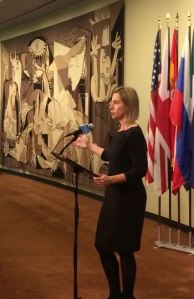
HR/VP Mogherini’s remarks earlier today to the Security Council contained very few details on the EU proposal to engage in “systematic efforts to identify, capture and destroy vessels before they are used by traffickers in accordance with international law.” Here is one excerpt from her remarks: Mogherini at UNSC

“[M]y presence here at the Security Council today is so important for us. We have in these weeks prepared for a possible naval operation in the framework of the European Union Common Security and Defence Policy. The mandate of this operation is currently being elaborated with the EU Member States in Brussels, and will be discussed by the meeting of the EU Foreign Affairs Council, in a week from now, in exactly a week from now on 18 May, with a possibility of taking decisions, the first decisions already. We want to work with the United Nations, in particular with the UNSC. …”

Full text here.

2 Comments

Filed under European Union, Frontex, Libya, Mediterranean, Statements, United Nations

UN Security Council, 11 May, Briefing and Informal Interactive Dialogue on the Smuggling of Migrants in the Mediterranean

Full text from “What’s in Blue” (published by Security Council Report):

“On Monday (11 May) the [Security] Council will receive a briefing by Federica Mogherini, the EU High Representative for Foreign Affairs and Security Policy, on the EU response to the smuggling of migrants in the Mediterranean Sea. After the briefing, Council members are expected to hold an informal interactive dialogue with her. At the request of Chad, the permanent observer of the AU to the UN, Ambassador Tete António, will also participate in these meetings.

This briefing comes after the 19 April incident in which more than 700 migrants drowned when the overcrowded boat on which they were traveling sank near Libya. According to the [International] Organization for Migration, more than 1,700 migrants have drowned since the beginning of January in the Mediterranean Sea. In a 21 April press statement, Council members expressed grave concern at the smuggling of migrants off the coast of Libya, highlighting the implications for regional stability. On 22 April, at the request of the UK, Council members exchanged views on this issue under ‘any other business”’

Mogherini is expected to brief Council members on the integrated strategy by the EU to address the smuggling of migrants in the Mediterranean Sea. The strategy includes the provision of bilateral development assistance to countries on the southern and eastern Mediterranean basin—as well as to countries of origin and transit—while tripling the financial resources available to operations Triton and Poseidon, currently existing in the territorial waters of EU member states. In a 20 April joint meeting of EU foreign and interior Ministers, chaired by Mogherini, the Home Affairs and Citizenship Commissioner Dimitris Avramopoulos of Greece presented a plan to respond to migrant smuggling in the Mediterranean, which would entail a systematic effort to capture and destroy vessels used by the smugglers, inspired by the EU Atalanta Operation deployed to fight against piracy off the coast of Somalia. The plan was endorsed in a 23 April meeting of the EU Council, and negotiations are ongoing at the EU to agree on the Crisis Management Concept, which is the basis for operational planning and conduct of any EU mission.

Since that meeting, discussions among EU members of the Council (France, Lithuania, Spain, and the UK) and Italy on a draft resolution apparently authorising such an operation have been ongoing. It seems some permanent members have been able to provide inputs. It appears the idea is for a Chapter VII resolution that will authorise an EU operation to use all necessary measures to inspect, seize and dispose of vessels when there are grounds to believe that they are participating in the smuggling of migrants. The draft may be circulated to the wider membership of the Council in the coming days.

Although most Council members have not seen the draft text, they are aware of some of its elements and are expected to seek information that might feed into any negotiations of the draft. Council members are likely to want to know more about the expected geographical scope of the resolution (whether this includes the high seas, the territorial waters of Libya or even its shore) and whether the EU is seeking Libya’s consent. In this context, Council members might inquire about Mogherini’s recent conversations in Tunisia with Libyan political actors, and the potential impact of such an operation on the political process. Some Council members might be worried that asking for the consent of the Tobruk-based government could negatively impact the talks, which are aimed at the formation of a government of national unity.

Some Council members may echo concerns regarding the protection of human rights and international refugee law that have been raised by the Secretary-General as well as the UN High Commissioners for Human Rights and Refugees. In particular, they might ask about the fate of the migrants taken into custody, and note the importance of respecting the guarantees of international law, notably the 1951 Refugee Convention and the principle of non-refoulement. When the programme of work was adopted, a briefing by the High Commissioner for Refugees, along with the head of the UN Office on Drugs and Crime, was being considered for some point in May. Some Council members may have expected these briefings to happen before engaging in discussions about the regional responses to the smuggling of migrants; however, at press time, it was unclear if and when they will be held.

In the past, it has been difficult to get agreement on resolutions authorising the interception of vessels, whether in the context of the implementation of sanctions or counter-piracy measures. Some Council members feel strongly about not contravening the freedom of navigation principle codified in the UN Convention on the Law of the Sea. As such, they have tended to focus their discussions in the past on issues such as the procedures to authorise the interdiction, whether the consent of the flag state is required, and where the interdiction is authorised to happen.”

3 Comments

Filed under African Union, European Union, Frontex, Libya, Mediterranean, News, United Nations

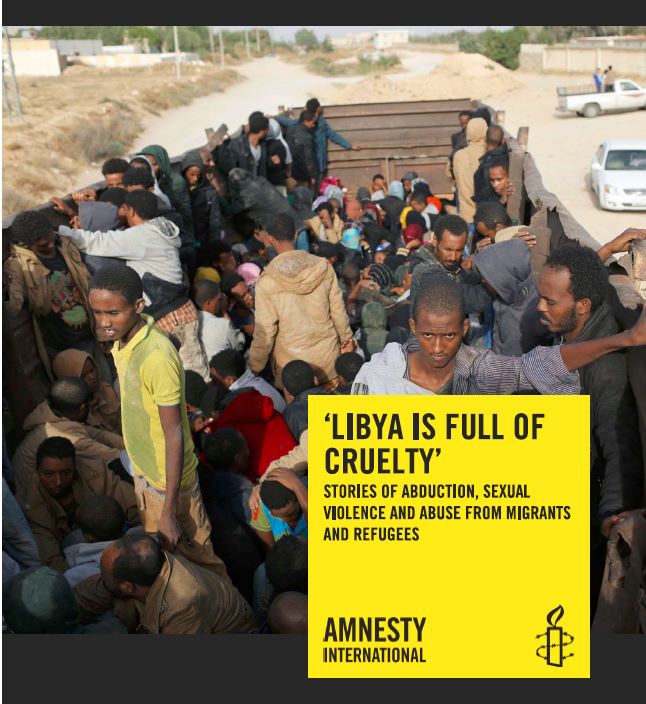
Amnesty International Report: ‘Libya is Full of Cruelty’ – Stories of Abduction, Sexual Violence and Abuse from Migrants and Refugees

Amnesty International has released a new report entitled: “’Libya is Full of Cruelty’ – Stories of Abduction, Sexual Violence and Abuse from Migrants and Refugees.” (also available here.)  2015-05-11_Amnesty Intl_Report_Libya_Libya_is_full_of_cruelty COVER

Key points include (see formal AI recommendations below):

  • “Widespread abuses by armed groups, smugglers, traffickers and organized criminal groups in Libya as well as systematic exploitation, lawlessness and armed conflicts are pushing hundreds of thousands of migrants, asylum-seekers and refugees to risk their lives by attempting to cross the Mediterranean Sea”;
  • “In many cases, migrants and refugees attempting to cross the Mediterranean Sea have been subjected to prolonged beatings in [detention] facilities following their interception and arrest by the Libyan coastguard or militias acting on their own initiative in the absence of strong state institutions”;
  • “While Amnesty International welcomes the EU’s commitment to increase resources for search and rescue operations, it is also concerned that some of the proposed measures, in particular plans to ‘systematically identify, capture and destroy vessels before they are used by traffickers’ would effectively contribute to migrants and refugees being trapped in Libya and expose them to a risk of serious human rights abuses”;
  • “As more people are drowning in the Mediterranean Sea, the priority for the international community must be to dramatically expand search and rescue operations and take effective steps to urgently address human rights abuses and serious violations of international humanitarian law in Libya. EU governments must also increase the number of resettlement places, humanitarian admissions and visas for people in need of international protection”.

Amnesty International makes the following recommendations:

To European governments

  • Urgently ensure the deployment of naval and aerial resources at a scale commensurate with foreseeable departure trends and which should patrol the high seas along the main migration routes. Whether such deployment occurs within the framework of Frontex Joint Operation Triton or through other agreements, it is crucial that ships and aircraft are delivered promptly and deployed in the area where most of calls for assistance come from and a great number of shipwrecks occurs;
  • To reduce the numbers of those risking their lives at sea, increase the number of resettlement places, humanitarian admissions and visas for people in need of international protection and ensure that refugees have effective access to asylum at land borders;
  • Ensure that any action against smugglers and traffickers is addressed through law enforcement measures, governed by human rights law and standards, and that it does not contribute to migrants and refugees being trapped in Libya without any means of escaping the violence;
  • Ensure that human rights abuses and violations of international humanitarian law, including against migrants, asylum-seekers and refugees in Libya, are addressed as part of the political dialogue aimed at ending the ongoing conflicts, and that a mechanism is put in place to monitor the human rights situation on the ground following any subsequent settlement. EU governments must also insist that Libyan authorities, armed groups and militias end the systematic indefinite detention of migrants and refugees based on their immigration status; all refugees and asylum-seekers and migrants detained for immigration purposes must be released.;
  • Investigate and bring to justice in fair trials those involved in trafficking of persons.

To the governments of Tunisia, Egypt and Algeria:

  • Keep the borders open to all individuals in need of international protection regardless of whether they have valid travel documents or meet visa requirements.

To governments along the smuggling route:

  • Ensure that any regional co-operation aimed at addressing irregular migration and dismantle smuggling networks fully complies with international law and standards, and does not infringe upon the rights and safety of asylum-seekers and refugees, with particular regard to the right to freedom of movement, the right to asylum, and the absolute prohibition on refoulement.

To militias, armed groups and Libyan authorities:

  • Release anyone detained solely on the basis of their immigration status, nationality, race, religion or ethnicity;
  • Make clear to all those under your command that torture or other ill-treatment, rape and sexual assault will not be tolerated under any circumstances. Remove from the ranks anyone suspected of such abuses;
  • Facilitate visits by independent organizations to immigration detention centres and other places of detention;
  • Ensure that all those deprived of their liberty can communicate regularly with their families and have access to adequate medical care.”

Leave a comment

Filed under Analysis, European Union, Frontex, Libya, Mediterranean, Reports, United Nations

New York Times Editorial: UN Security Council Should Reject Military Intervention in Libya

The NY Times in an editorial on Sunday called upon the UN Security Council to reject the EU request for a resolution authorising military intervention against smugglers in Libya:

“Military intervention would be a grave mistake. … It is, in fact, a cynical strategy, born of Europe’s panic over a tide of foreign migrants. … Destroying all the boats would condemn migrants to exile. A far better (and obvious) way to put the smugglers out of business is to make migration from Libya to Europe safe and legal. … The Security Council should tell [Federica Mogherini] that no military intervention is needed — just compassion and common sense.”

Leave a comment

Filed under Analysis, European Union, Libya, Mediterranean, United Nations

Libyan Government (Tobruk) Will Not Support Proposed UN Security Council Authorisation of Use of Force Against Smuggler Boats

Libyan UN ambassador Ibrahim Dabbashi (representing the Libyan government based in Tobruk) told AP that Libya rejects the EU plan that may soon be considered by the Security Council to authorise the use of force to seize or destroy smugglers boats within Libya.

According to AP, the current Security Council president said that the Council expected that Libya would support the EU proposal, but Dabbashi said that his government “hasn’t even been consulted and rul[ed] out EU forces on Libyan soil ‘at this stage’. … ‘We will not accept any boots on the ground’.” Dabbashi also criticised expanded rescue operations: “He called the idea of deploying more boats to the waters off Libya to save migrants a ‘completely stupid decision’ because it would encourage even more migrants to come to his country, further burdening local authorities.”

3 Comments

Filed under European Union, Mediterranean, News, United Nations

UN Security Council to Meet on 11 May to Consider Mediterranean Migrant Situation

The UN Security Council will meet on Monday, 11 May, to consider the situation in the Mediterranean. HRVP Federica Mogherini will brief the Security Council. Italy has circulated a draft resolution among European members of the Security Council. ANSA reports that the European members of the UN Security Council have reached an agreement and are “very close” to being able to circulate a draft resolution. Italian Foreign Minister Paolo Gentiloni said the goal is to get “a legal framework” to “perform individual operations against traffickers.” Gazzetta Del Sud reports that “European sources said next Monday’s Security Council meeting will be a ‘first step’ to assess what kind of mandate might be needed for European operations against migrant traffickers. It is not likely that meeting will come up with a resolution, the sources said. European High Foreign Representative Federica Mogherini will present a May 18 council of EU foreign ministers with various security and defense options.” Russia has already said that it would veto a resolution authorising military strikes, but that it might consider supporting “a more restricted mandate for any EU military mission, which could involve a search and rescue role alongside powers to stop and seize smugglers’ boats at sea.”

1 Comment

Filed under European Union, Italy, Libya, Mediterranean, News, United Nations

Russia Will Veto Any UN Security Council Resolution Seeking to Authorise Destruction of Smuggling Boats in Libya

The Financial Times (paywall or answer marketing questions) reported yesterday that Russia will veto any UN Security Council resolution that would authorise the destruction of migrant boats in Libya. The FT reported that Russia might consider supporting “a more restricted mandate for any EU military mission, which could involve a search and rescue role alongside powers to stop and seize smugglers’ boats at sea.”

The Security Council’s Programme of Work for the month of May does not currently include any meetings pertaining to the EU’s desire for authorisation of military strikes on smugglers boats, but a briefing by the UN High Commissioner for Refugees on the migrant crisis in the Mediterranean might take place next week according to footnotes to the Programme of Work.

4 Comments

Filed under European Union, Libya, Mediterranean, News, United Nations

Mogherini at UN Seeking “Framework of International Legality” for Military Strikes on Smuggling Boats; Security Council Expected to Consider Issue in Coming Weeks

Federica Mogherini, the EU High Representative for Foreign Affairs and Security Policy, is currently at the United Nations and seeking support for the authorisation of EU military strikes on smuggling boats in Libya: “[The EU] need[s] to make sure we have a framework of international legality in which we want to operate. There’s nothing we’re going to do that’s outside the framework of work together with U.N. and/or in partnership with the Libyan authorities” She said that the EU was working in “strong coordination” with the EU members of the U.N. Security Council on the issue. (See also tweet from EU UN Mission: “Human trafficking is threat for security & stability for all countries & EU will work with all partners.”)

Yesterday Mogherini sought to assure Libya that whatever the EU does, should not be perceived as an attack against the Libyan people: “I want to make it very clear there is nothing the European Union is preparing or thinking of that is to be intended against Libyan people or the Libyan authorities in all their complexity.”

Bernardino León, the head of the UN Support Mission in Libya (UNSMIL), will brief the UN Security Council today (Wednesday, 29 April) regarding the dialogue between different Libyan groups that is being facilitated by the UN.

While León’s briefing is not expected to address the issue of authorising EU military strikes, according to What’s In Blue-Security Council Report, “[t]he humanitarian situation in Libya is likely to be of interest to Council members. … In a 21 April press statement, Council members expressed grave concern at the recent proliferation of the smuggling of migrants off the coast of Libya. Even though this issue exceeds the scope of the conflict in Libya and is expected to be tackled separately by the Council in the coming weeks, Council members might be interested in asking León about reactions among Libyans of the potential responses to this phenomenon which are being discussed by the European Union and others….”

2 Comments

Filed under European Union, Libya, Mediterranean, News

If the EU Attacks Migrant Boats in Zuwara, Libya, How Will It Select from Among the 100s of Boats?

Italy and other EU States are clearly in possession of information regarding the specific locations in Libya from where migrant boats depart. The Guardian’ s Patrick Kingsley has been reporting from Libya in recent days, interviewing smugglers and observing a migrant boat depart on at least one recent occasion from the port of Zuwara located west of Tripoli.

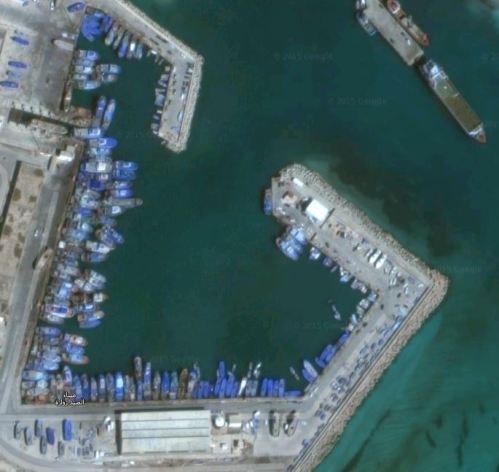
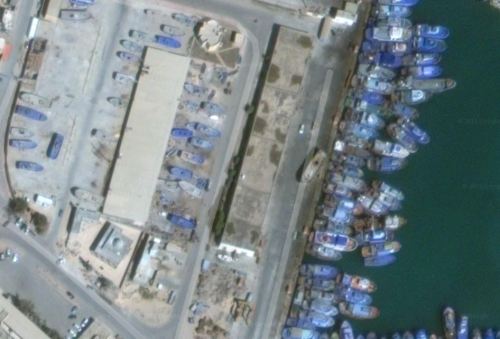
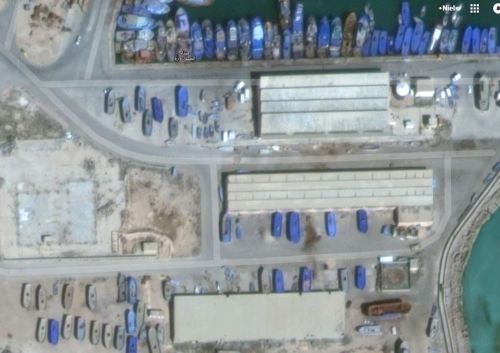
If the EU does press forward with its stated intention of destroying boats that may be used by smugglers, how will the EU select the boat or boats to be destroyed? Google Earth imagery dating from early this year shows approximately 125 large fishing boats moored in the harbour and another 100 boats on land immediately adjacent to the harbour. Dozens of smaller boats are also in the water and on land. (See screen shots below.) Additionally, the harbour is surrounded by at least five large warehouses, each approximately 100 metres in length. The Google Earth imagery suggests that additional boats may be located within some of the warehouses.

There is no effective and safe (or legal) means by which a particular smuggling boat can be identified and destroyed without destroying multiple other boats. As the Guardian’s Kingsley wrote, “smugglers do not maintain a separate, independent harbour of clearly marked vessels, ready to be targeted by EU air strikes. They buy them off fishermen at a few days’ notice. To destroy their potential pool of boats, the EU would need to raze whole fishing ports.”

UN Secretary General Ban Ki Moon on Sunday criticised the EU plan to use military force, telling La Stampa (as reported by Reuters), “[t]here is no military solution to the human tragedy playing out in the Mediterranean. It is crucial that we take a holistic approach that looks at the root causes, at security and the human rights of migrants and refugees, and have legal and regulated immigration networks.”

See previous posts on this topic: The EU’s Proposed Plan to Destroy Migrant Boats in Libya Must be Rejected by the European Council and UK and France to Seek UN Security Council Authorisation for Military Action Against Smuggler Boats.

Zuwara Harbour 2015 Via Google Earth

Zuwara Harbour.

Zuwara Harbour West Side Warehouses via Google Earth

Storage area and warehouses on west side of Zuwara Harbour.

Zuwara Harbour South Warehouses South 2015 via Google Earth

Storage area and warehouses on south side of Zuwara Harbour.

1 Comment

Filed under European Union, Libya, Mediterranean, News

The EU’s Proposed Plan to Destroy Migrant Boats in Libya Must be Rejected by the European Council

A plan for EU Member States to capture or destroy the boats used by people smugglers in the Mediterranean is one of ten possible courses of action that will be considered during the Extraordinary European Council Meeting on the Situation in the Mediterranean that will be held on 23 April.

The boat destruction proposal should be rejected for multiple reasons. There is no basis in law for the proposal and it would endanger lives of innocent people including migrants and fishermen, among others. It would certainly have little effect on its intended target, the people smugglers.

EU migration commissioner Avramopoulos described the plan, which has been recommended by the Foreign Affairs Council which met on 20 April, as a civil-military operation which would “capture and destroy vessels used by smugglers.” Avramopoulos reportedly compared the proposed EU boat destruction plan to Operation ATALANTA, the EU’s maritime operation against piracy off Somalia, saying that Atalanta “should inspire us for new operations against smugglers in the Mediterranean.”

As is always the case, the specific details of the proposed plan matter. There are situations where the destruction of a migrant boat under certain circumstances may be perfectly legal and otherwise appropriate. For example after a rescue operation when migrants have been safely removed from an unflagged and unseaworthy vessel, it may be appropriate for that vessel to be destroyed at sea rather than taking it in tow or leaving it adrift and thereby creating a navigational hazard. In such circumstances, there is no reason for an EU coast guard vessel, after migrants have been transferred from a migrant boat, to stand by and allow smugglers to take possession of the now empty migrant boat.

But if the EU boat destruction plan were to authorise the use of armed force to capture or destroy a smuggling boat at sea, particularly in the face of armed resistance from people smugglers, or if it were to authorise the destruction of boats at anchor in Libyan harbours, it is difficult to imagine how such a plan could be carried without endangering the lives of migrants and fisherman and thereby violating international humanitarian and human rights law.

Frontex and Italian patrol boats have already experienced armed threats at sea during rescue operations. One situation occurred on 13 April when armed people smugglers fired into the air to recover an empty migrant boat after an Italian tugboat and the Icelandic Coast Guard vessel Týr deployed by Frontex had rescued a group of migrants.  The Frontex vessel did not engage the people smugglers with force and allowed the smugglers to return to Libya with the empty migrant boat. If Frontex vessels or coast guard vessels were now to be called upon to use some level of appropriate force to prevent such incidents, rescue operations would be delayed, further complicated, and the rescued migrants would be placed in danger.

In regard to the possible destruction of boats at anchor in a Libyan harbour, the EU cannot engage in the proposed civil-military operation without having a legal basis to do so. One possible source of authority would be the invocation of Chapter VII of the UN Charter by the UN Security Council, but this would require the finding that the flow of migrant boats constitutes a threat to international peace and security. While the security situation in Libya or Syria might well constitute such a threat, the large scale movement of migrants by people smugglers does not.

Chapter VII has of course been invoked to authorise the EU Operation ATALANTA after the Security Council authorised of the use of force off Somalia in international waters and in Somalian territorial waters (as well as within Somalian territory). But the legal basis for Operation ATALANTA has no relevance to the proposed EU boat destruction plan. The suppression of piracy in international waters is authorised and governed by specialized international law and customary international practice relating to the suppression of piracy. There is no equivalent basis in international law for the suppression of people smuggling.

Chapter VII was likewise invoked in 2011 to authorise the use of force by NATO in Libya. The Security Council again made the necessary determination that the situation in Libya at the time was a threat to international peace. Among the factors referenced by the Security Council in Resolution 1973 was the plight of refugees and foreign workers who were subject to violence and who were forced to flee Libya. The resolution praised Tunisia and Egypt for protecting the fleeing refugees and called on the international community to support the efforts. It would be repugnant if today the ongoing violence in Libya was somehow used as a legal basis for a use of force which would serve to trap and endanger migrants, rather than making them safer.

In addition to the serious legal questions relating to the use of force to capture and destroy smugglers’ boats, there are serious practical concerns. Take the example of the unprecedented boat disaster and the 900 deaths that occurred earlier this week. One of the likely reasons for the massive death toll was the large number of persons who were locked below the main deck of the boat. What precautions would prevent the destruction of a suspected smuggling vessel at anchor with hundreds of people below deck and out of sight? Would the EU boat destruction plan require that any capture or destruction of a suspected smuggling boat be carried out by deploying EU military personnel on the ground in Libya with the resulting ability to more closely inspect a vessel before its destruction? Or would the plan permit destruction of a suspected smuggling boat by armed drones or military aircraft? If the destruction could occur through the use of aircraft, people will be killed, and it is more likely that those who will be killed will be migrants or innocent fisherman and not the people smugglers.

The easiest targets for destruction will be the larger fishing vessels that are being used by the people smugglers. But not so long ago the smuggling boats of choice were the Zodiacs and other large or medium–sized inflatable boats powered by outboard engines. This type of boat can be easily stored in vehicles or storage buildings and quickly moved into the water when needed. It would be an easy tactical shift on the part of the people smugglers to resume the use of inflatables if the larger fishing vessels were no longer obtainable.

The European Council needs to take new and significant steps to respond to this crisis. A focus on people smugglers should certainly be something that is addressed, but while the people smugglers are taking advantage of the crisis, they are not the cause. The EU response needs to instead focus on expanded search and rescue (i.e. Mare Nostrum plus – not Operation Triton plus) and creating alternative safe paths for people to seek protection in the EU or in other appropriate countries. The boat destruction plan should be rejected.

6 Comments

Filed under Analysis, European Union, Frontex, Italy, Libya, Mediterranean, Refugees, United Nations