Monthly Archives: December 2012

UNHCR Reports 55 people missing or drowned off northern Somali coast

UNHCR Press Release:

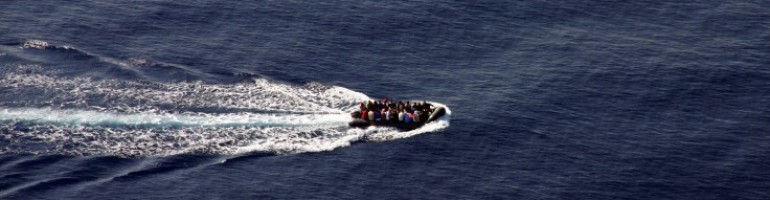
“Fifty-five people are drowned or missing after an overcrowded boat capsized off the Somali coast on Tuesday night (18 December). UNHCR is greatly saddened by this latest tragic incident – the biggest loss of life in the Gulf of Aden since February 2011 when 57 Somali refugees and migrants from the Horn of Africa drowned while attempting to reach Yemen.

According to five of the survivors – all young Somali men – the boat was overcrowded and ran into trouble almost immediately after leaving the port of Bosasso in northern Somalia on Tuesday. It capsized just 15 minutes into its journey, spilling all 60 passengers into sea. Those on board were Ethiopians and Somalis.

To date, 23 bodies have been recovered, including those of 14 women, eight men, and a boy said to be less than four years of age. Five of the dead are confirmed to have been Ethiopians. The thirty-two remaining passengers are presumed to have drowned.

‘The tragic loss of so many lives is a new and stark reminder of the risks Somali refugees are taking as they flee their country’ said UNHCR Representative for Somalia, Bruno Geddo. ‘Without doubt, the Gulf of Aden is now the deadliest route for people fleeing conflict, violence and human rights abuses in the Horn of Africa.’

100,000 people have crossed the Red Sea and the Gulf of Aden this year, despite warnings from UNHCR and other aid agencies about the risks such trips involve. In addition to using unseaworthy and overcrowded boats, those fleeing the Horn of Africa region often fall prey to unscrupulous smugglers, in whose hands they can face exploitation, extortion and even death.

With the latest deaths, 95 people have drowned or gone missing in the waters between Somalia and Yemen this year. UNHCR and other agencies, through the local Migration Response Centre (MRC) in Bosasso are currently providing support and services to the survivors and assisting the local authorities with the ongoing recovery operations.

END

Further info: Andy Needham, UNHCR Somalia PI Officer +254 733 120 931 needham@unhcr.org

Andy Needham Public Information Officer UNHCR Somalia First Floor, Lion Place, Waiyaki Way 43801-00100 Nairobi, Kenya

Somalia Displacement Portal: https://data.unhcr.org/horn-of-africa/somalia.php

m: +254 733 120 931 d: +254 20 420 2103 o: +254 20 420 2000

needham@unhcr.org www.unhcr.org www.takeaction.unhcr.org “

5 Comments

Filed under Gulf of Aden, News, Somalia, UNHCR, Yemen

At Least 20 Persons Dead After Migrant Boat Capsizes in Aegean Sea

A migrant boat attempting to sail from Turkey to Greece reportedly capsized near the Greek island of Lesvos on Thursday or Friday.  The boat was carrying about 28 persons.  At least 20 bodies have been recovered.  Only one survivor has been located.  Media reports describe the migrants as Iraqis or “of Asian origin.”  The boat’s captain was reportedly Turkish.

Click here (EN), here (EN) and here (GR) for articles.

3 Comments

Filed under Aegean Sea, European Union, Frontex, Greece, News, Turkey

UNODC Global Report on Trafficking in Persons 2012

UNODC released its 2012 Global Report on Trafficking in Persons on 10 December 2012.  The 98 page report “provides an overview of patterns and flows of trafficking in persons at global, regional and national levels, based on trafficking cases detected between 2007 and 2010 (or more recent). The report also includes a chapter on the worldwide response to trafficking in persons. The Country Profiles of the Global Report present a national level analysis for each of the 132 countries covered by this edition of the report.”

In regard to trafficked persons in Europe:

“Of the [trafficking] victims originating outside Europe, those from African countries are most prominently detected. About 18 per cent of the total number of victims detected in Western and Central Europe are African. Victims from West Africa, especially but not only Nigerians, comprise the vast majority. West Africans accounted for about 14 per cent of the total number of victims detected here….

In terms of trends, the proportion of West African victims among the total number of victims detected remained constant in Western and Central Europe during the reporting period. A detailed analysis at the country level, however, shows that a decreasing number of West African victims have been detected in a series of countries, while an increasing number have been detected in others. During the reporting period, fewer West African victims were detected in France and Italy, while they were increasingly detected in Austria and Germany. Similar contrasting trends can be noted among other destination countries in Western and Central Europe. The aggregated regional value is the result of compensation between opposite trends. This may indicate that the West African trafficking flow within the subregion may face some sort of displacement of destination.

Victims from the rest of sub-Saharan Africa accounted for a little more than 1 per cent of all victims detected in Western and Central Europe. As far as the North African victims are concerned, these were detected in or repatriated from 11 European countries, accounting for about 2.5 per cent of the victims detected during the reporting period, suggesting that these flows should not be underestimated.”

Click here full Report.

Click here for links to the Executive Summary and Country / Regional profiles.

Map 9, UNODC 2012 Global Report


2 Comments

Filed under Analysis, Data / Stats, European Union, Reports, UNODC

Guardian: Report of Syrians Having Been Turned Back on Evros River by Greek and Possibly Frontex Border Guards

A Guardian article today describes an incident which occurred earlier in the year which, if accurate, would indicate that Greek border guards and possibly border guards operating under Frontex Joint Operation Poseidon Land have returned Syrian asylum seekers (and migrants of other nationalities) to Turkish territory without registering and screening the migrants.

Excerpt: “This summer two people smugglers left 25 Syrian refugees to cross the Evros alone at night. There were two rubber dinghies. The first disappeared across the river into the night. The second …capsized. Most of the men, women and children could not swim. Some survived … The bedraggled Syrians who made it ashore [were detained].  After [irregular migrants are arrested], they are usually detained in administrative holding centres by the EU border police, Frontex, which has been deployed a few miles from the border since 2010. However, the group of Syrian refugees who made it across the Evros that night were not registered. Instead, they were arrested by officers in ‘blue uniforms’ and driven back to the river. ‘There were between 100 to 150 people by the river,’ said Farouk (not his real name), a 29-year-old from the Qamishli region in northern Syria. ‘They were of many nationalities, mainly Syrian. Some tried to make problems: they had paid a lot of money to get that far. When that happened, the police beat them. The police kicked and slapped them, including the women, they picked up children and threw them into the boat.’  The officers put people in small plastic boats, which they tied to larger, motorised boats, and returned them to Turkish territory.  … A UN High Commissioner for Refugees source said the organisation could not comment on Farouk’s story or illegal push-backs by Greek police in general. However, they acknowledged hearing similar accounts. ‘People say that there is a situation where people may enter the territory but are not registered as persons who are arrested in Greek territory. They are returned through use of force at night through the river. We think that these operations have been eliminated in the last two years.’ … Pasxalis Syritoudis, police chief of the northern Evros region, denied that his officers operated a push-back policy. … However, Syritoudis admitted that his main goal was to ‘prevent people entering Greek soil’. This meant sometimes his officers used boats to block migrants in dinghies from crossing the border. ‘We have 10 boats patrolling the river all the time. The boats are used to block people from crossing – to stop them getting to Greek territory.’…”

Click here for article.

2 Comments

Filed under European Union, Frontex, Greece, News, Turkey, UNHCR

UN Special Rapporteur on HR of Migrants expresses concern over plight of irregular migrants in Greece; calls for EU assistance; Frontex patrolling Greece-Italy sea border

The UN Special Rapporteur on the human rights of migrants, Prof. François Crépeau, has completed  a nine-day official visit to Greece, the fourth and last country visit in connection with a “a one-year comprehensive study to examine the rights of migrants in the Euro-Mediterranean region, focusing in particular on the management of the external borders of the European Union.”  The Special Rapporteur will present a thematic report on the human rights of migrants at the borders of the European Union to the UN Human Rights Council in May/ June 2013.  In addition to the visit to Greece, he previously conducted official visits to EU offices in Brussels, Tunisia, Turkey, and Italy.

One point of particular interest in the Special Rapporteur’s end-of-mission statement is that Frontex sea patrols in Greece are not along being used to patrol the external sea border of the EU (Greece-Turkey), but are also being used to patrol the sea border between Greece and Italy to prevent irregular migrants from leaving Greece.  (Is this within Frontex’s mandate?)  According to the end-of mission statement, Frontex Joint Operation Poseidon Sea “which used to cover the sea border between Greece and Turkey, was extended in 2012 to also cover the west coast of Greece, where migrants trying to reach Italy by boats operated by smugglers are intercepted and returned to Greece.”

The Special Rapporteur also notes “[t]he enhanced border controls at the Greek-Turkish land border under operation ‘Aspida’ (‘Shield’) initiated in August 2012, which included the deployment of approximately 1800 border police officers, coupled with the construction of a fence and the Frontex operation ‘Poseidon Land’ have resulted in a renewed influx of irregular migrants via the islands of the eastern Aegean Sea, with boats arriving on the different islands almost daily.”

Here are additional excerpts from the end-of-mission statement:

“[W]hile most EU countries have stopped returning asylum seekers to Greece under the Dublin II Regulation due to a decision of the European Court of Human Rights (M.S.S. vs Belgium and Greece), I was informed that there are still some returns to Greece based on this Regulation.”

“As the large number of irregular migrants stuck in Greece is mainly a result of EU policies and practices, there is a strong need for solidarity and responsibility-sharing within the EU in order to ensure full respect of the human rights of all these migrants.”

“While the role of the EU in managing the migration flows in Greece is crucial, the Greek government also needs to significantly step up its efforts in order to ensure that the rights of all migrants within its territory are fully respected.”

“I am deeply concerned about the widespread xenophobic violence and attacks against migrants in Greece, and I strongly condemn the inadequate response by the law enforcement agencies to curb this violence, and to punish those responsible.”

“I also deeply regret the Greek government’s new policy of systematically detaining everyone they detect irregularly entering the Greek territory, including unaccompanied children and families. I also regret the ‘sweep operations’ in the context of operation ‘Xenios Zeus’, which have led to widespread detention of migrants in different parts of the country, many of whom have lived and worked in Greece for years.”

Among the several preliminary recommendations to Greece and the EU was the recommendation that the EU “[e]nsure that the full protection of the human rights of all migrants, regardless of their status, is the primary consideration for its support to the Greek efforts in managing the migration flow entering the EU territory, including in relation to the activities undertaken by Frontex at the Greek borders.”

Click here for complete End-of-Mission Statement.

Click here for my previous post on the Special Rapporteur’s visits to other countries.

2 Comments

Filed under Aegean Sea, European Union, Frontex, Greece, Italy, OHCHR, Reports, Statements, Turkey

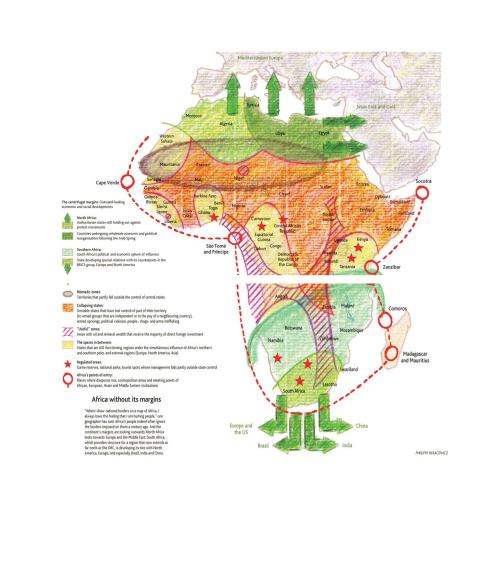
Map: “Africa without its margins” (Le Monde Diplo/Philippe Rekacewicz)

“Africa without its margins,” Le Monde Diplomatique, by Philippe Rekacewicz, Nov. 2012.

“Africa without its margins,” Le Monde Diplomatique, by Philippe Rekacewicz, Nov. 2012.

Leave a comment

Filed under Analysis, Maps