Author Archives: Niels Frenzen

Niels Frenzen's avatar

About Niels Frenzen

Clinical Professor of Law, Gould School of Law, University of Southern California, Los Angeles, USA. Contact: frenzen@usc.edu; @migrantsatsea

Italy Hopes to Revive Libyan Friendship Treaty, Including Migration Control Provisions

Italian officials, including Defence Minister Ignazio La Russa, said yesterday that the Italian-Libyan friendship treaty signed in 2008 by Prime Minister Berlusconi and Gaddafi should be revived once a new government takes power in Libya.  The head of the Libyan National Transitional Council, Mustafa Abdel Jalil, has previously said that the provisions of the treaty, including the migration control provisions, would be respected by the new Libyan government.  Italian Under Secretary for Foreign Affairs, Alfredo Mantica, is quoted by ANSA as saying that “the first duty of Italy will be to update the part [of the treaty] relating to migration” as soon as the situation in Libya has stabilized. [“Mantica ha spiegato che ‘il primo dovere dell’Italia sarà quello di aggiornare la parte che riguarda i flussi migratori’ del Trattato di amicizia italo-libico, non appena la situazione in Libia si sarà stabilizzata.”]

Click here and here for articles. (IT)

Click here and here for previous posts about Libyan NTC’s statements regarding the treaty.

2 Comments

Filed under European Union, Italy, Libya, Mediterranean, News

Tunisia Restricts Border Crossings with Libya

The Tunisian side of the main border crossing with Libya at Ras Jedir was reportedly closed to routine crossing on Monday; sick and injured persons were allowed to cross in to Tunisia.  According to media reports, Tunisian authorities are fearful that militia fighters and mercenaries working for Kadhafi may seek to enter Tunisia.

Click here and here for articles.  (FR)

1 Comment

Filed under Libya, News, Tunisia

UNHCR Calls on All Sides in Libya to Protect Third-Country Nationals

From UNHCR: “UN High Commissioner for Refugees António Guterres today [22 August] called on all sides of the conflict in Libya to ensure that the thousands of third-country nationals trapped in Tripoli and other areas by the continuing fighting are properly protected from harm. ‘Thousands of third-country nationals in Libya will be feeling great fear and uncertainty at this time,’ he said. ‘We have seen at earlier stages in this crisis that such people, Africans especially, can be particularly vulnerable to hostility or acts of vengeance. It is crucial that humanitarian law prevails through these climactic moments and that foreigners – including refugees and migrant workers – are being fully and properly protected from harm.’…”

Click here for full press statement.

Leave a comment

Filed under Libya, News, UNHCR

IOM: Large Number of Migrants in Tripoli in Need of Urgent Evacuation

Full text of IOM statement:

19-08-2011

 Libya – IOM is working to evacuate the growing number of migrants in need of help in the Libyan capital, Tripoli.

The Organization has received several requests to evacuate foreign nationals in Tripoli who are increasingly vulnerable and now want to leave.

Large numbers of Egyptian migrants are still believed to be in Tripoli and in the western part of Libya, with many other nationalities still present in the capital. Exact numbers of the total migrant population in the capital area are unknown.  Thousands of Egyptians have now registered with their Embassy and are ready for evacuation.

As IOM actively prepares a foreign national evacuation plan taking into account the highly complex logistical, political and security challenges, the Organization will soon be in need of significant new funds to carry out this urgent humanitarian operation.

“A rapid response on this is critical to ensuring that in the small window of opportunity we have to get people out of Tripoli, we are not constrained by funding issues,” says Pasquale Lupoli, Regional Director for the Middle East and North Africa, in Cairo.

In addition to the many thousands of stranded migrants IOM has assisted elsewhere in Libya since the start of the crisis in late February, IOM has evacuated more than 10,000 migrants by road from Tripoli to the Tunisian border point at Ras Adjir. That evacuation route had eventually to be abandoned due to increased fighting between rebel and government forces.

As logistics for this special operation from Tripoli are put into place, the Organization is continuing to evacuate migrants elsewhere.

Today, another IOM-chartered ship will be leaving the eastern Libyan town of Benghazi for Misrata on the 15th mission to evacuate migrants, mainly from northern African. It is the first of two rotations to take place between now and mid next week.

More than 8,300 migrants and wounded civilians have so far been assisted by IOM on its Misrata operations with funding from the European Commission’s Humanitarian and Civil Aid department (ECHO), the Australian, British, German, Irish, Japanese and US governments. The Organization has also delivered several thousands of humanitarian aid to the port city.

Click here for statement.

Click here to donate to IOM.


Leave a comment

Filed under Data / Stats, Libya, Mediterranean, News

Malta Blocks Italian Navy Ship From Disembarking 334 Rescued Migrants

Malta yesterday refused permission to the Italian Navy ship Borsini to land in Malta for the purpose of disembarking 334 rescued migrants.  The migrants were rescued in the Maltese Search and Rescue Area south of Lampedusa on Saturday by several Italian coastguard patrol boats and transferred at sea to the Borsini.  The Borsini then sailed to Malta.  Malta refused permission because it said that Lampedusa or Tunisia were the closest safe locations.  The Italians sought to disembark the rescued migrants at Malta because Lampedusa was overwhelmed with the arrivals of approximately 2000 migrants over the past 36 hours.  The Borsini left Malta and is sailing to Taranto on the Italian mainland to disembark the migrants.

Click here and here for articles.

3 Comments

Filed under Italy, Libya, Malta, Mediterranean, News, Tunisia

2000 Migrants Land on Lampedusa

Approximately 2000 migrants in 11 boats reached Lampedusa and Pantelleria over the past 36 hours or so.  Most of the migrant boats were rescued by Italian authorities and most are believed to have travelled from Libya, though one small boat is believed to have left from Tunisia.  Good weather is again the likely reason for the latest surge in numbers.

Click here (IT) and here (EN) for articles.

Leave a comment

Filed under Italy, Libya, Mediterranean, News, Tunisia

Fortress Europe Calculates 1,931 Deaths in the Mediterranean During First 7 Months of 2011

According to calculations made by Fortress Europe, 2011 is the deadliest year in the Mediterranean since at least 1994.  1,931 people have died during the first seven months of 2011.  This number is higher than the total number of deaths in all of 2008, the year with the previous highest death toll of 1,274.  Fortress Europe estimates that 1,674 (87%) of the 1,931 deaths have occurred in the Sicilian Channel and that most of the deaths in the Sicilian Channel have involved migrants travelling from Libya towards Europe.

Click here for Fortress Europe post.  (IT)

Click here for Clandestina blog post.  (EN)

From Fortress Europe:

Vittime del Canale di Sicilia dal 2002 ai primi 7 mesi del 2011
Anno 2002 2003 2004 2005 2006 2007 2008 2009 2010 2011
Morti 236 413 206 437 302 556 1274 425 20 1674

Leave a comment

Filed under Data / Stats, European Union, Italy, Libya, Malta, Mediterranean, News, Tunisia

NATO Denies It Failed to Respond to Migrant Boat in Distress

NATO said yesterday that Italian authorities never directly requested assistance from NATO in regard to the disabled migrant boat discovered earlier in the week by a Cypriot tug boat.  NATO spokespersons said while NATO was informed that the migrant boat was in distress, Italian authorities also informed NATO that Italian patrol boats and a rescue helicopter were responding to the situation.  NATO spokesperson Carmen Romero said NATO had a history of responding to emergency situations and pointed by way of example to NATO’s response on 26 March to two migrant boats in distress.   A Canadian naval ship under NATO command in March rendered assistance to two migrant boats but, unlike the incident last month when a Spanish ship under NATO command rescued 100 migrants and was unable to offload the migrants for five days, the Canadian ship did not take the migrants on board.

Click here (EN), here (IT) and here (IT) for articles.

Click here and here for previous posts on topic.

Click here for previous post about 11 July incident.

Click here and here for previous posts about the 26 March incident.

Leave a comment

Filed under Italy, Libya, Mediterranean, News

Italy Calls for Formal Inquest Into “Presumed Failure” of NATO to Render Assistance to Disabled Migrant Boat and for Expansion of NATO Mandate to Include Rescue at Sea

Here is today’s full statement from the Italian Foreign Ministry:

Minister for Foreign Affairs Franco Frattini instructed the Italian Permanent Representative to NATO to call for a formal inquest into the dynamic regarding the presumed failure to come to the aid of boats carrying civilians fleeing Libya. Minister Frattini also asked Ambassador Sessa to urge discussion within the Atlantic Alliance of the possibility of adapting the mandate of the mission sanctioned by UN resolutions 1970 and 1973 to safeguard Libyan civilians, to the effect that the defence and aid of those fleeing the conflict by sea, and thereby risking their lives, be adequately taken into consideration.

In relazione alle polemiche circa il presunto mancato soccorso a battelli con clandestini a bordo in fuga dalla Libia, il Ministro degli Esteri Frattini ha dato istruzioni al Rappresentante Permanente italiano presso la NATO di chiedere un’inchiesta formale per l’accertamento della dinamica di quanto accaduto. Il Ministro Frattini ha anche chiesto all’Ambasciatore Sessa di sollecitare una discussione all’interno dell’Alleanza Atlantica per il possibile adeguamento del mandato della missione di salvaguardia delle popolazioni civili in Libia, sulla base delle risoluzioni delle Nazioni Unite 1970 e 1973, affinchè vengano opportunamente considerate la tutela e soccorso anche di coloro che per cause belliche sono costretti a fuggire su barconi mettendo a rischio la propria incolumità.

Click here (EN) and here (IT) for links.

Click here (EN), here (EN) and here (IT) for articles.

Click here for previous post.

2 Comments

Filed under Italy, Libya, Mediterranean, News

Italy Rescues 300 Migrants from Disabled Boat; Multiple Deaths May Have Occurred Before Rescue; Italy Seeks Clarification Regarding Possible Failure of NATO Ship to Render Assistance

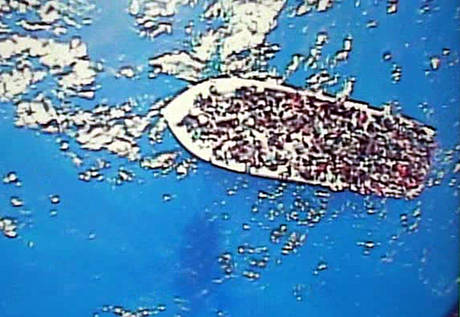
Italian patrol boats yesterday rescued approximately 300 migrants from a disabled boat 90 miles south of Lampedusa.  There are unconfirmed reports from survivors that before the rescue many people died and bodies were put in the sea.  The boat may have been drifting for one and a half days before the rescue.

The disabled migrant boat was reportedly first discovered by a Cyprus tug boat which was forced to move away from the disabled boat when some migrants jumped overboard and tried to swim to the tug.  An Italian helicopter which attempted to lower emergency supplies was forced to abandon its efforts when persons attempted to climb into the basket being used to drop supplies.

According to news reports, a NATO ship was located about 27 miles from the disabled migrant boat, but NATO reportedly failed to respond to a request by Italian authorities to render assistance.  Italian patrol boats were then forced to travel 90 miles from Lampedusa in order to reach the migrant boat.

The Italian government is seeking clarification from NATO regarding the possible failure to respond to the request to render assistance to the migrant boat.  A Spanish frigate under NATO command on 11 July rescued 100 migrants.  During the five day period that the migrants were on board the Spanish frigate, before the migrants were eventually transferred to Tunisian authorities, the Spanish frigate was removed from its NATO Operation Unified Protector embargo patrols due to the civilian passengers.

Click here, here, here, here, and here for articles. (IT)

Click here and here for articles.  (EN)

Click here for short AFP TV video from rescue helicopter.

Click here and here for previous posts on migrant rescue by Spanish frigate.

Image of migrant boat from monitor inside Italian rescue helicopter


3 Comments

Filed under Italy, Libya, Mediterranean, News

25 Persons Dead from Asphyxiation on Board Migrant Boat at Lampedusa

Italian authorities responded to a migrant boat in distress Sunday night near Lampedusa.  The boat was carrying about 270 migrants.  Seas were too rough to transfer the migrants to the Italian vessels and the migrant boat was escorted towards Lampedusa.  The boat broke down about one mile from Lampedusa and a transfer operation was begun this morning.  During the transfer 25 bodies were discovered in the boat.  It is believed that the deaths were probably caused by asphyxiation because the boat was overloaded and packed very tightly with passengers.

Click here, here, and here for articles.  (IT)

Leave a comment

Filed under Italy, Libya, Mediterranean, News

[Post Updated 4 August] Spanish Defence Ministry: NATO Instructed Spanish Navy to Transfer Rescued Migrants to Tunisia

A press release issued yesterday by the Spanish Ministry of Defence states that the 114 migrants who were rescued by the Spanish frigate Almirante Juan de Borbón on 11 July were transferred to Tunisian authorities on 16 July pursuant to orders issued by NATO command.

I previously have sought clarification from both NATO and the Spanish Defence Ministry regarding who made the decision to turn the rescued migrants over to Tunisian authorities and what procedures, if any, were followed to screen rescued migrants before the transfer.  NATO’s Operation Unified Protector press office informed me that all inquiries had to be directed to the Spanish Defence Ministry.  The Defence Ministry’s press office in turn has ignored my inquiries.

[Update – 4 August – I received information today from Communication Office of the Spanish Ministry of Defence reiterating that the Spanish frigate was under NATO command as an asset participating in NATO’s Operation Unified Protector.  According to the Communication Office, after the Spanish frigate commander made the decision that the migrants needed to be rescued, all of the frigate’s subsequent actions were carried out pursuant to specific commands issued by the NATO command, including the final order to transfer the migrants to Tunisian authorities.  Spanish authorities were never involved in discussions or negotiations with other countries regarding the rescued migrants.  The Communication Office referred me to NATO’s OUP Press Office for information regarding any further details of the operation.  I will try again with NATO.]

The press release issued yesterday pertains to a visit made to the Spanish  frigate Almirante Juan de Borbón by Italian Rear Admiral Filippo Maria Foffi, Commander of the NATO naval task group for Operation Unified Protector, where he praised the crew of the frigate for the rescue operation.

The press release goes on to state that after the migrants were taken on board the frigate on 11 July, “on orders from NATO command, the Juan de Borbón sailed to Malta and took a position 40 miles off the coast of that country. On 16 July, instructed by the command of NATO, the Spanish frigate headed for the coast of Tunisia to start the transfer to the Tunisian Navy patrol boat Carthage of the 106 immigrants who were still on board, after the earlier evacuation of eight persons for health and medical reasons.”

(“…siguiendo órdenes del mando de la OTAN, la ‘Juan de Borbón’ puso rumbo a Malta posicionándose a 40 millas frente a las costas de ese país.  El pasado 16 de julio, siguiendo instrucciones del mando de la Alianza, se dirigió hacia las costas de Túnez para iniciar el traslado al patrullero Carthage de la Armada tunecina, de los 106 inmigrantes que aún permanecían a bordo tras la evacuación de ocho personas por motivos médicos y de salud…”)

The Spanish government and NATO are rightfully to be praised for the rescue operation.  What is unfortunate is the lack of transparency on the part of both NATO and the Spanish Defence Ministry in regard to why the decision was made to transfer the migrants to Tunisia and what procedures, if any, were used to screen the migrants for claims to international protection.

Click here for Defence Ministry Press Release. (ES)

Click here for my last post on this topic.

2 Comments

Filed under Italy, Libya, Malta, Mediterranean, News, Spain, Tunisia

Office of Legal Counsel (US Dept of Justice) 1994 Legal Opinion, “Whether the Interdiction of Undocumented Aliens Within United States Territorial Waters Constitutes an Arrest Under Section 287(a)(2) of the Immigration and Nationality Act”

This post will be of little interest to most people, but I wanted to give an online home to this US Department of Justice Office of Legal Counsel (“OLC”) legal opinion issued on April 22, 1994 [22 April 1994 OLC Opinion] and which we obtained last month pursuant to a Freedom of Information Act request submitted to OLC in September 2009.

The legal opinion, “Whether the Interdiction of Undocumented Aliens Within United States Territorial Waters Constitutes an ‘Arrest’ Under Section 287(a)(2) of the Immigration and Nationality Act,” concludes that “[t]he interdiction within the territorial waters of the United States of illegal aliens entering or attempting to enter the United States is not an ‘arrest’ of such aliens within the meaning of INA § 287(a)(2).”

By concluding that an interdiction within US territorial waters does not constitute an arrest under US immigration laws, the 1994 legal opinion re-affirmed a 1993 OLC legal opinion that aliens interdicted within the 12 mile territorial sea zone are not entitled to hearings before an immigration judge which in turn means that such aliens are not able to seek protections under US immigration law, including protection against refoulement. The 1993 memo stated, inter alia, that “the State Department has advised us of its view that the United States’s international law obligations under the Protocol do not require it to provide … hearings to aliens who have merely arrived in its territorial waters.”

This rationale was extended by a 1996 OLC legal opinion to interdictions that occur within the “internal waters” of the US.  “Internal waters” under US law include such bodies of water as “the straits between the Florida Keys [and] portions of the Chesapeake Bay.”

Since 1992, the US has maintained the position that its obligation to apply Article 33 non-refoulement protection does not extend to persons encountered outside US territory in international waters.  While asserting it is not obligated to extend Article 33 protection to persons encountered in international waters, within the 12 mile territorial sea, or within internal waters, the US does extend Article 33 protection to interdicted migrants on a discretionary case-by-case basis.

Click on this link, 1994 OLC Opinion, for newly released 1994 OLC legal opinion: “Whether the Interdiction of Undocumented Aliens Within United States Territorial Waters Constitutes an ‘Arrest’ Under Section 287(a)(2) of the Immigration and Nationality Act,” Memorandum from Office of Legal Counsel, US Department of Justice (22 April 1994).

Click here for 1993 OLC legal opinion: “Immigration Consequences of Undocumented Aliens’ Arrival in United States Territorial Waters,” Memorandum from Office of Legal Counsel, US Department of Justice (13 October 1993).

Click here for 1996 OLC legal opinion: “Rights of Aliens Found in US Internal Waters,” Memorandum from Office of Legal Counsel, US Department of Justice (21 November 1996).

Click here for Executive Order No 12807 (29 May 1992) containing, inter alia, US interpretation of its Article 33 obligations in regard to persons encountered in international waters.

Leave a comment

Filed under Judicial, United States

20th Anniversary of the Arrival at Bari, Italy of 15,000 Albanian Boat People

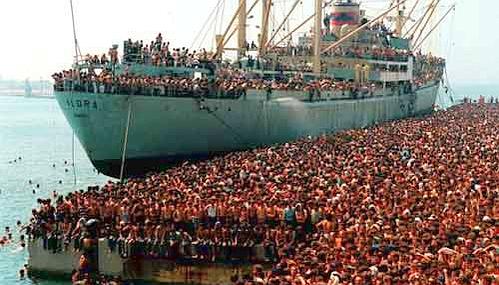
Twenty years ago, on 8 August 1991, several ships carrying approximately 15,000 Albanian migrants succeeded in entering the port of Bari, Italy.  The Italian government’s response was harsh.  Most of the Albanians were detained in a sports stadium without adequate food, water, or access to bathrooms.  Italian authorities dropped supplies to the detained migrants by helicopter.  Within several weeks most of the migrants were deported to Albania.  Their harsh treatment was criticised by human rights organisations and the Pope, but was justified by the Italian government as necessary to deter further irregular migration from Albania.

Excerpts from the 27 January 1992 PACE Report on the Exodus of Albanian Nationals:

“[***]

THE MASS EXODUS FROM ALBANIA

13.       Albania’s forty years of isolation from the rest of the world, combined with its disastrous economic, social and political situation, have had a traumatic effect on its citizens. They feel overwhelmed by hopelessness in the face of Albania’s domestic situation, and although their knowledge of other countries is based solely on what they have heard, or seen on Italian television, they long for the opportunity to start a new life abroad.

14.       This general mood became evident after mid-1990 when increasing numbers of asylum-seekers started to leave the country. Distressing images reminded the public in the rest of Europe of a part of the continent which they had forgotten existed.

15.       In July 1990, Western embassies in Tirana were besieged by large numbers of Albanian nationals. Some 5 000 people sought to leave the country. Thanks to the mediation of international organisations, and after intensive negotiations, a large number of them managed to obtain visas and were granted political asylum in several European countries, particularly Germany, Italy and France. Some have apparently since returned to Albania.

16.       At the end of 1990, some 3 000 Albanian nationals had arrived in Greece by crossing the border between the two countries without meeting any resistance from Albanian border guards. By mid-March 1991, 20 000 Albanians, many of them of Greek ethnic origin, were estimated to have entered Greece. Some of these Albanian nationals have applied to the Greek authorities for political asylum. However, interviews of asylum-seekers have shown clearly that the exodus was not politically motivated but directly linked to the difficult situation prevailing in Albania. The Greek authorities granted work permits to those who found a job and temporary residence permits to the others. Repatriation programmes for all those wishing to return voluntarily were carried out in close co-operation with the Office of the United Nations High Commissioner for Refugees (UNHCR).

17.       On 5 March 1991, a large number of Albanians gathered before the German, French, Greek and Italian Embassies in Tirana, where it was rumoured that visas were going to be distributed. The following day (according to various sources), several boats left the Albanian port of Durres with 20 000 Albanians on board.

18.       On 7 March 1991, Albanian ships began arriving at ports in southern Italy (Brindisi, Bari, Otranto and Monopoli). In spite of the Italian authorities’ public refusal to allow the Albanians to land, many managed to do so.

19.       On the following day, 8 March 1991, hygiene on the boats had deteriorated to such an extent that landing was unavoidable. Crowds of Albanians settled on the quays of Italian ports to await aid which took several days to arrive, as the Italian authorities were overwhelmed by their sheer number.

20.       The Italian authorities claim that 20 000 Albanians arrived in Italy between 7 and 10 March 1991. Negotiations between the authorities in Tirana and Rome subsequently brought the exodus to an end, and Italy has undertaken to discuss with Albania how to eliminate its root causes.

21.       Also in March 1991, an undetermined number of Albanians of Serbian and Montenegrin origin attempted to enter Yugoslavia illegally.

22.       In June 1991, the Albanian authorities requested the United Nations Development Programme to organise an interagency mission in order to undertake an assessment of Albania’s urgent humanitarian needs. In the field of migration, the mission concluded that the great majority of Albanians who had left the country were seeking improved economic conditions and recommended to the Albanian government that it provide incentives so as to encourage Albanians to remain in their country.

23.       During the first days of August 1991 thousands of Albanians reached the western port of Durres and the southern port of Vlora, in the hope of going on board ships that would take them to Italy.

24.       The Albanian authorities tried in vain to prevent its citizens from leaving the country by putting the ports under military control and halting passenger trains.

25.       On 8 August 1991 an estimated 10 000 Albanian nationals aboard several ships forced their way into the port of Bari in the south-east of Italy and approximately 1 000 into the port of Otranto. Moreover, 675 Albanians aboard two other ships who tried unsuccessfully to land at ports in Sicily, were diverged to Malta and later returned to Albania.

26.       After several hours of waiting in the port of Bari, the Italian authorities allowed the Albanians to disembark for humanitarian reasons and led them to La Vittoria Sports Stadium. As the Italian authorities started forced repatriation using military transport planes and ferries, clashes broke out between policemen and Albanians. The Albanians barricaded themselves in the stadium refusing to return to their country; some 300 succeeded in escaping.

27.       The Italian authorities offered the Albanians 50 000 lire (40 US dollars) each and new clothes if they would return home. As this offer did not attract the Albanians, forced repatriation continued.

28.       At the same time the Italian Government increased its financial aid to Albania. Right after the repatriation operations food and emergency aid was sent to Albania. On 12 August 1991, the European Community announced an extra 2,3 million US dollars of emergency aid to be used to buy food and medicines.

29.       The large majority of Albanians arriving in Italy were claiming to be looking for work and escaping the poor economic situation in their country. The failure to repatriate the 7 000 Albanians who arrived in March 1991 as well as rumours of an immigration agreement between Albania and Italy seemed to encourage this last flow.

30.       All of Europe witnessed the dramatic scenes, captured on television news, showing the Albanians being expelled by Italian officials. Although repatriation was legally justified, the way in which the operation was conducted was problematic. The vast majority of the Albanians, according to their accounts of the exodus, fled their country because they felt “buried alive” there. They explained that when the news spread like wildfire that it was possible to leave Albania, lorries were seized in the ensuing rush, ships commandeered, and their crews forced to set sail. It was a form of mass psychosis. It is difficult to determine whether this psychosis was triggered deliberately; rumours suggest that this was the case, but there is no conclusive evidence to support this.

31.       The Albanians’ deportation from Italy was beset with problems, and on a number of occasions the police were deployed. The Albanians were particularly distressed to find that despite promises from the Italian authorities to allow some of them to travel to new homes in Italy, they were still sent straight back to Albania.

32.       It should be noted, however, that the Italian authorities provided the Albanians with food, clothing and some money.

33.       Although there was remarkable sympathy for the Albanians in Italy, the official Italian position was that these persons were seeking economic betterment in Italy and consequently could not be considered as political refugees.

34.       From 15 to 17 August the International Organisation for Migration (IOM) and UNHCR sent a joint mission to Albania. It discussed with the Albanian authorities issues related to migration, such as:

–       the continuation of voluntary return projects from neighbouring countries;

–       the planned and orderly emigration of a small number of Albanians to work in industrialised countries;

–       the implementation of an information project aimed at informing Albanians of the economic and social situation in neighbouring countries;

–       the need to promote, in the mid-term, the reinsertion of returning Albanians, through appropriate vocational training before their return.

35.       It must also be recalled that, at the request of the Italian authorities, IOM and UNHCR, in conjunction with the Italian Red Cross, established a programme of voluntary return. As at the end of August 1991, 1 130 Albanians had been assisted by IOM in their voluntary return. The programme was financed by the Italian Government.

36.       By the end of December 1991 more than 200 000 Albanians were estimated to have left their country since the exodus began in July 1990. However, the UNHCR considers this figure could be substantially higher.

[***]”

Click here for 27 January 1992 PACE Report on the Exodus of Albanian Nationals:

Click here and here for articles about events in Bari marking the anniversary. (IT)
32 Comments

Filed under Council of Europe, Italy, News

Issue Brief- Cutting Off the Flow: Extraterritorial Controls to Prevent Migration

An Issue Brief, “Cutting Off the Flow: Extraterritorial Controls to Prevent Migration,” written by Eleanor Taylor-Nicholson, has been published by the Warren Institute for Law and Social Policy, University of California, Berkeley.  The issue brief was written as a background paper for a conference held by the Warren Institute at UC Berkeley Law School on 22 April 2011.

Excerpt: “… This issue brief explores the extent to which the United States, Europe and European governments have implemented different extraterritorial controls. Although we hear of such controls in the media, how common are they? Who is overseeing them? What do they involve? What are concerns with their use? To answer these questions, this brief presents information on key actors, including individual nation-states and their agents, and on the range of mechanisms used by both. A comparison of two major immigration destinations is included to consider similarities and differences in the use of extraterritorial controls by states.

A review of the literature and media reports finds that extraterritorial controls include a diverse range of measures by different actors, some of which have been extremely controversial, such as maritime interdiction and offshore detention, and others that are more accepted or less understood, such as visa controls and disruption of organized immigration crime. Further, while such controls are now ubiquitous in both regions, their design and implementation generally lack public oversight and accountability mechanisms. They may protect states from security threats, have the potential to provide early protection to people in need, and save traveling migrants in distress. But, if used primarily as an immigration deterrence mechanism, they can cause harm. Indeed they may provide states a means to evade their international obligations or lead to violations of international refugee law and human rights law.

In light of this, we recommend governments conduct a comprehensive and public review of the extraterritorial controls they have in place, taking into consideration international refugee and human rights commitments. We also urge governments to increase the transparency of their immigration control agreements with third parties, including private actors and other states….”

Click here for Issue Brief.

Leave a comment

Filed under Analysis, European Union, Frontex