Category Archives: Council of Europe

1 Year Anniversary of Italy’s Push-Back Practice

This month marks the first anniversary of the implementation of Italy’s push-back practice with Libya.  The practice is based primarily on the Italy-Libya Treaty of Friendship, August 2008, and the Supplementary Protocol of 4 February 2009.

The first push-back operation occurred on 6 May.  As a reminder, here is the European Committee for the Prevention of Torture’s (CPT) description of the first operation:

Operation of 6 May 2009

According to data provided by the Italian authorities, 231 migrants (191 men and 40 women) were aboard three vessels in distress. The information collected from other sources indicates that among the migrants there were unaccompanied minors and four pregnant women. Following the interception of the boats by two Coast Guard vessels and one vessel of the Guardia di Finanza, the migrants were transferred onto the three Italian vessels and returned to Libya. The CISOM [Order of Malta Italian Relief Corps] personnel and a journalist, who was aboard the vessel of the Guardia di Finanza, indicated that they were not aware that the migrants would be pushed back to Libya, and that the captains of the Italian vessels only received an order to do so in the course of the operation.

The delegation was unable to interview the migrants pushed back to Libya or, given the authorities’ refusal to provide their names, the captains of the Italian vessels involved in the operation. However, reliable information collected by the delegation would indicate that, during the operation, which lasted around 12 hours, the 74 persons on the Guardia di Finanza vessel were provided insufficient water and no food or blankets; further, physical violence, in particular with kicks, punches and blows with an oar, was allegedly used against a number of migrants by Libyan police at the harbour in Tripoli, to force them to disembark from the two Coast Guard vessels.

Click here (IT) for article and podcast from AMISnet: “Un anno di respingimenti.”

Click here for earlier post.

Click here for the full CPT Report.

Click here for the Response of the Italian Government.

1 Comment

Filed under European Committee for the Prevention of Torture and Inhuman or Degrading Treatment or Punishment, Italy, Libya, Mediterranean, News

Int’l Law Observer: Italy’s Asylum Policy Violates Int’l Law

Some additional comments on the Council of Europe CPT’s condemnation of Italy’s push-back practice in the Mediterranean can be found in a post by Michèle Morel on International Law Observer.

The “conclusion of the CPT is highly important in the light of the coming decision of the European Court of Human Rights on Italy’s asylum policy. It is a powerful signal, not only towards Italy but also towards other European countries carrying out the practice of intercepting and returning migrants without human rights guarantees, such as Spain and Greece.”

Click here for the complete post.

1 Comment

Filed under Analysis, Council of Europe, European Committee for the Prevention of Torture and Inhuman or Degrading Treatment or Punishment, Italy, Libya, Mediterranean

Council of Europe’s Committee for the Prevention of Torture Report is Highly Critical of Italy’s Push-Back Practice

The Council of Europe’s Committee for the Prevention of Torture and Inhuman or Degrading Treatment or Punishment (CPT) published on 28 April its report on its visit to Italy in July 2009 and the official response to the report from the Italian Government.

In the CPT’s view, “Italy’s [push-back] policy, in its present form, of intercepting migrants at sea and obliging them to return to Libya or other non-European countries, violates the principle of non-refoulement, which forms part of Italy’s obligations under Article 3 of the European Convention on Human Rights.”

“The so-called push-back policy, as pursued by the Italian authorities and described in this report, does not meet [the] requirements [ of the ECHR]. The CPT urges the Italian authorities to substantially review forthwith the current practice of intercepting migrants at sea, so as to ensure that all persons within Italy’s jurisdiction – including those intercepted at sea outside Italian territorial waters by Italian-controlled vessels – receive the necessary humanitarian and medical care that their condition requires and that they have effective access to procedures and safeguards capable of guaranteeing respect for the principle of non-refoulement.”

The CPT is also very critical of the lack of cooperation received from the Italian Government: “Regrettably, the co-operation received at the central level [of the Italian Government] was, in certain respects, unsatisfactory. The delegation was denied access to some documents and information it had requested, which did not facilitate its task. Other information requested by the delegation prior to and in the course of the visit was not provided in a timely manner and when eventually furnished was, moreover, incomplete.”

“For instance, information requested pertaining, inter alia, to the logbooks from each push-back operation and the names of personnel responsible for the operations, which the authorities undertook to provide to the delegation, was subsequently refused on grounds of confidentiality. Also, the Italian authorities denied the existence of a list/inventory of objects seized from migrants in the course of a push-back operation, a copy of which the delegation had requested, and yet certain representatives of the Navy had told the delegation that such a list had indeed been compiled.”

“Further, the CPT’s delegation learned from the press, and not from the Italian authorities, that during the visit, on 29-30 July 2009, a push-back operation took place. … In the Committee’s view, when a CPT delegation carries out a visit to a Party to the Convention focussing on a specific issue made known in advance, the State authorities should, in a spirit of co-operation, endeavour to keep the visiting delegation informed of significant events pertaining to that same issue.”

Click here for CPT Press Release.

Click here for the CPT Report.

Click here for the Response of the Italian Government.

1 Comment

Filed under European Committee for the Prevention of Torture and Inhuman or Degrading Treatment or Punishment, Italy, Libya, Mediterranean, Reports

ECtHR Decision in Medvedyev and Others v France

The Grand Chamber of the European Court of Human Rights issued its decision in Case of Medvedyev and Others v. France (Application no. 3394/03) on 29 March.  The applicants in the case were crew members on a Cambodian ship intercepted by the French Navy near Cape Verde.  The crew members were brought to France where they were convicted of drug smuggling.  Proceedings were then brought by the crew members before the ECtHR to challenge, among other things, the legality of their detention at sea.

An analysis of the decision by Douglas Guilfoyle, Lecturer in Law at University College London, is posted on EJIL: Talk! – “ECHR Rights at Sea: Medvedyev and others v. France.

From the Registrar’s Press Release:

“Article 1- The Court had established in its case-law that the responsibility of a State Party to the European Convention on Human Rights could arise in an area outside its national territory when as a consequence of military action it exercised effective control of that area, or in cases involving the activities of its diplomatic or consular agents abroad and on board aircraft and ships registered in, or flying the flag of, the State concerned. France had exercised full and exclusive control over the [ship] and its crew, at least de facto, from the time of its interception, in a continuous and uninterrupted manner. Besides the interception of the [ship] by the French Navy, its rerouting had been ordered by the French authorities, and the [ship’s] crew had remained under the control of the French military throughout the voyage to Brest. Accordingly, the applicants had been effectively within France’s jurisdiction for the purposes of Article 1.

Article 5 § 1 – The applicants had been under the control of the special military forces and deprived of their liberty throughout the voyage, as the ship’s course had been imposed by the French military. The Court therefore considered that their situation after the ship was boarded had amounted to a deprivation of liberty within the meaning of Article 5. The Court was fully aware of the need to combat international drug trafficking and could see why States were so firm in that regard. However, while noting the special nature of the maritime environment, it took the view that this could not justify the creation of an area outside the law. [***] Accordingly, the deprivation of liberty to which the applicants had been subjected between the boarding of their ship and its arrival in Brest had not been “lawful”, for lack of a legal basis of the requisite quality to satisfy the general principle of legal certainty. The Court therefore held by ten votes to seven that there had been a violation of Article 5 § 1.

Article 5 § 3 – The Court reiterated that Article 5 was in the first rank of the fundamental rights that protected the physical security of an individual, and that three strands in particular could be identified as running through the Court’s case-law: strict interpretation of the exceptions, the lawfulness of the detention and the promptness or speediness of the judicial controls, which must be automatic and must be carried out by a judicial officer offering the requisite guarantees of independence from the executive and the parties and with the power to order release after reviewing whether or not the detention was justified. While the Court had already noted that terrorist offences presented the authorities with special problems, that did not give them carte blanche to place suspects in police custody, free from effective control. The same applied to the fight against drug trafficking on the high seas. [***] At the time of its interception the [ship] had been off the coast of the Cape Verde islands, and therefore a long way from the French coast. There was nothing to indicate that it had taken any longer than necessary to escort it to France, particularly in view of the weather conditions and the poor state of repair of the vessel, which made it impossible for it to travel any faster. In view of these “wholly exceptional circumstances”, it had been materially impossible to bring the applicants before the investigating judges any sooner, bearing in mind that they had been brought before them eight or nine hours after their arrival, a period which was compatible with the requirements of Article 5 § 3. The Court therefore held by nine votes to eight that there had been no violation of Article 5 § 3.”

Click here for the EJIL: Talk! analysis by Douglas Guilfoyle.

Click here for the Press Release from the Registrar.

Click here (EN) or here (FR) for the Decision of the Grand Chamber.

Leave a comment

Filed under Eastern Atlantic, European Court of Human Rights, France, Judicial

Exchange of Letters Between COE HR Commissioner and Greece

COE Human Rights Commissioner Thomas Hammarberg has released copies of the correspondence between his office and the Greek government concerning his February visit to Greece and his concerns over a variety of issues, including Greece’s treatment of asylum seekers.  According to the Commissioner’s web site “[t]he letters focus on the human rights of migrants, especially asylum seekers, minorities, and the conduct of members of law enforcement agencies.  In view of long-standing, serious shortcomings in the field of asylum, the Commissioner highlights the urgent need for the authorities to support the ongoing reform in this field with the necessary institutional capacity and tools for implementation. The Commissioner also urges the authorities to address the situation of unaccompanied or separated migrant children.”

Click here for link to the statement and the letters.

Leave a comment

Filed under Aegean Sea, Commissioner for Human Rights, Greece, News

COE Committee of Ministers: “Europe’s boat people: mixed migration flows by sea into southern Europe”

The Council of Europe’s Committee of Ministers on 31 March adopted its Reply to COE Parliamentary Assembly Recommendation 1850 (2008) on“Europe’s boat people: mixed migration flows by sea into southern Europe.”

Comments from the COE European Committee for the Prevention of Torture and Inhuman or Degrading Treatment or Punishment are attached to the Rely as an Appendix.

The Reply contains an acknowledgement that the Committee of Ministers was not able to reach agreement on the recommendation that guidelines be prepared for minimum standards to be applied to the detention of irregular migrants:

“5. The Committee of Ministers has taken note of the proposal that guidelines be prepared for minimum standards to be applied to the detention of irregular migrants and asylum seekers. However, the Committee of Ministers has not, at the present time, reached a common position with regard to examining possibilities for Council of Europe action in this area. The Committee of Ministers underlines the importance of the relevant instruments of the Council of Europe, such as the European Convention on Human Rights and the recommendations adopted by the Committee of Ministers in this field (see paragraph 9 below), as well as those emerging from the work of the CPT and the Commissioner for Human Rights. It notes the ongoing work in the European Union in this field, including the revision under way of the 2003 directive laying down minimum standards for the reception of asylum seekers.”

Parliamentary Assembly Recommendation 1850 was issued in 2008 prior to the implementation in 2009 of Italy’s push-back practice and the Committee of Ministers’ Reply does not make explicit reference to Italy’s push-back policy.  The Recommendation and Reply are focused on the treatment of irregular migrants as they arrive on the shores of member states.

But there are several statements in the Reply which should apply implicitly to the irregular migrants whether encountered upon arrival on shore or intercepted or rescued in international waters.

For example:

“6. Particularly significant instruments in this field, also to be borne in mind in the framework of any possible activity in this area, include Committee of Ministers’ Recommendation No. R (98) 13 of 18 September 1998 on the right of rejected asylum seekers to an effective remedy against decisions on expulsion in the context of Article 3 of the European Convention on Human Rights, Recommendation No. R (98) 15 on the training of officials who first come into contact with asylum seekers, in particular at border points and Recommendation Rec(2003)5 on measures of detention of asylum seekers. The Committee of Ministers would also signal the “Twenty guidelines on forced return” adopted on 20 May 2005 and the Guidelines on human rights protection in the context of accelerated asylum procedures adopted on 1 July 2009.”

“7. The Committee of Ministers would also refer to other texts relevant in this area, such as its reply to Parliamentary Assembly Recommendation 1755 (2006) on “Human rights of irregular migrants” in which it draws attention to the minimum safeguards provided for in the European Convention on Human Rights that can be applied to irregular migrants. It also recalls its Recommendation No. R (2000) 3 to member states on the right to satisfaction of basic material needs of persons in situations of extreme hardship, which provides a minimum threshold of rights which should be recognised regardless of their status.”

“10. The Committee of Ministers would also draw attention to the extensive work of the Commissioner for Human Rights in this field and to his recommendations to member states and his appeals for solidarity within Europe with those countries that are on the frontline and facing a very difficult situation. It also refers to the regular exchanges of views that it holds with the Commissioner during the year. These exchanges are both of a general nature but also concern specific country reports in which he addresses, inter alia, the protection of human rights of immigrants and asylum seekers, including, where relevant, those arriving by sea. [***]”

Click here for the full Committee of Ministers Reply.

1 Comment

Filed under Aegean Sea, Commissioner for Human Rights, Committee of Ministers, Council of Europe, Eastern Atlantic, European Committee for the Prevention of Torture and Inhuman or Degrading Treatment or Punishment, Greece, Italy, Mediterranean, Spain, Statements

NRC Article: Seaborne interception of immigrants tested in ECtHR

From NRC Handelsblad (Netherlands):  “None of them have ever set foot on European soil. Most are incarcerated in Libyan detention centres. Some may have already been sent back to their countries of origin. Yet they are filing suit against the Italian state in the European Court of Human Rights (ECHR). The plaintiffs are 24 immigrants from Somalia and Eritrea who tried to sail from Libya to Italy on May 6, 2009. They were intercepted by the Italian coast guard 35 kilometres off the island of Lampedusa and immediately sent back to Libya. Back in the north African country, the would-be immigrants were put in touch with two Italian immigration lawyers, who then brought their case to the ECHR in Strasbourg.

The case is unique, said Thomas Spijkerboer, a professor of migration law at Amsterdam’s Vrije Universiteit. ‘For the first time, Europe’s highest court for human rights will look into the most controversial policy combating illegal seaborne migration any European state has implemented so far,’ he said. …

The Italian lawyer Anton Giulio Lana has been granted power of attorney to act on the behalf of 24 returned would-be immigrants. Lana was put in touch with his clients by an international NGO that operates in Libya. Speaking on the phone from Rome, Lana explained: ‘I would rather not say what NGO is helping us. It needs to be able to operate in Libya for the time being.’  According to Lana, Italy has violated Article 3 of the European Convention on Human Rights that prohibits ‘torture or inhuman or degrading treatment or punishment’. Deported immigrants run the risk of being exposed to such treatment in Libya. The convention also forbids collective expulsion of foreigners, and according to refugee law, it is illegal to deport asylum seekers to a country where they could face persecution.”

Click here for full article.

Leave a comment

Filed under European Court of Human Rights, Italy, Libya, Mediterranean, News

UNHCR Files ECtHR Third Party Intervention in Hirsi v. Italy

The UNHCR submitted a third party intervention to the European Court of Human Rights in the case of Hirsi and others v Italy, Requête no 27765/09, which was filed on 26 May 2009 by 11 Somalis and 13 Eritreans who were among the first group of about 200 migrants interdicted by Italian authorities and summarily returned to Libya pursuant to Italy’s push-back practice.  The case was communicated by the Second Section of the Court on 17 November 2009.

The UNHCR’s intervention “addresses the practice and justification of ‘push-back’ operations by the Italian government, the conditions for reception and seeking asylum in Libya and the extraterritorial scope of the principle of non-refoulement and pursuant legal obligations concerning the rescue and interception of people at sea.”

Excerpts from the intervention:

“[***]  2.2.1  On 6 May 2009, the Italian government, in cooperation with the government of Libya, initiated the so-called “push-back policy” by intercepting people, including those who may be in need of international protection, on the high seas and returning them to Libya. This policy was a departure from the previous practice where Italian naval forces had regularly disembarked such persons in Lampedusa or Sicily. Based on UNHCR’s estimates, in 2008 some 75% of sea arrivals in Italy applied for asylum, and 50% of those who applied received some form of protection after their claims were assessed in the Italian asylum procedure.

2.2.2  According to the Italian authorities, from 6 May to 6 November 2009, a total of nine operations were carried out, returning a total of 834 persons to Libya. The precise modalities of the operations have not been made public and were not otherwise fully disclosed to UNHCR. …

4.1  The extraterritorial scope of the principle of non-refoulement under Article 33 (1) of the 1951 Convention…

4.1.2  The territorial scope of Article 33 (1) is not explicitly defined in the 1951 Convention. The meaning, purpose and intent of the provision demonstrate, in UNHCR’s view, its extraterritorial application, e.g., to situations where a state acts outside its territory or territorial waters. Furthermore, the extraterritorial applicability of human rights obligations contained in various instruments supports this position ….

4.2  The extraterritorial scope of the principle of non-refoulement in human rights law

4.2.1  The complementary and mutually reinforcing nature of international human rights law and international refugee law speak strongly in favour of delineating the same territorial scope for all expressions of the non-refoulement principle, whether developed under refugee or human rights law….

4.3  The principle of non-refoulement in the context of interception and search and rescue operations on the high seas

4.3.1  As stated earlier, the principle of non-refoulement applies whenever a state exercises jurisdiction. Jurisdiction can be based on de jure entitlements and/or de facto control. De jure jurisdiction on the high seas derives from the flag state jurisdiction.  De facto jurisdiction on the high seas is established when a state exercises effective control over persons. Whether there is effective control will depend on the circumstances of the particular case.

4.3.2  Where people are intercepted on the high seas, rescued and put on board a vessel of the intercepting state, the intercepting state is exercising de jure as well as de facto jurisdiction. While de jure jurisdiction applies when the people on board a ship are sailing under the flag of the intercepting state, it is also exercised – relevant to the case of “push-backs” – where the intercepting state has taken the persons on board its vessel, bringing them under its full (effective) control. In UNHCR’s view, as becomes clear from section 2.2 above, the Italian authorities were in full and effective control of the persons throughout the “push-back” operations until the formal hand-over to the Libyan authorities. Article 4 of the Italian Code of Navigation specifies that Italian ships on the high seas are considered as Italian territory.

4.3.3  When jurisdiction on the high seas has been established, the obligations deriving from it in relation to the principle of non-refoulement should be examined. The UNHCR’s Executive Committee has emphasized the fundamental importance of fully respecting this principle for people at sea, underlining that: ‘interception measures should not result in asylum-seekers and refugees being denied access to international protection, or result in those in need of international protection being returned, directly or indirectly, to the frontiers of territories where their life or freedom would be threatened on account of a Convention ground, or where the person has other grounds for protection based on international law.’

4.3.4  In UNHCR’s view, the situation in which a state exercises jurisdiction on the high seas over people on board its vessels requires respect for the principle of non-refoulement. It follows that states are obliged, inter alia, not to hand over those concerned to the control of a state where they would be at risk of persecution (direct refoulement), or from which they would be returned to another country where such a risk exists (indirect refoulement). The state exercising jurisdiction needs to ensure that asylum-seekers are able to access fair and effective asylum procedures in order to determine their needs for international protection….

4.3.6  For interception or rescue operations carried out by EU Member States, UNHCR has clarified that, “… disembarkation of people rescued in the Search and Rescue (SAR) area of an EU Member State should take place either on the territory of the intercepting/rescuing State or on the territory of the State responsible for the SAR. This will ensure that any asylum-seekers among those intercepted or rescued are able to have access to fair and effective asylum procedures. The disembarkation of such persons in Libya does not provide such an assurance”.

5.  Conclusion

5.1  UNHCR considers that the interception of persons on the high seas between Italy and Libya, their transfer from Italian to Libyan custody, and their return to Libya, may be at variance with the principle of non-refoulement and in contradiction to Article 3 of the ECHR. By returning persons to Libya without an adequate assessment of their protection needs, the Italian authorities appear not to have sufficiently taken into account the potential risk of refoulement, including indirect refoulement, and other possible violations of fundamental rights upon return of the affected persons to Libya. The lack of an asylum system in Libya means that there are not sufficient safeguards to ensure that persons in need of international protection will be recognized as such and accorded legal status and associated entitlements that could ensure their rights, including to protection against refoulement, are not violated. The risk of chain refoulement denying international protection, especially to Eritrea, cannot be excluded.”

Click here for the full text of the UNHCR intervention.

Click here for an earlier post on the case.

1 Comment

Filed under European Court of Human Rights, Italy, Judicial, Libya, Mediterranean, News, UNHCR

COE Human Rights Commissioner Expresses Concern to ECtHR Over Greece’s Treatment of Asylum Seekers

Council of Europe Human Rights Commissioner Thomas Hammarberg has made public the third party intervention he submitted to the European Court of Human Rights on 10 March.  The intervention was made at the invitation of the ECtHR pursuant to Article 36, paragraph 2 of the ECHR, and is the first such submission of its kind by the Commissioner.

The intervention was submitted in case 26494/09 AHMED ALI v. the Netherlands and Greece, and thirteen related cases.  The cases all deal with the return of asylum seekers from the Netherlands to Greece pursuant to the EC Dublin Regulation.

The Commissioner’s Office notes in a Press Statement that “[w]ith the entry into force of Protocol No. 14 to the [ECHR], the Commissioner will [now] have the right to intervene proprio motu as third party in the Court’s proceedings.”

Excerpts from the Commissioner’s intervention before the ECtHR:

“Introduction – [***]

3. The protection of the human rights of asylum seekers and refugees is a priority theme of the Commissioner’s present work concerning all Council of Europe member states. The Commissioner has repeatedly stressed the importance of guaranteeing the individual right to seek and enjoy asylum and has addressed a number of relevant recommendations to member states. [***]

I. Observations on the current framework of refugee protection in Greece

6. The Commissioner is fully cognisant of the considerable, mixed migration (immigrants and asylum seekers) flow pressures that have been exerted on Greece, as is the case for other Mediterranean Council of Europe member states, for many years. The increase of irregular migration into Greece that has occurred particularly in the last five years has further strained this country’s resources. Nonetheless, the complex international phenomenon of migration should be dealt with by Greece and all other Council of Europe member states concerned in a manner which is not only efficient but also effectively respectful of the Council of Europe human rights standards.

7. Greece received the sixth largest number of refugee applicants in the EU during the first half of 2009 (9 800 applications).

8. In 2009, a total of 15 928 asylum applications were lodged in Greece; there were 11 recognitions of Convention refugee status and 18 grants of humanitarian status or subsidiary protection. The Commissioner has noted with concern that in 2009 the recognition rate at first instance was 0,04% for Convention refugee status and 0,06% for the other two statuses. The pending applications at first instance in 2009 reached 3 122. As regards asylum appeals in 2009, there were 12 095 appeals, 25 recognitions of Convention refugee status and 11 grants of humanitarian or subsidiary protection. The respective recognition rates on appeal were 2,87% and 1,26%. On 10 February 2010 the Commissioner was informed by the Minister of Citizen Protection of the fact that the total of pending asylum claims in early February 2010 was as high as 44 560, and found this to be worrying.

9. The Commissioner noted that during the first ten months of 2009 Greece received 7 857 applications from other EU member states to receive back refugee applicants under the Dublin Regulation. Of these applications, 2 770 were accepted and 106 rejected. The final transfers to Greece during that period totalled 995. [***]

II. Major issues concerning the asylum procedure in Greece and human rights safeguards

Legal framework  [***]

Asylum seekers’ access to domestic and international remedies

23. The Commissioner recalls his Recommendation concerning the rights of aliens wishing to enter a Council of Europe member State and the enforcement of expulsion orders, where he stresses the need for the right of judicial remedy within the meaning of Article 13 of the Convention not only to be guaranteed in law but also to be granted in practice when a person alleges that the competent authorities have contravened or are likely to contravene a right guaranteed by the Convention. [***]

27. In view of the above, the Commissioner is worried that asylum seekers in Greece face a serious, real risk of being deprived of their right to an effective remedy in respect of the violations of the Convention of which they allege to be victims, which is guaranteed under Article 13 of the Convention and Article 39 of the Directive 2005/85/EC. The notion of an effective remedy under Article 13 requires a scope of review conducted by a domestic court able to address the key elements of whether there has been a violation of the Convention.

28. As regards access to the European Court of Human Rights, although this is guaranteed in principle for every individual within Greece’s jurisdiction, lodging an application before the Court appears to be very difficult in practice. The same applies for requests made under Rule 39 of the Rules of the Court (interim measures): the number of such requests introduced from and against Greece seems to be quite low compared to other state parties, and can be linked to difficulties, described in other parts of the present written submission, in accessing interpretation services and lawyers, in particular for people in detention, and to the lack of proper legal information available in general.

Protection of asylum seekers from refoulement

29. During both his visits the Commissioner was informed by migrants he met and by Greek refugee lawyers about instances of non registration by the Police of asylum claims and of instances of refoulement, especially from Greece to Turkey. Such forced returns have occasionally taken place before the migrants were able to apply for asylum, but also concern ‘pink card’ holders registered as asylum seekers in Greece. Characteristically, during the Commissioner’s discussions with migrant detainees at the Feres border guard station in December 2008, one of them reported that of the group of 65 persons who were arrested in 2008, having crossed the Evros river, 50 of them were ‘immediately deported’. [***]

31. In this context, it is noted that despite the Commissioner’s recommendations, Greece has not as yet acceded to the 1963 Protocol No. 4 to the European Convention on Human Rights which, inter alia, proscribes the collective expulsion of aliens, while Turkey still adheres to the geographical limitation of the 1951 UN Refugee Convention, thus excluding from refugee status persons coming from outside of Europe.

32. During his visit to Greece in February 2010 the Commissioner was informed of and concerned at another reported case of refoulement concerning a group of 43 Kurds who had arrived at the town of Chania, Crete on 18 July 2009; 17 of them applied for refugee status. According to NGO reports, on 27 July 2009 they were all transferred to the aliens’ detention centre of Venna (North East Greece) from where they were subsequently expelled to Turkey. A series of other collective expulsions of migrant groups, ranging from 30 to 120 persons, to Turkey (through the land border of the Evros department) from various eastern Aegean islands were reported by Greek refugee lawyers to have occurred in July and August 2009. The Commissioner was informed by Greek refugee lawyers of more similar collective expulsions that have reportedly occurred in December 2009, January and February 2010.

33. The Commissioner underlines that such practices are not compatible with member states’ obligations recalled by the Committee of Ministers Twenty Guidelines on Forced Returns (especially Guideline 3 – prohibition of collective expulsion) and with the states’ fundamental obligation under the Convention not to return a person to a country where they would face a real risk of being subjected to treatment contrary to Article 3, or even Article 2. The Commissioner is concerned that asylum seekers returning to Greece by virtue of the Dublin Regulation may face such risks, jeopardising the enjoyment by them of their human rights enshrined in the Convention. [***]

Conclusions

47. In conclusion, the Commissioner considers that current asylum law and practice in Greece are not in compliance with international and European human rights standards. In particular:

– access to refugee protection remains highly problematic, notably due to the non-functioning of the first instance Advisory Refugee Committees, lack of proper information on asylum procedures and legal aid that should be available to potential or actual asylum seekers, widely reported instances of refoulement or non-registration of asylum claims;

– the quality of asylum decisions at first instance is inadequate, notably because of structural deficiencies and lack of procedural safeguards, in particular concerning the provision of legal aid and interpretation;

– existing domestic remedy against negative asylum applications is not effective;

– asylum seekers, including persons transferred under the Dublin Regulation, face extremely harsh living conditions in Greece.

48. Since the beginning of his mandate, the Commissioner has been following developments relating to migration, and especially asylum, in Greece. The Commissioner is pleased to note the new Greek government’s decision and willingness, shown to him during his visit in February 2010, to overhaul the refugee protection system and overcome its current serious, chronic and structural deficiencies.

49. The Commissioner fully supports these efforts and has urged the Greek authorities to proceed and engage with determination and commitment in the necessary legislative and administrative changes that would bring the Greek asylum system in line with international and European human rights standards.”

Click here for full submission to ECtHR.

Click here for the Commissioner’s Press Statement.

Leave a comment

Filed under Aegean Sea, European Court of Human Rights, Greece, Judicial, Statements

Frattini, Ministre des Affaires étrangères: l’Italie est le pays le plus engagé à sauver la vie de ceux qui sont en danger en Méditerranée

Discours de Franco FRATTINI Ministre des Affaires étrangères de l’Italie le 26 janvier à l’occasion de la 1ère partie de la session ordinaire de 2010 de l’Assemblée parlementaire du Conseil de l’Europe (Strasbourg, 25-29 janvier 2010).

(Extrait du compte-rendu des débats)

M.. FRATTINI, ministre des Affaires étrangères de l’Italie (Interprétation):

“[***] [L]’immigration peut et doit être gérée pour bénéficier de toutes ses potentialités, minimiser le risque des chocs sociaux, et pour encourager au mieux une insertion harmonieuse des nouveaux arrivants dans nos pays.

Pour l’Italie, cela signifie qu’il convient d’adopter une double approche. Il convient d’un côté de lutter avec détermination, contre l’immigration clandestine, de l’autre, de gérer les flux migratoires, tout en définissant une stratégie à long terme pour préparer les parcours d’intégration des migrants en situation régulière.

Nous savons que les flux migratoires qui viennent de l’Afrique par la Méditerranée vers l’Europe représentent l’un des problèmes les plus complexes les plus urgents et les plus dramatiques de notre époque.

Ce défi exige une approche moderne qui tienne compte de l’aspect multidimensionnel de l‘immigration il suppose que tous les acteurs impliqués prennent leurs responsabilités : pays d’origine, pays de transit et pays de destination. En d’autres termes, il convient de mettre en place un véritable partenariat entre l’Europe et, principalement, les pays africains.

La question de l’immigration doit être abordée avec un mélange de fermeté et de sens de l’accueil, dans le plein respect de la légalité et des droits de l’homme, un respect profond pour les droits fondamentaux des migrants. Je dois dire que les opinions publiques européennes ne sont pas toujours pleinement informées du fait que l’Italie est une plate-forme facile à atteindre pour les immigrés clandestins et que lorsque nous accueillons des immigrés, c’est au nom de tous les pays de l’Union européenne. Nous sommes la porte de l’Europe.

C’est la raison pour laquelle l’Italie, malgré quelques vaines tentatives de communication, peut proclamer qu’elle est le pays qui s’est le plus engagé à sauver la vie de ceux qui sont en danger en Méditerranée, – et elle continuera de le faire.

Entre 2008 et 2009, nous avons secouru en mer plus de 40 000 migrants. Mais nous devons faire preuve de la plus grande sévérité à l’encontre des trafiquants d’êtres humains, car ces personnes étaient pour la grande majorité victimes d’un trafic bien organisé, nouvel esclavage du XXIe siècle.

Nous devons donc travailler sur la prévention, en encourageant le développement des pays d’origine. C’est ce que nous avons fait en situant l’Afrique parmi les priorités de la politique étrangère de l‘Italie.

La politique qui vise à gérer ce phénomène si complexe ne peut pas relever uniquement des pays qui sont le plus directement exposés en raison de leur situation géographique. C’est la raison pour laquelle l’Italie insiste pour que l’Europe s’engage davantage sur la question de l’immigration en Méditerranée. L’Union européenne doit faire plus et aborder ce défi dans un esprit de véritable solidarité entre les Etats membres. Une décision récente de l’union européenne, l’approbation du programme « Justice, liberté et sécurité », dénommé le programme de Stockholm, est un pas dans la bonne direction.

Les propositions de l’Italie ont été acceptées. Elles visaient à renforcer l’Agence Frontex, à mettre en place un Office européen de l’asile, à instaurer un régime commun d’asile dans le cadre européen et à développer la protection internationale en dehors du territoire européen. Enfin, l’initiative italienne visait à instaurer une coopération accrue avec les pays de la rive sud de la Méditerranée.  [***]”

Click here for full French text.

Click here for partial English translation of text.

Leave a comment

Filed under Council of Europe, Italy, Mediterranean, Statements

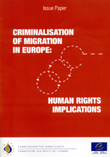
Hammarberg: Criminalising migration is the wrong answer to a complex social phenomenon

“‘Criminalising the irregular entry and presence of migrants in Europe corrodes established international law principles and causes many human tragedies without achieving its purpose of genuine control’ said Thomas Hammarberg, the Council of Europe Commissioner for Human Rights, presenting today in Brussels an Issue Paper on this topic.

‘I have observed with increasing concern this trend as part of a policy of migration management’ he said. ‘States have a legitimate interest to control their borders, but criminalisation is a disproportionate measure which causes further stigmatisation and marginalisation of migrants. Immigration offences should remain administrative in nature.’

This Issue Paper builds upon these concerns and examines systematically the human rights implications of the criminalisation of migration in Europe. It analyses the external border crossing, migrants’ residence and protection of their social rights including employment, as well as asylum and detention.

It concludes with a number of recommendations to Council of Europe member states, as a starting point to ensure the correct intersection of human rights standards and the treatment of foreign nationals.

Issue Papers are commissioned and published by the Commissioner for Human Rights for the purpose of contributing to debate or further reflection on a current and important human rights matter. The full text is available on the Commissioner’s web-site.”

Click here for Issue Paper.

Leave a comment

Filed under Council of Europe, Reports, Statements

ECtHR Communicates Case of ‘Hirsi et Autres c. Italie’ Relating to Italy’s Summary Migrant Interdiction Programme

On 17 November the Second Section of the European Court of Human Rights communicated the case of Hirsi and others v Italy, Requête no 27765/09.  The case was filed on 26 May 2009 by 11 Somalis and 13 Eritreans who were among the first group of about 200 migrants interdicted by Italian authorities and summarily returned to Libya under the terms of the Libya-Italy agreement which took effect on 4 February 2009.  The Applicants were intercepted on 6 May 2009 approximately 35 miles south of Lampedusa.

The Applicants allege violations of numerous provisions of the European Convention on Human Rights including:

Protocol 4 Art. 4 Prohibition of collective expulsion of aliens;

Art. 3 Torture;

Art. 1 (1) General undertaking/HPC;

Art. 13 Effective remedy/national authority; and

Art. 3 Inhuman or degrading treatment.

The Statement of facts, complaints and questions put by the Court to the parties is currently available only in French:

GRIEFS

Invoquant l’article 3 de la Convention, lu en conjonction avec l’article 1 de la Convention, les requérants se plaignent de ce que les modalités de leur renvoi en Libye, ainsi que leur séjour dans ce pays ou leur rapatriement dans leurs pays respectifs les soumettrait au risque de subir des tortures ou des traitements inhumains et dégradants.

Invoquant l’article 4 du Protocole no 4, lu en conjonction avec l’article 1 de la Convention, ils affirment avoir fait l’objet d’une expulsion collective atypique et dépourvue de toute base légale.

Invoquant l’article 13, les requérants dénoncent l’impossibilité de contester devant les autorités italiennes leur renvoi en Libye et le risque de rapatriement dans leurs pays d’origine.

QUESTIONS AUX PARTIES ET DEMANDES D’INFORMATIONS

QUESTIONS

1.  Les faits dont les requérants se plaignent en l’espèce relèvent-ils de la juridiction de l’Italie ?

2.  La décision des autorités italiennes d’intercepter en haute mer les embarcations et de renvoyer immédiatement les requérants, compte tenu notamment des informations provenant de sources internationales et concernant les conditions des migrants clandestins en Libye, a-t-elle exposé les requérants au risque d’être soumis à des traitements contraires à l’article 3 de la Convention dans ce pays ?

3.  Compte tenu des allégations des requérants (voir formulaire de requête annexé), y a-t-il des motifs sérieux de craindre que le rapatriement dans leurs pays d’origine, soit la Somalie et l’Érythrée, les exposerait à des traitements contraires à l’article 3 ?

4.  Le renvoi des requérants en Libye de la part des autorités italiennes s’analyse-t-il en une expulsion contraire à l’article 4 du Protocole no 4 ?

5.  Les intéressés ont-ils eu accès à un recours effectif devant une instance nationale garanti par l’article 13 de la Convention pour faire valoir leurs droits garantis par les articles 3 et 4 du Protocole no 4 ?

DEMANDES D’INFORMATIONS

Le gouvernement défendeur est également invité à fournir à la Cour toute information disponible concernant :

– Le nombre de migrants irréguliers arrivés mensuellement sur les côtes italiennes, et en particulier à Lampedusa, au cours des dernières années ;

– L’entité et l’origine du phénomène migratoire en Libye ; la législation en la matière en vigueur dans ce pays ; le traitement réservé par les autorités libyennes aux migrants irréguliers arrivés en Libye directement ou suite au renvoi depuis l’Italie.

Le Gouvernement est également invité à produire à la Cour les textes des accords signés par les gouvernement italien et le gouvernement libyen les 27 décembre 2007 et 4 février 2009.

Il est enfin invité à expliquer à la Cour le rapport existant entre les opérations prévues par les accords bilatéraux avec la Libye et l’activité de l’ « Agence européenne pour la gestion de la coopération opérationnelle aux frontières extérieures des États membres de l’Union européenne (Frontex) ».

Click here for “The Statement of facts, complaints and questions put by the Court.”

5 Comments

Filed under European Court of Human Rights, Italy, Judicial, Mediterranean

COE Commissioner for HR Releases Letters to Italy and Malta (Statements)

Council of Europe Commissioner for Human Rights, Thomas Hammarberg, released copies of two letters he sent last August to the Minister of Interior of Italy, Roberto Maroni, and to the Minister for Justice and Home Affairs, of Malta, Carmelo Mifsud Bonnici in regard to the incident in August when a boat carrying over 70 migrants was left adrift for over two weeks.  Most of the migrants died.

A statement on the Commissioner’s web page states as follows:

“I publish these letters in order to reopen the discussion on the need to fully align migration practices with human rights standards. This serious incident should be effectively investigated” said the Commissioner. “Four of the five survivors have been granted refugee status in Italy and one is waiting for the decision on her application. This is good news. However, there is still an urgent need to take all necessary measures to prevent the recurrence of such tragedies. Regrettably, the authorities have not replied so far.”

In his letters, the Commissioner also underlined that the responsibility to rescue persons at sea appeared to have been neglected. He therefore recommended that both countries concerned engage in a constructive cooperation to develop sea patrolling which is duly respectful of human rights and humanitarian principles.

“The protection of the human rights of migrants needs urgent attention” said the Commissioner. “Every European country should act in a spirit of solidarity towards other countries, discharge its responsibilities under international law and effectively protect migrants, whose fundamental rights are at serious risk.”

Relevant excerpts from the letters:

Letter to Italian Minister Maroni, Ministry of the Interior – 25 August 2009

“[O]ne element is already evident: these people have not benefited from international humanitarian protection. In particular, the responsibility to rescue persons at sea appears to have been neglected. The Italian Coast Guard and other agencies – as well as fishermen – have shown until recently a laudable record of rescuing at sea hundreds of irregular migrants attempting to reach Italy. What happened this time? Have the provisions set out in the new security package played a deterrent role? Is the cooperation with the Coast Guards of other countries not functioning properly, thereby preventing boats in distress from being spotted and rescued?”

“Indeed, many migrants are human beings in dire circumstances who deserve our attention and respect. A substantial number of them are fleeing persecution or violence; this necessitates the provision of international protection. All European countries, not only Italy, must grant protection to migrants and cooperate more effectively to handle migration flows in a coherent manner, with full regard to humanitarian principles.

I hope that the Italian government will take all necessary measures to avoid such tragedies in the future. In this context, a constructive cooperation with the authorities in Malta, to develop sea patrolling which is duly respectful of human rights and humanitarian principles, would be highly beneficial.”

“The survivors of such tragedies should of course not be criminalised. Instead, they should be provided with all the necessary assistance. Their right to apply for asylum should be fully respected, and their request examined with the utmost attention. The situation of their country of origin and of departure should also be taken into account.

I deeply believe that it is both wrong and counterproductive to politicise migration issues. It is much more in keeping with our common values – and, ultimately, more effective – to address them based on a comprehensive and cooperative approach, guided by human rights and humanitarian principles.”

Click here for the Italian letter.

Letter to Maltese Minister Bonnici, Justice and Home Affairs Ministry – 26 August 2009

“[T]he people on the ill-fated boat have not benefited from international

humanitarian protection. In particular, the responsibility to rescue persons at sea appears to have been neglected. What happened? Is the cooperation with the Coast Guards of other countries not functioning properly, thereby preventing boats in distress from being spotted and rescued?”

“Migratory flows present major challenges to many European countries. A common European approach is therefore needed to meet those challenges. I have raised the issue with the Swedish Presidency of the European Union. There is a need for responsibility-sharing, where every country is ready to contribute in a spirit of solidarity, not only with regard to the reception capacities of other countries, but also vis-à-vis migrants themselves. Many migrants are human beings in dire circumstances who deserve our attention and respect. A substantial number of them are fleeing persecution or violence and deserve international protection.”

“I hope that the Maltese government will take all necessary measures for such tragedies to be avoided in the future. A constructive cooperation with the authorities in Italy, to develop sea patrolling which is duly respectful of human rights and humanitarian principles, would be highly beneficial. I hope it will be possible to address these crucial issues with a cooperative approach, guided by human rights norms.”

Click here for the Maltese letter.

Leave a comment

Filed under Council of Europe, Italy, Libya, Malta, Mediterranean, Statements