Category Archives: EU and EU Organizations

Italy Considers Offering €1500 to Tunisian Migrants Who Agree to Leave

The Italian government has tentatively considered the possibility of offering €1500 to any Tunisian who agrees to return to Tunisia.  Foreign Minister Frattini said that Italy could pay the funds to those migrants willing to leave and that the funds would then be reimbursed to Italy by the EU Commission.  The IOM would likely be asked to administer the program.  The proposal was immediately and strongly criticised by Umberto Bossi the head of the Northern League and a fellow minister in the Berlusconi Government.  Bossi called for the migrants to be returned to Tunisia.  A statement posted later in the day on the Foreign Ministry web site said that the proposal would “be activated only in the presence of a full financing on the part of the European Union.”

The situation on Lampedusa continues to deteriorate.  There were approximately 1000 new migrant arrivals yesterday.  The migrant population on the island is approximately 5000 with 2500 people sleeping rough in makeshift tents made of plastic sheeting.

Click here and here for articles.  (IT)

Click here for brief statement from Ministry of Foreign Affairs.

Leave a comment

Filed under European Union, Italy, Mediterranean, News, Tunisia

Frontex Announces Expansion of Joint Operation Poseidon Sea to Include Crete and Eastern Portions of Central Mediterranean

Two days after announcing the extension of Joint Operation Hermes and the westward expansion of the operational area of JO Hermes to include the waters around Sardinia, Frontex on 26 March announced the expansion of the operational area of Joint Operation Poseidon Sea to include the waters around Crete.  The expansion is due to the “highly volatile situation in North Africa” and was called for by the European Council’s Conclusions issued at the end of the Council meeting of 24/25 March: “the Commission will make additional resources available in support to [Frontex’s] 2011 Hermes and Poseidon operations and Member States are invited to provide further human and technical resources.”

Excerpts from the Frontex statement:  “March 26, 2011 — Responding to the highly volatile situation in North Africa Frontex extends operational area of its on-going Joint Operation (JO) Poseidon Sea. In the first four weeks of deployment Joint Operation Poseidon Land sees decreasing numbers of arrivals across the land border with Turkey.   In view of potential migratory flows from Libya operational area of JO Poseidon Sea, which covers the Greek islands in the Aegean sea, has been widened to include Crete. On Thursday, 24 February Romanian maritime surveillance vessel and a Portuguese plane were deployed to increase patrolling intensity in this region. [***]”

Click here for Frontex Poseidon Sea press release.

Click here for the Frontex Hermes press release.

Click here for the Council Conclusions.

Click here for previous post on the expansion of JO Hermes.

Leave a comment

Filed under Aegean Sea, European Union, Frontex, Greece, Italy, Libya, Mediterranean, News, Tunisia

European Council Meeting Conclusions re Migrant and Refugee Flows from North Africa

While most of the European Council meeting of 24/25 March was devoted to economic policy and the Euro Zone crisis, the Council also considered the situation in Libya and the “Southern Neighborhood.”  The Council’s Conclusions noted that the Commission would be presenting “a Plan for the development of capacities to manage migration and refugee flows in advance of the June European Council.”  The Council conclusions also stated that “Agreement should be reached by June 2011 on the regulation enhancing the capabilities of Frontex. In the meantime the Commission will make additional resources available in support to the agency’s 2011 Hermes and Poseidon operations….”

Excerpts from the Council 24/25 March 2011 Conclusions:

“II. LIBYA / SOUTHERN NEIGHBOURHOOD

18. The European Council discussed the situation in Libya and endorsed the conclusions adopted by the Foreign Affairs Council on 21 March. Recalling its March 11 Declaration, the European Council expressed its satisfaction after the adoption of UN Security Council Resolution 1973, which expresses the principle of the responsibility to protect, and underlined its determination to contribute to its implementation. It also welcomed the Paris Summit of 19 March as a decisive contribution to its implementation…. [***]

21. The humanitarian situation in Libya and on its borders remains a source of serious concern. The EU will continue to provide humanitarian assistance to all those affected, in close cooperation with all the humanitarian agencies and NGOs involved. The EU has stepped up and will continue its planning on support for humanitarian assistance / civil protection operations, including by maritime means.  [***]

25. The European Council welcomes the recent visit of Presidency and the Commission to Egypt as part of a first phase of consultations to promote a comprehensive approach to migration as between the countries of the Southern Neighbourhood region and the European Union. In this context the European Council invites the Commission to present its proposals on the Global Approach to Migration as well as on the Mobility Partnership well in advance of the June European Council.

26. The European Council also looks forward to the presentation by the Commission of a Plan for the development of capacities to manage migration and refugee flows in advance of the June European Council. Agreement should be reached by June 2011 on the regulation enhancing the capabilities of Frontex. In the meantime the Commission will make additional resources available in support to the agency’s 2011 Hermes and Poseidon operations and Member States are invited to provide further human and technical resources. The EU and its Member States stand ready to demonstrate their concrete solidarity to Member States most directly concerned by migratory movements and provide the necessary support as the situation evolves.  [***]”

Click here for full document.

Leave a comment

Filed under Egypt, European Union, Frontex, Libya, Mediterranean, News, Statements, Tunisia

Frontex Announces Extension and Expansion of Joint Operation Hermes in Central Mediterranean

On 23 March Frontex announced a 5 month extension of its Joint Operation Hermes.  Frontex also announced a westward expansion of the operational area to include Sardinia, roughly 300 km northwest of Lampedusa.  According to Frontex Director Laitinen, “100 percent [of] the request the Italian authorities [have] made to Frontex” has been satisfied.

Frontex statement in full:

“Warsaw, 23 March 2011 — Due to the notable increase in migratory pressure on Italy and the island of Lampedusa in particular, Frontex has widened the operational area of Joint Operation Hermes and extended its duration for five more months, with the aim of strengthening Europe’s border control response capability in the Central Mediterranean.

‘In close cooperation with the Italian authorities, we have decided to run Joint Operation Hermes until the end of August 2011, and to extend the operational area to include Sardinia, where Frontex has already deployed aerial assets to strengthen the patrolling capacity of the Italian authorities,’ said Frontex Executive Director Ilkka Laitinen.

‘Frontex is closely monitoring the developments in North Africa and stands ready to assist the Member States operationally if requested. We are also continuously developing additional operational responses for potential rapid deployment throughout the Mediterranean if needed,’ he added.

As of 23 March 2011, Lampedusa remained the main destination for migrants from Tunisia. During the previous week alone, 3,230 undocumented persons arrived on the island, bringing the total number of arrivals detected in the whole operational area since Hermes began on 20 February to 9,098. The majority of migrants are young men but 52 women and more than 240 minors were also detected during Italian-led Hermes. At the time of writing the great majority of migrants who recently arrived in Lampedusa claimed to be of Tunisian nationality.

In addition to one aircraft and two vessels already financed and coordinated by Frontex, one Dutch and one Portuguese plane have now arrived in Pantelleria and Sardinia respectively to assist the Italian authorities in strengthening their border control activities.

‘With this equipment and 20 experts currently working in the centres of Bari, Caltanisetta and Crotone, we have satisfied 100 percent the request the Italian authorities made to Frontex,’ Laitinen concluded.

The cost of the first 40 days of the operation amounts to EUR 2.6 mln.”

Click here for statement.

2 Comments

Filed under European Union, Frontex, Italy, Libya, Mediterranean, News, Tunisia

Italian Navy Transports 600 Migrants from Lampedusa to Sicily

In an effort to relieve the severe overcrowding on Lampedusa, the San Marco, an Italian naval ship yesterday transported about 600 Tunisians from Lampedusa to Sicily.  The ship’s departure was delayed by several hours because the ship’s captain had apparently not been given instructions where to take the migrants.  The ship was eventually directed to sail to the port of Augusta on Sicily.  It is unclear whether the ship will return to Lampedusa to pick up more migrants.

There has been confusion over the identity of the 600 migrants who were selected to be moved to Sicily.  Initial statements by Italian officials said that the migrants who were to be moved had been identified as asylum seekers or were women and children.  But later reports indicted that there were fewer than 20 women and children among the 600 and that none of the 600 have been identified as asylum seekers.   UNHCR said that no formal refugee processing is being conducted on Lampedusa in part due to the chaos and severe overcrowding on the island and also due to the fact that only a few migrants have reportedly expressed a desire to seek asylum.

Approximately 650 other migrants were transported off the island yesterday by planes and yesterday marked the first day in many days where there was a net decrease in the migrant population on Lampedusa.  1200 migrants left the island and about 300 new migrants in seven boats arrived on the island yesterday.

Foreign Minister Frattini and Interior Minister Maroni are now scheduled to travel to Tunis on Friday, 25 March, to discuss a new migration agreement with Tunisia.

Click here (IT), here (IT), here (IT), and here (EN) for articles.

Leave a comment

Filed under European Union, Frontex, Italy, Mediterranean, News, Tunisia, UNHCR

Save the Children: Conditions for 250 Unaccompanied Migrant Children on Lampedusa Unacceptable

Save the Children released a press statement yesterday describing the conditions for more than 250 unaccompanied migrant children on Lampedusa and calling for their immediate transfer from the island.  Excerpts:

“’The structure that has been allocated [to the children on Lampedusa] is totally inadequate and the conditions on an hourly basis are becoming more critical from the point of view of hygiene and [other conditions]’ said Raffaella Milano, Italy-Programs Manager, Save the Children Europe.  Since the beginning of the increased arrivals of migrants from Tunisia – since February 10 – more than 530 children, the vast majority of them unaccompanied, have arrived in Lampedusa.  Of these, 283 have been placed in communities to accommodate the children in Sicily.  ‘More than 250 unaccompanied minors are still remaining in Lampedusa and many have been living many days in conditions that do not guarantee minimum standards of reception.’ …  Save the Children calls for the transfer of the children and setting up temporary structures … if necessary, where the children may stay until being placed within the community. … This delay is not justifiable.”

For more information:
Press Office Save the Children Italy,
Tel. 06.48070023-71-001;
press@savethechildren.it
http://www.savethechildren.it

Click here for link to statement.

Also click here for 22 March UNHCR urgent call for action by the Italian authorities to alleviate overcrowding on Lampedusa.

Leave a comment

Filed under European Union, General, Italy, Mediterranean, News, Statements, Tunisia, UNHCR

EMHRN Statement: Italy and EU should suspend all measures of forcible removal towards Tunisia

Press release in its entirety from the Euro-Mediterranean Human Rights Network:

“Brussels, 23 March 2011.  Italy and the other Member States of the EU should suspend all measures of forcible removal towards Tunisia and share in the reinstallation of Libyan and non-Libyan refugees who have to flee Libya

Italian ministers Frattini and Maroni have announced their intention to travel to Tunisia to renew bilateral cooperation on migration issues. In the view of the Euro-Mediterranean Network, in the present circumstances, the ministers’ insistence that the Tunisian authorities must prevent new departures from Tunisia and cooperate in the forcible removal of the Tunisian migrants who have landed in Italy since the beginning of the year, is particularly inappropriate.

The upheavals that are shaking the region at the moment have exposed the short-sightedness and futility of a policy that favours dictators instead of migrants.

Expecting from the Tunisian authorities, first and foremost, a crack down on immigration from third countries and emigration towards the European Union amounts to encouraging them in returning to the authoritarian practices of the former regime. This is not the kind of support Tunisia needs.

In this transition period, Italy and the other member states of the European Union should, on the contrary, suspend all measures imposing the forcible removal of Tunisian nationals towards Tunisia and share in the resettlement of Libyan and non-Libyan refugees who have had to flee Libya, arrived in Tunisia and cannot return to their home country.

While the number of Tunisian migrants who have landed on Lampedusa Island is significant relative to the size and population of the island, it is minuscule, on the European scale, when compared to the scope of the humanitarian emergency confronting Tunisia on its border with Libya. No fewer than 165,000 people have crossed the border at Ras Adjir in an attempt to flee the violence in Libya since 20 February, but no Tunisian official has made inflammatory statements comparing migrants and asylum seekers with criminals or terrorists. Tunisia is forced to cope with the arrival of tens of thousands of Tunisian workers, some of whom had been living in Libya for many years, as well as tens of thousands of immigrant workers, mainly from Bangladesh and sub-Saharan countries, who are awaiting repatriation to their countries of origin with assistance from UNHCR and OIM, not to mention Libyans and nationals of countries such as Somalia, Eritrea or Sudan, who for obvious reasons cannot return to their countries of origin, where their lives and physical integrity would be at risk.”

Click here for link.

Leave a comment

Filed under European Union, Italy, Libya, Mediterranean, News, Statements, Tunisia

IOM: New Migrant Arrivals on Lampedusa Lead to Massive Overcrowding

Full text:  “IOM Press Note – Monday 21 March 2011 – New Migrant Arrivals on Lampedusa Lead to Massive Overcrowding —  The arrival of more than 1,630 irregular migrants on the Italian island of Lampedusa on Sunday 20 March and overnight Monday 21st has led to massive overcrowding at the migrant reception centre where IOM and partners monitor reception assistance and provide legal counselling to migrants, asylum-seekers and unaccompanied minors.

With the weekend’s arrival of Tunisian migrants bringing the current number of migrants on Lampedusa to nearly 4,780 and the reception centre built to host 800 people, migrants are being hosted wherever possible around the island.

This includes about 2,000 migrants at the port area which doesn’t have the sanitation facilities needed to host such numbers of people and who for the past few days have been sleeping in the open without adequate protection from the elements and in whatever space they can find.

Among the nearly 4,780 migrants on Lampedusa are about 200 minors. IOM and UNHCR worked with partner Save the Children to find suitable accommodation for all the minors who have arrived in recent days and who could not be left to sleep at the pier with no blankets or mattresses.

IOM also found safe accommodation for 13 women away from the overcrowded reception centre.

With boat landings taking place during the day and night, IOM and partners are working in shifts to ensure assistance is provided 24 hours a day.

Staff report that the situation on the island, which has a population of 5,000, is critical and tense and that rapid transfers to other migrant reception centres elsewhere in Italy are essential.

Since February, around 14,000 Tunisian migrants have arrived on Lampedusa. With migrant reception centres in Puglia in southern Italy and on Sicily also fairly full, Italian authorities have established a centre at an ex-NATO base residence at Mineo on Sicily.

From today, 21 March, IOM staff will be present at Mineo where, as part of an Italian government funded project, the Organization will provide legal counselling to migrants and monitor reception assistance.

The vast majority of the migrants who have arrived on Lampedusa are young men who have left Tunisia either to find employment in Europe or to be united with families. For further information, please contact Flavio di Giacomo, IOM Rome, email: fdigiacomo@iom.int – Tel: +39.06.44.186.207 or +39.347.089.89.96

For additional information:

Jemini Pandya Tel : 41 22 717 9486 – Mobile : 41 79 217 33 74, Email : jpandya@iom.int

Jumbe Omari Jumbe Tel: 41 22 717 9405 – Mobile: 41 79 812 77 34, Email: jjumbe@iom.int

ISDN Line : 41 22 788 38 61″

I don’t have a link to this press briefing other than the following google docs link here. First posted on Euromed-MigrAsyl.

Leave a comment

Filed under European Union, Italy, Mediterranean, News, Statements, Tunisia

Italy Has Not Requested Frontex Assistance with Transfer of Migrants from Lampedusa

According to the EUobserver, “[a] spokeswoman for … Frontex, … told this website that the Italian authorities have not yet asked for help in transferring the migrants from Lampedusa to Sicily, for instance by extending the existing ‘Hermes’ operation set up in February to assist them with the Tunisian situation.”  No Frontex “debriefing experts sent by member states [are] based in Lampedusa.”  “Romain Prevot, a French border official now based in Trapani, northern Sicily, told EUobserver that ‘initially we were supposed to be in Lampedusa,” but then “for security reasons,’ the Italian government decided to deploy them to Sicily and the mainland.”

Click here for full article.

Leave a comment

Filed under European Union, Frontex, Italy, Mediterranean, News, Tunisia

100+ Libyans Reach Sicily by Boat

Speaking at a press conference earlier today, Italian Interior Minister Roberto Maroni reported that 117 migrants who are believed to be Libyan reached Catania, Sicily in two boats during the night of 20-21 March.  According to Maroni, a total of 14,918 immigrants have landed in Italy since the beginning of the year.  [UPDATED INFORMATION – more recent reports suggest that the many or all of the migrants involved may be Egyptian nationals who posed as Libyans, possibly for purposes of seeking refugee protection. Click here (IT) for more recent article.]

Click here, here, and here for articles. (EN)

Leave a comment

Filed under Data / Stats, Frontex, Italy, Libya, Mediterranean, News

Hundreds of Tunisians Continue to Arrive in Lampedusa; Italian Navy Ship to Transport Migrants from Island to Relieve Overcrowding; Local Residents Block Migrant Landings

Hundreds of Tunisians continue to reach Lampedusa.  Conditions at the main migrant reception centre on the island are extremely bad due to massive overcrowding and hundreds of migrants are sleeping in the open under tarps.  The centre is currently holding about 3000 persons whereas its capacity is supposed to be limited to 800 persons.  An Italian navy ship was scheduled to arrive on the island late on the 19th or on the 20th of March and it is anticipated that the ship will transport at least 1000 migrants to other locations in Italy.

Some local residents protested the continuing arrival of migrant boats by preventing for several hours coast guard and Guardia di Fiananza boats carrying rescued migrants from docking and disembarking the migrants in port.

Click here (IT), here, (IT), here (IT), and here (EN) for articles.

Leave a comment

Filed under European Union, Frontex, Italy, Mediterranean, News, Tunisia

EP Foreign Affairs Committee Calls for Reinstatement of EU-Libya Migration Agreement Once New Libyan Govt in Power

While the likelihood of there being a new transitional government in Libya appears less and less likely every day, the European Parliament’s Foreign Affairs Committee yesterday, 16 March, called for the reinstatement of the EU-Libya cooperation agreement on migration, signed in Tripoli on 4 October 2010 by Commissioner Cecilia Malmström, as soon as a new transition government able to respect human rights is in place in Libya.

From the EP Press Release: “MEPs believe that the EU-Libya cooperation agreement on migration – currently suspended – should be reinstated as soon as a new transition government able to respect human rights is in place.  This move … [was] highlighted on Wednesday in a draft resolution by the Foreign Affairs Committee as the best way[] to tackle illegal immigration from conflict regions.   Regretting that ‘the only option available’ was the suspension of the EU-Libya Cooperation Agenda on migration, MEPs stress that the suspension ‘should be revoked as soon as there is a new transitional government willing to promote a democratic and human rights based implementation of the agreement’. Similar migration agreements should be reached with other EU neighbouring countries, said MEPs in the draft resolution, which was adopted by 53 votes to 1, with 3 abstentions.”

The Committee also called for a burden sharing plan “to help resettle refugees from the region and provide support for displaced persons.  This would require activation of Article 80 of the EU Treaty on the Functioning of the European Union (TFEU), which cites the principle of solidarity and fair burden-sharing among all Member States on policies to do with managing border checks, asylum and immigration, including their financial implications.”

Click here for EP Press Release.

Click here for article.

Click here for 18 Jan 2011 Draft Resolution (18.1.2011) and amendments considered (18.2.2011).

Leave a comment

Filed under European Union, Libya, Mediterranean, News

2000 Migrants Reach Lampedusa Over 24 Hour Period; Ship Carrying 1800 Remains in Int’l Waters in Need of Fuel

Approximately 2000 new migrants in more than 20 boats arrived in Lampedusa on 14-15 March.  Some were rescued and some reached Lampedusa on their own.  One boat is believed to have sunk near Tunisia and approximately 35 persons are believed to be missing.

According to a UNHCR briefing yesterday, just over 10,000 migrants, nearly all young Tunisian men, have arrived in Italy since mid-January.  UNHCR spokesperson Melissa Fleming said that “[t]he outflow from Tunisia is unrelated to the ongoing crisis in Libya. From our interactions with Tunisians arriving in Italy over past weeks, we believe that most are seeking employment and better economic opportunities, rather than international protection.   UN staff and partners in Tunisia report that some villages appear largely empty of their young male population, with only women, children and elderly people remaining. This type of outflow is not atypical of countries in transition, and we are well aware of the many demands on the Tunisian authorities at present. Solutions to this type of flow need to be found in dialogue between the concerned governments, including arrangements for the orderly and dignified return of persons who are found not to be in need of international protection, and the establishment of opportunities for labor migration which can meet the needs of countries on both sides of the Mediterranean.”

The standoff with the Moroccan ferry, the Mistral Express, continues.  The ship left Libya several days ago and is located in international waters about 20 miles from the port of Augusta, Sicily.  Italian authorities have refused to permit the ship to enter Italian waters and are considering providing fuel to the ship while it remains at sea in order to prevent any of the 1800+ mostly Moroccan passengers from attempting to leave the ship and enter Italy.

Click here for UNHCR press briefing.

Click here, here, here, here, and here for articles.  (IT)

Leave a comment

Filed under European Union, Frontex, Italy, Libya, Mediterranean, Morocco, News, Tunisia, UNHCR

Prof. Goodwin-Gill: ‘The Right to Seek Asylum: Interception at Sea and the Principle of Non-Refoulement’

On 16 February Professor Guy S. Goodwin-Gill presented the inaugural lecture of the Fondation Philippe Wiener – Maurice Anspach, Chaire W. J. Ganshof van der Meersch.  The lecture was entitled ‘The Right to Seek Asylum: Interception at Sea and the Principle of Non-Refoulement’.  The complete text of the lecture is available at this link: Goodwin-Gill: The Right to Seek Asylum-Interception at Sea and the Principle of Non-Refoulement.  The complete text also contains a helpful reference list.

I have reproduced several excerpts below:

“Looking at the interception and return measures adopted in the Mediterranean and off the west coast of Africa … one may rightly wonder what has happened to the values and principles considered fundamental to the Member States of the European Union….  [***]

… [I]t is all the more surprising when [European] governments, ministers and officials either pretend that the rules [- including Article 78(1) of the TFEU which requires the Union to develop a common asylum policy with regard to ‘any third country national requiring international protection and ensuring compliance with the principle of non-refoulement’ – policy which ‘must be in accordance with the Geneva Convention… and other relevant treaties’-] do not apply, or seek ways to avoid their being triggered.

In my view, the problems begin at the beginning, just as they commonly do also at the national level. A policy or goal is identified – in this case, reducing the number of irregular migrants, including asylum seekers, leaving the north African coast and heading for Europe – and then belatedly some attempt is made to bend implementation of the policy to fit in with principle and rule. A better approach, in my view, would be to begin with a clear understanding of the applicable law – the prohibition of discrimination, of refoulement, of inhuman or degrading treatment – and then to see what can be done by working within the rules.

Of course, this approach is premised on the assumption that States generally seek to work within the rule of law. It will not likely influence the State determined to deal with the migrant and the asylum seeker arbitrarily, and without reference to principle. Such cases must be confronted head-on, by way of judicial and political mechanisms of control.  [***]

… The problem, though, lies not in formal recognition of protection principles but, as ever, in operationalising the rules – in making protection a reality at the point of enforcement. On the plus side stands a substantial body of legislation: the Frontex regulation itself; the RABIT amendment, with its express insistence on compliance with fundamental rights and conformity with Member States’ protection and non-refoulement obligations; and the Schengen Borders Code, Article 3 of which requires the Code to be applied, ‘without prejudice to the rights of refugees… in particular as regards non-refoulement’. Add to this the April 2010 Council Decision supplementing the Code and dealing specifically with the surveillance of maritime borders and Frontex operations; it is currently being challenged by the Parliament on vires grounds, and it was also objected to by Malta and Italy, mainly for its proposal that in the last resort, rescue cases should be disembarked in the State hosting the Frontex operation. The Decision’s formulation of the applicable law in the matter of protection, however, is unremarkable, restating the principle of non-refoulement and the need to avoid indirect breach, but also providing for those intercepted to have an opportunity to set out reasons why they might be at risk of such a violation of their rights….  [***]

What do we know about either unilateral or Frontex-led interception operations so far? Not as much as we might expect as citizens of a democratic Union bounded by the rule of law and basic principles of good governance, such as transparency and accountability….  [***]

Exactly what Frontex does in an interception context has been questioned. Human Rights Watch has claimed that Frontex has been involved in facilitating interception, though this has been denied. Amnesty International and ECRE note that Frontex has stated that it does not know whether any asylum applications were submitted during interception operations, as it does not collect the data. How, then, should we approach what appears to be wilful ignorance? In the Roma Rights Case in 2004, discrimination on racial grounds was alleged in the conduct of immigration procedures by British officials at Prague Airport, which were intended to prevent potential asylum seekers leaving for the United Kingdom. There, too, the authorities did not keep any records of the ethnic origin of those they interviewed. Finding on the evidence that the government had acted in violation of relevant legislation, the House of Lords called attention to the importance of gathering information, ‘which might have helped ensure that this high-risk operation was not being conducted in a discriminatory manner…’

Given the secrecy attaching to interception operations, and the fact that no data are gathered or retained, it is reasonable to infer that some level of Frontex involvement has occurred, and that, absent evidence to the contrary, the relevant principles of international and EU law have not been observed.  [***]

… The object and purpose of EU operations in maritime areas, therefore, should be first and foremost to ensure protection, and secondarily to manage and prevent irregular migration….

In the absence of effective and verifiable procedures and protection in countries of proposed return, the responsibility to ensure protection remains that of the EU agency or Member State. In practice, this will require that they identify all those intercepted, and keep records regarding nationality, age, personal circumstances and reasons for passage. Given protection as the object and purpose of interception operations, an effective opportunity must be given for objections and fears to be expressed; these must then be subject to rational consideration, leading to the formulation of written reasons in explanation of the next steps. Where this entails return to or disembarkation in a non-EU State, a form of judicial control is required as a necessary safeguard against ill-treatment and the abuse of power – exactly what form of judicial control calls for an exercise of juristic imagination. In the nature of things, such oversight should be prompt, automatic, impartial and independent, extending ideally to the monitoring of interception operations overall….”

Click here or on the following link for complete text: Guy S. Goodwin-Gill, ‘The Right to Seek Asylum: Interception at Sea and the Principle of Non-Refoulement’

I thank Prof. Goodwin-Gill for permitting me to post the text of his lecture.
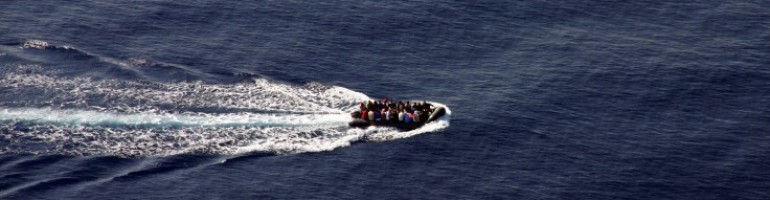


1 Comment

Filed under Aegean Sea, Analysis, Eastern Atlantic, European Union, Frontex, Mediterranean, UNHCR

Le Pen in Lampedusa: Migrants Should Be Stopped At Sea

Marine Le Pen, the head of France’s Front National, visited Lampedusa yesterday.  She was critical of the EU’s efforts to stop illegal migration and called for the use of bi-lateral agreements between Italy, France, and Spain and North African states to prevent migration.  She also suggested that migrants should be prevented from reaching European territory by being intercepted at sea, though in such cases humanitarian assistance in the form of food and water should be provided to the migrants at sea rather than on Lampedusa as is now the case.

Click here (IT), here (EN), here (EN) and here (IT) for articles.

Leave a comment

Filed under European Union, France, Italy, Libya, Mediterranean, News, Tunisia