Category Archives: Reports

New Statewatch Report: NeoConOpticon- The EU Security-Industrial Complex

Statewatch and the Transnational Institute have published a comprehensive new report.

The report, “NeoConOpticon, The EU Security-Industrial Complex”, is a “follow-up [to Arming Big Brother, 2006] [and] contains new research showing how the European Security Research Programme [ESRP] continues to be shaped by prominent transnational defence and security corporations and other vested interests. Though technically a Research and Development (R&D) programme, the ESRP is heavily focused on the application of security technologies (rather than objective research per se), and is increasingly aligned with EU policy in the fields of justice and home affairs (JHA, the ‘third pillar’), security and external defence (CFSP, the ‘second pillar’).”

The Report includes a discussion of maritime immigration enforcement.  Excerpt:

“Having fortified many of the traditional entry points to Europe, the focus of the ‘war on migration’ has shifted to the islands of the Mediterranean and the coastlines of Africa and the Middle East. For FRONTEX, the newly created EU border management agency, this ‘southern maritime frontier’ is the ‘first line of defence’ of ‘Europe’s borders’. Since 2003 FRONTEX has coordinated a host of joint police and naval missions to combat ‘illegal’ immigration by sea and is now in the process of setting up a permanent European Patrols Network for the Mediterranean and a corps of Rapid Border Intervention Teams (RABITs) for deployment to ‘illegal immigration hotspots’.

This militarised approach to immigration control is part of a broader EU maritime security and defence strategy. In 2005, following the lead of the USA’s ‘SeaPower21’ strategy, the Chiefs of European Navies (CHENS) launched a 20-year ‘Vision for the Future Role of European Maritime Forces’ to meet the demands of the European Security Strategy (2003) and enhanced NATO Maritime Joint Operations. The rationale behind the CHENS strategy is that the sea: ‘has already been used for terror attacks by boats armed with rockets and small arms’ and ‘for logistic support to terrorism’. The sea is also a potential conduit for CBRN material and “criminal activity including narcotics, human trafficking and piracy’, all of which is ‘increasing in sophistication and volume.’ …”

Click here for Executive Summary.

Click here for full report.

Leave a comment

Filed under Eastern Atlantic, European Union, Frontex, Mediterranean, Reports

Hammarberg: Criminalising migration is the wrong answer to a complex social phenomenon

“‘Criminalising the irregular entry and presence of migrants in Europe corrodes established international law principles and causes many human tragedies without achieving its purpose of genuine control’ said Thomas Hammarberg, the Council of Europe Commissioner for Human Rights, presenting today in Brussels an Issue Paper on this topic.

‘I have observed with increasing concern this trend as part of a policy of migration management’ he said. ‘States have a legitimate interest to control their borders, but criminalisation is a disproportionate measure which causes further stigmatisation and marginalisation of migrants. Immigration offences should remain administrative in nature.’

This Issue Paper builds upon these concerns and examines systematically the human rights implications of the criminalisation of migration in Europe. It analyses the external border crossing, migrants’ residence and protection of their social rights including employment, as well as asylum and detention.

It concludes with a number of recommendations to Council of Europe member states, as a starting point to ensure the correct intersection of human rights standards and the treatment of foreign nationals.

Issue Papers are commissioned and published by the Commissioner for Human Rights for the purpose of contributing to debate or further reflection on a current and important human rights matter. The full text is available on the Commissioner’s web-site.”

Click here for Issue Paper.

Leave a comment

Filed under Council of Europe, Reports, Statements

US to Haitians: Don’t Rush to the Boats

While there have been few, if any, Haitians attempting to leave Haiti since the 12 January earthquake, and while the US has deployed a significant naval force in Haitian waters for the purpose of providing humanitarian relief, the deployment of the US Coast Guard vessels serves the dual purpose of discouraging boat people.

The US Air Force is flying a C-130 plane along the Haitian coastline broadcasting AM radio messages to Haitians on the ground – among the pre-recorded Kreyol language broadcast is a message from the Haitian Ambassador to the US, Raymond Joseph:

“Listen, don’t rush on boats to leave the country.  If you do that, we’ll all have even worse problems. Because I’ll be honest with you: If you think you will reach the U.S. and all the doors will be wide open to you, that’s not at all the case.  And they will intercept you right on the water and send you back home where you came from.”

The US is also erecting tents and other facilities at the Guantanamo Naval Base in Cuba in preparation for the mass detention of thousands of Haitians should there be a sudden surge in departures from Haiti.

The research office of the US Congress has issued an updated report on Haitian migration warning of possible mass migration:

“There are growing concerns that the crisis conditions in Haiti may result in mass migration from the country. Not only has there been massive displacement of people caused by the earthquake, but observers of the situation warn of potential and widespread lawlessness as well as outbreaks of disease. These health, safety, and security factors—individually or in combination—could trigger an exodus of Haitians seeking refuge in nearby countries, including the United States. At least five federal agencies now handle Haitian migrants: DHS’s Coast Guard (interdiction); Customs and Border Protection (apprehensions and inspections); Immigration and Customs Enforcement (detention); U.S. Citizenship and Immigration Services (credible fear determination); and DOJ’s EOIR (asylum and removal hearings). DHS would take the lead in handling a potential mass migration and has long had a set of operational plans in place to respond to such a situation. In her TPS announcement, Secretary Napolitano warned of the consequences of Haitians fleeing to the United States.

At this moment of tragedy in Haiti it is tempting for people suffering in the aftermath of the earthquake to seek refuge elsewhere. But attempting to leave Haiti now will only bring more hardship to the Haitian people and nation…. It is important to note that TPS will apply only to those individuals who were in the United States as of January 12, 2010. Those who attempt to travel to the United States after January 12, 2010 will not be eligible for TPS and will be repatriated.

The balancing of DHS’s border security and immigration control responsibilities in the midst of a humanitarian disaster poses a unique challenge.”

Click here and here for articles.

Click here for US Congressional Research Service Report.

Leave a comment

Filed under Caribbean - West Indies, Haiti, News, Reports, United States

Human Rights Watch: Hostile Shores- Abuse and Refoulement of Asylum Seekers and Refugees in Yemen

Human Rights Watch has issued a new report detailing the treatment refugees arriving in Yemen from the Horn of Africa.

“This report documents the harsh treatment of refugees traveling to Yemen and calls on the Yemeni government to stop systematically arresting Ethiopian asylum seekers and forcibly returning them home. The 53-page report also calls on the United Nations High Commissioner for Refugees (UNHCR) to put more pressure on the Yemeni government to meet its obligations toward all asylum seekers and refugees.”

Click here for report.

Leave a comment

Filed under Gulf of Aden, Reports, UNHCR, Yemen

JRS Malta – “Do They Know? Asylum Seekers Testify to Life in Libya”

The Jesuit Refugee Service Malta released a report entitled “Do They Know? Asylum Seekers Testify to Life in Libya.”

“Since May 2009, some 1409 migrants, attempting to reach a place where they could obtain protection or the possibility to live in safety and dignity, were pushed back to Libya.  These actions were widely criticised and held by many to be a violation of international law, as Libya does not have the mechanisms in place to grant protection to those who need it and there is evidence that those returned would be at risk of harm.”

“JRS Malta believes that returning migrants to Libya, where they cannot obtain effective protection if they need it and where they face a real risk of serious harm, violates international law. We therefore call upon the government to:

• Ensure that all asylum seekers within Malta’s effective jurisdiction are allowed to apply for protection.

• Rescue migrants intercepted by the AFM if they have requested assistance, as otherwise their safety cannot be guaranteed

• Ensure that all those rescued within Malta’s Search and Rescue Area are disembarked at a safe port, where those in search of protection can seek asylum

• Refrain from actions that will result, directly or indirectly, in the return of migrants to a country where they risk suffering serious violations of their fundamental human rights.”

Click here for copy of JRS Malta statement.

Click here for the report “Do They Know? Asylum Seekers Testify to Life in Libya.”

Leave a comment

Filed under Italy, Libya, Malta, Mediterranean, Reports

HRW Report: Italy’s Forced Return of Boat Migrants and Asylum Seekers, Libya’s Mistreatment of Migrants and Asylum Seekers (Reports)

Blog - HRW Cover

Human Rights Watch has released a report regarding Italy’s forcible push-back policy:

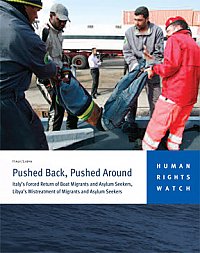
Pushed Back, Pushed Around – Italy’s Forced Return of Boat Migrants and Asylum Seekers, Libya’s Mistreatment of Migrants and Asylum Seekers

“On May 6, 2009, for the first time in the post-World War II era, a European state ordered its coast guard and naval vessels to interdict and forcibly return boat migrants on the high seas without doing any screening whatsoever to determine whether any passengers needed protection or were particularly vulnerable. The interdicting state was Italy; the receiving state was Libya.  Italian coast guard and finance guard patrol boats towed migrant boats from international waters without even a cursory screening to see whether some might be refugees or whether others might be sick or injured, pregnant women, unaccompanied children, or victims of trafficking or other forms of violence against women. The Italians disembarked the exhausted passengers on a dock in Tripoli where the Libyan authorities immediately apprehended and detained them.”

HRW’S Recommendations include:

“To the Government of Italy

  • Immediately cease interdicting and summarily returning boat migrants to Libya.
  • Investigate allegations that Italian naval personnel beat and used electric shocks to force interdicted boat migrants onto Libyan vessels and prosecute naval or coast guard officials who abused their authority, including those with command responsibility.
  • Stop cooperating with the Libyan authorities on the interdiction and interception of third-country nationals trying to leave Libya.
  • Make public all treaties and agreements between the governments of Italy and Libya.
  • Cease to fund or provide other bilateral support to Libya aimed at increasing that country’s effectiveness at intercepting asylum seekers and migrants before they take to the sea or before they reach Italian waters. Redirect such support into multilateral efforts, especially through UNHCR and OHCHR, to ensure that fundamental human rights standards relating to the treatment of such persons in Libya are observed.
  • Ensure access to full and fair asylum procedures, including the right to raise fear of treatment contrary to article 3 of the ECHR, for every person in the control of the Italian authorities, including those interdicted or rescued at sea.”

“To European Union Institutions and EU Member States

  • Demand that Italy not violate article 3 of the European Convention on Human Rights by its interdiction and summary return of migrants to a place where they are subjected to inhuman and degrading treatment.
  • Ensure access to full and fair asylum procedures, including the right to raise fear of treatment contrary to article 3 of the ECHR, for every person in the control of any EU member state, including those interdicted or rescued at sea.
  • Adopt clear, consistent, and binding rules on EU member states establishing responsibility for disembarking migrants rescued at sea.
  • Refrain from expelling third-country (non-Libyan) nationals to Libya, either directly or as partners in Frontex-coordinated operations, until Libya’s treatment of migrants, asylum seekers and refugees fully meets European standards in relation to persecution or risk of treatment contrary to article 3 ECHR. Under current conditions, the return of third-country nationals breaches European nonrefoulement obligations not to return people to inhuman or degrading treatment.
  • Encourage Libya to 1) ratify the 1951 Refugee Convention and its 1967 Protocol; 2) adopt a national asylum law; and 3) formally recognize UNHCR.
  • Display greater transparency in negotiations with Libya on all matters relating to migration and border controls.
  • Ensure  that the human rights clause in the Libya-EU Framework Agreement, being negotiated at the time of this writing, and in agreements flowing from it, contain explicit reference to the rights of asylum seekers and migrants as a prerequisite for any cooperation on migration-control schemes.
  • Refrain from encouraging Libya from establishing any reception regime which falls below the European reception condition standards
  • Quickly admit UNHCR-identified refugees in need of resettlement from Libya. Do so, however, only as a supplement rather than as a substitute for allowing spontaneous arrivals in EU territory to seek asylum.
  • Direct development assistance to improve respect for human rights and human dignity in migrants’ and asylum seekers’ countries of origin to address the root causes of forced migration.”

Click here for the report.

Leave a comment

Filed under European Union, Frontex, Italy, Libya, Mediterranean, Reports

MSF Report on its Mediterranean Activities (Reports)

Blog - MSF Report CoverDoctors Without Borders/Médecins Sans Frontières has issused a short report on its activities in Italy, Greece, Malta, and Morocco: “Migrants, Refugees and Asylum Seekers: Vulnerable People at Europe’s Doorstep”.

Click here for the link.

Leave a comment

Filed under Greece, Italy, Malta, Mediterranean, Morocco, Reports

IOM Report – Southward Migration from East Africa and the Horn Towards the RSA (Reports)

Blog - IOM report cover southward migrationWhile slightly off topic from this blog’s primary focus (northward migration from Africa towards Europe), IOM released a substantial study of the irregular migration of men from East Africa and the Horn of Africa towards the Republic of South Africa.

In Pursuit of the Southern Dream: Victims of Necessity: Assessment of the irregular movement of men from East Africa and the Horn to South Africa

Some excerpts follow:

“[T]his research illuminates, for the first time, the scope and nature of irregular migration and human smuggling of men from East Africa and the Horn towards South Africa.

“Of the countries relevant to this study, Ethiopia, Somalia, Tanzania and Zimbabwe have not signed the UN Protocol Against the Smuggling of Migrants by Land, Sea and Air, supplementing the United Nations Convention Against Transnational Organized Crime, also known as the Smuggling Protocol. Kenya, Malawi and Zambia acceded to, or ratified, the protocol in 2005, while Mozambique ratified it in 2006. RSA signed the protocol in December 2000 and ratified the same in 2004.5 However, there is a need to reflect the protocol in national legislation and implement this protocol for it to be effective.

“For some migrants, arrival in RSA is the start of a long-cherished dream; for many more, it is a step in a process that they hope will result in admittance to Europe or North America via similar means.

“This report also emphasizes that irregular migrants should no longer be perceived as perpetrators of criminal acts. Instead, they should be provided proper protection in line with international law, and the penal focus should be on those who smuggle and abuse migrants. The corruption and complicity associated with these irregular movements result in great profit to smugglers, and allegations of official corruption must be addressed more seriously.

“Marginalizing human rights – Soon after the creation of what are known as the UN Smuggling Protocol and the UN Trafficking Protocol (Palermo Protocol), the former trafficking adviser to the UN Office of the High Commissioner for Human Rights (UNHCHR) warned that there was a risk of human rights being marginalized. The reasoning was that these protocols (which are supplements to the UN Convention Against Transnational Organized Crime and the second attempts to address trafficking in persons) were not developed as human rights tools, but in response to a growing international concern to curb trafficking and smuggling crimes. This concern, not surprisingly, was felt most urgently by destination countries, where a “growing intolerance of all forms of irregular migration” was increasing, making it progressively more difficult to give priority to individuals and their rights in the debate.

“The alternatives to direct air travel are: a combination of limited air travel with additional road travel, a combination of boat and road travel, or the most common choice, which is overland travel the entire way. In many cases, migrants must walk certain stretches of the smuggled journey – in some cases for many days at a time.  The impression gained during the study was of a scenario in which the smugglers were continually assessing the success and viability of these four modes of travel (air, boat, vehicle and foot). Because of the flexibility of the network, the mode of transport and the routes used can be altered on short notice, depending on circumstances.

“The role of sea travel  Travel to RSA by sea is relatively common for the Somali and Ethiopian irregular migrant. It is unknown for Kenyans and slightly more common for a limited number of Tanzanians who have been known to stow themselves away on ships between Dar es Salaam and RSA’s eastern ports (Durban, East London and Port Elizabeth).

“A significant number of the 293 irregular migrants whose data was captured through in-depth interviews for this study did travel by boat. An average of 33 per cent of all Somali and Ethiopian respondents described a sea voyage as part of their journey to RSA. In many cases, the voyage passed without incident and lasted a few days, but the vessels were overloaded and, being primitive trading dhows, had neither rescue equipment nor any facility to protect passengers from sun or storm. The respondents also mentioned that they usually were given neither food nor water throughout the trip.

“The respondents in this study travelled by boat along the following routes:

• From Mogadishu (Somalia) to Mombasa (Kenya)

• From Kismayo (Somalia) to Mombasa (Kenya)

• From Mombasa (Kenya) to Pemba or Mocimboa (Mozambique)

• From Mombasa (Kenya) to Dar es Salaam (Tanzania)

• From Mombasa (Kenya) to Tanga or Mtwara (Tanzania)

• From Shimoni and Funzi Island (Kenya) to Tanga, Bagamoyo or Pangani (all in Tanzania)

“Blaming neighbours – Many of the countries involved in this study are troubled by the number of irregular migrants passing through their territory. They see this trespassing as a threat to their state security and an infringement of their immigration laws and border controls. In their frustration with a problem that appears intractable and growing, it was common during the course of the study to hear government officials criticize the inadequate policies of neighbouring countries: “Compared to ten years ago, the increase of Somalis and Ethiopians is visible and significant. South Africa complains that Mozambique is too liberal, but the problem is Tanzania and Kenya, who are far too lax,” stated one refugee official in Maputo, Mozambique. The same criticism was heard in Malawi, Tanzania and Kenya, where officials blamed other transit countries or origin countries for their own problems with irregular migrants.

“While further legislative review of the relevant laws and policies regarding smuggling in all relevant countries is required, it can already be said that the status offered to irregular migrants by different countries (whether they can apply for asylum or refugee status, etc.) and the level of criminalization of irregular migrants and of leniency towards smugglers contribute to a regional environment of disharmony. It is a disharmony that appears to work towards the direct benefit of the smuggling networks that exploit it and is currently expanding their trade. It is a disharmony that appears to call out for regional review and re-appraisal if a solution to controlling migrant flows and border management is to be found.”

Click here for more information about the report.

Click here for the full report.
Leave a comment

Filed under East Africa - Western Indian Ocean, Reports

Forum Réfugiés: 9e rapport annuel sur l’asile en France et en Europe (Reports)

Conference-de-presse-a-Lyon_medium“A l’occasion de la Journée mondiale du réfugié, Forum réfugiés publie son 9e rapport annuel sur l’asile en France et en Europe. Seul document en France à faire un état des lieux précis du dossier de l’asile et des réfugiés, ce rapport reprend tous les indicateurs et statistiques indispensables à un débat objectif sur les migrations forcées.
 “Dans ce document, Forum réfugiés fait le bilan du droit d’asile en France, chez nos voisins européens et dans le monde, de janvier 2008 à mai 2009. A travers des chronologies, cartes et tableaux statistiques, ce rapport remet un an d’actualité en perspectives et pose des balises indispensables à la compréhension des débats actuels et des enjeux à venir.”

The full text of the 2009 report does not seem to be posted on the web site.

 Click here for more information and for le Dossier de presse Lyon.

Leave a comment

Filed under France, Reports

US Committee for Refugees and Immigrants 2009 World Refugee Survey (Reports)

APTOPIX Indonesia Migrants

‘[In 2008] Out of about 67,000 people crossing to Europe by sea, some 35,000 arrived in Italy and 2,800 in Malta, mostly via Libya.  About three-quarters of those arriving in Italy applied for asylum and Italy granted around half of them refugee status or protection on other humanitarian grounds.  Nearly all who arrived irregularly by sea in Malta applied for asylum and Malta found some 60 percent to be in need of international protection.’

Click here for link to full Report.

Leave a comment

Filed under General, Reports

AI Fact-Finding Visit to Libya, including Misratah [migrant] Detention Centre (Reports)

Blog - AI logoDocument – Libya: Amnesty International completes first fact-finding visit in over five years

AMNESTY INTERNATIONAL

PUBLIC STATEMENT

AI Index: MDE 19/003/2009

29 May 2009

“[***]  Amnesty International was also able to undertake a brief visit to the Misratah Detention Centre, some 200 kilometres from Tripoli, in which several hundred alleged irregular migrants from other African countries are held in severely overcrowded conditions, and to interview several of those held there. Many have been detained since they were intercepted while seeking to make their way to Italy or other countries in southern Europe, which look to Libya and other North African countries to staunch the flow of irregular migrants from sub-Saharan Africa to Europe.

“Worryingly, Misratah, like Abu Salim Prison in Tripoli, appears to be controlled by the General People’s Committee for Public Security rather than the Justice Committee, and to be outside the jurisdiction of the public prosecutor or other judicial authorities. Those held there may include refugees fleeing persecution, but as Libya has no asylum procedure and is not a party to the Refugee Convention or its 1967 Protocol, foreigners, including those in need of international protection, may find themselves outside the protection of the law. There is also virtually no opportunity for detainees to lodge complaints of torture and other ill-treatment to competent judicial authorities.

“In its meetings with government officials, Amnesty International expressed concern about the detention and alleged ill-treatment of hundreds, possibly thousands, of foreign nationals whom the authorities assume to be irregular migrants, and urged them to put in place proper procedures to identify asylum seekers and refugees and afford them appropriate protection. As well, Amnesty International urged the Libyan authorities to cease forcible returns of foreign nationals to countries at which they are at risk of serious human rights violations, and to find a better alternative to detention for those foreigners whom they are not able to return to their countries of origin for this reason. Some of the Eritrean nationals who comprise a sizeable proportion of the foreign nationals detained at Misratah told Amnesty International that they had been held there for two years. [***]”

Click here or here for links to report.

Leave a comment

Filed under Italy, Libya, Mediterranean, Reports