Category Archives: Libya

Berlusconi Visits Lampedusa and Promises All Migrants Will be Moved Within 60 Hours

Prime Minister Silvio Berlusconi visited Lampedusa this afternoon and said that all 6000 migrants now on the island would be moved to new locations within Italy, in Sicily and elsewhere, within 48-60 hours.  He indicated that a navy ship and multiple civilian ferries would be used to transport the migrants.  He promised a massive clean-up operation and beautification programme for the island, announced there would be a tax holiday for island residents, said Lampedusa would be nominated for the Nobel Peace Prize, and said that he had just purchased a personal home on Lampedusa.

Berlusconi said new unspecified measures were being taken to prevent new migrant arrivals.  He seemed to say that some vessels that could be used for the transport of migrants from Tunisia have been purchased by Italy (or by him?).  (“Abbiamo attuato anche misure imprenditoriali. Ve ne diro’ una variopinta: abbiamo comprato pescherecci affinche’ non possano essere utilizzati per le traversate.” “We have also implemented business measures. I will tell you [something] colorful: we bought vessels so they can not be used for the crossings.”)

There has been a lull in migrant arrivals to the island; no new boats from Tunisia or Libya arrived overnight.

Click here (IT), here (IT), here (IT), and here (EN) for articles.

Leave a comment

Filed under Italy, Libya, Mediterranean, News, Tunisia

NATO Policy Regarding Migrant Boats Leaving Libya

I posed several questions to NATO Maritime Command Naples asking what NATO’s policy is in regard to encounters between NATO ships and migrant boats leaving Libya.  NATO Maritime Command Naples is responsible for enforcing the maritime embargo of Libya known as Operation Unified Protector.  I also asked for more information about the encounter on 25-26 March between the Canadian navy ship, HMCS Charlottetown, and what was probably the first recent migrant boat from Libya.  This particular migrant boat was subsequently taken to Linosa by the Italian Coast Guard.

Today’s response from NATO’s public affairs office is fairly straightforward and states that NATO ships will respond to vessels or persons in distress.  The response suggests that NATO ships will otherwise not interfere with the passage of migrant boats unless a boat is suspected of carrying arms or mercenaries.  Presumably NATO would also seek to stop and board migrant vessels suspected of carrying any persons of particular interest to NATO, e.g. Libyan officials.

Here are my questions and the responses from the Public Affairs Office at NATO Maritime Command Naples:

Q:  Does Operation Unified Protector have plans or procedures in place regarding what to do in the situation where a NATO vessel encounters a boat or inflatable that is carrying irregular migrants or asylum seekers out of Libya and attempting to reach another country, e.g. Italy or Malta?

NATO:  Operation Unified Protector is part of the broad international effort to protect civilians and civilian-populated areas under threat of attack. The maritime portion of the operation foresees NATO warships and aircraft patrolling the approaches to Libyan territorial waters to reduce the flow of arms, related material and mercenaries to Libya as called for in UN Security Council Resolution 1973. Issues of migration or asylum seekers are not within the mandate of this specific NATO operation.

Q:  If there are plans or procedures for encounters with migrant boats, what do they provide for?

NATO:  A master of a ship at sea which is in a position to be able to provide assistance on receiving information from any source that persons are in distress at sea, is bound to proceed with all speed to their assistance, if possible informing them or the search and rescue service that the ship is doing so. This obligation to provide assistance applies regardless of the nationality or status of such persons or the circumstances in which they are found.

Q:  Additionally, can you provide details regarding what HMCS Charlottetown did on/about 26 March when it encountered a migrant boat carrying approximately 350 African migrants from Libya?  Did HMCS Charlottetown request assistance in connection with this encounter from the Italian Coast Guard or Navy or from Frontex?  What assistance, if any, was provided to the migrant boat?

NATO:  On 25 and 26 of March 2011, NATO ships patrolling in International Waters attended a boat to ensure there was not a case of Safety of Life at Sea (SOLAS). Assistance was offered in the form of technical expertise and supplies. NATO ships monitored the situation constantly throughout the stated period. For action taken by Italy with regard to this event we recommend you contact the appropriate authorities.

Q:  Does NATO anticipate that there may at some point be large numbers of non-Libyans or Libyans attempting to leave Libya by sea?

NATO:  We do not feel that we can speculate on this matter.

Click here for link to NATO Maritime Command Naples and here for link to Operation Unified Protector.
3 Comments

Filed under Italy, Libya, Malta, Mediterranean, News

Malmström and Füle to Visit Tunisia for Migration Discussion

Commissioners Cecilia Malmström and Stefan Füle are scheduled to travel to Tunisia 30 and 31 March to assess the situation at the refugee camps along the Tunisia-Libya border, including the camp near Djerba, and for discussions with Tunisian Prime Minister Béji Caïd Essebsi and other officials.  Among the topics to be discussed will be the Tunisian nationals who have come to Italy in recent weeks, but who are not in need of international protection and who therefore are likely to be sent back to Tunisia by Italy. Malmström will be discussing with the Tunisian transitional government how the returns could possibly be carried out.

Click here (SV), here (SV), and here (FR) for articles.

Leave a comment

Filed under European Union, Italy, Libya, Mediterranean, News, Tunisia

Libyan Rebel Leader Jalil Promises to Respect Immigration Agreements Between Libya and Italy

Libyan rebel leader, Mustafa Abdel Jalil, president of the Libyan Transitional National Committee, has promised that a post-Gaddafi Libyan Government will respect “all agreements with Italy by the [Gaddafi] regime, including those involving combating illegal migration and oil contracts with Eni.”  The promise was made during an interview yesterday on the Porta a Porta programme on Rai 1.  According to ANSA, Jalil said he will “respect the Italian-Libyan Treaty signed by Prime Minister Silvio Berlusconi and Colonel Muammar Gaddafi. … Any treaty or agreement [which was done] we respect it” and “we will try to implement the treaties.”  Jalil defected from the Gaddafi government last month.  He was previously Gaddafi’s Minister of Justice.

Click here and here for articles. (IT)

3 Comments

Filed under Italy, Libya, Mediterranean, News

Maltese Minister Says Malta Will Not Reconsider Its Detention of Migrants

Malta Today reports that Justice and Home Affairs Minister Carm Mifsud Bonnici reaffirmed Malta’s detention law and disagrees with the comments made by COE Human Rights Commissioner Thomas Hammarberg.  From Malta Today: “‘This [the detention policy] is compliant with Malta’s EU and other international obligations. As a matter of fact, the European Convention on Human Rights does not rule out detention,’ Mifsud Bonnici said, citing Article 5 (1)(f) of the Convention. … Mifsud Bonnici however said that the judgement in the [ECtHR’s] Massoud vs Malta case, ‘cannot, in any way be interpreted as constituting a condemnation of Malta’s detention policy. This has been proved and explained time and again.’”

Click here for article.

Click here for Commissioner Thomas Hammarberg’s statement.

Leave a comment

Filed under Commissioner for Human Rights, European Court of Human Rights, Libya, Malta, Mediterranean, News, Statements

500 Migrants Reach Malta from Libya – First Arrivals in 2011

300 migrants arrived in Malta this afternoon.  A second group of approximately 250 is expected to arrive this evening.  The migrants are believed to be Sub-Saharan asylum seekers from Libya.

Under Maltese law, the arriving asylum seekers will be detained.  The law purports to authorise detention for up to 18 months.  Malta’s detention centres are at present largely empty due to the lack of recent migrant arrivals.  COE Human Rights Commissioner Thomas Hammarberg concluded a visit to Malta just last week.  The Commissioner’s report pertaining to his visit has not yet been released, but a statement was released in which the Commissioner called for “the policy of mandatory detention of all irregular migrants, including asylum seekers, [to] be reconsidered.”

Excerpts from the Statement:

“‘Malta and Europe need each other if the challenges of migration are to be met in a manner that respects human rights,’ said the Council of Europe Commissioner for Human Rights, Thomas Hammarberg, following his visit to Malta from 23 to 25 March. According to the Commissioner, Malta needs to move away from a reactive approach to migration and establish a system that is fully in line with European standards concerning the human rights of immigrants and asylum seekers. At the same time, a much more generous and collegial approach is needed on the part of other European states, by accepting to host some of the persons to whom Malta has rightly accorded international protection. ‘However, with the exception of France and Germany – and further afield the US – this has not been the case so far.’

The Commissioner underlined that the current uncertainty related to the events in Libya and possible forced migration towards Malta and Europe should not deter the Maltese authorities from undertaking the necessary reforms. ‘Instead this is another reason for more European solidarity to support these reforms’ said the Commissioner, noting also that the substantial decrease in the number of irregular arrivals in Malta over the last two years has taken considerable pressure off Malta.

In this context, the policy of mandatory detention of all irregular migrants, including asylum seekers, should be reconsidered. The Commissioner notes that the mandatory detention of migrants can hardly be reconciled with the requirements set by the European Convention on Human Rights, as also reflected in a July 2010 judgment of the Strasbourg Court in the case of Louled Massoud, which found that Malta had violated the Convention by detaining an asylum seeker, whose claim had been rejected, for almost 18 months. ‘Malta should take all necessary legislative and other measures in order to implement fully and effectively this important judgment of the European Court of Human Rights’ said the Commissioner. Alternatives to the detention of migrants should be provided for in law, in accordance with the Council of Europe Parliamentary Assembly’s Resolution 1707 (2010). …”

Click here and here for articles.

Click here for the Commissioner’s full statement

Click here for link to Commissioner’s thematic web page on human rights of immigrants, refugees and asylum seekers.

1 Comment

Filed under Commissioner for Human Rights, Libya, Malta, Mediterranean, News, Statements

2000 Migrant Arrivals Over Last 24 Hours; Lampedusa Residents Continue Protests and Blockade Port

Over 1900 migrants have reached Lampedusa over the past 24 hour period.  Approximately 3700 have arrived over the past 3 days.  Fishermen have placed four empty migrant boats across the entry to the main harbour on the island in an effort to prevent the entry of migrant boats or Coast Guard boats carrying migrants.  Officials say that by Wednesday of this week, ships with capacity to carry up to 10,000 people will arrive on Lampedusa in order to move many of the migrants now on the island to other locations.

Click here and here for articles. (IT)

Leave a comment

Filed under Frontex, Italy, Libya, Mediterranean, News, Tunisia

Boat With 350 African Migrants from Libya Receives Assistance from Canadian Navy Ship

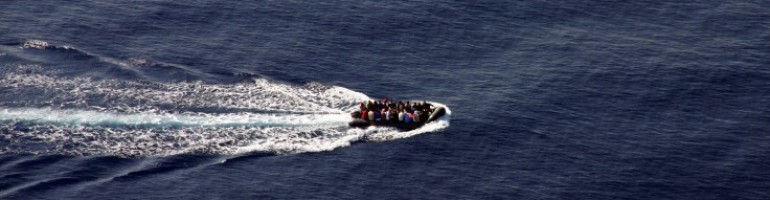
A boat carrying approximately 350 African migrants or asylum seekers from Libya has been intercepted and is being diverted to the Italian island of Linosa between Malta and Lampedusa.  There have been reports over the past several days that the migrant boat was at sea.  A Canadian navy ship, probably the frigate HMCS Charlottetown, first intercepted and boarded the migrant boat to determine whether the passengers required immediate rescue or not and to provide a pump.  The migrant boat was allowed to proceed.  An Italian navy helicopter later rescued a woman who gave birth on the boat.  The woman, the newborn baby, the father, and a second pregnant woman were removed from the migrant boat and taken to hospitals on Lampedusa and Sicily.  The Italian navy said that the migrant boat will be taken to Linosa rather than Lampedusa.  UNHCR spokeswoman Laura Boldrini is quoted by AFP as saying that “[t]his is the first boat coming from Libya with people fleeing the military escalation, the vendettas and the retaliation attacks and that “the people on board the boat required ‘international protection’”.  AFP also reported that “Mussie Zerai, an Eritrean Catholic priest in Italy who has been in direct contact with the vessel via a satellite phone, said conditions on the boat were extremely difficult with around 10 children and 20 women on board.  He said the people were mostly Eritreans, Ethiopians and Somalians.”  Zerai also “said four or five other boats carrying African migrants had … left Libyan shores carrying around 1,000 people.”

Click here (EN) and here (IT) for articles.

2 Comments

Filed under Eritrea, Ethiopia, Italy, Libya, Malta, Mediterranean, News, Somalia, UNHCR

Frontex Announces Expansion of Joint Operation Poseidon Sea to Include Crete and Eastern Portions of Central Mediterranean

Two days after announcing the extension of Joint Operation Hermes and the westward expansion of the operational area of JO Hermes to include the waters around Sardinia, Frontex on 26 March announced the expansion of the operational area of Joint Operation Poseidon Sea to include the waters around Crete.  The expansion is due to the “highly volatile situation in North Africa” and was called for by the European Council’s Conclusions issued at the end of the Council meeting of 24/25 March: “the Commission will make additional resources available in support to [Frontex’s] 2011 Hermes and Poseidon operations and Member States are invited to provide further human and technical resources.”

Excerpts from the Frontex statement:  “March 26, 2011 — Responding to the highly volatile situation in North Africa Frontex extends operational area of its on-going Joint Operation (JO) Poseidon Sea. In the first four weeks of deployment Joint Operation Poseidon Land sees decreasing numbers of arrivals across the land border with Turkey.   In view of potential migratory flows from Libya operational area of JO Poseidon Sea, which covers the Greek islands in the Aegean sea, has been widened to include Crete. On Thursday, 24 February Romanian maritime surveillance vessel and a Portuguese plane were deployed to increase patrolling intensity in this region. [***]”

Click here for Frontex Poseidon Sea press release.

Click here for the Frontex Hermes press release.

Click here for the Council Conclusions.

Click here for previous post on the expansion of JO Hermes.

Leave a comment

Filed under Aegean Sea, European Union, Frontex, Greece, Italy, Libya, Mediterranean, News, Tunisia

European Council Meeting Conclusions re Migrant and Refugee Flows from North Africa

While most of the European Council meeting of 24/25 March was devoted to economic policy and the Euro Zone crisis, the Council also considered the situation in Libya and the “Southern Neighborhood.”  The Council’s Conclusions noted that the Commission would be presenting “a Plan for the development of capacities to manage migration and refugee flows in advance of the June European Council.”  The Council conclusions also stated that “Agreement should be reached by June 2011 on the regulation enhancing the capabilities of Frontex. In the meantime the Commission will make additional resources available in support to the agency’s 2011 Hermes and Poseidon operations….”

Excerpts from the Council 24/25 March 2011 Conclusions:

“II. LIBYA / SOUTHERN NEIGHBOURHOOD

18. The European Council discussed the situation in Libya and endorsed the conclusions adopted by the Foreign Affairs Council on 21 March. Recalling its March 11 Declaration, the European Council expressed its satisfaction after the adoption of UN Security Council Resolution 1973, which expresses the principle of the responsibility to protect, and underlined its determination to contribute to its implementation. It also welcomed the Paris Summit of 19 March as a decisive contribution to its implementation…. [***]

21. The humanitarian situation in Libya and on its borders remains a source of serious concern. The EU will continue to provide humanitarian assistance to all those affected, in close cooperation with all the humanitarian agencies and NGOs involved. The EU has stepped up and will continue its planning on support for humanitarian assistance / civil protection operations, including by maritime means.  [***]

25. The European Council welcomes the recent visit of Presidency and the Commission to Egypt as part of a first phase of consultations to promote a comprehensive approach to migration as between the countries of the Southern Neighbourhood region and the European Union. In this context the European Council invites the Commission to present its proposals on the Global Approach to Migration as well as on the Mobility Partnership well in advance of the June European Council.

26. The European Council also looks forward to the presentation by the Commission of a Plan for the development of capacities to manage migration and refugee flows in advance of the June European Council. Agreement should be reached by June 2011 on the regulation enhancing the capabilities of Frontex. In the meantime the Commission will make additional resources available in support to the agency’s 2011 Hermes and Poseidon operations and Member States are invited to provide further human and technical resources. The EU and its Member States stand ready to demonstrate their concrete solidarity to Member States most directly concerned by migratory movements and provide the necessary support as the situation evolves.  [***]”

Click here for full document.

Leave a comment

Filed under Egypt, European Union, Frontex, Libya, Mediterranean, News, Statements, Tunisia

Frontex Announces Extension and Expansion of Joint Operation Hermes in Central Mediterranean

On 23 March Frontex announced a 5 month extension of its Joint Operation Hermes.  Frontex also announced a westward expansion of the operational area to include Sardinia, roughly 300 km northwest of Lampedusa.  According to Frontex Director Laitinen, “100 percent [of] the request the Italian authorities [have] made to Frontex” has been satisfied.

Frontex statement in full:

“Warsaw, 23 March 2011 — Due to the notable increase in migratory pressure on Italy and the island of Lampedusa in particular, Frontex has widened the operational area of Joint Operation Hermes and extended its duration for five more months, with the aim of strengthening Europe’s border control response capability in the Central Mediterranean.

‘In close cooperation with the Italian authorities, we have decided to run Joint Operation Hermes until the end of August 2011, and to extend the operational area to include Sardinia, where Frontex has already deployed aerial assets to strengthen the patrolling capacity of the Italian authorities,’ said Frontex Executive Director Ilkka Laitinen.

‘Frontex is closely monitoring the developments in North Africa and stands ready to assist the Member States operationally if requested. We are also continuously developing additional operational responses for potential rapid deployment throughout the Mediterranean if needed,’ he added.

As of 23 March 2011, Lampedusa remained the main destination for migrants from Tunisia. During the previous week alone, 3,230 undocumented persons arrived on the island, bringing the total number of arrivals detected in the whole operational area since Hermes began on 20 February to 9,098. The majority of migrants are young men but 52 women and more than 240 minors were also detected during Italian-led Hermes. At the time of writing the great majority of migrants who recently arrived in Lampedusa claimed to be of Tunisian nationality.

In addition to one aircraft and two vessels already financed and coordinated by Frontex, one Dutch and one Portuguese plane have now arrived in Pantelleria and Sardinia respectively to assist the Italian authorities in strengthening their border control activities.

‘With this equipment and 20 experts currently working in the centres of Bari, Caltanisetta and Crotone, we have satisfied 100 percent the request the Italian authorities made to Frontex,’ Laitinen concluded.

The cost of the first 40 days of the operation amounts to EUR 2.6 mln.”

Click here for statement.

2 Comments

Filed under European Union, Frontex, Italy, Libya, Mediterranean, News, Tunisia

EMHRN Statement: Italy and EU should suspend all measures of forcible removal towards Tunisia

Press release in its entirety from the Euro-Mediterranean Human Rights Network:

“Brussels, 23 March 2011.  Italy and the other Member States of the EU should suspend all measures of forcible removal towards Tunisia and share in the reinstallation of Libyan and non-Libyan refugees who have to flee Libya

Italian ministers Frattini and Maroni have announced their intention to travel to Tunisia to renew bilateral cooperation on migration issues. In the view of the Euro-Mediterranean Network, in the present circumstances, the ministers’ insistence that the Tunisian authorities must prevent new departures from Tunisia and cooperate in the forcible removal of the Tunisian migrants who have landed in Italy since the beginning of the year, is particularly inappropriate.

The upheavals that are shaking the region at the moment have exposed the short-sightedness and futility of a policy that favours dictators instead of migrants.

Expecting from the Tunisian authorities, first and foremost, a crack down on immigration from third countries and emigration towards the European Union amounts to encouraging them in returning to the authoritarian practices of the former regime. This is not the kind of support Tunisia needs.

In this transition period, Italy and the other member states of the European Union should, on the contrary, suspend all measures imposing the forcible removal of Tunisian nationals towards Tunisia and share in the resettlement of Libyan and non-Libyan refugees who have had to flee Libya, arrived in Tunisia and cannot return to their home country.

While the number of Tunisian migrants who have landed on Lampedusa Island is significant relative to the size and population of the island, it is minuscule, on the European scale, when compared to the scope of the humanitarian emergency confronting Tunisia on its border with Libya. No fewer than 165,000 people have crossed the border at Ras Adjir in an attempt to flee the violence in Libya since 20 February, but no Tunisian official has made inflammatory statements comparing migrants and asylum seekers with criminals or terrorists. Tunisia is forced to cope with the arrival of tens of thousands of Tunisian workers, some of whom had been living in Libya for many years, as well as tens of thousands of immigrant workers, mainly from Bangladesh and sub-Saharan countries, who are awaiting repatriation to their countries of origin with assistance from UNHCR and OIM, not to mention Libyans and nationals of countries such as Somalia, Eritrea or Sudan, who for obvious reasons cannot return to their countries of origin, where their lives and physical integrity would be at risk.”

Click here for link.

Leave a comment

Filed under European Union, Italy, Libya, Mediterranean, News, Statements, Tunisia

Correction–100+ Newly Arrived Migrants on Sicily Are Egyptians, Not Libyans

More recent media reports are now reporting that the 120+ migrants who reached Sicily during the night of 20-21 March are Egyptian nationals who may have said they were from Libya in order to make asylum claims.

Click here, here, and here for articles. (IT) .


Leave a comment

Filed under Egypt, Italy, Libya, Mediterranean, News

100+ Libyans Reach Sicily by Boat

Speaking at a press conference earlier today, Italian Interior Minister Roberto Maroni reported that 117 migrants who are believed to be Libyan reached Catania, Sicily in two boats during the night of 20-21 March.  According to Maroni, a total of 14,918 immigrants have landed in Italy since the beginning of the year.  [UPDATED INFORMATION – more recent reports suggest that the many or all of the migrants involved may be Egyptian nationals who posed as Libyans, possibly for purposes of seeking refugee protection. Click here (IT) for more recent article.]

Click here, here, and here for articles. (EN)

Leave a comment

Filed under Data / Stats, Frontex, Italy, Libya, Mediterranean, News

Italy Seeking New Immigration Agreement with Tunisia; Frattini and Maroni Likely to Travel to Tunis on 22 March

In an interview posted yesterday on the Italian Foreign Ministry web page, Foreign Minister Franco Frattini said that the “real problem [with the current flow of migrants from Tunisia] is the loosening of controls [in Tunisia] and [that he and Interior Minister Maroni] will almost certainly be in Tunis [on Tuesday, 22 March] to establish a bilateral agreement.”  Minister Frattini said in the interview that Italy is ready to provide “practical help”, has released 90 million euros to Tunisia, wants to discuss deploying Italian naval patrols along the Tunisian coast, and wants to block human trafficking.

Click here (IT) for Foreign Ministry posting and here (IT) for article.

[If Foreign Ministry link does not load properly try this link and look under 20 Marzo 2011.]

Leave a comment

Filed under Italy, Libya, Mediterranean, News