Category Archives: United Nations

UNHCR Reports 55 people missing or drowned off northern Somali coast

UNHCR Press Release:

“Fifty-five people are drowned or missing after an overcrowded boat capsized off the Somali coast on Tuesday night (18 December). UNHCR is greatly saddened by this latest tragic incident – the biggest loss of life in the Gulf of Aden since February 2011 when 57 Somali refugees and migrants from the Horn of Africa drowned while attempting to reach Yemen.

According to five of the survivors – all young Somali men – the boat was overcrowded and ran into trouble almost immediately after leaving the port of Bosasso in northern Somalia on Tuesday. It capsized just 15 minutes into its journey, spilling all 60 passengers into sea. Those on board were Ethiopians and Somalis.

To date, 23 bodies have been recovered, including those of 14 women, eight men, and a boy said to be less than four years of age. Five of the dead are confirmed to have been Ethiopians. The thirty-two remaining passengers are presumed to have drowned.

‘The tragic loss of so many lives is a new and stark reminder of the risks Somali refugees are taking as they flee their country’ said UNHCR Representative for Somalia, Bruno Geddo. ‘Without doubt, the Gulf of Aden is now the deadliest route for people fleeing conflict, violence and human rights abuses in the Horn of Africa.’

100,000 people have crossed the Red Sea and the Gulf of Aden this year, despite warnings from UNHCR and other aid agencies about the risks such trips involve. In addition to using unseaworthy and overcrowded boats, those fleeing the Horn of Africa region often fall prey to unscrupulous smugglers, in whose hands they can face exploitation, extortion and even death.

With the latest deaths, 95 people have drowned or gone missing in the waters between Somalia and Yemen this year. UNHCR and other agencies, through the local Migration Response Centre (MRC) in Bosasso are currently providing support and services to the survivors and assisting the local authorities with the ongoing recovery operations.

END

Further info: Andy Needham, UNHCR Somalia PI Officer +254 733 120 931 needham@unhcr.org

Andy Needham Public Information Officer UNHCR Somalia First Floor, Lion Place, Waiyaki Way 43801-00100 Nairobi, Kenya

Somalia Displacement Portal: https://data.unhcr.org/horn-of-africa/somalia.php

m: +254 733 120 931 d: +254 20 420 2103 o: +254 20 420 2000

needham@unhcr.org www.unhcr.org www.takeaction.unhcr.org “

5 Comments

Filed under Gulf of Aden, News, Somalia, UNHCR, Yemen

UNODC Global Report on Trafficking in Persons 2012

UNODC released its 2012 Global Report on Trafficking in Persons on 10 December 2012.  The 98 page report “provides an overview of patterns and flows of trafficking in persons at global, regional and national levels, based on trafficking cases detected between 2007 and 2010 (or more recent). The report also includes a chapter on the worldwide response to trafficking in persons. The Country Profiles of the Global Report present a national level analysis for each of the 132 countries covered by this edition of the report.”

In regard to trafficked persons in Europe:

“Of the [trafficking] victims originating outside Europe, those from African countries are most prominently detected. About 18 per cent of the total number of victims detected in Western and Central Europe are African. Victims from West Africa, especially but not only Nigerians, comprise the vast majority. West Africans accounted for about 14 per cent of the total number of victims detected here….

In terms of trends, the proportion of West African victims among the total number of victims detected remained constant in Western and Central Europe during the reporting period. A detailed analysis at the country level, however, shows that a decreasing number of West African victims have been detected in a series of countries, while an increasing number have been detected in others. During the reporting period, fewer West African victims were detected in France and Italy, while they were increasingly detected in Austria and Germany. Similar contrasting trends can be noted among other destination countries in Western and Central Europe. The aggregated regional value is the result of compensation between opposite trends. This may indicate that the West African trafficking flow within the subregion may face some sort of displacement of destination.

Victims from the rest of sub-Saharan Africa accounted for a little more than 1 per cent of all victims detected in Western and Central Europe. As far as the North African victims are concerned, these were detected in or repatriated from 11 European countries, accounting for about 2.5 per cent of the victims detected during the reporting period, suggesting that these flows should not be underestimated.”

Click here full Report.

Click here for links to the Executive Summary and Country / Regional profiles.

Map 9, UNODC 2012 Global Report


2 Comments

Filed under Analysis, Data / Stats, European Union, Reports, UNODC

Guardian: Report of Syrians Having Been Turned Back on Evros River by Greek and Possibly Frontex Border Guards

A Guardian article today describes an incident which occurred earlier in the year which, if accurate, would indicate that Greek border guards and possibly border guards operating under Frontex Joint Operation Poseidon Land have returned Syrian asylum seekers (and migrants of other nationalities) to Turkish territory without registering and screening the migrants.

Excerpt: “This summer two people smugglers left 25 Syrian refugees to cross the Evros alone at night. There were two rubber dinghies. The first disappeared across the river into the night. The second …capsized. Most of the men, women and children could not swim. Some survived … The bedraggled Syrians who made it ashore [were detained].  After [irregular migrants are arrested], they are usually detained in administrative holding centres by the EU border police, Frontex, which has been deployed a few miles from the border since 2010. However, the group of Syrian refugees who made it across the Evros that night were not registered. Instead, they were arrested by officers in ‘blue uniforms’ and driven back to the river. ‘There were between 100 to 150 people by the river,’ said Farouk (not his real name), a 29-year-old from the Qamishli region in northern Syria. ‘They were of many nationalities, mainly Syrian. Some tried to make problems: they had paid a lot of money to get that far. When that happened, the police beat them. The police kicked and slapped them, including the women, they picked up children and threw them into the boat.’  The officers put people in small plastic boats, which they tied to larger, motorised boats, and returned them to Turkish territory.  … A UN High Commissioner for Refugees source said the organisation could not comment on Farouk’s story or illegal push-backs by Greek police in general. However, they acknowledged hearing similar accounts. ‘People say that there is a situation where people may enter the territory but are not registered as persons who are arrested in Greek territory. They are returned through use of force at night through the river. We think that these operations have been eliminated in the last two years.’ … Pasxalis Syritoudis, police chief of the northern Evros region, denied that his officers operated a push-back policy. … However, Syritoudis admitted that his main goal was to ‘prevent people entering Greek soil’. This meant sometimes his officers used boats to block migrants in dinghies from crossing the border. ‘We have 10 boats patrolling the river all the time. The boats are used to block people from crossing – to stop them getting to Greek territory.’…”

Click here for article.

2 Comments

Filed under European Union, Frontex, Greece, News, Turkey, UNHCR

UN Special Rapporteur on HR of Migrants expresses concern over plight of irregular migrants in Greece; calls for EU assistance; Frontex patrolling Greece-Italy sea border

The UN Special Rapporteur on the human rights of migrants, Prof. François Crépeau, has completed  a nine-day official visit to Greece, the fourth and last country visit in connection with a “a one-year comprehensive study to examine the rights of migrants in the Euro-Mediterranean region, focusing in particular on the management of the external borders of the European Union.”  The Special Rapporteur will present a thematic report on the human rights of migrants at the borders of the European Union to the UN Human Rights Council in May/ June 2013.  In addition to the visit to Greece, he previously conducted official visits to EU offices in Brussels, Tunisia, Turkey, and Italy.

One point of particular interest in the Special Rapporteur’s end-of-mission statement is that Frontex sea patrols in Greece are not along being used to patrol the external sea border of the EU (Greece-Turkey), but are also being used to patrol the sea border between Greece and Italy to prevent irregular migrants from leaving Greece.  (Is this within Frontex’s mandate?)  According to the end-of mission statement, Frontex Joint Operation Poseidon Sea “which used to cover the sea border between Greece and Turkey, was extended in 2012 to also cover the west coast of Greece, where migrants trying to reach Italy by boats operated by smugglers are intercepted and returned to Greece.”

The Special Rapporteur also notes “[t]he enhanced border controls at the Greek-Turkish land border under operation ‘Aspida’ (‘Shield’) initiated in August 2012, which included the deployment of approximately 1800 border police officers, coupled with the construction of a fence and the Frontex operation ‘Poseidon Land’ have resulted in a renewed influx of irregular migrants via the islands of the eastern Aegean Sea, with boats arriving on the different islands almost daily.”

Here are additional excerpts from the end-of-mission statement:

“[W]hile most EU countries have stopped returning asylum seekers to Greece under the Dublin II Regulation due to a decision of the European Court of Human Rights (M.S.S. vs Belgium and Greece), I was informed that there are still some returns to Greece based on this Regulation.”

“As the large number of irregular migrants stuck in Greece is mainly a result of EU policies and practices, there is a strong need for solidarity and responsibility-sharing within the EU in order to ensure full respect of the human rights of all these migrants.”

“While the role of the EU in managing the migration flows in Greece is crucial, the Greek government also needs to significantly step up its efforts in order to ensure that the rights of all migrants within its territory are fully respected.”

“I am deeply concerned about the widespread xenophobic violence and attacks against migrants in Greece, and I strongly condemn the inadequate response by the law enforcement agencies to curb this violence, and to punish those responsible.”

“I also deeply regret the Greek government’s new policy of systematically detaining everyone they detect irregularly entering the Greek territory, including unaccompanied children and families. I also regret the ‘sweep operations’ in the context of operation ‘Xenios Zeus’, which have led to widespread detention of migrants in different parts of the country, many of whom have lived and worked in Greece for years.”

Among the several preliminary recommendations to Greece and the EU was the recommendation that the EU “[e]nsure that the full protection of the human rights of all migrants, regardless of their status, is the primary consideration for its support to the Greek efforts in managing the migration flow entering the EU territory, including in relation to the activities undertaken by Frontex at the Greek borders.”

Click here for complete End-of-Mission Statement.

Click here for my previous post on the Special Rapporteur’s visits to other countries.

2 Comments

Filed under Aegean Sea, European Union, Frontex, Greece, Italy, OHCHR, Reports, Statements, Turkey

UN Special Rapporteur on HR of Migrants expresses concern over Italy-Libya cooperation on migration

The UN Special Rapporteur on the human rights of migrants, Prof. François Crépeau, for the past six months has been conducting “a one-year comprehensive study to examine the rights of migrants in the Euro-Mediterranean region, focusing in particular on the management of the external borders of the European Union.”  The Special Rapporteur will present a thematic report on the human rights of migrants at the borders of the European Union to the UN Human Rights Council in June 2013.  To date he has concluded official visits to EU offices in Brussels, Tunisia, Turkey, and Italy; a nine-day visit to Greece began on 25 November.  The Special Rapporteur has issued preliminary conclusions at the end of each completed mission.  One common concern is that various actions of the EU and neighbouring countries are resulting in human rights considerations being overshadowed by migration control and security objectives.

At the conclusion of the most recent mission to Italy (30 September – 8 October 2012), the Special Rapporteur expressed concern over Italy’s (and the EU’s) ongoing cooperation with Libya:

“Another matter of paramount importance are the bilateral cooperation agreements negotiated between Italy and its neighbours on the question of migration. Although the EU has negotiated a number of EU wide readmission agreements, the absence of a clear regional framework for such agreements, including a lack of minimum human rights standards, has led to the creation of a number of bilateral readmission agreements between Italy and its neighbours which often do not appear to have human rights at their core.  Of particular concern is the Italy-Libya bilateral cooperation on migration. The 2008 agreement formalised cooperation to strengthen Libya`s capacity to intercept irregular migrants on Libyan territory or territorial waters, even though Libya’s record at effectively protecting the human rights of migrants was poor and reports of human rights abuses of migrants in Libya were frequent. In line with the decision of the European Court of Human Rights pronounced in the Hirsi case that such ‘push-backs’ by Italian authorities towards Libya were not acceptable, the agreement is currently suspended and the Hirsi-defined push-backs appear to have ceased. However, Italy-Libya migration cooperation was recently reinforced through a 2012 processo verbale. This new political framework however, contains very little concrete information on strengthening Libya’s normative framework and institutional capacities regarding the human rights of migrants.”

The Special Rapporteur also expressed concern that the current technical assistance in Search and Rescue capability being provided by Italy to Libya is in effect disguised migration control assistance:

 “Moreover, I have learnt of increased bilateral cooperation between Italian and Libyan authorities regarding search and rescue operations, including the provision of logistical and technical support to Libyan coast guards. Whilst increased search and rescue capacity in the Mediterranean is undoubtedly of paramount importance, I have observed that there appears to be a strong focus on strengthening the capacities of the Libyan authorities to intercept migrants hoping to reach Europe, on both their territory and in their territorial waters, and return them to Libya. In this context, I warn EU member states against a progressive ‘externalisation’ of border control. In particular, considering the on-going difficulties of the Libyan authorities and the reports of human rights abuses against migrants on Libyan territory, this migration cooperation with Libya should not lead to any migrant being returned to Libyan shores against their will, either by Italian coast guards or Guardia di Finanza, or by Libyan coast guards with the technical or logistical support of their Italian counterparts.”

While acknowledging the important support provided to Italy by Frontex, the Special Rapporteur expressed concern over certain Frontex activities in Italy:

“[  ] I am aware that the key focus of FRONTEX remains information and intelligence gathering. In Italy FRONTEX thus works predominantly with the Guarda di Finanza and the Border Police to combat irregular migration, migrant smuggling and other migration related crimes. I remain concerned that these security objectives still appear to overshadow human rights considerations. For example, I have learned that FRONTEX officers conduct interviews with migrants in Italian detention facilities in order to gather information on their journeys. However these interviews are conducted without any external supervision. It is thus essential that effective human rights standards be integrated into all departments and agencies related to border management.”

The Special Rapporteur made the following “Preliminary Recommendations to the Italian government”:

  • “Ensure that migration cooperation with Libya does not lead to any migrant being returned to Libyan shores against their will, either by Italian authorities, or by Libyan authorities with the technical or logistical support of their Italian counterparts.
  • Prohibit the practice of informal automatic “push-backs” to Greece.
  • Guarantee the full access by international organisations, including UNHCR and IOM, civil society organisations and lawyers to all areas where migrants are held or detained to identify protection concerns
  • Develop a nation-wide regulatory framework, with respect for human rights at its core, for the organisation and management of all migrant detention centres.
  • Develop a simpler and fairer appeal system for expulsion and detention orders that integrates human rights considerations at each procedural step.
  • Develop a speedier identification system, including commencing the identification of foreign inmates whilst in prison, in order to make sure that detention of migrants for identification purposes is limited to the shortest time possible, with a maximum of 6 months.”

Similar concerns were expressed by the Special Rapporteur after his missions to Tunisia and Turkey:

Tunisia, 8 June 2012: “… Nevertheless, I learned that a large majority of regional migration initiatives coming from the EU continue to be focused on issues of border control, and do not consider important issues such as the facilitation of regular migration channels. Thus I encourage the European authorities to develop, in the context of the Migration and Mobility Partnership currently being negotiated, and in conjunction with bilateral agreements of the Member States of the Union, a more nuanced policy of migration cooperation with Tunisia, which moves beyond security issues to develop new initiatives in consultation and in real partnership with Tunisian authorities, which place at their core the respect, protection and promotion of the human rights of migrants….”

Turkey, 29 June 2012:  “… While the EU and Turkey have developed a close cooperation on migration issues, which has led to some notable positive developments, the assistance offered to Turkey regarding migration management appears to focus largely on securitising the borders and decreasing irregular migration to the European common territory through focusing on projects related to the detention and removal of migrants in Turkey and the increased monitoring of the Turkish border. Often neglected from the equation, is an equivalent emphasis on the human rights of those most vulnerable and most affected by the migration process: the migrants themselves….”

The Special Rapporteur will likely issue preliminary observations at the conclusion of the current mission to Greece on or after 3 December.

Click here (Italy), here (Tunisia), and here (Turkey) for the Special Rapporteur’s statements.

Click here for the web site for the UN Special Rapporteur on the human rights of migrants.

3 Comments

Filed under Aegean Sea, European Union, Frontex, Greece, Human Rights Council, Italy, Libya, Mediterranean, News, Statements, Tunisia, Turkey, United Nations

UNHCR: More people are risking lives in the Caribbean to reach safety

Full text of 13 July 2012 statement: UNHCR is very concerned by the loss of life we are seeing in maritime incidents in the Caribbean among people trying to escape difficult conditions in Haiti.

On Tuesday July 10, a woman drowned when a boat carrying more than 100 Haitian migrants ran aground near the Bahamas. In an earlier tragedy, on June 12, more than a dozen Haitians lost their lives in Bahamian and US waters while trying to reach the shores of Florida. These events are a reminder of the extremes that people in difficult situations sometimes resort to.

Continuing difficulties in Haiti following the 2010 earthquake are leading thousands of Haitians to flee their homeland each year, often in unseaworthy vessels. Although no firm statistics exist, it is estimated that hundreds of deaths occur yearly as a result.

US Coast Guard data shows that since December 2011 over 900 people have been found on boats in rescue or interception operations including some 652 Haitians, 146 Cubans and 111 people from the Dominican Republic. [See US Coast Guard statistics here.]

Inside Haiti, internal displacement remains significant with 421,000 individuals still living in camps in and around Port-au-Prince and elsewhere in the country. The political situation remains tense, and a rise is reported in criminality and insecurity. A cholera outbreak has continued.

UNHCR is also concerned about countries that are returning the Haitians to Haiti, ignoring an earlier joint-appeal by UNHCR and OHCHR asking states not to return Haitians, for humanitarian reasons, without adequate individual protection screening. The joint call was made in view of the daunting humanitarian challenges that Haiti still faces, exacerbated by the January 2010 earthquake.

UNHCR continues to advocate for the inclusion of adequate protection safeguards for individuals apprehended at sea, and hopes that such tragedies can be avoided in the future through enhanced international cooperation in the region.

Click here for statement.

Click here for link to US Coast Guard “Alien Migrant Interdiction” statistics page.

Leave a comment

Filed under Caribbean - West Indies, Data / Stats, Haiti, News, UNHCR

Statement from PACE Rapporteur Tineke Strik on Most Recent Deaths in Mediterranean Sea: “When will this ever end?”

Full Text (FR ci-dessous):  Strasbourg, 11.07.2012 – “Yet again, a dinghy with 55 people on board drifted for 15 days on the Mediterranean. This time, only one person survived. When will this ever end?,” today asked Tineke Strik (Netherlands, SOC), rapporteur of the Parliamentary Assembly of the Council of Europe (PACE) on “Lives lost in the Mediterranean Sea: who is responsible?”. She expressed her great sadness and anger over the deaths of another 54 boat people fleeing Libya towards Italy.

“It is still not safe in Libya and the boats will continue to arrive. Europe knows that. I had hoped my report on the ‘left-to-die boat’ would serve as an eye-opener to prevent such tragedies happening time and time again. States must never hesitate to undertake immediate action to rescue people, even if they think someone else should be responsible: every minute counts,” said Senator Strik.

“Governments in Europe, and not only in the countries on the southern shores of Europe, must react, and take an equal share in the protection of asylum seekers arriving from Africa,” she added.

“It is all the more important that the resolution adopted by the Assembly in April this year is implemented and that the remaining questions are answered by NATO and by European governments. I am therefore now making public my most recent requests to member States and NATO, which remain unanswered,” she concluded.

The UNHCR estimates that this year over 170 people have lost their lives attempting to reach Italy by sea. Over 1 300 have arrived from Libya to Italy, and over 1 000 to Malta.

Letter to the Defence Secretary the United Kingdom

Letter to the Defence Minister of Spain

Letter to the NATO Deputy Assistant Secretary General for Operations

PACE Resolution 1872 (2012) (PDF)

Tineke Strik’s full report (PDF)

Strasbourg, 11.07.2012 – « Une fois de plus, un canot pneumatique avec 55 personnes à son bord a dérivé pendant 15 jours en Méditerranée. Cette fois, il n’y a eu qu’un seul survivant. Quand cela s’arrêtera-t-il ? », s’interroge Tineke Strik (Pays-Bas, SOC), l’auteur du rapport de l’Assemblée parlementaire du Conseil de l’Europe (APCE) « Vies perdues en Méditerranée : qui est responsable ? ». Elle a exprimé aujourd’hui sa profonde tristesse et sa colère à l’annonce de la mort de 54 personnes qui fuyaient la Libye pour l’Italie.

« La situation en Libye n’est toujours pas sûre et d’autres bateaux continueront d’arriver. L’Europe le sait. J’avais espéré que mon rapport sur le « bateau cercueil » provoquerait une prise de conscience et empêcherait que ces tragédies ne se reproduisent toujours et encore. Les États ne doivent jamais hésiter à prendre des mesures immédiates pour sauver des personnes, même s’ils estiment que quelqu’un d’autre devrait être responsable : chaque minute compte », a déclaré la sénatrice Strik.

« Les gouvernements européens, et pas seulement ceux des pays du rivage sud de la Méditerranée, doivent réagir et prendre une part égale dans la protection des demandeurs d’asile venant d’Afrique », a-t-elle ajouté.

« Il est d’autant plus important que la résolution adoptée par l’Assemblée en avril de cette année soit mise en œuvre et que l’OTAN et les gouvernements européens répondent aux questions encore en suspens. C’est pourquoi je rends publiques mes dernières demandes aux Etats membres et à l’OTAN, qui sont restées sans réponse », conclut-elle.

Le Haut-Commissariat de l’ONU pour les réfugiés estime que plus de 170 personnes ont péri cette année en tentant de gagner l’Italie par la mer. Plus de 1.300 personnes en provenance de Libye sont arrivées en Italie, et plus de 1.000 à Malte.

Lettre au Secrétaire d’Etat à la Défense du Royaume-Uni

Lettre au Ministre de la Défense de l’Espagne

Lettre au Secrétaire général adjoint délégué, Division des opérations de l’OTAN

Résolution 1872 (2012) de l’APCE

Rapport intégral de Tineke Strik (PDF)

Leave a comment

Filed under Council of Europe, European Union, Italy, Libya, Malta, Mediterranean, News, Statements, UNHCR

UNHCR Reports 54 Persons Dead After Migrant Boat Drifts in Mediterranean for 15 Days

The UNHCR reported yesterday that UNHCR staff interviewed the sole survivor of a migrant boat that departed from Tripoli for Italy in late June with 55 people on board.  The survivor was interviewed in Zarzis, Tunisia. “According to the survivor, there was no water on board and people started to die of dehydration within days. Many drank sea water, including the man who survived. He was rescued [off the coast of Tunisia] floating on the remains of the [inflatable] boat and a jerry can. According to the survivor over half of the deceased were from Eritrea, including three of his relatives.”  According to the UNHCR press statement “[s]o far in 2012, over 1,300 people have arrived by boat from Libya in Italy. A boat, reportedly carrying 50 Eritreans and Somalis, is currently at sea. They refused to be rescued by Maltese military forces [on 9 July].  Over 1,000 people on 14 boats have arrived in Malta from Libya so far this year. Two other boats were intercepted by Maltese authorities, but the majority elected not to be rescued and continued to Italy.  UNHCR Italy estimates that so far this year some 170 people have been declared dead or lost at sea attempting to make the journey from Libya to Europe.”

Click here for UNHCR press statement.

Leave a comment

Filed under Data / Stats, European Union, Italy, Libya, Malta, Mediterranean, News, UNHCR

Israel’s Refugee Practices, Past and Present

Yesterday, 10 June 2012, marked the 35th anniversary of the rescue by an Israeli ship (the freighter Yuvali) of 66 Vietnamese boat people in the South China Sea.  After neighboring countries, including Hong Kong and Taiwan, refused to permit the disembarkation of the rescued Vietnamese, the Israeli government agreed to allow the 66 Vietnamese to be transported to and resettled in Israel.  While I have not confirmed this, an Associated Press report at the time of the event quoted an Israeli Interior Ministry official as saying that this was the first time that Israel had permitted non-Jewish refugees to settle in Israel.  The humanitarian decision taken 35 years ago stands in stark contrast to the asylum and migration laws that are now to be enforced in Israel.

Israeli Interior Minister Eli Yishai announced last week that the revised Prevention of Infiltration Law will begin being enforced.  The Infiltration Law allows the arrest and detention of irregular border crossers, including asylum seekers.  The Israeli Defence Ministry also announced last week that five new detention centres are under construction and when completed will consist of 20,000 to 25,000 tents.  “The objective of the plan, according to the [Defence] ministry, is to ensure that all African migrants who enter Israel will be directly transferred to a detention center where they will stay for long periods of time, in order to prevent their entry to Israeli cities.”

Human Rights Watch issued a statement on 10 June calling on the Israeli government to refrain from enforcing the law until its provisions are amended to comply with Israel’s international legal obligations:  “On January 10 [2012] the Knesset amended the 1954 Prevention of Infiltration Law to define all irregular border-crossers as ‘infiltrators.’ The law permits Israeli authorities to detain all irregular border-crossers, including asylum seekers and their children, for three years or more before their deportation. The law also allows officials to detain some people indefinitely, even if border control officials recognize they might face persecution if returned to their country. [***]   The government and the United Nations High Commissioner for Refugees (UNHCR) estimate that since 2005, around 60,000 Africans have entered Israel somewhere along the 240-kilometer border with Egypt after passing through the Sinai desert. Many of the migrants and asylum seekers fall victim to abusive human traffickers en route to Israel, particularly in the Sinai. [***] Israel is building a fence along the border to prevent irregular crossings and expanding a detention facility for irregular border-crossers from 2,000 beds to around 5,400, according to Israeli refugee rights groups….”

Click here for HRW Statement.

Click here or here for article from ECRE’s Weekly Bulletin, 8 June.

Click here and here for articles.

Click here or here for 1977 article.

Leave a comment

Filed under Israel, News, UNHCR

Oxford Migration Law Discussion Group Seminar: A discussion on Hirsi v Italy (Oxford, 27 Feb)

“The Migration Law Discussion Group at the University of Oxford is holding a meeting Monday, 27 Feb. 2012, to discuss the Grand Chamber judgment delivered by the Strasbourg Court on the case of Hirsi v Italy. The session will start with a presentation by UNHCR (third party intervener in the case) and provide ample opportunity for discussion afterwards.  The details are as follows:  MLDG SEMINAR: ‘How far does non-refoulement go? A discussion on Hirsi v Italy’;  SPEAKER: Madeline Garlick, Head of Unit, Policy and Legal Support, UNHCR Europe;   ABSTRACT:  The European Court of Human Rights, on 23 February 2012, has handed down its judgment in the matter of Hirsi & Ors v Italy. This case, brought to the court by a group of migrants intercepted at sea and returned to Libya by Italy in 2009, raises important questions around the scope and application of the principle of non-refoulement. This includes notably the extent of States’ protection obligations when exercising jurisdiction over individuals outside their territory. The decision is ground-breaking and should lead to a dramatic change in the way border controls are conducted in Europe, affording protection to migrants and refugees in an unprecedented way.  The speaker, who represented UNHCR before the Court in the case, will examine key points of interest in the judgment and convey the perspective of UNHCR as a third party intervener. Participants at the event will be invited to discuss the judgment and its wider implications.

DATE: Monday, 27 February 2012
VENUE: Seminar Room 2, Refugee Studies Centre – Queen Elizabeth House, 3 Mansfield Rd – Oxford OX1 3TB
TIME: 5h30 pm”

(From Migration and Law Network listserve.)

Click here for more information.

Leave a comment

Filed under Colloques / Conferences, European Court of Human Rights, Mediterranean, UNHCR

11 Dead, 34 Missing in Gulf of Aden – Smugglers Forced Passengers Into Sea

The UNHCR reported on 10 February that at least 11 persons drowned and 34 are missing after their boat capsized in the Gulf of Aden. The boat left Somalia for Yemen on 4 February, became disabled and drifted, and then capsized on 8 February in bad weather.  UNHCR reported that “[s]hocking details came to light [on 9 February] as survivors recounted to local authorities and our partners how smugglers forced 22 passengers overboard soon after the engine failed. … So far, 11 bodies have been recovered on beaches around the village of Ceelaayo some 30 kilometers west of Bossaso. Locals also found 13 survivors, including two women and a teenage boy and girl….”

This latest disaster occurs after an almost 100% increase in the number of refugees, asylum-seekers, and migrants crossing the Gulf of Aden and Red Sea from Africa to Yemen in 2011 compared to 2010.  103,000 migrants are estimated to have made the sea crossing in 2011 compared to an estimated 53,000 in 2010.  130 persons are known to have drowned in 2011.

Click here for UNHCR report.

Click here for my last post on the 2011 statistics.

Leave a comment

Filed under Gulf of Aden, News, Somalia, UNHCR, Yemen

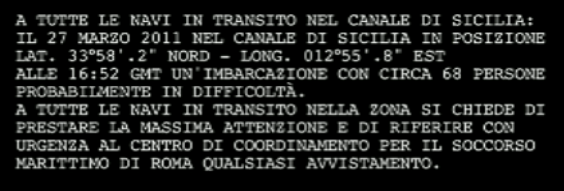
Mare Deserto: RSI documentary about the failure to rescue and subsequent deaths of 60 migrants in the Mediterranean in March 2011

RSI LA1, the Swiss Italian-language television network, last month broadcasted a one hour documentary,  Mare deserto , produced by Emiliano Bos and Paul Nicol.  The documentary is in Italian.  It investigates the events that occurred between 25 March and 10 April 2011 when a disabled migrant boat attempting to travel from Libya to Italy drifted for days during which time approximately 60 persons died.  Survivors from the migrant boat reported that at various times military ships and helicopters ignored their requests for assistance.  The producers located and interviewed 9 of the known survivors in Italy, Tunisia and Norway.

Click here or here for a link to the documentary.  (IT)

Click here and here for some of my previous posts on the incident and the ongoing PACE investigation into the incident.

2 Comments

Filed under Council of Europe, Italy, Libya, Mediterranean, News, Reports, UNHCR

UNHCR: “Mediterranean takes record as most deadly stretch of water for refugees and migrants in 2011”

Full Text of UNHCR Briefing Note, 31 January:

“This is a summary of what was said by UNHCR spokesperson Sybella Wilkes – to whom quoted text may be attributed – at the press briefing, on 31 January 2012, at the Palais des Nations in Geneva.

According to UNHCR estimates, more than 1,500 people drowned or went missing while attempting to cross the Mediterranean to reach Europe in 2011. This makes 2011 the deadliest year for this region since UNHCR started to record these statistics in 2006. The previous high was in 2007 when 630 people were reported dead or missing.

Last year is also a record in terms of the massive number of arrivals in Europe via the Mediterranean, with more than 58,000 people arriving. The previous high was in 2008 when 54,000 people reached Greece, Italy and Malta. During 2009 and 2010, border control measures sharply reduced arrivals in Europe. The frequency of boat arrivals increased in early 2011 as the regimes in Tunisia and Libya collapsed.

Our teams in Greece, Italy, Libya and Malta, warn that the actual number of deaths at sea may be even higher. Our estimates are based on interviews with people who reached Europe on boats, telephone calls and e-mails from relatives, as well as reports from Libya and Tunisia from survivors whose boats either sank or were in distress in the early stages of the journey.

Survivors told UNHCR staff harrowing stories of being forced onboard by armed guards, particularly during April and May in Libya. The actual journey took place on unseaworthy vessels with refugee and migrant passengers often forced into having to skipper boats themselves. In addition, some survivors told UNHCR that fellow passengers beat and tortured them. Judicial investigations are ongoing in Italy following these reports.

The majority of last year’s arrivals by sea landed in Italy (56,000, of whom 28,000 were Tunisian) while Malta and Greece received 1,574 and 1,030 respectively. The vast majority arrived in the first half of the year. Most were migrants, not asylum-seekers. Only three boats landed from mid-August to the end of the year. In addition, according to Greek government figures, some 55,000 irregular migrants crossed the Greek-Turkish land border at Evros.

We are disturbed that since the beginning of 2012, despite high seas and poor weather conditions, three boats have attempted this perilous journey from Libya, with one going missing at sea. This boat, carrying at least 55 people raised the alarm on 14 January, warning of engine failure. Libyan coast guards informed UNHCR that 15 dead bodies, all identified as Somali, were found washed up on the beaches last week, including 12 women, two men and a baby girl. On Sunday, three more bodies were recovered. It was confirmed later that all those that perished were Somali residents of the makeshift site in Tripoli known as the Railway Project.

The other two boats that made it to Malta and Italy in January required rescuing. The first rescue of 72 Somali nationals by the Italian coast guard took place on 13 January. Those rescued included a pregnant woman and 29 children.

The second boat was rescued by the Maltese Armed Forces on 15 January with the support of the US Navy and a commercial vessel. In total 68 people were rescued from a dinghy found drifting some 56 nautical miles from Malta. A baby girl was born on one of the rescue vessels. Another woman reported a miscarriage during the voyage.

UNHCR welcomes the ongoing efforts of the Italian, Maltese and Libyan authorities to rescue boats in distress in the Mediterranean. We renew our call to all shipmasters in the Mediterranean, one of the busiest stretches of water in the world, to remain vigilant and to carry out their duty of rescuing vessels in distress.

For further information on this topic, please contact:

In Rome: Laura Boldrini on mobile +39 33 55 403 194

In Valetta: Fabrizio Ellul on mobile +356 99 69 0081

In Geneva: Sybella Wilkes on mobile +41 79 557 91 38”

Click here for link to statement.

Leave a comment

Filed under Data / Stats, European Union, Greece, Italy, Libya, Malta, Mediterranean, News, Statements, Tunisia, UNHCR

Pillay: Extreme Concern Regarding Ill-Treatment of Detainees in Libya, Including Large Number of Sub-Saharan Africans

UN High Commissioner for Human Rights Navi Pillay addressed the UN Security Council on 25 January regarding the situation in Libya.  Pillay expressed extreme concern regarding the conditions of detention in Libya faced by thousands of detainees, including a large number of Sub-Saharan African nationals, and called for all detention centres to be brought under the control of the Ministry of Justice and the General Prosecutor’s Office.

Amnesty International and MSF have both just released additional reports documenting ongoing torture of detainees in Libya.

Excerpts from Pillay’s statement:

“The Interim Government still does not exercise effective control over the revolutionary brigades and this has human rights repercussions in a number of areas. …

A related area that I am extremely concerned about is the conditions of detention and treatment of detainees held by various revolutionary brigades. The ICRC visited over 8,500 detainees in approximately 60 places of detention between March and December 2011. The majority of detainees are accused of being Gaddafi loyalists and include a large number of sub-Saharan African nationals. The lack of oversight by the central authorities creates an environment conducive to torture and ill-treatment. My staff have received alarming reports that this is happening in places of detention that they have visited.

It is therefore urgent that all detention centres are brought under the control of the Ministry of Justice and the General Prosecutor’s Office. Moreover, a structure and process for judicial screening of detainees should be put in place immediately so that those detainees held without any legal basis can be released while others receive a fair trial. … However, detainees continue to be held in unacceptable circumstances outside any legal framework or the protection of the state….”

Click here for Pillay’s Statement.

Click here for AI Statement.

Click here for MSF Statement.

Leave a comment

Filed under Libya, News, OHCHR, Reports, Statements

UNHCR: Record Number of Refugees and Migrants Cross to Yemen in 2011

The UNHCR reports that there has been an almost 100% increase in the number of refugees, asylum-seekers, and migrants who crossed the Gulf of Aden and Red Sea from Africa to Yemen in 2011 compared to 2010.  103,000 migrants are estimated to have made the sea crossing in 2011 compared to an estimated 53,000 in 2010.  130 persons are known to have drowned.  Ethiopians now make up the largest nationality making the voyage, accounting for about 75% of the total.  Prior to 2009 Somalis were the largest group.

Click here (EN), here (EN) and here (FR) for UNHCR statements.

4 Comments

Filed under Data / Stats, Eritrea, Ethiopia, Gulf of Aden, News, Somalia, UNHCR, Yemen