Category Archives: United Nations

IMO: Final Link in Africa SAR Cover – Multi-lateral Agreement on North and West African Sub-regional Maritime Rescue Coordination Centre

From IMO: “Complete search and rescue cover around Africa’s coast was secured on Thursday (3 March 2011) with the signing, in the presence of representatives from Cape Verde, the Gambia, Guinea Bissau, Mauritania, Morocco and Senegal, of an ad-hoc multi-lateral co-operative agreement on the North and West African sub-regional Maritime Rescue Coordination Centre (MRCC), which establishes a new Morocco MRCC near Rabat, with its associated sub-centres.  The Morocco sub-regional MRCC, located at Bouznika, a seaside area 20 Km from Rabat, will join those already commissioned in Mombasa, Kenya, in 2006; in Cape Town, South Africa, in 2007; in Lagos, Nigeria, in 2008; and in Monrovia, Liberia, in 2009, thus completing the final link in the chain of sub-regional African MRCCs, each with its own network of associated sub-centres….”  IMO Secretary-General Mr. Efthimios E. Mitropoulos said “The sharing of information derived from the centres we establish will also play an important role in the fight against piracy, kidnap and ransom on the high seas – something, which IMO, and the whole maritime community, has pledged to tackle with renewed vigour during 2011 in line with this year’s World Maritime Day theme “Piracy: Orchestrating the response”.

Click here for link to IMO statement.

Leave a comment

Filed under Eastern Atlantic, Gambia, Guinea Bissau, Mauritania, Morocco, News, Senegal, United Nations

2000 Migrants Reach Lampedusa Over 24 Hour Period; Ship Carrying 1800 Remains in Int’l Waters in Need of Fuel

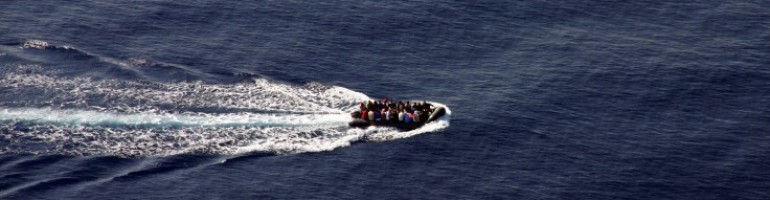
Approximately 2000 new migrants in more than 20 boats arrived in Lampedusa on 14-15 March.  Some were rescued and some reached Lampedusa on their own.  One boat is believed to have sunk near Tunisia and approximately 35 persons are believed to be missing.

According to a UNHCR briefing yesterday, just over 10,000 migrants, nearly all young Tunisian men, have arrived in Italy since mid-January.  UNHCR spokesperson Melissa Fleming said that “[t]he outflow from Tunisia is unrelated to the ongoing crisis in Libya. From our interactions with Tunisians arriving in Italy over past weeks, we believe that most are seeking employment and better economic opportunities, rather than international protection.   UN staff and partners in Tunisia report that some villages appear largely empty of their young male population, with only women, children and elderly people remaining. This type of outflow is not atypical of countries in transition, and we are well aware of the many demands on the Tunisian authorities at present. Solutions to this type of flow need to be found in dialogue between the concerned governments, including arrangements for the orderly and dignified return of persons who are found not to be in need of international protection, and the establishment of opportunities for labor migration which can meet the needs of countries on both sides of the Mediterranean.”

The standoff with the Moroccan ferry, the Mistral Express, continues.  The ship left Libya several days ago and is located in international waters about 20 miles from the port of Augusta, Sicily.  Italian authorities have refused to permit the ship to enter Italian waters and are considering providing fuel to the ship while it remains at sea in order to prevent any of the 1800+ mostly Moroccan passengers from attempting to leave the ship and enter Italy.

Click here for UNHCR press briefing.

Click here, here, here, here, and here for articles.  (IT)

Leave a comment

Filed under European Union, Frontex, Italy, Libya, Mediterranean, Morocco, News, Tunisia, UNHCR

Prof. Goodwin-Gill: ‘The Right to Seek Asylum: Interception at Sea and the Principle of Non-Refoulement’

On 16 February Professor Guy S. Goodwin-Gill presented the inaugural lecture of the Fondation Philippe Wiener – Maurice Anspach, Chaire W. J. Ganshof van der Meersch.  The lecture was entitled ‘The Right to Seek Asylum: Interception at Sea and the Principle of Non-Refoulement’.  The complete text of the lecture is available at this link: Goodwin-Gill: The Right to Seek Asylum-Interception at Sea and the Principle of Non-Refoulement.  The complete text also contains a helpful reference list.

I have reproduced several excerpts below:

“Looking at the interception and return measures adopted in the Mediterranean and off the west coast of Africa … one may rightly wonder what has happened to the values and principles considered fundamental to the Member States of the European Union….  [***]

… [I]t is all the more surprising when [European] governments, ministers and officials either pretend that the rules [- including Article 78(1) of the TFEU which requires the Union to develop a common asylum policy with regard to ‘any third country national requiring international protection and ensuring compliance with the principle of non-refoulement’ – policy which ‘must be in accordance with the Geneva Convention… and other relevant treaties’-] do not apply, or seek ways to avoid their being triggered.

In my view, the problems begin at the beginning, just as they commonly do also at the national level. A policy or goal is identified – in this case, reducing the number of irregular migrants, including asylum seekers, leaving the north African coast and heading for Europe – and then belatedly some attempt is made to bend implementation of the policy to fit in with principle and rule. A better approach, in my view, would be to begin with a clear understanding of the applicable law – the prohibition of discrimination, of refoulement, of inhuman or degrading treatment – and then to see what can be done by working within the rules.

Of course, this approach is premised on the assumption that States generally seek to work within the rule of law. It will not likely influence the State determined to deal with the migrant and the asylum seeker arbitrarily, and without reference to principle. Such cases must be confronted head-on, by way of judicial and political mechanisms of control.  [***]

… The problem, though, lies not in formal recognition of protection principles but, as ever, in operationalising the rules – in making protection a reality at the point of enforcement. On the plus side stands a substantial body of legislation: the Frontex regulation itself; the RABIT amendment, with its express insistence on compliance with fundamental rights and conformity with Member States’ protection and non-refoulement obligations; and the Schengen Borders Code, Article 3 of which requires the Code to be applied, ‘without prejudice to the rights of refugees… in particular as regards non-refoulement’. Add to this the April 2010 Council Decision supplementing the Code and dealing specifically with the surveillance of maritime borders and Frontex operations; it is currently being challenged by the Parliament on vires grounds, and it was also objected to by Malta and Italy, mainly for its proposal that in the last resort, rescue cases should be disembarked in the State hosting the Frontex operation. The Decision’s formulation of the applicable law in the matter of protection, however, is unremarkable, restating the principle of non-refoulement and the need to avoid indirect breach, but also providing for those intercepted to have an opportunity to set out reasons why they might be at risk of such a violation of their rights….  [***]

What do we know about either unilateral or Frontex-led interception operations so far? Not as much as we might expect as citizens of a democratic Union bounded by the rule of law and basic principles of good governance, such as transparency and accountability….  [***]

Exactly what Frontex does in an interception context has been questioned. Human Rights Watch has claimed that Frontex has been involved in facilitating interception, though this has been denied. Amnesty International and ECRE note that Frontex has stated that it does not know whether any asylum applications were submitted during interception operations, as it does not collect the data. How, then, should we approach what appears to be wilful ignorance? In the Roma Rights Case in 2004, discrimination on racial grounds was alleged in the conduct of immigration procedures by British officials at Prague Airport, which were intended to prevent potential asylum seekers leaving for the United Kingdom. There, too, the authorities did not keep any records of the ethnic origin of those they interviewed. Finding on the evidence that the government had acted in violation of relevant legislation, the House of Lords called attention to the importance of gathering information, ‘which might have helped ensure that this high-risk operation was not being conducted in a discriminatory manner…’

Given the secrecy attaching to interception operations, and the fact that no data are gathered or retained, it is reasonable to infer that some level of Frontex involvement has occurred, and that, absent evidence to the contrary, the relevant principles of international and EU law have not been observed.  [***]

… The object and purpose of EU operations in maritime areas, therefore, should be first and foremost to ensure protection, and secondarily to manage and prevent irregular migration….

In the absence of effective and verifiable procedures and protection in countries of proposed return, the responsibility to ensure protection remains that of the EU agency or Member State. In practice, this will require that they identify all those intercepted, and keep records regarding nationality, age, personal circumstances and reasons for passage. Given protection as the object and purpose of interception operations, an effective opportunity must be given for objections and fears to be expressed; these must then be subject to rational consideration, leading to the formulation of written reasons in explanation of the next steps. Where this entails return to or disembarkation in a non-EU State, a form of judicial control is required as a necessary safeguard against ill-treatment and the abuse of power – exactly what form of judicial control calls for an exercise of juristic imagination. In the nature of things, such oversight should be prompt, automatic, impartial and independent, extending ideally to the monitoring of interception operations overall….”

Click here or on the following link for complete text: Guy S. Goodwin-Gill, ‘The Right to Seek Asylum: Interception at Sea and the Principle of Non-Refoulement’

I thank Prof. Goodwin-Gill for permitting me to post the text of his lecture.


1 Comment

Filed under Aegean Sea, Analysis, Eastern Atlantic, European Union, Frontex, Mediterranean, UNHCR

Sudden drop in numbers of people fleeing Libya into Tunisia – UNHCR concerned that people are being prevented from leaving Libya

From UNHCR:  “GENEVA, March 4 (UNHCR) – The UN refugee agency on Friday reported a sharp drop in the numbers of people crossing the border at Ras Adjir from Libya into Tunisia, and said it was increasingly worried at reports of people being impeded from fleeing.

As of mid-week, some 10,000-15,000 people were crossing the border daily, placing huge strains on the abilities of Tunisian authorities and humanitarian agencies to cope. But since Wednesday afternoon the numbers have fallen sharply. On Thursday, less than 2,000 people crossed.

‘The border on the Libyan side is now manned by heavily armed pro-government forces,’ UNHCR spokesperson Melissa Fleming told a press conference in Geneva. ‘From those that did manage to cross the border, we have heard that mobile phones and cameras were being confiscated en route. Many people appear to be frightened and are unwilling to speak’.…”

Click here, here, and here for full articles.

Click here for picture of pro-Gaddafi demonstration on Libyan side of border.

Leave a comment

Filed under Libya, Mediterranean, News, Tunisia, UNHCR, United Nations

UN OCHA Situation Report 4 on Libya / UNHCR Update

OCHA Situation Report 4 on Libya.  “HIGHLIGHTS/KEY PRIORITIES:

  • United Nations Secretary-General Ban Ki-moon convened a meeting of United Nations agencies and regional organizations to discuss a coordinated approach to the humanitarian situation in and around Libya. He intends to appoint a special envoy responsible for coordinating the relief effort;
  • According to IOM, 172,874 people, mainly migrant workers, have left Libya to date;
  • The OCHA-led joint United Nations rapid assessment reported little evidence of destruction between the Egyptian border and Benghazi. There are concerns over the implications a fuel-supply cut will have on the continuity of water and power supplies for critical infrastructure;
  • According to the Financial Tracking Service, US$35.6 million has been contributed and $10 million pledged from donors in response to the crisis.”

Click here for OCHA Situation Report.

Click here for OCHA Map and Data update.

UNHCR – “GENEVA, March 3 (UNHCR) – An operation to evacuate tens of thousands of people from the Tunisian border and fly them home was under way on Wednesday. Under a programme led by UNHCR and the International Organization for Migration (IOM), more than 50 flights were planned on Thursday to take migrant workers, mostly Egyptians, back home. UNHCR flew home 177 people to Egypt on a first flight Wednesday evening…..”

Click here for UNHCR update.

Leave a comment

Filed under Data / Stats, Egypt, Libya, Mediterranean, News, OCHA, Tunisia, UNHCR, United Nations

Satellite Imagery- Situation at Ra´s Ajdir, Libya-Tunisia Border Crossing Facility (3 MAR 2011)

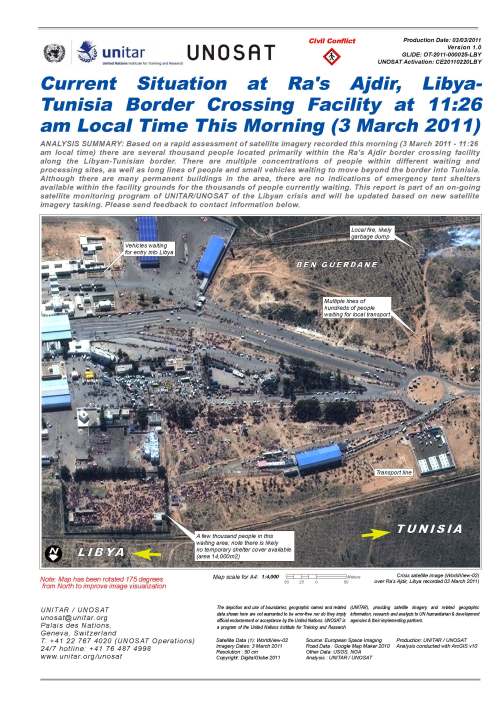
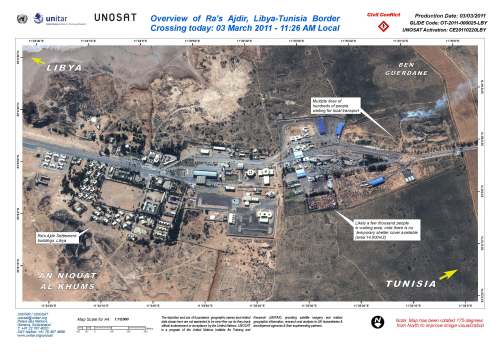
From UNITAR/UNOSAT:  “Based on a rapid assessment of satellite imagery recorded this morning (3 March 2011 – 11:26 am local time) there are several thousand people located primarily within the Ra´s Ajdir border crossing facility along the Libyan-Tunisian border. There are multiple concentrations of people within different waiting and processing sites, as well as long lines of people and small vehicles waiting to move beyond the border into Tunisia. Although there are many permanent buildings in the area, there are no indications of emergency tent shelters available within the facility grounds for the thousands of people currently waiting. This report is part of an on-going satellite monitoring program of UNITAR/UNOSAT of the Libyan crisis and will be updated based on new satellite imagery tasking.”

Click on pictures below or here for links to images.


1 Comment

Filed under Data / Stats, Libya, Mediterranean, News, OCHA, Tunisia, United Nations

UN OCHA Situation Report 3 on Libya

OCHA Situation Report 3 on Libya.  HIGHLIGHTS/KEY PRIORITIES:

  • On 1 March, an estimated 12,000 people were evacuated from the Tunisia-Libya border to Egypt by air and sea;
  • A United Nations joint rapid assessment mission is currently in eastern Libya proceeding to Benghazi to assess humanitarian needs;
  • The United Nations Emergency Relief Coordinator has allocated some US$5 million from the Central Emergency Response Fund to kick-start emergency efforts to help people fleeing violence in Libya.

Click here for Report.

Leave a comment

Filed under Egypt, Libya, Mediterranean, News, OCHA, Reports, Tunisia

CERD Issues Urgent Call for Protection of Non-Citizens and Migrants in Libya

Acting pursuant to its early warning and urgent action procedures, “[t]he United Nations Committee on the Elimination of Racial Discrimination called on the international community and the UN system to seek urgent measures to protect non-citizens, migrant populations, migrant workers, refugees and other minority groups in Libya….”

Click here for Relief Web summary and here for CERD Statement.

Leave a comment

Filed under CERD, Libya, Mediterranean, News, Statements, United Nations

UN OCHA Situation Report 2 on Libya

From the UN Office for the Coordination of Humanitarian Affairs (OCHA), Situation Report No. 2, 1 March 2011:

Libya – thousands of migrants stranded at Benghazi port;

Tunisia – 10,000 to 15,000 people arrived in Tunisia on 1 March, creating a huge bottleneck on the border due to a lack of onward transportation to their home countries. Thousands of people (including over 15,000 Bangladeshis) are stuck on the Libyan side of the border and are not allowed to cross. They are stranded and without access to food, health, water and sanitation;

Egypt – 5,000 to 7,000 migrants stranded in the border area at Saloum, in “no man’s land”. The Egyptian authorities are not allowing those without valid tickets and documentation to leave. According to IOM, these stranded migrants need food, water, blankets, shelter and proper sanitation facilities. IOM has established a registration process for migrants from African and Asian countries who cannot continue their journey into Egypt because of lack of travel documents or entry visas;

Niger – IOM is preparing for the arrival later this week of an estimated 2,000 Nigerians and other African nationals who have recently managed to cross Libya’s southern border at Gatrone.

Click here for full document.

Leave a comment

Filed under Egypt, Libya, Mediterranean, News, Niger, OCHA, Tunisia

Chaos at Libyan-Tunisian border

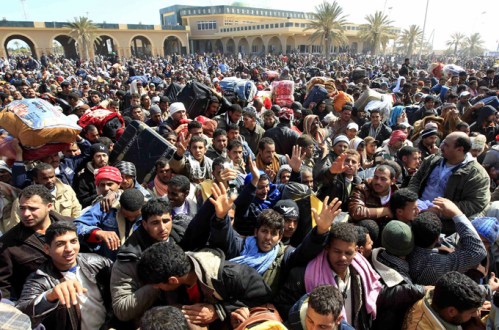
A photo of what is apparently the Ras Jdir (Ra’s Ajdir) crossing on the Libya- Tunisia border on 1 March 2011.  (Photo Credit Reuters via Al Jazeera.)

Reuters via Al Jazeera


Leave a comment

Filed under Libya, Mediterranean, News, Tunisia, UNHCR

UNHCR: Crisis at Libya-Tunisia Border; 140,000 Have Fled to Egypt and Tunisia; Tunisia May Be Barring Sub-Saharan Africans from Entering Tunisia

1 March 2011 update from UNHCR:

“UNHCR staff at the Libya-Tunisia border have this morning told us that the situation is reaching crisis point. According to the Tunisian authorities, 70-75,000 people have fled Libya to Tunisia since 20 February. Fourteen thousand people crossed yesterday, the highest number to date, with tens of thousands of people now in urgent need of onwards transportation to their home countries. With 10,000-15,000 people expected to arrive today…

[T]housands of people have been waiting on the Libyan side to enter for as long as three days, obliged to spend the night outside in the bitter cold without shelter. We are very concerned that a large number of sub-Saharan Africans are not being allowed entry into Tunisia…

Meanwhile at the Egyptian border, the Government reported that some 69,000 people had crossed from Libya since 19 February. The majority of those who have crossed are Egyptians…”

Click here for UNHCR update.

Leave a comment

Filed under Egypt, Libya, Mediterranean, News, Tunisia, UNHCR

Blog du Monde Diplo: une démonstration de force navale; une petite armada converge en direction des côtes libyennes

Du blog de “Défense en ligne” écrit par Philippe Leymarie: “Guerre civile en Libye et options militaries.”

“Alors que le Conseil de sécurité de l’ONU réuni vendredi dernier a décidé d’un embargo sur les armes et de sanctions contre le régime Kadhafi, la violence de la répression en Libye a incité les pays européens, qui n’envisagent pas d’intervention militaire pour le moment, à entamer une démonstration de force… navale, qui a pris forme en quelques heures, avec une célérité inhabituelle. Une petite armada converge en direction des côtes libyennes, dans ce qui pourrait, à terme, devenir une véritable opération, mêlant la dissuasion à l’humanitaire. …

“Dans la pratique, le déploiement de cette petite armada pourrait également constituer un cordon de sécurité afin d’éviter une fuite en masse par la mer de Libyens ou d’immigrés africains vers l’Europe – donnant plus de consistance à l’opération de surveillance « Hermès », entamée (sous la pression notamment de l’Italie, en première ligne) par l’agence européenne Frontex….”

Cliquez ici pour l’article complet.

Leave a comment

Filed under Analysis, European Union, Frontex, Libya, Mediterranean, United Nations

AlertNet: Poor migrant workers feared unable to flee Libya violence

From AlertNet: “Tens of thousands of impoverished migrant workers from sub-Saharan Africa and southern Asia may be trapped by the escalating violence in Libyan cities, unable to leave the country because they cannot pay for transport to border areas, the International Organization for Migration (IOM) said on Thursday. … ‘We are very concerned for all those migrants who may wish to leave, but cannot,’ Laurence Hart, IOM’s chief of mission for Libya, said in a statement. …  IOM spokesman Jean Philippe Chauzy told AlertNet around half a dozen states … to evacuate their nationals from Libya. The agency says it currently does not have the funds to launch such an operation, and will make an appeal for additional contributions on Friday. …  On Wednesday, the U.N. refugee agency (UNHCR) said it had received ‘alarming reports’ Libyans were turning on refugees from other African countries, suspecting them of being mercenaries fighting for Gaddafi’s administration. ‘African refugees from Somalia, Ethiopia and Eritrea have told us that just being a black face in Libya is very dangerous at the moment,’ spokeswoman Sybella Wilkes told Reuters….”

Click here for full article.

3 Comments

Filed under Libya, Mediterranean, News, UNHCR

UNHCR: Imperative that Tunisia and Egypt Continue to Maintain Open Borders With Libya

The UNHCR “welcomed the positive indications it has received over the past two days from Tunisia and Egypt that they will maintain open borders for people fleeing the continuing violence in Libya.”

Click here for full statement.

1 Comment

Filed under Egypt, Libya, Mediterranean, Statements, Tunisia, UNHCR

JHA Council Meets 24-25 Feb – Meeting Topics Include North African Migrants, EASO, Greek Asylum Reform, EU-Turkey Readmission Agreement, and Frontex 2011 Work Programme

The two day JHA Council meeting begins today in Brussels.  According to the Background Note, “ministers will discuss the major influx of migrants from Northern Africa, particularly from Tunisia, to Southern EU member states, especially Italy. They will also look at the state of play on three other important internal border and migration issues:  the implementation of Greece’s National Action Plan on Migration Management and Asylum Reform; [and] the EU-Turkey readmission agreement. In this context, the Communication will present an evaluation and future strategy for EU readmission agreements;…  Ministers will then have exchange of views with the High Commissioner for Refugees (UNHCR) as well as with the Executive Director of the recently established European Asylum Support Office (EASO).”  Additionally, “FRONTEX will present to the committee its work programme for 2011.”

Click here for Background Note and here for Agenda.

Leave a comment

Filed under Aegean Sea, European Union, Frontex, Greece, Italy, Libya, Malta, Mediterranean, News, Tunisia, Turkey, UNHCR