Category Archives: UNHCR

Migreurop Report: European borders- Controls, detention and deportations

Migreurop has released its second report on Europe’s borders: “European borders- Controls, detention and deportations.”  Migreurop describes the report as a “[denunciation of] the « externalization » process of the European union migratory policy [which] shows how third countries are obliged, through the threat of the reconsideration of cooperation agreements and development aid, not only to readmit the migrants chased from Europe, but also to keep them on their own territory from travelling towards its doors.   From Calais area in France to the edge of Turkey and the Adriatic sea, from the surroundings of Gibraltar to the Sahel Saharan desert and the new member states of eastern Europe, a subcontracting of migratory control is carried out in series, sometimes very far away from the Union but also within its territory, especially when it deals with sending asylum seekers from country to country considered as unwanted. A large population of exiles, from both sides of the European borders, is subjected to arbitrary incarceration, wandering, and the constant humiliation of a hostile environment….”

Here is the Table of Contents:

Introduction

  • What have migrants become 3

Ceuta, a gilded prison

  • A murderous border 7
  • A legal limbo 8
  • The situation of migrants in detention 8
  • The situation of migrants in the CETI (open centre) 9
  • Deportations and expulsions 12
  • Surviving without resources 14

Sahel-Saharan countries, Europe’s new sentries

  • I – European interference in inter-African migrations – the case of Mauritania 18
    • The “crisis of the cayucos” 18
    • 1. Cooperation instigated by Europe 18
    • 2. Mauritania tramples on its own principles and conforms 21
    • 3. Subcontracting repression and endangering foreigners 22
  • II – Bargaining between Libya and Europe: migrants as an exchange currency –the case of Niger 33
    • 1. A reciprocal exploitation 34
    • 2. An increasingly repressive control of borders 37
    • 3. Arrests and detention in Libyan territory 39
    • 4. A deadly expulsion policy 42
  • Conclusion: the real face of Kadhafi’s pan-Africanism 44

Poland, Romania: how to be good state members in the enlarged EU

  • I – At the new frontiers: the screening of migration 47
    • 1. Reducing the transit and deserving Schengen 48
    • 2. The border police, Frontex and cooperation with other European states 48
  • II – Reception and detention centres 52
    • 1. The detention of foreigners 52
    • 2. Reception centres: isolating asylum seekers 60
    • 3. “Dublinized” asylum seekers 61
  • III – Returns 63
  • IV – Intolerance towards migrants and refugees 66
  • V – Embryonic mobilizations 70

The Ionian and Adriatic seas: forced returns between Italy and Greece

  • A new migration route at Europe’s gates 73
  • I – Controlling and blocking 75
    • 1. Controls in Greece 75
    • 2. Controls at sea 77
    • 3. Controls in Italian ports 78
  • II – Turning back and readmission 82
    • 1. Arbitrary practices and violation of rights 82
    • 2. The port of Venice: collective returns 83
    • 3. The port of Ancona 86
    • 4. Forced return to Greece 86
  • III – Detention 88
    • 1. At the borders and at sea: areas beyond legality 88
    • 2. Detention in Italy 89
    • 3. Detention in Greece 90
  • IV – Some cruel situations 93
    • 1. In Greece 93
    • 2. In Italy 96
  • V – Mobilizations 97
    • 1. In Venice 97
    • 2. In Ancona 97
    • 3. In Greece 98

Ping-pong at the Greco-Turkish border

  • Selective expulsions and random readmissions 106
  • Reactions to a degrading and sometimes murderous situation 107
  • Assistance, support, resistance 108

Dismantling the Calais jungle: a deceptive operation

  • I – The declared objectives of the 22 September 2009 operation 112
  • II – The real objectives of dismantling the jungle 113
  • III – The Modus Operandi: brutality and trickery 115
  • IV – What next? 116

Migreurop network 121

Annexes 122

  • Knocking down walls and defending the right to migrate 122
  • UNHCR-Libya : the bid is rising, migrants pay the price 124
  • All for the closure of camps for migrants, in Europe and beyond 125
  • Italia and Libya: hand in hand 127
  • Roma people victims of the French government xenophobia 128

Click here for the report (EN), or  here (FR), or here (ES).

Click here for article (ES) in Periodismo Humano about the report.

1 Comment

Filed under Aegean Sea, Eastern Atlantic, English Channel / La Manche, European Union, France, Frontex, Italy, Libya, Mauritania, Mediterranean, Morocco, Niger, Reports, Spain, Turkey, UNHCR

UNHCR Issues Protection Policy Paper: Maritime Interception Operations and the Processing of International Protection Claims

The UNHCR has issued a Protection Policy Paper: “Maritime interception operations and the processing of international protection claims: legal standards and policy considerations with respect to extraterritorial processing.” (Nov. 2010).

The “paper outlines UNHCR’s views on extraterritorial processing of claims for international protection made by persons who are intercepted at sea.”  UNHCR’s position is that it is not possible to conduct a full and adequate RSD onboard a ship and therefore intercepted persons should in most circumstances be disembarked in the territory of the intercepting state to have their claims for protection considered in regular in-country RSD procedures.

The paper should be read in its entirety (17 pages).  Here are some excerpts (with most footnotes omitted):

“1. Governments in some regions have adopted, or are considering, measures to process certain claims for international protection outside of their territory.  This is particularly the case following maritime interception operations, 2  where asylum-seekers and migrants are prevented from reaching their destination while on the high seas or in the territorial waters of a third State. …

(Ftnt 2 There is no internationally accepted definition of interception, and its meaning is largely informed by State practice. A working definition is provided in Executive Committee Conclusion No. 97 (LIV) (2003) on Protection Safeguards in Interception Measures, available at http://www.unhcr.org/41b041534.html .)

4. If extraterritorial processing is part of a comprehensive or cooperative strategy to address mixed movements, the location of reception and processing arrangements is only one relevant element. With its 10-Point Plan on Refugee Protection and Mixed Migration, (‘10-Point Plan’), UNHCR has developed a tool that provides suggestions across a number of areas, … This paper should be read in conjunction with the 10-Point Plan, and related strategies for comprehensive State cooperation in this field.

[…]

9. The existence of jurisdiction triggers State responsibilities under international human rights and refugee law.  It is generally recognized that a State has jurisdiction, and consequently is bound by international human rights and refugee law, if it has effective de jure and/or de facto control over a territory or over persons….

(Ftnt 10 Some governments have argued that an intercepting State may not have jurisdiction under international law over persons located on parts of its territory that have been excised under domestic law (e.g. declared ‘international’ or ‘transit’ areas in airports, ports and border areas, or other parts of State territory including remote territories or islands), on high seas, or on the territory of a third State that is under the control of the intercepting State (e.g. because the intercepting State is responsible for a military base or reception centre). Such arguments are inconsistent with the notion of jurisdiction under international law. Domestic law is not determinative of the existence of jurisdiction as a matter of fact under international law: The Vienna Convention on the Law of Treaties, 1155 U.N.T.S. 331, 8 I.L.M. 679, entered into force 27 January 1980, Article 27 (providing that a State may not invoke the provisions of its internal law as a justification for its failure to perform a treaty); see also Article 3 of ILC, Draft Articles on the Responsibility of States for International Wrongful Acts with Commentaries (2001).)

55. Processing onboard maritime vessels is generally not appropriate. In exceptional circumstances, that would need to be defined further, initial profiling or prescreening onboard the maritime vessel by the intercepting State may be one solution to ensure that persons with international protection needs are identified and protected against refoulement. Following profiling, those persons identified as having potential protection needs would need to be disembarked in the territory of the intercepting State to have their international protection claims considered in regular in-country RSD procedures….

56. In general the carrying out of full RSD procedures onboard maritime vessels will not be possible, as there can be no guarantee of reception arrangements and/or asylum procedures in line with international standards….”

(My thanks to Dr. Neil Falzon, former Head of UNHCR’s Malta Office, for bringing this to my attention over a week ago – and my apologies for being behind in email and updates. –nwf)

Click here for complete Paper.

Leave a comment

Filed under Analysis, Statements, UNHCR

Yemen to End Prima Facie Refugee Status for Somalis

Yemen announced a plan to end its policy of granting prima facie refugee status to Somali nationals.  If the change is approved by the Council of Ministers, arriving Somalis would be required to make individual requests for refugee status.  The Yemen Observer reported that “[a]ccording to Essam al-Mahbashi, member of the National Committee for Refugee Affairs (NACRA), not all Somalis are fleeing conflict as many of them come from safe regions such as the port of Bosasso in the Puntland region of northern Somalia in search of better economic opportunities. Al-Mahbashi said that the emergence of extremist groups in Somalia like al-Shabab al-Mujahideen is one of the reasons why Yemen wants to cancel the prima facie refugee status policy.”  “Patrick Duplat of NGO Refugees International (RI) told IRIN that RI encouraged countries, including Yemen, to offer Somalis the broadest protection mechanisms possible given the current situation in their homeland. However, he said Yemen’s new policy would be in line with newly issued UNHCR guidelines on Somalis that allow for such screening but call for those Somalis not granted refugee status to be afforded ‘complementary forms of international protection.’”

Click here for article.

1 Comment

Filed under Gulf of Aden, News, Somalia, UNHCR, Yemen

ECRE Critical of EU Migration Agreement with Libya

ECRE has posted a statement on its web site that is very critical of the recent EU-Libya Migration agreement.  Also posted is an interview with MEP Sylvie Guillaume (S&D, France) who is a member of the LIBE Committee where she discusses the human rights implications of the EU agreement.

Excerpts from ECRE’s Statement:  “It is difficult to understand why the EU is finalising a deal with the political dictatorship in Libya on issues that impact the fundamental rights of thousands of people. In June this year, Tripoli ordered the UN Refugee Agency, UNHCR, to close its offices in the country, a perfect illustration of Libya’s particular understanding of refugee protection and the unreliable nature of the regime under Colonel Gaddafi. Can we honestly think that refugees are safe in Libya? …

Through this ‘migration cooperation agenda’, the EU is trusting Libya to stop irregular migration towards Europe and to decide on the fate of those asylum seekers who will find it now even harder to reach safety in Europe. This follows last year’s highly questionable agreement between Rome and Tripoli to allow Italy to push back migrants to Libya without assessing their need for international protection. Since then, hardly any refugee has managed to reach Italy by sea. The EU Governments and the European Commission have so far turned a blind eye….

In particular, EU representatives have committed to assist Tripoli in reinforcing its capacity to prevent migrants from entering Libya through its Southern borders and in developing its patrolling capacities in its territorial waters and at high sea. The agreement also covers EU’s assistance to Libya in screening migrants in order to identify those in need of international protection. By setting up EU-sponsored asylum processing centres in Libya, EU States would evade their obligations to protect refugees and shift the responsibility to a country with an appalling human rights record….”

Click here for full statement.

Click here (EN) and here (FR) for interview with MEP Sylvie Guillaume.

1 Comment

Filed under European Union, Italy, Libya, Mediterranean, Statements, UNHCR

Erika Feller’s Comments Regarding Boat People and Irregular Secondary Movements

During her annual address to the UNHCR’s Executive Committee on 6 October, Assistant High Commissioner for Protection Erika Feller reviewed significant protection issues over the past year, noting also that 2010 marks the 60th anniversary of the founding of the UNHCR in December 1950 and the 59th anniversary of the Refugee Convention.

Among the topics she addressed were the challenges posed by the arrival of irregular secondary movements of migrants, including boat people.  She is critical of interdiction practices being carried out throughout the world and makes the strong point that “[t]he evidence suggests that tough sea policies have not solved, just changed and indeed complicated the dynamics, of irregular movements.”  While Ms. Feller does not identify countries by name, she is apparently referencing increased maritime interdiction in the Aegean Sea and the resulting surge in irregular crossings along Greece’s land borders.  The point could also be made in regard to the Italian push-back practice.

Excerpts from her address:

“Arrivals of undocumented migrants continue to test the capacity of States, with the problem of so-called “irregular secondary movement” exacerbated in recent years by boat arrivals. The Pacific, the Mediterranean, the Caribbean or the Gulf of Aden are all regular theatres, with ‘boatpeople’ being interdicted, intercepted, turned around, ignored by passing ships, shot at, or denied landing. Even when rescued, disembarkation somewhere has no guarantees attached, as an incident currently playing out off the Somalia/Djibouti coasts starkly reminds us.

All this is seriously at odds not only with protection principles but also with the reality that when they manage to gain access to territory and asylum processes, a large percentage of asylum-seekers who come by boat are actually found to be refugees. …

Boat arrivals can provoke fears and high emotions which may be difficult for Governments to manage. However, in our experience, an approach built predominantly around closing borders and trying to prevent movement is not the answer, as it does not work. In fact it can make situations even more difficult to deal with. Developments in relation to one country that has pursued a tough policy towards boats are actually quite revealing. While arrivals by sea are dramatically down, arrivals by land have basically doubled. In addition, while sea arrivals had been able to be concentrated through being channeled to one main reception point, land arrivals now come through multiple crossing points and have been able to disperse more effectively and rapidly through the community, below any radar screen. The evidence suggests that tough sea policies have not solved, just changed and indeed complicated the dynamics, of irregular movements….

The phenomenon of refugees on the move for non-protection reasons is also growing. Numbers and categories vary with the regions but the concern is global. On the African continent, where camps are more the norm than the exception, it is preoccupying that camp environments are starting to be compromised by a form of transit migration to and through them, with refugees, and others, seeking to use their facilities for R&R en route to a more distant destination. Just as concerning has been the misuse of reception centers as way-stations, or even lucrative recruitment opportunities for smugglers and traffickers. These facts are not a rationale for abandoning camps or centers. They are, though, a solid reason to rethink how better to manage them within a burden sharing framework….”

Click here for full address.

2 Comments

Filed under Aegean Sea, European Union, Greece, Italy, Libya, Mediterranean, News, Statements, UNHCR

Cecilia Malmström: Back From Libya

Commissioner Malmström writes her own blog, Cecilia Malmström Mitt Europa (My Europe).  Here is her most recent posting regarding her trip to Libya (translated from Swedish with Google Translate).  There are several points worth noting – and worrying about.  She notes that Libya is not a signatory to the 1951 Refugee Convention or 1967 Protocol.  (Though Libya is a signatory to the OAU Refugee Convention.)  She suggests that the new migration agreement between the EU and Libya will involve the UNHCR, but no insight is offered regarding whether or how the UNHCR might return to Libya.  She concedes that the European Commission does not know all of the details of the bi-lateral agreement between Italy and Libya which has resulted in the current push-back practice in the central Mediterranean.  And she seems to say that she was greatly troubled by what she saw when she visited one of the southern migrant detention centres in Libya during her official trip.

Translated excerpts:

“Just returned from Libya … I have been there to try to initiate a dialogue between the EU and Libya on issues relating to asylum, migration and international protection. … I believe it is necessary to have a dialogue with Libya.

Libya has not signed the Geneva Convention and the concept of asylum is not in Libyan law. … Since Italy and Libya signed an agreement, which we unfortunately do not know everything about, it has basically been that case that no boats are crossing the Mediterranean.

Against this background, I see it as progress that the first time we have agreed a text with Libya, a version of a plan for cooperation, which deals with issues of asylum and international protection…  Our aim is to identify people in need of international protection, while helping Libya to raise standards in the detention centres in order to provide decent conditions to people. We also address the issues of border control, labor migration and human smuggling in this plan for cooperation. From the EU side, we are prepared to put up 50 million euros over three years to support reforms. These will obviously not be given as a blank check to Libya but will be provided using the guidelines of the European Commission. For example, we support specific projects by various organizations, including the UNHCR.

Besides holding talks with Libyan ministers, I also visited Libya’s southern border in the middle of the desert, observed International Organisation for Migration activities in Libya, and visited one of the detention centres where many migrants have ended up. I had the opportunity to talk to some of the people there.  Several of these stories that I heard have kept both me and my staff awake at night. …”

Click here for the full posting.

3 Comments

Filed under European Union, Italy, Libya, Mediterranean, News, UNHCR

Libya May Allow Eritreans to Remain – Italy Claims Credit for Decision

Libya has reportedly agreed to allow approximately 400 Eritreans to remain in Libya, though they will not be given refugee protection as Libya is not a signatory to the Refugee Convention.

ANSAmed reported that Italian officials have claimed credit for Libya’s decision, though the Italians have questioned whether any of the Eritreans have been mistreated and whether any of the Eritreans were subjected to Italy’s push-back practice.  Italian Foreign Ministry Undersecretary Stefania Craxi stated that ”the Italian government never backed away from raising awareness with[] Libyan authorities on the topic of human rights.”  Craxi said ”it is thanks to the Italian government [that] the UNHCR activities in Tripoli have started again, albeit in an informal and conditioned way.”  Foreign Minister Franco Frattini said ”it is unbelievable that Brussels did not even make a press release.  [Italy] worked in silence, without proclamations, sadly with the total and absolute absence of Europe. We asked for a compromise, a mediation and the result came.”

While it is good if the Italian Government did indeed work to arrive at a temporary and imperfect solution for this particular group of Eritreans and it is good that the Italian ministers speak of respecting human rights in Libya, the Italians should be equally if not more concerned with the human rights implications of their push-back practice in the Mediterranean.

Click here for article.

Leave a comment

Filed under European Union, Italy, Libya, Mediterranean, News, UNHCR

Hammarberg Makes Urgent Request of Italy for Information on Eritreans in Libya

COE Human Rights Commissioner Thomas Hammarberg has made an urgent request to the Italian Government for information on alleged human rights violations of Eritrean migrants in Libya, including Eritreans who may have been among persons intercepted at sea by Italy and forcibly returned to Libya without being afforded an opportunity to seek international protection.

In a letter to the Italian Foreign Minister, Commissioner Hammarberg wrote “[g]iven the recent decision of the Libyan authorities to discontinue UNHCR’s activities in the country, it is increasingly difficult to confirm the exact accuracy of these reports. However, given their consistency and the seriousness of the allegations, I hope that I can count on your cooperation to urgently clarify the situation with the Libyan authorities and be kept informed about the results of your investigations.”

The Foreign Minister and Interior Minister have written a joint letter to the Il Foglio newspaper where they say that the Italian Government “was mediating with Tripoli to identify the Eritreans and try to find them employment in Libya so that they would not be forcibly repatriated.”  According to Reuters, the ministers also said “it was necessary to respect Libyan sovereignty and [they] called for an international approach, involving the United Nations and other organizations” and that the “fate of these Eritrean citizens cannot be resolved only through our bilateral relationship (with Libya).”

Click here for the Commissioner’s letter to the Italian Foreign Minister.

Click here for the Commissioner’s letter to the Italian Interior Minister.

Click here for article.

Click here (IT) for Italian Ministers’ Reply to Il Foglio.

Leave a comment

Filed under Commissioner for Human Rights, Italy, Libya, Mediterranean, News, UNHCR

Libya to Permit UNHCR to Resume Limited Activities

The UNHCR announced on Friday that it has received permission to resume some activities in Libya.  The UNHCR said that “its operations will be restricted to only its current caseload” in Libya.

Libyan officials have offered several reasons for why the Libyan government ordered UNHCR to cease operations several weeks ago, including complaints that UNHCR entered into cooperation agreements with local NGOs within Libya without authorisation, rented office space without permission, displayed the UNHCR logo improperly, and, most recently, that one or more persons associated with UNHCR accepted bribes and/or sexual favours from persons in exchange for refugee status.

“UNHCR spokesperson Adrian Edwards stressed that the Libyan allegations remain unsubstantiated. He told journalists in Geneva that talks on the agency’s future in the country will resume shortly and that the expulsion order has not yet been formally lifted. ‘UNHCR does take very seriously any accusation against any UNHCR staff member from whatever source,’ he said. ‘We have a zero tolerance policy for misconduct. We have asked the Libyan Government to substantiate these particular claims. If and when we receive these indications, we will be in a position to investigate through our normal procedures.’”

Click here for UN statement.

Click here, here, here (EN) and here (AR) for articles.

Leave a comment

Filed under Libya, Mediterranean, News, UNHCR

Updated CARIM Overview of Migration Developments in Libya

CARIM just issued a short paper, Libya: The Migration Scene – Which implications for migrants and refugees?: “In the light of UNHCR’s announcement of the 8th of June 2010 that it was requested to close its offices in Libya, CARIM provides an overview of migration developments in Libya from sociopolitical, legal and demographic-economic perspectives.”

Click here for the document.

Leave a comment

Filed under Analysis, European Union, Libya, Mediterranean, UNHCR

Amnesty Int’l Report on Libya Criticises Libya and EU on Refugee Treatment

Amnesty International has released a comprehensive report on Libya entitled “Libya of Tomorrow – What Hope for Human Rights?”  The report covers a range of matters including the criminal justice system and the use of the death penalty.   Section 5 of the report (beginning at p 91) addresses the rights of refugees, asylum-seekers and migrants.  The report was finalised before the recent decision of the Libyan government to close the UNHCR office in Tripoli.

In regard to refugee issues, Amnesty is very critical of both Libya and the EU and calls upon EU member states to “ensure that any bilateral agreements with Libya in the area of migration and asylum, including the EU-Libya Framework Agreement currently being negotiated, are based on full respect for the rights of asylum-seekers, refugees and migrants.”

Excerpts from Section 5, “Rights of refugees, asylum-seekers and migrants”:

Members of the EU have been actively seeking the collaboration of Libya in controlling the flow of migrants to European shores – turning a blind eye to Libya’s dire human rights record, the absence of a functioning asylum system in Libya, and persistent reports of the abuse and ill-treatment of refugees, asylum-seekers and migrants.  The Treaty of Friendship, Partnership and Co-operation signed in August 2008 between Italy and Libya includes provisions for bilateral efforts to combat “illegal migration”, facilitated by the joint patrolling of the sea agreed upon in December 2007 in the “Protocol” and the “Additional Technical-Operational” Protocol”.

As part of the agreements, Italy promised to compensate Libya for its occupation of the country between 1911 and 1943. The Treaty of Friendship, Partnership and Co-operation involves a US$5bn package for construction projects, [and other items].  In return, Libya agreed, among other things, to tighten control of its territorial waters and accept disembarkation on its soil of individuals intercepted at sea by Italian vessels. Italy was also reported to have undertaken to provide resources, including technology, to control migrant flows through the southern borders of Libya. In fact, Italy has provided Libya with six motor patrol boats since the Treaty entered into force.

In the framework of these agreements, from May 2009 onwards Italy started returning refugees, asylum-seekers and migrants intercepted in international waters to Libya. On 6 May 2009, distress calls were sent from three vessels with an estimated 230 third-country nationals on board. Italian coastguard vessels intervened but transported the individuals to Tripoli, without stopping in an Italian port and without checking whether any individuals on board were in need of international protection or basic humanitarian assistance. Further interceptions and returns occurred in the subsequent months: according to official information from the Italian Ambassador to Libya, between 6 May and 3 September 2009, over 1,000 individuals were returned to Libya. They included nationals from Eritrea, Somalia and other sub-Saharan African countries. The Italian Minister of the Interior Roberto Maroni was reported to have called this action “an historic achievement after one year of bilateral negotiations with Libya”….

Despite these pleas by UNHCR and consistent reports of abuses suffered by refugees, asylum-seekers and migrants in Libya, the Italian authorities continue to intercept vessels at sea and send them back to other countries most notably Libya.  In January 2010, Italian Minister of the Interior Roberto Maroni stated that the number of migrants arriving to Italian shores was reduced by 74 per cent in 2009 compared to 2008, attributing the reduction to Italy’s bilateral agreements with Libya.

Italy is not alone in seeking Libya’s cooperation to control the flow of migrants to European shores. Negotiations between Libya and the EU over a Framework Agreement started in November 2008 covering the control of migration, among other issues, including potential readmission agreements for third-country nationals who have transited through Libya on their way to Europe….

UNHCR [prior to its recent expulsion from Libya] and its partners have also been involved in screening individuals pushed back to Libya from Italy. UNHCR declared that by October 2009, it had been able to screen 890 people and had registered 206 of them as refugees and secured their release from detention.  UNCHR also registered 80 individuals pushed back from Italy in November 2009, granting 40 of them refugee status. The remainder were awaiting their interviews for refugee status determination at the time of writing. UNHCR confirmed that a total of 685 individuals determined to be refugees or asylum-seekers were released from detention from 2008 to February 2010, including 450 Eritreans and 150 Somalis…..

Click here for the Report.

Click here for AI Press Release regarding the Report.

Leave a comment

Filed under European Union, Italy, Libya, Mediterranean, Reports, UNHCR

World Refugee Day 2010

UNHCR World Refugee Day 2010

Leave a comment

Filed under UNHCR

ECRE: Can EU Trust Libya With Refugee Protection?

ECRE issued a press release last week regarding Libya’s decision to expel the UNHCR:

“Bjarte Vandvik, Secretary General of the European Council on Refugees and Exiles (ECRE) said: ‘UNHCR’s expulsion from Libya will hopefully be temporary but it does reveal the unreliability of this regime, as well as its understanding of refugee protection. How will the EU ensure that Libya keeps its word regarding commitments towards human rights? How can the EU trust such a partner?’”

“ECRE calls on the EU to seriously reconsider its cooperation on asylum and refugee issues with Libya, a country that is not a party to the 1951 Geneva Refugee Convention. In particular, negotiations on an EU – Libya framework agreement must now be reviewed, as should any EU funding that supports Libyan authorities in intercepting refugees along their Southern border…. While UNHCR”s presence does not make Libya a safe place for refugees, the decision to prevent UNHCR from operating in the country once again illustrates the real intentions of the Libyan authorities when it comes to refugee protection. The EU cannot simply continue to ignore this reality but should make clear that the protection of refugees is still a fundamental value of the EU.”

(HT to Ana Lopez, ECRE’s Media and Information Officer).

Click here for full ECRE statement.

1 Comment

Filed under European Union, Libya, Mediterranean, Statements, UNHCR

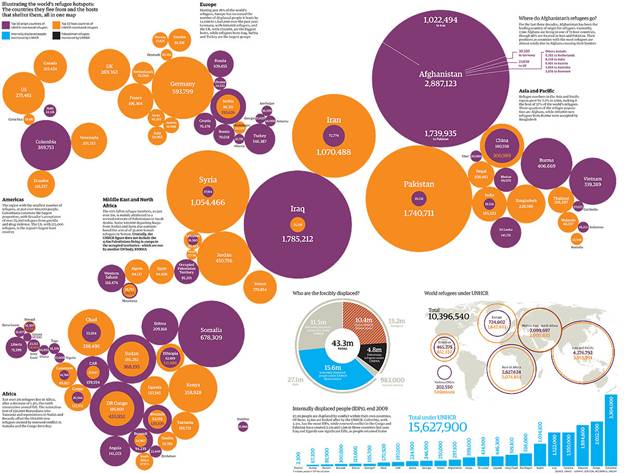
UNHCR Report: 2009 Global Refugee Trends & Guardian Data Map

The UNHCR released its annual report this week for last year: “2009 Global Trends- Refugees, Asylum-seekers, Returnees, Internally Displaced and Stateless Persons.”

The UNHCR estimates that approximately 43.3 million people were forcibly displaced at the end of 2009.  South Africa continued in 2009 to be the destination country receiving the largest number of new asylum seekers (222,000).  The US and France were second and third with less than 50,000 new asylum seekers.

The Guardian’s Data Blog published an interesting graphic with the UNHCR statistics.

Click here for UNHCR web article.

Click here for link to the UNHCR Report.

Click here for link to the Guardian’s map.

[UNHCR refugee statistics mapped. Illustration: Paul Scruton for the Guardian.]

Leave a comment

Filed under Data / Stats, Reports, UNHCR

Side Meeting on Boat People at Upcoming UNHCR-NGO Consultations

The annual UNHCR-NGO consultations will take place beginning 29 June (registration is closed).  Various side-meetings will also be held, including one on 1 July: “A hearing on Boat People: Different people, different needs and rights to protection.” Palais des Nations, Geneva, 13h15 – 14h45, Room XXII

“A hearing on Boat People: Different people, different needs and rights to protection.

Brief description: What are the needs of today’s boat people—and how can these needs be differentiated and matched to rights and practical responses of protection and assistance—among boat people arriving in Europe or Yemen from Africa; in the US from Haiti; in various parts of south and southeast Asia and Australia from Burma or Sri Lanka, or following other sea crossings? This session is organized as a hearing, not a series of presentations. It will begin with a brief introduction of the importance of differentiating needs and rights to protection and assistance among all the people arriving, (i.e., refugees, victims of human trafficking and smuggling, victims of torture, children, etc.) Conclusions from an experts roundtable in Tunis last year will then be offered as a reference, which participants will be invited to comment upon and at the end of the session, consider supporting. During the bulk of the session however, panelists from UNHCR, IOM, IFRC and UNODC will serve as a hearing board: listening, probing and recording the experience, concrete practices and recommendations of NGO participants who respond to boat people, either in Europe or in other parts of the world. Input will then be organized and submitted to the international organizations and to government policy makers, including the European Union and Council of Europe through the new EU-funded NGO partnership “DRIVE” (Differentiation for Refugee Identification and Vulnerability Evaluation).”

Click here for full Side Meeting agenda.

Leave a comment

Filed under Colloques / Conferences, UNHCR