European Patrol Network Meeting, 23-24 Sept.

The quarterly meeting of the European Patrol Network (EPN) will be held 23 and 24 September in Bruges.  EPN was established by Frontex and unites the members of the agency’s operational branch of the ‘Joint Maritime Operations’.

According to the Belgian Police EU Presidency Newsletter, 7th Edition, the purpose of the meeting is to “allow the participating countries to ensure better coordination of the operations….  A number of technical points will come up for discussion, but for instance also the progress of the [Frontex] 2010 Joint Operations, the creation of a national coordination centre, the issue of the interpreters, as well as the Eurosur project. At present the efforts of the EPN are mostly focused on the Mediterranean, due to the immigration pressure from this region.”  (The Newsletter says the meeting is scheduled for October, but the Belgian Integrated Police – Belgian Presidency of the EU website indicates the meeting is 23-24 September.)

Leave a comment

Filed under Belgium, European Union, Frontex, Mediterranean, News

RSQ Article: Refugees, Europe, Camps/State of Exception: “Into The Zone”, the EU and Extraterritorial Processing of Migrants, Refugees, and Asylum-seekers

The latest issue of Refugee Survey Quarterly has been released (2010; Vol. 29, No. 1).  An article by Dr. Carl Levy (Reader in European Politics, Department of Politics at Goldsmiths College, University of London) is of particular interest.

Here is the Abstract:  This article outlines the debate over extraterritorial processing in the European Union (EU) from the Treaty of Amsterdam (1997) to the Treaty of Lisbon (2009). It will briefly outline the historical precedents, the evolution of policy within the EU, and the role of other models (Australian, American, etc.). This article emphasizes the contested understandings of how these zones might be manifested in practice. It uses evidence from the political history and policy-making of the EU to question Giorgio Agamben’s concept of the state of exception. In fact, the promotion of extraterritorial zones was not merely sold as necessary, if unfortunate, choices. Likewise, the more sinister interpretation of these zones as a regression from the Liberal State to the universe of camps failed accurately to capture what was happening in reality. Firstly, supranational extraterritorial processing was beyond the constitutional or political capacity of the EU. Secondly, at times, the unintended consequences might have led to a liberalization of so-called “Fortress Europe” and caused certain politicians to become disenchanted precisely because the proposed form of extraterritorial processing threatened to institute a rigorous form of burden sharing.

Click here for link to Journal.  (Subscription required.)

Leave a comment

Filed under Analysis, European Union, Frontex

ECRE Statement Re EU Conference on Quality and Efficiency in the Asylum Process

ECRE released a statement at the conclusion of this week’s EU Ministerial Conference on Quality and Efficiency in the Asylum Process:

“… Since its peak in the early 1990s, the number of asylum applications lodged within the European Union has experienced a sharp decline, despite the increase in some individual Member States. However, a difficult political and economic environment in Europe is fuelling little appetite for welcoming foreigners, which is translated into a slow progress at the table of negotiations to build a Common European Asylum System.

ECRE believes that initiatives to increase practical cooperation, such as this conference and the establishment of a European Asylum Support Office, which will soon be up and running in Malta, will help to make the asylum system fairer and more efficient. For instance, yesterday’s discussions have provided examples of how to improve the treatment of children or traumatised asylum seekers. Also, pooling resources with regard to information about the home countries of asylum seekers, interpretation services and training can contribute to better decisions.

Bjarte Vandvik, ECRE’s Secretary General, said: ‘The current EU asylum system is failing both Member States and people who arrive to Europe fleeing war or persecution. Practical cooperation is part of the solution but will not be enough. European Member States also need to resolve the impasse in the negotiations and work together to agree on fairer common asylum rules’.

Asylum seekers still have hugely different chances of being granted international protection depending on the EU country that will examine their application. For instance, in 2009, virtually no Iraqis were recognised as refugees in Greece, while in Germany, 77% of Iraqi asylum seekers were granted international protection and could rebuild their lives. A harmonised asylum system with higher standards of protection would not be only fairer; it would also be more efficient and less costly in the longer term.”

Click here for information on the Conference organised by the Belgian Presidency.

Click here for Commissioner Cecilia Malmström’s statement at the conference.

Leave a comment

Filed under European Union, News, Statements

Patrol Boat Given to Libya by Italy Fires On Italian Fishing Vessel

One of the six Italian patrol boats given to Libya by the Italian government to assist in efforts to stop migrants from leaving Libya fired on an Italian fishing boat in the Gulf of Sirte on Monday.  An Italian official was on board the Libyan vessel as an observer during the incident.  Libya apologised for the incident which is being investigated.

Click here and here for articles.

1 Comment

Filed under Italy, Libya, Mediterranean, News

Dutch Govt Position on Asylum Requests Made at Sea

The Dutch Minister of Justice, E.M.H. Hirsch Ballin, recently outlined the Dutch government’s position regarding the proper handling of asylum requests made by migrants who are intercepted at sea during Frontex coordinated operations.  The position is contained in a letter sent by the Justice Minister to the Chairman of the Dutch Senate on 3 September 2010.

This recent statement was brought to my attention by Dr Matteo Tondini, Vrije Universiteit Amsterdam, who succinctly summarized the Dutch Government’s position as follows:

  1. Dutch vessels are not a portion of Dutch territory;
  2. Asylum requests of migrants made on board Dutch vessels must be assessed by a competent authority (not by Dutch authorities, however, but possibly by the host nation); and
  3. The Netherlands considers this as a conditio sine qua non for its participation in FRONTEX operations at sea.

The Minister’s letter refers to provisions of the Council Decision re Rules for Sea Border Operations Coordinated by Frontex the validity of which is now being consider by the European Court of Justice pursuant to a challenge by the European Parliament.

I reproduce here an English translation of the Justice Minister’s letter provided by Dr  Tondini:

“21 501-28  Defense Council – Nr. 61  Letter from the Minister of Justice

To the President of the House of Representatives, The Hague, September 3, 2010

With this letter I keep my promise, made during the debate on 18 June 2008, to brief your House about the operational requirements for Frontex operations at sea. I also come here after the commitment undertaken by the then State Secretary for European Affairs on 16 June 2009 to your Chamber, about the procedure to be followed if a request for asylum is made on a Dutch ship during Frontex operations at sea.

Introduction

FRONTEX coordinates the operational cooperation between independent States which are competent for the management of external borders. Different operations of member states under the coordination of Frontex have been carried out in this framework. Due to a call by the European Council for clear rules and uniformity in the implementation of Frontex operations at sea, in 2007 the Commission was mandated to draw the requirements for the Agency’s maritime operations.

Operational requirements for Frontex operations at sea

The creation of these rules was a laborious and lengthy process. Based on the results of an extensive debate within a group of experts from the European Commission, the European Commission has drafted rules for Frontex operations at sea in the context of the surveillance of the external borders, in order to prevent illegal migration. The attached decision that embeds these rules, is a supplement to the Schengen Borders Code and applies since 4 May 2010.

In Part I of the Annex, the Decision contains a number of mandatory requirements for the interception of migrants in the contiguous zone and on the high seas. Part II of the Annex to the decision includes a number of non-binding rules on the search and rescue of people in distress during Frontex operations at sea, concerning the safe debarkation of survivors.

These requirements are a specification of the international norms and regulations on the interception and the search and rescue of people in distress at sea, contained in the UN Convention on the Law of the Sea, the International Convention for the Safety of Life at Sea and the International Convention on Maritime Search and Rescue.

In the Decision it is stated that these requirements are included and elaborated in the operational plans for each operation set up by the Agency. The arrangements for the rescue and debarkation of migrants in distress are also included in the operational plan. Furthermore, Section No. 1.2 of the Annex I to the Decision explicitly indicates the principle of non-refoulement.

The rules contained in the decision will contribute to create a greater uniformity of action between Member States during FRONTEX maritime operations and will make it possible to address Member States when they deviate from the norms concerning the activities related to the interception and the search and rescue of people at sea.

Procedure to request asylum on Dutch ships during Frontex operations at sea

An asylum request can only be submitted to the responsible authority of the state in which territory – including the territorial waters – the application is made. A Dutch ship is not part of the Dutch territory and on a Dutch ship there is no authority responsible for handling applications, being the commander of the ship not entitled to receive them. However, on a Dutch ship the Dutch jurisdiction applies.

In this regard, it is the responsibility of a Dutch ship’s commander that if a migrant on board expresses a wish to submit an application, this is not left without consequences. This requires that an alien who thinks to need protection has to be returned only after his/her request has been assessed and there is no reason to grant the protection in question. These migrants should therefore be given the opportunity to submit an application to a competent authority.

In the operational requirements for Frontex maritime operations it is provided that Member States should clarify in the operational plan for Frontex operations the steps to be taken with regard to intercepted or rescued people who are in need of protection and the place of their debarkation, according to international law and all the applicable bilateral agreements.

This means that the operational plan may include an explicit provision on that it is the host nation which is responsible for handling the applications of intercepted or rescued migrants made on board the Dutch ship. The Netherlands considers the inclusion of this provision as a condition to participate in a Frontex operation.

Member States are always bound by the principle of non-refoulement under the 1951 Refugee Convention and the European Convention for the Protection of Human Rights and Fundamental Freedoms (ECHR).

In addition, during the training provided by Frontex much attention is given to the preparation of border guards in the field of asylum and refugee law, focusing in particular on the identification of asylum seekers within mixed migration flows. Courses are aimed to even better prepare border guards to properly identify the protection needs of refugees.

The Minister of Justice, E.M.H. Hirsch Ballin”

Click here for the Letter (NL).

(I thank Dr Tondini for this information and the translation.  -nwf)
Leave a comment

Filed under European Union, Frontex, Netherlands, News, Statements

Commission Report on Asylum Procedures Directive

The European Commission issued on 8 September 2010 a periodic Report on the Asylum Procedures Directive (Council Directive 2005/85/EC of 1 December 2005, on minimum standards on procedures in Member States for granting and withdrawing refugee status).  The Report identified numerous “shortcomings in existing common standards” according to the Commission Press Release which accompanied the Report.

One purpose of the report is to “give[] an overview of the transposition and implementation of the Directive in Member States, including possible problematic issues.”  While the report includes a short section (Sect. 5.2.7.) discussing application procedures at Member State borders, it does not address application procedures beyond borders, e.g. in international waters.

The report concludes as follows:  “This evaluation confirms that some of the Directive’s optional provisions and derogation clauses have contributed to the proliferation of divergent arrangements across the EU, and that procedural guarantees vary considerably between Member States. This is notably the case with respect to the provisions on accelerated procedures, ‘safe country of origin’, ‘safe third country’, personal interviews, legal assistance, and access to an effective remedy. Thus, important disparities subsist. A number of cases of incomplete and/or incorrect transposition and flaws in the implementation of the Directive have also been identified. The cumulative effect of these deficiencies may make procedures susceptible to administrative error. It is noteworthy, in this regard, that a significant share of first instance decisions is overturned on appeal.

“The present report shows that the objective of creating a level playing field with respect to fair and efficient asylum procedures has not been fully achieved. The Commission will continue to examine and pursue all cases where problems of transposition and/or implementation have been identified, so as to facilitate the correct and consistent application of the Directive, and to ensure full respect for the principle of non-refoulement and other rights enshrined in the EU Charter. Procedural divergences caused by the often vague and ambiguous standards could only be addressed by legislative amendment. Accordingly, and on the basis of a thorough evaluation of the implementation of the Directive, the Commission adopted on 21 October 2009 a proposal to recast the Directive in order to remedy the deficiencies identified.”

Click here for the Report.

Click here for the Commission Press Release.

Leave a comment

Filed under European Union, News, Reports

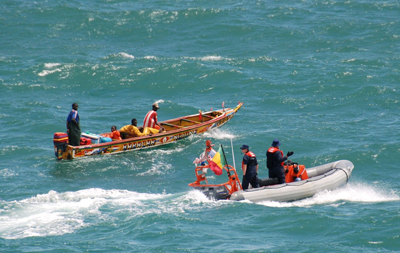
Joint US–Senegal Maritime Patrols

U.S Navy photo by Lt. Cmdr. James Stockman/Released

The United States Coast Guard recently completed a joint mission in cooperation with a Senegalese Law Enforcement Detachment (LEDET).   Such patrols have been conducted with several other African countries.   The US Coast Guard operations were conducted under the umbrella of the U.S. Military’s Africa Command and are a part of the ongoing African Maritime Law Enforcement Partnership (AMLEP).   While it is unclear whether this particular joint mission resulted in the interception of migrants, the US military article refers to numerous vessels stopped and searched for a variety of reasons, including narcotics interdiction.  The US vessel involved in this recent joint operation, USCGC Mohawk, frequently patrols the Haitian and Bahamian coasts as part of the US “Alien Migrant Interdiction Operations.”

Click here for US Military article.

Leave a comment

Filed under Eastern Atlantic, News, Senegal, United States

IMO Information Resources on Stowaways/Illegal Migrants/Treatment of Persons Rescued at Sea – update

The International Maritime Organization’s (IMO) Maritime Knowledge Centre updated in August its  Information Resources document on “Stowaways / Illegal Migrants / Treatment of Persons Rescued at Sea.”

The document contains information, citations, and links to IMO documents, publications, circulars, and reports, as well as non-IMO citations and / or links to many other resources, including relevant UN reports, resolutions, and treaties.

Click here for the document.

Leave a comment

Filed under General, Reports

FRA Call for tender: Treatment of third country nationals at the EU’s external borders

The EU’s Fundamental Rights Agency has issued a call for tender.

From FRA:  The overall objective of the project is to examine the treatment of third-country nationals at the external borders of the European Union in light of the existing fundamental rights framework. The project will not cover all fundamental rights issues that may emerge in the context of management of external borders, but focus on 2 specific components.

The first component of the project focuses on the southern maritime borders of the European Union. The second component of the project will analyse the treatment of third-country nationals at border crossing points.”

The first part of the fieldwork (relating to interception and rescue at sea) will be carried out in Cyprus, Greece, Italy, Malta and Spain and the second part in 10 border crossing points to be identified among those with the highest number of entries of third country nationals into the Schengen area.

Duration: 23 months; Budget: 760.000,00 EUR;

Deadline for submission of proposals: 13 September 2010.

(Noted earlier today on the Migration and Law Network listserve.)

Click here for full information.

Leave a comment

Filed under Aegean Sea, European Union, Mediterranean, News

ECJ Invites Council to Submit Statement of Defence re EP Challenge to Frontex Sea Borders Rule

In an Order issued on 28 July, the European Court of Justice invited the European Council to submit a statement of defence in:  Case No. C-355/10, European Parliament v. Council of European Union (Application under Article 263 TFEU for annulment of Council Decision 2010/252/EU).

Here are the relevant portions of the Order (several footnotes omitted):

“1. By application under Article 263 TFEU, notified to the Council on 26 July 2010, the European Parliament asked the Court to annul Council Decision 2010/252/EU of 26 April 2010 supplementing the Schengen Borders Code as regards the surveillance of the sea external borders in the context of operational cooperation coordinated by the European Agency for the Management of Operational Cooperation at the External Borders of the Member States of the European Union.

2. In support of its action for annulment, the European Parliament argues that the Council in adopting the contested decision exceeded the implementing powers set out in Article 12(5) of the Schengen Borders Code to adopt additional measures governing border surveillance.

3. The Council is invited to submit a statement of defence, in accordance with Article 40(1) and Article 81(2) of the Rules of Procedure of the Court of Justice.

[***]”

(Thank you to the editor at Blogging Portal.EU for bringing this new development to my attention – and now back to my vacation break.)

Click here for the full document from the ECJ.

Click here for previous post (with links to earlier posts).

4 Comments

Filed under European Union, Frontex, Judicial, Mediterranean

Vacation Break

I am taking a break for a few weeks and will be back 14 August.

Leave a comment

Filed under General

DIIS Working Paper: Sovereignty at Sea: The Law and Politics of Saving Lives in the Mare Liberum

DIIS (Danish Institute for International Studies) has published a paper by Thomas Gammeltoft-Hansen and Tanja Aalberts, Sovereignty at Sea: The Law and Politics of Saving Lives in the Mare Liberum (DIIS Working Paper 2010:18).

The paper addresses “the complicated politics and law of ‘rescue at sea’, and the legal duty to render assistance to migrants in distress at sea that falls upon all sovereign states. Yet, exactly because this takes in international waters, the precise division and content of this sovereign responsibility remains contested and subject to varying interpretations. As a result, ‘the drowning migrant’ finds herself subject to an increasingly complex field of governance, in which participating states may successfully barter off and deconstruct responsibility by reference to traditional norms of sovereignty and international law. …  The … paper was presented at the first international workshop in this framework titled ‘Sovereignty, Territory and Emerging Geopolitics’ held at DIIS, 3-4 May 2010.”

Click here for the Paper.

Leave a comment

Filed under Analysis, Mediterranean

CARIM: Updated migration profile for Senegal

CARIM has published an updated migration profile for Senegal.  CARIM profiles are “[d]ivided into three parts – the demographic-economic, legal, and socio-political frameworks [and] portray key trends and dynamics as well as legal and policy developments crucial to acquiring a general picture of outward and inward migration in the country.”

Click here for the July 2010 profile.

Leave a comment

Filed under Analysis, Data / Stats, Senegal

EUROSTAT Q1 2010 Asylum Statistics for EU27 Countries

EUROSTAT released updated data on 15 July for the First Quarter of 2010.  The report is entitled: Asylum applicants and first instance decisions on asylum applications in Q1 2010 (Doc. 32/2010).

Notable statistics include reductions of over 50% in the number of asylum applicants in three countries, Malta, Italy, and Greece, relative to the First Quarter of 2009.  Malta had the largest reduction of approximately 95%.

The reductions in Malta and Italy are almost certainly due to Italy’s push-back practice.  Though the first migrant arrivals in Malta in 2010 occurred this past weekend, 17 July, when 55 migrants on a sinking vessel were intercepted by Maltese and Libyan patrol boats.  The Times of Malta reported that the migrants were “shared out” between the Maltese and Libyan patrol boats.  28 migrants were brought to Malta and 27 were apparently taken to Libya.

Click here for the full EUROSTAT document.

Click here for Times of Malta article.

3 Comments

Filed under Aegean Sea, Data / Stats, Eastern Atlantic, European Union, Greece, Italy, Libya, Malta, Mediterranean, News

ECRE’s Recommendations to the Belgian EU Presidency

ECRE issued last week a letter and memorandum setting forth its recommendations to the Belgian EU Presidency in regard to the Common European Asylum System (CEAS), the European Asylum Support Office (EASO), and other related legislative files that will be considered during the Belgian Presidency.

Among the several important recommendations made by ECRE are the following:

“Access to protection – … [C]ooperation between the EASO, FRA and FRONTEX provide opportunities to develop mechanisms at EU level to guarantee that border control mechanisms are protection-sensitive in practice. The recently adopted guidelines for joint sea operations coordinated by FRONTEX restate the international human rights framework governing interception at sea and reaffirm the obligation of Member States to ensure that “no person shall be disembarked in, or otherwise handed over to the authorities of a country in contravention of the principle of non-refoulement, or from which there is a risk of expulsion or return to another country in contravention of that principle.”  They also explicitly require that “the person intercepted or rescued shall be informed in an appropriate way so that they can express any reasons for believing that disembarkation in the proposed place would be in breach of the principle of non-refoulement”. Whereas the guidelines merely restate these principles, they need to be implemented in practice. Given that the actual disembarkation of persons intercepted or rescued in the context of FRONTEX operations is dealt with in the non-binding part of the guidelines, it remains to be seen how effective this tool will be in order to ensure effective access to protection.

Recently the Commission proposed the third substantive revision of FRONTEX’ mandate. The Commission proposal unambiguously asserts that relevant EU standards, as well as international human rights and refugee law, are applicable to all border operations carried out by Member States under the auspices of Frontex and to all other activities entrusted to the Agency, which ECRE welcomes.

At the same time, while the intention of the Commission is to further clarify the role and responsibilities of FRONTEX vis-à-vis the Member States, the fundamental ambiguities about accountability for possible human rights violations during border control operations coordinated by FRONTEX are not resolved. ECRE believes that the respective roles and responsibilities of Member States’ guest officers, host Member State border officers, observers from third countries and FRONTEX personnel in those operations must be clearly established to avoid “accountability shifting” between the various actors involved. The enhanced role of FRONTEX in coordinating joint operations necessarily adds to FRONTEX’ responsibility and therefore further amendments to the Commission proposal are required to reinforce the Agency’s accountability.

Moreover, the proposed expansion of the role of FRONTEX in cooperating with third countries in border management, including through the posting of Immigration Liaison Officers, raises a number of concerns from a fundamental rights perspective, in particular regarding the ability of individuals to flee and find protection from persecution. Consequently, ECRE believes that additional safeguards are needed to ensure that FRONTEX activities will indeed not “prevent access to protection systems by persons in need of international protection” as required by the Stockholm Programme.

ECRE calls upon the Council and the European Parliament in particular to:

  • Support the proposed amendments to the FRONTEX Regulation reasserting the obligations under EU law and fundamental rights which are incumbent upon Member States when taking part in the Agency’s operations.
  • Establish mechanisms to reinforce FRONTEX accountability in view of the increasing responsibilities placed on the Agency.
  • Introduce the necessary safeguards to ensure that FRONTEX enhanced capacity to cooperate with third countries does not prevent access to protection systems by persons in need of international protection.”

Click here for the ECRE Memorandum.

Click here for the ECRE Letter to the Belgian EU Presidency.

Leave a comment

Filed under Belgium, Communiqués, European Union, Frontex, Statements