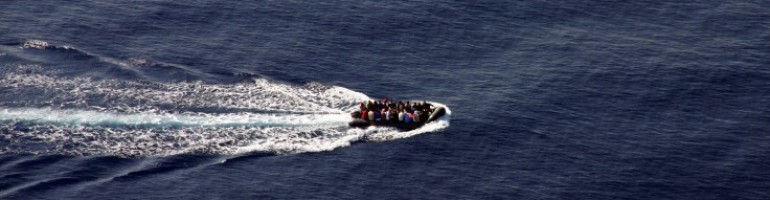
A photo of what is apparently the Ras Jdir (Ra’s Ajdir) crossing on the Libya- Tunisia border on 1 March 2011. (Photo Credit Reuters via Al Jazeera.)
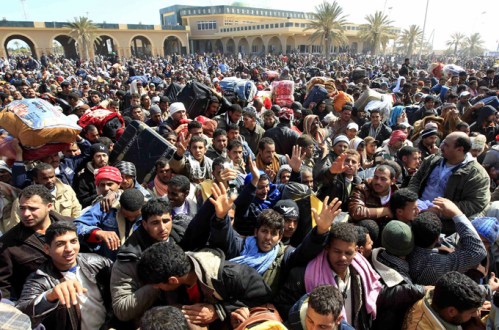
Reuters via Al Jazeera
A photo of what is apparently the Ras Jdir (Ra’s Ajdir) crossing on the Libya- Tunisia border on 1 March 2011. (Photo Credit Reuters via Al Jazeera.)
Reuters via Al Jazeera
Filed under Libya, Mediterranean, News, Tunisia, UNHCR
There is a notice on the European Court of Human Rights web page dated 1 March 2011 stating the following:
“The Chamber dealing with the case of Hirsi and Others v. Italy has relinquished jurisdiction in favour of the Grand Chamber. The applicants, 11 Somali nationals and 13 Eritrean nationals, were part of a group of illegal migrants who left Libya by boat heading for the Italian coast. The application concerns the interception of their boats on the high seas and their immediate return to Libya on board Italian naval vessels.”
Previous history of the case:
On 17 November the Second Section of the European Court of Human Rights communicated the case of Hirsi and others v Italy, Requête no 27765/09. The case was filed on 26 May 2009 by 11 Somalis and 13 Eritreans who were among the first group of about 200 migrants interdicted by Italian authorities and summarily returned to Libya under the terms of the Libya-Italy agreement which took effect on 4 February 2009. The Applicants were intercepted on 6 May 2009 approximately 35 miles south of Lampedusa.
Click here for previous post on the case.
More details on this development later.
Filed under European Court of Human Rights, European Union, Italy, Judicial, Libya, Mediterranean
1 March 2011 update from UNHCR:
“UNHCR staff at the Libya-Tunisia border have this morning told us that the situation is reaching crisis point. According to the Tunisian authorities, 70-75,000 people have fled Libya to Tunisia since 20 February. Fourteen thousand people crossed yesterday, the highest number to date, with tens of thousands of people now in urgent need of onwards transportation to their home countries. With 10,000-15,000 people expected to arrive today…
[T]housands of people have been waiting on the Libyan side to enter for as long as three days, obliged to spend the night outside in the bitter cold without shelter. We are very concerned that a large number of sub-Saharan Africans are not being allowed entry into Tunisia…
Meanwhile at the Egyptian border, the Government reported that some 69,000 people had crossed from Libya since 19 February. The majority of those who have crossed are Egyptians…”
Click here for UNHCR update.
EC President Van Rompuy has called an extraordinary meeting of the European Council: “In light of the developments in our Southern Neighbourhood, and Libya in particular, I decided to convene an extraordinary meeting of the European Council. The meeting will take place on 11 March 2011 in Brussels at 11.30 am.”
Click here for full statement.
Filed under European Union, Mediterranean, News
The Hungarian Presidency and LIBE have released summaries regarding today’s LIBE Committee meeting. Here are some points from the two summaries:
Click here and here for the two articles.
Frontex Director Ilkka Laitinen is in Malta today for discussions with Maltese officials about the situation in Libya and the possibility of a new migrant flow from Libya. It seems that the discussions concern the expansion of Joint Operation Hermes Extension or the creation of a new joint operation based in Malta. Before leaving Brussels earlier today, Laitinen said that “although the situation is fluid and until now no flows of asylum seekers to Europe has resulted, Frontex was preparing for such an eventuality.”
Click here (EN), here (IT) and here (IT) for articles.
Filed under European Union, Frontex, Italy, Libya, Malta, Mediterranean, News, Tunisia
LIBE will reconvene today, 1 March, 09:00-10:30, to discuss “the situation in the central Mediterranean…. They will consider the democratisation process in the region and its impact on migration flows and EU immigration and asylum policy. In attendance: Hungarian Presidency representative, H.E. Peter Györkös, Cecilia Malmström, Commissioner for Home Affairs and Ilkka Laitinen, Executive Director of Frontex, the EU border security agency.”
Click here for live coverage.
Filed under European Union, Frontex, Italy, Libya, Malta, Mediterranean, News, Tunisia
Austrian Interior Minister Maria Fekter said that while she doubts there will be a massive flow of refugees from Libya, if necessary, Austria would be in a position to accept up to 6,000 asylum seekers.
Click here (EN) and here (DE) for articles.
Filed under Austria, European Union, Italy, Libya, Malta, Mediterranean, News
An article from OpenDemocracy by Prof. Gregor Noll (Lund University) and Mariagiulia Giuffré (doctoral candidate at the School of International Studies, University of Trento):
“[T]here is a far-reaching consensus that a government [such as the Gaddafi Government] that uses indiscriminate lethal force to retain power is, as the diplomatic phrasebook has it, “unacceptable”. Yet, over the past six years, it has been perfectly acceptable for EU governments to outsource its border protection to an authoritarian leader with a dismal human rights record…. We, the citizens of the EU, should also be reminded that for over three years now, we have relied on Gaddafi and his state apparatus to keep asylum seekers and other migrants away from our doors….”
Click here for article.
Filed under Analysis, European Union, Italy, Libya, Mediterranean
Du blog de “Défense en ligne” écrit par Philippe Leymarie: “Guerre civile en Libye et options militaries.”
“Alors que le Conseil de sécurité de l’ONU réuni vendredi dernier a décidé d’un embargo sur les armes et de sanctions contre le régime Kadhafi, la violence de la répression en Libye a incité les pays européens, qui n’envisagent pas d’intervention militaire pour le moment, à entamer une démonstration de force… navale, qui a pris forme en quelques heures, avec une célérité inhabituelle. Une petite armada converge en direction des côtes libyennes, dans ce qui pourrait, à terme, devenir une véritable opération, mêlant la dissuasion à l’humanitaire. …
“Dans la pratique, le déploiement de cette petite armada pourrait également constituer un cordon de sécurité afin d’éviter une fuite en masse par la mer de Libyens ou d’immigrés africains vers l’Europe – donnant plus de consistance à l’opération de surveillance « Hermès », entamée (sous la pression notamment de l’Italie, en première ligne) par l’agence européenne Frontex….”
Cliquez ici pour l’article complet.
Filed under Analysis, European Union, Frontex, Libya, Mediterranean, United Nations
Italian Defence Minister Ignazio La Russa stated that “the Italy-Libya treaty is effectively defunct, inoperative, suspended.” In addition to the migration control provisions, the treaty also contains provisions which forbade Italy from participating in military actions again Libya.
La Russa also said that the Italian Finance Police officers who under the terms of the treaty were assigned to Libyan patrol vessels engaged in anti-migrant patrols have been withdrawn and are present at the Italian embassy in Tripoli.
Click here (EN), here (EN) (WSJ registration required), here (IT), and here (IT) for articles.
Filed under Italy, Libya, Mediterranean, News
The Malta Independent reported yesterday that Frontex Director Ilkka Laitinen will visit Malta shortly “with a view to organising a Frontex mission that would be hosted by Malta but, [Justice and Home Affairs Minister] Dr Mifsud Bonnici stresses, not under the infamous guidelines that are being disputed [before the European Court of Justice] by Malta, Italy and the European Parliament.” Dr Mifsud Bonnici said “I have also made it a precondition that if we are to host this Frontex mission, it would not be under those guidelines and there is an agreement on that.”
Malta’s primary objection to the Frontex Sea Border Rule is likely due to provisions which require that intercepted migrants be taken to the country hosting the Frontex mission under certain circumstances. The relevant provision provides:
“2. Disembarkation- 2.1. The operational plan should spell out the modalities for the disembarkation of the persons intercepted or rescued, in accordance with international law and any applicable bilateral agreements. The operational plan shall not have the effect of imposing obligations on Member States not participating in the operation. Without prejudice to the responsibility of the Rescue Coordination Centre, and unless otherwise specified in the operational plan, priority should be given to disembarkation in the third country from where the ship carrying the persons departed or through the territorial waters or search and rescue region of which that ship transited and if this is not possible, priority should be given to disembarkation in the host Member State unless it is necessary to act otherwise to ensure the safety of these persons.”
Commissioner Cecilia Malmström has previously said that the Sea Border Rule guidelines can be negotiated by member states on a mission by mission basis and that before a mission starts participating member states can agree on different rules of engagement, which might include the sharing of responsibility where not all intercepted migrants would be brought to country hosting the mission.
Click here for Malta Independent article.
Click here for previous post regarding Malmström’s comments.
Filed under European Union, Frontex, Libya, Malta, Mediterranean, News
The assets dedicated to Joint Operation Hermes Extension continue to increase, although at present there are only two coastal patrol boats (Italian) participating in the Frontex mission. Ten surveillance aircraft will soon be deployed. See the table with the list of resources below.
While the naval assets dedicated to JO Hermes Extension are minimal, there is a growing number of EU and NATO naval ships in the Central Mediterranean. Nicolas Gros-Verheyde (writing on the Bruxelles2 blog (FR)) has counted 14 naval ships from EU states that are present in the waters near Libya; the ships consist of destroyers, frigates, electronic surveillance ships, and supply and support ships. Additionally, Turkey has two naval ships in the area.
Some of the naval ships have already been used to evacuate European and other non-Libyan nationals from Libya. What additional activity the EU ships may engage in remains to be seen. They may become involved in military activities (presumably with UN authority (?)) and/or they may play a yet undetermined role should there be a sudden flow of migrants and asylum seekers from Libya. If there is a sudden and significant migratory flow, the naval ships should function in a search and rescue manner, but there is always the possibility that if faced with large numbers of migrants, the navy vessels may be used to interdict, blockade, or otherwise to try to prevent migrants from leaving Libya.
Click here for link to Frontex update regarding deployed assets.
Click here and here for Bruxelles2 postings. (FR)
Table: Resources available to JO Hermes Extension 2011 as of February 25, 2011.
| Italy (HMS) | 2 Coastal Patrol Vessel, 1 aircraft, 5 experts, 2 cultural mediators |
| Austria | 1 expert |
| Belgium | 2 experts |
| Denmark | 3-5 experts |
| France | 10 experts, 1 aircraft |
| Germany | 2 experts, 2 aircrafts |
| Hungary | 2 experts |
| the Netherlands | 1 aircraft, 2 experts |
| Portugal | 7 experts, 1 aircraft |
| Romania | 6 experts |
| Sweden | 1 expert |
| Switzerland | 2 experts |
| Spain | 4 experts, 1 aircraft (at a later stage) |
Filed under Algeria, Data / Stats, European Union, Frontex, General, Italy, Libya, Malta, Mediterranean, News, Tunisia
From CIR: “…[I]l Network Euro Mediterraneo per i Diritti dell’Uomo ha organizzato una missione di raccolta informazioni, che si è svolta dal 18 al 24 febbraio prima in Tunisia e poi in Italia. La missione era composta da rappresentanti di organizzazioni membro del Network e di partner e da esperti del Nord e del Sud del Mediterraneo. La missione ha potuto raccogliere testimonianze e informazioni dirette, tanto in Tunisia che in Italia.
La missione ha permesso di smentire sia la tesi della presenza massiva tra i migarnti arrivati in Italia di delinquenti di diritto comune evasi dalle carceri, sia quella di un complotto migratorio che sarebbe stato ordito dalla Libia e dai nostalgici di Ben Ali.
Nel corso della missione, le preoccupazione legate agli avvenimenti drammatici che sconvolgono la Libia hanno, in qualche maniera, soppiantato gli interrogativi che circondano i migranti tunisini.
Al termine di questa missione, il Network formula le seguenti raccomandazioni:
Alle autorità italiane:
Alle autorità tunisine
Alle autorità europee
Click here (IT) for full CIR post.
See also CIR “Emergenza Nord Africa”.
Filed under European Union, General, Italy, Libya, Mediterranean, Reports, Statements, Tunisia
Consiglio Italiano per i Rifugiati (CIR) created a special web page – Emergenza Nord Africa – which is tracking migration and other related aspects of the North African crisis.
Click here (IT).
Filed under European Union, Italy, Libya, News, Tunisia


 MIGRANTS AT SEA