Tag Archives: Libya

New Patrol Boats for Libya and Malta

Italy has delivered to Libya three patrol boats pursuant to the terms of Italy’s bi-lateral agreement with Libya to control irregular immigration.  The three boats that were turned over to Libya in a ceremony attended by Italian Interior Minister Roberto Maroni supplement three patrol boats which were delivered by Italy earlier.

Maroni spoke at the ceremony and said “Italy and Libya alone cannot carry the burden of a migration problem that touches the whole of Europe.  … [The European Commission] has not done much to date [on the migration issue].  In recent days I travelled to Ghana and Niger to sign bilateral accords and it is the first time these countries sign such agreements [on immigration] with a European state. This shows Italy is taking a leading role.”

And unrelated to the new Libyan boats, four new Armed Forces of Malta patrol boats were scheduled to arrive on Wednesday in Malta from Australia.  The new patrol boats cost €9.3m and were funded in part by the EU.

Click here and here for articles.

Leave a comment

Filed under Italy, Libya, Malta, Mediterranean, News

Italy’s “Africa Campaign”: Stop Migrants in Countries of Origin

Italian Interior Minister Roberto Maroni has completed a visit to Ghana and is now in Niger.  A trip to Senegal will occur soon.  In Ghana he signed an agreement to increase cooperation on combating illegal immigration, human trafficking, and other forms of organized crime.

Maroni is quoted as saying ”We have excellent bilateral agreements with the African countries of the Mediterranean region, from Morocco to Egypt. However, these are often transit countries for illegal immigrants who in reality originate in sub-Saharan African states. This is why now, while awaiting action from Europe, we want to extend security measures to that area not only regarding immigration, but also regarding the issues of drug trafficking and terrorism.”

ANSAmed reported that Maroni said Italy’s agreement with Libya has reduced the numbers of illegal migrants arriving in Italy and that “[n]ow the focus is to completely eliminate their arrival by blocking the departure of these ‘journeys of hope’.”

Click here and here for articles.

Leave a comment

Filed under Ghana, Italy, Libya, Mediterranean, News, Niger, Senegal

“Un échec total’’ – Trois tentatives de traverser la Méditerrané

“Oumar Baldé, [un sénégalais] de 36 ans, fait partie des candidats à à l’émigration revenus dans son Fouladou natal après avoir, comme il le dit, ‘’essuyé un échec total’’ dans sa tentative de rejoindre l’Espagne.  Parti du Sénégal par voie terrestre en 2000, en passant par le Mali, le Burkina Faso, le Niger, traversant le Sahara pour se retrouver en Libye…. “Ce fut un échec total’’, souligne Baldé, précisant avoir travaillé pendant 18 mois en Lybie avant de se retrouver en Algérie, puis au Maroc où il est resté pendant six ans, avec trois tentatives de traverser la Méditerranée, sans succès.”

“’On payait 8000 dirhams (500 000 francs CFA) [ €750 ] par traversée, poursuit-il, à des Arabes pour nous faire traverser la rive, ils nous amenaient jusqu’en pleine mer et on se perdait, il ne nous rester qu’à retourner et d’être pris par les gardes côtes marocaines qui nous jeter à la frontière algérienne’.  De guère lasse et ne disposant plus de moyens … Oumar Baldé s’est résigné à rentrer [en Sénégal]…”

“D’après le président du Conseil de la jeunesse de Dioulacolon, Abdoulaye Baldé, l’exemple de Oumar Baldé, n’est qu’une goutte d’eau dans l’océan. … ‘Il arrive qu’une famille dépêche deux à trois enfants pour tenter l’aventure. Et deux ou trois mois après, elles sont informées qu’ils sont tous morts en mer, entre la Mauritanie et l’Espagne’, se désole Abdoulaye Baldé.”

Click here for full article.

Leave a comment

Filed under Algeria, Libya, Mediterranean, Morocco, News, Senegal, Spain

African migrants and their desperate ploy for a better life – Times Online

From The Sunday Times Magazine, 22 November 2009:

“Meet the survivors, bereaved families from Gambia and Senegal, and a man who smuggles the people — at a colossal price.”

“… The routes [African migrants] take are many and varied. From west Africa, migrants trek through the pitiless Sahara to Libya, from there to brave the Mediterranean — or, more perilous yet, strike out for the Canary Islands in fragile canoes known as ‘pirogues’.  If they then cross to the Spanish mainland they will probably do so in tiny, open Spanish fishing boats. An estimated one in every eight migrants who try to travel across the ocean to Europe don’t make it, their bodies carried out into the cold Atlantic. Those who perish are identified only by chance, their skeletons dredged from the sea by Italian and Spanish trawlers, or their bodies washed on to beaches used by holidaymakers…”

Full article:  African migrants and their desperate ploy for a better life – Times Online.

Leave a comment

Filed under Eastern Atlantic, Gambia, Italy, Libya, Malta, Mediterranean, News, Senegal, Spain

Libya’s Selective Immigration Enforcement and Italy’s Foreign Policy Concessions

Dr Emanuela Paoletti, a junior research fellow at Somerville College, Oxford, has an article in the electronic journal Pambazuka News discussing “Libya’s selective enforcement of restrictive immigration policies as a means of gaining foreign policy concessions from Italy.”

“Since the late 1990s, immigration from Libya to Italy had increased significantly, from less than 5,000 in 2000 to 30,000 in 2008. In May 2009, Gaddafi made his first trip to Italy, which was followed by a second visit on the occasion of the meeting of the G20. Concomitant with these visits, there was a drastic reduction in migration from Libya. From 1 May 2008 to 31 August 2008, 15,000 people arrived to Italy from Libya; in the same period in 2009 only 1,400 have landed on Italian shores. The Italian minister of interior, Roberto Maroni could recently announce, immigration from Libya in 2009 has decreased by 90 per cent compared to 2008. What explains the drastic decrease in ‘illegal’ migration from Libya to Italy?”

Click here for the full article.

Leave a comment

Filed under Analysis, Italy, Libya, Mediterranean

JRS Malta – “Do They Know? Asylum Seekers Testify to Life in Libya”

The Jesuit Refugee Service Malta released a report entitled “Do They Know? Asylum Seekers Testify to Life in Libya.”

“Since May 2009, some 1409 migrants, attempting to reach a place where they could obtain protection or the possibility to live in safety and dignity, were pushed back to Libya.  These actions were widely criticised and held by many to be a violation of international law, as Libya does not have the mechanisms in place to grant protection to those who need it and there is evidence that those returned would be at risk of harm.”

“JRS Malta believes that returning migrants to Libya, where they cannot obtain effective protection if they need it and where they face a real risk of serious harm, violates international law. We therefore call upon the government to:

• Ensure that all asylum seekers within Malta’s effective jurisdiction are allowed to apply for protection.

• Rescue migrants intercepted by the AFM if they have requested assistance, as otherwise their safety cannot be guaranteed

• Ensure that all those rescued within Malta’s Search and Rescue Area are disembarked at a safe port, where those in search of protection can seek asylum

• Refrain from actions that will result, directly or indirectly, in the return of migrants to a country where they risk suffering serious violations of their fundamental human rights.”

Click here for copy of JRS Malta statement.

Click here for the report “Do They Know? Asylum Seekers Testify to Life in Libya.”

Leave a comment

Filed under Italy, Libya, Malta, Mediterranean, Reports

Libya Interdicts Migrants in Maltese Waters for First Time (News)

On 23 November a Libyan patrol boat intercepted approximately 80 Eritrean and Somali migrants in Maltese waters near Sicily.  The migrants were returned directly to Libya and reportedly taken to a Libyan detention centre.  This may have been the first time that Libyan authorities intercepted migrants in Maltese waters.

The UNHCR expressed concern over the incident.  “’This practice of getting the Libyan authorities to come directly [into non-Libyan waters] reduces even further the guarantees given to migrants arriving in Europe,’ said [UNHCR spokesperson Laura] Boldrini.”

Click here and here for articles.

Leave a comment

Filed under Italy, Libya, Malta, Mediterranean, News

COE Commissioner for HR Releases Letters to Italy and Malta (Statements)

Council of Europe Commissioner for Human Rights, Thomas Hammarberg, released copies of two letters he sent last August to the Minister of Interior of Italy, Roberto Maroni, and to the Minister for Justice and Home Affairs, of Malta, Carmelo Mifsud Bonnici in regard to the incident in August when a boat carrying over 70 migrants was left adrift for over two weeks.  Most of the migrants died.

A statement on the Commissioner’s web page states as follows:

“I publish these letters in order to reopen the discussion on the need to fully align migration practices with human rights standards. This serious incident should be effectively investigated” said the Commissioner. “Four of the five survivors have been granted refugee status in Italy and one is waiting for the decision on her application. This is good news. However, there is still an urgent need to take all necessary measures to prevent the recurrence of such tragedies. Regrettably, the authorities have not replied so far.”

In his letters, the Commissioner also underlined that the responsibility to rescue persons at sea appeared to have been neglected. He therefore recommended that both countries concerned engage in a constructive cooperation to develop sea patrolling which is duly respectful of human rights and humanitarian principles.

“The protection of the human rights of migrants needs urgent attention” said the Commissioner. “Every European country should act in a spirit of solidarity towards other countries, discharge its responsibilities under international law and effectively protect migrants, whose fundamental rights are at serious risk.”

Relevant excerpts from the letters:

Letter to Italian Minister Maroni, Ministry of the Interior – 25 August 2009

“[O]ne element is already evident: these people have not benefited from international humanitarian protection. In particular, the responsibility to rescue persons at sea appears to have been neglected. The Italian Coast Guard and other agencies – as well as fishermen – have shown until recently a laudable record of rescuing at sea hundreds of irregular migrants attempting to reach Italy. What happened this time? Have the provisions set out in the new security package played a deterrent role? Is the cooperation with the Coast Guards of other countries not functioning properly, thereby preventing boats in distress from being spotted and rescued?”

“Indeed, many migrants are human beings in dire circumstances who deserve our attention and respect. A substantial number of them are fleeing persecution or violence; this necessitates the provision of international protection. All European countries, not only Italy, must grant protection to migrants and cooperate more effectively to handle migration flows in a coherent manner, with full regard to humanitarian principles.

I hope that the Italian government will take all necessary measures to avoid such tragedies in the future. In this context, a constructive cooperation with the authorities in Malta, to develop sea patrolling which is duly respectful of human rights and humanitarian principles, would be highly beneficial.”

“The survivors of such tragedies should of course not be criminalised. Instead, they should be provided with all the necessary assistance. Their right to apply for asylum should be fully respected, and their request examined with the utmost attention. The situation of their country of origin and of departure should also be taken into account.

I deeply believe that it is both wrong and counterproductive to politicise migration issues. It is much more in keeping with our common values – and, ultimately, more effective – to address them based on a comprehensive and cooperative approach, guided by human rights and humanitarian principles.”

Click here for the Italian letter.

Letter to Maltese Minister Bonnici, Justice and Home Affairs Ministry – 26 August 2009

“[T]he people on the ill-fated boat have not benefited from international

humanitarian protection. In particular, the responsibility to rescue persons at sea appears to have been neglected. What happened? Is the cooperation with the Coast Guards of other countries not functioning properly, thereby preventing boats in distress from being spotted and rescued?”

“Migratory flows present major challenges to many European countries. A common European approach is therefore needed to meet those challenges. I have raised the issue with the Swedish Presidency of the European Union. There is a need for responsibility-sharing, where every country is ready to contribute in a spirit of solidarity, not only with regard to the reception capacities of other countries, but also vis-à-vis migrants themselves. Many migrants are human beings in dire circumstances who deserve our attention and respect. A substantial number of them are fleeing persecution or violence and deserve international protection.”

“I hope that the Maltese government will take all necessary measures for such tragedies to be avoided in the future. A constructive cooperation with the authorities in Italy, to develop sea patrolling which is duly respectful of human rights and humanitarian principles, would be highly beneficial. I hope it will be possible to address these crucial issues with a cooperative approach, guided by human rights norms.”

Click here for the Maltese letter.
Leave a comment

Filed under Council of Europe, Italy, Libya, Malta, Mediterranean, Statements

Italy Responds to EC Request for Information on Push-Back Practice (News)

The Italian Government formally responded to the EC request for details regarding its push-back policy that has been in effect since May.  The response is contained in a letter dated 8 September and released to the media today.

Italy claims that none of the 757 migrants intercepted since May and subsequently forcibly returned to Libya made a request for asylum: none of the immigrants taken to Libya between May 6 and August 30 ”made any request for international protection or mention of persecution in their own country”.

The claim by Italy that not a single migrant asked for protection strains credulity.  It is inconsistent with among other things the incident in August when 75 Somali migrants who were intercepted by the Italians used a satellite telephone to call a BBC reporter in Italy to request help before they were turned over to Libyan authorities.  One caller told the BBC reporter ”we told the Italian military that we wanted to request asylum and asked them not to hand us over to the Libyans because we were afraid of going to jail, but they wouldn’t listen to us.”   Click here for the article regarding this incident.

The Italian letter also seeks to counter criticism that Libya does not protect the rights of asylum seekers and is not a signatory to the UN Refugee Protocol by noting that Libya has ratified an African Union Convention on refugees ”obliging it to guarantee protection of anyone facing persecution”.

Click here for article.

Leave a comment

Filed under European Union, Italy, Libya, Mediterranean, News

Frontex Concedes it “May Be Helping” with Italian Push-Back Practice (News)

A Frontex spokesperson has modified Frontex’s strong denial several days ago that it had no involvement in or responsibility for the Italian push-back practice in the Mediterranean.

Frontex now concedes that it is assisting the Italians with the detection and interception of migrant boats, but that Frontex has no information regarding what happens to intercepted migrants after the Italian coastguard intercepts them.

“In an interview with European Voice [reporter Judith Crosbie], [Frontex spokesperson Gil] Arias-Fernández said: ‘Technically speaking, assets co-ordinated by Frontex are taking part in operations in the area and … these people could be sent back to their country of origin.’ But he said to hold Frontex responsible for the return of migrants to Libya was ‘far from reality’. ‘We can’t be accountable for decisions taken by Italy,’ he said.”  Arias- Fernández, however, conceded that Frontex might bear some moral responsibility for the push-back practice.

Click here for article.

Leave a comment

Filed under Frontex, Italy, Libya, Mediterranean, News

Italian Official: Migrants Forcibly Returned to Libya Never Ask For Asylum (News)

The Italian Government has rejected the ongoing criticism by HRW and others of its push back policy.

News24 reports that Interior undersecretary Alfredo Mantovano, stated that Italian authorities “have never denied” intercepted migrants the right to ask for asylum.  “Each operation to escort migrants back to Libya lasted more than 10 hours during which none of the people involved, asked to be recognised as refugees, nor did they say they were fleeing from persecution in their countries of origin, Mantovano said.”

According to Mantovano, 757 migrants have been forcibly returned to Libya between May 6 and August 30.

Click here for article.

Leave a comment

Filed under Data / Stats, Italy, Libya, Mediterranean, News

Frontex Issues Response to HRW Report (Communiqués)

Frontex has denied responsibility for and involvement in the Italian push-back practice.

Full text of the Frontex press release:

“By way of response to statements included in the Human Rights Watch report “Pushed Back, Pushed Around” Frontex would like to state categorically that the agency has not been involved in diversion activities to Libya (these are based on a bilateral agreement which Italy signed with Libya in May this year).

“The Frontex operation referred to in the report, Operation Nautilus 2009, was underway on June 18th 2009, but in a different operational area. Though German helicopters did participate in this operation, they were at no time involved in the incident described in the report (on the basis of two press reports, one from ANSA and one from Malta Today).

“In general, Frontex would like to point out that the task of helicopters involved in joint operations coordinated by the agency is only to patrol the operational area, not to divert. “

Click here for press release.

Leave a comment

Filed under Communiqués, Frontex, Italy, Libya, Mediterranean

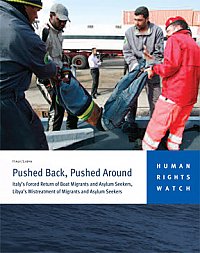
HRW Report: Italy’s Forced Return of Boat Migrants and Asylum Seekers, Libya’s Mistreatment of Migrants and Asylum Seekers (Reports)

Blog - HRW Cover

Human Rights Watch has released a report regarding Italy’s forcible push-back policy:

Pushed Back, Pushed Around – Italy’s Forced Return of Boat Migrants and Asylum Seekers, Libya’s Mistreatment of Migrants and Asylum Seekers

“On May 6, 2009, for the first time in the post-World War II era, a European state ordered its coast guard and naval vessels to interdict and forcibly return boat migrants on the high seas without doing any screening whatsoever to determine whether any passengers needed protection or were particularly vulnerable. The interdicting state was Italy; the receiving state was Libya.  Italian coast guard and finance guard patrol boats towed migrant boats from international waters without even a cursory screening to see whether some might be refugees or whether others might be sick or injured, pregnant women, unaccompanied children, or victims of trafficking or other forms of violence against women. The Italians disembarked the exhausted passengers on a dock in Tripoli where the Libyan authorities immediately apprehended and detained them.”

HRW’S Recommendations include:

“To the Government of Italy

  • Immediately cease interdicting and summarily returning boat migrants to Libya.
  • Investigate allegations that Italian naval personnel beat and used electric shocks to force interdicted boat migrants onto Libyan vessels and prosecute naval or coast guard officials who abused their authority, including those with command responsibility.
  • Stop cooperating with the Libyan authorities on the interdiction and interception of third-country nationals trying to leave Libya.
  • Make public all treaties and agreements between the governments of Italy and Libya.
  • Cease to fund or provide other bilateral support to Libya aimed at increasing that country’s effectiveness at intercepting asylum seekers and migrants before they take to the sea or before they reach Italian waters. Redirect such support into multilateral efforts, especially through UNHCR and OHCHR, to ensure that fundamental human rights standards relating to the treatment of such persons in Libya are observed.
  • Ensure access to full and fair asylum procedures, including the right to raise fear of treatment contrary to article 3 of the ECHR, for every person in the control of the Italian authorities, including those interdicted or rescued at sea.”

“To European Union Institutions and EU Member States

  • Demand that Italy not violate article 3 of the European Convention on Human Rights by its interdiction and summary return of migrants to a place where they are subjected to inhuman and degrading treatment.
  • Ensure access to full and fair asylum procedures, including the right to raise fear of treatment contrary to article 3 of the ECHR, for every person in the control of any EU member state, including those interdicted or rescued at sea.
  • Adopt clear, consistent, and binding rules on EU member states establishing responsibility for disembarking migrants rescued at sea.
  • Refrain from expelling third-country (non-Libyan) nationals to Libya, either directly or as partners in Frontex-coordinated operations, until Libya’s treatment of migrants, asylum seekers and refugees fully meets European standards in relation to persecution or risk of treatment contrary to article 3 ECHR. Under current conditions, the return of third-country nationals breaches European nonrefoulement obligations not to return people to inhuman or degrading treatment.
  • Encourage Libya to 1) ratify the 1951 Refugee Convention and its 1967 Protocol; 2) adopt a national asylum law; and 3) formally recognize UNHCR.
  • Display greater transparency in negotiations with Libya on all matters relating to migration and border controls.
  • Ensure  that the human rights clause in the Libya-EU Framework Agreement, being negotiated at the time of this writing, and in agreements flowing from it, contain explicit reference to the rights of asylum seekers and migrants as a prerequisite for any cooperation on migration-control schemes.
  • Refrain from encouraging Libya from establishing any reception regime which falls below the European reception condition standards
  • Quickly admit UNHCR-identified refugees in need of resettlement from Libya. Do so, however, only as a supplement rather than as a substitute for allowing spontaneous arrivals in EU territory to seek asylum.
  • Direct development assistance to improve respect for human rights and human dignity in migrants’ and asylum seekers’ countries of origin to address the root causes of forced migration.”

Click here for the report.

Leave a comment

Filed under European Union, Frontex, Italy, Libya, Mediterranean, Reports

Swiss End Financial Support for UN Refugee Programme in Libya (News)

The Swiss Foreign Ministry confirmed that it has discontinued its financial support for a UNHCR programme in Libya which provides assistance to migrants in Libya.

Switzerland had contributed SFr 520,000 between 2007 and 2009 to the programme.

Click here for article.

Leave a comment

Filed under Libya, News, Switzerland, UNHCR

¿First Frontex Forced Repatriation Operation? (18 June Repatriation Near Malta) (News)

Malta Today reported that the forced repatriation operation involving 74 migrants that took place on 18 June was the first time that Frontex ever coordinated a forced repatriation operation at sea.

“Even though the migrants were intercepted by an Italian coast guard boat, the same migrants, that included women and children, were identified by a Frontex asset that followed the operation through.”

The operation, part of Nautilus IV, used a German helicopter, the Italian coast guard, and a Libyan patrol boat.

Click here for article.

Leave a comment

Filed under Frontex, Germany, Italy, Libya, Malta, Mediterranean, News