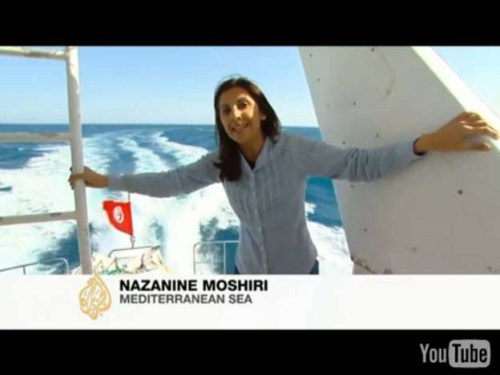
Here is a short Al Jazeera video story about current Tunisian coast guard patrols.
Frontex posted data on its web site summarizing migrant detections in southern Italy as of 13 February. According to media reports, with the exception of a small number of Egyptians who landed in Sicily on Tuesday (it is unclear whether they sailed directly from Egypt), no North African migrants have landed in Italy since 14 February.
From Frontex: “Warsaw, February 15—According to official data provided by Italian authorities, between January 1 and February 13, 2011, a total of 5526 migrants were recorded landing in the Pelagic Island, in a total of 116 incidents. This compares to 7,200 for the whole of 2008, the peak year for arrivals of irregular migrants in these islands to date, when Tunisians were the most commonly represented nationality, accounting for 23% of arrivals. Of the official 2011 figures, by far the biggest influx was noted in Lampedusa, where 5031 migrants were recorded between January 1 and February 13, in 80 arrivals…. The table below gives a summary of detections in 2011 until February 13. ”
| Incidents | Migrants
Landed |
Male | Female | Minors | Accom-panied minors | Unacc-ompanied minors | |
| Lampedusa and Linosa | 80 | 5031 | 4944 | 18 | 69 | 0 | 69 |
| Agrigento coast | 3 | 20 | 20 | 0 | 0 | 0 | 0 |
| Other places in Sicily | 21 | 211 | 210 | 0 | 1 | 0 | 1 |
| Apulia | 3 | 57 | 43 | 2 | 12 | 6 | 6 |
| Calabria | 8 | 192 | 152 | 14 | 26 | 12 | 14 |
| Sardinia | 1 | 15 | 15 | 0 | 0 | 0 | 0 |
| Total | 116 | 5526 | 5384 | 34 | 108 | 18 | 90 |
Filed under Data / Stats, Egypt, Frontex, Italy, Mediterranean, News, Tunisia
The European Voice reports that Frontex began consultations yesterday with member states to identify what equipment and personnel they will commit to a planned joint operation with Italy to deter migrants seeking to leave North Africa. “Naval vessels, surveillance aircraft and enhanced radar tracking are likely to be deployed….”
Assuming an emergency joint operation is deployed in the coming days, it may to some extent simply be a revival of Frontex’s Joint Operation Nautilus (slated to be renamed Operation Chronos). Less than two weeks ago, on 4 February Malta for the second year running announced that it would not host or participate in Operation Nautilus this year due to the success of Italy’s push-back agreement with Libya which eliminated the movement of migrants in the Central Mediterranean.
Malta, however, also likely refused to host the Frontex mission due to the 2010 guidelines governing Frontex enforcement operations at sea which require that intercepted migrants be taken to the country hosting the Frontex mission under certain circumstances. The validity of the Frontex sea border rule is currently under review by the European Court of Justice. The legal challenge to the rule was brought by the European Parliament. Maltese MEP Simon Busuttil initiated the challenge within the LIBE Committee. It will be interesting to see what role Malta will be willing to play in any new emergency joint operation. Even though the Frontex sea border rule is under review by the ECJ, the referral clearly requested the ECJ “to preserve the effects of the measure until a new legislative act has been adopted.” The rule therefore remains in effect.
Click here for EV article.
Click here for the Council decision on the surveillance of sea external borders (the Sea Border Rule).
Click here, here, here, here, and here for previous posts on the sea border rule and the ECJ challenge.
Filed under Egypt, European Union, Frontex, Italy, Libya, Malta, Mediterranean, News, Tunisia
Wednesday marked the third day without any migrants reaching Lampedusa. The Italian Coast Guard was searching for a 45 meter boat that may have left Tunisia with migrants and which was reported missing. Sea conditions continue to be rough and Italian authorities predict the migrant flow will resume once sea conditions improve. Plans to move migrants from Lampedusa to other locations within Italy to reduce overcrowding on the island have been delayed because the new reception centres are not yet prepared to receive the migrants.
40 Egyptian migrants reached Marina di Ragusa on the southern coast of Sicily on Tuesday. Interior Minister Maroni announced that the migrants were returned to Egypt on Wednesday by a charter flight after the new Egyptian government agreed to their return. He praised the new military government for honouring the agreements that Italy had with the Mubarak government. (“Significa che il nuovo Governo egiziano dei militari rispetta gli accordi che noi avevamo sottoscritto con il Governo Mubarak e che consentono un rapido rimpatrio degli egiziani arrivati sulle nostre coste”.)
Click here, here, and here for articles. (IT)
Tunisia’s Interim PM Mohamed Ghannouchi and Italian Foreign Minister Franco Frattini reached an agreement Monday evening to establish what Tunisie Afrique Press news service describes as “operational co-operation to stop the flow of illegal immigration.” The agreement includes “providing the Tunisian army with advanced technology equipment , a radar network for monitoring and patrol boats to be operated by the Tunisians.”
Even before this agreement was announced on Tuesday, Tunisia has been taking further steps to secure its ports and coast. There are some media reports that the migrant flow is slowing. It is unclear whether this is due to Tunisia’s efforts or due to the reported bad sea conditions which may be discouraging boats from sailing.
Click here, here, and here for articles. (EN)
Filed under Italy, Mediterranean, News, Tunisia
After several days of inconsistent public statements by Italian officials, according to a statement on the Frontex web site “[t]he Italian Government [on 15 February] requested assistance in strengthening the surveillance of the EU’s external borders in the form of a Joint Operation. In addition, Italy requested a targeted risk analysis on the possible future scenarios of increased migratory pressure in the region in the light of recent political developments in North Africa and the possibility of the opening up of a further migratory front in the Central Mediterranean area. … In the current situation, the Agency foresees its main role as coordinating border guards from among the Member States, particularly with regard to second-line experts in the screening and debriefing of irregular migrants as well as in coordinating an appropriate operational response to the humanitarian needs in the area. In addition, the Agency is investigating the most optimal means by which to adapt a range of technical assets engaged in Sea Border Operations in the Mediterranean to the needs of the Italian authorities.…”
Click here for full statement.
Filed under European Union, Frontex, Italy, Mediterranean, News, Tunisia
Commissioner Malmström spoke during the EP’s plenary session earlier this afternoon regarding the migration situation in Italy. Click here for the text of her speech.
Filed under European Union, Frontex, Italy, Mediterranean, Statements, Tunisia
Frontex posted a statement on its web site on Monday saying that it is sending a fact-finding team to Italy “to liaise with local authorities and monitor the situation on the ground” but that “[a]s of Monday February 14, Frontex has not received a formal request for assistance from the Italian Government, however, the Warsaw HQ is ready to act if necessary and is preparing an appropriate operational response in the event of it being requested.”
Commissioner Malmström reiterated on her blog that as of yesterday “Italy has not made a formal request for assistance, but of course we are looking at how we can assist both in a humanitarian capacity and practically with the screening of potential refugees (so far it does not seem that any of the Tunisians who have come to Italy have asked for asylum) and with their return.” (“Fortfarande har Italien inte kommit med någon formell begäran om hjälp men vi tittar förstås på hur vi skall kunna bistå både humanitärt, praktiskt med screening av eventuella flyktingar (hittills verkar det inte som om någon av de tuniseier som kommit till Italien har begärt asyl) och med återvändande.”)
Click here for the Frontex statement and here for Malmström’s blog.
Filed under European Union, Frontex, Italy, Mediterranean, News, Statements, Tunisia
The agenda for the Tuesday, 15 February, plenary session of the European Parliament will include the following two items:
These agenda items are scheduled to be considered at 16:00 or at the end of the preceding debate.
Click here for agenda.
Filed under European Union, Italy, Mediterranean, News, Tunisia
Italy has requested an extraordinary meeting of the Council of EU Heads of State to discuss the migration situation in Italy. According to the EU Observer, “Hungarian [EU Presidency] sources told EUobserver that Budapest ‘will do all it can to accommodate the Italians,’ but the timing is tight, and it is far from certain whether other EU member states will view the situation the same way as Rome.” The next regularly scheduled meeting of the EU justice and home affairs ministers who would ordinarily consider the situation and Italy’s requests for assistance is scheduled for 24-25 February.
Mario Mauro, MEP, Head of the Italian Delegation (PDL) of the EPP Group in the European Parliament, has also called upon Herman Van Rompuy, José Manuel Barroso, and EP President Jerzy Buzek to convene a meeting of the EU Heads of State within the next few days. Mauro’s press release describes the situation as “an epic emergency comparable in intensity and scale to the fall of the Soviet Bloc in 1989” and further says that “[w]hat is happening in the Maghreb countries has to fully put into question the weakness of the EU Mediterranean Strategy. The European Commission’s solidarity initiatives or parliamentary debates will not be enough, nor will the prompt use of FRONTEX instruments. We must realise that history is making us face a challenge that has to be tackled with the same determination and the same resources used in recent years to stabilise Eastern European countries. Southern European countries should not be left alone to deal with this urgency.”
In the meantime, the Times of Malta reports that Tunisian security forces are expanding their efforts to secure the departure points in Tunisia.
Click here for MEP Mauro’s Press Release.
Click here and here for articles. (EN)
Filed under European Union, Frontex, Italy, Malta, Mediterranean, News, Tunisia
PACE President Mevlüt Çavusoglu released a statement today concerning the arrivals in Lampedusa and elsewhere in Italy and called for the proper treatment of those who are arriving, including granting of international protection where appropriate, and asking that there be no mass expulsions. The statement also said that “it is also absolutely necessary that Europe share the responsibility for these people. Today it is Italy taking the brunt. Tomorrow it could be Malta, next week it could be Greece, in a year Turkey. All of Europe is concerned. In this context, the EU Agency Frontex has an important role to play, but it must abide by all the maritime and human rights provisions applying to rescue and interception at sea.”
The statement also referenced PACE Resolution 1637 (2008), “Europe’s boat people: mixed migration flows by sea into southern Europe” whose provisions include the following:
“9. The Assembly calls on Mediterranean member states of the Council of Europe receiving mixed flows of irregular migrants, refugees and asylum seekers to:
9.1. comply fully with and, when applicable, implement international and regional human rights law, including the European Convention on Human Rights (ETS No. 5), international refugee law, and European Union legislation, including Council Directives 2003/9/EC (laying down minimum standards for the reception of asylum seekers), 2004/83/EC (“refugee qualification directive”) and 2005/85/EC (“refugee procedures directive”);
9.2. comply fully with international maritime obligations on search and rescue, and examine fully any allegations of breaches of these obligations, including allegations of boats being refused assistance and being “pushed back”;
9.3. progressively proscribe administrative detention of irregular migrants and asylum seekers, drawing a clear distinction between the two groups, and in the meantime allow detention only if it is absolutely necessary to prevent unauthorised entry into the country or to ensure deportation or extradition, in accordance with the European Convention on Human Rights; [***]
Click here for Statement.
Click here for PACE Resolution 1637 (2008).
Filed under Council of Europe, Frontex, Italy, Mediterranean, Statements, Tunisia
Italian Foreign Minister Franco Frattini has called for naval or coast guard patrols along the coast of Tunisia and a possible blockade of Tunisia in order to prevent the reoccurrence of the events of August 1991 when thousands of Albanians reached Italian territory by sea after the collapse of the Albanian dictatorship. (While the first wave of Albanians in March 1991 were largely welcomed by Italy, the second wave of 15,000 Albanians in August 1991 were not welcomed and were detained by Italian authorities.)
During a press conference earlier today in Syria, Frattini said that “until now the mechanism of patrolling the coast of North Africa worked and we want to restore the mechanism that up to a month ago had reduced illegal immigration to zero.” Italy is ready to offer “tools” to help land and naval patrols in Tunisia. Italy can offer much to Tunisia, from “logistical support in terms of equipping the police forces, including the provision of important tools, both naval and land, to patrol the coast of Tunisia.” (“Fin’ora il meccanismo dei pattugliamenti delle coste nord africane ha funzionato e vogliamo ripristinare quel meccanismo che fino ad un mese fa aveva portato a zero l’immigrazione clandestina”. L’Italia ha pronti “strumenti” navali e terrestri per aiutare la Tunisia nel pattugliamento . L’Italia può offrire molto alla Tunisia, a partire da “un aiuto logistico in termini di equipaggiamento delle forze di polizia, ivi compresa la messa a disposizione di strumenti importanti, sia navali sia terrestri, per il pattugliamento della costa tunisina.’’)
Click here (IT) and here (EN) for posts from the Italian Foreign Ministry
Click here (EN) for article.
Filed under Italy, Mediterranean, News, Tunisia
Italy on Friday requested an urgent meeting of the EU Justice and Home Affairs Council to address the immigration situation that is developing with Tunisia and the arrivals in Italy of over 2000 Tunisians over the past two days. Interior Minister Maroni said that the bilateral cooperation agreement between Italy and Tunisia that has in the past controlled departures from Tunisia is not being implemented due to the crisis within Tunisia. (“Il problema è che l’accordo bilaterale che abbiamo con la Tunisia che ha permesso finora di gestire in modo efficace l’immigrazione clandestina, non viene attuato da Tunisi per la situazione di crisi. C’è una incapacità di fronteggiare la situazione da parte dell’autorità tunisina”.)
Click here (IT), here (IT), and here (EN) for articles.
Filed under European Union, Frontex, Italy, Mediterranean, News, Tunisia
The Times of Malta reported on Friday that Malta has for the second consecutive year informed Frontex that it will not host or participate in joint sea patrols in the Central Mediterranean, saying that there is no need for the patrols given the drastic reduction in the number of boat people attributable to Italy’s push-back practice with Libya which has been in effect since 2009. Only 47 migrants reached Malta in 2010 compared with 2,775 in 2008. Frontex’s Central Mediterranean joint operation, referred to as Operation Nautilus (renamed Operation Chronos last year), has in past years operated during the summer sailing months when sea conditions are most favourable for small boats.
Last year Malta initially said that it would not host the joint operation due to the then recently approved guidelines governing Frontex enforcement operations at sea which required that intercepted migrants be taken to the country hosting the mission under certain circumstances. A Maltese government spokesperson later said that the decision not to host the operation was not due to the new guidelines, but was due to Malta’s view that there was no longer a need for the operation because of the success of the Italy-Libya migration agreement. “The reason why we decided not to take part in [the 2010] mission is that we feel there is no need for this year’s EU patrol. We have noticed that, following the introduction of joint patrols by Libya and Italy last year, the number of illegal immigrants reaching Malta has dropped significantly. We feel that, as long as this operation remains in place, there is no real need for another anti-migration mission on behalf of the EU.”
Click here for article.
See my previous posts:
Italy and Malta question need for Frontex sea patrols (9 July 2010)
Malta says Frontex Chronos Mission not needed due to success of Italy-Libya push-back agreement (29 April 2010)
Filed under Data / Stats, European Union, Frontex, Italy, Libya, Malta, Mediterranean, News
On 16 January the Frontex Risk Analysis Unit released its Report for the Third Quarter of 2010 (July-Sept.). The report contains data, charts, and graphs detailing detections of migrants, asylum seekers, false document use, detections of facilitators, and other information. The deployment of Frontex’s RABIT force to the Greek-Turkey border did not begin until 2 November 2010, so the effects of the RABIT deployment do not appear in the Third Quarter.
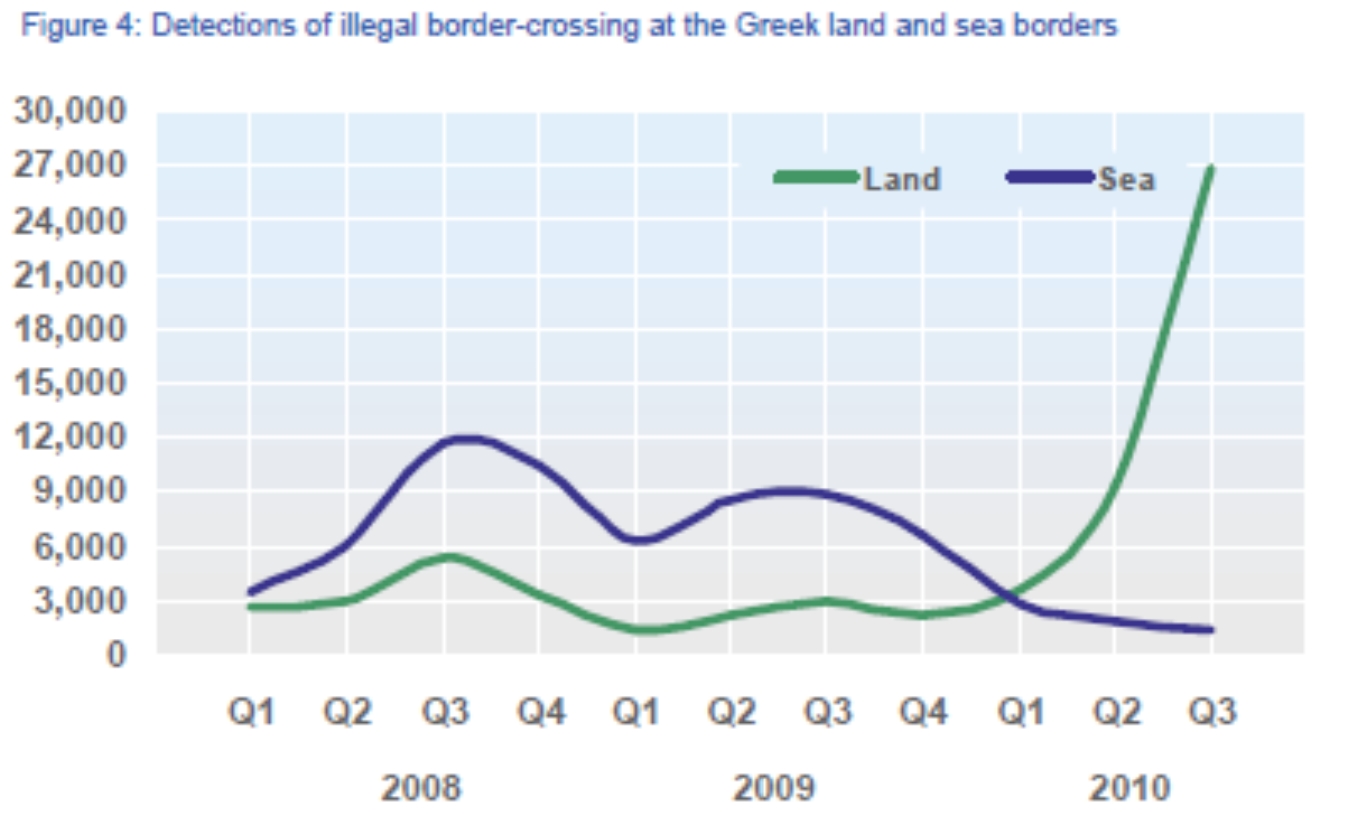
The Report notes that the “unprecedented peak in illegal border-crossings at the Greek land border with Turkey is the result of a shift from the sea to the land border” coupled with a “large increase in the absolute number of migrants” using Turkey as an EU entry point. The Report states that there has been an eight-fold increase in the number Maghreb nationals detected at the Greek land border which “is thought to be the result of a displacement effect from the West Africa and Western Mediterranean routes.”
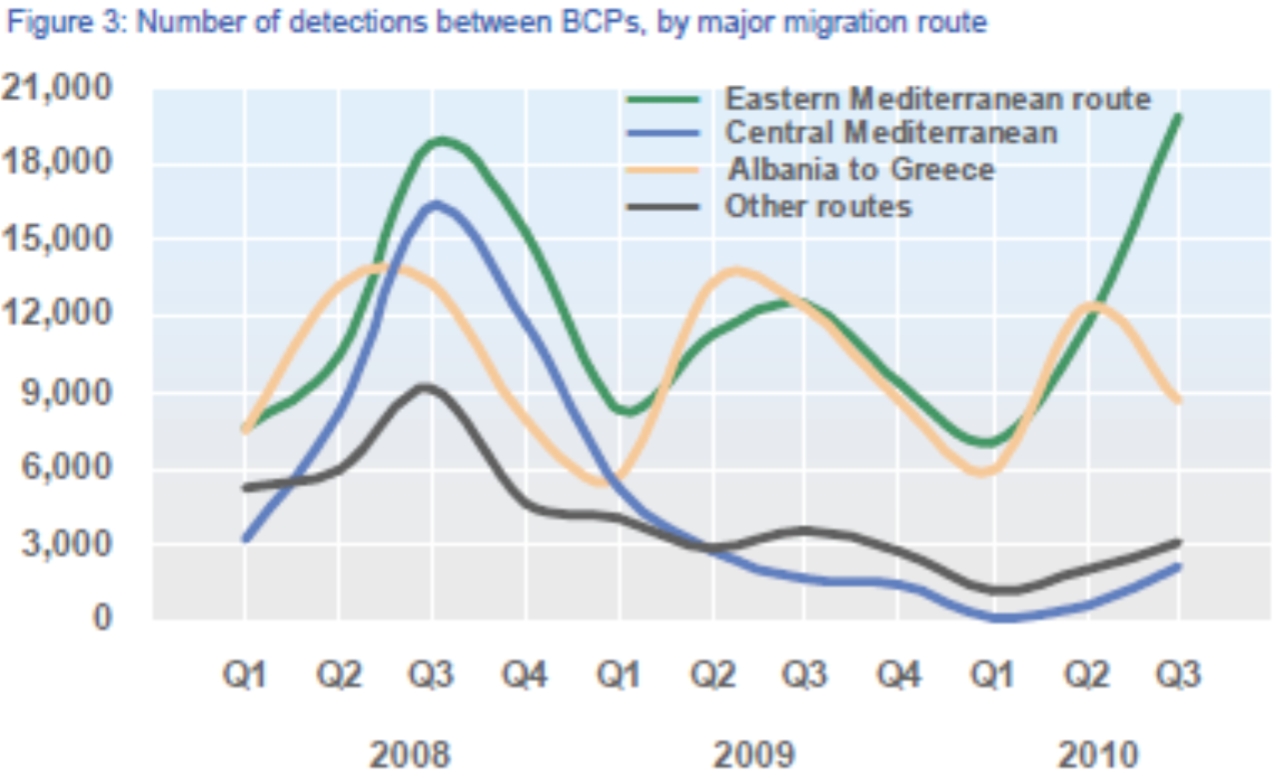
The Report also notes an increase in the number of detections on the Central and Western Mediterranean sea routes compared to Q2 which may be attributable to seasonal variations or “may be indicative of reorganized modi operandi in these areas in response to Frontex Joint Operations, more effective border controls and bilateral agreements implemented in 2008.” See Figure 3 below.
Excerpts from the Report:
“Detections of illegal border-crossing”
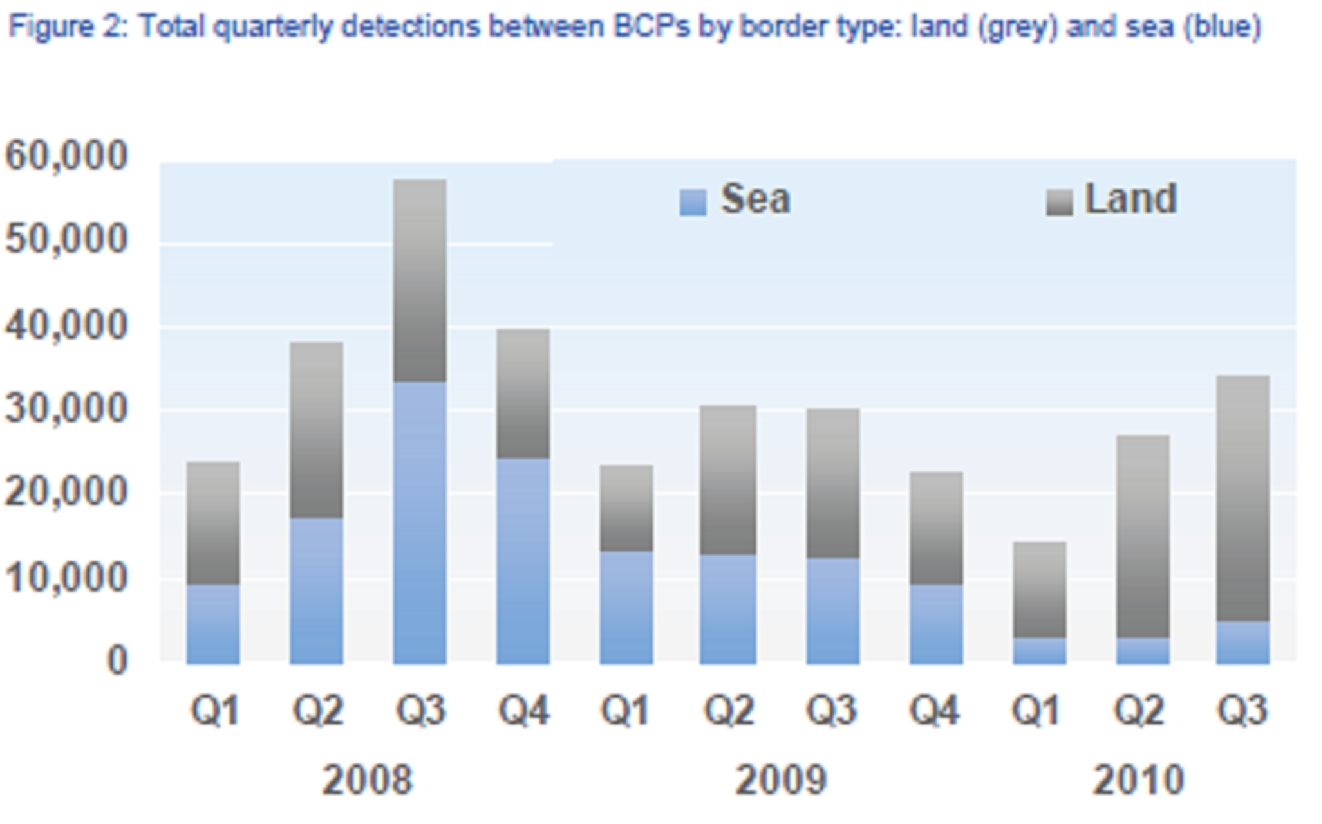
“… Fig. 2 [see below] shows quarterly detections at the land and sea borders of the EU since the beginning of 2008. The 30% increase in the number of detections between the previous and present quarters is comprised of a 60% increase at the sea borders (although from a lower base) and a 23% increase at the land borders. This means that the shift from sea to land borders has not continued to same extent as in the previous quarters. Nevertheless in Q3 2010, there were some 29 000 detections of illegal border-crossing at the external land border of the EU, which constitutes 85% of all the detections at the EU level, and the highest number of detections at the land border since data collection began in early 2008….”
“Eastern Mediterranean route”
The Report observes that there has been a shift in illegal crossings from the Greece-Turkey maritime border to the Greece-Turkey land border and notes an increase in the number of nationals from Maghreb countries apprehended at the Greece-Turkey land border. “This route [being taken by Maghreb nationals] is very indirect, but is thought to be the result of a displacement effect from the West Africa and Western Mediterranean routes….”
See Figure 4 below which shows that detections of illegal border crossers at the land border of Greece have exceeded detections at the sea border since Q1 of 2010.
“Central Mediterranean route”
“There were 2 157 detections of illegal border-crossing during Q3 2010. This is more than a three-fold increase compared to the previous quarter and a third higher than the same period last year. However despite this apparently large increase, detections still remain massively reduced compared to the peak of around 16 000 during the same period in 2008 (Fig. 3)….”
“The JO Hermes 2010 which was operational between June and October 2010, focused on illegal migratory flows departing from Algeria to the southern borders of the EU, specifically to Sardinia. In 2010, there were fewer detections than in previous years….”
“Departures from Libya also remained low. In June 2010, a new law was implemented to serve more severe punishments for facilitating illegal immigration. Ambassadors of the countries of origin were called into the Ministry of Foreign Affairs in Tripoli to be informed about the consequences of the new law, which suggests that this may be a serious implementation.”
“Western Mediterranean route”
“In general, irregular immigration to southern Spain has decreased massively since the beginning of 2006. However, in Q3 2010 there were 2 200 detections of illegal border crossing in the Western Mediterranean, more than twice that of the previous quarter and around a third higher than the same period in 2009. There is growth in the number of detections of a wide range of African nationalities, nine of which more than doubled in number between Q2 and Q3 2010. The most detected nationalities were Algerian, Moroccan, Cameroonian and Guinean.”
“Western Africa route”
“The cooperation and bilateral agreements between Spain and the rest of the Western African countries (Mauritania, Senegal and Mali) are developing steadily, and are one of the main reasons for the decrease in arrivals, as is the presence of patrolling assets near the African coast.”
“According to data collected during JO Hera, the numbers of arrivals in the Canary Islands and detections in West Africa are very low compared to the same time last year. The main nationality and place of departure is from Morocco, to where migrants are returned within a few days.”
Click here for the 3rd Quarter 2010 Report.
Click here for the 2nd Quarter 2010 Report.
Click here for the 1st Quarter 2010 Report.
Click here for my previous post regarding the 2nd Quarter Report.
Filed under Aegean Sea, Algeria, Data / Stats, Eastern Atlantic, European Union, Frontex, General, Greece, Italy, Libya, Malta, Mauritania, Mediterranean, Morocco, News, Reports, Senegal, Spain, Tunisia, Turkey


 MIGRANTS AT SEA