Tag Archives: UNHCR

UNHCR Report: “2010 Asylum Levels and Trends in Industrialized Countries”; Levels Fall to Half of 2001 Levels

From UNHCR’s statement summarizing the report which was released this morning:

“Asylum figures fall in 2010 to almost half their 2001 levels-

GENEVA – The number of asylum-seekers in the industrialized world continued to fall in 2010, bringing the figure down to nearly half the level at the start of the millennium.

This was among the main findings as the UN refugee agency today released its 2010 statistical overview of asylum applications in 44 industrialized countries. The report deals with new asylum claims and does not show how many individuals were granted refugee status.

According to the report, 358,800 asylum applications were lodged in industrialized countries last year – down 5 per cent from 2009, and some 42 per cent lower than the decade’s peak in 2001, when almost 620,000 asylum applications were made…

Numbers fall in most regions

Last year’s total number of new asylum claims was the fourth lowest in the last decade. Year-on-year decreases were reported in most regions, including in Europe, North America and North Asia. Within Europe, the largest decline was seen in southern Europe, where claims fell by 33 per cent compared to 2009. This was mainly because fewer people requested protection in Malta, Italy and Greece. However, this decline was offset by increases elsewhere, especially in Germany (49%), Sweden (32%), Denmark (30%), Turkey (18%), Belgium (16%) and France (13%). In the Nordic countries, the increases in Denmark and Sweden were offset by substantial declines in Norway (-42 per cent) and Finland (-32 per cent)….

US tops recipient list

Among individual countries, the United States remained the largest asylum recipient for the fifth consecutive year, accounting for one out of every six asylum applications in the industrialized countries covered in the report. The US saw an increase of 6,500 applications, partly due to a rise in the number of Chinese and Mexican asylum-seekers.

France maintained its position as host to the second-largest number of new applications, with 47,800 in 2010, largely from Serbian, Russian and Congolese asylum-seekers. Germany became the third-largest recipient country with a 49-percent rise. The increases can partly be attributed to a rise in asylum seekers from Serbia and the former Yugoslav Republic of Macedonia. That development is widely attributed to the introduction of visa-free entry to the European Union for nationals of these two countries since December 2009.

Sweden and Canada ranked fourth and fifth respectively. Together, the top five countries of asylum accounted for more than half (56 per cent) of all asylum applications covered in this report.

Most claims from Serbia

In terms of places of origin, the largest group of asylum-seekers in 2010 were from Serbia (28,900, including Kosovo). The country saw a 54 per cent increase compared to 2009, when it ranked sixth. Interestingly, the number of asylum applications in 2010 was comparable to 2001, soon after the Kosovo crisis.

Afghanistan slid to second place with a decrease of 9 per cent compared to the previous year. Unlike in 2009, when Afghan claims were mainly lodged in Norway and the United Kingdom, in 2010 more claims were filed in Germany and Sweden. Chinese asylum-seekers made up the third-largest asylum group in 2010, partly due to a substantial drop in the number of new applications from Iraq and Somalia. For the first time since 2005, Iraq was not one of the top two countries of origin of asylum-seekers. It dropped to fourth place, followed by the Russian Federation. Somalia, which occupied the third spot in 2009, fell to sixth in 2010….”

Click here for full report.

Click here for key graphs from report.

Leave a comment

Filed under Data / Stats, European Union, News, Reports, UNHCR

Save the Children: Conditions for 250 Unaccompanied Migrant Children on Lampedusa Unacceptable

Save the Children released a press statement yesterday describing the conditions for more than 250 unaccompanied migrant children on Lampedusa and calling for their immediate transfer from the island.  Excerpts:

“’The structure that has been allocated [to the children on Lampedusa] is totally inadequate and the conditions on an hourly basis are becoming more critical from the point of view of hygiene and [other conditions]’ said Raffaella Milano, Italy-Programs Manager, Save the Children Europe.  Since the beginning of the increased arrivals of migrants from Tunisia – since February 10 – more than 530 children, the vast majority of them unaccompanied, have arrived in Lampedusa.  Of these, 283 have been placed in communities to accommodate the children in Sicily.  ‘More than 250 unaccompanied minors are still remaining in Lampedusa and many have been living many days in conditions that do not guarantee minimum standards of reception.’ …  Save the Children calls for the transfer of the children and setting up temporary structures … if necessary, where the children may stay until being placed within the community. … This delay is not justifiable.”

For more information:
Press Office Save the Children Italy,
Tel. 06.48070023-71-001;
press@savethechildren.it
http://www.savethechildren.it

Click here for link to statement.

Also click here for 22 March UNHCR urgent call for action by the Italian authorities to alleviate overcrowding on Lampedusa.

Leave a comment

Filed under European Union, General, Italy, Mediterranean, News, Statements, Tunisia, UNHCR

2000 Migrants Reach Lampedusa Over 24 Hour Period; Ship Carrying 1800 Remains in Int’l Waters in Need of Fuel

Approximately 2000 new migrants in more than 20 boats arrived in Lampedusa on 14-15 March.  Some were rescued and some reached Lampedusa on their own.  One boat is believed to have sunk near Tunisia and approximately 35 persons are believed to be missing.

According to a UNHCR briefing yesterday, just over 10,000 migrants, nearly all young Tunisian men, have arrived in Italy since mid-January.  UNHCR spokesperson Melissa Fleming said that “[t]he outflow from Tunisia is unrelated to the ongoing crisis in Libya. From our interactions with Tunisians arriving in Italy over past weeks, we believe that most are seeking employment and better economic opportunities, rather than international protection.   UN staff and partners in Tunisia report that some villages appear largely empty of their young male population, with only women, children and elderly people remaining. This type of outflow is not atypical of countries in transition, and we are well aware of the many demands on the Tunisian authorities at present. Solutions to this type of flow need to be found in dialogue between the concerned governments, including arrangements for the orderly and dignified return of persons who are found not to be in need of international protection, and the establishment of opportunities for labor migration which can meet the needs of countries on both sides of the Mediterranean.”

The standoff with the Moroccan ferry, the Mistral Express, continues.  The ship left Libya several days ago and is located in international waters about 20 miles from the port of Augusta, Sicily.  Italian authorities have refused to permit the ship to enter Italian waters and are considering providing fuel to the ship while it remains at sea in order to prevent any of the 1800+ mostly Moroccan passengers from attempting to leave the ship and enter Italy.

Click here for UNHCR press briefing.

Click here, here, here, here, and here for articles.  (IT)

Leave a comment

Filed under European Union, Frontex, Italy, Libya, Mediterranean, Morocco, News, Tunisia, UNHCR

Hirsi and Others v. Italy – ECtHR Grand Chamber Hearing Scheduled for 22 June

The case of Hirsi and others v Italy, Requête no 27765/09, has been scheduled for a hearing on 22 June 2011, 9.15 am, before the Grand Chamber of the European Court of Human Rights.

Proceedings before the Grand Chamber were initiated on 1 March 2011 when the Second Section of the Court relinquished jurisdiction.  On 17 November 2009 the Second Section of the Court communicated the case.  The case was filed on 26 May 2009 by 11 Somalis and 13 Eritreans who were among the first group of about 200 migrants interdicted by Italian authorities and summarily returned to Libya under the terms of the Libya-Italy agreement which took effect on 4 February 2009.  The Applicants were intercepted on 6 May 2009 approximately 35 miles south of Lampedusa.

The Applicants allege violations of numerous provisions of the European Convention on Human Rights:

Protocol 4, Art. 4 Prohibition of collective expulsion of aliens;

Art. 3 Torture;

Art. 1 (1) General undertaking/HPC;

Art. 13 Effective remedy/national authority; and

Art. 3 Inhuman or degrading treatment.

The Statement of facts, complaints and questions (EXPOSÉ DES FAITS et QUESTIONS AUX PARTIES ET DEMANDES D’INFORMATIONS) issued by the Second Section to the parties is available only in French:

GRIEFS

Invoquant l’article 3 de la Convention, lu en conjonction avec l’article 1 de la Convention, les requérants se plaignent de ce que les modalités de leur renvoi en Libye, ainsi que leur séjour dans ce pays ou leur rapatriement dans leurs pays respectifs les soumettrait au risque de subir des tortures ou des traitements inhumains et dégradants.

Invoquant l’article 4 du Protocole no 4, lu en conjonction avec l’article 1 de la Convention, ils affirment avoir fait l’objet d’une expulsion collective atypique et dépourvue de toute base légale.

Invoquant l’article 13, les requérants dénoncent l’impossibilité de contester devant les autorités italiennes leur renvoi en Libye et le risque de rapatriement dans leurs pays d’origine.

QUESTIONS AUX PARTIES ET DEMANDES D’INFORMATIONS

QUESTIONS

1.  Les faits dont les requérants se plaignent en l’espèce relèvent-ils de la juridiction de l’Italie ?

2.  La décision des autorités italiennes d’intercepter en haute mer les embarcations et de renvoyer immédiatement les requérants, compte tenu notamment des informations provenant de sources internationales et concernant les conditions des migrants clandestins en Libye, a-t-elle exposé les requérants au risque d’être soumis à des traitements contraires à l’article 3 de la Convention dans ce pays ?

3.  Compte tenu des allégations des requérants (voir formulaire de requête annexé), y a-t-il des motifs sérieux de craindre que le rapatriement dans leurs pays d’origine, soit la Somalie et l’Érythrée, les exposerait à des traitements contraires à l’article 3 ?

4.  Le renvoi des requérants en Libye de la part des autorités italiennes s’analyse-t-il en une expulsion contraire à l’article 4 du Protocole no 4 ?

5.  Les intéressés ont-ils eu accès à un recours effectif devant une instance nationale garanti par l’article 13 de la Convention pour faire valoir leurs droits garantis par les articles 3 et 4 du Protocole no 4 ?

DEMANDES D’INFORMATIONS

Le gouvernement défendeur est également invité à fournir à la Cour toute information disponible concernant :

– Le nombre de migrants irréguliers arrivés mensuellement sur les côtes italiennes, et en particulier à Lampedusa, au cours des dernières années ;

– L’entité et l’origine du phénomène migratoire en Libye ; la législation en la matière en vigueur dans ce pays ; le traitement réservé par les autorités libyennes aux migrants irréguliers arrivés en Libye directement ou suite au renvoi depuis l’Italie.

Le Gouvernement est également invité à produire à la Cour les textes des accords signés par les gouvernement italien et le gouvernement libyen les 27 décembre 2007 et 4 février 2009.

Il est enfin invité à expliquer à la Cour le rapport existant entre les opérations prévues par les accords bilatéraux avec la Libye et l’activité de l’ « Agence européenne pour la gestion de la coopération opérationnelle aux frontières extérieures des États membres de l’Union européenne (Frontex) ».

Click here (FR) for EXPOSÉ DES FAITS et QUESTIONS AUX PARTIES ET DEMANDES D’INFORMATIONS.

Click here, here, and here for my previous posts on the case.

1 Comment

Filed under European Court of Human Rights, Italy, Judicial, Libya, Mediterranean, News

Prof. Goodwin-Gill: ‘The Right to Seek Asylum: Interception at Sea and the Principle of Non-Refoulement’

On 16 February Professor Guy S. Goodwin-Gill presented the inaugural lecture of the Fondation Philippe Wiener – Maurice Anspach, Chaire W. J. Ganshof van der Meersch.  The lecture was entitled ‘The Right to Seek Asylum: Interception at Sea and the Principle of Non-Refoulement’.  The complete text of the lecture is available at this link: Goodwin-Gill: The Right to Seek Asylum-Interception at Sea and the Principle of Non-Refoulement.  The complete text also contains a helpful reference list.

I have reproduced several excerpts below:

“Looking at the interception and return measures adopted in the Mediterranean and off the west coast of Africa … one may rightly wonder what has happened to the values and principles considered fundamental to the Member States of the European Union….  [***]

… [I]t is all the more surprising when [European] governments, ministers and officials either pretend that the rules [- including Article 78(1) of the TFEU which requires the Union to develop a common asylum policy with regard to ‘any third country national requiring international protection and ensuring compliance with the principle of non-refoulement’ – policy which ‘must be in accordance with the Geneva Convention… and other relevant treaties’-] do not apply, or seek ways to avoid their being triggered.

In my view, the problems begin at the beginning, just as they commonly do also at the national level. A policy or goal is identified – in this case, reducing the number of irregular migrants, including asylum seekers, leaving the north African coast and heading for Europe – and then belatedly some attempt is made to bend implementation of the policy to fit in with principle and rule. A better approach, in my view, would be to begin with a clear understanding of the applicable law – the prohibition of discrimination, of refoulement, of inhuman or degrading treatment – and then to see what can be done by working within the rules.

Of course, this approach is premised on the assumption that States generally seek to work within the rule of law. It will not likely influence the State determined to deal with the migrant and the asylum seeker arbitrarily, and without reference to principle. Such cases must be confronted head-on, by way of judicial and political mechanisms of control.  [***]

… The problem, though, lies not in formal recognition of protection principles but, as ever, in operationalising the rules – in making protection a reality at the point of enforcement. On the plus side stands a substantial body of legislation: the Frontex regulation itself; the RABIT amendment, with its express insistence on compliance with fundamental rights and conformity with Member States’ protection and non-refoulement obligations; and the Schengen Borders Code, Article 3 of which requires the Code to be applied, ‘without prejudice to the rights of refugees… in particular as regards non-refoulement’. Add to this the April 2010 Council Decision supplementing the Code and dealing specifically with the surveillance of maritime borders and Frontex operations; it is currently being challenged by the Parliament on vires grounds, and it was also objected to by Malta and Italy, mainly for its proposal that in the last resort, rescue cases should be disembarked in the State hosting the Frontex operation. The Decision’s formulation of the applicable law in the matter of protection, however, is unremarkable, restating the principle of non-refoulement and the need to avoid indirect breach, but also providing for those intercepted to have an opportunity to set out reasons why they might be at risk of such a violation of their rights….  [***]

What do we know about either unilateral or Frontex-led interception operations so far? Not as much as we might expect as citizens of a democratic Union bounded by the rule of law and basic principles of good governance, such as transparency and accountability….  [***]

Exactly what Frontex does in an interception context has been questioned. Human Rights Watch has claimed that Frontex has been involved in facilitating interception, though this has been denied. Amnesty International and ECRE note that Frontex has stated that it does not know whether any asylum applications were submitted during interception operations, as it does not collect the data. How, then, should we approach what appears to be wilful ignorance? In the Roma Rights Case in 2004, discrimination on racial grounds was alleged in the conduct of immigration procedures by British officials at Prague Airport, which were intended to prevent potential asylum seekers leaving for the United Kingdom. There, too, the authorities did not keep any records of the ethnic origin of those they interviewed. Finding on the evidence that the government had acted in violation of relevant legislation, the House of Lords called attention to the importance of gathering information, ‘which might have helped ensure that this high-risk operation was not being conducted in a discriminatory manner…’

Given the secrecy attaching to interception operations, and the fact that no data are gathered or retained, it is reasonable to infer that some level of Frontex involvement has occurred, and that, absent evidence to the contrary, the relevant principles of international and EU law have not been observed.  [***]

… The object and purpose of EU operations in maritime areas, therefore, should be first and foremost to ensure protection, and secondarily to manage and prevent irregular migration….

In the absence of effective and verifiable procedures and protection in countries of proposed return, the responsibility to ensure protection remains that of the EU agency or Member State. In practice, this will require that they identify all those intercepted, and keep records regarding nationality, age, personal circumstances and reasons for passage. Given protection as the object and purpose of interception operations, an effective opportunity must be given for objections and fears to be expressed; these must then be subject to rational consideration, leading to the formulation of written reasons in explanation of the next steps. Where this entails return to or disembarkation in a non-EU State, a form of judicial control is required as a necessary safeguard against ill-treatment and the abuse of power – exactly what form of judicial control calls for an exercise of juristic imagination. In the nature of things, such oversight should be prompt, automatic, impartial and independent, extending ideally to the monitoring of interception operations overall….”

Click here or on the following link for complete text: Guy S. Goodwin-Gill, ‘The Right to Seek Asylum: Interception at Sea and the Principle of Non-Refoulement’

I thank Prof. Goodwin-Gill for permitting me to post the text of his lecture.


1 Comment

Filed under Aegean Sea, Analysis, Eastern Atlantic, European Union, Frontex, Mediterranean, UNHCR

UN OCHA Situation Report 4 on Libya / UNHCR Update

OCHA Situation Report 4 on Libya.  “HIGHLIGHTS/KEY PRIORITIES:

  • United Nations Secretary-General Ban Ki-moon convened a meeting of United Nations agencies and regional organizations to discuss a coordinated approach to the humanitarian situation in and around Libya. He intends to appoint a special envoy responsible for coordinating the relief effort;
  • According to IOM, 172,874 people, mainly migrant workers, have left Libya to date;
  • The OCHA-led joint United Nations rapid assessment reported little evidence of destruction between the Egyptian border and Benghazi. There are concerns over the implications a fuel-supply cut will have on the continuity of water and power supplies for critical infrastructure;
  • According to the Financial Tracking Service, US$35.6 million has been contributed and $10 million pledged from donors in response to the crisis.”

Click here for OCHA Situation Report.

Click here for OCHA Map and Data update.

UNHCR – “GENEVA, March 3 (UNHCR) – An operation to evacuate tens of thousands of people from the Tunisian border and fly them home was under way on Wednesday. Under a programme led by UNHCR and the International Organization for Migration (IOM), more than 50 flights were planned on Thursday to take migrant workers, mostly Egyptians, back home. UNHCR flew home 177 people to Egypt on a first flight Wednesday evening…..”

Click here for UNHCR update.

Leave a comment

Filed under Data / Stats, Egypt, Libya, Mediterranean, News, OCHA, Tunisia, UNHCR, United Nations

UN OCHA Situation Report 2 on Libya

From the UN Office for the Coordination of Humanitarian Affairs (OCHA), Situation Report No. 2, 1 March 2011:

Libya – thousands of migrants stranded at Benghazi port;

Tunisia – 10,000 to 15,000 people arrived in Tunisia on 1 March, creating a huge bottleneck on the border due to a lack of onward transportation to their home countries. Thousands of people (including over 15,000 Bangladeshis) are stuck on the Libyan side of the border and are not allowed to cross. They are stranded and without access to food, health, water and sanitation;

Egypt – 5,000 to 7,000 migrants stranded in the border area at Saloum, in “no man’s land”. The Egyptian authorities are not allowing those without valid tickets and documentation to leave. According to IOM, these stranded migrants need food, water, blankets, shelter and proper sanitation facilities. IOM has established a registration process for migrants from African and Asian countries who cannot continue their journey into Egypt because of lack of travel documents or entry visas;

Niger – IOM is preparing for the arrival later this week of an estimated 2,000 Nigerians and other African nationals who have recently managed to cross Libya’s southern border at Gatrone.

Click here for full document.

Leave a comment

Filed under Egypt, Libya, Mediterranean, News, Niger, OCHA, Tunisia

Chaos at Libyan-Tunisian border

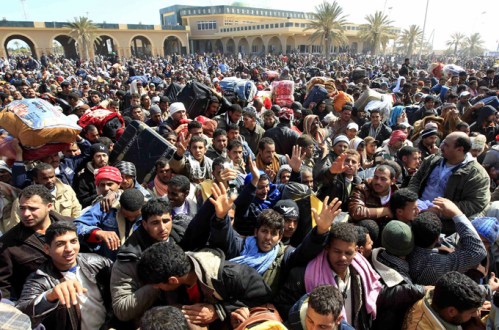
A photo of what is apparently the Ras Jdir (Ra’s Ajdir) crossing on the Libya- Tunisia border on 1 March 2011.  (Photo Credit Reuters via Al Jazeera.)

Reuters via Al Jazeera


Leave a comment

Filed under Libya, Mediterranean, News, Tunisia, UNHCR

UNHCR: Crisis at Libya-Tunisia Border; 140,000 Have Fled to Egypt and Tunisia; Tunisia May Be Barring Sub-Saharan Africans from Entering Tunisia

1 March 2011 update from UNHCR:

“UNHCR staff at the Libya-Tunisia border have this morning told us that the situation is reaching crisis point. According to the Tunisian authorities, 70-75,000 people have fled Libya to Tunisia since 20 February. Fourteen thousand people crossed yesterday, the highest number to date, with tens of thousands of people now in urgent need of onwards transportation to their home countries. With 10,000-15,000 people expected to arrive today…

[T]housands of people have been waiting on the Libyan side to enter for as long as three days, obliged to spend the night outside in the bitter cold without shelter. We are very concerned that a large number of sub-Saharan Africans are not being allowed entry into Tunisia…

Meanwhile at the Egyptian border, the Government reported that some 69,000 people had crossed from Libya since 19 February. The majority of those who have crossed are Egyptians…”

Click here for UNHCR update.

Leave a comment

Filed under Egypt, Libya, Mediterranean, News, Tunisia, UNHCR

AlertNet: Poor migrant workers feared unable to flee Libya violence

From AlertNet: “Tens of thousands of impoverished migrant workers from sub-Saharan Africa and southern Asia may be trapped by the escalating violence in Libyan cities, unable to leave the country because they cannot pay for transport to border areas, the International Organization for Migration (IOM) said on Thursday. … ‘We are very concerned for all those migrants who may wish to leave, but cannot,’ Laurence Hart, IOM’s chief of mission for Libya, said in a statement. …  IOM spokesman Jean Philippe Chauzy told AlertNet around half a dozen states … to evacuate their nationals from Libya. The agency says it currently does not have the funds to launch such an operation, and will make an appeal for additional contributions on Friday. …  On Wednesday, the U.N. refugee agency (UNHCR) said it had received ‘alarming reports’ Libyans were turning on refugees from other African countries, suspecting them of being mercenaries fighting for Gaddafi’s administration. ‘African refugees from Somalia, Ethiopia and Eritrea have told us that just being a black face in Libya is very dangerous at the moment,’ spokeswoman Sybella Wilkes told Reuters….”

Click here for full article.

3 Comments

Filed under Libya, Mediterranean, News, UNHCR

UNHCR: Imperative that Tunisia and Egypt Continue to Maintain Open Borders With Libya

The UNHCR “welcomed the positive indications it has received over the past two days from Tunisia and Egypt that they will maintain open borders for people fleeing the continuing violence in Libya.”

Click here for full statement.

1 Comment

Filed under Egypt, Libya, Mediterranean, Statements, Tunisia, UNHCR

JHA Council Meets 24-25 Feb – Meeting Topics Include North African Migrants, EASO, Greek Asylum Reform, EU-Turkey Readmission Agreement, and Frontex 2011 Work Programme

The two day JHA Council meeting begins today in Brussels.  According to the Background Note, “ministers will discuss the major influx of migrants from Northern Africa, particularly from Tunisia, to Southern EU member states, especially Italy. They will also look at the state of play on three other important internal border and migration issues:  the implementation of Greece’s National Action Plan on Migration Management and Asylum Reform; [and] the EU-Turkey readmission agreement. In this context, the Communication will present an evaluation and future strategy for EU readmission agreements;…  Ministers will then have exchange of views with the High Commissioner for Refugees (UNHCR) as well as with the Executive Director of the recently established European Asylum Support Office (EASO).”  Additionally, “FRONTEX will present to the committee its work programme for 2011.”

Click here for Background Note and here for Agenda.

Leave a comment

Filed under Aegean Sea, European Union, Frontex, Greece, Italy, Libya, Malta, Mediterranean, News, Tunisia, Turkey, UNHCR

UNHCR gravely concerned for safety of asylum seekers & refugees in Libya

From UNHCR: “… Some of the reports we are getting from third-party sources are very worrying. A journalist has passed information to us from Somalis in Tripoli who say they are being hunted on suspicion of being mercenaries. He says they feel trapped and are frightened to go out, even though there is little or no food at home. … We ask all countries to recognize the humanitarian needs at this time of all people fleeing targeted violence, threats, and other human rights abuses in Libya.”

Click here for UNHCR note.

Leave a comment

Filed under Libya, Mediterranean, News, Statements, UNHCR

COE Seminar: Human rights dimensions of migration in Europe (Istanbul, 17-18 Feb)

Thomas Hammarberg, COE Commissioner for Human Rights, and the Turkish Chairmanship of the Council of Europe Committee of Ministers are holding a migration and human rights seminar in Istanbul, 17-18 February.  From the Commissioner’s web site:  The seminar “aims to exchange views on the most important discrepancies between European migration laws and practices and human rights standards, as well as on optimal ways to provide assistance to states in reflecting on and revisiting their migration policies.”

Three general topics will be addressed: Human rights challenges of migration in Europe, Unaccompanied migrant children, and Smuggling of migrants.  Scheduled speakers and participants include:

  • Karim Atassi, UNHCR Deputy Representative to Turkey;
  • Tina Acketoft, PACE Committee on Migration, Refugees and Population;
  • Emily Logan, Irish Ombudsman for Children;
  • Rebecca O’Donnell, Save the Children, Brussels;
  • Elisabet Fura, ECtHR Judge;
  • Martin Fowke, Unit on Trafficking in Persons and Smuggling of Migrants, UNODC;
  • Richard Ares Baumgartner, Frontex Senior External Relations Officer ;
  • Professor Dr. Nuray Ekşi, Chair of Private International Law Department at the Law Faculty of ĺstanbul Kültür University;
  • Professor Theodora Kostakopoulou;

Click here for draft programme.

2 Comments

Filed under Aegean Sea, Colloques / Conferences, Commissioner for Human Rights, Committee of Ministers, Council of Europe, European Court of Human Rights, Frontex, Turkey, UNHCR, UNODC

Boats Carrying 200+ Tunisians Reach Lampedusa

Over 200 Tunisians reached Lampedusa during the night of 8-9 February in several boats.  Approximately 500 Tunisians have reportedly arrived in Italy in less than one month.  EveryOne Group has called upon the UNHCR and Italian officials to ensure that the newly arrived individuals be provided the right to apply for international protection or asylum.  Italian Interior Minister Maroni said there “is tremendous pressure on the Tunisian coast: it is still red alert, but it can become and we are monitoring the situation closely.” («una fortissima pressione sulle coste tunisine: non è ancora allarme rosso, ma può diventarlo e stiamo monitorando attentamente la situazione».)  Maroni also said “we are very concerned about the escape of criminals from jails in Tunisia for the risk of terrorist infiltration between the Tunisians who want to come to Europe in the guise of political refugees.” («Ci preoccupa molto la fuga di criminali dalle carceri della Tunisia per il rischio di infiltrazioni terroristiche tra i tunisini che vogliono venire in Europa sotto le spoglie di rifugiati politici. »)

Click here (IT), here (IT), and here (EN) for articles.

Leave a comment

Filed under Italy, Mediterranean, News, Tunisia, UNHCR