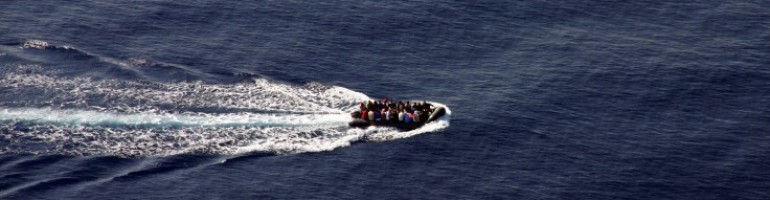
Luxembourg has provided a leased maritime patrol airplane, a CASA 212, to the Armed Forces of Malta for use during the ongoing Frontex operation “Nautilus IV” in the central Mediterranean. The German Police continue to provide several Puma helicopters to Frontex. The helicopters operate from Malta.
Author Archives: Niels Frenzen
New Surveillance Plane for Frontex Operation “Nautilus IV” (News)
Filed under Frontex, Germany, Luxembourg, Malta, Mediterranean, News
EC to Consider Voluntary Intra-Europe Resettlement Programme (News)
A formal proposal for the programme will be presented to member states for approval in September. “Malta and Italy are insisting that [the programme] should be compulsory, in order to force member states to share the burden of the southern EU member states, [EC Justice Commissioner] Barrot said this was not possible under the EU treaties and would therefore have to be on a voluntary basis.”
“The pilot project for a burden-sharing mechanism has specifically been tailored for Malta. Mr Barrot said the project would be operated on an experimental basis in the hope that it could eventually become a permanent instrument of EU solidarity. Specific reference to such a burden-sharing mechanism is also made in the draft Stockholm Programme presented earlier this year by the Commission.”
Click here for article.
Libya Seeks €200-€300 million From EU in Exchange for Assistance With Migrants (News)
EC Justice Commissioner Jacques Barrot plans to travel to Libya after the summer holidays to discuss EU – Libyan cooperation regarding migrants who transit Libya for Europe.
Barrot hopes to visit Libya with the United Nations High Commissioner for Refugees, Antonio Guterres. “’I know his administration is not very keen (on the trip), but he understands the problems,’ he said. The UN refugee agency has harshly criticised bilateral agreements signed between Italy and Libya to turn back would-be refugees.”
“’[Libya is] demanding impossible things,’ he said, explaining that Tripoli has put ‘enormous’ financial demands on the EU in exchange for its help. ‘We proposed 20 million euros, but they are asking for 200 to 300 million,’ sources in Barrot’s entourage said. Tripoli says it needs the funds to monitor its border with Niger and Chad.”
Click here for article.
Filed under Frontex, Libya, Mediterranean, News
Dublin Regulation Will Not Be Revisited Until 2014 (News)
EC Vice-President Jacques Barrot said that the common European asylum system should be implemented by 2012 at the latest, but the “revision of the Dublin Regulation, which stipulates that migrants apply for asylum in the first EU member state they enter and has resulted in disproportionate pressure on Greece and other southern EU states, will not be considered until 2014.” Greece and other certain other southern EU states seek an earlier revision to the Dublin Regulation.
Filed under European Union, Greece, News
European Refugee Fund May Be Used for Economic Migrants as Well as Asylum Seekers (News)
During the recent EU interior and justice ministers meeting in Stockholm, EC Vice President and Justice Commissioner Jacques Barrot agreed “to extend the European Refugee Fund to apply to all incoming migrants, not just those meriting asylum. As a result, several million euros in aid will be set aside for Greece and other Mediterranean states to spend on additional reception centers, food and medical supplies and social support for migrants.”
Click here for article.
Filed under European Union, Greece, News
Caritas Europa: Recommendations Regarding EU “Stockholm Programme” (Statements)
Caritas Europa and five Christian partner organisations have presented a series of recommendations on the “Stockholm Programme” to the Swedish Presidency of the EU, the European Commission and the European Council. Recommendations include:
“Border management measures must not lead to the deaths of hundreds of men, women and children. They must effectively guarantee that human rights, including the “nonrefoulement” obligation, are respected under all circumstances. In this regard training of border guards in the rights and obligations pertaining to international protection can be of great importance. Above all, border management structures must become more transparent and accountable. Instead of simply strengthening capacities and funding, a procedure must be put in place that proficiently ensures that those who are committing abuses will be held accountable. To this effect, the mandate and the activities of EU agencies such as FRONTEX should be clarified with respect to international obligations of the Union and its Member States towards persons in need of international protection.”
“Furthermore we encourage the European Parliament to tighten and enhance its control over activities of the FRONTEX Agency and the envisaged European Asylum Support Office. The active involvement of UNHCR and NGOs (including Church-related organisations) is vital for the success of these bodies.”
“Moreover in this context the recent initiatives of some Mediterranean Member States should be taken up and a coherent responsibility sharing policy should be devised, in the sense that other Member States assume responsibility for dealing with a certain number of asylum applications. Additionally the Union must develop a procedure of immediate suspension of the Dublin II Regulation when a Member State cannot comply with its duties under international and European law to ensure a fair procedure, decent reception conditions and effective protection. Nevertheless Member States must comply with their obligations under EU asylum legislation.”
” The negotiation of readmission and other agreements with third countries concerning the treatment (especially the return) of third country nationals must be transparent and subjected to close scrutiny by the European Parliament and the general public. Agreements are only acceptable if they ensure that the human rights of all persons concerned are completely and effectively respected.”
Click here for the full Recommendations.
Filed under Statements
UNHCR Criticises Italy’s Push-Back Policy (News)
“UNHCR staff in Libya have [interviewed] people who were intercepted by the Italian Navy on the high seas on July 1 about 30 nautical miles from the Italian island of Lampedusa. They were transferred to a Libyan ship and later transported to Libya. Based on subsequent interviews, it does not appear that the Italian Navy made any attempt to establish nationalities or reasons for fleeing their countries.”
“Once in Libya, the group was placed in detention centers…. Of those attempting to reach Italy, 76 originate from Eritrea, including nine women and at least six children. Based on UNHCR’s assessment of the situation in Eritrea and our interviews with the people themselves, it is clear that a significant number from this group are in need of international protection.”
“During interviews UNHCR heard disturbing accounts alleging that force was used by Italian personnel during the transfer to the Libyan vessel. … In view of the seriousness of these allegations, UNHCR has sent a letter to the Italian Government requesting information on the treatment of people returned to Libya and asking that international norms be respected.”
“Since the beginning of May, a new push-back policy was introduced and at least 900 people trying to reach Italy by sea have now been sent to other countries, mainly to Libya. UNHCR has expressed serious concerns about the impact of this new policy which, in the absence of adequate safeguards, can prevent access to asylum and undermines the international principle of non-refoulement.”
Click here for UNHCR briefing note.
Filed under Italy, Libya, Mediterranean, News, UNHCR
Malta: Monthly Migrant Arrival Numbers 01/2004 – 07/2009 (Statistics)

Times of Malta (numbers as of 14 July 2009)
Click here for Times of Malta article.
Filed under Data / Stats, Malta, Mediterranean
Frontex to receive technical assistance from ICMPD (news)
“On 27 June, Frontex established a basis for cooperation with the International Center for Migration Policy Development (ICMPD) via an exchange of letters between Ilkka Laitinen, the Executive Director of Frontex and Gottfried Zurcher, Director General of ICMPD. The aim of the agreement is to enhance cooperation between the two organizations in the promotion, development and implementation of integrated border management projects in EU Member States and Third Countries” – said Ilkka Laitinen.”
“The two organisations will focus on improving the management of migratory flows via cooperation in the field of training, research and capacity-building activities for the border guards of EU Member States or those of third countries.”
Click here for Frontex press release.
“The International Centre for Migration Policy Development (ICMPD) was founded in 1993, upon the initiative of Austria and Switzerland. The organisation was created to serve as a support mechanism for informal consultations, and to provide expertise and efficient services in the newly emerging landscape of multilateral co-operation on migration and asylum issues.”
“ICMPD today is an international organisation with eleven Member States (Austria, Bulgaria, Croatia, Czech Republic, Hungary, Poland, Portugal, Slovakia, Slovenia, Sweden and Switzerland), sixty staff members at its Vienna Headquarters, a mission in Brussels and regional offices and representatives throughout Europe, CIS, Northern Africa and the Middle East. ICMPD holds UN observer status. The purpose of ICMPD is to promote innovative, comprehensive and sustainable migration policies and to function as a service exchange mechanism for governments and organisations.”
Click here for ICMPD web site.
New Book : The Snakehead: An Epic Tale of the Chinatown Underworld and the American Dream (Books)
“In 1992, after a crackdown on corruption in the Bangkok airport (where snakeheads procured fake documents), the smugglers turned to boats, or what was known as the “bucket business.” Most ships were barely seaworthy; some had as many as a hundred cabins and packed the bodies in. Routes were byzantine: the FBI tracked one group of migrants from Fuzhou to Hong Kong, Bangkok, Kuala Lumpur, Singapore, Dubai, Frankfurt, and then Washington. Keefe puts it this way: “In the minds of the snakeheads, humans were ultimately a form of cargo like any other, subject to the economies of scale.” Like the global trade in more ordinary goods, shipping on the sea worked, leaving U.S. authorities in its wake for quite a while.”
Click here for review.
Filed under Books, China, United States
Appel pour un camp No Border à Lesbos en Grèce du 25 au 31 août (Conferences)
“Nous vous invitons à venir à Lesbos du 25 au 31 août 2009, là où le système de contrôle des frontières européennes est flagrant, pour que nous échangions nos expériences dans le domaine des lignes de frontières, pour discuter, se coordonner et lutter ensemble.” Coordination NO BORDER Lesvos 2009
Filed under Aegean Sea, Colloques / Conferences, Greece
Sénégal et l’Espagne: coopération dans le contrôle de l’émigration clandestine vers l’Europe (News)
“Le Sénégal et l’Espagne [qui] collaborent depuis 2006 dans le contrôle des flux d’émigrés clandestins vers l’Europe … ont signé mardi à Dakar un accord prolongeant d’un an la coopération de leurs deux pays dans le contrôle de l’émigration clandestine…. ”
“Avec le FRONTEX, nous avons pu réduire considérablement ce fléau’’, a affirmé Cheikh Tidiane Sy [le ministre sénégalais de l’Intérieur].”
“Le FRONTEX, avec lequel collabore la police sénégalaise, a permis de réduire fortement les flux d’émigrés clandestins en provenance d’Afrique subsaharienne, pour rejoindre l’Europe.”
Click here for article.
Increasing Numbers Seek Entry to US By Sea From Mexico (News, Statistics)
While migrants and asylum seekers have long sought entry to the US from the Caribbean Sea, efforts to reach the US mainland from Mexico via the Pacific Ocean have been less common. The US Department of Homeland Security reports that increasing numbers of migrants are seeking to enter the US (California) by sea from Mexico.
“[US Coast Guard] Commander Pearce and other officials in the Department of Homeland Security say those sporadic efforts have accelerated to unprecedented levels recently — a doubling in the number of illegal immigrants — more than 300 in the last two years — caught on boats or beaches….”
“New smuggling rings have also emerged, operating out of beach towns south of the border and islands off the Mexican coast, convincing migrants that the passage is safe and the ocean too wide open for maritime law enforcement to catch them.”
“The authorities arrested 136 illegal immigrants sneaking in by sea in the fiscal year that ended Oct. 30, double the 66 marine arrests in 2007. Since October, more than 100 illegal immigrants have been arrested….”
Click here for article.
Filed under Data / Stats, Mexico, News, Pacific Ocean, United States
Australia: Four Fold Increase in Number of Boat People (News, Statistics)
Approximately 900 migrants have been intercepted near Australia so far this year. This is four times the number of migrants who were found in all of 2008.
“In the latest case, about 73 asylum seekers are being taken to the Australian territory of Christmas Island in the middle of the Indian Ocean for processing. Most of the migrants trying to reach Australia this year are escaping fighting in Afghanistan, Iraq, Pakistan and Sri Lanka. Most travel to Malaysia or Indonesia where people smugglers [operate].”
Click here for article.
Filed under Australia, Data / Stats, News
Significant Reduction in Migrants Reaching Canary Islands (News, Statistics)
Only 1,318 people reached the Canary Islands by boat over the first six months of 2009. This low number contrasts with the record number of 31,678 who reached the Canary Islands on approximately 600 boats in 2006 and 9,181 migrants who arrived in 2008.
“The Spanish government credits the decline on increased maritime surveillance and agreements with several African nations that allows it to send migrants back.”
“Under the EU’s Frontex programme, Spain’s Civil Guard police patrol the waters off West Africa, in partnership with the authorities from Senegal and Mauritania. In the first six months of 2009, these patrols diverted 762 migrants back to their points of departure. Additionally, a single, satellite communications network, called Sea Horse, pools information between the two continents.”
Filed under Data / Stats, Eastern Atlantic, Frontex, Mauritania, News, Senegal, Spain