Category Archives: European Union

Malta Says Frontex Chronos Mission Not Needed Due to Success of Italy-Libya Push-Back Agreement

Malta previously said that it would not host Operation Chronos, Frontex’s annual central Mediterranean enforcement operation, formerly known as Nautilus, due to the recently approved guidelines governing Frontex enforcement operations at sea which require that intercepted migrants be taken to the country hosting the mission under certain circumstances.

But the Times of Malta is reporting that a Maltese government spokesperson said that the decision not to host Frontex is not because of the new guidelines, but is due to Malta’s view that there is no longer a need for Operation Chronos because of the success of the Italy-Libya migration agreement. “The reason why we decided not to take part in this year’s mission is that we feel there is no need for this year’s EU patrol.  We have noticed that, following the introduction of joint patrols by Libya and Italy last year, the number of illegal immigrants reaching Malta has dropped significantly. We feel that, as long as this operation remains in place, there is no real need for another anti-migration mission on behalf of the EU.”

The Times article reports that 84 boats carrying 2,775 migrants arrived in 2008 and that this number was reduced in 2009 to 17 boats carrying 1,475, with the majority of arrivals occurring in the first half of 2009 before the Italian push-back policy was implemented.

Commissioner Cecilia Malmström travels to Rome and Malta this week for meetings with officials on asylum and migration issues.

Click here for article.

Click here, here, and here for earlier related posts.

4 Comments

Filed under Data / Stats, European Union, Frontex, Italy, Libya, Malta, Mediterranean, News

Thomas More Institute: Towards a Sustainable Security in the Maghreb – An Opportunity for the Region

The Thomas More Institute has released a report, “Towards a Sustainable Security in the Maghreb –  An Opportunity for the Region, a Commitment for the European Union.”  The report was released on 7 April at the “Maghreb and the European Union: Enhancing the partnership for a sustainable security” conference in Brussels.

From the Executive Summary:  “The relationship between Europe and the Maghreb is a complex, multidimensional and somewhat passionate one. The two areas share a common history and are bound by common interests. United against a number of joint challenges (economic development, regional stability, fight against terrorism, migration, sustainable development), it is time for the two shores of the Mediterranean to reconsider the basis for their cooperation. [***] The EU is well aware of what is at stake and must now look for ways of making a more active commitment in the region, particularly on sensitive issues such as human rights and migration. [***] The question of migration, which extends as far as the Sahelian area, is another area of cooperation which needs to be looked into in more depth, since the EU’s policy of limiting migratory flows can no longer be restricted to the northern border of the Maghreb. Reinforcing the role of the European agency FRONTEX throughout the area, for example by opening regional offices and assigning resources, is one possible solution. Intensifying efforts to coordinate development assistance policies between the EU and Maghreb countries to help Sub-Saharan African countries that represent sources of immigration is another solution that should not be ignored.”

A further excerpt: “A need for increased cooperation between the European Union and the Maghreb – Europe’s policy on migration is based on the principle that the great era of mass migrations is over, replaced by a new international division of labour, whereby a foreign workforce is substituted for the national workforce, and by policies that involve returning and rehabilitating non-Europeans in their countries of origin and internal mobility for Europeans within an area with no interior borders. European countries – and the Community, followed by the EU – concentrated their efforts on border control, in a securitarian view dictated by the migratory risk and concerns about the challenges of integration. Schengen relegated the countries of the Maghreb, and others, to the status of “outsider countries”, with which human circulation is restricted. This logic was maintained by the militarisation of borders which started in 1988 when barriers were built around the Spanish enclaves of Ceuta and Melilla, then as of 2002 by the installation of the Integrated System of External Vigilance (SIVE) around Gibraltar and later along the Spanish coasts – including the Canary isles – comprising twenty-five detection points, a dozen mobile radar and ten or so patrol units. The attacks perpetrated on September 11th reinforced the security component and, following the creation of FRONTEX (European Agency for the Management of Operational Cooperation at the External Borders) in 2005, other areas were militarised, with preventive sea and air patrols in the Mediterranean and even in the Atlantic, near the Canary isles. The EU also provides its members with technical assistance. [***] The Maghreb has made a real effort to contribute and cooperate with the EU in the fight against immigration.  In February 2004, Morocco and Spain started joint patrols and in 2008, cooperation was reinforced by improving controls in the ports of Tangier and Algeciras.  According to the Spanish authorities, the result was an overall drop of 60% in illegal immigration originating in Morocco between 2007 and 2008.  The decrease in illegal Moroccans was reportedly around 38%. However, reinforced controls caused a shift in migratory routes. According to the Italian Ministry of the Interior, the number of illegal immigrants arriving in Italy by sea rose by 75% between 2007 and 2008. 14 000 people arrived in Italy illegally in 2007, whereas the figure was in excess of 40 000 in 2008. Following the signature of the Benghazi treaty between Italy and Libya on 30th August 2008, Italy obtained greater assistance from Tripoli in the form of bilateral cooperation on illegal immigration and the application of the December 2007 agreement on joint patrols off the Libyan coasts, plus the installation of radars by Finmeccanica at Libya’s southern borders.”

Click here for full Report.

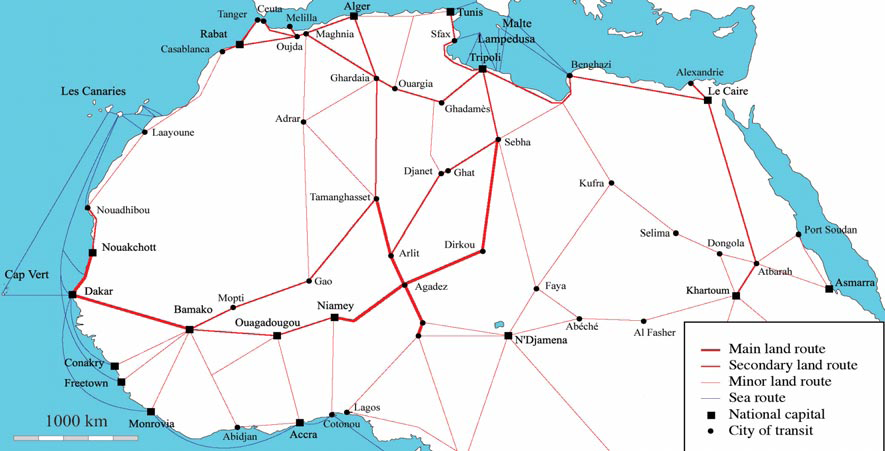
Main routes of present-day Trans-Saharan migrations

1 Comment

Filed under Algeria, Analysis, Data / Stats, Eastern Atlantic, European Union, Frontex, Italy, Libya, Malta, Mauritania, Mediterranean, Morocco, Spain

EDA Report on Maritime Surveillance in Support of CSDP

The “Wise Pen Team” Final Report to the EDA Steering Board on Maritime Surveillance in Support of the Common Security and Defence Policy (CSDP) was released on 26 April.

The EDA Press Release states: “the Ministerial Steering Board received the report of the Wise Pen Team of five retired admirals on Maritime Surveillance in support of CSDP. The central message of the report is the need for linking national and international military and civilian assets in order to create a federated maritime surveillance network. The report contains concrete recommendations and will provide an important contribution to the activities on Integration of Maritime Surveillance, led by the European Commission.  ‘The Wise Pen Team’s report has already had a major impact. It has brought different actors together, civilian and military, which will be crucial for developing effective Integrated Maritime Surveillance’, Catherine Ashton stated. She added: ‘My dual-hat capacity as High Representative and Vice-President of the Commission has exactly been created to realise the synergies we need in the EU between the civilian and military sides in areas like Maritime Surveillance.’”

Executive  Summary: “[***] Increasing maritime insecurity, not least terrorism, piracy and illegal immigration, has highlighted the need to improve European security by integrating maritime policy making, sharing information more effectively and transparently and coordinating a collective response to security challenges. Many useful initiatives are already underway, but there is the need to make graduated improvements in co-ordination and integration which are affordable and not technologically difficult. [***]”

I have not attempted to read this 50+ page document yet, but it may of interest to some.

Here is the Table of Contents:

  • Introduction: Trends in the Economy and Maritime Security Context
  • The Interim Conclusions of the Intermediate Report
  • Changes Since the Issue of the Intermediate Report
  • Maritime Surveillance. Its Aims and Purposes
  • Naviesʼ Contribution to Maritime Surveillance
  • Tools and Networks
  • Alternative Organisational Approaches
  • Data, Information, Knowledge
  • Preferable Approaches
  • Conclusions and Recommendations

Click here for the Report.

Click here for EDA Press Release.

Leave a comment

Filed under European Union, Reports

MEPs Lambert and Iacolino on CEAS

MEP Jean Lambert (Green – UK) writes in New Europe in regard to the Common European Asylum System (CEAS) that  the Greens “want to see a fair and efficient system which will deliver consistent and high quality decisions for those in need of protection. Amongst the major challenges at present are the inconsistencies across the EU in both the practical delivery of Member State’s asylum systems and the outcomes of their decisions. It would be fair to refer to the ‘European Asylum lottery’ when faced with statistics on the divergences in protection rates between Member States – 73.2 % of Iraqi applicants were granted subsidiary protection at first instance in Sweden in the first quarter of 2007 compared with 0% in Greece.”

Click here for full article.

MEP Salvatore Iacolino, Vice Chair of LIBE, (Christian Democrat – Italy) writes “we must ensure, on the one hand, access to efficient and streamlined procedures for persons seeking international protection, and, on the other, consistent application of rules in order to build mutual trust between Member States.  We cannot just think of a national dimension for the strategies for immigration and asylum, but it is essential to create a mechanism for equitable sharing of responsibilities.”

Click here for full article.

1 Comment

Filed under European Union, Italy, News, UK

Commissioner Cecilia Malmström’s blog – Mitt Europa

This is not new, but I just noticed Cecilia Malmström’s blog, Mitt Europa.   It is in Swedish but easily accessible using Google Translate.   Given the difficulty in accessing information concerning the European Commission and Frontex, perhaps some interesting information will turn up from time to time.

Click here for blog.

1 Comment

Filed under European Union, News

LIBE-Odysseus Network Round Table (26 April) and LIBE Meeting Agenda

A Round Table on “Towards a Common European Asylum System: A study on some horizontal issues” will be held on 26 April at 15.00 – 18.30. The meeting is organised by the LIBE Committee and the Policy Department Citizens’ Rights and Constitutional Affairs with the participation of the National Parliaments and the Odysseus Network.  The Round Table meeting precedes the two day meeting, 27-28 April, of the LIBE Committee which will be considering numerous agenda topics including:

  • Creation of an immigration liaison officers network;
  • The establishment of a joint EU resettlement programme;
  • Discussion concerning the European Refugee Fund; and
  • Institutional aspects of accession by the European Union to the European Convention for the Protection of Human Rights and Fundamental Freedoms.

The final agenda item is a Meeting with UN High Commissioner for Refugees, Antonió Guterres on matters relating to asylum policy, co-chaired by the Committee on Development and the Subcommittee on Human Rights.

Click here for Round Table agenda.

Click here for LIBE meeting documents.

Leave a comment

Filed under Colloques / Conferences, European Union, News, UNHCR

France Agrees to Accept 92 Refugees from Malta for Resettlement

French Ambassador Daniel Rondeau announced that France will shortly accept 92 additional refugees from Malta as part of the EU voluntary resettlement programme.  The Times of Malta reports that the Ambassador said “These people are prepared to die to live anywhere except their country; so many die in the Mediterranean Sea. It is really a tragedy and Malta was affected by it… we have to share this tragedy with the Maltese and with the immigrants. It’s our sea and it’s at our door, we cannot look the other way.”  France resettled 95 refugees from Malta last year.  Several other countries, including Germany and the UK have voluntarily accepted refugees from Malta.

Click here for article.

1 Comment

Filed under European Union, France, General, Malta, Mediterranean, News

Analysis of the Real Instituto Elcano- Frontex: Successful Blame Shifting of the Member States?

Analysis of the Real Instituto Elcano: “Frontex: Successful Blame Shifting of the Member States?” by Jorrit J. Rijpma, PhD European University Institute, Florence, and Lecturer in EU law, Europa Instituut, Leiden University.

Excerpts:

“Frontex in Short – Frontex can be seen as the outcome of a ‘re-balancing’ of powers between the Member States, the Council and the Commission following the communitarisation of the policy on external borders after the Treaty of Amsterdam, constituting an important shift from the intergovernmental coordination of operational activity under the Council to a more Community-based approach. [***]

Joint Operations at Sea – [***] Currently, the most controversial practice is that of the diversion by national border guards of ships back to their point of departure. This practice entails not only a real risk to the life and safety of the passengers on board these often unseaworthy ships, but as regards possible asylum seekers on board, it also risks violating the right to claim asylum and the prohibition of refoulement. The Greek coast guard has the questionable reputation of regularly diverting boats back to the Turkish shores. Italy has openly admitted to the interception and return of irregular migrants and asylum seekers from Libya under its 2008 Treaty on Friendship, Partnership and Cooperation with the latter country. Both within and outside the Hera operations, Spain has been returning people to Senegal and Mauritania, but here at least the interceptions are formally cast in terms of rescue operations and transfer to the nearest place of safety.

Frontex: the Lesser Evil?- There are many reasons why Frontex can be subject to criticism. It could be argued that it is an instrument of an essentially flawed EU migration and asylum policy. [***] Finally, it could be said that the Agency reinforces a securitised perception of what is essentially a humanitarian problem through its one-sided mandate, the background of most of its staff in national law-enforcement agencies and its military-style operations. [***] However, it is important to realise that for the moment the Agency’s scope for independent action remains very limited, both in practical and in legal terms. Serious human-rights violations are more likely to occur in operations from national border guards removed from the public eye, than in relatively well-scrutinised joint operations. Frontex, being a Community body, is subject to numerous reporting and evaluation duties, as well rules on transparency. [***]

Conclusion: Efforts should focus on ensuring full respect of international rules regarding international protection and search and rescue and an authoritative interpretation of these rules in a broad sense. These are essentially political decisions. It is the Member States and the Community institutions, not Frontex, that are to be reproached for the failure to do so. [***]”

Click here for full Analysis.

Leave a comment

Filed under Aegean Sea, Analysis, Eastern Atlantic, European Union, Frontex, Greece, Italy, Libya, Malta, Mauritania, Mediterranean, Senegal, Spain, Turkey

CONCORD Briefing Paper on Revisions to Cotonou Agreement

CONCORD, the European NGO Confederation for Relief and Development, prepared an updated briefing paper regarding the ongoing negotiations concerning revisions to the Cotonou Agreement for the ACP-EU Joint Parliamentary Assembly session held 27 March to 1 April in Tenerife.

Excerpts regarding Article 13 (Migration) from an updated CONCORD Cotonou Working Group Briefing Paper:

“Migration, still unresolved – The revision of Article 13 on Migration is a major stumbling block to the negotiations.  The two sides failed to reach an agreement by the extraordinary ACP-EU Council on 19 March. EU and ACP states agreed in a joint declaration to continue dialogue on the migration article and report to the joint ACP/EU Council in June 2011.

The bulk of the disagreement lies on the clause on readmission. The EU side would like the clause on readmission in the Cotonou Agreement to become self-executive and binding for all ACP countries without needing complementary bilateral agreements. This will imply unmanageable obligations for many countries and hence an increased risk of migrants rights violations throughout the process of readmission.

In no way should EC and MS ODA [Official Development Assistance] be dependent on the signature of readmission agreements (being bilateral or multilateral).  By making development aid conditional on cooperation on border control, the EU is turning development aid into a tool for implementing restrictive and security-driven immigration policies which are at odds with its commitment to make migration work for development.

Article 13 should rather be focusing on concrete opportunities for increased mobility and ensuring that ACP states are assisted in their national efforts to ‘make migration work for development’ (countering of the negative economic and social effects of brain drain and care drain, sustainable migration opportunities, facilitating remittances…). This would bring progress towards Policy Coherence for Development in the migration area. Opportunities of legal migration, including for low skilled workers, and respect of migrants’ rights are necessary conditions for exploiting the development potential of migration. Provisions on legal migration should be as strong and binding. Finally, EU and ACP states should ratify the UN Convention on Migrants Rights and ratify it themselves.”

Click here for full text of CONCORD Cotonou Working Group Briefing paper.

Click here and here for earlier related posts.

1 Comment

Filed under European Union, News

Annual GDISC Asylum Conference

From 8-10 March the German Federal Office for Migration and Refugees and the Directors General of Immigration Services Conference GDISC – organised the annual GDISC Asylum Conference in Nuremberg.

Representatives from 24 European countries, the EC, UNHCR, and IGC discussed the current situation in the field of asylum as it relates to the issues of unaccompanied minors, quality management of asylum services, the impact of the proposed changes on the EU directives to the field of asylum, and the functioning of the asylum support teams within the European Asylum Support Office (EASO).  The next GDISC conference will be held in Prague on 15-15 June 2010.

Click here for the Draft Summary Conclusions of the Conference.

Leave a comment

Filed under European Union, Germany, News, UNHCR

Conference for Heads of Coast Guards of EU States and Schengen Countries

The Second Conference for Heads of Coast Guards from the EU Member States and Schengen Associated Countries is being held in Málaga, Spain.  According to Santiago Macarrón, el general de Fiscal y Fronteras de la Guardia Civil, the conference represents an ongoing effort to standardize actions within the EU.  Among the topics being discussed at the Conference is the question of where migrants who are intercepted at sea are to be taken. Frontex’s Deputy Director Gil Arias stated that where migrants are to be landed is not clear under international law and has caused problems in the past, especially in the Mediterranean.

Click here for article (Spanish).

1 Comment

Filed under European Union, Frontex, Mediterranean, News

ECRE Interview with Frontex Spokesperson

ECRE interviewed Frontex spokesperson Michal Parzyszek about the changes to Frontex’s mandate.  The interview took place before the 25 March European Parliament’s vote which allowed the changes to take effect.

Click here for the interview.

Leave a comment

Filed under European Union, Frontex, News

Malta Will Not Host Future Frontex Operations

Maltese PM Lawrence Gonzi said on 28 March that because of the new guidelines approved by the European Parliament addressing Frontex sea operations, Malta will no longer host Frontex operations.  “This is a major disappointment…our position is that the new rule does not make sense and unless this rule is amended, Malta will not participate in Frontex operations. However, if the rule if changed, we will take part.”

Malta objects to a provision in the new guidelines requiring that intercepted migrants be brought to the member state hosting the Frontex operation rather than the closest available port which in the past has meant that intercepted migrants would often be brought to an Italian port rather than Malta.

Click here and here for articles.

4 Comments

Filed under European Union, Frontex, Malta, Mediterranean, News

EP Vote Allows New Guidelines for Frontex Operations at Sea to Take Effect

New guidelines governing Frontex enforcement operations at sea will now take effect even though the European Parliament voted on 25 March to reject the guidelines by a vote of 336 to 253 with 30 abstentions.  However, an absolute majority of all EP Members, 369 votes, was required in order to block the new guidelines.

Malta opposes the new guidelines.  The Times of Malta reported that “the European Commission and Council have managed to get their way and will be able to introduce new rules of engagement during this year’s anti-migration patrol missions coordinated by Frontex as the resolution to reject these rules approved by the Civil Liberties Committee last week didn’t manage to garner the necessary support of the Socialist group in the EP.”

“According to the new rules, all irregular immigrants and asylum seekers saved on the high-seas during a Frontex mission have to be taken to the mission’s host country and not to the closer safe port. This means that if Malta hosts a Frontex mission in the future, as it has done in the past two years, it will have to take all the illegal immigrants found at sea. Malta has already declared that it will not continue to take part in Frontex missions under these rules.”

An EP press release stated that the “EU guidelines say[]that border patrols have a moral duty to rescue migrants in distress at sea….  The guidelines cover ‘search and rescue situations and for disembarkation’ in the context of operations on the EU’s sea borders.  They state that Member States fleets operating under FRONTEX must render assistance to persons in distress at sea, regardless of their nationality or status, or the circumstances in which that person is found…. Disembarkation procedures should be carried out in line with international law and existing bilateral agreements between Member States and third countries.”

Click here for article.

Click here for EP Press Release.

Click here, here and here for earlier posts on the new Guidelines.

2 Comments

Filed under Aegean Sea, Eastern Atlantic, European Union, Frontex, Malta, Mediterranean, News

UNHCR Report on EU Member State Implementation of the Asylum Procedures Directive

The UNHCR has released a comprehensive report entitled “Improving Asylum Procedures: Comparative Analysis and Recommendations for Law and Practice: A UNHCR research project on the application of key provisions of the Asylum Procedures Directive in selected Member States.”

From the Report’s introduction:

“In the exercise of its supervisory role under Article 35 of the 1951 Convention relating to the Status of Refugees … UNHCR has undertaken a wide-ranging comparative analysis of the transposition of key provisions of the [2005 Asylum Procedures Directive] into national law by selected EU Member States, and the practical application of those provisions….

The research and recommendations also aim to inform negotiations in the Council and the European Parliament on possible amendments to the APD, as put forward by the Commission in October 2009. They also seek to provide constructive input to preparations for the work of the European Asylum Support Office (EASO). The EASO has a mandate to facilitate practical cooperation on asylum among Member States, and Member States have underlined their interest in prioritizing the promotion of quality asylum decision-making among its tasks. In that context, this report will provide helpful material.

The research addressed 18 articles of the APD, as they are transposed in law and implemented in practice in the twelve participating states: Belgium, Bulgaria, Czech Republic, Finland, France, Germany, Greece, Italy, the Netherlands, Slovenia, Spain and the United Kingdom. As such, the research and recommendations do not address all provisions in the APD, nor the law and practice in every Member State bound by the Directive. This project does not seek to focus scrutiny on any particular Member State.  Where gaps or problematic practices have been observed, UNHCR hopes that this research provides an opportunity to discuss and address them, and to draw on the numerous good practices which have also been observed.”

The UNHCR press release states that the “study found not only that member states are applying the Asylum Procedures Directive in diverging ways, but, in some cases, in ways that may breach international refugee law. Researchers reported that applicants were not always afforded personal interviews, or were not given enough time to prepare for interviews or to explain their claims. Interpreters were not always available or qualified…. These and other practices, the study concludes, create the risk that protection needs are not properly identified and people may be sent back to countries where they face persecution or grave personal harm.  At the same time, the research identified many good practices, including the provision of clear information on how to appeal negative decisions, codes of conduct for interviewers and interpreters, careful recording of interviews and of decisions, and good cross-cultural communication skills on the part of interviewers.”

Click here or here for the Report.

Click here for UNHCR press release.

Leave a comment

Filed under European Union, Reports, UNHCR