Category Archives: Frontex

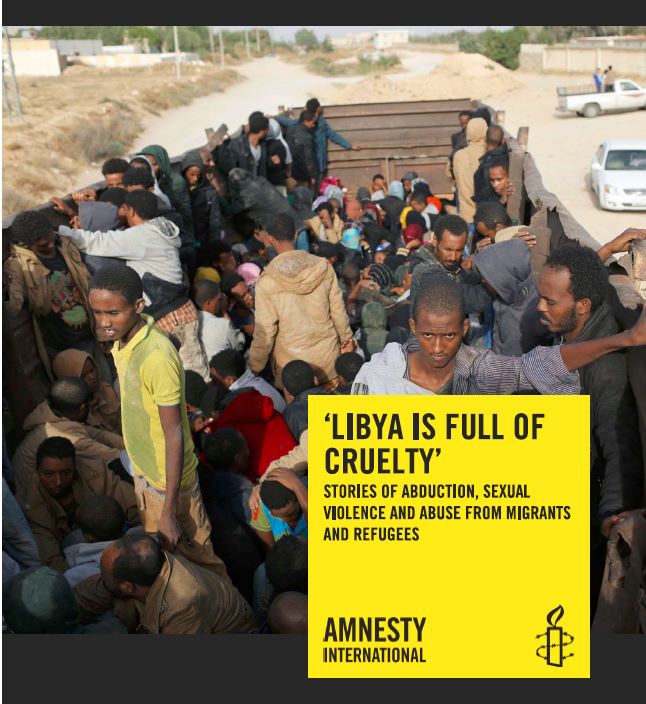
Amnesty International Report: ‘Libya is Full of Cruelty’ – Stories of Abduction, Sexual Violence and Abuse from Migrants and Refugees

Amnesty International has released a new report entitled: “’Libya is Full of Cruelty’ – Stories of Abduction, Sexual Violence and Abuse from Migrants and Refugees.” (also available here.)  2015-05-11_Amnesty Intl_Report_Libya_Libya_is_full_of_cruelty COVER

Key points include (see formal AI recommendations below):

  • “Widespread abuses by armed groups, smugglers, traffickers and organized criminal groups in Libya as well as systematic exploitation, lawlessness and armed conflicts are pushing hundreds of thousands of migrants, asylum-seekers and refugees to risk their lives by attempting to cross the Mediterranean Sea”;
  • “In many cases, migrants and refugees attempting to cross the Mediterranean Sea have been subjected to prolonged beatings in [detention] facilities following their interception and arrest by the Libyan coastguard or militias acting on their own initiative in the absence of strong state institutions”;
  • “While Amnesty International welcomes the EU’s commitment to increase resources for search and rescue operations, it is also concerned that some of the proposed measures, in particular plans to ‘systematically identify, capture and destroy vessels before they are used by traffickers’ would effectively contribute to migrants and refugees being trapped in Libya and expose them to a risk of serious human rights abuses”;
  • “As more people are drowning in the Mediterranean Sea, the priority for the international community must be to dramatically expand search and rescue operations and take effective steps to urgently address human rights abuses and serious violations of international humanitarian law in Libya. EU governments must also increase the number of resettlement places, humanitarian admissions and visas for people in need of international protection”.

Amnesty International makes the following recommendations:

To European governments

  • Urgently ensure the deployment of naval and aerial resources at a scale commensurate with foreseeable departure trends and which should patrol the high seas along the main migration routes. Whether such deployment occurs within the framework of Frontex Joint Operation Triton or through other agreements, it is crucial that ships and aircraft are delivered promptly and deployed in the area where most of calls for assistance come from and a great number of shipwrecks occurs;
  • To reduce the numbers of those risking their lives at sea, increase the number of resettlement places, humanitarian admissions and visas for people in need of international protection and ensure that refugees have effective access to asylum at land borders;
  • Ensure that any action against smugglers and traffickers is addressed through law enforcement measures, governed by human rights law and standards, and that it does not contribute to migrants and refugees being trapped in Libya without any means of escaping the violence;
  • Ensure that human rights abuses and violations of international humanitarian law, including against migrants, asylum-seekers and refugees in Libya, are addressed as part of the political dialogue aimed at ending the ongoing conflicts, and that a mechanism is put in place to monitor the human rights situation on the ground following any subsequent settlement. EU governments must also insist that Libyan authorities, armed groups and militias end the systematic indefinite detention of migrants and refugees based on their immigration status; all refugees and asylum-seekers and migrants detained for immigration purposes must be released.;
  • Investigate and bring to justice in fair trials those involved in trafficking of persons.

To the governments of Tunisia, Egypt and Algeria:

  • Keep the borders open to all individuals in need of international protection regardless of whether they have valid travel documents or meet visa requirements.

To governments along the smuggling route:

  • Ensure that any regional co-operation aimed at addressing irregular migration and dismantle smuggling networks fully complies with international law and standards, and does not infringe upon the rights and safety of asylum-seekers and refugees, with particular regard to the right to freedom of movement, the right to asylum, and the absolute prohibition on refoulement.

To militias, armed groups and Libyan authorities:

  • Release anyone detained solely on the basis of their immigration status, nationality, race, religion or ethnicity;
  • Make clear to all those under your command that torture or other ill-treatment, rape and sexual assault will not be tolerated under any circumstances. Remove from the ranks anyone suspected of such abuses;
  • Facilitate visits by independent organizations to immigration detention centres and other places of detention;
  • Ensure that all those deprived of their liberty can communicate regularly with their families and have access to adequate medical care.”

Leave a comment

Filed under Analysis, European Union, Frontex, Libya, Mediterranean, Reports, United Nations

Approximately 40 Migrants Reported Dead After Merchant Ship Approached Migrant Boat

Reuters and other news agencies report that rescued survivors arriving today in Sicily told Save the Children that about 40 persons died – other survivors reported that “lots” of people died – after “dozens of people fell into the sea when they saw the merchant ship approach” their overloaded rubber dinghy. The migrant boat left Libya and was rescued on Sunday south of Sicily.

1 Comment

Filed under European Union, Frontex, Italy, Libya, News, Operation Triton

UK Delays Deployment of Navy Ship in Mediterranean Until Italy Agrees to Accept Rescued Migrants

Another example of why ships, commercial and military, may sometimes avoid rescuing migrant boats: the Guardian reported yesterday that the UK has kept the HMS Bulwark at anchor in Sicily “amid a diplomatic spat over where rescued people should be disembarked and processed. … Involvement was held up by deliberations between the Italian and British foreign ministries. Britain, which agreed to send the ship after emergency EU talks last month, sought guarantees that the migrants rescued by HMS Bulwark could be taken to Italian ports once they are saved from the high seas.”

1 Comment

Filed under Frontex, Mediterranean, News

Highlights from Frontex Annual Risk Analysis 2015 – Detections of Illegal Border-Crossing Between Border Crossing Points

Frontex released its Annual Risk Analysis 2015 (also here) on 28 April. Over the next few days I will post some key points and excerpts from portions of the 70 page report which are most relevant to migration by sea. See Executive Summary and Statistical Annex. 2015-04-28_Frontex_Annual_Risk_Analysis_2015-COVER
This post contains excerpts and key points from the ARA, Section 3, Situational Picture in 2014 / Detections of illegal border-crossing between border crossing points:

• In 2014, detections of illegal border-crossing reached a new record, with more than 280 000 detections. This was twice as many as the previous record of 140 000 detections in 2011, the year of the Arab Spring;
• With a record level of migrants crossing the border illegally, resources are devoted to their immediate care, but not towards screening;
• Syrians and Eritreans did not apply for asylum in the Member States of entry but rather in other Member States;
• As in 2013 and in 2011, the Central Mediterranean route was the main area for illegal border-crossing into the EU, representing 60% of all detections in 2014;
• Around 3 400 people died or went missing at sea in 2014;
• Civilian vessels have been increasingly involved in the detection and rescue of migrants at sea. More than 600 merchant ships have been diverted from their routes to rescue persons at sea in 2014;
• An increasing number of cases have been reported of cargo vessels being used to smuggle migrants from Turkey directly to Italy. This new trend affects the Eastern Mediterranean route, as the departure area, and the Central Mediterranean area, as the arrival area;
• In 2014, 50 800 detections were reported in the Eastern Mediterranean area, representing 18% of the EU total. This was twice as many as in 2013, mostly due to a sharp increase in detections in the Aegean Sea (from 11 829 in 2013 to 43 377 in 2014);
• In 2014 there were 7 842 detections of illegal border-crossing in the Western Mediterranean region, which consists of several areas of the southern Spanish coast and the land borders of Ceuta and Melilla. This total shows an increase of 15% compared to the total of 6 838 reported in 2013.;
• Detections of illegal border-crossing on the Black Sea were extremely rare. However, since 2013, Bulgaria and Romania have reported an increasing number of detections, totalling 433 migrants in 2014.

Excerpts:

“3.3. Detections of illegal border-crossing between BCPs [along land and sea routes in 2014]

In 2014, detections of illegal border-crossing reached a new record, with more than 280 000 detections. This was twice as many as the previous record of 140 000 detections in 2011, the year of the Arab Spring. This unprecedented number of migrants crossing illegally the external border has roots in the fighting in Syria that have created the worst refugee crisis since the Second World War. Indeed, most of the detections at the borders concern migrants from Syria, who later applied for asylum within the EU. [***]

With a record level of migrants crossing the border illegally, resources are devoted to their immediate care, but not towards screening and obtaining information on basic characteristics like their nationality. As migrants quickly continue their journey to other Member States, increasing the movements of persons staying illegally within the EU, this puts the EU internal security at risk. [***]

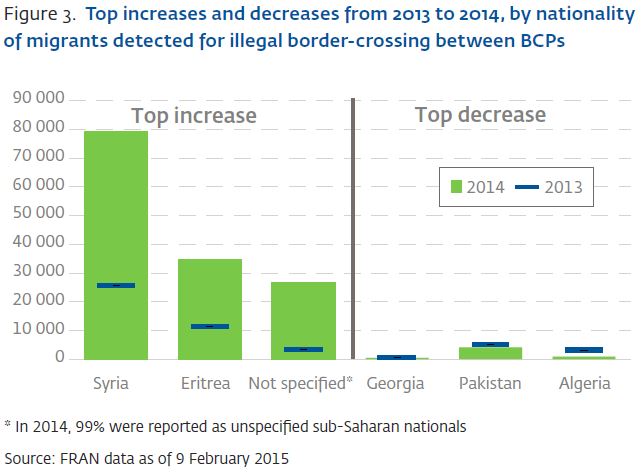
Indeed, Syrians alone (79 169) represented more than a quarter (28%) of the total as shown in Figure 3. [SEE BELOW.] They were also the top nationality for other indicators, in particular asylum applications, reflecting the dire situation in Syria and the desperate plight of Syrian asylum seekers. However, the vast majority of Syrians did not apply for asylum in the Member States of entry but rather in other Member States for many different reasons, notably because they expect to receive more attractive welfare benefits.

Regarding Eritreans, their detections in 2014 reached a record level (more than 34 500, compared to 11 300 in 2013). They were mostly arriving through Libya on the Central Mediterranean route. Like Syrians, they did not apply for asylum in the Member States of entry, but rather continued to other Member States. Many of the Eritreans stated that they had lived for some time in Libya but decided to leave because of the violence.

Detections of Afghans sharply increased from about 9 500 in 2013 to more than 22 000 in 2014. Afghans were detected on the Eastern Mediterranean route (mostly crossing the Eastern Aegean Sea), and then once again on the Western Balkan route. [***]

Central Mediterranean route

In 2014, more than 170 000 migrants arrived irregularly in the EU through the Central Mediterranean route (see Fig. 4).[SEE BELOW.] As in 2013 and in 2011, the Central Mediterranean route was the main area for illegal border-crossing into the EU, representing 60% of all detections in 2014. Detections were the largest between June and September at over 20 000 per month, but throughout the year, monthly detections were larger than in 2013. Most migrants were Syrians and Eritreans departing from the Libyan coast.

The vast majority were rescued by border-control authorities after issuing a distress call; however, despite best efforts there were many fatalities. Smugglers typically make use of frail, overcrowded boats, with limited fuel available to maximise their profits, putting migrants’ lives at considerable risk. The role of the Italian Navy and the JO Hermes/ Triton was crucial in rescuing an unprecedented number of migrants. Despite these efforts, around 3 400 people died or went missing at sea in 2014 and around 2 800 since the beginning of July according to UNHCR estimates.

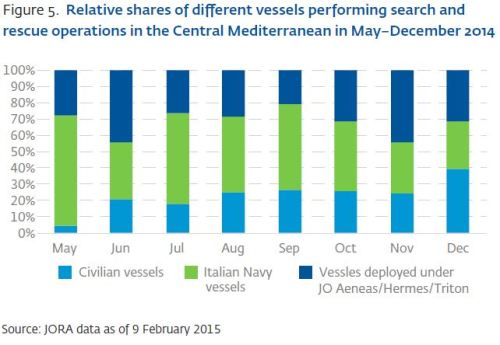
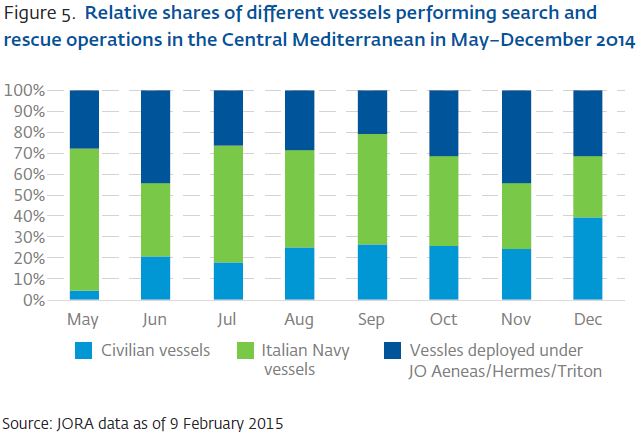
Besides naval assets, civilian vessels have been increasingly involved in the detection and rescue of migrants at sea (see Fig. 5). [SEE BELOW.] According to the International Maritime Organization (IMO), more than 600 merchant ships have been diverted from their routes to rescue persons at sea in 2014. These deviations are, in the words of the Secretary General, detrimental to shipping and are not offset by any realistic prospects of salvage awards.

In addition to migrants leaving from Libya, since September 2014, an increasing number of cases have been reported of cargo vessels being used to smuggle migrants from Turkey directly to Italy. This new trend affects the Eastern Mediterranean route, as the departure area, and the Central Mediterranean area, as the arrival area. This practice is further developed under the section related to the Eastern Mediterranean route.

As migrants were rescued in high-sea, they were reported as part of the Central Mediterranean route. Many were disembarked in Apulia and Calabria, to alleviate the burden on reception capacity in Sicily. From a statistical point of view, these disembarkations artificially inflated the number of migrants usually reported on the Apulia and Calabria route. In 2014, there were fewer migrants departing from Egypt and targeting this area of the Italian coast than in 2013. [***]

Eastern Mediterranean route

Since data collection began in early 2008, the Eastern Mediterranean has maintained its status as a hotspot of irregular migration (see Fig. 6). In 2014, 50 800 detections were reported from the area, representing 18% of the EU total. This was twice as many as in 2013, mostly due to a sharp increase in detections in the Aegean Sea (from 11 829 in 2013 to 43 377 in 2014). Detections remained comparatively much lower at the Bulgarian and Greek land borders with Turkey (12 262 in 2013 and 5 938 in 2014).

Sea border

Aegean Sea

Compared to the previous year, the sharp increase in the Aegean Sea in 2014 meant that migrants departed from more areas, and also arrived on a larger number of islands. While the islands reporting the largest number of arrivals remained Lesbos, Chios and Samos, detections were also reported from small islands from North to South, stretching capacity of surveillance. Many migrants claimed to be Syrian, and were thus handed an administrative notice allowing them to stay in Greece for up to six months, even without applying for asylum.

Screening processes of some migrants revealed a high degree of falsely claimed nationalities to avoid return. Not knowing the nationality of migrants who are illegally crossing the border and travelling within the EU is evidently a vulnerability for EU internal security. [***]

Increasing use of cargo ships

Since August 2014 the number of irregular migrants arriving in the Central Mediterranean from Turkey sharply increased compared to earlier in the year and to the same period in 2013. This sharp increase was directly related to the use of cargo ships to facilitate migrants and asylum seekers from Turkey to Italy (for example, see Fig. 7).

To date, Mersin has been the place where those wishing to travel to the EU in an irregular fashion have made contact with the smuggling networks. Wooden boats, however, have departed from various points along south-eastern Turkish coast such as Mersin, Adana and Hatay provinces to reach cargo vessels waiting off shore.

Smuggling migrants from Turkey on board large cargo vessels is extremely profitable, and such funds are likely to be an important source of income for smuggling networks also engaged in other criminal activities. This means that the criminal networks might be financing other criminal activities by exploiting and putting at risk vulnerable groups of displaced families from Syria.

Specifically, the cargo ships, which are often bought as scrap, tend to cost between EUR 150 000 and 400 000. There are often as many as 200–800 migrants on board, each paying EUR 4 500–6 000 for the trip, either in cash a few days before the departure or by Hawala payment after reaching the Italian coast. The cost is high because the modus operandi is viewed as being safe and has been demonstrated as being successful.

Hence, the gross income for a single journey can be as high as EUR 2.5 or even 4 million depending on the size of the vessel and the number of migrants on board. In some cases, the profit is likely to be between EUR 1.5 and 3 million once other overheads such as recruiters, safe houses, shuttle vessels, crew and fuel have been taken into account. Given this level of financial gain it is important to act against this modus operandi not only to stem the flow of irregular migration but also to limit the financial assets of the smuggling networks. [***]

Western Mediterranean route

In 2014 there were 7 842 detections of illegal border-crossing in the Western Mediterranean region, which consists of several areas of the southern Spanish coast and the land borders of Ceuta and Melilla. This total shows an increase of 15% compared to the total of 6 838 reported in 2013.

Like in 2013, the first half of 2014 showed most detections being reported at the land border, mostly from Melilla. Indeed, the Spanish authorities reported several violent attempts to cross the fence.

As mitigating measures, the fence has been upgraded. As a result, in the second half of the year, Spain reported more detections at the sea border than at the land border.

Once in Melilla, migrants are turned over to Spanish Police Headquarters for identification, and many are transferred to the Temporary Centre for Immigrants (CETI – Centro de Estancia Temporal de Inmigrantes). However, this centre only has a limited capacity and some migrants had to be transferred to mainland Spain.

In terms of nationality, most of the migrants are from Western Africa, in particular from Cameroon and Mali. Algerians and Moroccans have also been reported among the top ten nationalities, but mostly at the sea border.

Since November 2014, Spain also reported an increase in detections of illegal border-crossing of Syrians at the land border (more than 250 in November and December), then applying for asylum. This increase, combining with increasing detections of Syrians using forged document to enter to the EU, has prompted Spain to open asylum and international protection offices at the borders of Ceuta and Melilla in March 2015.

Black Sea route

Detections of illegal border-crossing on the Black Sea were extremely rare. However, since 2013, Bulgaria and Romania have reported an increasing number of detections, totalling 433 migrants in 2014.

These incidents still constitute isolated cases, and are possibly linked to the increased surveillance on the Eastern Mediterranean route and the increasing number of migrants waiting in Turkey to reach the EU illegally. [***]”
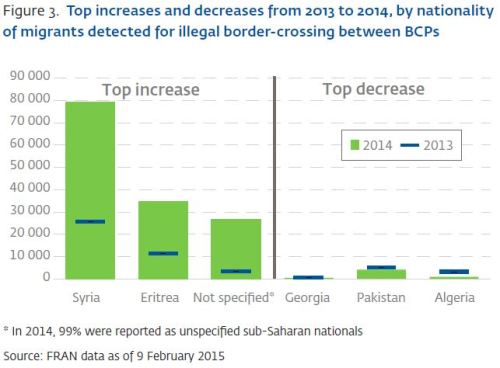
 

Figure 3


Figure 4


Figure 5

2 Comments

Filed under Aegean Sea, Black Sea, Egypt, Frontex, Greece, Italy, Libya, Malta, Mediterranean, Reports, Spain, Statistics, Syria, Tunisia, Turkey

Frontex Releases Annual Risk Analysis 2015 Report

Frontex Press Statement regarding Annual Risk Analysis 2015 (also here):

“2015-04-28
Last year, the European Union detected the biggest number of illegal border crossings since Frontex data-collection started eight years ago. The record number of 280 000 detections was mainly fuelled by the ongoing fighting in Syria, which has caused the worst refugee crisis since the Second World War. Syrians fleeing their country were the largest group of irregular migrants seeking to enter the EU.

Most of the detections were reported as part of search and rescue operations in the Central Mediterranean area. Although border control authorities continued to save the lives of thousands of people, smugglers increasingly used unsafe boats, putting migrants in greater danger.

The unprecedented number of migrants also encouraged facilitators to use cargo ships to smuggle them at a large scale. Starting in September, such vessels took migrants directly from the Turkish coast near Mersin to Italy. This is a multi-million-euro business for organised crime groups, which is likely to be replicated in other departure countries.

Another trend explained by the Frontex risk analysis experts has been the increasing number of deliberate attempts to involve merchant ships in rescuing migrants. This has prompted the International Maritime Organization (IMO) to voice the concerns of the shipping industry over its involvement in rescuing migrants.

The profile of detected irregular migrants remained relatively unchanged compared to 2013. They are mostly adult males, although the proportion of women (11%) and children (15%) reflects the fact that many migrants intend to claim asylum.

More than 60% (170 000) of all illegal border crossings were detected in the Central Mediterranean. On the second most frequented route in the Eastern Mediterranean covering borders of Greece, Bulgaria and Cyprus, there were more than 50 000 detections. Near the end of 2014, detections increased sharply at the Hungarian land border with Serbia, making the Western Balkan route the third most important irregular migration route with more than 43 000 detections.

Detections of migrants hidden in vehicles seeking to enter the EU via regular border crossings surged to over 3 000, five times the number from the previous year. This jump was due to a tenfold increase in detections reported from the Bulgarian border crossings along the land border with Turkey.

In 2014, there were some 9 400 incidents of document fraud on entry to the EU/ Schengen area from third countries, which represented a slight decrease compared to the previous year. By contrast, cases reported on intra-EU Schengen movements showed a 27 percent increase to almost 10 000. This marked the first year where there were more fraudulent documents detected on intra-EU/Schengen movements than during border checks of passengers arriving from third countries. This was partly due to the large number of migrants undertaking secondary movements within the EU, often with fraudulent documents obtained in the country of their entry into the EU.”

1 Comment

Filed under Frontex, Mediterranean, Reports

Migration Policy Centre – Policy Brief: “Drowned Europe”

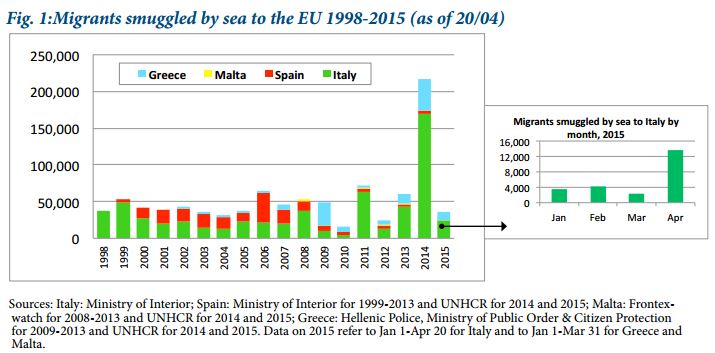
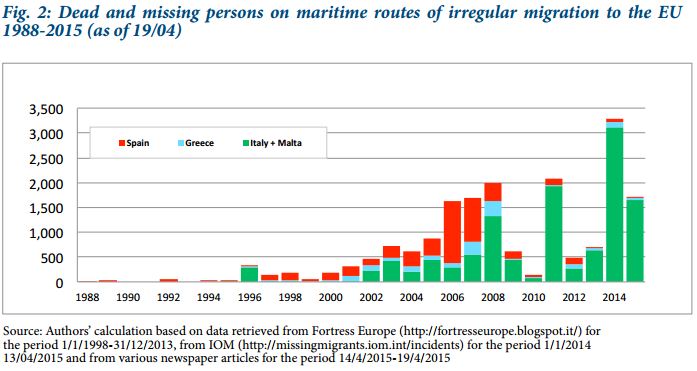
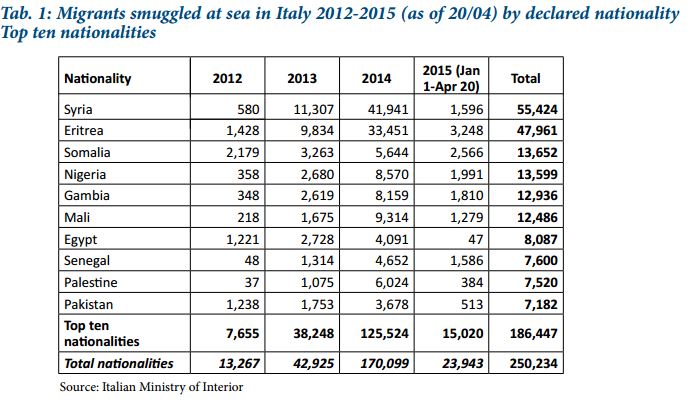
Drowned Europe“, policy brief by Philippe FARGUES and Anna DI BARTOLOMEO, Migration Policy Centre at the European University Institute, Florence.

ABSTRACT:
The drowning of 800 migrants, 19 April 2015, after the capsizing of a smuggling boat, triggered responses from across Europe. But when EU leaders met four days later, the news-cycle had moved on and the European Council, 23 April, gave a disappointing response. The 28 agreed to scale up their joint search-and-rescue efforts at sea to the more substantial efforts of what Italy has achieved alone in the last year. There were, also, a handful of other minor actions. Mr Junker, President of the Commission, lamented that the EU should be more ambitious. He was right, in as much as the EU meeting will not sustainably curb the deadly trends we have seen in the Mediterranean in recent years.

2015-April_MPI Policy Brief_Drowned Europe_Fig 12015-April_MPI Policy Brief_Drowned Europe_Fig 22015-April_MPI Policy Brief_Drowned Europe_Tab 1

2 Comments

Filed under Analysis, European Union, Frontex, Italy, Libya, Mediterranean

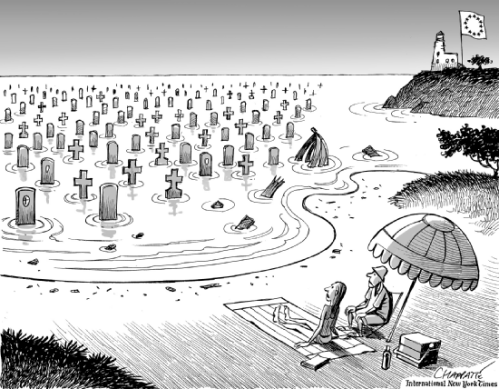
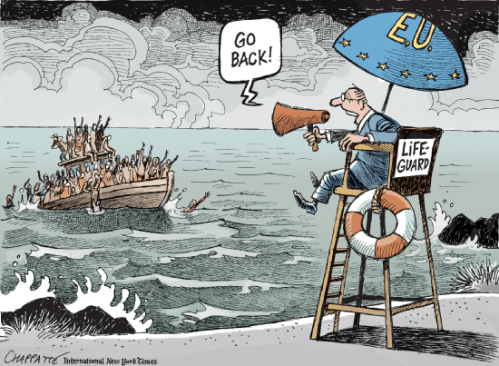
Chappatte on the situation in the Mediterranean

© Chappatte – http://www.globecartoon.com – Used by Migrants At Sea with permission.

© Chappatte – http://www.globecartoon.com – Used by Migrants At Sea with permission.

© Chappatte – http://www.globecartoon.com – Used by Migrants At Sea with permission.

© Chappatte – http://www.globecartoon.com – Used by Migrants At Sea with permission.

2 Comments

Filed under Cartoon, European Union, Frontex, Mediterranean

Official Statement: Special meeting of the European Council, 23 April 2015

Full text:

“1. The situation in the Mediterranean is a tragedy. The European Union will mobilise all efforts at its disposal to prevent further loss of life at sea and to tackle the root causes of the human emergency that we face, in cooperation with the countries of origin and transit. Our immediate priority is to prevent more people from dying at sea.

2. We have therefore decided to strengthen our presence at sea, to fight the traffickers, to prevent illegal migration flows and to reinforce internal solidarity and responsibility. Given that instability in Libya creates an ideal environment for the criminal activities of traffickers, we will actively support all UN-led efforts towards re-establishing government authority in Libya. We will also step up efforts to address conflict and instability as key push factors of migration, including in Syria.

3. We today commit to:

Strengthening our presence at sea

a) rapidly reinforce EU Operations Triton and Poseidon by at least tripling the financial resources for this purpose in 2015 and 2016 and reinforcing the number of assets, thus allowing to increase the search and rescue possibilities within the mandate of FRONTEX. We welcome the commitments already made by Member States which will allow to reach this objective in the coming weeks;

Fighting traffickers in accordance with international law

b) disrupt trafficking networks, bring the perpetrators to justice and seize their assets, through swift action by Member State authorities in co-operation with EUROPOL, FRONTEX, the European Asylum Support Office (EASO) and EUROJUST, as well as through increased intelligence and police-cooperation with third countries;

c) undertake systematic efforts to identify, capture and destroy vessels before they are used by traffickers;

d) at the same time, the High Representative is invited to immediately begin preparations for a possible CSDP operation to this effect;

e) use EUROPOL to detect and request removal of internet content used by traffickers to attract migrants and refugees, in accordance with national constitutions;

Preventing illegal migration flows

f) increase support to Tunisia, Egypt, Sudan, Mali and Niger among others, to monitor and control the land borders and routes, building on current CSDP operations in the region, as well as on regional cooperation frameworks (Rabat and Khartoum processes); step up dialogue with the African Union at all levels on all these issues;

g) reinforce our political cooperation with African partners at all levels in order to tackle the cause of illegal migration and combat the smuggling and trafficking of human beings. The EU will raise these issues with the African Union and the key countries concerned, with whom it will propose the holding of a summit in Malta in the coming months;

h) step up cooperation with Turkey in view of the situation in Syria and Iraq;

i) deploy European migration liaison officers in key countries to gather information on migratory flows, co-ordinate with national liaison officers, and co-operate directly with the local authorities;

j) work with regional partners in building capacity for maritime border management and search and rescue operations;

k) launch Regional Development and Protection programmes for North Africa and the Horn of Africa;

l) invite the Commission and the High Representative to mobilise all tools, including through development cooperation and the implementation of EU and national readmission agreements with third countries, to promote readmission of unauthorised economic migrants to countries of origin and transit, working closely with the International Organisation for Migration;

m) while respecting the right to seek asylum, set up a new return programme for the rapid return of illegal migrants from frontline Member States, coordinated by FRONTEX;

Reinforcing internal solidarity and responsibility

n) rapid and full transposition and effective implementation of the Common European Asylum System by all participating Member States, thereby ensuring common European standards under existing legislation;

o) increase emergency aid to frontline Member States and consider options for organising emergency relocation between all Member States on a voluntary basis;

p) deploy EASO teams in frontline Member States for joint processing of asylum applications, including registration and finger-printing;

q) set up a first voluntary pilot project on resettlement across the EU, offering places to persons qualifying for protection.

4. The EU institutions and the Member States will work immediately on the full implementation of these orientations. The Presidency and the Commission will present next week a roadmap setting out work up to June.

5. The European Council looks forward to the Commission Communication on a European Agenda for Migration, in order to develop a more systemic and geographically comprehensive approach to migration. The European Council will remain seized of the situation and will closely monitor the implementation of these orientations. The Council and the Commission will report to the European Council in June.”

1 Comment

Filed under European Union, Frontex, Mediterranean, Statements

Post Meeting Remarks from Council President Tusk: EU to destroy smugglers’ boats in line with int’l law; triple resources for Frontex Operation Triton; seek better co-operation with countries of origin and transit; coordinate resettlement of more refugees

Remarks by President Donald Tusk following the special European Council meeting on migratory pressures in the Mediterranean – 23/04/2015, 22:00

Full Text:

“Good evening. Today, we discussed the dramatic situation in the Mediterranean at the highest political level. Saving the lives of innocent people is the number one priority. But saving lives is not just about rescuing people at sea. It is also about stopping the smugglers and addressing irregular migration.

Let me be clear. Europe did not cause this tragedy. But that does not mean we can be indifferent. We are facing a difficult summer and we need to be ready to act.

Therefore, leaders have agreed four priority areas for action.
First, leaders have asked the High Representative to propose actions in order to capture and destroy the smugglers’ vessels before they can be used. Naturally, this will be in line with international law and respect for human rights. We will step up co-operation against smuggling networks by working through Europol, and by deploying immigration officers to third countries.

Second, we have agreed to triple the resources available to Triton, our border mission in the Central Mediterranean, and to enhance its operational capability. The mission will continue to carry out its mandate and respond to distress calls where necessary. I am happy to announce that leaders have already pledged significantly greater support, including many more vessels, aircraft and experts, and money.

Third, we need to limit irregular migration flows and to discourage people from putting their lives at risk. This means better co-operation with the countries of origin and transit, especially the countries around Libya.

Finally, we will do more on refugee protection. The European Union will help front-line Member States under pressure and co-ordinate the resettlement of more people to Europe on a voluntary basis, and with an option for emergency relocation. For those who do not qualify as refugees, we will operate an effective returns policy.
Leaders had no illusions that we would solve this international human emergency today. Therefore, we have tasked the Commission, the Council and the High Representative to step up their work based on what we have now agreed. This issue remains our priority and the European Council will come back to it in June.

As a final remark, let me repeat that the European Union is completely opposed to the death penalty. It cannot be the answer to drug trafficking. I am referring here to Mr Atlaoui, the French citizen who has been condemned by the Indonesian authorities. Thank you.”

3 Comments

Filed under European Union, Frontex, Mediterranean, Statements

Text of Draft European Council Statement (via Statewatch)

From Statewatch, here is the text of the Draft European Council Statement that will be considered today:

DRAFT EUROPEAN COUNCIL STATEMENT

1. The situation in the Mediterranean is a tragedy. The European Union will mobilise all efforts at its disposal to prevent further loss of life at sea and to tackle the root causes of the human emergency that we face, in cooperation with the countries of origin and transit. Our immediate priority is to prevent more people from dying at sea.

2. We have therefore decided to strengthen our presence at sea, to fight the traffickers, to prevent illegal migration flows and to reinforce internal solidarity. Given that instability in Libya creates an ideal environment for the criminal activities of traffickers, we will actively support all UN-led efforts towards re-establishing government authority in Libya. We will also step up efforts to address conflict and instability as key push factors of migration, including in Syria.

3. We today commit to:

Strengthening our presence at sea

a)rapidly reinforce EU Operations Triton and Poseidon by at least doubling the financial resources for this purpose in 2015 and 2016 and reinforcing the number of assets, thus allowing to increase the search and rescue possibilities within the mandate of FRONTEX; [p.m.: welcome pledges]

Fighting traffickers

b) disrupt trafficking networks, bring the perpetrators to justice and seize their assets, through swift action by Member State authorities in co-operation with EUROPOL, FRONTEX, the European Asylum Support Office (EASO) and EUROJUST, as well as through increased intelligence and police-cooperation with third countries;

c) undertake systematic efforts to identify, capture and destroy vessels before they are used by traffickers. The High Representative is invited to immediately begin preparations for a possible CSDP operation to this effect, in accordance with international law;

d) use EUROPOL to detect and request removal of internet content used by traffickers to attract migrants and refugees, in accordance with national constitutions;

Preventing illegal migration flows

e) increase support to Tunisia, Egypt, Sudan, Mali and Niger among others, to monitor and control the land borders and routes in order to prevent potential migrants from gaining access to Mediterranean shores, building on current CSDP operations in the region, as well as on regional cooperation frameworks (Rabat and Khartoum processes); step up dialogue with the African Union at all levels on all these issues;

f) deploy European migration liaison officers in key countries to gather information on migratory flows, co-ordinate with national liaison officers, and co-operate directly with the local authorities;

g) work with regional partners in building capacity for maritime border management and search and rescue operations;

h) launch Regional Development and Protection programmes for North Africa and the Horn of Africa;

i) invite the Commission and the High Representative to mobilise all tools, including through development cooperation, to promote readmission of unauthorised economic migrants to countries of origin, working closely with the International Organisation for Migration;

j) set up a new return programme for the rapid return of irregular migrants from frontline Member States, coordinated by FRONTEX;

Reinforcing internal solidarity

k) set up a first voluntary pilot project on resettlement, offering at least 5,000 places to persons qualifying for protection;

l) increase emergency aid to frontline Member States and consider options for organising emergency relocation between Member States;

m) deploy EASO teams in frontline Member States for joint processing of asylum applications, including registration and finger-printing.

4.The EU institutions and the Member States will work immediately on the full implementation of these orientations. The European Council looks forward to the Commission Communication on a European Agenda for Migration, in order to develop a more systemic and geographically comprehensive EU approach to migration. The European Council will remain seized of the situation and will closely monitor the implementation of these orientations. The Council and the Commission will report to the European Council in June.

3 Comments

Filed under European Union, Frontex, Mediterranean, News

The EU’s Proposed Plan to Destroy Migrant Boats in Libya Must be Rejected by the European Council

A plan for EU Member States to capture or destroy the boats used by people smugglers in the Mediterranean is one of ten possible courses of action that will be considered during the Extraordinary European Council Meeting on the Situation in the Mediterranean that will be held on 23 April.

The boat destruction proposal should be rejected for multiple reasons. There is no basis in law for the proposal and it would endanger lives of innocent people including migrants and fishermen, among others. It would certainly have little effect on its intended target, the people smugglers.

EU migration commissioner Avramopoulos described the plan, which has been recommended by the Foreign Affairs Council which met on 20 April, as a civil-military operation which would “capture and destroy vessels used by smugglers.” Avramopoulos reportedly compared the proposed EU boat destruction plan to Operation ATALANTA, the EU’s maritime operation against piracy off Somalia, saying that Atalanta “should inspire us for new operations against smugglers in the Mediterranean.”

As is always the case, the specific details of the proposed plan matter. There are situations where the destruction of a migrant boat under certain circumstances may be perfectly legal and otherwise appropriate. For example after a rescue operation when migrants have been safely removed from an unflagged and unseaworthy vessel, it may be appropriate for that vessel to be destroyed at sea rather than taking it in tow or leaving it adrift and thereby creating a navigational hazard. In such circumstances, there is no reason for an EU coast guard vessel, after migrants have been transferred from a migrant boat, to stand by and allow smugglers to take possession of the now empty migrant boat.

But if the EU boat destruction plan were to authorise the use of armed force to capture or destroy a smuggling boat at sea, particularly in the face of armed resistance from people smugglers, or if it were to authorise the destruction of boats at anchor in Libyan harbours, it is difficult to imagine how such a plan could be carried without endangering the lives of migrants and fisherman and thereby violating international humanitarian and human rights law.

Frontex and Italian patrol boats have already experienced armed threats at sea during rescue operations. One situation occurred on 13 April when armed people smugglers fired into the air to recover an empty migrant boat after an Italian tugboat and the Icelandic Coast Guard vessel Týr deployed by Frontex had rescued a group of migrants.  The Frontex vessel did not engage the people smugglers with force and allowed the smugglers to return to Libya with the empty migrant boat. If Frontex vessels or coast guard vessels were now to be called upon to use some level of appropriate force to prevent such incidents, rescue operations would be delayed, further complicated, and the rescued migrants would be placed in danger.

In regard to the possible destruction of boats at anchor in a Libyan harbour, the EU cannot engage in the proposed civil-military operation without having a legal basis to do so. One possible source of authority would be the invocation of Chapter VII of the UN Charter by the UN Security Council, but this would require the finding that the flow of migrant boats constitutes a threat to international peace and security. While the security situation in Libya or Syria might well constitute such a threat, the large scale movement of migrants by people smugglers does not.

Chapter VII has of course been invoked to authorise the EU Operation ATALANTA after the Security Council authorised of the use of force off Somalia in international waters and in Somalian territorial waters (as well as within Somalian territory). But the legal basis for Operation ATALANTA has no relevance to the proposed EU boat destruction plan. The suppression of piracy in international waters is authorised and governed by specialized international law and customary international practice relating to the suppression of piracy. There is no equivalent basis in international law for the suppression of people smuggling.

Chapter VII was likewise invoked in 2011 to authorise the use of force by NATO in Libya. The Security Council again made the necessary determination that the situation in Libya at the time was a threat to international peace. Among the factors referenced by the Security Council in Resolution 1973 was the plight of refugees and foreign workers who were subject to violence and who were forced to flee Libya. The resolution praised Tunisia and Egypt for protecting the fleeing refugees and called on the international community to support the efforts. It would be repugnant if today the ongoing violence in Libya was somehow used as a legal basis for a use of force which would serve to trap and endanger migrants, rather than making them safer.

In addition to the serious legal questions relating to the use of force to capture and destroy smugglers’ boats, there are serious practical concerns. Take the example of the unprecedented boat disaster and the 900 deaths that occurred earlier this week. One of the likely reasons for the massive death toll was the large number of persons who were locked below the main deck of the boat. What precautions would prevent the destruction of a suspected smuggling vessel at anchor with hundreds of people below deck and out of sight? Would the EU boat destruction plan require that any capture or destruction of a suspected smuggling boat be carried out by deploying EU military personnel on the ground in Libya with the resulting ability to more closely inspect a vessel before its destruction? Or would the plan permit destruction of a suspected smuggling boat by armed drones or military aircraft? If the destruction could occur through the use of aircraft, people will be killed, and it is more likely that those who will be killed will be migrants or innocent fisherman and not the people smugglers.

The easiest targets for destruction will be the larger fishing vessels that are being used by the people smugglers. But not so long ago the smuggling boats of choice were the Zodiacs and other large or medium–sized inflatable boats powered by outboard engines. This type of boat can be easily stored in vehicles or storage buildings and quickly moved into the water when needed. It would be an easy tactical shift on the part of the people smugglers to resume the use of inflatables if the larger fishing vessels were no longer obtainable.

The European Council needs to take new and significant steps to respond to this crisis. A focus on people smugglers should certainly be something that is addressed, but while the people smugglers are taking advantage of the crisis, they are not the cause. The EU response needs to instead focus on expanded search and rescue (i.e. Mare Nostrum plus – not Operation Triton plus) and creating alternative safe paths for people to seek protection in the EU or in other appropriate countries. The boat destruction plan should be rejected.

6 Comments

Filed under Analysis, European Union, Frontex, Italy, Libya, Mediterranean, Refugees, United Nations

IOM Report on Recent Use of Cargo Ships to Transport Syrians to Italy

Excerpts from a short IOM report released on 6 January 2015 on the recent use of cargo ships, specifically the Blue Sky M and the Ezadeen, to transport Syrians towards Italy:

“IOM analysts do believe the prospect of single-nationality cargoes – on these latest voyages, migrants fleeing Syria – creates opportunities for smuggling rings to employ certain economies of scale that were not apparent in the more ‘mixed’ passenger manifests seen leaving Egypt and Libya in 2014.”

“‘The predictability of thousands now fleeing Syria every month allows smugglers to plan for a reliable stream of customers, which of course allows them to set a price point,’ explained Joel Millman, a spokesperson for IOM in Geneva. ‘So they can predict how much revenue each trip will bring, and then quickly deploy vessels and crews’. Millman added that Lebanon’s recent decision to require visas of Syrian migrants seeking to enter Lebanon may divert new migrant traffic to Turkey’s coasts, which will swell demand for smugglers’ services.”

“In the last four months of 2014 IOM learned of larger ‘mother’ ships waiting in open water to receive passengers ferried out by smugglers. Larger ships leaving Turkey loaded with migrants from Syria began appearing in greater numbers late last year in the Eastern Mediterranean.”

“Maritime experts calculate that such ships normally would be available for between USD 100,000 and USD 150,000, allowing smugglers to earn upwards of USD 3 million for voyages like the two that ended in recent days, with up to 900 migrants crammed on board.”

“‘This new route is a direct consequence of the Syrian crisis,’ added IOM’s [Federico] Soda. ‘Despite the end of the Mare Nostrum’s rescue-at-sea operations, arrivals continue because of the many crises close to Europe.’”

Click here for report.

1 Comment

Filed under Aegean Sea, Frontex, Migrants, Refugees, Reports

Turkish Coast Guard Reports Intercepting 12,872 Migrants in Aegean Sea in 2014; Some Migrants Pushed-Back into Turkish Territorial Waters

“A total of 12,872 migrants trying to cross into Greece from Turkey over the Aegean Sea were captured by Turkish Coast Guard Command teams in 524 separate incidents in 2014, while 74 people were also arrested on charges of smuggling migrants, Anadolu Agency has reported. The number of migrants who were captured in 2013 was 8,047, including 6,937 on the Aegean Sea. The total number of migrants captured by authorities across Turkey in 2012 was 2,531. The official number in 2011 was 546, which means that the number of captured migrants has increased 24-fold since then. …”

An unspecified number of the intercepted migrants were reportedly subjected to push-back practices where the affected migrants were returned to Turkish territorial waters [“Yasa dışı göçmenlerin bir kısmı da ‘geri atma olayı (gittiği ülkeden Türkiye karasularına geri gönderilme)’ olarak arz edilen olaylar sonucu yakalandı.”].

The push-backs were presumably carried out by Greek patrol boats or possibly by vessels operating pursuant to Frontex Joint Operation Poseidon Sea 2013 (which operated through 2014 Q1).

Click here (EN) and here (TR) for articles.

5 Comments

Filed under Aegean Sea, Data / Stats, European Union, Frontex, Greece, Migrants, Refugees, Turkey

Frontex: Preliminary Figures Indicate 270,000 Irregular Migrants and Asylum Seekers Reached EU in 2104 – Double Previous Record Set in 2011

In an interview with EFE, “Frontex Deputy Executive Director Gil Arias Fernandez said the numbers for 2014 nearly doubled the previous record of 141,000 that was registered in 2011 and attributed to spillovers from the Arab Spring. … [Arias Fernandez] noted that the number of immigrants fleeing their countries seeking international protection has increased. ‘A few years ago, immigration for economic reasons was estimated at 50 percent and the same percentage for political refugees, while in 2014 about 80 percent of immigrants to the EU will be asylum seekers,’ he said. Although Frontex will not reveal specific details until mid-January 2014, [Arias Fernandez] said the total figure will likely exceed 270,000 people, as about 260,000 migrants were recorded till November….”

Click here (EN) or here (ES) for articles.

1 Comment

Filed under Data / Stats, European Union, Frontex, Mediterranean, Migrants, Refugees

Frontex Update on Incident Involving Ezadeen Cargo Vessel

Frontex press statement: The cargo vessel was carrying 360 migrants and had departed from Turkey. “People smugglers began using cargo vessels like Ezadeen last summer, and it has now become a new method of bringing migrants to Europe. These decommissioned freighters, up to 75-metre long, depart from Turkey and head for the Italian cost. Some 15 incidents involving cargo ships have taken place since August 2014.”

1 Comment

Filed under European Union, Frontex, Migrants, Refugees