Category Archives: Frontex

Libyan Migrant Boats Carrying Over 400 People Missing; Reports of Deaths

There have been reports in recent days from the UNHCR and others about at least two boats that are believed to have left Libya over the past 10-14 days carrying persons from Eritrea, Ethiopia, Somalia, and possible other countries.  Family members and friends of people who are believed to be on the boats have been calling for assistance in searching for the boats.  Reuters reported that “[o]ne of the boats was reported to have left Libya on March 22 with 335 people on board.  Italian media said 68 people on the other boat had almost certainly died during the journey, although there was no official confirmation. The top Vatican official in Tripoli, Bishop Giovanni Innocenzo Martinelli, said 10 bodies of African migrants were at the capital’s morgue on [4 April]. … He said there were reports of ‘many more bodies’ of migrants washed up on the shores of Garaboulli, some 40 km from Tripoli.”  Father Mussie Zerai, who is based in Rome, “said he had last spoken to migrants on board the smaller boat, an inflatable, by satellite phone on 26 March before the line went dead.  ‘I have meanwhile had no contact with the larger boat, but family members of those on board have called us from Canada, Sweden and Switzerland to tell us they left.’”

Click here and here for articles. (EN)

There have been confirmed deaths among migrants who have left Tunisia in recent weeks.  At least 27 bodies had been recovered as of last week in Kerkennah.  The dead were probably on board boats that sank on the 13th and 27th of March off the Tunisian coast.

Click here for article.

UPDATE:  If you have information about a family member or friend who may be on a boat or if you are seeking information, please consider contacting the Agenzia Habeshia per la Cooperazione allo Sviluppo in Italy at this email address: agenzia_habeshia@yahoo.it .


4 Comments

Filed under European Union, Frontex, Italy, Libya, Mediterranean, News, Tunisia, UNHCR

Frontex Releases its “Fundamental Rights Strategy”

According to a Frontex press release, “Frontex’s Management Board endorsed the Agency’s Fundamental Rights Strategy during its most recent meeting, on March 31. The approved document sets out the objectives, legal and political context, operational implications and implementation plan for the strategy.”  “The new strategy will be elaborated into an Action Plan, which has been requested by the Management Board with a view to adopting it at the next meeting, scheduled for May 24.”

I have done a quick read of the 8 page document and overall had a positive reaction to the strategy.  One weakness, and there are probably others, is that in the end “Member States remain primarily responsible for the implementation of the relevant international, EU or national legislation and law enforcement actions undertaken in the context of Frontex coordinated joint operations…”  (See Para 13 below.)  There is not much that Frontex can do about this, unless Frontex is given authority to act independently from individual MS.

The strategy does contemplate that Frontex can terminate a Joint Operation if respect for fundamental rights can not be guaranteed.  (See Para 15 below.)  I try to imagine how this strategy would operate within the current Joint Operation Hermes if the influx of Tunisians were to continue and expand and if Italy were to begin unilateral returns of Tunisian nationals (or others) to Tunisia without adequate process.  Would Frontex discontinue Operation Hermes?  It is hard to imagine that happening given the current situation in North Africa.

Here are some excerpts from the strategy consisting of some of the provisions which jumped out at me – the full document however should be consulted:

“Preamble

Frontex considers that respect and promotion of fundamental rights are unconditional and integral components of effective integrated border management.

[***]

The Legal and Political Context

[***]

13. Member States remain primarily responsible for the implementation of the relevant international, EU or national legislation and law enforcement actions undertaken in the context of Frontex coordinated joint operations (JOs) and therefore also for the respect of fundamental rights during these activities. This does not relieve Frontex of its responsibilities as the coordinator and it remains fully accountable for all actions and decisions under its mandate. Frontex must particularly focus on creating the conditions for ensuring compliance with fundamental rights obligations in all its activities.

The Operationalisation

Joint Operations

14. [***] One particular objective in [Joint Operations] is ensuring that the right to international protection must not be hampered by the law enforcement action and that persons seeking protection are referred to the competent national authorities to assess their case.

15. [***] Corrective measures should be taken in case of breach or serious risk of breach of fundamental rights. As last resort, Frontex might terminate a JO if the conditions guaranteeing the respect for fundamental rights are no longer met. [***]

17. Frontex will put in place an effective reporting system to ensure that any incidents or serious risks regarding fundamental rights are immediately reported by any participating officer or Frontex staff member and can be acted upon. This reporting should be the basis for effective monitoring of all its operations. The monitoring effectiveness and credibility will rely heavily on the commitment of national border guard services to report but also on the involvement of external stakeholders. The Operational Plan shall set out the modalities for reporting, including how and to who report.

[***]

19. Alleged violations of human rights reported either by national or Frontex officers or third parties, when substantiated, will be followed up by Frontex by communicating and clarifying the situation in cooperation with the competent national authorities without prejudice to any resulting administrative or penal procedures. Member States should also inform Frontex on the follow-up measures.

[***]

21. In addition to pursuing a regular exchange of information with external partners engaged in fundamental rights protection activities, in particular the Fundamental Rights Agency (FRA), the European Asylum Support Office (EASO), the United Nations High Commissioner for Refugees (UNHCR), the International Organization for Migration (IOM) and the EU Anti-Trafficking Coordinator, Frontex will endeavour to ensure their regular involvement in the relevant operational activities in accordance with the Working Arrangements with these partners. The involvement of these external partners or others should be foreseen in the Operational Plan, which should also define the scope of the cooperation.

22. Frontex will also seek advice from its external partners on the relevant instructions or guidelines for officers taking part in Frontex activities. These instructions or guidelines, which should form an integral part of each Operational Plan, could relate to methods for better identifying people seeking international protection, proper treatment of vulnerable groups including potential victims of trafficking or fundamental rights monitoring of operational activities. The final aim is to promote the highest standards in compliance with fundamental rights by the development and promotion of best practices.

[***]

External Relations

28. Frontex cooperation with Third Countries’ border-guard services is conducted under the EU External Relations Policy and shall therefore be guided by the principle of the respect of human rights. Frontex is committed to adjusting its cooperation arrangements and activities to the EU foreign policy measures adopted as a consequence of the human rights situation in the partner Third Country.

[***]

The Implementation

[***]

38. In order to increase the transparency and credibility of this process, external third parties, in particular those representing civil society, shall be involved. Their concerns and perspectives must be taken into account for the evaluation and revision of the strategy. Frontex, national border-guard services, external partners and representatives of civil society shall therefore have the possibility to exchange views and suggest means of improvement for the strategy and the Action Plan in a consultative forum, to be convened periodically at Frontex Headquarters.

[***]”

Click here for the Frontex strategy document.

Click here for Frontex press release.
1 Comment

Filed under European Union, Frontex, News

Nationalities of Migrants Who Arrived in Malta from Libya Last Week

From the Times of Malta (sources: Home Affairs Ministry and parliamentary replies) and as noted on EASO Monitor:

Nationalities of migrants who arrived last week

  • Somalia – 411
  • Eritrea – 250
  • Ethiopia – 87
  • Ivory Coast – 26
  • Mali – 16
  • Pakistan – 14
  • Sudan – 6
  • Nigeria – 6
  • Yemen – 2
  • Mauritania – 1
  • Total: 819

Migrants in Malta before Libya crisis

  • Held in detention: 79
  • Living in open centres: 2,224
  • Living in the community: 1,400
  • Total: 3,703

Migrant arrivals in previous years

  • 2007: 1,702
  • 2008: 2,775
  • 2009: 1,397
  • 2010: 27

Click here for article.

Leave a comment

Filed under Data / Stats, Eritrea, Ethiopia, European Union, Frontex, Libya, Malta, Mediterranean, News, Somalia

Maltese Conditions for Hosting Frontex Mission Not Accepted by Frontex

The Times of Malta has posted copies of an exchange of correspondence between Home Affairs Minister Carmelo Mifsud Bonnici and Frontex Director Ilkka Laitinen.   The Times of Malta article does not identify the source of the correspondence.  It appears likely that the posted correspondence does not include all of the recent communications between Malta and Frontex.  However, that which has been made available by the Times of Malta provides additional background information regarding Malta’s refusal to host a Frontex mission.

According to the posted correspondence, on 10 March, Mifsud Bonnici made an urgent request to Frontex for a new Joint Operation and deployment of a Rapid Border Intervention Team.  Malta’s request however was conditioned upon Frontex agreeing to the establishment of a joint processing centre outside of Malta and an agreement not to follow the non-binding Guidelines pertaining to the surveillance of the sea external borders contained in Part II of the Annex to Council Decision 2010/252/EU.

On 29 March, Director Laitinen responded.  Laitinen said that on 22 March he took the decision to deploy a RABIT team to Malta and that a fact-finding visit to Malta took place 24-25 March, but that during the visit, the Frontex delegation was informed that Malta would agree to accept a RABIT deployment only if Malta’s requests for the creation of the joint external processing centre and the Joint Operation were organised simultaneously with the RABIT deployment.  Laitinen said that as of 28 March Frontex had received 10 official answers from Member States responding to Malta’s request for contribution to a possible Joint Operation and creation of the external processing centre; 9 of the answers were negative or questioned the concept of joint operation:  “According to the replies – and also indicted by the number of missing replies – it is obvious that the MS consider the establishment of a joint processing centre as an issue that needs discussion and agreement on political level.  It remains doubtful from legal point of view that a joint operation not applying the non-binding part of the Maritime guidelines – Council decision No 2010/252/EU – could be developed and implemented under Frontex coordination.”

Mifsud Bonnici’s initial letter was written before the first migrant boat from Libya arrived  in Malta on 28 March.  Presumably discussions between Malta, Frontex, and the Commission are ongoing.

Click here or on this link (Mifsud Bonnici Ltr – 10 March 2011 ) for the letter from Mifsud Bonnici to Laitinen.

Click here or on this link (Laitinen Ltr – 29 March 2011 ) for the letter from Laitinen to Mifsud Bonnici.

Click here for Times of Malta article.

A third letter from Commissioner Malmström was also posted by the Times of Malta.  It makes reference to the exchange discussed above.  More on this and on Malta’s call for triggering the Temporary Protection Instrument later.

Click here or on this link ( Malmström Ltr – 1 April 2011 ) for the letter from Malmström to Mifsud Bonnici.

1 Comment

Filed under European Union, Frontex, Libya, Malta, Mediterranean, News

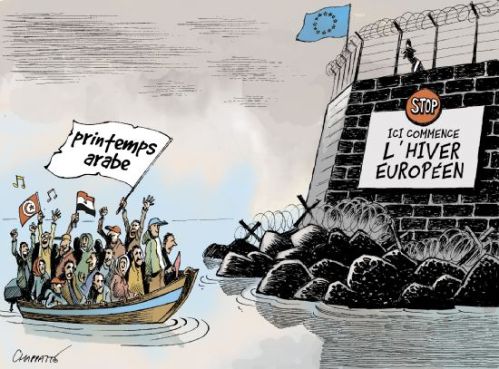
The Arab Spring meets the European Winter (by Chappatte)

© Chappatte - http://www.globecartoon.com - Used by Migrants At Sea with permission.


Leave a comment

Filed under Analysis, European Union, Frontex, Mediterranean

Italy Issues Warning: If Tunisia Fails to Stop Migrants, Italy Will Begin Forced Repatriations

Italian Interior Minister Roberto Maroni said on Monday that “[i]f [the Tunisian Government] do[es] not send specific signals [and begin] keeping the promise of a commitment to stop the migration, Italy will proceed with the forced repatriations.” (“Se non manderà segnali concreti, mantenendo la promessa di un impegno per fermare i flussi migratori, l’Italia procederà con i rimpatri forzosi.”)  Maroni also said “Tunisia had promised an immediate commitment to stop migration, but the boats continue to arrive.  We are not subject to blackmail as with Libya for oil. [Tunisia is] dependent on us, especially in the tourism sector.”

Foreign Minister Frattini said that if Tunisian migrants do not agree to assisted returns to Tunisia, with the possible payment of €1500 using EU funds, “there is a second level of intervention for those who do not accept assisted repatriation, which is stated in the Bossi-Fini law: expulsion.”

Click here, here, here and here for articles. (IT)

Click here (EN), here (IT), and here (IT) for postings on the Foreign Ministry web site.

Leave a comment

Filed under Frontex, Italy, Mediterranean, News, Tunisia

2000 Migrant Arrivals Over Last 24 Hours; Lampedusa Residents Continue Protests and Blockade Port

Over 1900 migrants have reached Lampedusa over the past 24 hour period.  Approximately 3700 have arrived over the past 3 days.  Fishermen have placed four empty migrant boats across the entry to the main harbour on the island in an effort to prevent the entry of migrant boats or Coast Guard boats carrying migrants.  Officials say that by Wednesday of this week, ships with capacity to carry up to 10,000 people will arrive on Lampedusa in order to move many of the migrants now on the island to other locations.

Click here and here for articles. (IT)

Leave a comment

Filed under Frontex, Italy, Libya, Mediterranean, News, Tunisia

Frontex Announces Expansion of Joint Operation Poseidon Sea to Include Crete and Eastern Portions of Central Mediterranean

Two days after announcing the extension of Joint Operation Hermes and the westward expansion of the operational area of JO Hermes to include the waters around Sardinia, Frontex on 26 March announced the expansion of the operational area of Joint Operation Poseidon Sea to include the waters around Crete.  The expansion is due to the “highly volatile situation in North Africa” and was called for by the European Council’s Conclusions issued at the end of the Council meeting of 24/25 March: “the Commission will make additional resources available in support to [Frontex’s] 2011 Hermes and Poseidon operations and Member States are invited to provide further human and technical resources.”

Excerpts from the Frontex statement:  “March 26, 2011 — Responding to the highly volatile situation in North Africa Frontex extends operational area of its on-going Joint Operation (JO) Poseidon Sea. In the first four weeks of deployment Joint Operation Poseidon Land sees decreasing numbers of arrivals across the land border with Turkey.   In view of potential migratory flows from Libya operational area of JO Poseidon Sea, which covers the Greek islands in the Aegean sea, has been widened to include Crete. On Thursday, 24 February Romanian maritime surveillance vessel and a Portuguese plane were deployed to increase patrolling intensity in this region. [***]”

Click here for Frontex Poseidon Sea press release.

Click here for the Frontex Hermes press release.

Click here for the Council Conclusions.

Click here for previous post on the expansion of JO Hermes.

Leave a comment

Filed under Aegean Sea, European Union, Frontex, Greece, Italy, Libya, Mediterranean, News, Tunisia

European Council Meeting Conclusions re Migrant and Refugee Flows from North Africa

While most of the European Council meeting of 24/25 March was devoted to economic policy and the Euro Zone crisis, the Council also considered the situation in Libya and the “Southern Neighborhood.”  The Council’s Conclusions noted that the Commission would be presenting “a Plan for the development of capacities to manage migration and refugee flows in advance of the June European Council.”  The Council conclusions also stated that “Agreement should be reached by June 2011 on the regulation enhancing the capabilities of Frontex. In the meantime the Commission will make additional resources available in support to the agency’s 2011 Hermes and Poseidon operations….”

Excerpts from the Council 24/25 March 2011 Conclusions:

“II. LIBYA / SOUTHERN NEIGHBOURHOOD

18. The European Council discussed the situation in Libya and endorsed the conclusions adopted by the Foreign Affairs Council on 21 March. Recalling its March 11 Declaration, the European Council expressed its satisfaction after the adoption of UN Security Council Resolution 1973, which expresses the principle of the responsibility to protect, and underlined its determination to contribute to its implementation. It also welcomed the Paris Summit of 19 March as a decisive contribution to its implementation…. [***]

21. The humanitarian situation in Libya and on its borders remains a source of serious concern. The EU will continue to provide humanitarian assistance to all those affected, in close cooperation with all the humanitarian agencies and NGOs involved. The EU has stepped up and will continue its planning on support for humanitarian assistance / civil protection operations, including by maritime means.  [***]

25. The European Council welcomes the recent visit of Presidency and the Commission to Egypt as part of a first phase of consultations to promote a comprehensive approach to migration as between the countries of the Southern Neighbourhood region and the European Union. In this context the European Council invites the Commission to present its proposals on the Global Approach to Migration as well as on the Mobility Partnership well in advance of the June European Council.

26. The European Council also looks forward to the presentation by the Commission of a Plan for the development of capacities to manage migration and refugee flows in advance of the June European Council. Agreement should be reached by June 2011 on the regulation enhancing the capabilities of Frontex. In the meantime the Commission will make additional resources available in support to the agency’s 2011 Hermes and Poseidon operations and Member States are invited to provide further human and technical resources. The EU and its Member States stand ready to demonstrate their concrete solidarity to Member States most directly concerned by migratory movements and provide the necessary support as the situation evolves.  [***]”

Click here for full document.

Leave a comment

Filed under Egypt, European Union, Frontex, Libya, Mediterranean, News, Statements, Tunisia

Frontex Announces Extension and Expansion of Joint Operation Hermes in Central Mediterranean

On 23 March Frontex announced a 5 month extension of its Joint Operation Hermes.  Frontex also announced a westward expansion of the operational area to include Sardinia, roughly 300 km northwest of Lampedusa.  According to Frontex Director Laitinen, “100 percent [of] the request the Italian authorities [have] made to Frontex” has been satisfied.

Frontex statement in full:

“Warsaw, 23 March 2011 — Due to the notable increase in migratory pressure on Italy and the island of Lampedusa in particular, Frontex has widened the operational area of Joint Operation Hermes and extended its duration for five more months, with the aim of strengthening Europe’s border control response capability in the Central Mediterranean.

‘In close cooperation with the Italian authorities, we have decided to run Joint Operation Hermes until the end of August 2011, and to extend the operational area to include Sardinia, where Frontex has already deployed aerial assets to strengthen the patrolling capacity of the Italian authorities,’ said Frontex Executive Director Ilkka Laitinen.

‘Frontex is closely monitoring the developments in North Africa and stands ready to assist the Member States operationally if requested. We are also continuously developing additional operational responses for potential rapid deployment throughout the Mediterranean if needed,’ he added.

As of 23 March 2011, Lampedusa remained the main destination for migrants from Tunisia. During the previous week alone, 3,230 undocumented persons arrived on the island, bringing the total number of arrivals detected in the whole operational area since Hermes began on 20 February to 9,098. The majority of migrants are young men but 52 women and more than 240 minors were also detected during Italian-led Hermes. At the time of writing the great majority of migrants who recently arrived in Lampedusa claimed to be of Tunisian nationality.

In addition to one aircraft and two vessels already financed and coordinated by Frontex, one Dutch and one Portuguese plane have now arrived in Pantelleria and Sardinia respectively to assist the Italian authorities in strengthening their border control activities.

‘With this equipment and 20 experts currently working in the centres of Bari, Caltanisetta and Crotone, we have satisfied 100 percent the request the Italian authorities made to Frontex,’ Laitinen concluded.

The cost of the first 40 days of the operation amounts to EUR 2.6 mln.”

Click here for statement.

2 Comments

Filed under European Union, Frontex, Italy, Libya, Mediterranean, News, Tunisia

Italian Navy Transports 600 Migrants from Lampedusa to Sicily

In an effort to relieve the severe overcrowding on Lampedusa, the San Marco, an Italian naval ship yesterday transported about 600 Tunisians from Lampedusa to Sicily.  The ship’s departure was delayed by several hours because the ship’s captain had apparently not been given instructions where to take the migrants.  The ship was eventually directed to sail to the port of Augusta on Sicily.  It is unclear whether the ship will return to Lampedusa to pick up more migrants.

There has been confusion over the identity of the 600 migrants who were selected to be moved to Sicily.  Initial statements by Italian officials said that the migrants who were to be moved had been identified as asylum seekers or were women and children.  But later reports indicted that there were fewer than 20 women and children among the 600 and that none of the 600 have been identified as asylum seekers.   UNHCR said that no formal refugee processing is being conducted on Lampedusa in part due to the chaos and severe overcrowding on the island and also due to the fact that only a few migrants have reportedly expressed a desire to seek asylum.

Approximately 650 other migrants were transported off the island yesterday by planes and yesterday marked the first day in many days where there was a net decrease in the migrant population on Lampedusa.  1200 migrants left the island and about 300 new migrants in seven boats arrived on the island yesterday.

Foreign Minister Frattini and Interior Minister Maroni are now scheduled to travel to Tunis on Friday, 25 March, to discuss a new migration agreement with Tunisia.

Click here (IT), here (IT), here (IT), and here (EN) for articles.

Leave a comment

Filed under European Union, Frontex, Italy, Mediterranean, News, Tunisia, UNHCR

Italy Has Not Requested Frontex Assistance with Transfer of Migrants from Lampedusa

According to the EUobserver, “[a] spokeswoman for … Frontex, … told this website that the Italian authorities have not yet asked for help in transferring the migrants from Lampedusa to Sicily, for instance by extending the existing ‘Hermes’ operation set up in February to assist them with the Tunisian situation.”  No Frontex “debriefing experts sent by member states [are] based in Lampedusa.”  “Romain Prevot, a French border official now based in Trapani, northern Sicily, told EUobserver that ‘initially we were supposed to be in Lampedusa,” but then “for security reasons,’ the Italian government decided to deploy them to Sicily and the mainland.”

Click here for full article.

Leave a comment

Filed under European Union, Frontex, Italy, Mediterranean, News, Tunisia

100+ Libyans Reach Sicily by Boat

Speaking at a press conference earlier today, Italian Interior Minister Roberto Maroni reported that 117 migrants who are believed to be Libyan reached Catania, Sicily in two boats during the night of 20-21 March.  According to Maroni, a total of 14,918 immigrants have landed in Italy since the beginning of the year.  [UPDATED INFORMATION – more recent reports suggest that the many or all of the migrants involved may be Egyptian nationals who posed as Libyans, possibly for purposes of seeking refugee protection. Click here (IT) for more recent article.]

Click here, here, and here for articles. (EN)

Leave a comment

Filed under Data / Stats, Frontex, Italy, Libya, Mediterranean, News

Hundreds of Tunisians Continue to Arrive in Lampedusa; Italian Navy Ship to Transport Migrants from Island to Relieve Overcrowding; Local Residents Block Migrant Landings

Hundreds of Tunisians continue to reach Lampedusa.  Conditions at the main migrant reception centre on the island are extremely bad due to massive overcrowding and hundreds of migrants are sleeping in the open under tarps.  The centre is currently holding about 3000 persons whereas its capacity is supposed to be limited to 800 persons.  An Italian navy ship was scheduled to arrive on the island late on the 19th or on the 20th of March and it is anticipated that the ship will transport at least 1000 migrants to other locations in Italy.

Some local residents protested the continuing arrival of migrant boats by preventing for several hours coast guard and Guardia di Fiananza boats carrying rescued migrants from docking and disembarking the migrants in port.

Click here (IT), here, (IT), here (IT), and here (EN) for articles.

Leave a comment

Filed under European Union, Frontex, Italy, Mediterranean, News, Tunisia

2000 Migrants Reach Lampedusa Over 24 Hour Period; Ship Carrying 1800 Remains in Int’l Waters in Need of Fuel

Approximately 2000 new migrants in more than 20 boats arrived in Lampedusa on 14-15 March.  Some were rescued and some reached Lampedusa on their own.  One boat is believed to have sunk near Tunisia and approximately 35 persons are believed to be missing.

According to a UNHCR briefing yesterday, just over 10,000 migrants, nearly all young Tunisian men, have arrived in Italy since mid-January.  UNHCR spokesperson Melissa Fleming said that “[t]he outflow from Tunisia is unrelated to the ongoing crisis in Libya. From our interactions with Tunisians arriving in Italy over past weeks, we believe that most are seeking employment and better economic opportunities, rather than international protection.   UN staff and partners in Tunisia report that some villages appear largely empty of their young male population, with only women, children and elderly people remaining. This type of outflow is not atypical of countries in transition, and we are well aware of the many demands on the Tunisian authorities at present. Solutions to this type of flow need to be found in dialogue between the concerned governments, including arrangements for the orderly and dignified return of persons who are found not to be in need of international protection, and the establishment of opportunities for labor migration which can meet the needs of countries on both sides of the Mediterranean.”

The standoff with the Moroccan ferry, the Mistral Express, continues.  The ship left Libya several days ago and is located in international waters about 20 miles from the port of Augusta, Sicily.  Italian authorities have refused to permit the ship to enter Italian waters and are considering providing fuel to the ship while it remains at sea in order to prevent any of the 1800+ mostly Moroccan passengers from attempting to leave the ship and enter Italy.

Click here for UNHCR press briefing.

Click here, here, here, here, and here for articles.  (IT)

Leave a comment

Filed under European Union, Frontex, Italy, Libya, Mediterranean, Morocco, News, Tunisia, UNHCR