Category Archives: Mediterranean

Erika Feller’s Comments Regarding Boat People and Irregular Secondary Movements

During her annual address to the UNHCR’s Executive Committee on 6 October, Assistant High Commissioner for Protection Erika Feller reviewed significant protection issues over the past year, noting also that 2010 marks the 60th anniversary of the founding of the UNHCR in December 1950 and the 59th anniversary of the Refugee Convention.

Among the topics she addressed were the challenges posed by the arrival of irregular secondary movements of migrants, including boat people.  She is critical of interdiction practices being carried out throughout the world and makes the strong point that “[t]he evidence suggests that tough sea policies have not solved, just changed and indeed complicated the dynamics, of irregular movements.”  While Ms. Feller does not identify countries by name, she is apparently referencing increased maritime interdiction in the Aegean Sea and the resulting surge in irregular crossings along Greece’s land borders.  The point could also be made in regard to the Italian push-back practice.

Excerpts from her address:

“Arrivals of undocumented migrants continue to test the capacity of States, with the problem of so-called “irregular secondary movement” exacerbated in recent years by boat arrivals. The Pacific, the Mediterranean, the Caribbean or the Gulf of Aden are all regular theatres, with ‘boatpeople’ being interdicted, intercepted, turned around, ignored by passing ships, shot at, or denied landing. Even when rescued, disembarkation somewhere has no guarantees attached, as an incident currently playing out off the Somalia/Djibouti coasts starkly reminds us.

All this is seriously at odds not only with protection principles but also with the reality that when they manage to gain access to territory and asylum processes, a large percentage of asylum-seekers who come by boat are actually found to be refugees. …

Boat arrivals can provoke fears and high emotions which may be difficult for Governments to manage. However, in our experience, an approach built predominantly around closing borders and trying to prevent movement is not the answer, as it does not work. In fact it can make situations even more difficult to deal with. Developments in relation to one country that has pursued a tough policy towards boats are actually quite revealing. While arrivals by sea are dramatically down, arrivals by land have basically doubled. In addition, while sea arrivals had been able to be concentrated through being channeled to one main reception point, land arrivals now come through multiple crossing points and have been able to disperse more effectively and rapidly through the community, below any radar screen. The evidence suggests that tough sea policies have not solved, just changed and indeed complicated the dynamics, of irregular movements….

The phenomenon of refugees on the move for non-protection reasons is also growing. Numbers and categories vary with the regions but the concern is global. On the African continent, where camps are more the norm than the exception, it is preoccupying that camp environments are starting to be compromised by a form of transit migration to and through them, with refugees, and others, seeking to use their facilities for R&R en route to a more distant destination. Just as concerning has been the misuse of reception centers as way-stations, or even lucrative recruitment opportunities for smugglers and traffickers. These facts are not a rationale for abandoning camps or centers. They are, though, a solid reason to rethink how better to manage them within a burden sharing framework….”

Click here for full address.

2 Comments

Filed under Aegean Sea, European Union, Greece, Italy, Libya, Mediterranean, News, Statements, UNHCR

Cecilia Malmström: Back From Libya

Commissioner Malmström writes her own blog, Cecilia Malmström Mitt Europa (My Europe).  Here is her most recent posting regarding her trip to Libya (translated from Swedish with Google Translate).  There are several points worth noting – and worrying about.  She notes that Libya is not a signatory to the 1951 Refugee Convention or 1967 Protocol.  (Though Libya is a signatory to the OAU Refugee Convention.)  She suggests that the new migration agreement between the EU and Libya will involve the UNHCR, but no insight is offered regarding whether or how the UNHCR might return to Libya.  She concedes that the European Commission does not know all of the details of the bi-lateral agreement between Italy and Libya which has resulted in the current push-back practice in the central Mediterranean.  And she seems to say that she was greatly troubled by what she saw when she visited one of the southern migrant detention centres in Libya during her official trip.

Translated excerpts:

“Just returned from Libya … I have been there to try to initiate a dialogue between the EU and Libya on issues relating to asylum, migration and international protection. … I believe it is necessary to have a dialogue with Libya.

Libya has not signed the Geneva Convention and the concept of asylum is not in Libyan law. … Since Italy and Libya signed an agreement, which we unfortunately do not know everything about, it has basically been that case that no boats are crossing the Mediterranean.

Against this background, I see it as progress that the first time we have agreed a text with Libya, a version of a plan for cooperation, which deals with issues of asylum and international protection…  Our aim is to identify people in need of international protection, while helping Libya to raise standards in the detention centres in order to provide decent conditions to people. We also address the issues of border control, labor migration and human smuggling in this plan for cooperation. From the EU side, we are prepared to put up 50 million euros over three years to support reforms. These will obviously not be given as a blank check to Libya but will be provided using the guidelines of the European Commission. For example, we support specific projects by various organizations, including the UNHCR.

Besides holding talks with Libyan ministers, I also visited Libya’s southern border in the middle of the desert, observed International Organisation for Migration activities in Libya, and visited one of the detention centres where many migrants have ended up. I had the opportunity to talk to some of the people there.  Several of these stories that I heard have kept both me and my staff awake at night. …”

Click here for the full posting.

3 Comments

Filed under European Union, Italy, Libya, Mediterranean, News, UNHCR

EU and Libya Sign “Unclear” Migration Cooperation Agreement

At the end of a two day visit to Tripoli, 4-5 October, Cecilia Malmström, European Commissioner for Home Affairs, and Štefan Füle, European Commissioner for Enlargement and European Neighbourhood, signed a “migration cooperation agenda” with Libya.  The European Commission issued a Press Release with details of the negotiations and signed agreement.

The specific contents of the full agreement and negotiations however are not clear.  “‘What worries us is the vagueness of the deal,’ Annelise Baldaccini from Amnesty International told [euobserver.com]. ‘We do not know what the EU has signed up to. It mentions for instance addressing the burden of recognised refugees and rejected asylum seekers, but it does not say what this involves.’”

Here are some excerpts from the Commission press release:

In the framework of the visit an agreement on a migration cooperation agenda was signed yesterday evening in Tripoli by Commissioner Malmström, Commissioner Füle, M. Moussa Koussa, the Secretary of General People’s Committee for Foreign Liaison and International Cooperation, and M. Yunis Al-Obeidi, the Secretary of General People’s Committee for Public Security. This is a Cooperation agenda between the European Commission and Libya, including concrete steps on border surveillance system, mobility-related issues, smuggling and trafficking in human beings, and dialogue on refugees and international protection.

Commenting the signature of the Cooperation agenda Commissioner Malmström said: ”It is my objective to put the protection of fundamental rights of all people involved in migratory and asylum flows at the centre of our efforts in the EU relationship with Libya. The Cooperation Agenda will enable us also to promote initiatives aimed at better protecting and assisting the rights of migrants and refugees’.

Commissioner Füle said: “I welcome agreeing on this cooperation agenda because this is an important first step to solve the serious challenge irregular migration poses not only to Libya but also to the EU. This step is part of the much broader relationship we are trying to build together. It was clear from our talks in Tripoli that both EU and Libya have at heart to sustain the new momentum in our relationship over recent months.”

The EU and Libya also discussed the establishment of an informal group of senior officials that would oversee the implementation of the list of possible initiatives in the field of migration cooperation. The proposed initiatives will be implemented through a variety of means, ranging from the sharing of experience and best practices, as well as financing of actions, including the acquisition of equipment in accordance with applicable rules.

Both sides agreed on the following initiatives for possible further dialogue and cooperation.

1. Regional and Pan african dialogue and cooperation

  • Increasing joint efforts in the development of African countries of origin of migration. This would build on the serious and substantial efforts of Libya and the European Union as major donors to African countries. In this context, the EU and Libya will continue to address root causes of migration in the countries of origin of migrants travelling through Libya and creating viable alternatives to migration in these countries.
  • The EU and Libya will support awareness campaigns to take place in main countries of origin of migrants transiting through North Africa and Libya specifically to alert migrants to the dangers of irregular migration.
  • Libya and the EU will work together in the implementation of the “Declaration of Tripoli on Migration and Development” of 2006, and the EU-Africa Migration, Mobility and Employment Partnership adopted in Lisbon in 2007.
  • Libya and the EU will increase dialogue and exchange information regarding the issue of smuggling of human beings and related illicit traffics reaching Libya from other countries and the EU from Libya.
  • Libya and the EU will also establish an informal consultative group that will exchange information on development policies benefitting Africa, and possibly also to identify development projects in sub Saharan Africa. This group will be composed by the Libyan administration, by the representatives of the European Commission and of the EU member States which are willing to participate.

[***]

3. Ensuring effective management of migratory flows

  • Supporting the development in Libya of a more efficient system to manage labour migration. This could be done by allowing to maximise the skills of the migrants already present in the country and of the newcomers.
  • Enhancing the capacities of Libyan authorities, Libyan NGOs and international organisations, to properly launch and implement search and rescue operations aimed at saving lives of migrants in the desert or on high seas and to provide them with the necessary humanitarian assistance.
  • Providing decent treatment, reception and assistance – in line with international standards – to irregular migrants intercepted or readmitted or to be returned by Libyan authorities, or stranded in Libya, with focus on migrants belonging to vulnerable categories (like unaccompanied minors, victims of trafficking; pregnant women, and families with small children). This could build on the activities already carried out in Libya by the local authorities, international organisations and NGOs.
  • Offering assisted voluntary return home to irregular migrants intercepted or readmitted or to be returned by Libyan authorities, or stranded in Libya or in the countries of origin, as well as offer support for their social and professional reintegration.
  • Enhancing the capacity to address smuggling and trafficking in human beings, with reference in particular to the two respective protocols of the 2000 UN Convention on the Trans-national organised Crime, and in view of reinforcing the capabilities of law enforcement officials in charge of the implementation of this legislation, by taking also into the account the Ouagadougou Action Plan to combat Trafficking in Human Beings.

4. Border management

  • Carrying out a gap-analysis on the current functioning modalities of the Libyan border and immigration services, aimed at reinforcing the capacity of the latter to prevent the irregular migration flows from entering Libya from its Southern borders.
  • Strengthening cooperation between Libya and the neighbouring and other transit and origin countries, in the border surveillance and in the prevention of attempts of irregular migrants and smugglers to violate Libyan borders, through promoting joint patrolling, intelligence sharing, the development of joint training, the facilitation of working contacts and the establishment of dedicated communication channels aimed at transmitting early warnings and sensible data.
  • Supporting the development of Libyan patrolling, search and rescue capacities in its territorial waters and at high sea. Delimiting the search and rescue region for which it Libya is responsible, pursuant to the SAR Convention it has ratified.
  • Establishment of an integrated surveillance system along the Libyan land borders, with focus on the areas prone to irregular migration flows, in line with the Memorandum of Understanding agreed between Libya and the European Commission on 23 July 2007.
  • Exploring concrete possibilities of cooperation between Libyan police, border, migration authorities and agencies and those of the EU Member States as regards the return and readmission of irregular migrants.

5. International Protection

  • Supporting Libya in its efforts aimed at establishing a protection system able to deal with asylum seekers and refugees in line with international standards and in good cooperation with the competent international organisation , in particular through providing advice on the development of a legislation in line with the 1969 African Union Convention Governing the Specific Aspects of Refugee Problems in Africa as well as providing training, technical assistance and equipment in view of promoting the development of administrative structures and human resources, able to properly act in line with this legislation
  • Assisting Libyan authorities in screening migrants in order to identify those in need of international protection and in addressing the burden represented both by the recognized refugees and the unsuccessful asylum seekers, and which would consist in resettling some of the recognized refugees towards EU Member States, in supporting the voluntary return of some of the unsuccessful asylum seekers back to their origin country, as well as in enhancing the reception capacities offered in Libya to asylum seekers and refugees.

Click here for full European Commission Press Release.

Click here, here, and here for articles.

4 Comments

Filed under European Union, Libya, Mediterranean, News

Increased Human Smuggling to Cyprus

According to an article in the Turkish newspaper Today’s Zaman, Turkish Interior Ministry data indicates that human smuggling in Turkey has decreased since 2007, but that one consequence of increased enforcement within Turkey has been a diversion of human smuggling to the Turkish controlled northern portion of Cyprus.

“According to the ministry, the total number of illegal immigrants, asylum seekers and immigrants caught at land and sea borders with Syria, Iran, Iraq, Georgia, Greece and Bulgaria declined to 28,355 in 2009.”  This number is in contrast to the 50,800 migrants reportedly arrested in 2008 and 7,465 arrested over the first six months of 2010.

The Ministry also reported a decline in known deaths: “In line with the drop in the number of immigrants trying to get to the West through Turkey, there has been a decline in the number of illegal immigrant deaths. In 2007, 82 immigrants died in accidents on the Aegean Sea and 102 went missing. The number of deaths dropped to 76 in 2008 and to 43 in 2008. The number of deaths in the first half of 2010 was nine.”

According to the article, there has been a diversion of smuggling operations towards Turkish controlled Cyprus and as a result the “KKTC [the self-declared Turkish Republic of Northern Cyprus] [is] facing the biggest migration move ever in its history.”  “In 2008, the number [of irregular migrants] doubled and increased to 568. It continued to increase in 2009. According to estimates, 750 migrants entered the island in 2009. … Illegal immigrants are brought by ships to Cyprus during the night and left in places that are far from settlement areas in Dipkarpaz and the İskele region. In addition to the KKTC, a similar number of immigrants are brought to Greek Cyprus.  It is believed that illegal immigrants pay between $2,000-$3,000 on average to human smugglers to enter the KKTC. In the latest smuggling cases in Turkey, they pay $5,000-$10,000.”

Click here for article.

Click here Turkish Ministry of Foreign Affairs web site on Illegal Migration.

1 Comment

Filed under Aegean Sea, Cyprus, Data / Stats, Greece, Mediterranean, News, Turkey

Frontex 2nd Quarter Report

The Frontex Risk Analysis Unit has released its Report for the Second Quarter of 2010 (April-June).  It is a 30+ page report containing data, charts, and graphs detailing entry routes, detections of migrants, detections of facilitators, and other information.

Excerpts from the Report’s Executive Summary:

Illegal migration pressure in the EU underwent a foreseeable seasonal increase during the second quarter of 2010, but is still clearly in a period of decline.…

The widespread decline in illegal migration pressure is probably due to two key factors. The first is decreased employment opportunities in the EU …  [and the] second is stricter migration and asylum policies in Member States, supported by much more effective collaboration with key third countries. For example, stricter migration and asylum policies in Norway and the UK have reduced the number of applications in these Member States…. Similarly, bilateral agreements between Italy and Libya, and between Spain and both Senegal and Mauritania, continue to control, for the time being at least, most illegal migration via the Central Mediterranean and West African routes, respectively.

Notwithstanding the general decline in detections, there were two emerging trends in the second quarter (Q2) of 2010: a continued and intensified shift from the Greek sea border to the Greek land border with Turkey….  In the beginning of 2009 illegal crossings of the EU external border between Greece and Turkey were divided roughly equally between the land and sea borders.  However, there has been a gradual and recently intensified shift to the land border. Reasons for this shift from sea to land borders are linked to the effectiveness of the Frontex activities in the Aegean Sea, combining surveillance activities with identification of illegal migrants, and opening the possibility of return to origin countries for detected migrants. ….

Main trends:

  • There is a general decline in illegal migration to the EU compared to a year ago;
  • For the time being, Turkey is the main transit country for illegal migration to the EU….;
  • In the Eastern Mediterranean route, there has been a gradual and recently intensified shift from the Greek-Turkish sea border to the land border, where 90% of detections were made….   At the Greek-Turkish land border around 60% of detections were made at the Border Control Unit (BCU) Orestiada which is under the biggest pressure. Air connections to Turkey are increasingly used by migrants from North Africa, who then illegally cross the EU external border with Turkey. As well as effective Frontex-coordinated joint operations at the sea border, potential explanations for this shift include cheaper facilitation costs, a lower risk crossing, lower detection rates…;
  • There were increased detections on the Central Mediterranean route, probably due to the recent re-organisation of criminal groups in response to effective bilateral agreements in the area. In June 2010 Libya expelled the United Nations High Commissioner for Refugees (UNHCR), with whom 9,000 refugees and 4,000 asylum-seekers were registered and who, in the absence of protection, may now attempt entry to the EU.

Click here for the 2nd Quarter Report.

Click here for the 1st Quarter Report.

2 Comments

Filed under Aegean Sea, Analysis, Data / Stats, Eastern Atlantic, European Union, Frontex, Greece, Italy, Libya, Malta, Mauritania, Mediterranean, News, Reports, Senegal, Spain, Turkey

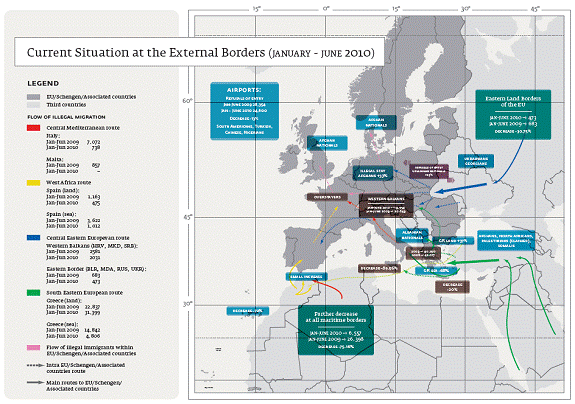
Frontex: Current Situation at the External Borders (JANUARY – JUNE 2010)

Frontex posted this map to its web site this week.  According to Frontex, “[t]he map describes the current migratory situation at the external borders of the EU, including the main entry routes of irregular migration into the European Union.”

Note the significant reductions in migrants detected at all maritime borders:

  • Jan-June 2010 – 6.557
  • Jan-June 2009 – 26.398
  • Decrease of 75%

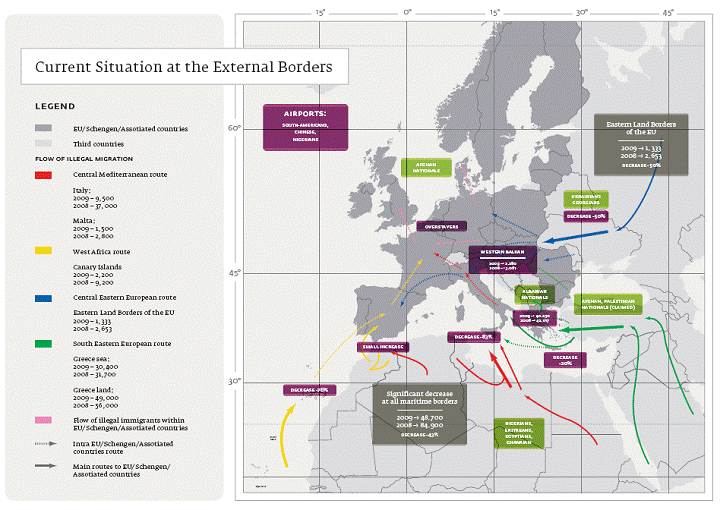
This 75% decrease over the first six months of 2010 compared with the first six months of 2009 is on top of the 43% reduction in migrants detected at maritime borders in 2009 relative to 2008:

  • 2009 – 48.700
  • 2008 – 84.900
  • Decrease of 43%

Note the further breakdown of the figures in the Legends of the two maps.  You probably need to click on the links to view higher quality images of the maps.

Click here for link to Jan-June 2010 Map.

Click here for link to 2009 Map.

Current Situation at the External Borders (January - June 2010)

Current Situation at the External Borders (January - June 2010)

Situation at the External Borders (2009)

Situation at the External Borders (2009)

1 Comment

Filed under Aegean Sea, Data / Stats, Eastern Atlantic, European Union, Frontex, Mediterranean, News

Libyan Court Delays Ruling in Mass Trafficking Trial

According to the Libyan newspaper Oya (or Oea), the State Security Court has delayed its ruling in the mass human trafficking trial involving approximately 520 defendants until 17 October.

Click here for article. (AR)

Click here for previous post.

Leave a comment

Filed under Italy, Judicial, Libya, Mediterranean, News

HRW Calls on Libya to Halt Firing on Migrant Boats

Human Rights Watch on 16 September called on the Libyan government to “immediately end what appears to be a policy that allows shooting at boats carrying migrants from Libya to Italy.”  HRW also called for Italy to stop participating in joint patrols with Libya.

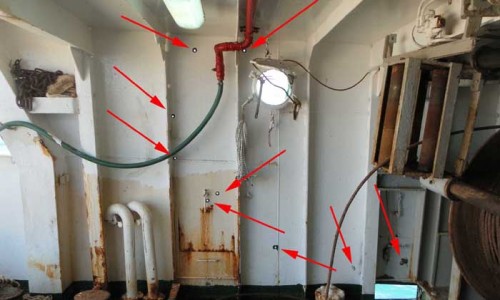
The request was made as a result of the incident on 12 September when a Libyan patrol boat fired on an Italian fishing vessel.  After the incident, Italian Interior Minister Roberto Maroni suggested that the Libyans “perhaps…confused the fishing boat for a boat with illegal migrants.” [”Posso immaginare che i libici abbiano confuso il peschereccio con una imbarcazione con immigrati irregolari, ma posso immaginare soltanto.”]

Bill Frelick, Refugee Program director at Human Rights Watch, said “the Libyans and Italians appear to agree that it was a mistake to shoot at Italian fishermen, but imply that it’s OK to shoot at migrants. The bullet-riddled boat shows a reckless use of potentially lethal force that would have been just as bad if it had actually targeted nonthreatening migrants.  This incident shows once again the dangers when an EU member outsources its border controls to third countries.  Italy should immediately end its agreement with Libya aimed at intercepting migrants trying to leave Libya.”

Click here for full HRW statement.

Click here and here (IT) for articles.

The arrows indicate the holes left by shots fired from a machine gun against a Libyan patrol boat fishing boat fleet of Mazara del Vallo, Aries (Ansa)

Click here for photo source.

Leave a comment

Filed under Italy, Libya, Mediterranean, News

Libyan State Security Court Expected to Rule Soon in Human Trafficking Trial Involving 500+ Defendants

The Libyan newspaper Oya (or Oea) reported this past week that the State Security Court is expected to issue a ruling on 26 September in a mass human trafficking trial involving approximately 520 defendants.  The trials have been ongoing since at least May 2010.  The defendants reportedly include members of the armed forces, public security, and Navy. They have been charged with offences relating to human trafficking and facilitating illegal immigration from Libya to Italy.

Click here for article. (AR) (Recently I have not been able to get Google Translate to work with Arabic.  I am therefore “reading” Arabic via these two sites: http://www.appliedlanguage.com/web_translation.shtml?s=dd and http://translation.babylon.com/ .)

Click here and here for previous posts on the trial.

2 Comments

Filed under Italy, Judicial, Libya, Mediterranean, News

European Patrol Network Meeting, 23-24 Sept.

The quarterly meeting of the European Patrol Network (EPN) will be held 23 and 24 September in Bruges.  EPN was established by Frontex and unites the members of the agency’s operational branch of the ‘Joint Maritime Operations’.

According to the Belgian Police EU Presidency Newsletter, 7th Edition, the purpose of the meeting is to “allow the participating countries to ensure better coordination of the operations….  A number of technical points will come up for discussion, but for instance also the progress of the [Frontex] 2010 Joint Operations, the creation of a national coordination centre, the issue of the interpreters, as well as the Eurosur project. At present the efforts of the EPN are mostly focused on the Mediterranean, due to the immigration pressure from this region.”  (The Newsletter says the meeting is scheduled for October, but the Belgian Integrated Police – Belgian Presidency of the EU website indicates the meeting is 23-24 September.)

Leave a comment

Filed under Belgium, European Union, Frontex, Mediterranean, News

Patrol Boat Given to Libya by Italy Fires On Italian Fishing Vessel

One of the six Italian patrol boats given to Libya by the Italian government to assist in efforts to stop migrants from leaving Libya fired on an Italian fishing boat in the Gulf of Sirte on Monday.  An Italian official was on board the Libyan vessel as an observer during the incident.  Libya apologised for the incident which is being investigated.

Click here and here for articles.

1 Comment

Filed under Italy, Libya, Mediterranean, News

FRA Call for tender: Treatment of third country nationals at the EU’s external borders

The EU’s Fundamental Rights Agency has issued a call for tender.

From FRA:  The overall objective of the project is to examine the treatment of third-country nationals at the external borders of the European Union in light of the existing fundamental rights framework. The project will not cover all fundamental rights issues that may emerge in the context of management of external borders, but focus on 2 specific components.

The first component of the project focuses on the southern maritime borders of the European Union. The second component of the project will analyse the treatment of third-country nationals at border crossing points.”

The first part of the fieldwork (relating to interception and rescue at sea) will be carried out in Cyprus, Greece, Italy, Malta and Spain and the second part in 10 border crossing points to be identified among those with the highest number of entries of third country nationals into the Schengen area.

Duration: 23 months; Budget: 760.000,00 EUR;

Deadline for submission of proposals: 13 September 2010.

(Noted earlier today on the Migration and Law Network listserve.)

Click here for full information.

Leave a comment

Filed under Aegean Sea, European Union, Mediterranean, News

ECJ Invites Council to Submit Statement of Defence re EP Challenge to Frontex Sea Borders Rule

In an Order issued on 28 July, the European Court of Justice invited the European Council to submit a statement of defence in:  Case No. C-355/10, European Parliament v. Council of European Union (Application under Article 263 TFEU for annulment of Council Decision 2010/252/EU).

Here are the relevant portions of the Order (several footnotes omitted):

“1. By application under Article 263 TFEU, notified to the Council on 26 July 2010, the European Parliament asked the Court to annul Council Decision 2010/252/EU of 26 April 2010 supplementing the Schengen Borders Code as regards the surveillance of the sea external borders in the context of operational cooperation coordinated by the European Agency for the Management of Operational Cooperation at the External Borders of the Member States of the European Union.

2. In support of its action for annulment, the European Parliament argues that the Council in adopting the contested decision exceeded the implementing powers set out in Article 12(5) of the Schengen Borders Code to adopt additional measures governing border surveillance.

3. The Council is invited to submit a statement of defence, in accordance with Article 40(1) and Article 81(2) of the Rules of Procedure of the Court of Justice.

[***]”

(Thank you to the editor at Blogging Portal.EU for bringing this new development to my attention – and now back to my vacation break.)

Click here for the full document from the ECJ.

Click here for previous post (with links to earlier posts).

4 Comments

Filed under European Union, Frontex, Judicial, Mediterranean

DIIS Working Paper: Sovereignty at Sea: The Law and Politics of Saving Lives in the Mare Liberum

DIIS (Danish Institute for International Studies) has published a paper by Thomas Gammeltoft-Hansen and Tanja Aalberts, Sovereignty at Sea: The Law and Politics of Saving Lives in the Mare Liberum (DIIS Working Paper 2010:18).

The paper addresses “the complicated politics and law of ‘rescue at sea’, and the legal duty to render assistance to migrants in distress at sea that falls upon all sovereign states. Yet, exactly because this takes in international waters, the precise division and content of this sovereign responsibility remains contested and subject to varying interpretations. As a result, ‘the drowning migrant’ finds herself subject to an increasingly complex field of governance, in which participating states may successfully barter off and deconstruct responsibility by reference to traditional norms of sovereignty and international law. …  The … paper was presented at the first international workshop in this framework titled ‘Sovereignty, Territory and Emerging Geopolitics’ held at DIIS, 3-4 May 2010.”

Click here for the Paper.

Leave a comment

Filed under Analysis, Mediterranean

EUROSTAT Q1 2010 Asylum Statistics for EU27 Countries

EUROSTAT released updated data on 15 July for the First Quarter of 2010.  The report is entitled: Asylum applicants and first instance decisions on asylum applications in Q1 2010 (Doc. 32/2010).

Notable statistics include reductions of over 50% in the number of asylum applicants in three countries, Malta, Italy, and Greece, relative to the First Quarter of 2009.  Malta had the largest reduction of approximately 95%.

The reductions in Malta and Italy are almost certainly due to Italy’s push-back practice.  Though the first migrant arrivals in Malta in 2010 occurred this past weekend, 17 July, when 55 migrants on a sinking vessel were intercepted by Maltese and Libyan patrol boats.  The Times of Malta reported that the migrants were “shared out” between the Maltese and Libyan patrol boats.  28 migrants were brought to Malta and 27 were apparently taken to Libya.

Click here for the full EUROSTAT document.

Click here for Times of Malta article.

3 Comments

Filed under Aegean Sea, Data / Stats, Eastern Atlantic, European Union, Greece, Italy, Libya, Malta, Mediterranean, News