Category Archives: Analysis

Migreurop: What Price Will Europe Pay if Gaddafi Authorises UNHCR’s Return to Libya?

Migreurop takes the position that Libya’s recent decision to expel the UNHCR is a negotiating tactic that will be used to leverage more money and concessions from the European Union in the context of the ongoing EU-Libya partnership negotiations and poses the important question:  What Price Will Europe Pay if Gaddafi Again Authorises UNHCR’s Return to Libya?  The UNHCR’s presence in Libya has played an essential role in Europe’s immigration policy, specifically Europe’s migration management and border outsourcing:

“Thanks to UNHCR’s presence in Tripoli, Europe and Italy, which concluded its agreement with Libya in August 2008, were able to claim that the boat people who were forcibly returned to Libya could find a minimal level of security and protection. Everyone knows full well that this was a smokescreen: the conditions under which migrants are treated in Libya are well documented and well known to European authorities and institutions.”

“The presence of the UNHCR in Libya justified the policy of externalisation and deportation carried out by the EU. … Libya has now raised the stakes and the UNHCR is an accomplice in the sordid negotiations:  UNHCR’s return is already planned.…”

Click here or here for Migreurop’s full statement / analysis (FR).

Click here for previous post.

Leave a comment

Filed under Analysis, European Union, Italy, Libya, Mediterranean, UNHCR

Article: Overview of North African Bilateral Cooperation on the Removal of Unauthorized Migrants

The May 2010 publication by the Middle East Institute (Washington DC), Viewpoints- Migration and the Maghreb, contains several articles including “An Overview of North African Countries’ Bilateral Cooperation on the Removal of Unauthorized Migrants: Drivers and Implications” by Jean-Pierre Cassarino.

Excerpts from the article (at page 34):

“Since 1965, when Bourguiba’s Tunisia signed with Austria its first bilateral agreement on the repatriation of its own nationals, North African countries’ patterns of cooperation on readmission or removal have changed dramatically….

“[R]eadmission agreements are … one of the many ways to consolidate a broader bilateral cooperative framework, including other strategic, and perhaps more crucial, policy areas such as security, energy, development aid, and police cooperation….

“Faced with the uncertainty surrounding the concrete implementation of the cooperative agreements, some EU Member States, particularly those affected by migration flows originating in North Africa (e.g., France, Spain, Italy), set out to devise flexible arrangements while opting for different ways of dealing with readmission. These include exchanges of letters, memoranda of understanding, or other types of arrangements (e.g., police cooperation agreements and pacts)….

“Readmission is embedded in power relations that can shape the intensity of the quid pro quo. Following their proactive involvement in the reinforced police control of the EU external borders, North African countries have become gradually aware that they could play the efficiency card in the field of migration and border management, while gaining further international credibility….”

Click here for link to publication (see p. 34 for this article.)

Click here for the MIREM Project Inventory of Agreements Linked to Readmission.

Leave a comment

Filed under Analysis, European Union

Frontex’s 5th Anniversary

Yesterday, 25 May, marked Frontex’s fifth anniversary.  Frontex marked the occasion by holding a conference, European Day for Border Guards, “publicising the work of 400,000 border guards in Europe [and] providing a forum for discussion and the exchange of best practices.”

Here is an interesting and thoughtful post on the Frontex anniversary by Professor J. Peter Burgess:

“… FRONTEX is quickly and quietly evolving into a kind of moral testing ground for Europe. It is here that the airy principles of European construction meet the pavement, where decisions are made about the role of rights and responsibilities in the management of Europe’s most dilemma-ridden challenge: the management of its external borders.  Border control is the operational theater where Europe meets its others: other worlds, other human beings, other values. It is here where the aspirations of those who long to embrace Europe, to be European, live under the protection of Europe’s social and economic well-being are confronted with European ideals of tolerance and universal rights. It’s also the place where Europe meets its ‘other’ other: trafficking, smuggling and other forms of cross-border criminality. The coherence with which Europe manages its others in both these forms is one measure of the success of the European project.….”

Click here for the full post.

Leave a comment

Filed under Analysis, European Union, Frontex, News

IMO Information Resources on Stowaways/Illegal Migrants/Treatment of Persons Rescued at Sea

The International Maritime Organization’s (IMO) Maritime Knowledge Centre has posted an updated 20+ page Information Resources document to “assist those who are conducting research in the area of ‘Stowaways/Illegal Migrants/Treatment of Persons Rescued at Sea’.”

The document contains a wealth of information, citations, and links to IMO documents, publications, circulars, and reports, as well as non-IMO citations and / or links to many other resources, including relevant UN reports, resolutions, and treaties.

For example the contents include:

Provisions in UN and IMO Treaties…

IMO Material on the Website …

IMO Documents…

IMO Sub-Committee on Radiocommunication and Search and Rescue documents…

IMO Legal Committee documents…

IMO Maritime Safety Committee documents…

IMO Publications …

UN Materials …

Click here for the IMO Information Resources document.

Leave a comment

Filed under Analysis, Reports

Int’l Law Observer: Italy’s Asylum Policy Violates Int’l Law

Some additional comments on the Council of Europe CPT’s condemnation of Italy’s push-back practice in the Mediterranean can be found in a post by Michèle Morel on International Law Observer.

The “conclusion of the CPT is highly important in the light of the coming decision of the European Court of Human Rights on Italy’s asylum policy. It is a powerful signal, not only towards Italy but also towards other European countries carrying out the practice of intercepting and returning migrants without human rights guarantees, such as Spain and Greece.”

Click here for the complete post.

1 Comment

Filed under Analysis, Council of Europe, European Committee for the Prevention of Torture and Inhuman or Degrading Treatment or Punishment, Italy, Libya, Mediterranean

UNODC Migrant Smuggling Issue Papers

The UN Office on Drugs and Crime’s (UNODC) Anti-Human Trafficking and Migrant Smuggling Unit has posted two Issue Papers on migrant smuggling on its web site: “A Short Introduction to Migrant Smuggling” and “Migrant Smuggling by Air.”  The occasional “Issue Papers [discuss] aspects of the crime of migrant smuggling and the global response to it. Issue Papers bring together expertise from practitioners around the world in an effort to support information sharing between those working in various capacities to prevent migrant smuggling, protect smuggled migrants and prosecute those who commit the crime.”

Click here for link to Issue Papers.

1 Comment

Filed under Analysis, Reports, UNODC

Thomas More Institute: Towards a Sustainable Security in the Maghreb – An Opportunity for the Region

The Thomas More Institute has released a report, “Towards a Sustainable Security in the Maghreb –  An Opportunity for the Region, a Commitment for the European Union.”  The report was released on 7 April at the “Maghreb and the European Union: Enhancing the partnership for a sustainable security” conference in Brussels.

From the Executive Summary:  “The relationship between Europe and the Maghreb is a complex, multidimensional and somewhat passionate one. The two areas share a common history and are bound by common interests. United against a number of joint challenges (economic development, regional stability, fight against terrorism, migration, sustainable development), it is time for the two shores of the Mediterranean to reconsider the basis for their cooperation. [***] The EU is well aware of what is at stake and must now look for ways of making a more active commitment in the region, particularly on sensitive issues such as human rights and migration. [***] The question of migration, which extends as far as the Sahelian area, is another area of cooperation which needs to be looked into in more depth, since the EU’s policy of limiting migratory flows can no longer be restricted to the northern border of the Maghreb. Reinforcing the role of the European agency FRONTEX throughout the area, for example by opening regional offices and assigning resources, is one possible solution. Intensifying efforts to coordinate development assistance policies between the EU and Maghreb countries to help Sub-Saharan African countries that represent sources of immigration is another solution that should not be ignored.”

A further excerpt: “A need for increased cooperation between the European Union and the Maghreb – Europe’s policy on migration is based on the principle that the great era of mass migrations is over, replaced by a new international division of labour, whereby a foreign workforce is substituted for the national workforce, and by policies that involve returning and rehabilitating non-Europeans in their countries of origin and internal mobility for Europeans within an area with no interior borders. European countries – and the Community, followed by the EU – concentrated their efforts on border control, in a securitarian view dictated by the migratory risk and concerns about the challenges of integration. Schengen relegated the countries of the Maghreb, and others, to the status of “outsider countries”, with which human circulation is restricted. This logic was maintained by the militarisation of borders which started in 1988 when barriers were built around the Spanish enclaves of Ceuta and Melilla, then as of 2002 by the installation of the Integrated System of External Vigilance (SIVE) around Gibraltar and later along the Spanish coasts – including the Canary isles – comprising twenty-five detection points, a dozen mobile radar and ten or so patrol units. The attacks perpetrated on September 11th reinforced the security component and, following the creation of FRONTEX (European Agency for the Management of Operational Cooperation at the External Borders) in 2005, other areas were militarised, with preventive sea and air patrols in the Mediterranean and even in the Atlantic, near the Canary isles. The EU also provides its members with technical assistance. [***] The Maghreb has made a real effort to contribute and cooperate with the EU in the fight against immigration.  In February 2004, Morocco and Spain started joint patrols and in 2008, cooperation was reinforced by improving controls in the ports of Tangier and Algeciras.  According to the Spanish authorities, the result was an overall drop of 60% in illegal immigration originating in Morocco between 2007 and 2008.  The decrease in illegal Moroccans was reportedly around 38%. However, reinforced controls caused a shift in migratory routes. According to the Italian Ministry of the Interior, the number of illegal immigrants arriving in Italy by sea rose by 75% between 2007 and 2008. 14 000 people arrived in Italy illegally in 2007, whereas the figure was in excess of 40 000 in 2008. Following the signature of the Benghazi treaty between Italy and Libya on 30th August 2008, Italy obtained greater assistance from Tripoli in the form of bilateral cooperation on illegal immigration and the application of the December 2007 agreement on joint patrols off the Libyan coasts, plus the installation of radars by Finmeccanica at Libya’s southern borders.”

Click here for full Report.

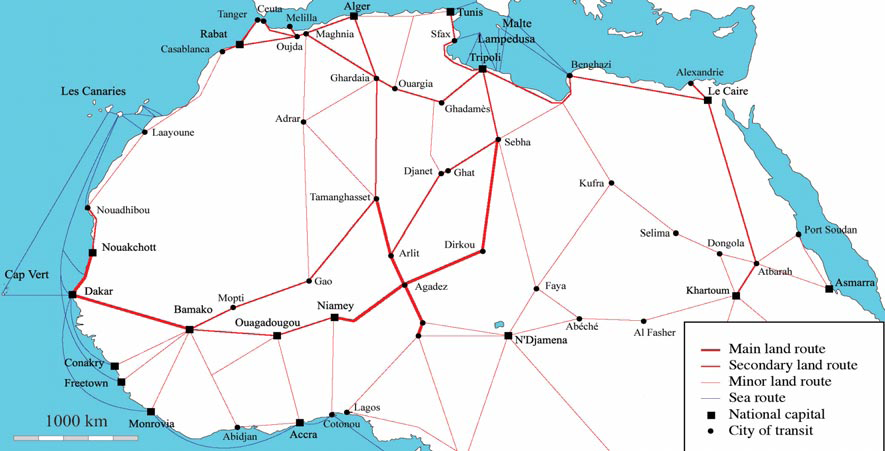
Main routes of present-day Trans-Saharan migrations

1 Comment

Filed under Algeria, Analysis, Data / Stats, Eastern Atlantic, European Union, Frontex, Italy, Libya, Malta, Mauritania, Mediterranean, Morocco, Spain

Analysis of the Real Instituto Elcano- Frontex: Successful Blame Shifting of the Member States?

Analysis of the Real Instituto Elcano: “Frontex: Successful Blame Shifting of the Member States?” by Jorrit J. Rijpma, PhD European University Institute, Florence, and Lecturer in EU law, Europa Instituut, Leiden University.

Excerpts:

“Frontex in Short – Frontex can be seen as the outcome of a ‘re-balancing’ of powers between the Member States, the Council and the Commission following the communitarisation of the policy on external borders after the Treaty of Amsterdam, constituting an important shift from the intergovernmental coordination of operational activity under the Council to a more Community-based approach. [***]

Joint Operations at Sea – [***] Currently, the most controversial practice is that of the diversion by national border guards of ships back to their point of departure. This practice entails not only a real risk to the life and safety of the passengers on board these often unseaworthy ships, but as regards possible asylum seekers on board, it also risks violating the right to claim asylum and the prohibition of refoulement. The Greek coast guard has the questionable reputation of regularly diverting boats back to the Turkish shores. Italy has openly admitted to the interception and return of irregular migrants and asylum seekers from Libya under its 2008 Treaty on Friendship, Partnership and Cooperation with the latter country. Both within and outside the Hera operations, Spain has been returning people to Senegal and Mauritania, but here at least the interceptions are formally cast in terms of rescue operations and transfer to the nearest place of safety.

Frontex: the Lesser Evil?- There are many reasons why Frontex can be subject to criticism. It could be argued that it is an instrument of an essentially flawed EU migration and asylum policy. [***] Finally, it could be said that the Agency reinforces a securitised perception of what is essentially a humanitarian problem through its one-sided mandate, the background of most of its staff in national law-enforcement agencies and its military-style operations. [***] However, it is important to realise that for the moment the Agency’s scope for independent action remains very limited, both in practical and in legal terms. Serious human-rights violations are more likely to occur in operations from national border guards removed from the public eye, than in relatively well-scrutinised joint operations. Frontex, being a Community body, is subject to numerous reporting and evaluation duties, as well rules on transparency. [***]

Conclusion: Efforts should focus on ensuring full respect of international rules regarding international protection and search and rescue and an authoritative interpretation of these rules in a broad sense. These are essentially political decisions. It is the Member States and the Community institutions, not Frontex, that are to be reproached for the failure to do so. [***]”

Click here for full Analysis.

Leave a comment

Filed under Aegean Sea, Analysis, Eastern Atlantic, European Union, Frontex, Greece, Italy, Libya, Malta, Mauritania, Mediterranean, Senegal, Spain, Turkey

New CARIM Migration Profile on Mauritania

CARIM has issued an updated migration profile for Mauritania.  Excerpts pertaining to irregular migration by sea include:

“Mauritania has worked with Spain and FRONTEX since 2006 to combat irregular emigration by readmitting foreign nationals who transited through the country and who are placed in detention camps before repatriation….”

“Due to Mauritania’s position as a juncture between Northern and Sub-Saharan Africa, its proximity with a peripheral part of EU territory (the Canary Islands) as well as its relatively lax border controls, today’s challenges include managing clandestine and transit migration, and sensitizing the local population and government officials to the human rights of asylum seekers and undocumented migrants. In spite of a flourishing civil society advocating democracy and a human-rightist approach towards migration governance, Mauritania has been severely criticized for its treatment of undocumented immigrants and refugees in the last years (Amnesty International Report 2008)….”

Click here for the full March 2010 profile.

Leave a comment

Filed under Analysis, Eastern Atlantic, Mauritania, Reports

Migration Provision of the Cotonou Agreement

Eurostep Weekly notes the failure of the EU and ACP to agree on mutually acceptable revisions to Article 13, the Migration provision, of the Cotonou Agreement and calls attention to a February 2010 briefing paper issued by CONCORD’s Cotonou Working Group.

Negotiations between the EU and ACP regarding the second revisions to the Agreement are to continue and are expected to be concluded before the next ACP-EU Ministerial Council in Ouagadougou, Burkina Faso on 3-4 June.

Excerpts from CONCORD’s briefing paper:

“[***]  Migration – The revision of Article 13 on Migration of the Cotonou Partnership Agreement aims at bringing the current provision into line with the Global Approach to Migration centered on three pillars: legal migration, fight against illegal migration and the synergies between migration and development. However, there is a real danger that the fight against illegal migration, strongly advocated by the EU side, is prioritized and that ODA [Official Development Assistance] is used as a means and incentive to encourage legal and policy frameworks in origin and transit countries to limit migration and restrict migrants’ rights.

Currently, Article 13 includes a clause on readmission, but to become operational, it requires the implementation of bilateral readmission agreements. The implementation of readmission agreements includes important risks of:

– inhumane and degrading treatment

– extended an arbitrary treatment in the countries migrants are brought back to

– a breach of the principle of non-refoulement of asylum seekers when these countries do not guarantee access to a fair asylum procedure

– a breach of article 3 of the European Human Rights Convention which stipulates that a person should not be submitted to the risk of inhumane and degrading treatment, nor deported to a country where he or she risks exposure to such treatment.

The EU side would like the clause on readmission in the Cotonou Agreement to become self-executive and binding for all ACP countries without needing complementary bilateral agreements. This will imply unmanageable obligations for many countries and hence an increased risk of migrants rights violations throughout the process of readmission. In no way should EC and MS ODA be dependent on the signature of readmission agreements (being bilateral or multilateral). By making development aid conditional on cooperation on border control, the EU is turning development aid into a tool for implementing restrictive and security-driven immigration policies which are at odds with its commitment to make migration work for development…..”

Click here for CONCORD’s Briefing Paper.

Click here for Eurostep Weekly article.

2 Comments

Filed under Analysis, European Union

Article: “A Contested Asylum System: The European Union between Refugee Protection and Border Control in the Mediterranean Sea”

An article in the most recent edition (Vol. 12, Number 1, 2010) of the European Journal of Migration and Law by Silja Klepp:

Abstract:

“During the past few years the border waters between Europe and Africa have become an EU-policy crucible. In the midst of the tightening of EU border controls and refugee protection claims, supranational, national and local actors find themselves in a phase of legal insecurity and negotiation. This article is based on ethnographical research carried out in Libya, Italy and Malta. It sheds light on the different actors’ practices at sea and in the surrounding border region. It also explores how new parameters for refugee protection are emerging in the border regions of the European Union. The article argues that the policy practices of the co-operation between Italy and Libya as well as the informal operational methods carried out in the Mediterranean Sea function as a trailblazer of the overall EU refugee policy. In the long term, some of these practices will affect and change the legal basis and the formal regulations of the European refugee regime. The principle of non-refoulement could first be undermined and then abolished in this process. Using an approach that combines the empirical study of border regions with a legal anthropological perspective, the article analyses the Union’s processes of change and decision-making on local, national and supranational levels and their interconnections.”

Click here for link to full article – restricted access only.

1 Comment

Filed under Analysis, European Union, Italy, Libya, Malta, Mediterranean

Commission Staff Working Document Impact Assessment re Proposal to Amend the Frontex Regulation

Click here for full Document.

COMMISSION STAFF WORKING DOCUMENT IMPACT ASSESSMENT accompanying the Proposal for a REGULATION OF THE EUROPEAN PARLIAMENT AND OF THE COUNCIL amending Council Regulation (EC) No 2007/2004 establishing a European Agency for the Management of Operational Cooperation at the External Borders of the Member States of the European Union (FRONTEX)

Brussels, 24.2.2010, SEC(2010) 149

{COM(2010) 61 final}

{SEC(2010) 150}

TABLE OF CONTENTS

1. PROCEDURAL ISSUES AND CONSULTATION OF INTERESTED PARTIES

1.1. Background and political context

1.2. Procedural issues and consultations with interested parties

2. PROBLEM DEFINITION

2.1. The legal framework

2.2. The context

2.3. What are the problems to be addressed?

2.3.1. Insufficient technical equipment put at the disposal by Member States

2.3.2. Insufficient human resources put at the disposal for joint operations by Member States; lack of uniform standards

2.3.3. Inefficient coordination and follow up of joint operations

2.3.4. Insufficient and inefficient cooperation with third countries

2.3.5. Collection, storage and processing of personal data

2.3.6. Return

2.3.7. No use of the expertise of the Agency to evaluate Member States’ performance in the area of border management

2.4. How would the problem evolve, all things being equal?

2.5. Right to act

3. OBJECTIVES

3.1. General objectives (cf Article 1 of the Regulation)

3.2. Specific objectives (cf Article 2 of the Regulation)

3.3. Operational objectives

4. POLICY OPTIONS

4.1. Assessment criteria

5. DESCRIPTION OF SUBOPTIONS AND ANALYSIS OF IMPACTS

5.1. Revising existing provisions on the use of technical equipment in joint operations, including the mechanisms for contributions from the Member States of such equipment

5.1.1. Do the suboptions address the general objectives?

5.1.2. Do the options have an impact on external countries/partners?

5.1.3. Can the involved costs be (or become) part of the FRONTEX budget and how high are they?

5.1.4. What are the possible impacts on fundamental rights?

5.1.5. Comparison of the suboptions

5.2. Mechanisms to improve the availability of border guards in joint operations

5.2.1. Do the suboptions address the general objectives?

5.2.2. Does the option have an impact on external countries/partners?

5.2.3. Can the involved costs be (or become) part of the FRONTEX budget and how high are they?

5.2.4. What are the possible impacts on fundamental rights?

5.2.5. Comparison of the suboptions

5.3. Revising the role of the Agency in preparing, coordinating and implementing operations, including with regard to the sharing of tasks between the Agency and the Member States

5.3.1. Do the suboptions address the general objectives?

5.3.2. Can the involved costs be (or become) part of the FRONTEX budget and how high are they?

5.3.3. What are the possible impacts on fundamental rights?

5.3.4. Comparison of the options

5.4. Expanding the mandate of the Agency in cooperating with third countries on border management

5.4.1. Do the suboptions address the general objectives?

5.4.2. Does the option/recommendation have an impact on external countries/partners?

5.4.3. Can the involved costs be (or become) part of the FRONTEX budget and how high are they?

5.4.4. What are the possible impacts on fundamental rights?

5.4.5. Comparison of the suboptions

5.5. Mandating the Agency to collect and process personal data

5.5.1. Do the suboptions address the general objectives?

5.5.2. Do the options have an impact on external countries/partners?

5.5.3. Can the involved costs be (or become) part of the FRONTEX budget and how high are they?

5.5.4. What are the possible impacts on fundamental rights?

5.5.5. Comparison of the options

5.6. Revising the mandate of the Agency as concerns return operations

5.6.1. Do the suboptions address the general objectives?

5.6.2. Does the option have an impact on external countries/partners?

5.6.3. Can the involved costs be (or become) part of the FRONTEX budget and how high are they?

5.6.4. What are the possible impacts on fundamental rights?

5.6.5. Comparison of the options

5.7. Mandating the Agency to evaluate Member States’ performance in the area of border management

5.7.1. Do the suboptions address the general objectives?

5.7.2. Does the option have an impact on external countries/partners?

5.7.3. Can the involved costs be (or become) part of the FRONTEX budget and how high are they?

5.7.4. What are the possible impacts on fundamental rights?

5.7.5. Comparison of the options

5.8. Subsidiarity and proportionality

6. ASSESSMENT OF THE PREFERRED POLICY OPTION

6.1. Summary of the preferred option

6.2. Overall assessment of impact of the preferred policy option

6.2.1. Subsidiarity and proportionality

6.2.2. Costs

7. MONITORING AND EVALUATION

Click here for full Document.

Leave a comment

Filed under Analysis, European Union, Frontex

Analysis of the Real Instituto Elcano: Controlling Migration in Southern Europe

Analysis of the Real Instituto Elcano: Controlling Migration in Southern Europe, Part 1: Fencing Strategies and Part 2: Gate-keeping Strategies by Anna Triandafyllidou.

“Part 1 Summary: Dealing with irregular migration has emerged as a policy priority at both the national and the EU level, although EU countries are not all affected by this phenomenon in the same way. Countries at the geographical periphery of the Union, and, in particular, southern EU member states that are close to important migration source and transit countries, face significant inflows from their land and sea borders.

This ARI discusses critically the policies adopted by different countries in southern Europe (Italy, Spain and Greece) for managing irregular migration, with a view to showing that reducing irregular migration cannot be achieved by tougher border controls only. Discourses of politicians and the media in announcing ‘floods’ or ‘waves’ of irregular migrants crossing the EU’s external borders and, on the basis of these ‘floods’, considering or indeed approving tougher border enforcement measures as the main means to effectively combat irregular migration need to be questioned by voters as well as by experts.”

Excerpt: “It is interesting to note that while sea-border patrolling and the related FRONTEX operation in the Atlantic Ocean in 2006 did not have substantial results (Triandafyllidou, 2007), the Spanish government’s diplomatic ‘offensive’ in West Africa did. Thus, during the last two years Spain has managed to sign re-admission agreements with Cape Verde, Mali, Guinea Conakry, Guinea Bissau and Nigeria and varied forms of cooperation agreements with other states in the region, with the result of a notable improvement in border management and hence a notable decrease of irregular arrivals from Africa (González Enríquez, 2009). Apprehensions of irregular migrants arriving at the Canary Islands have fallen from over 30,000 in 2006 to approximately 12,000 in 2007 (data from the Spanish Ministry of the Interior cited in Arango & Finotelli, 2008). This decrease is to some extent attributable to the intensification of sea-border patrols and joint FRONTEX operations in the area which led migrants and smugglers to try alternative routes.”

Click here for Part 1 and here for Part 2.

Leave a comment

Filed under Aegean Sea, Analysis, Eastern Atlantic, Greece, Italy, Mediterranean, Spain

Background Note Pertaining to Proposed Guidelines for Frontex Operations at Sea

Given the strong objections by Malta and Italy to the proposed Guidelines for Frontex Operations at Sea, the “Note for the File” pertaining to the “Draft Council Decision supplementing the Schengen Borders Code as regards sea border surveillance in the context of operational cooperation coordinated by FRONTEX (COM(2009)658) as amended by the Council on 25 January 2010” is worth reading.

The “Note” explains the origins of the Guidelines and the additional procedures which will need to be completed before the Guidelines take effect:

“Note for the File:

The questions of who is responsible for saving people at sea and where they should be disembarked have been subject to intense debates in the context of surveillance operations concerning the EU’s sea borders coordinated by Frontex. The operations take place in a highly complex legal and political environment and touch upon international law issues and on the EU’s relations with third countries.

After long preparatory work, including a study on the relevant international law instruments completed in 2007, the Commission drafted a set of guidelines intended to

  • ensure that international rules are uniformly applied by all Member States taking part in surveillance operations coordinated by Frontex (Convention on the Law of the Sea (UNCLOS), conventions on safety at sea and search and rescue, international law on refugees and fundamental rights) and
  • create a basis in EU law enabling one Member State to carry out surveillance of another Member States’ maritime borders.

The Commission presented the draft guidelines in the form of an implementing measure, based on Article 12 (5) of the Schengen Borders Code.  This provision, together with Article 33 of the Borders Code, authorises the Commission to adopt additional measures governing border surveillance in accordance with the regulatory procedure with scrutiny as laid down in Council Decision 1999/468/EC (“comitology decision”).

After the entry into force of the Treaty of Lisbon this procedure continues to apply until the basic legal act, the Schengen Borders Code, has been aligned to the framework of the Treaty of Lisbon. Therefore, the regulatory procedure with scrutiny applies to the present draft measure.

The draft was first submitted to the Borders Code Committee. Member States’ experts failed to agree on the draft; therefore, the Committee did not issue a formal opinion. One of the controversial issues was whether the Commission’s draft went beyond its implementing powers.

On 7 December 2009, the Commission submitted a revised draft to the Council and to the Parliament, in the form of a draft Council Decision (COM(2009)658).

In accordance with the regulatory procedure with scrutiny the Council, acting by qualified majority, had the following options:

  • · oppose the proposed measure, in which case it will not be adopted; the Commission may submit an amended proposal or present a legislative proposal (option 1)
  • · envisage adopting the proposed measure, in which case it shall without delay submit it to the European Parliament (option 2)
  • · not act within the two months, in which case the Commission shall without delay submit the measures to the Parliament.

The Council had to act within a deadline of two months, i.e. before 7 February 2010.  On 25 January 2010 the Council, with Italy and Malta abstaining, decided to envisage adopting draft Council Decision and submit the draft Council Decision to the European Parliament. Furthermore, the Council agreed on an additional declaration to be adopted by the Council if Parliament does not oppose the measure, asking Frontex to report on the practical implementation of this decision.

European Parliament’s role in the procedure and deadline

In accordance with the regulatory procedure with scrutiny, Parliament has four months in total, starting from the date of referral on 7 December 2009, to scrutinise the draft measure. In practice, Parliament now has two more months to take position before 7 April 2010.

Parliament’s options in the regulatory procedure with scrutiny are limited to the following. Parliament may, acting by a majority of its component Members,

  • · oppose the adoption of the measure; in this case, Parliament must justify its opposition, stating that the proposed measure exceeds the implementing powers granted to the Commission in the basic instrument, or is not compatible with the aim or the content of the basic instrument or does not respect the principles of subsidiarity or proportionality; if Parliament opposes, the draft measure shall not be adopted; the Commission may submit an amended proposal or present a legislative proposal
  • · not oppose the adoption of the draft measure; in this case, the draft measure may be adopted by the Council or the Commission.

LIBE, as the committee responsible, will prepare Parliament’s position, in accordance with Rule 88 of the Rules of Procedure. The Member responsible in LIBE is Michael Cashman, rapporteur for the basic act, the Schengen Borders Code. Once the Council’s position, adopted on 25 February 2010, has been officially referred to the Parliament, the chairman will set a deadline for Members who wish to propose that the committee objects to the draft measure. If the committee decides to object, it shall table a motion for a resolution to the plenary for adoption before 7 April 2010.

Action undertaken by LIBE so far:

On 11 January 2010, LIBE, as the committee responsible, heard presentations of the Commission (Mr Henrik Nielsen, Head of Unit, DG JLS) and the Spanish Presidency (Mr Burgos Nieto, JHA Counsellor) and held a first exchange of views on the file.

During the debate, several Members highlighted the political importance of the decision on the guidelines (Mr Busuttil, Mrs Flautre, Mr Moraes, Mrs Hennis-Plasschaert) and the fact that this was a long-standing discussion in the Council. The Executive Director of Frontex (Mr Laitinen) underlined the swift adoption of guidelines would enhance the efficiency of Frontex’ operations.

Next steps:

The Council will refer its position, which was adopted on 25 January 2010, to the Parliament within a few days. Then it will be Parliament’s turn to take a position before the expiry of the deadline on 7 April 2010.

In order to prepare LIBE’s position, the rapporteur recommends that an opinion be requested from the Parliament’s legal service, which should answer the following questions:

1)

a) Having regard to the delineation between “rules” and “guidelines” for Member States in the draft measure as amended by the Council, could the content be considered a “non-essential element” of the final legal framework shaping the role of the Member States and Frontex?

b) Has the Commission exceeded its implementing powers under Article 12 (5) of the Schengen Borders Code by proposing the present draft measure?

2) In case the content or a part of the content of the draft measure touches upon essential elements of the basic act, could the objectives of the measure be achieved by a legislative act, notably by amending the basic act, i.e. the Schengen Borders Code?

OPERATIONAL INFORMATION:

Documents:

  • · Proposal for a Council Decision supplementing the Schengen Borders Code as regards the surveillance of the sea external borders in the context of the operational cooperation coordinated by Frontex, COM(2009)658 of 27.11.2009, as amended by the Council on 25 January 2010
  • · Commission staff working document, Study on the international law instruments in relation to illegal immigration by sea, SEC (2007)691 of 15.5.2007, available in EN and FR.

Contacts:

European Parliament:

Member responsible: Michael CASHMAN

Asisstant to Mr Cashman: Renaud-Raphaël Savignat, tel. – 47759

S&D political Advisor: Mrs Annie Lemarchal, tel. – 43057

Desk officer responsible in the LIBE Secretariat: Lotte Madlen Tittor, tel. -40785

European Commission:

Desk officer responsible in DG JLS: Ana Isabel Sanchez Ruiz, tel. 02-2998239, email: Ana-Isabel.Sanchez-Ruiz@ec.europa.eu

Head of the responsible Unit in DG JLS: Henrik Nielsen, tel. 02-2991641, email: Henrik.Nielsen@ec.europa.eu

Council General Secretariat:

Desk officer: Mr Bent Mejborn, tel. 02-2816722, email: bent.mejborn@consilium.europa.eu

Spanish Presidency:

Mr Eugenio Burgos Nieto, JHA Counsellor, email: eugenio.burgos@reper.maec.es”

Click here for link to Document.

1 Comment

Filed under Analysis, European Union, Frontex, Italy, Malta, Mediterranean

Le Monde, Point de vue: 2010, l’année du droit à migrer ?

“En annonçant que la centaine de boat people débarqués à Bonifacio le 22 janvier bénéficierait d’un examen individuel de situation, les autorités françaises ont laissé entendre que certains pourraient se voir reconnaître le droit d’asile. Au même moment, le ministre de l’immigration proposait pourtant “le déploiement immédiat de renforts opérationnels européens sous l’égide de l’agence européenne de surveillance des frontières (Frontex)”, pour éviter “que la Corse ne devienne une destination des candidats à l’immigration comme l’île italienne de Lampedusa”.  Autrement dit, d’empêcher qu’à l’avenir, d’autres personnes fuyant les persécutions ne trouvent protection en France. … ”

Click here for full Le Monde opinion article by Emmanuel Blanchard, Olivier Clochard et Claire Rodier , membres du réseau euro-africain Migreurop et ont coordonné l’Atlas des migrants en Europe. Géographie critique des politiques migratoires, Paris, Armand Colin, 2009.

Leave a comment

Filed under Analysis, European Union, France, Mediterranean