Category Archives: Data / Stats

Record Numbers of Migrants Reaching Ceuta and Melilla by Sea

Since the beginning of July there has been a surge in the number of irregular migrants entering the North African Spanish autonomous cities of Ceuta and Melilla.  Over 200 migrants have entered Ceuta mostly by swimming or using small rafts to enter the territory from Morocco.  Melilla has reportedly had approximately 207 migrants reach its territory during the same period.  This is the largest number of irregular entries by sea in recent years, though the number is small compared to the events of 2005 when numerous migrants were able to traverse the border fences of the two cities.

The CETI (Centre for Temporary Stay of Immigrants) in Melilla is at roughly twice its capacity and is holding over 730 immigrants.  The CETI in Ceuta has an official capacity of 512 and is now holding over 680 migrants. The three main political groups in Ceuta’s local government have called on the Spanish government to transfer migrants from Ceuta to the mainland in order to relief the overcrowding.

Francisco Javier Velázquez, the director general of the Spanish police and Civil Guard just completed a visit to Rabat to seek greater cooperation from Morocco in controlling the migratory flow towards the Spanish territories.  Several media reports suggest that Moroccan authorities have reduced police and border guard patrols near the Spanish cities because they were deployed elsewhere in Morocco in response to the large demonstrations surrounding the referendum on the new Moroccan constitution.  With the internal demonstrations becoming smaller and less frequent, Spanish authorities believe that the Moroccan border patrols will soon be restored.

Click here, here, here, here, here, and here for articles. (all ES)

Leave a comment

Filed under Data / Stats, Mediterranean, Morocco, News, Spain

1000 Migrants Reach Andalucía by Boat in First Half of 2011

According to figures compiled by Europa Press, 1,003 migrants in 40 boats reached Andalucía (Almeria, Granada, Cádiz, Huelva and Malaga) between 1 January and 7 July 2011.  The majority of the migrants landed in the province of Granada.

Click here (ES) for article.

Leave a comment

Filed under Data / Stats, Eastern Atlantic, Mediterranean, Morocco, News, Spain

Italian Coast Guard: 44,000 Migrants Reach Italy by Boat in First Half of 2011

In a presentation on 28 June before the Italian Parliament’s Schengen Committee (Comitato parlamentare di controllo sull’attuazione dell’accordo di Schengen), officials from the Italian Coast Guard reported that at least 44,000 migrants have reached Italy by boat so far in 2011.

1,000 additional migrants arrived in Lampedusa over the 24 hour period Wednesay to Thursday of this week.  With the exception of one small boat carrying 8 Tunisians, all of the boats are believed to have left from Libya in recent days.

Click here, here, and here for articles.  (IT)

Leave a comment

Filed under Data / Stats, Italy, Libya, Mediterranean, News, Tunisia

1400 Migrant Landings in Malta in First 5 Months of 2011; 91% of Protection Applications Approved

According to information presented by Maltese Justice Minister Carmelo Mifsud Bonnici, 1,451 migrants have reached Malta during the first five months of 2011.  There were no arrivals during the first two months of the year.  819 people arrived in March, 288 in April, and 347 in May.  Most of the migrants were Somali (411) and Eritrean (280).

In a separate statement, Maltese Refugee Commissioner Mario Guido Friggieri said that a total of 1,530 migrants in seven boats have arrived in Malta to date in 2011.  This would suggest that there have been 79 migrant arrivals so far during the month of June.

Friggieri also reported that the Refugee Office has received 600 applications for protection of which 420 have been decided: 5 migrants have been granted refugee status, 370 granted subsidiary protection, 8 granted temporary humanitarian protection status, and 1 was granted “special protection.” 36 applications have been rejected.  91% of the applications for protection decided to date have been approved in some fashion.

As of the end of the month of April, there were 1,048 migrants being detained in detention centres and 2,294 in open centres.

Click here, here, and here for articles.

Leave a comment

Filed under Data / Stats, European Union, Libya, Malta, Mediterranean, News

Italy Surpasses Greek-Turkish Border as Main Entry Point to EU for Irregular Migrants

Frontex Deputy Executive Director Gil Arias announced today at a press conference that during the first quarter of 2011 most irregular migrants have entered the EU through Italy, primarily at Lampedusa.  In 2010 the Greek-Turkish border was the main entry point for irregular migrants.

A total of 32,906 irregular migrants were detected at the EU borders during the 1st Quarter 2011 compared with a total of 14,857 during the 1st Quarter of 2010.  Of the 32,906, 22,000 entered through Italy during the 1st Quarter, mostly at or around Lampedusa, and 7,200 entered the EU through Greece.

So far this year, January 1 to present, approximately 41,000 irregular migrants have entered the EU in the area around Lampedusa and other nearby islands.

Click here (EN), here (EN), here (IT), and here (IT) for articles.

1 Comment

Filed under Data / Stats, European Union, Frontex, Greece, Italy, Libya, Mediterranean, News, Tunisia, Turkey

42,000 Migrant Landings in Italy in First 5 Months of 2011

Italian officials report that 42,807 migrants landed in Italy during the first five months of 2011.  The arrivals involved 507 separate landings.  This number contrasts with 4,406 arrivals in all of 2010 involving 159 separate landings.

Most of the migrants in 2011 have been Tunisian nationals (24,356) whereas Afghans (1699) were the largest group in 2010.  Most migrants crossed the Adriatic in 2010 whereas the central Mediterranean is now the location of most migrant voyages.

2010:   Afghanistan (1699), Tunisia (650), Egypt (551), Algeria (297), Iraq (161), Iran (159) , Palestine (128), Turkey (112), Syria (100), Somalia (61), Eritrea (55).

January–May 2011:   Tunisia (24,356), Somalia, Eritrea, Ethiopia (combined total of 4,157), Nigeria (1689), Ghana (1312), Mali (1134), Bangladesh (827), Egypt (761), Côte d’Ivoire (730), Afghanistan (713), Pakistan (530).

Click here and here for articles.  (IT)

1 Comment

Filed under Data / Stats, Italy, Mediterranean, News

EU Council Resource Centre – Free Movement and Migration web site

A new resource from the EU Council:  “Check out our new online resource centre: http://www.eucouncilfiles.eu/.  It contains everything there is to know about free movement and migration….”

The site contains several folders for specific topics including:  Southern Neighbourhood (contains, among other things, updated statistics of migrants flows since the beginning of the current crisis);  Asylum, and  Migration.

Click here for main site.

1 Comment

Filed under Data / Stats, European Union, News

CARIM: Libya Migration Profile

CARIM has published an updated Migration Profile for Libya.  The profile includes IOM data regarding migrant departures from Libya between 20 February and 26 May 2011 which again highlights the humanitarian burden imposed on Tunisia and Egypt relative to Italy and the EU.

Tunisia received 232,856 individuals from Libya during this period (185,442 of whom were TCNs) which is 43.8% of the total number of migrants who have fled Libya.  Egypt received 172,318 individuals (74,911 TCNs) which constitutes 32.4% of the migrants who have fled.  Italy received 13,110 individuals (all TCNs) which constitutes 2.5% of the total.   Niger received 13.1% of the total, Chad 5.1%, Algeria 2.3%, and Malta 0.3%.

Click here for the Profile.

Leave a comment

Filed under Algeria, Analysis, Data / Stats, Egypt, European Union, Italy, Libya, Malta, Mediterranean, Niger, Reports, Tunisia

Update Regarding Migrant Boat Sinking Off Tunisian Coast

Tunisian authorities continue to recover the bodies of victims from the migrant boat that capsized off the coast of the Kerkennah islands  last week.  TAP reported that 26 additional bodies were recovered on Sunday, 5 June.  Poor weather conditions on Sunday made recovery operations difficult.  According to TAP, 577 persons were rescued from the boat and 200 to 270 persons are believed to have drowned.  There are conflicting media reports regarding the numbers of confirmed deaths.  Some reports indicate that at least 150 bodies have been recovered in addition to the 26 bodies reportedly recovered on 5 June.

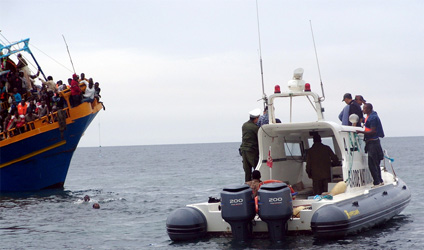
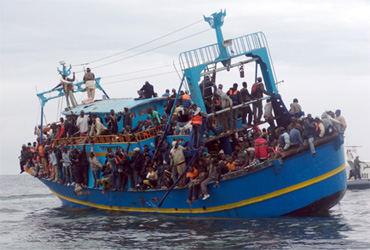
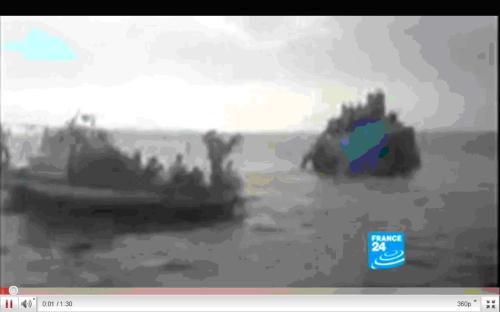
The boat, named The Wave, ran around last week, probably on Wednesday, 1 June.  The boat did not capsize until after rescue boats had arrived on the scene.   Tunisian coast guard and local fishing boats were involved in the rescue efforts.  The rescue boats did not have the capacity to rescue all of the migrants from the stranded migrant boat and some people jumped into the water and others moved to one side of the migrant boat causing it to capsize.  Media pictures show the vessel in an upright position with some rescue boats already on scene.  A France24 video report contains cell phone video shot immediately after the boat capsized.  (See pictures below.)

UNHCR and IOM staff have conducted interviews with some of the survivors.  According to UNHCR, the boat left Tripoli on 28 May with up to 850 people on board.  The passengers were primarily from West Africa, Pakistan, and Bangladesh. The crew was recruited on an ad hoc basis and had little or no maritime experience. The France24 video report states that survivors said Libyan military assisted them in leaving Libya.  The boat became lost after leaving Tripoli and on Wednesday, 1 June, it ran around near the Kerkennah islands.  UNHCR spokesman Adrian Edwards said that the boat “capsized as desperate passengers rushed to one side, seeking rescue by the Tunisian coast guard and fishing boats that had approached the vessel. Many fell into the water.”  IOM staff reported that at least one survivor said that during the boat’s voyage some people were thrown overboard alive.  The boat reportedly had run out of food and water.

Click here for a France24 video news report (EN) with cell phone video shot immediately after the migrant boat capsized.

Click here and here for UNHCR reports on the incident.

Click here for IOM Press Briefing Note.

Click here, here, here, and here for Tunisian articles. (FR)

Click here, here, and here for articles.  (EN)

Photo Agence Tunis Afrique Presse 04 juin 2011

La Garde maritime à Sfax au secours du chalutier libyen bloqué au large de Kerkennah (Photo AFP)

France24 03 June 2011 - Screen shot

France24 03 June 2011 - Screen Shot


1 Comment

Filed under Data / Stats, European Union, Italy, Libya, Mediterranean, News, Tunisia, UNHCR

600+ Migrants Reach Andalusian Coast in 2011

A total of 612 migrants in 24 different boats have reached the Andalusian coast of Spain (Almeria, Granada, Cadiz and Huelva) from Morocco and Algeria so far in 2011.

Click here for article (ES).

Leave a comment

Filed under Algeria, Data / Stats, Eastern Atlantic, Mediterranean, Morocco, News, Spain

Frontex Issues 2011 Annual Risk Analysis

Frontex posted its 2011 Annual Risk Analysis to its web site yesterday. [Update 9 May 2012: 2011 Annual Risk Analysis also available here: frontex_annual_risk_analysis_2011 ]

From the Frontex web page: “Frontex’s Annual Risk Analysis 2011 records the main trends in regular and irregular migration into the European Union in 2010 and offers predictions for the coming year’s trends. Regarding irregular migration, the sharp decrease reported in 2009 (of around a third on 2008) stabilised in 2010; Member States and Schengen Associated Countries reported a total of 104,049 detections of illegal border crossing at the sea and land external borders, a total almost identical to the 2009 figure of 104,599….”

Executive Summary:  “Irregular migration represents a small proportion of the total movement of persons across the borders, three quarters of which are EU nationals. Over 100 nationalities require a visa to enter the EU, accounting for more than 80% of the non-EU population, while about 1 billion nationals from 37 countries do not require a visa. As yet, there are no precise statistics available on passenger flows for 2010, but it is widely regarded to have recovered somewhat from the decline of 2009.

Regarding irregular migration, the sharp decreasing trend reported in 2009 stabilised in 2010; Member States and Schengen Associated Countries reported 104 049 detections of illegal border-crossing at the sea and land external borders, a total almost identical to 2009.

Irregular migration through western African, western Mediterranean and central Mediterranean routes continued to decrease, thus reducing the overall detection of irregular migration of West Africans who, in the past, used to be the most commonly detected migrants on those routes. By contrast, there was an abrupt increase in detections of illegal border-crossing at the land border between Turkey and Greece. Consequently, in 2010 the eastern Mediterranean route became the main channel of irregular migration into the EU, and Turkey – the main transit country for irregular migrants.

The sudden increase in detections of illegal border-crossings along a small section of the Greek-Turkish land border in October 2010 was due to facilitators exploiting variations in the vulnerability of the external border. This development triggered the first deployment of the Rapid Border Intervention Team (RABIT) in November 2010.

At EU level, refusals of entry decreased marginally in 2010; however, trends differed extensively between nationalities. Ukrainians continued to be the main nationality refused entry at EU Member States’ external borders in 2010, mostly at the Ukrainian border with Poland which is one of the busiest border sections along the EU’s external borders. Furthermore, Serbians became the second most frequently refused nationality at the external land borders, with more than an 80% increase, following the visa liberalisation process in the Western Balkans. At the external air borders, Brazilians continued to be the nationality most often refused despite the fact that these refusals declined by more than 20% compared to 2009.

At the end of 2010, the detection of false documents at entry points to the EU reached their highest level since data collection began in early 2009. Apart from this increase, there are reports of widespread abuse of authentic documents by unauthorised users known as impostors.

Looking ahead, regular passenger flows across the external borders will increase due to rising global mobility, possible visa-liberalisation procedures for the EU’s eastern European partners and new local border-traffic agreements along the eastern borders. These developments will increase the workload of border-control authorities in preventing the use of legal channels for overstaying. In addition, Europe will host two major sporting events – the Olympic Games in London and the UEFA Euro 2012 in Poland/Ukraine.

Consistent with the increasing flow of passengers, the growing number of registered traveller programmes (RTP) should further facilitate bona fide passenger flows and will put additional emphasis on risk analysis-driven border checks in order to ensure the smooth flow of legitimate passengers.

There might be changes in the external Schengen and EU borders in 2011 or 2012, with the possible entry of Romania and Bulgaria into the Schengen area and Croatia’s possible accession to the EU.

The most likely high-pressure points for illegal border-crossings in 2012 will be along the Mediterranean coast and the land border with Turkey. Migrants with relatively easy access to Turkey or North Africa will continue to typify the flow.”

Click here for the Frontex statement.

Click here for the 2011 Annual Risk Analysis.  [Update 9 May 2012: 2011 Annual Risk Analysis also available here: frontex_annual_risk_analysis_2011 ]

2 Comments

Filed under Analysis, Data / Stats, European Union, Frontex, News, Reports

Nationalities of Migrants Who Arrived in Malta from Libya Last Week

From the Times of Malta (sources: Home Affairs Ministry and parliamentary replies) and as noted on EASO Monitor:

Nationalities of migrants who arrived last week

  • Somalia – 411
  • Eritrea – 250
  • Ethiopia – 87
  • Ivory Coast – 26
  • Mali – 16
  • Pakistan – 14
  • Sudan – 6
  • Nigeria – 6
  • Yemen – 2
  • Mauritania – 1
  • Total: 819

Migrants in Malta before Libya crisis

  • Held in detention: 79
  • Living in open centres: 2,224
  • Living in the community: 1,400
  • Total: 3,703

Migrant arrivals in previous years

  • 2007: 1,702
  • 2008: 2,775
  • 2009: 1,397
  • 2010: 27

Click here for article.

Leave a comment

Filed under Data / Stats, Eritrea, Ethiopia, European Union, Frontex, Libya, Malta, Mediterranean, News, Somalia

Tunisian Migrant Crisis vs. Italian Migrant Crisis – Comparing the Numbers

Since the collapse of Tunisian president Ben Ali’s rule on 14 January 2011, tens of thousands of people have been on the move as a result of the events in Tunisia and the ensuing events elsewhere in the Middle East and North Africa.  Many of those taking advantage of this transitional period are Tunisians who are leaving their country to seek better opportunity in Europe.   Most however, are people who have fled from Libya to neighbouring countries due to fighting and threats to their safety.

So far Italy has received about 20,000 migrants and a smaller number of asylum seekers.  The 20,000 migrants are almost all Tunisian nationals.  At the same time, Tunisia has received over 150,000 asylum seekers and others who have fled from Libya.

Based on the raw numbers alone – 20,000 vs. 150,000 – Tunisia has received 7.5 times as many people as Italy over the past 2 ½ months.  When you compare these numbers in light of the respective population of the two countries, the burden imposed on Tunisia is even more striking.  Italy has a current population of approximately 61.0 million people.  Tunisia’s current population is approximately 10.6 million.  Assuming my calculations are correct, Italy has received approximately 3.3 persons per 10,000 of its population and Tunisia has received approximately 141.5 persons per 10,000 of its population.  Tunisia has therefore received almost 43 times as many people per capita relative to Italy.  There is no comparison between the humanitarian crises faced by the two countries.  Tunisia is facing by far the greater burden.

Agence Tunis Afrique Press on Saturday attributed the statement below to an authorised source within the Tunisian Ministry of Foreign Affairs.  The statement notes the burden faced by Tunisia and asks Italy to show understanding and solidarity within the context of the ongoing migration talks between Tunisia and Italy.  Italian Prime Minister Silvio Berlusconi travels to Tunis today (Monday) for continuing migration talks with Tunisia.

Statement attributed to Tunisian Ministry of Foreign Affairs:  “While reaffirming the strong historical ties that bind [Tunisia] to the friendly country [of Italy], especially since the signing of the agreement of friendship and good neighborliness in 2003, Tunisia calls on the government and the people of Italy to show proof of their solidarity with the Tunisian people in this important transitional stage that this country is now experiencing, after the glorious revolution, and especially in light of the challenges posed by the current situation on the Tunisian-Libyan border, with the arrival of more than 150,000 displaced persons who have been welcomed by the Tunisian people in a unique showing of solidarity, despite the difficult conditions faced by Tunisia, as witnessed by several countries and international and humanitarian organizations.”

(“Tout en réaffirmant la solidité des liens historiques qui l’unissent à ce pays ami, notamment, depuis la signature de la convention d’amitié et de bon voisinage en 2003, la Tunisie elle appelle le gouvernement et le peuple italiens à faire preuve de solidarité avec le peuple tunisien en cette étape transitoire importante que vit le pays, après sa glorieuse révolution et, tout particulièrement, dans le contexte des défis que pose la situation actuelle sur les frontières tuniso-libyennes, avec l’arrivée de plus de 150.000 déplacés, qui ont été accueillis par le peuple tunisien dans un élan de solidarité sans pareil, en dépit des conditions difficiles auxquelles la Tunisie est confrontée, comme en témoignent plusieurs pays et organisations internationales et humanitaires.”)

Click here (FR) for TAP article.

Leave a comment

Filed under Analysis, Data / Stats, Italy, Libya, Mediterranean, Tunisia

UNHCR Report: “2010 Asylum Levels and Trends in Industrialized Countries”; Levels Fall to Half of 2001 Levels

From UNHCR’s statement summarizing the report which was released this morning:

“Asylum figures fall in 2010 to almost half their 2001 levels-

GENEVA – The number of asylum-seekers in the industrialized world continued to fall in 2010, bringing the figure down to nearly half the level at the start of the millennium.

This was among the main findings as the UN refugee agency today released its 2010 statistical overview of asylum applications in 44 industrialized countries. The report deals with new asylum claims and does not show how many individuals were granted refugee status.

According to the report, 358,800 asylum applications were lodged in industrialized countries last year – down 5 per cent from 2009, and some 42 per cent lower than the decade’s peak in 2001, when almost 620,000 asylum applications were made…

Numbers fall in most regions

Last year’s total number of new asylum claims was the fourth lowest in the last decade. Year-on-year decreases were reported in most regions, including in Europe, North America and North Asia. Within Europe, the largest decline was seen in southern Europe, where claims fell by 33 per cent compared to 2009. This was mainly because fewer people requested protection in Malta, Italy and Greece. However, this decline was offset by increases elsewhere, especially in Germany (49%), Sweden (32%), Denmark (30%), Turkey (18%), Belgium (16%) and France (13%). In the Nordic countries, the increases in Denmark and Sweden were offset by substantial declines in Norway (-42 per cent) and Finland (-32 per cent)….

US tops recipient list

Among individual countries, the United States remained the largest asylum recipient for the fifth consecutive year, accounting for one out of every six asylum applications in the industrialized countries covered in the report. The US saw an increase of 6,500 applications, partly due to a rise in the number of Chinese and Mexican asylum-seekers.

France maintained its position as host to the second-largest number of new applications, with 47,800 in 2010, largely from Serbian, Russian and Congolese asylum-seekers. Germany became the third-largest recipient country with a 49-percent rise. The increases can partly be attributed to a rise in asylum seekers from Serbia and the former Yugoslav Republic of Macedonia. That development is widely attributed to the introduction of visa-free entry to the European Union for nationals of these two countries since December 2009.

Sweden and Canada ranked fourth and fifth respectively. Together, the top five countries of asylum accounted for more than half (56 per cent) of all asylum applications covered in this report.

Most claims from Serbia

In terms of places of origin, the largest group of asylum-seekers in 2010 were from Serbia (28,900, including Kosovo). The country saw a 54 per cent increase compared to 2009, when it ranked sixth. Interestingly, the number of asylum applications in 2010 was comparable to 2001, soon after the Kosovo crisis.

Afghanistan slid to second place with a decrease of 9 per cent compared to the previous year. Unlike in 2009, when Afghan claims were mainly lodged in Norway and the United Kingdom, in 2010 more claims were filed in Germany and Sweden. Chinese asylum-seekers made up the third-largest asylum group in 2010, partly due to a substantial drop in the number of new applications from Iraq and Somalia. For the first time since 2005, Iraq was not one of the top two countries of origin of asylum-seekers. It dropped to fourth place, followed by the Russian Federation. Somalia, which occupied the third spot in 2009, fell to sixth in 2010….”

Click here for full report.

Click here for key graphs from report.

Leave a comment

Filed under Data / Stats, European Union, News, Reports, UNHCR

100+ Libyans Reach Sicily by Boat

Speaking at a press conference earlier today, Italian Interior Minister Roberto Maroni reported that 117 migrants who are believed to be Libyan reached Catania, Sicily in two boats during the night of 20-21 March.  According to Maroni, a total of 14,918 immigrants have landed in Italy since the beginning of the year.  [UPDATED INFORMATION – more recent reports suggest that the many or all of the migrants involved may be Egyptian nationals who posed as Libyans, possibly for purposes of seeking refugee protection. Click here (IT) for more recent article.]

Click here, here, and here for articles. (EN)

Leave a comment

Filed under Data / Stats, Frontex, Italy, Libya, Mediterranean, News