Category Archives: News

Eritreans Diverted from Libya Held by Human Smugglers at Egypt-Israel Border

Several organizations, including Gruppo EveryOne, are making an appeal on behalf of a group of 80 Eritreans who are reportedly being held by traffickers at the Egypt-Israel border. The Eritreans apparently departed Tripoli en route to Israel.  This incident provides anecdotal evidence that African asylum seekers are attempting to enter Israel because the Central Mediterranean sea route to Europe has for all practical purposes been closed by the Italian-Libyan push-back practice in effect since May 2009.

Click here (EN) or here (IT) for the Gruppo EveryOne appeal.

1 Comment

Filed under Egypt, Eritrea, Israel, Italy, Libya, Mediterranean, News

Commission Issues New “EU Internal Security Strategy”

Earlier today the Commission released a Communication entitled “The EU Internal Security Strategy in Action.” The Communication to the EP and Council contains 41 proposals in five general areas: organised crime, terrorism, cybercrime and cyber security, border management, and crises and disasters.  It contains a strategy which is described as an effort to identify, explain, and coordinate what the EU seeks to achieve in the area of internal security.  The accompanying Commission Press Release quotes Commissioner Malmström as stating that “EU internal security has traditionally been following a silo mentality, focusing on one area at a time. Now we take a common approach on how to respond to the security threats and challenges ahead. Terrorism, organised, cross-border and cyber crime, and crises and disasters are areas where we need to combine our efforts and work together in order to increase the security of our citizens, businesses, and societies across the EU. This strategy outlines the threats ahead and the necessary actions we must take in order to be able to fight them….”

Here are several excerpts (with some footnotes omitted) from Objective Number 4 entitled “Strengthen security through border management”:

“[***] In relation to movement of persons, the EU can treat migration management and the fight against crime as twin objectives of the integrated border management strategy. It is based on three strategic strands.

  • An enhanced use of new technology for border checks (the second generation of the Schengen Information System (SIS II), the Visa Information System (VIS), the entry/exit system and the registered traveller programme);
  • an enhanced use of new technology for border surveillance (the European Border Surveillance System, EUROSUR) with the support of GMES security services, and the gradual creation of a common information sharing environment for the EU maritime domain [25 Commission communication, ‘Towards the integration of maritime surveillance: A Common information environment for the EU maritime domain’, COM (2009) 538 ]; and
  • an enhanced coordination of Member States through Frontex.

[***]

Action 1: Exploit the full potential of EUROSUR

The Commission will present a legislative proposal to set up EUROSUR in 2011 to contribute to internal security and the fight against crime. EUROSUR will establish a mechanism for Member States’ authorities to share operational information related to border surveillance and for cooperation with each other and with Frontex at tactical, operational and strategic level. [27 Commission proposals for the development of the EUROSUR system and for the development of a common information sharing environment (CISE) for the EU maritime domain are set out in COM (2008) 68 and COM(2009) 538 respectively. A six step road map for establishing the CISE was recently adopted – COM(2010) 584.]  EUROSUR will make use of new technologies developed through EU funded research projects and activities, such as satellite imagery to detect and track targets at the maritime border, e.g. tracing fast vessels transporting drugs to the EU. In recent years, two major initiatives on operational cooperation at the maritime borders have been launched – one on human trafficking and human smuggling under the umbrella of Frontex and the second on drugs smuggling in the framework of MAOC-N [28 MAOC-N – Maritime Analysis and Operations Centre – Narcotics] and CeCLADM. [29 CeCLAD-M – Centre de Coordination pour la lutte antidrogue en Méditerranée.]

As part of the development of integrated and operational action at the EU’s maritime border, the EU will launch in 2011 a pilot project at its southern or south-western border, involving those two centres, the Commission, Frontex and Europol. This pilot project will explore synergies on risk analysis and surveillance data in common areas of interest concerning different types of threats, such as drugs and people smuggling. [30 This project will complement the other integrated maritime surveillance projects such as BlueMassMed and Marsuno, which aim to optimise the efficiency of maritime surveillance in the Mediterranean Sea, Atlantic and the northern European sea basins.]

Action 2: Enhancing the contribution of Frontex at the external borders

[***] From 2011 onwards, the Commission, with joint input from Frontex and Europol, will present a report by the end of each year on specific cross-border crimes such as human trafficking, human smuggling and smuggling of illicit goods. This annual report will serve as a basis for assessing the need for Frontex and its joint operations and joint operations between police, customs and other specialised law enforcement authorities to be carried out from 2012 onwards. [***]”

Click here for the complete Commission Document.

Click here for Commission’s Press Release.

Click here for the Feb 2010 Council Draft Internal Security Strategy.

Click here (SW) for comments on Commissioner Malmström’s blog.

Leave a comment

Filed under European Union, Frontex, News

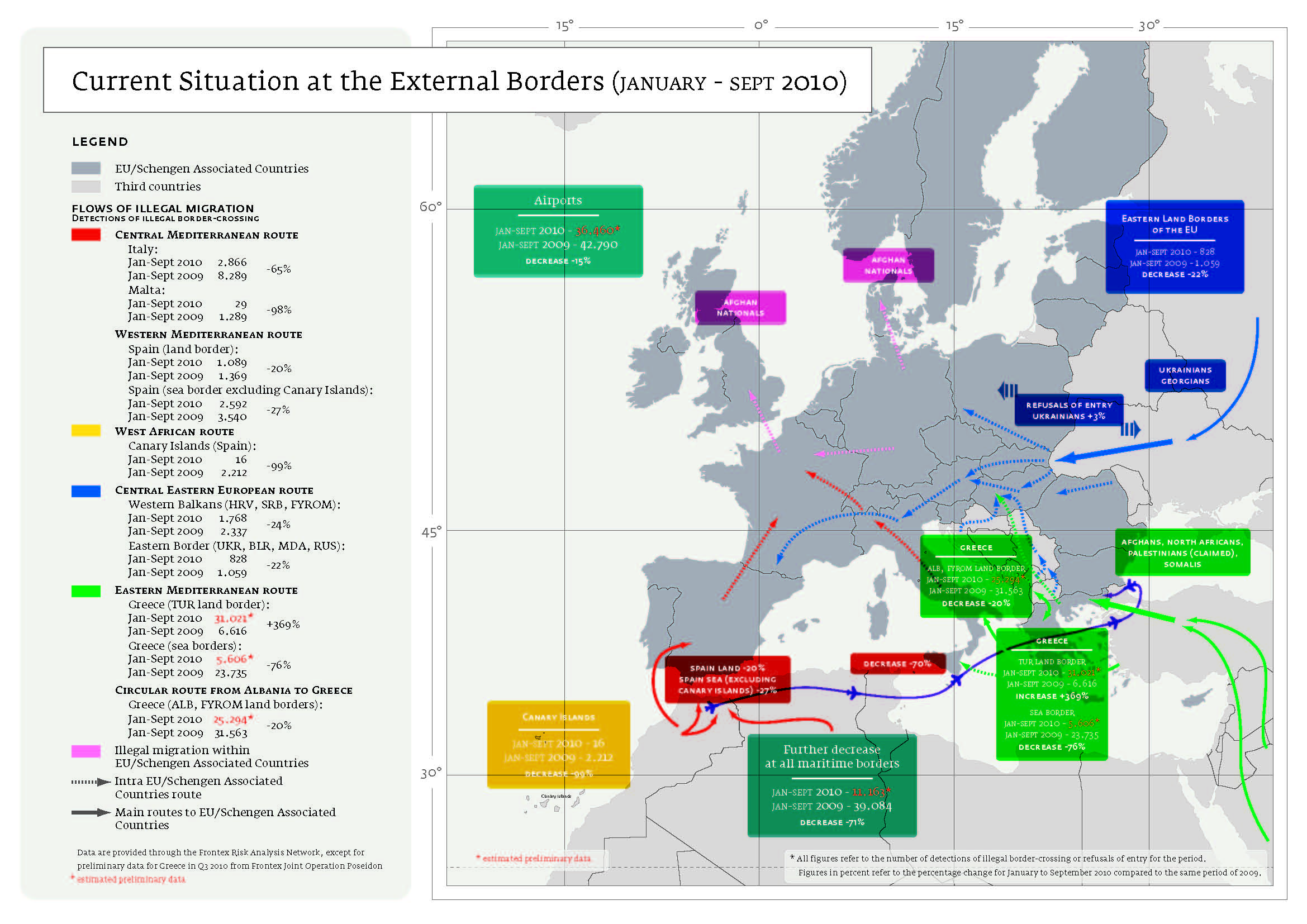
Frontex Map: Current Situation at the External Borders (JANUARY – SEPT 2010)

Frontex has released an updated Third Quarter map, January-September 2010, showing data regarding the situation at the external borders.   Note the information on the map pre-dates the deployment of the Frontex RABIT forces to the Greek border in October/November.  The data shows a 369% increase in detected irregular crossings along the Greek-Turkey land border over the first three quarters of 2010 compared to 2009.

The significant reduction in migrants detected at maritime borders continues:

  • Jan-Sept 2010:   11.163 (estimated preliminary data)
  • Jan-Sept 2009:   39.084
  • 71% reduction

Data by route:

Central Mediterranean route

  • Italy:
    • Jan-Sept 2010:     2.866
    • Jan-Sept 2009:    8.289
    • 65% reduction
  • Malta:
    • Jan-Sept 2010:    29
    • Jan-Sept 2009:    1.289
    • 98% reduction

Western Mediterranean route

Spain (land border):

  • Jan-Sept 2010:   1.089
  • Jan-Sept 2009:   1.369
  • 20% reduction

Spain (sea border excluding Canary Islands):

  • Jan-Sept 2010:   2.592
  • Jan-Sept 2009:   3.540
  • 27% reduction

West African route – Canary Islands (Spain):

  • Jan-Sept 2010:   16
  • Jan-Sept 2009:   2.212
  • 99% reduction

Eastern Mediterranean route

Greece (TUR land border):

  • Jan-Sept 2010:   31.021 (estimated preliminary data)
  • Jan-Sept 2009:   6.616
  • 369% increase

Greece (sea borders):

  • Jan-Sept 2010:   5.606 (estimated preliminary data)
  • Jan-Sept 2009:   23.735
  • 76% decrease

Click here to view Jan-Sept 2010 Map.

Click here for link to Jan-June 2010 Map.

Click here for link to 2009 Map.

1 Comment

Filed under Aegean Sea, Data / Stats, Eastern Atlantic, European Union, Frontex, Greece, Italy, Libya, Malta, Mediterranean, News, Spain, Turkey

Israel Begins Construction of Border Fence to Block African Migrants

Israel today begins the construction of a 250 km border fence along portions of its border with Egypt.  The barrier is primarily designed to prevent the entry into Israel of African migrants and asylum seekers.  Prime Minister Benjamin Netanyahu is quoted as saying that “Peace does not include the flood of illegal infiltrators, who come from Africa through Sinai … This is a blow which our neighbours in Egypt are also suffering from.”

The Israeli Interior Ministry reported that on average on a weekly basis 1,100 irregular migrants enter Israel along its southern border with Egypt.  The Ministry reported that over 10,000 such migrants have entered Israel in this manner so far in 2010 compared with 4,431 for all of 2009.

The construction project will take at least one year to complete and will include sensors and other devices designed to detect persons along the border.

One effect of such a fence will be the diversion of migrants and asylum seekers who will either attempt to cross at unfenced portions of the border or pursue new destinations, with or without the assistance of human traffickers.

Click here, here, and here for articles.

Click here for the Association for Civil Rights in Israel “Refugee and Asylum-Seeker” Fact Sheet.

Leave a comment

Filed under Data / Stats, Egypt, Israel, News

Australian High Court Decision Calls Into Question “Pacific Strategy”

The High Court of Australia issued a decision on 11 November concluding that asylum seekers initially detained on Christmas Island, a so-called “excised offshore place”, are entitled to access to courts and to the same legal protections and procedural fairness as asylum seekers on the mainland.

The unanimous seven judge decision in Plaintiff M61/2010E v Commonwealth of Australia; Plaintiff M69 of 2010 v Commonwealth of Australia [2010] HCA 41 (11 Nov 2010) determined that the process pursuant to which two Sri Lankan Tamil asylum seekers were found not to be persons to whom protection obligations were owed was unlawful because it was a “non-legal” or “non-statutory” process which “did not treat the provisions of the Migration Act 1958 (Cth) and the decisions of Australian courts as binding, and further, failed to observe the requirements of procedural fairness.”  The two stage “non-legal” asylum process at issue has been in effect since 2008.

While the decision does not directly affect the Pacific Strategy, offshore detention practises, or the existence of the excised offshore places, the benefit of the strategy sought by past Governments and by the current Coalition Government to minimise the legal process afforded to asylum seekers within the excised offshore places by denying access to courts and judicial review has now apparently been eliminated by the High Court decision.

Click  here for High Court decision.

Click here, here, and here for articles.

Here is a lengthy excerpt from the decision which provides some of the historical background beginning with the 2001 incident involving the MV Tampa:

“Historical context

29.              In 2001, the Parliament enacted six Acts[11], one after the other, which affected the entry into, and remaining in, Australia by aliens. Those six Acts were all assented to, and for the most part came into operation, on the same day. The first of those Acts, the Border Protection (Validation and Enforcement Powers) Act 2001 (Cth) (“the Border Protection Act“), sought to validate certain actions taken between 27 August 2001 and the commencement of the Act. The actions in question were actions taken by the Commonwealth, by any Commonwealth officer, or by any other person acting on behalf of the Commonwealth, in relation to the MV Tampa and certain other vessels, and actions in relation to persons who were on board those vessels during the relevant period. The circumstances that gave rise to those actions are sufficiently described in Ruddock v Vadarlis[12]. In addition, the Border Protection Act, and several of the other five Acts, amended the Migration Act to change the way in which persons who arrived in, or sought to enter, Australian territory without a valid visa were to be dealt with.

30.              Those changes had a number of features of immediate relevance to the present matters. First, certain Australian territory, including the Territory of Christmas Island, was excised from the migration zone[13], thus introducing the category of places called excised offshore places. A person who entered Australia at an excised offshore place, after the excision time, and who became an unlawful non-citizen because of that entry, was identified as an “offshore entry person”. The Migration Act was amended[14], by inserting s 46A, to provide that an application for a visa is not a valid application if it is made by an offshore entry person who is in Australia and is an unlawful non-citizen.

31.              One of the consequential provisions made for dealing with unauthorised arrivals in places excised from the migration zone was to provide, by the insertion of s 198A into the Migration Act[15], that offshore entry persons might be taken from Australia to a country declared under that section. The new s 198A(3) provided that the Minister might declare a country for the purposes of that section by declaring that, in effect, the country in question provides access for persons seeking asylum to effective procedures for assessing their need for protection; provides protection for persons seeking asylum pending determination of their refugee status; provides protection to persons who are given refugee status pending their voluntary repatriation to their country of origin or resettlement in another country; and meets relevant human rights standards in providing that protection. An offshore entry person being dealt with under that provision is taken[16] not to be in immigration detention. The Republic of Nauru and Papua New Guinea were declared countries and persons were removed from Australia to those places in exercise of the power given by s 198A.

32.              The Department referred to the procedure contemplated by s 198A, of removing offshore entry persons from Australia to another country, as the “Pacific Strategy”. Removal of offshore entry persons to those countries began in 2001 but ceased in 2008.

33.              While the so-called Pacific Strategy was operating, claims by offshore entry persons taken to a declared country that they were owed protection obligations were assessed according to procedures specified by the Department. The document that recorded those procedures began by stating Australia’s international obligations in the following terms:

“Australia’s primary obligation under the Refugees Convention is not to refoule (return) a refugee, either directly or indirectly, to a country where they have a well-founded fear of persecution for a Convention ground. Australia’s protection obligations extend to refugees who have entered Australia’s territorial seas. The Pacific strategy in no way detracts from these obligations.” (emphasis added)

Because persons dealt with under these procedures were not in Australia, but were in either Nauru or Papua New Guinea, s 46A of the Migration Act did not apply to prevent their making a valid application for a visa. But being outside Australia, and in a declared country, such persons could apply for only certain classes of visa and, in particular, could not apply for a Protection (Class XA) visa.

34.              It is not necessary to examine further the operation of the arrangements that were made to effect the Pacific Strategy. What is presently important is that the changes to the Migration Act that were worked by inserting s 46A and, in consequence, inserting s 198A, are to be seen as reflecting a legislative intention to adhere to that understanding of Australia’s obligations under the Refugees Convention and the Refugees Protocol that informed other provisions made by the Act. As the document recording procedures for administration of the so-called Pacific Strategy said:

“The new legislation underpinning the Pacific strategy has two mechanisms that reflect Australia’s obligations under Article 33 of the Refugees Convention and other Conventions. These mechanisms are:

. a framework to enable the Minister for Immigration and Multicultural and Indigenous Affairs to decide whether to allow an application for a visa to be made by unauthorised arrivals on excised offshore places (offshore entry persons) (while in Australia), following consideration of protection obligations under the relevant United Nations Conventions; and
. the ability to take unauthorised arrivals who have entered Australia at excised offshore places (such as Ashmore Reef and Christmas Island) to another country provided that the Minister for Immigration and Multicultural and Indigenous Affairs has declared under s 198A of the Migration Act 1958 that the country [meets the requirements described earlier].” (emphasis added)

[***]

The Minister’s announcement

37.              On 29 July 2008, the Minister announced that the Government had decided to strengthen and enhance the RSA [Refugee Status Assessment] process. This announcement followed an earlier announcement by the Government “that asylum claims of future unauthorised boat arrivals would be processed on Christmas Island”.

[***]

40.              The adoption of these procedures, and their application in these particular cases, can only be understood as implementing the announcements that have been mentioned: one that the Pacific Strategy would no longer be followed; the other that steps of the kind ultimately recorded in the RSA Manual and the IMR Manual [“Guidelines for the Independent Merits Review of Refugee Status Assessments”] would be undertaken as the means of meeting Australia’s obligations under the Refugees Convention and Refugees Protocol, instead of following the Pacific Strategy. And if the power to remove offshore entry persons from Australia under s 198A was not to be used, the only statutory powers that could be engaged to avoid breaching Australia’s international obligations were the powers under ss 46A and 195A.

The RSA Manual

41.              The purpose of the RSA process was described in the RSA Manual as being “so that the Minister … can be advised whether Australia’s protection obligations under the Refugees Convention are engaged”. It was said that “[c]onsideration of the exercise of the Minister’s power under s 46A to allow a visa application to be made will occur following assessment of protection obligations as outlined in this manual”.

42.              Much emphasis was given in the Manual to the RSA process being “a non-statutory process”. But the source of the power to undertake the process was not identified. Rather, the Manual described what were said to be some consequences of the process being “a non-statutory process”. In particular, it was said that “[t]his means that the Migration Act, the Migration Regulations 1994 … and Australian case law on the interpretations of the definition of a refugee and ‘protection obligations’ do not apply”, though it was said that “officers should be guided by these as a matter of policy”.

43.              The Manual said that the common law rules of natural justice or procedural fairness were to be applied “to safeguard the fairness of the RSA procedures”. The particular procedures laid down in the Manual were described as being “modelled closely on the onshore [p]rotection visa determination procedures”. In that respect, it may be noted that, although the process was repeatedly described as “non-statutory”, the Manual proceeded on a footing that suggested that some provisions of the Migration Act applied to at least some aspects of the process. So, for example, the directions given in the Manual about seeking further information or comment from a claimant proceeded on the footing that what the Migration Act describes as “non-disclosable information”[17] need not be disclosed, regardless of whether procedural fairness would require that to be done.

44.              If, at the end of the RSA process, an offshore entry person was found to be owed protection obligations, the Manual described the consequence as being that a submission would be prepared by the Department for the Minister “advising the Minister that Australia’s protection obligations are engaged and seeking his/her agreement to lift the bar under s 46A of the Act”. By contrast, if the officer making the assessment determined that the person was not a person to whom Australia has protection obligations, no submission would go to the Minister. Instead, an opportunity would be given to seek the review of the decision under the IMR process. If the outcome of the review was negative, an opportunity would be given to the person to provide any new or additional information which he or she wished the Department to take into consideration. A further assessment would be undertaken by the Department of whether any other international treaty obligation was engaged in the particular case. If no other international obligation was engaged, the process for removal of the person from Australia would begin.

The IMR Manual

45.              As would be expected, much that was set out in the IMR Manual followed or reflected what was said in the RSA Manual. It is therefore not necessary to do more than mention some particular matters arising from the IMR Manual.

46.              The system of Independent Merits Review was described, in the IMR Manual, as having been introduced as one of the new arrangements announced by the Minister on 29 July 2008. Previously, reviews of departmental assessments of refugee status had been undertaken by a senior officer of the Department.

47.              Much emphasis was given in the IMR Manual (as it was in the RSA Manual) to the RSA process and the IMR process being “non-statutory”. Again, however, the Manual did not seek to identify what power was being exercised. Rather, the consequences said to follow from the process being “non-statutory” were identified. In particular, it was said in the IMR Manual that independent reviewers “may still be guided by the legislated interpretations of the Refugees Convention in sections 36 and 91R-91U of the Act and Australian case law on the interpretation of ‘protection obligations'”, but it was also said to be “important to note that these sources of interpretation are not binding authorities”.

48.              The IMR process was subject to what the Department described as “a quality assurance check before an offshore entry person would be notified of the outcome of the IMR review”. That process, now supervised by the Registrar of the Refugee Review Tribunal (while on secondment to the Department), was said to “primarily [involve] checking IMR recommendations for spelling, grammatical, cut and paste or other obvious errors”. But it was a process that may “result in a suggestion being made to an independent reviewer that he or she may wish to consider an additional matter, consider more up to date country information, or clarify parts of a decision-record or recommendation”.

49.              At the end of the review, the reviewer was to make a recommendation about whether Australia had protection obligations to the claimant. If the reviewer concluded that Australia did have protection obligations to the claimant, a departmental officer would prepare a submission to the Minister for consideration of the exercise of power under either s 46A(2) or s 195A. If the reviewer concluded that Australia did not have protection obligations to the claimant, no submission would be made to the Minister. Steps of the kind described in connection with the RSA process for considering engagement of any other relevant international obligation would be undertaken and, subject to that, processes for removing the claimant would then begin.

[***]”

Click here for High Court decision.

1 Comment

Filed under Australia, Indian Ocean, Judicial, News, Pacific Ocean

JHA Council 8 Nov. Meeting Results

The Justice and Home Affairs Council met on 8 November.  A Council press release containing the “provisional version” of the main results of the meeting includes the following summaries relating to the CEAS and FRONTEX:

“Common European Asylum System (CEAS) – Ministers continued work on the establishment of a Common European Asylum System (CEAS) on the basis of a discussion paper (15561/10). The CEAS includes a package of six legislative proposals which EU member states have committed to adopt by 2012.

The main focus of the debate was on the developments since the October Council, in particular as regards the four proposals that have been identified as priority instruments on the legislative side of the CEAS: the Directives on Qualification and on Long Term Residents and the Regulations on Dublin II and Eurodac. Furthermore, the Presidency identified a number of possible priority objectives, reflecting the discussion at the discussion at the Ministerial Conference on Asylum in September 2010, for the new European Asylum Support Office (EASO) . The EASO will soon be operational and is designed to become an important tool for practical cooperation and solidarity in the asylum area. …

FRONTEX regulation –  The [Mixed Committee (the EU plus Norway, Iceland, Liechtenstein and Switzerland)] discussed the state-of-play concerning revised rules for the external borders agency FRONTEX. Some of the issues outstanding include the development of a common integrated risk analysis model, the processing of personal data and the creation of a European system of border guards.

Council preparatory bodies will continue to discuss the text. Negotiations with the European Parliament have not yet started.

On 24 February 2010 the Commission submitted a proposal to amend Council Regulation (EC) No 2007/2004 (6898/10)….

Click here for Council press release.

Click here for Background paper for the JHA Council meeting.

Click here for the CEAS discussion paper.

1 Comment

Filed under European Union, Frontex, News

Yemen to End Prima Facie Refugee Status for Somalis

Yemen announced a plan to end its policy of granting prima facie refugee status to Somali nationals.  If the change is approved by the Council of Ministers, arriving Somalis would be required to make individual requests for refugee status.  The Yemen Observer reported that “[a]ccording to Essam al-Mahbashi, member of the National Committee for Refugee Affairs (NACRA), not all Somalis are fleeing conflict as many of them come from safe regions such as the port of Bosasso in the Puntland region of northern Somalia in search of better economic opportunities. Al-Mahbashi said that the emergence of extremist groups in Somalia like al-Shabab al-Mujahideen is one of the reasons why Yemen wants to cancel the prima facie refugee status policy.”  “Patrick Duplat of NGO Refugees International (RI) told IRIN that RI encouraged countries, including Yemen, to offer Somalis the broadest protection mechanisms possible given the current situation in their homeland. However, he said Yemen’s new policy would be in line with newly issued UNHCR guidelines on Somalis that allow for such screening but call for those Somalis not granted refugee status to be afforded ‘complementary forms of international protection.’”

Click here for article.

1 Comment

Filed under Gulf of Aden, News, Somalia, UNHCR, Yemen

Libya Purchases Coastal Surveillance System

Libyan officials signed a €20 million contract on 14 October to purchase a national coastal surveillance system from Transas Marine, an Irish company.  According to the company’s press release, the system “will ensure continuous surveillance of the territorial waters, safety of navigation, reduction of illegal immigration and protection of the marine environment.”  The system is scheduled to become operational in 16 months.  Malta Today noted that the “deal was inked after the European Commission … offered Libya up to 50 million euros in aid to stop the flow of illegal migrants to Europe and to protect refugees.”

Click here for article.

Click here for Transas Marine press release.

2 Comments

Filed under European Union, Libya, Mediterranean, News

Bulgaria Prepares for Admission to Schengen Zone and Begins Patrols on Black Sea

The Sofia News Agency Novinite reports that Bulgaria has added five new coast guard ships which will soon begin patrolling Bulgaria’s Black Sea border.  The patrols are a requirement for Bulgaria’s impending admission to the Schengen Zone which is set to occur in March 2011.

The ships will reportedly be included in “Bulgaria’s integrated system for the observation of the sea border, which is part of the European External Border Surveillance System (EUROSUR)” and “will be taking part in operations of the Frontex Agency … under the European Patrol Network project.”

Click here for article.

Leave a comment

Filed under Black Sea, Bulgaria, European Union, Frontex, News

Erika Feller’s Comments Regarding Boat People and Irregular Secondary Movements

During her annual address to the UNHCR’s Executive Committee on 6 October, Assistant High Commissioner for Protection Erika Feller reviewed significant protection issues over the past year, noting also that 2010 marks the 60th anniversary of the founding of the UNHCR in December 1950 and the 59th anniversary of the Refugee Convention.

Among the topics she addressed were the challenges posed by the arrival of irregular secondary movements of migrants, including boat people.  She is critical of interdiction practices being carried out throughout the world and makes the strong point that “[t]he evidence suggests that tough sea policies have not solved, just changed and indeed complicated the dynamics, of irregular movements.”  While Ms. Feller does not identify countries by name, she is apparently referencing increased maritime interdiction in the Aegean Sea and the resulting surge in irregular crossings along Greece’s land borders.  The point could also be made in regard to the Italian push-back practice.

Excerpts from her address:

“Arrivals of undocumented migrants continue to test the capacity of States, with the problem of so-called “irregular secondary movement” exacerbated in recent years by boat arrivals. The Pacific, the Mediterranean, the Caribbean or the Gulf of Aden are all regular theatres, with ‘boatpeople’ being interdicted, intercepted, turned around, ignored by passing ships, shot at, or denied landing. Even when rescued, disembarkation somewhere has no guarantees attached, as an incident currently playing out off the Somalia/Djibouti coasts starkly reminds us.

All this is seriously at odds not only with protection principles but also with the reality that when they manage to gain access to territory and asylum processes, a large percentage of asylum-seekers who come by boat are actually found to be refugees. …

Boat arrivals can provoke fears and high emotions which may be difficult for Governments to manage. However, in our experience, an approach built predominantly around closing borders and trying to prevent movement is not the answer, as it does not work. In fact it can make situations even more difficult to deal with. Developments in relation to one country that has pursued a tough policy towards boats are actually quite revealing. While arrivals by sea are dramatically down, arrivals by land have basically doubled. In addition, while sea arrivals had been able to be concentrated through being channeled to one main reception point, land arrivals now come through multiple crossing points and have been able to disperse more effectively and rapidly through the community, below any radar screen. The evidence suggests that tough sea policies have not solved, just changed and indeed complicated the dynamics, of irregular movements….

The phenomenon of refugees on the move for non-protection reasons is also growing. Numbers and categories vary with the regions but the concern is global. On the African continent, where camps are more the norm than the exception, it is preoccupying that camp environments are starting to be compromised by a form of transit migration to and through them, with refugees, and others, seeking to use their facilities for R&R en route to a more distant destination. Just as concerning has been the misuse of reception centers as way-stations, or even lucrative recruitment opportunities for smugglers and traffickers. These facts are not a rationale for abandoning camps or centers. They are, though, a solid reason to rethink how better to manage them within a burden sharing framework….”

Click here for full address.

2 Comments

Filed under Aegean Sea, European Union, Greece, Italy, Libya, Mediterranean, News, Statements, UNHCR

Cecilia Malmström: Back From Libya

Commissioner Malmström writes her own blog, Cecilia Malmström Mitt Europa (My Europe).  Here is her most recent posting regarding her trip to Libya (translated from Swedish with Google Translate).  There are several points worth noting – and worrying about.  She notes that Libya is not a signatory to the 1951 Refugee Convention or 1967 Protocol.  (Though Libya is a signatory to the OAU Refugee Convention.)  She suggests that the new migration agreement between the EU and Libya will involve the UNHCR, but no insight is offered regarding whether or how the UNHCR might return to Libya.  She concedes that the European Commission does not know all of the details of the bi-lateral agreement between Italy and Libya which has resulted in the current push-back practice in the central Mediterranean.  And she seems to say that she was greatly troubled by what she saw when she visited one of the southern migrant detention centres in Libya during her official trip.

Translated excerpts:

“Just returned from Libya … I have been there to try to initiate a dialogue between the EU and Libya on issues relating to asylum, migration and international protection. … I believe it is necessary to have a dialogue with Libya.

Libya has not signed the Geneva Convention and the concept of asylum is not in Libyan law. … Since Italy and Libya signed an agreement, which we unfortunately do not know everything about, it has basically been that case that no boats are crossing the Mediterranean.

Against this background, I see it as progress that the first time we have agreed a text with Libya, a version of a plan for cooperation, which deals with issues of asylum and international protection…  Our aim is to identify people in need of international protection, while helping Libya to raise standards in the detention centres in order to provide decent conditions to people. We also address the issues of border control, labor migration and human smuggling in this plan for cooperation. From the EU side, we are prepared to put up 50 million euros over three years to support reforms. These will obviously not be given as a blank check to Libya but will be provided using the guidelines of the European Commission. For example, we support specific projects by various organizations, including the UNHCR.

Besides holding talks with Libyan ministers, I also visited Libya’s southern border in the middle of the desert, observed International Organisation for Migration activities in Libya, and visited one of the detention centres where many migrants have ended up. I had the opportunity to talk to some of the people there.  Several of these stories that I heard have kept both me and my staff awake at night. …”

Click here for the full posting.

3 Comments

Filed under European Union, Italy, Libya, Mediterranean, News, UNHCR

EU and Libya Sign “Unclear” Migration Cooperation Agreement

At the end of a two day visit to Tripoli, 4-5 October, Cecilia Malmström, European Commissioner for Home Affairs, and Štefan Füle, European Commissioner for Enlargement and European Neighbourhood, signed a “migration cooperation agenda” with Libya.  The European Commission issued a Press Release with details of the negotiations and signed agreement.

The specific contents of the full agreement and negotiations however are not clear.  “‘What worries us is the vagueness of the deal,’ Annelise Baldaccini from Amnesty International told [euobserver.com]. ‘We do not know what the EU has signed up to. It mentions for instance addressing the burden of recognised refugees and rejected asylum seekers, but it does not say what this involves.’”

Here are some excerpts from the Commission press release:

In the framework of the visit an agreement on a migration cooperation agenda was signed yesterday evening in Tripoli by Commissioner Malmström, Commissioner Füle, M. Moussa Koussa, the Secretary of General People’s Committee for Foreign Liaison and International Cooperation, and M. Yunis Al-Obeidi, the Secretary of General People’s Committee for Public Security. This is a Cooperation agenda between the European Commission and Libya, including concrete steps on border surveillance system, mobility-related issues, smuggling and trafficking in human beings, and dialogue on refugees and international protection.

Commenting the signature of the Cooperation agenda Commissioner Malmström said: ”It is my objective to put the protection of fundamental rights of all people involved in migratory and asylum flows at the centre of our efforts in the EU relationship with Libya. The Cooperation Agenda will enable us also to promote initiatives aimed at better protecting and assisting the rights of migrants and refugees’.

Commissioner Füle said: “I welcome agreeing on this cooperation agenda because this is an important first step to solve the serious challenge irregular migration poses not only to Libya but also to the EU. This step is part of the much broader relationship we are trying to build together. It was clear from our talks in Tripoli that both EU and Libya have at heart to sustain the new momentum in our relationship over recent months.”

The EU and Libya also discussed the establishment of an informal group of senior officials that would oversee the implementation of the list of possible initiatives in the field of migration cooperation. The proposed initiatives will be implemented through a variety of means, ranging from the sharing of experience and best practices, as well as financing of actions, including the acquisition of equipment in accordance with applicable rules.

Both sides agreed on the following initiatives for possible further dialogue and cooperation.

1. Regional and Pan african dialogue and cooperation

  • Increasing joint efforts in the development of African countries of origin of migration. This would build on the serious and substantial efforts of Libya and the European Union as major donors to African countries. In this context, the EU and Libya will continue to address root causes of migration in the countries of origin of migrants travelling through Libya and creating viable alternatives to migration in these countries.
  • The EU and Libya will support awareness campaigns to take place in main countries of origin of migrants transiting through North Africa and Libya specifically to alert migrants to the dangers of irregular migration.
  • Libya and the EU will work together in the implementation of the “Declaration of Tripoli on Migration and Development” of 2006, and the EU-Africa Migration, Mobility and Employment Partnership adopted in Lisbon in 2007.
  • Libya and the EU will increase dialogue and exchange information regarding the issue of smuggling of human beings and related illicit traffics reaching Libya from other countries and the EU from Libya.
  • Libya and the EU will also establish an informal consultative group that will exchange information on development policies benefitting Africa, and possibly also to identify development projects in sub Saharan Africa. This group will be composed by the Libyan administration, by the representatives of the European Commission and of the EU member States which are willing to participate.

[***]

3. Ensuring effective management of migratory flows

  • Supporting the development in Libya of a more efficient system to manage labour migration. This could be done by allowing to maximise the skills of the migrants already present in the country and of the newcomers.
  • Enhancing the capacities of Libyan authorities, Libyan NGOs and international organisations, to properly launch and implement search and rescue operations aimed at saving lives of migrants in the desert or on high seas and to provide them with the necessary humanitarian assistance.
  • Providing decent treatment, reception and assistance – in line with international standards – to irregular migrants intercepted or readmitted or to be returned by Libyan authorities, or stranded in Libya, with focus on migrants belonging to vulnerable categories (like unaccompanied minors, victims of trafficking; pregnant women, and families with small children). This could build on the activities already carried out in Libya by the local authorities, international organisations and NGOs.
  • Offering assisted voluntary return home to irregular migrants intercepted or readmitted or to be returned by Libyan authorities, or stranded in Libya or in the countries of origin, as well as offer support for their social and professional reintegration.
  • Enhancing the capacity to address smuggling and trafficking in human beings, with reference in particular to the two respective protocols of the 2000 UN Convention on the Trans-national organised Crime, and in view of reinforcing the capabilities of law enforcement officials in charge of the implementation of this legislation, by taking also into the account the Ouagadougou Action Plan to combat Trafficking in Human Beings.

4. Border management

  • Carrying out a gap-analysis on the current functioning modalities of the Libyan border and immigration services, aimed at reinforcing the capacity of the latter to prevent the irregular migration flows from entering Libya from its Southern borders.
  • Strengthening cooperation between Libya and the neighbouring and other transit and origin countries, in the border surveillance and in the prevention of attempts of irregular migrants and smugglers to violate Libyan borders, through promoting joint patrolling, intelligence sharing, the development of joint training, the facilitation of working contacts and the establishment of dedicated communication channels aimed at transmitting early warnings and sensible data.
  • Supporting the development of Libyan patrolling, search and rescue capacities in its territorial waters and at high sea. Delimiting the search and rescue region for which it Libya is responsible, pursuant to the SAR Convention it has ratified.
  • Establishment of an integrated surveillance system along the Libyan land borders, with focus on the areas prone to irregular migration flows, in line with the Memorandum of Understanding agreed between Libya and the European Commission on 23 July 2007.
  • Exploring concrete possibilities of cooperation between Libyan police, border, migration authorities and agencies and those of the EU Member States as regards the return and readmission of irregular migrants.

5. International Protection

  • Supporting Libya in its efforts aimed at establishing a protection system able to deal with asylum seekers and refugees in line with international standards and in good cooperation with the competent international organisation , in particular through providing advice on the development of a legislation in line with the 1969 African Union Convention Governing the Specific Aspects of Refugee Problems in Africa as well as providing training, technical assistance and equipment in view of promoting the development of administrative structures and human resources, able to properly act in line with this legislation
  • Assisting Libyan authorities in screening migrants in order to identify those in need of international protection and in addressing the burden represented both by the recognized refugees and the unsuccessful asylum seekers, and which would consist in resettling some of the recognized refugees towards EU Member States, in supporting the voluntary return of some of the unsuccessful asylum seekers back to their origin country, as well as in enhancing the reception capacities offered in Libya to asylum seekers and refugees.

Click here for full European Commission Press Release.

Click here, here, and here for articles.

4 Comments

Filed under European Union, Libya, Mediterranean, News

Increased Human Smuggling to Cyprus

According to an article in the Turkish newspaper Today’s Zaman, Turkish Interior Ministry data indicates that human smuggling in Turkey has decreased since 2007, but that one consequence of increased enforcement within Turkey has been a diversion of human smuggling to the Turkish controlled northern portion of Cyprus.

“According to the ministry, the total number of illegal immigrants, asylum seekers and immigrants caught at land and sea borders with Syria, Iran, Iraq, Georgia, Greece and Bulgaria declined to 28,355 in 2009.”  This number is in contrast to the 50,800 migrants reportedly arrested in 2008 and 7,465 arrested over the first six months of 2010.

The Ministry also reported a decline in known deaths: “In line with the drop in the number of immigrants trying to get to the West through Turkey, there has been a decline in the number of illegal immigrant deaths. In 2007, 82 immigrants died in accidents on the Aegean Sea and 102 went missing. The number of deaths dropped to 76 in 2008 and to 43 in 2008. The number of deaths in the first half of 2010 was nine.”

According to the article, there has been a diversion of smuggling operations towards Turkish controlled Cyprus and as a result the “KKTC [the self-declared Turkish Republic of Northern Cyprus] [is] facing the biggest migration move ever in its history.”  “In 2008, the number [of irregular migrants] doubled and increased to 568. It continued to increase in 2009. According to estimates, 750 migrants entered the island in 2009. … Illegal immigrants are brought by ships to Cyprus during the night and left in places that are far from settlement areas in Dipkarpaz and the İskele region. In addition to the KKTC, a similar number of immigrants are brought to Greek Cyprus.  It is believed that illegal immigrants pay between $2,000-$3,000 on average to human smugglers to enter the KKTC. In the latest smuggling cases in Turkey, they pay $5,000-$10,000.”

Click here for article.

Click here Turkish Ministry of Foreign Affairs web site on Illegal Migration.

1 Comment

Filed under Aegean Sea, Cyprus, Data / Stats, Greece, Mediterranean, News, Turkey

Global Migration Group Statement on the Human Rights of Migrants in Irregular Situation

The Global Migration Group (GMG) issued a Statement on the Human Rights of Migrants in Irregular Situation on 30 September.  Excerpts from the Statement follow:

“The Global Migration Group is deeply concerned about the human rights of international migrants in an irregular situation around the globe….

Too often, States have addressed irregular migration solely through the lens of sovereignty, border security or law enforcement, sometimes driven by hostile domestic constituencies. Although States have legitimate interests in securing their borders and exercising immigration controls, such concerns cannot, and indeed, as a matter of international law do not, trump the obligations of the State to respect the internationally guaranteed rights of all persons, to protect those rights against abuses, and to fulfill the rights necessary for them to enjoy a life of dignity and security….

The GMG calls upon States to review the situation of migrants in an irregular situation within their territories and to work towards ensuring that their laws and regulations conform with and promote the realization of the applicable international human rights standards and guarantees at all stages of the migration process. The GMG recognizes the difficulties many States face and stands ready to continue to support them in their efforts to ensure the effective implementation of appropriate legislation, including through capacity development….

The irregular situation which international migrants may find themselves in should not deprive them either of their humanity or of their rights….”

GMG is an inter-agency group bringing together 12 UN agencies, the World Bank, and the International Organization for Migration to promote the application of relevant international instruments and norms relating to migration, and to encourage the adoption of more coherent, comprehensive and better coordinated approaches to the issue of international migration.

(As noted by Prof. William Schabas on his blog.)

Click here for the full Statement.

Leave a comment

Filed under News, Statements, United Nations

Frontex 2nd Quarter Report

The Frontex Risk Analysis Unit has released its Report for the Second Quarter of 2010 (April-June).  It is a 30+ page report containing data, charts, and graphs detailing entry routes, detections of migrants, detections of facilitators, and other information.

Excerpts from the Report’s Executive Summary:

Illegal migration pressure in the EU underwent a foreseeable seasonal increase during the second quarter of 2010, but is still clearly in a period of decline.…

The widespread decline in illegal migration pressure is probably due to two key factors. The first is decreased employment opportunities in the EU …  [and the] second is stricter migration and asylum policies in Member States, supported by much more effective collaboration with key third countries. For example, stricter migration and asylum policies in Norway and the UK have reduced the number of applications in these Member States…. Similarly, bilateral agreements between Italy and Libya, and between Spain and both Senegal and Mauritania, continue to control, for the time being at least, most illegal migration via the Central Mediterranean and West African routes, respectively.

Notwithstanding the general decline in detections, there were two emerging trends in the second quarter (Q2) of 2010: a continued and intensified shift from the Greek sea border to the Greek land border with Turkey….  In the beginning of 2009 illegal crossings of the EU external border between Greece and Turkey were divided roughly equally between the land and sea borders.  However, there has been a gradual and recently intensified shift to the land border. Reasons for this shift from sea to land borders are linked to the effectiveness of the Frontex activities in the Aegean Sea, combining surveillance activities with identification of illegal migrants, and opening the possibility of return to origin countries for detected migrants. ….

Main trends:

  • There is a general decline in illegal migration to the EU compared to a year ago;
  • For the time being, Turkey is the main transit country for illegal migration to the EU….;
  • In the Eastern Mediterranean route, there has been a gradual and recently intensified shift from the Greek-Turkish sea border to the land border, where 90% of detections were made….   At the Greek-Turkish land border around 60% of detections were made at the Border Control Unit (BCU) Orestiada which is under the biggest pressure. Air connections to Turkey are increasingly used by migrants from North Africa, who then illegally cross the EU external border with Turkey. As well as effective Frontex-coordinated joint operations at the sea border, potential explanations for this shift include cheaper facilitation costs, a lower risk crossing, lower detection rates…;
  • There were increased detections on the Central Mediterranean route, probably due to the recent re-organisation of criminal groups in response to effective bilateral agreements in the area. In June 2010 Libya expelled the United Nations High Commissioner for Refugees (UNHCR), with whom 9,000 refugees and 4,000 asylum-seekers were registered and who, in the absence of protection, may now attempt entry to the EU.

Click here for the 2nd Quarter Report.

Click here for the 1st Quarter Report.

2 Comments

Filed under Aegean Sea, Analysis, Data / Stats, Eastern Atlantic, European Union, Frontex, Greece, Italy, Libya, Malta, Mauritania, Mediterranean, News, Reports, Senegal, Spain, Turkey