Category Archives: News

EUROSTAT Q1 2010 Asylum Statistics for EU27 Countries

EUROSTAT released updated data on 15 July for the First Quarter of 2010.  The report is entitled: Asylum applicants and first instance decisions on asylum applications in Q1 2010 (Doc. 32/2010).

Notable statistics include reductions of over 50% in the number of asylum applicants in three countries, Malta, Italy, and Greece, relative to the First Quarter of 2009.  Malta had the largest reduction of approximately 95%.

The reductions in Malta and Italy are almost certainly due to Italy’s push-back practice.  Though the first migrant arrivals in Malta in 2010 occurred this past weekend, 17 July, when 55 migrants on a sinking vessel were intercepted by Maltese and Libyan patrol boats.  The Times of Malta reported that the migrants were “shared out” between the Maltese and Libyan patrol boats.  28 migrants were brought to Malta and 27 were apparently taken to Libya.

Click here for the full EUROSTAT document.

Click here for Times of Malta article.

3 Comments

Filed under Aegean Sea, Data / Stats, Eastern Atlantic, European Union, Greece, Italy, Libya, Malta, Mediterranean, News

Malmström Meets With Libyan Foreign Minister

Commissioner Cecilia Malmström met with Libyan Foreign Minister Moussa Koussa on 13 July.  I cannot find any reference to the meeting on Commissioner Malmström’s official web site, but she mentions the meeting on her personal blog (written in Swedish).   She writes simply that she met with the FM and that “Libya is a complex but important neighbour and we have a lot to talk about – not least, migration and asylum and human rights.  The meeting was a first opportunity to talk.” (translation using Google translate.)

According to an article in Il Manifesto (and reposted on the Diritti Globali web site where I first read / Google-translated it), the ongoing EU-Libya partnership accord talks and the immigration aspects of the accord were discussed in the meeting between the Libyan FM and Malmström.

Also apparently discussed at the meeting was Libya’s decision to release up to 3000 detained migrants from several detention centres, including the Eritreans who were likely detained by Libya after being interdicted at sea and subjected to Italy’s push-back practice.

From the Il Manifesto article:

Quanto alle responsabilità italiane nella vicenda, legate in particolare al fatto che 103 dei 205 detenuti di Braq sono stati respinti in mare dalle navi italiane, la Commissione Ue continua a mantenere un profilo alquanto basso. Ieri Stefano Manservisi, Direttore generale della DG interni della Commissione Ue, intervenendo al dibattito in Parlamento sugli eritrei, ha affermato che «non abbiamo informazioni su dove sono state intercettate queste persone, non si può dire che Malta doveva fare o l’Italia doveva fare, si sa che ora sono in Libia e dobbiamo verificare in che condizioni si trovano». .[…]

Per ora il silenzio, che dura da un anno sui respingimenti, e poche parole anche sul Trattato di partenariato, amicizia e cooperazione tra Italia-Libia, che ha di fatto dato il via libera a questa nuova politica. «Riguardo agli accordi bilaterali, a titolo personale – ha affermato ancora il numero 2 della Malmström – considero migliore un accordo europeo a uno bilaterale, ma ci vuole chiarezza, questo accordo ha pure dimostrato la propria efficacia, è un dato di fatto che il flusso di immigrati si è bloccato».  E ancora: «Ci è stato notificato un accordo in linea con la normativa Ue, anche se c’è una componente segreta che non conosciamo». Pur con questa dosi di oscurità, per la Commissione il futuro dell’intesa tra Bruxelles e Tripoli dovrebbe ricalcare una buona parte dell’ accordo tra Berlusconi e Gheddafi: «Dobbiamo fare modo che ciò che è coperto da accordi bilaterali possa diventare base accordo più amplio», ha concluso Manservisi.

Per procedere nei contatti, lo stesso Direttore generale si recherà in Libia prima dell’autunno, quindi toccherà alla commissaria Malmström in ottobre, il tutto in vista della stesura di un accordo generale che parli di immigrazione, ma anche controllo delle frontiere, visti e relazioni economiche. Altro appuntamento chiave il vertice Ue-Unione africana del 29 e 30 novembre a Sirte.

Click here (SV) for the Commissioner’s personal blog post.

Click here (IT) for full Il Manifesto article.

Leave a comment

Filed under European Union, Italy, Libya, Mediterranean, News

Frontex 2010 1st Quarter Report: Irregular Migration at Sea Borders Less Than 10% of Peak Levels

Frontex has released information from its 2010 First Quarter report by the Frontex Risk Analysis Network (FRAN).  A copy of the report itself has apparently not been released.  According to the summary provided, there have been significant reductions in irregular migration:

  • “[D]etections of irregular immigrants at [all EU] sea borders … were less than one-tenth of the peak level (for the third quarter of 2008) when roughly 33,600 detections were reported.”
  • “[D]etections at the Spanish and Italian sea borders became negligible…”
  • “[D]etections at the dominant Eastern Aegean Sea border between Greece and Turkey also fell by more than 60% to just under 2,300.”
  • “Detections at the Greek-Turkish land border were for the first time greater than those at the countries’ sea border.”
  • There were “only 150 detections of illegal border-crossing [in the Central Mediterranean], compared to 5,200 detections in the first quarter of 2009…”
  • There were “only 500 irregular immigrants detected [in the Western Mediterranean] (almost 72% down on the fourth quarter of 2009 …).”
  • There were “only five detections over the first three months of 2010 [on the West African/Canary Island route], in contrast to 31,700 detections in 2006…”

Click here for full statement.

Leave a comment

Filed under Aegean Sea, Algeria, Analysis, Data / Stats, Eastern Atlantic, European Union, Frontex, Greece, Italy, Libya, Malta, Mauritania, Mediterranean, Morocco, News, Reports, Senegal, Spain, Turkey

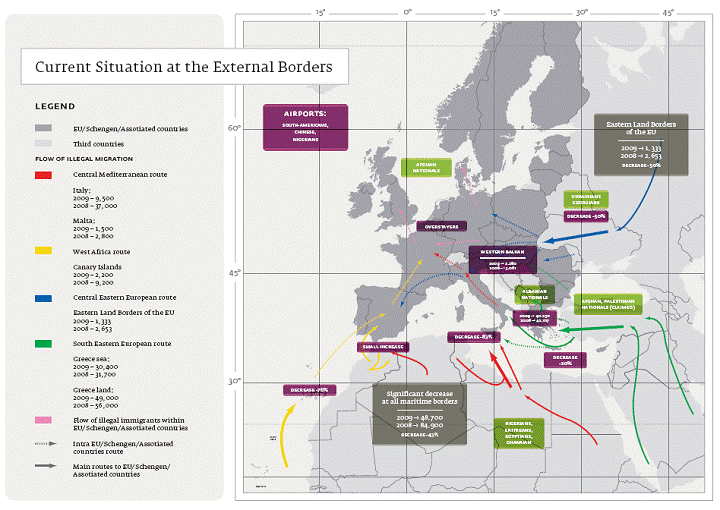
Frontex Map: 2009 Situation at External Borders

Frontex posted this map to its web site earlier this week.  The map “describes the … situation [as of the end of 2009] at the external borders of the EU, including the main entry routes of irregular migration into the European Union: West African route, via Canary islands, Central Mediterranean, including Italy and Malta, South Eastern European route (including Greek land and sea borders) as well as the Eastern land borders.”

Click here for link to the map.

1 Comment

Filed under Data / Stats, European Union, Frontex, News

Italy and Malta Question Need for Frontex Sea Patrols

Italy and Malta held a one day summit yesterday that focused on “Strategic Mediterranean” themes.  The two countries are calling for a reassessment of Frontex’s role in the Mediterranean, suggesting that Frontex may be best suited for repatriation operations and not for sea patrols.  Maltese Foreign Minister Tonio Borg said that even Italy questioned the need for ongoing Frontex missions fearing that such missions might upset the Italy-Libya migration agreement which has almost eliminated irregular migration from Libya.  A statement issued by the Italian Foreign Ministry described the Italy-Libya migration agreement as a model that is “exemplary for extension to other African countries.”

Malta also reaffirmed that it would not reconsider its decision not to host Frontex missions unless the Frontex rule addressing where intercepted migrants are to be taken is changed.

Click here and here for articles.

Click here for Italian Foreign Ministry statement.

1 Comment

Filed under Frontex, Italy, Libya, Malta, Mediterranean, News

Libya Confirms It Is Detaining “Pushed Back” Eritreans

Reuters reported that the Libyan Foreign Ministry confirmed there are approximately 400 Eritreans being held in detention centres in Libya and that 245 of these Eritreans were turned over to Libyan authorities after being intercepted at sea by Italian authorities.   Italian officials have previously questioned whether any of the Eritreans in question had been subjected to the Italian push-back practice.

Click here for article.

Leave a comment

Filed under Italy, Libya, Mediterranean, News

Libya May Allow Eritreans to Remain – Italy Claims Credit for Decision

Libya has reportedly agreed to allow approximately 400 Eritreans to remain in Libya, though they will not be given refugee protection as Libya is not a signatory to the Refugee Convention.

ANSAmed reported that Italian officials have claimed credit for Libya’s decision, though the Italians have questioned whether any of the Eritreans have been mistreated and whether any of the Eritreans were subjected to Italy’s push-back practice.  Italian Foreign Ministry Undersecretary Stefania Craxi stated that ”the Italian government never backed away from raising awareness with[] Libyan authorities on the topic of human rights.”  Craxi said ”it is thanks to the Italian government [that] the UNHCR activities in Tripoli have started again, albeit in an informal and conditioned way.”  Foreign Minister Franco Frattini said ”it is unbelievable that Brussels did not even make a press release.  [Italy] worked in silence, without proclamations, sadly with the total and absolute absence of Europe. We asked for a compromise, a mediation and the result came.”

While it is good if the Italian Government did indeed work to arrive at a temporary and imperfect solution for this particular group of Eritreans and it is good that the Italian ministers speak of respecting human rights in Libya, the Italians should be equally if not more concerned with the human rights implications of their push-back practice in the Mediterranean.

Click here for article.

Leave a comment

Filed under European Union, Italy, Libya, Mediterranean, News, UNHCR

Hammarberg Makes Urgent Request of Italy for Information on Eritreans in Libya

COE Human Rights Commissioner Thomas Hammarberg has made an urgent request to the Italian Government for information on alleged human rights violations of Eritrean migrants in Libya, including Eritreans who may have been among persons intercepted at sea by Italy and forcibly returned to Libya without being afforded an opportunity to seek international protection.

In a letter to the Italian Foreign Minister, Commissioner Hammarberg wrote “[g]iven the recent decision of the Libyan authorities to discontinue UNHCR’s activities in the country, it is increasingly difficult to confirm the exact accuracy of these reports. However, given their consistency and the seriousness of the allegations, I hope that I can count on your cooperation to urgently clarify the situation with the Libyan authorities and be kept informed about the results of your investigations.”

The Foreign Minister and Interior Minister have written a joint letter to the Il Foglio newspaper where they say that the Italian Government “was mediating with Tripoli to identify the Eritreans and try to find them employment in Libya so that they would not be forcibly repatriated.”  According to Reuters, the ministers also said “it was necessary to respect Libyan sovereignty and [they] called for an international approach, involving the United Nations and other organizations” and that the “fate of these Eritrean citizens cannot be resolved only through our bilateral relationship (with Libya).”

Click here for the Commissioner’s letter to the Italian Foreign Minister.

Click here for the Commissioner’s letter to the Italian Interior Minister.

Click here for article.

Click here (IT) for Italian Ministers’ Reply to Il Foglio.

Leave a comment

Filed under Commissioner for Human Rights, Italy, Libya, Mediterranean, News, UNHCR

EP Refers Frontex Sea Borders Rule to ECJ

On 23 June the JURI committee (Committee on Legal Affairs) voted in camera to refer the question of the validity of the Frontex rule regarding the surveillance of the sea external borders to the European Court of Justice (Council Decision 2010/252/EU (“Frontex / Sea borders”)).  The referral requests the Court “to preserve the effects of the measure until a new legislative act has been adopted.”

Maltese MEP Simon Busuttil, the EPP Coordinator in the Civil Liberties Committee, was quoted as saying: “we have given notice to the Commission that not all is fine with these Frontex guidelines and it is time for a rethink. We want to ensure that Parliament’s role is defended and that we can have our say. We want these rules to be fair. In their current version they are not.”

Both the LIBE and JURI committees believe that the European Commission exceeded its power when it presented the new Frontex rule under the comitology procedure as opposed to using the ordinary legislative procedure which would have given the Parliament the ability to amend the rule.  Malta has strongly objected to provisions within the rule.  Malta has said that its decision not to host Frontex’s Central Mediterranean enforcement operation this year, Operation Chronos, was due to the disembarkation provisions contained in the new Frontex rule.  Malta believes that the rule would require intercepted migrants to be taken to Malta.

Click here for article.

Click here for statement on MEP Simon Busuttil’s web site.

Click here for EPP Group press release.

Click here and here for earlier posts.

4 Comments

Filed under European Union, Frontex, Judicial, Malta, Mediterranean, News

Libya to Permit UNHCR to Resume Limited Activities

The UNHCR announced on Friday that it has received permission to resume some activities in Libya.  The UNHCR said that “its operations will be restricted to only its current caseload” in Libya.

Libyan officials have offered several reasons for why the Libyan government ordered UNHCR to cease operations several weeks ago, including complaints that UNHCR entered into cooperation agreements with local NGOs within Libya without authorisation, rented office space without permission, displayed the UNHCR logo improperly, and, most recently, that one or more persons associated with UNHCR accepted bribes and/or sexual favours from persons in exchange for refugee status.

“UNHCR spokesperson Adrian Edwards stressed that the Libyan allegations remain unsubstantiated. He told journalists in Geneva that talks on the agency’s future in the country will resume shortly and that the expulsion order has not yet been formally lifted. ‘UNHCR does take very seriously any accusation against any UNHCR staff member from whatever source,’ he said. ‘We have a zero tolerance policy for misconduct. We have asked the Libyan Government to substantiate these particular claims. If and when we receive these indications, we will be in a position to investigate through our normal procedures.’”

Click here for UN statement.

Click here, here, here (EN) and here (AR) for articles.

Leave a comment

Filed under Libya, Mediterranean, News, UNHCR

EU and ACP Fail to Reach Agreement on Migration in Revised Cotonou Agreement

Representatives of the EU and ACP (Africa, Caribbean, and Pacific group of states) signed the second revision to the Cotonou Agreement in Ouagadougou on 22 June.  The Agreement provides the basic framework for relations between the EU and ACP states.  The parties failed to reach agreement on revisions to Article 13, the migration provision.

The EU has been pressuring the ACP states to agree to changes in the Cotonou Agreement which would make it easier for EU member states to return illegal or irregular migrants from the EU to their home countries.  ACP states resisted incorporating such a provision in the Agreement, instead wanting to deal with readmission issues on a bi-lateral basis.

As a result of this ongoing disagreement, Article 13 of the Agreement will remain unchanged for the time being.  The EU and ACP instead agreed on a Joint Declaration (Declaration III) which was signed yesterday in conjunction with the revised Cotonou Agreement.  It reads as follows:

“JOINT DECLARATION ON MIGRATION AND DEVELOPMENT (ARTICLE 13)

The Parties agree to strengthen and deepen their dialogue and cooperation in the area of migration, building on the following three pillars of a comprehensive and balanced approach to migration:

1. Migration and Development, including issues relating to diasporas, brain drain and remittances;

2. Legal migration including admission, mobility and movement of skills and services; and

3. Illegal migration, including smuggling and trafficking of human beings and border management, as well as readmission.

Without prejudice to the current Article 13, the Parties undertake to work out the details of this enhanced cooperation in the area of migration.  They further agree to work towards the timely completion of this dialogue and to report about the progress made to the next ACP-EC Council.”

Click here for the full 2010 amendments to the Cotonou Agreement.

Click here for EU Council Press Release.

Click here for the Secretariat of the ACP States’ web page pertaining to the Cotonou Agreement.

Click here for the EU web page pertaining to the Cotonou Agreement.

Click here, here, and here for previous posts on the Migration provision of the Cotonou Agreement.

Leave a comment

Filed under Communiqués, European Union, News

La Tribune (Algérie): La Libye met l’Union européenne au pied du mur

“L’Europe, l’obsession sécuritaire et l’immigration utilitaire – … Les négociations entre l’UE et la Libye semblent suggérer que les Européens sont prêts à aller très loin dans la volonté de faire des Etats du Sud les gendarmes luttant contre l’immigration clandestine. En effet, pour signer un accord d’association comprenant le volet immigration, la Libye exige la fermeture pure et simple du bureau du Haut-Commissariat aux réfugiés (HCR), en plus de moyens financiers supplémentaires et du matériel de surveillance des frontières terrestres et maritimes qui viendront s’ajouter aux nombreux dispositifs de contrôle déjà financés par l’UE dans ce pays depuis le début des années 2000. La politique européenne sur l’immigration inclut également l’ouverture sur le sol libyen de «points d’accueil», qui permettraient aux réfugiés de déposer leur demande d’asile sans prendre le risque d’une traversée de la Méditerranée. Le commissaire en charge des questions d’asile et d’immigration, Jacques Barrot, s’était rendu sur place pour étudier la possibilité d’un tel dispositif…..”

Cliquez ici pour télécharger l’article.

Leave a comment

Filed under Algeria, European Union, Libya, Mediterranean, News

EUROSTAT: 2009 EU27 Asylum Statistics and Characteristics of Asylum Seekers

Excerpts from the EUROSTAT asylum statistics press release issued on 18 June 2010:

The EU27 Member States granted protection to 78 800 asylum seekers in 2009 compared with 75 100 in 2008.

The largest groups of beneficiaries of protection status in the EU27 were citizens of Somalia (13 400 persons or 17% of the total number of persons granted protection status), Iraq (13 100 or 17%) and Afghanistan (7 100 or 9%).

In 2009, 317 500 decisions on asylum applications were made in the EU27, of which 228 600 were first instance decisions and 88 900 final decisions on appeal. Decisions made at the first instance resulted in 61 700 persons being granted protection status, while a further 17 100 received protection status on appeal.

The rate of recognition of asylum applicants, i.e. the share of positive decisions in the total number of decisions, was 27% for first instance decisions and 19% for final decisions on appeal.

In 2009, the highest number of persons granted protection status was registered in the United Kingdom (12 500), followed by Germany (12 100), France (10 400), Sweden (9 100), Italy (8 600) and the Netherlands (8 100). These Member States accounted for more than three quarters of all those granted protection status in the EU27.

The rate of recognition varies considerably among Member States…. The highest rates of recognition in the first instance were recorded in Malta (66%), Slovakia (56%), Portugal (51%), the Netherlands and Denmark (both 48%), and the lowest in Greece (1%), Ireland (4%), Spain (8%), France (14%) and Slovenia (15%).

Somalis were the single largest group of persons granted protection status in the EU27.

[M]inors accounted for 60 500 of the applicants [in 2009], of which 12 200 were unaccompanied.

Click here for the EUROSTAT Asylum Statistics document.

Click here for EUROSTAT Characteristics of asylum seekers in Europe report.

Click here for EU Commissioner for Home Affairs Cecilia Malmström’s statement on the EUROSTAT reports.

Leave a comment

Filed under Data / Stats, European Union, News

Frontex: Collaboration With African Countries Contributed to Reduction in Irregular Migrants in 2009

Speaking at a press conference in Athens earlier this week, Gil Arias Fernandez, Frontex’s deputy executive director, credited the global recession as the key factor in 2009 for the reduced numbers of migrants seeking to enter the EU.  He also credited “good collaboration from the African countries where immigrants usually depart[,]” referring to measures taken by Libya, Mauritania and Senegal to prevent migrants from leaving the countries.

Click here and here for articles.

Click here and here for earlier posts on Frontex’s 2009 General Report.

Leave a comment

Filed under Data / Stats, European Union, Frontex, Libya, Mauritania, News, Senegal, Statements

More on Libya’s Decision to Expel UNHCR

Libya’s decision to expel the UNHCR from Libya was made public during the seventh round of Framework Agreement talks between the EU and Libya.  The talks concluded yesterday in Tripoli.  “[Libya’s Deputy Foreign Minister Mohammed Tahar] Sayala said the main stumbling blocks to progress were illegal immigration and the International Criminal Court (ICC), which Libya does not recognise.  [Sayala] said Libya wanted financing and equipment [from the EU] for the surveillance of its borders, both on land and sea.”

Amnesty International criticized the decision to expel the UNHCR and called on Libya to reverse the decision:

“[***] The move to expel the UNHCR came against the backdrop of the 7th round of negotiations, which started on 6 June in Tripoli, between Libya and the EU over a Framework Agreement, which addresses bilateral cooperation in the control of irregular migration, among other issues, including potential readmission agreements for third-country nationals, who have transited through Libya on their way to Europe. EU member states, most notably Italy, have been seeking Libya’s assistance in decreasing the flow of arrivals of asylum-seekers and migrants to European shores. The expulsion of the UNHCR further casts doubt on Libya’s commitment to respect its obligations under the Organization of African Unity Convention Governing the Specific Aspects of Refugee Problems in Africa. It also shows how essential it is to include effective human rights safeguards and adequate standards of protection in any bilateral agreements with Libya in the field of the control of migration. [***]”

The European Commission also expressed “concern” with Libya’s decision “but sees it as one more reason to engage in ‘dialogue’ with General Gaddafi’s country on immigration and asylum.”

And as noted by Michèle Morel on International Law Observer, even though Libya is not a signatory to the UN Refugee Convention, Libya is bound by customary international law which prohibits refoulement to countries where there is a risk of torture, “[t]herefore, while Libya itself has no asylum system for the examination of asylum seekers’ situations, refusing to allow UNHCR to carry out its activities in Libya would amount to a violation of international human rights law.”

Click here, here, here (EN), and here (AR) for articles.

Click here for Amnesty International’s statement.

Click here for link to ILO post.

3 Comments

Filed under European Union, Libya, Mediterranean, News, UNHCR