Category Archives: States

Is Morocco Allowing More Migrant Boat Departures in Protest of CJEU Judgment Finding EU-Morocco Fisheries Agreement Not Applicable to Western Sahara?

An article in Sunday’s Diario de Cadiz by Encarna Maldonado discusses a moderate but noticeable increase in the number of migrant boats reaching Spain from Morocco and the possibility that the Moroccan government may be relaxing its migration patrols to protest last month’s Court of Justice of the EU judgment in Council v Front Polisario, Case C-104/16 P, 21 Dec 2016, where the CJEU concluded that the agriculture and fisheries agreements the EU has with Morocco are not applicable to the Western Sahara because Western Sahara has a status that is separate and distinct from Morocco. Morocco previously suspended diplomatic relations with the EU over its disagreement with an earlier judgment in the case by the General Court.

From Diario de Cadiz: “The arrival of migrants in small boats in Andalusia grew considerably since the start of 2016, almost coinciding with the [General Court’s] first statement (December 2015) supporting the complaint of the Polisario Front against the trade agreement that, among other things, allows part of the Spanish fishing fleet to fish in Moroccan waters. Although surveillance and rescue boats Andalusia recorded the less last year than in 2015 (354 vs. 491), the number of people traveling in these boats increased by 81% from 3,369 to 6,109 migrants. The appeal to the Court of Justice of the European Union and especially the judgment, issued on December 21, has coincided with a new surge in small boats to the Andalusian coast….”

The article also notes that some experts question whether the surge is related directly to the CJEU judgment.

Click here for article. [ES]

1 Comment

Filed under CJEU, European Union, Judicial, Mediterranean, Morocco, News, Spain

MaltaToday: Italy withholding data on Mediterranean rescue operations from Frontex

An article from yesterday in MaltaToday by Jurgen Balzan reports that Italian authorities are not sharing information with Frontex regarding the number of migrants and asylum seekers rescued at sea in the Central Mediterranean and suggests that the withholding of information may be related to an effort to minimize public concerns over migration as Italy nears a vote next month on a constitutional referendum supported by PM Renzi.

From the article: “…Italian authorities are not sharing the data [regarding rescued migrants] with Frontex … and are keeping the number of people rescued under wraps. A Frontex spokesperson told MaltaToday that although the agency is actively participating in the rescue operations, the Italian authorities ‘are not sharing’ the data on how many people were rescued or how many people lost their lives last week.  Sources close to the Armed Forces of Malta said that Frontex normally holds and provides such data and ‘if they don’t have the numbers then information is being withheld by the Italians.’…”

Leave a comment

Filed under Data / Stats, Italy, Libya, Malta, Mediterranean, Migrants, News, Refugees

NATO Expands Aegean Sea Migrant Patrols Into Turkish and Greek Territorial Waters – Rescued Migrants to Be Automatically Returned to Turkey

NATO announced on Sunday, 6 March, that its Aegean Sea patrols have been expanded to Greek and Turkish territorial waters. NATO patrols have been operating only in international waters. And while NATO says its ‘mission is not to stop or turn back those trying to cross into Europe’, NATO has made it clear that NATO ships will return rescued migrants directly to Turkey: ‘In case of rescue at sea of persons coming via Turkey, they will be taken back to Turkey.’ NATO’s plan to summarily return intercepted migrants is consistent with previous statements made by the British and German defence ministers who have said that the purpose of the NATO mission is to stop migrants and return them to Turkey.

NATO’s characterisation of its operation seems to be an attempt to draw a distinction between a push-back practice where any migrant boat, regardless of whether it is in need of rescue, would be intercepted and pushed back and a search and rescue operation providing assistance to migrant boats in need of rescue. This is meaningless distinction given the current situation in the Aegean where every migrant boat is in need of assistance or rescue.

NATO ships are subject to the same rescue at sea obligations imposed by the SOLAS and SAR Conventions as all other ships and are obligated to disembark rescued persons in a ‘place of safety.’ And while disembarking in Turkey is safer than disembarking in Syria or Libya, there are serious questions as to whether Turkey is a place of safety. See the recent Q&A issued by Human Rights Watch concluding that Turkey is not a ‘safe third country’ as defined by EU law. While the question of a ‘place of safety’ under the SAR Convention is not identical to the ‘safe third country’ question under EU law, the fact remains that rescued migrants should not in all cases be automatically returned to Turkey without adequate screening and processing. The failure to screen rescued migrants is a clear violation of the non-refoulement obligations of the individual EU and non-EU States operating under the NATO command.

1 Comment

Filed under Aegean Sea, European Union, Frontex, General, Greece, News, Turkey

EUNAVFOR MED-Six Month Report: No Indication of Refugee Protection Plan for EU Operations within Libyan Territorial Waters and No Reports of Human Trafficking

There is a lot of information in the EUNAVFOR MED Operation SOPHIA Six Month Report   (also here: EEAS-2016-126) that was released last week by WikiLeaks, but there are two subjects not discussed which jumped out at me.

No Discussion of Refugee Protection Plan

First, the Report does not contain information regarding what the EU military force intends to do with migrants who are intercepted or rescued by EU vessels if and when EUNAVFOR MED patrols begin to operate within Libyan territorial waters.

The Report’s ‘Next Steps and Key Challenges’ section [pp 19-21] discusses different EU contingency plans for Phase 2B of the operation and specifically discusses how suspected smugglers arrested by EU forces within Libyan territorial waters would be handled. The Report says suspected smugglers should not be turned over by EU forces to Libyan officials for criminal prosecution unless it can be ensured ‘that they [will be] treated in accordance with human rights standards that are acceptable to the EU and Member States.’ According to the Report, forty-six suspected smugglers have been arrested by EUNAVFOR MED in international waters (between 22 June and 31 December 2015) and all of these individuals have been turned over to Italian authorities for prosecution by Italy’s DNAA – Direzione Nazionale Antimafia ed Antiterrorismo. Italy is so far the only EU Member State prosecuting suspected smugglers.

But unlike the discussion regarding the treatment of suspected smugglers, there is no discussion in the Report about where migrants who are intercepted or rescued in Libyan territorial waters will be taken or how they will be processed. It is certainly possible that intercepted migrants would continue to be taken from Libyan territorial waters to Italy, as is currently the case with operations on the high seas, but I suspect this may not be the plan once EUNAVFOR MED operations are expanded to Libyan territorial waters.

The fact that there is no discussion in the Report of where intercepted migrants will be taken does not mean that EUNAVFOR MED does not have appropriate plans in place, but the omission is troubling because the Report makes clear that once Phase 2B (territorial waters) operations begin, EUNAVFOR MED forces will be interacting and cooperating with the Libyan Navy and Coastguard. (The Report also notes that if requested and if its mandate is amended, EUNAVFOR MED is ready to begin quickly providing capability and capacity building to the Libyan Navy and Coastguard.)

EUNAVFOR MED’s interaction with Libyan forces in territorial waters would, according to the Report, initially include Libyan ‘cooperation in tackling the irregular migration issue’, with the expectation that at a later point in time ‘Libyan authorities could take the lead in patrolling and securing their Territorial Waters, with support being provided by EUNAVFOR Med.’ The Report therefore describes a changing scenario where EU forces would first act alone in Libyan territorial waters, which would lead to some level of cooperation with Libyan authorities (joint patrols? shipriders?), which would finally lead to Libyan authorities taking the lead on enforcement activities, with the EU playing a supporting role of some sort.

The legality of the Phase 2B operations will depend on the details of how intercepted or rescued migrants are processed and where they are taken. EU Member States operating within EUNAVFOR MED would necessarily be exercising effective control over migrants when operating unilaterally or jointly with Libyan forces within Libyan territorial waters and EU Member States would therefore be bound by the non-refoulement obligations in the ECHR, the Refugee Convention, the CAT, and the ICCPR. Any such operations would be subject to the 2012 Hirsi Jamaa v Italy judgment of the ECtHR which rejected Italy’s past push-back practices and close cooperation with the pre-Arab Spring Libya, finding the push-back practices to violate the ECHR’s prohibition on non-refoulement and to constitute collective expulsion.

EUNAVFOR MED’s Phase 2B operation seeks to replicate what Frontex and Spain have done off the coasts of Mauritania, Senegal and Morocco since 2006 pursuant to Joint Operation HERA where Spain and Frontex initially deployed naval patrols in international waters, then negotiated bilateral agreements to move patrols to territorial waters, deployed joint patrols and shipriders within territorial waters, and then continued to provide various forms of support to Mauritania and other West African states to patrol their own territorial waters. Operation HERA succeeded in stopping most boat migration from West Africa, but did so in a manner which did not provide any process to screen intercepted migrants for claims for international protection and subjected intercepted migrants to refoulement.

In order to ensure that non-refoulement obligations are respected and that rights of migrants are otherwise protected, as the EU and EUNAVFOR MED move towards implementation of Phase 2B operations within Libyan territorial waters, more information and transparency is needed to determine and monitor the legality of all aspects of the operations.

No Reports of Human Trafficking

The second perhaps less significant piece of information that jumped out at me as I read the Report was the lack of any suggestion that EUNAVFOR MED patrols have discovered evidence of human trafficking. The Report makes multiple references to trafficking, but always in conjunction with human smuggling, eg, ‘smuggler and traffickers’ business model’, ‘smuggler and trafficker vessels’. The use of the trafficking term seems to be a continuation of the use of imprecise terminology (and possible ongoing confusion over the differences between human trafficking and smuggling as well?). But the Report’s ‘Smugglers’ Business Model’ section [pp 6-8] is clearly only discussing acts of smuggling.

4 Comments

Filed under Analysis, European Court of Human Rights, European Union, Frontex, Italy, Libya, Mediterranean, Refugees, Reports, UN Security Council, UNHCR

WikiLeaks Releases Restricted Document: EUNAVFOR MED Operation SOPHIA Six Monthly Report

WikiLeaks yesterday released the ‘EUNAVFOR MED Op SOPHIA – Six Monthly Report’. (Also available here: EEAS-2016-126.) The 22 page document is classified as EU RESTRICTED and provides a detailed description of EUNAVFOR MED’s operations during the period 22 June-31 December 2015 and discusses the next steps for the operation, including the move to Phase 2B which would entail operations within Libyan territorial waters. The operation currently operates outside of Libyan territorial waters consistent with UN Security Council Resolution 2259 (2015). The report is signed by Rear Admiral Enrico CREDENDINO, EUNAVFOR MED Op SOPHIA Operation Commander.

Here are some selected excerpts from the report:

Smugglers’ Business Model –

…Wooden boats are mainly used for migrant smuggling to the west of Tripoli, and rubber boats are more common to the east of Tripoli. Wooden boats are more valuable than rubber dinghies because they can carry more people, hence more profit for smugglers and are more resilient to bad weather and can be re-used if recovered by smugglers. However, following operation SOPHIA entering into Phase 2A (High Seas), smugglers can no longer recover smuggling vessels on the High seas, effectively rendering them a less economic option for the smuggling business and thereby hampering it.

Inflatable boats are used in two thirds of the cases and wooden boats in one third of the cases. According to intelligence sources, the wooden boats used are purchased from Libyan fishermen or imported from Tunisia and Egypt. EUNAVFOR MED are monitoring, within capabilities, the supply routes for these, but no detection has been obtained to confirm beyond any reasonable doubt this supply method.

Reports of rubber boast being imported from China and transhipped in Malta and Turkey are supported by a recent interception by Maltese customs of 20 packaged rubber boats in a container destined for Misratah, Libya. As there are no legal grounds for holding such shipments, it was released for delivery to the destination….

Legal Basis for Phase 2A – High Seas –

…The legal basis applicable to phase 2A (High Seas) relies on the international law applicable to the Operation (UN Convention on the Law of the Sea, Palermo protocol against the smuggling of migrants by land and sea) and on individual Member States’ application of the EU mandate through domestic legislation to board, seize and divert vessels and to detain suspected smugglers and traffickers. The adoption of UNSCR 2240 (2015) by the UN Security Council on 9 October, reinforces the legal framework applicable to EUNAVFOR MED activities in international waters. The resolution now provides the legal basis for all Member States to undertake these activities against suspected smugglers and traffickers coming from Libya….

Cooperation with International Organisations –

…In particular we have embedded the training initially provided by UNHCR on migrant handling and international law and this is now a core part of the inchop [command zone] package for new units joining the operation. We are further building on this training with input from UNICEF….

Campaign Assessment –

…Entry into Libyan Territorial Waters will undoubtedly allow us to achieve further success as we get towards the heart of [smuggler and trafficker] networks….

…From a military perspective, EUNAVFOR MED is ready to proceed to Phase 2B (Territorial Waters), though the political and legal challenges ahead remain a significant challenge….

…Transition from phase 2A to 2B [Libyan Territorial Waters] will require for a number of significant challenges to be resolved before I can actually recommend the transition.

Next Steps and Key Challenges-

From a military perspective, and to be more effective against the smugglers’ business model, I need to move to phase 2B (Territorial Waters) as soon as possible. However there are a number of key issues that need to be addressed. These are:

The Legal Finish.

As we will be operating in Libyan Territorial Waters, the current legal finish, of prosecuting suspected smugglers in Italy will not apply. We will therefore need a new legal basis; either an agreement with the Libyan authorities that they will waive their right to prosecute suspected smugglers in Libya and allow them to be prosecuted by another Member State, or to have a transfer agreement in place for apprehended smugglers to be transferred to the Libyan authorities for prosecution. Both options have specific challenges end rely on the consent of the Libyan authorities. If we were to transfer suspected persons to the Libyan authorities, we would need to ensure that they are treated in accordance with human rights standards that are acceptable to the EU and Member States….

…Regardless of the challenges with both options, we are working very closely with the EEAS to come to a workable solution. It is however clear that regardless of the solution taken, the Libyan authorities are fundamental in making this happen, either by providing the agreement to prosecute in another country, or to agree to prosecute in Libya through a judicial system which meets those standards required by the EU. I want to underline the fact that this issue must be solved before we can move to phase 2 Bravo. Without the required legal finish we will be compelled to release suspected smugglers apprehended in Libyan Territorial Waters, with a subsequent loss of credibility for the operation in the media and EU public opinion.

Legal mandate – UNSCR and Libyan Invitation.

In order to move to phase 2 in Libyan territorial waters, we need firstly an invitation from the GNA, as the sole legitimate Government of Libya under UNSCR 2259(2015), and secondly a UN Security Council Resolution to provide the necessary legal mandate to operate. Whilst the transition to phase 2 in Libyan TTW with only a UNSCR without an invitation from the Libyan authorities is theoretically possible, it is unlikely that the UNSCR would be adopted as Russia and China have previously stated that a Libyan invitation would be required by them so as not to block the resolution….

Capacity and Capability Building –

As we move into Territorial Waters, our interaction with the Libyan Navy and Coastguard will increase and we will need to gain confidence in their activities. The capability and capacity of the Libyan Coastguard to protect their borders needs to be developed and therefore preventing illegal migration from Libyan shores, so that we can reach the end state of the mission where illegal migration is at a manageable level without the need for EUNAVFOR Med. This will have to be shaped with Libyan authorities to match their expectations and could benefit from cooperation with other EU missions….

Full document is here or click on this link EEAS-2016-126.

Leave a comment

Filed under European Union, Frontex, Italy, Libya, Malta, Mediterranean, Migrants, Reports, UN Security Council, UNHCR

UN Security Council to Vote Today, 8 October, on Resolution Authorising EU to Inspect and Seize Vessels on High Seas Suspected of Engaging in Smuggling or Trafficking of Persons

From What’s in Blue: The Security Council “is expected to vote [on 8 Oct. 2015] on a resolution aimed at disrupting human trafficking and the smuggling of migrants on the high seas off the coast of Libya. …

The draft resolution authorises member states, acting nationally or through regional organisations, to inspect vessels on the high seas off the coast of Libya that they have reasonable grounds to suspect are being used for migrant smuggling or human trafficking. Furthermore, the draft authorises member states to seize vessels if there is confirmation that they are being used for migrant smuggling or human trafficking from Libya. These authorisations are for a period of one year from the date of the adoption, and the draft stresses how these are given in exceptional and specific circumstances. …

It seems that the two most divisive issues during negotiations related to references to Chapter VII and the use of force. Several Council members, including Chad, Russia and Venezuela, raised concerns over the implications of having a Chapter VII resolution with a broad mandate. Following bilateral negotiations, the draft to be voted on is under Chapter VII but states that this is specifically to put an end to the recent ‘proliferation of, and endangerment of lives by, the smuggling of migrants and trafficking of persons in the Mediterranean sea off the coast of Libya’. …

In relation to the use of force, one of the difficulties was defining the instances in which member states are authorised to use force. The initial draft circulated by the UK included an authorisation to use ‘all necessary measures’ in confronting migrant smugglers or human traffickers. Some Council members wanted further guarantees that this was not a blanket mandate to use force. As a result of the members’ concerns compromise language was added to authorise member states to use ‘all measures commensurate to the specific circumstances’ in confronting them. …

While Council negotiations were put on hold during the high-level debate of the UN General Assembly, amendments were made to the draft in order to secure the consent of the Libyan permanent mission to the UN. …

Some Council members stressed the need to respect international refugee law, as well as the protection of the rights of migrants and asylum seekers. The draft underscores that it is not intended to undermine the human rights of individuals or prevent them from seeking protection under international human rights law and international refugee law.

The resolution is expected to provide legal backing for the EU NAVFOR MED’s operation in the high seas (which was renamed Operation Sophia on 28 September). … Council negotiations over a draft resolution authorising such an operation earlier this year (April-May) were put on hold following difficulties getting consent from Libyan authorities to operate in the territorial waters of Libya and its shore. Following the humanitarian crisis in the Mediterranean this summer, EU Council members decided to narrow the scope of the resolution to vessels operating on the high seas off the coast of Libya. A subsequent phase of the deployment of the operation in the territorial waters and on the shore of Libya is likely to be contingent upon the formation of a government of national accord in Libya.”

Full text of What’s in Blue article here.

1 Comment

Filed under European Union, Frontex, Italy, Libya, Mediterranean, News, UN Security Council, United Nations

ECtHR: Italy’s Use of Summary Procedures to Return Tunisian Migrants Constituted Unlawful Collective Expulsion

The ECtHR, Second Section, issued a judgment on 1 September in Khlaifia et autres c. Italie (Requête no 16483/12) (official judgment in French) finding that the summary procedures used by Italy in 2011 to quickly return thousands of Tunisians who were reaching Italy by sea during the height of the Arab Spring violated the prohibition of collective expulsion of aliens contained in Art. 4 of Protocol 4 of the ECHR. (Judges SAJÓ and VUĊINIĊ did not find that collective expulsion had occurred and filed a dissenting opinion.) The Court also found violations of Art. 3, Art. 5, §§ 1, 2, 5, and Art. 13 (inhuman or degrading treatment, failure to promptly explain basis for detention, inability to challenge detention, lack of an effective remedy).

This is the fifth time that the ECtHR has found a violation of the collective expulsion prohibition. (See Čonka v. Belgium, no. 51564/99, § 62-63, ECHR 2002‑I; Georgia v. Russia (I) [GC], no. 13255/07, § 175, ECHR 2014;  Hirsi Jamaa and Others v. Italy [GC], no. 27765/09, § 185, ECHR 2012; Sharifi and Others v. Italy and Greece, no. 16643/09, 21 October 2014.)

The Court acknowledged that unlike the applicants in Hirsi Jamaa, the Tunisian applicants in Khlaifia had been subjected to individualized identification and processing by Italian authorities, but under the circumstances the Court did not consider an identification procedure standing alone to be sufficient:

“156. [T]he Court is of the opinion that the mere implementation of an identification procedure is not sufficient to exclude the existence of collective expulsion. … [T]he expulsion orders did not contain any reference to the personal circumstances of the affected persons; the Government did not produce any document that could prove that individual interviews regarding the specific situation of each applicant would have occurred before the adoption of these [expulsion] orders; many people of the same origin experienced, at the time of the incriminating facts, the same fate as the applicants; [Italy’s] bilateral agreements with Tunisia … have not been made public and provided for the repatriation of irregular Tunisian migrants through simplified procedures, based on the simple identification of the person concerned by Tunisian consular authorities.”

The procedures at issue occurred during the 2011 Arab Spring when North Africa and the EU experienced significant movements of migrants and refugees. The Court took note of these exceptional circumstances but made clear that such circumstances do not excuse a state from complying with its obligations under the ECHR.  (See paras 127-128.)

The Court’s judgment should serve as a caution to the European Commission, EASO, Frontex, and EU member states as they consider new streamlined procedures to process the refugees and migrants reaching Europe; procedures must provide for meaningful individualized processing and individuals must be afforded a meaningful opportunity to challenge an expulsion order, among other requirements. The dissenting opinion of Judges SAJÓ AND VUĊINIĊ (in English), concluding that there had not been a collective expulsion, is well reasoned and reviews the history of the collective expulsion prohibition.

This is an excerpt from the Court’s judgment. The official version is only available in French, the English translation is mine:

“2. Appréciation de la Cour
2. Findings of the Court

153. La Cour observe qu’en l’espèce les requérants ont fait l’objet de décrets de refoulement individuels. Ces derniers étaient cependant rédigés dans des termes identiques, les seules différences étant les données personnelles des destinataires.

153. The Court observes that in this case the applicants were the subject of individual expulsion orders. They were, however, drafted in identical terms, the only differences being the personal information of the recipients.

154. La Cour a déjà précisé que le fait que plusieurs étrangers fassent l’objet de décisions semblables ne permet pas en soi de conclure à l’existence d’une expulsion collective lorsque chaque intéressé a pu individuellement exposer devant les autorités compétentes les arguments qui s’opposaient à son expulsion. La Cour a également jugé qu’il n’y a pas violation de l’article 4 du Protocole no 4 si l’absence de décision individuelle d’éloignement est la conséquence du comportement fautif des personnes intéressées (Hirsi Jamaa et autres, précité, § 184).

154. The Court has already held that the fact that multiple foreigners are subject to similar decisions does not in itself lead to the conclusion that there was collective expulsion when each person was individually able to present arguments against expulsion to competent authorities. The Court has also held that there is no violation of Article 4 of Protocol No. 4 if the absence of individual expulsion decisions is due to the wrongful conduct of the affected persons (Hirsi Jamaa and Others, cited above, § 184).

155. La Cour relève de surcroît qu’à la différence de l’affaire Hirsi Jamaa et autres (précité, § 185), en l’espèce, à l’instar des autres migrants débarqués sur l’île de Lampedusa en septembre 2011, les requérants ont fait l’objet d’une procédure d’identification. Le Gouvernement le souligne à juste titre (paragraphe 152 ci-dessus). Les requérants reconnaissent par ailleurs qu’immédiatement après leur débarquement à Lampedusa, les autorités de frontière italiennes ont enregistré leur identité et relevé leurs empreintes (paragraphe 149 ci dessus).

155. The Court further notes that, unlike the case of Hirsi Jamaa and Others (cited above, § 185), in this case, like the other migrants who landed on Lampedusa in September 2011, the applicants were the subject of an identification procedure. The Government rightly points this out (paragraph 152 above). The applicants also recognize that immediately after landing in Lampedusa, the Italian border authorities registered their identity and took their fingerprints (paragraph 149 above).

156. La Cour est cependant d’avis que la simple mise en place d’une procédure d’identification ne suffit pas à exclure l’existence d’une expulsion collective. Elle estime de surcroît que plusieurs éléments amènent à estimer qu’en l’espèce l’expulsion critiquée avait bien un caractère collectif. En particulier, les décrets de refoulement ne contiennent aucune référence à la situation personnelle des intéressés ; le Gouvernement n’a produit aucun document susceptible de prouver que des entretiens individuels portant sur la situation spécifique de chaque requérant auraient eu lieu avant l’adoption de ces décrets ; un grand nombre de personnes de même origine a connu, à l’époque des faits incriminés, le même sort des requérants ; les accords bilatéraux avec la Tunisie (paragraphes 28-30 ci dessus) n’ont pas été rendus publics et prévoyaient le rapatriement des migrants irréguliers tunisiens par le biais de procédures simplifiées, sur la base de la simple identification de la personne concernée de la part des autorités consulaires tunisiennes.

156. However, the Court is of the opinion that the mere implementation of an identification procedure is not sufficient to exclude the existence of collective expulsion. It considers moreover that several factors lead to the consideration in this case that the expulsion at issue was indeed of a collective nature. In particular, the expulsion orders did not contain any reference to the personal circumstances of the affected persons; the Government did not produce any document that could prove that individual interviews regarding the specific situation of each applicant would have occurred before the adoption of these orders; many people of the same origin experienced, at the time of the incriminating facts, the same fate as the applicants; the bilateral agreements with Tunisia (see paragraphs 28-30 above) have not been made public and provided for the repatriation of irregular Tunisian migrants through simplified procedures, based on the simple identification of the person concerned by Tunisian consular authorities.

157. Cela suffit à la Cour pour exclure l’existence de garanties suffisantes d’une prise en compte réelle et différenciée de la situation individuelle de chacune des personnes concernées (voir, mutatis mutandis, Čonka, précité, §§ 61-63).

157. This is sufficient for the Court to rule out the existence of sufficient guarantees of a genuine and differentiated consideration of the individual circumstances of the persons involved (see, mutatis mutandis, Čonka, cited above, §§ 61-63).

158. Au vu de ce qui précède, la Cour conclut que l’éloignement des requérants a revêtu un caractère collectif contraire à l’article 4 du Protocole no 4. Partant, il y a eu violation de cette disposition.

158. In view of the foregoing, the Court concludes that the expulsion of the applicants took on a collective character contrary to Article 4 of Protocol No. 4. Accordingly, there has been a violation of this provision.
[***]”
 

1 Comment

Filed under European Union, Frontex, Italy, Judicial, Tunisia

Efforts to Secure Security Council Resolution on EU Migrant Plan “Paused”

From ANSA: “Preparation of a draft UN Security Council resolution to authorize a European mission against migrant traffickers in the Mediterranean ‘has been suspended until the issue of the consent of the Libyan authorities has been resolved,’ a diplomat of the UN Security Council told ANSA on Wednesday. … However, the same source said that ‘regarding implementation, cooperation is necessary from all parties in the country’; and the Libyan government [in Tobruk] can not give authorization because it does not control the whole territory.”

From Reuters: “A senior U.N. diplomat said drafting of the resolution had been ‘paused’ until it was ‘clear there will be Libyan consent’. … [A] senior U.N. diplomat said that legally a letter from a representative of the internationally-recognised Libyan government was needed to authorise the EU mission, but that to ensure successful implementation of the operation ‘cooperation with a wide variety of authorities’ would also be required.”

From Libya Herald: “[Libyan Foreign Minister Mohamed Dairi (Tobruk)] went on the record today [in Brussels] saying that while Libya was interested ‘in cooperation with Europe in order to address the growing terrorism inside the country as well as in order to address the problem of illegal immigration’, it would not approve any military operation.”

Leave a comment

Filed under European Union, Libya, Mediterranean, United Nations

Libyan UN Ambassador to Oppose Security Council Resolution on EU Migrant Plan

AFP reports that Libyan UN Ambassador Ibrahim Dabbashi (representing the internationally recognised Tobruk government) will refuse to consent to a UNSC Resolution authorizing the EU to use military force against smugglers in Libya “as long as European governments were discussing the plan with Libyan militias that control coastal territory.” Dabbashi said that “[t]he position of Libya is clear: as long as the European Union and some other countries are not dealing with the legitimate government as the sole representative of the Libyan people, they will not get any consent on our part.” According to the AFP report, “Security Council diplomats privately said the European effort to present a resolution on the migrant crisis had hit a wall over Libya’s refusal to give its approval. European governments had instructed their diplomats mostly based in Tunis to reach out to various Libyan factions to try to get them onboard the plan before formally presenting the draft resolution at the Security Council.” According to the Security Council Report, “[f]or at least one permanent [Security Council] member the consent of the Tobruk/al-Bayda-based government seems to be indispensable for the adoption of the resolution.”

2 Comments

Filed under European Union, Libya, Mediterranean, United Nations

Security Council Negotiations Regarding EU Call for Use of Force Against Smugglers Ongoing; Russia Warns Against Repeating “Abuse” of 2011 UNSC Resolution

The Security Council Report reports that “[t]he negotiations on the EU draft aimed at tackling the smuggling of migrants on the Mediterranean were still ongoing at press time between some Council members and the Libyan authorities. (For at least one permanent member the consent of the Tobruk/al-Bayda-based government seems to be indispensable for the adoption of the resolution.) In the past, it has been difficult to get agreement on resolutions authorising the interception of vessels, whether in the context of the implementation of sanctions or counter-piracy measures. Some Council members feel strongly about not contravening the principle of freedom of navigation codified in the UN Convention on the Law of the Sea. As such, they have tended to focus their discussions in the past on such issues as the procedures to authorise interdiction, whether the consent of the flag state is required and the maritime zones where the interdiction is authorised to happen. In the informal interactive dialogue with Mogherini, some Council members inquired about the potential impact that requesting consent from Libya could have on the political process. The UK is the penholder on Libya.”

Reuters and Interfax reported that Russian Foreign Minister Sergey Lavrov said any resolution would have to describe “in the most minute detail the mandate of [an EU military] mission under [UN Charter] Chapter 7.” “‘The mandate of such an operation will have to be spelled out to the last detail because we do not want the ambiguity, which became a source of flagrant violations of the known resolution on Libya adopted in 2011, to repeat itself.’ … Lavrov said discussions in the Security Council on the new resolution against human traffickers were on hold as the EU was in talks with the internationally-recognized Libyan authorities sitting in Tobruk to work out necessary details. ‘As we have been told, European Union representatives are holding consultations with the lawful Libyan authorities recognized by the UN, these are the authorities seated in Tobruk, where the Chamber of Deputies and the government are operating’.”

1 Comment

Filed under European Union, Libya, Mediterranean, News, United Nations

20 May – Informal Meeting between Members of UN Security Council and EU Political and Security Committee

From “What’s In Blue”: On 20 May, “members of the Security Council will hold an informal meeting with members of the EU Political and Security Committee (PSC). Since this is an informal meeting, it will not be held in the Security Council chamber and is not on the official programme of work of the Council. The meeting was requested by the EU and will be hosted by Lithuania, the current president of the Council, at the premises of the EU Delegation to the UN. The mutually agreed agenda for the meeting includes EU-UN peacekeeping cooperation in Africa, Libya and Ukraine.”

Among the topics that will be discussed is the proposed EU military operation in Libya:

“Libya/Migrant Smuggling – On this … issue, Council members are also expected to discuss with the members of the EU PSC the details of the EU military operation (EU NAVFOR Med) the EU decided to establish on 18 May to break the business model of the smuggling of migrants. Briefing the Council on 11 May, Mogherini presented proposals for the EU strategy to tackle the flow of migrants towards Europe. As part of this strategy, Mogherini discussed the plans for an EU military operation that would be authorised under Chapter VII to inspect, seize and dispose of vessels when there are grounds to believe that they are participating in the smuggling of migrants. Negotiations are ongoing among EU members of the Council (France, Lithuania, Spain and the UK) and China, Russia and the US on a draft resolution to authorise the EU operation. Council members are likely to be interested in the details that the EU PSC ambassadors can provide on this proposed operation, and what they are seeking from the Council, including on the appropriateness of this response to tackle this phenomenon, the protections foreseen in accordance with international refugee law, the issues associated with consent from the Libyan authorities, the geographical scope of the resolution, and consent by the flag states regarding interdictions.”

Leave a comment

Filed under European Union, Libya, Mediterranean, News, United Nations

Statewatch Analysis: The EU’s Planned War on Smugglers

Statewatch has issued an Analysis, “The EU’s Planned War on Smugglers,” written by Steve Peers, Professor of EU Law, University of Essex:

“The EU’s Foreign Affairs Council is meeting today to discuss the possibility of a military operation in the Mediterranean to take actions against smuggling of migrants. Officially, at least, the purpose of the operation (as defined by EU leaders last month) is to destroy smugglers’ boats. The EU’s High Representative has stated that there will be ‘no boots on the ground’; and as she arrived at the Council meeting today, she referred to authorising an ‘EU operation at sea’. However, it is clear from the documents discussed in the EU’s Political and Security Committee last week that (unless plans have changed radically in the meantime) the High Representative is being “economical with the truth”. The EU action clearly contemplates action by ground forces. Moreover, it anticipates the possible loss of life not only of smugglers but also of Member States’ forces and refugees. In effect, the EU is planning to declare war on migrant smugglers – without thinking through the consequences. [***]”

1 Comment

Filed under Analysis, European Union, Frontex, Libya, Mediterranean

UN’s Sutherland calls on EU “not to put any refugees or migrants in the line of fire.”

Peter Sutherland, Special Representative of the UN Secretary-General for International Migration and Development in a statement welcomed the European Commission’s “European Agenda on Migration” but “urge[d] [EU] Member States not to put any refugees or migrants in the line of fire, and to design any [anti-smuggling] operation in complete conformity with international law.” Sutherland urged the EU to take steps to ensure that Frontex Operations Triton and Poseidon “are at least equal in effect to Mare Nostrum” and “to make search-and-rescue the top priority…”

Leave a comment

Filed under European Union, Frontex, Libya, Mediterranean, Statements, United Nations

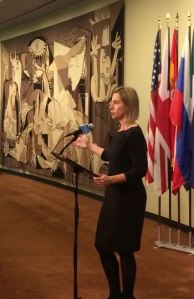
HR/VP Federica Mogherini’s remarks at the UN Security Council, 11 May 2015

HR/VP Mogherini’s remarks earlier today to the Security Council contained very few details on the EU proposal to engage in “systematic efforts to identify, capture and destroy vessels before they are used by traffickers in accordance with international law.” Here is one excerpt from her remarks: Mogherini at UNSC

“[M]y presence here at the Security Council today is so important for us. We have in these weeks prepared for a possible naval operation in the framework of the European Union Common Security and Defence Policy. The mandate of this operation is currently being elaborated with the EU Member States in Brussels, and will be discussed by the meeting of the EU Foreign Affairs Council, in a week from now, in exactly a week from now on 18 May, with a possibility of taking decisions, the first decisions already. We want to work with the United Nations, in particular with the UNSC. …”

Full text here.

2 Comments

Filed under European Union, Frontex, Libya, Mediterranean, Statements, United Nations

UN Security Council, 11 May, Briefing and Informal Interactive Dialogue on the Smuggling of Migrants in the Mediterranean

Full text from “What’s in Blue” (published by Security Council Report):

“On Monday (11 May) the [Security] Council will receive a briefing by Federica Mogherini, the EU High Representative for Foreign Affairs and Security Policy, on the EU response to the smuggling of migrants in the Mediterranean Sea. After the briefing, Council members are expected to hold an informal interactive dialogue with her. At the request of Chad, the permanent observer of the AU to the UN, Ambassador Tete António, will also participate in these meetings.

This briefing comes after the 19 April incident in which more than 700 migrants drowned when the overcrowded boat on which they were traveling sank near Libya. According to the [International] Organization for Migration, more than 1,700 migrants have drowned since the beginning of January in the Mediterranean Sea. In a 21 April press statement, Council members expressed grave concern at the smuggling of migrants off the coast of Libya, highlighting the implications for regional stability. On 22 April, at the request of the UK, Council members exchanged views on this issue under ‘any other business”’

Mogherini is expected to brief Council members on the integrated strategy by the EU to address the smuggling of migrants in the Mediterranean Sea. The strategy includes the provision of bilateral development assistance to countries on the southern and eastern Mediterranean basin—as well as to countries of origin and transit—while tripling the financial resources available to operations Triton and Poseidon, currently existing in the territorial waters of EU member states. In a 20 April joint meeting of EU foreign and interior Ministers, chaired by Mogherini, the Home Affairs and Citizenship Commissioner Dimitris Avramopoulos of Greece presented a plan to respond to migrant smuggling in the Mediterranean, which would entail a systematic effort to capture and destroy vessels used by the smugglers, inspired by the EU Atalanta Operation deployed to fight against piracy off the coast of Somalia. The plan was endorsed in a 23 April meeting of the EU Council, and negotiations are ongoing at the EU to agree on the Crisis Management Concept, which is the basis for operational planning and conduct of any EU mission.

Since that meeting, discussions among EU members of the Council (France, Lithuania, Spain, and the UK) and Italy on a draft resolution apparently authorising such an operation have been ongoing. It seems some permanent members have been able to provide inputs. It appears the idea is for a Chapter VII resolution that will authorise an EU operation to use all necessary measures to inspect, seize and dispose of vessels when there are grounds to believe that they are participating in the smuggling of migrants. The draft may be circulated to the wider membership of the Council in the coming days.

Although most Council members have not seen the draft text, they are aware of some of its elements and are expected to seek information that might feed into any negotiations of the draft. Council members are likely to want to know more about the expected geographical scope of the resolution (whether this includes the high seas, the territorial waters of Libya or even its shore) and whether the EU is seeking Libya’s consent. In this context, Council members might inquire about Mogherini’s recent conversations in Tunisia with Libyan political actors, and the potential impact of such an operation on the political process. Some Council members might be worried that asking for the consent of the Tobruk-based government could negatively impact the talks, which are aimed at the formation of a government of national unity.

Some Council members may echo concerns regarding the protection of human rights and international refugee law that have been raised by the Secretary-General as well as the UN High Commissioners for Human Rights and Refugees. In particular, they might ask about the fate of the migrants taken into custody, and note the importance of respecting the guarantees of international law, notably the 1951 Refugee Convention and the principle of non-refoulement. When the programme of work was adopted, a briefing by the High Commissioner for Refugees, along with the head of the UN Office on Drugs and Crime, was being considered for some point in May. Some Council members may have expected these briefings to happen before engaging in discussions about the regional responses to the smuggling of migrants; however, at press time, it was unclear if and when they will be held.

In the past, it has been difficult to get agreement on resolutions authorising the interception of vessels, whether in the context of the implementation of sanctions or counter-piracy measures. Some Council members feel strongly about not contravening the freedom of navigation principle codified in the UN Convention on the Law of the Sea. As such, they have tended to focus their discussions in the past on issues such as the procedures to authorise the interdiction, whether the consent of the flag state is required, and where the interdiction is authorised to happen.”

3 Comments

Filed under African Union, European Union, Frontex, Libya, Mediterranean, News, United Nations