Category Archives: Libya

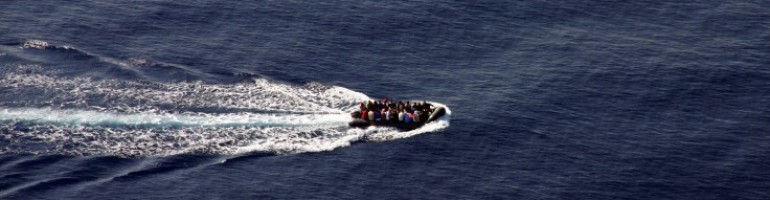
UNHCR Calls on Malta and Italy to Expand Search For Missing Migrant Boat

UNHCR’s Malta office issued the following statement on Thursday while search efforts for the migrant boat by the Armed Forces of Malta continued:

“The United Nations High Commissioner for Refugees (UNHCR) expresses deep concern for the fate of tens of migrants on board of a boat coming from Libya who have sent out SOS calls on Tuesday evening.   The presence of the migrants has reportedly also been confirmed by a number of Somali relatives in Italy who have received the distress calls.  The boat has not been sighted yet and this raises UNHCR concern, especially as it is much more dangerous to cross the Mediterranean in the current season. UNHCR calls on Malta and Italy to strengthen the search operations in order to save the lives of tens of persons at the mercy of the sea.”

Click here for link.

Leave a comment

Filed under Italy, Libya, Malta, Mediterranean, News

Director Laitinen Describes Frontex Response to the 2011 Migratory Flows from North Africa

In a recent opinion article published on Publicservice.co.uk, Frontex Director Ilkka Laitinen described the challenges faced by Frontex and provided a description of Frontex’s “unprecedented” activities over the past 12 months in the operational theatre, referring to the first RABIT deployment in October 2010 and the response to the migratory flows from North Africa beginning in January 2011.

Extensive excerpts regarding the response to the migratory flows from North Africa:

“…  Since January 2011, world attention has been focused as never before on the Arab world. The ‘Arab Spring’ uprisings in North Africa and the Middle East once again redrew the European migration map, and Frontex’s operational capacity was tested again. With the arrival of almost 5,000 migrants on the tiny Italian island of Lampedusa, the agency was once more called upon to assist. However, the support required was in a very different form than that in Greece.

African exodus
The migratory flows from North Africa towards the EU external borders – predominantly to Italy and Malta – have been very different from those to Greece. Initially, almost all were economic migrants from Tunisia seeking work in Europe.

The modus operandi of the facilitation networks behind the phenomenon was a familiar one to Frontex, namely, over-packing unseaworthy vessels with inadequately experienced crews and little life-saving equipment, if any. This created a predominantly humanitarian need for search and rescue activities at sea. It also created an administrative challenge on shore, to process usually undocumented migrants, establish their nationalities and identities and take care of their immediate needs, as well as to transfer them to better equipped facilities on the mainland and start return procedures where appropriate. There was no call from Italy for a RABIT deployment, however. Italy is very well equipped for maritime border control, as well as for search and rescue activities. Where the Italian authorities requested most support was in Frontex’s other areas of specialisation – intelligence gathering, situational awareness, and the deployment of experts to the field to assist in the screening and debriefing of migrants (establishing probable nationality and gathering evidence of people smuggling respectively). Long before being called on by the Italian Ministry of Interior, Frontex’s Situation Centre and Risk Analysis Unit were busy identifying the full range of possible scenarios in Egypt, Tunisia and Libya, as well as monitoring developments in other countries in the region.

Since the first waves of migrants from Tunisia, the situation has evolved constantly, with ever more sub-Saharan migrants and refugees seeking international protection. Such changeable flows require flexibility and constant adjustment to the operational response. For each possible scenario, an appropriate operational response was planned by the Joint Operations Unit and all necessary steps were taken to ensure that a rapid response could be launched anywhere in the operational area at any time.

This is an ongoing process and a challenge to which expert staff at the agency’s Warsaw HQ, and the Frontex Operational Office in Piraeus, Athens, continue to respond. This readiness ensures operational flexibility. It also demonstrates another important area in which Frontex adds value to member states’ activities at the EU’s external borders. It must always be borne in mind that it is the member states themselves that remain at all times responsible for their own borders; Frontex’s role is to provide support when requested. Keeping member states up to date with detailed and accurate intelligence is one of the ways the agency works behind the scenes to maximise member states’ effectiveness. Another way is by providing a platform for exchange of data and other information. Equally, experts in the field debrief migrants to build up a clearer picture of the routes used, prices paid and other modi operandi of the smuggling networks involved.

The cruel sea
The maritime domain remains the most complicated for border control, not least legally. The provisions of national and international maritime law and their impact on migration management, make the seas the most challenging environment for operations. It is for this reason that for many years, Frontex has been encouraging greater coordination between the southern member states themselves through the European Patrols Network (EPN) – an initiative to increase efficiency, improve information sharing and reduce overlapping of efforts and the incumbent gaps they leave in surveillance. It was the existing EPN provisions in the Mediterranean that formed the basis of Frontex’s operational response to the migration flows from North Africa. And it is the EPN that will be strengthened as a combined surveillance response going forward. EPN will form an essential component of EUROSUR, the common European surveillance system now being developed. It will also help to enhance Europe’s search-and-rescue capacity in the Mediterranean.

But as has been said many times, border control is no panacea. It is the last line of control and rescue. Its rightful place is at the heart of a far-reaching IBM [Integrated Border Management] system that includes deterrents against illegal migration as well as incentives for legal migration, and that tackles the root causes of such migration in countries of origin and transit. To put it simply, prevention is better than cure, and by the time migrants reach the external EU border it is often too late.

The most effective way to tackle the dangers of illegal migration by sea is to deter migrants from setting out in the first place. Only when this principle is enshrined at the EU policy level can it be claimed that the Union is seriously tackling illegal migration and cross-border crime.”

Click here for link to full text of article.

Leave a comment

Filed under European Union, Frontex, Greece, Italy, Libya, Malta, Mediterranean, News, Tunisia

Malmström: Commission Hopes Migration Talks With Libya Will Begin Soon

In response to a parliamentary question submitted by Italian MEP Fiorello Provera (EFD, Northern League) regarding the “control of migratory flows in the southern Mediterranean”, Commissioner Cecilia Malmström provided a written response on 25 October in which she stated that “[t]he Commission hopes [migration discussions] will start as soon as possible with the Libyan authorities.”

In his question, MEP Provera praised the Italy-Libya Friendship Agreement:  “In an example of successful migration control, Italy and Libya signed a friendship treaty in 2008, which included measures to put Libya in charge of its 2 000 km coastline to stem the flow of illegal migrants into the EU. The agreement had an enormous impact: in 2008, 40 000 migrants attempted to cross illegally into Italy, but according to The Economist, the number of migrants was reduced to 4 406 in 2010. However, following the popular uprising against Gaddafi forces at the start of 2011, 27 000 immigrants managed to cross from Libya into Europe.”

Full text of Ms Malmström’s written response:   “The Commission would like to underline that the discussions which were held on 4 October 2010 in Tripoli by the Members of the Commission responsible for Home Affairs and Enlargement and European Neighbourhood Policy took place in a context, and with interlocutors, which have profoundly changed.

Although the tentative list of common actions identified in October 2010 (1) may still represent a basis for future cooperation between the EU and Libya in the areas of migration, asylum, visa policy and border management, it is clear that the pattern and content of this future cooperation will have to be substantially revised on the basis of new discussions. The Commission hopes these will start as soon as possible with the Libyan authorities.

The revision of the cooperation with Libya, in any case, is necessary also to take into account several important changes which have taken place not only in Libya but also in the EU since the spring.

In particular, the European Council of 24 June 2011 which approved a new policy approach towards the Southern Mediterranean countries. This approach will be characterised by the launch of a Dialogue on Migration, Mobility and Security with these countries aimed at reinforcing cooperation and strengthening relations with Europe’s southern neighbours.

(1) ‘common actions aimed at preventing irregular migration, addressing more effectively its consequences and root causes, promoting the use of the regular channels of migration and mobility, avoiding further loss of migrants’ lives as well as to protecting their fundamental rights’.”

Click here for Question and here for Answer.

Click here for article. (EN)

Leave a comment

Filed under European Union, Italy, Libya, Mediterranean, News

Reports of First Post-Gaddafi Migrant Boat [UPDATED 2345 GMT – Lampedusa “Closed” for SAR Operations]

Italian media is reporting this afternoon that a satellite telephone distress call has been received from a disabled migrant boat carrying about 50 persons from Libya.  A search in the Maltese SAR zone is being undertaken.  The boat is reportedly drifting about 70 miles south of Lampedusa.  If the report is accurate, this would appear to be the first known migrant boat to have left Libya since the overthrow of Gaddafi.

Click here and here for articles.  (IT)  Click here for article. (EN)

[UPDATE 23:45 GMT – A Malta Today report suggests, as has been the case before, there may be  disagreement between Maltese and Italian officials regarding who has responsibility for coordinating SAR operations.  Malta Today reports that Malta is now coordinating SAR operations due to the “closure” of Lampedusa by Italian officials.  Click here for article.]

Leave a comment

Filed under European Union, Frontex, Italy, Libya, Malta, Mediterranean, News

Italy Extends Temporary Permits for Tunisians Who Arrived Before 6 April 2011 and Extends Declaration of State of Emergency Relating to Influx of Migrants from North Africa

Italy has extended for an additional six month period the temporary residency permits issued to Tunisian migrants who arrived in Italy after 1 January 2011 and before 6 April 2011.  Italy also extended until 31 December 2012 the “Declaration of a state of humanitarian emergency in relation to the exceptional influx of citizens from the countries of North Africa.” (“Proroga dello stato di emergenza umanitaria in relazione all’eccezionale afflusso di cittadini appartenenti ai paesi del Nord Africa.”)

The decree granting the extension of the temporary residency permits noted the positive actions that have been undertaken by the Tunisian government pursuant to the bi-lateral agreement of 5 April 2011 between Italy and Tunisia, specifically the increased supervision of the Tunisian coast, Tunisia’s actions to prevent and fight against illegal immigration, and Tunisia’s cooperation with the repatriation of Tunisian nationals.  The decree noted that the new Tunisian government which will be formed after elections later this month will be expected to confirm and strengthen bi-lateral relations, especially in regard to the voluntary return programme and immigration controls.

(… “Rilevato che, in base all’accordo del 5 aprile 2011 tra il  Governo italiano e quello  tunisino,  sono  proseguite  con  risultati  molto positivi sia l’attivita’  di  vigilanza  sulle  coste  tunisine,  sia l’azione di prevenzione e di  contrasto  dell’immigrazione  illegale, sia le operazioni di  rimpatrio  dei  cittadini  tunisini  giunti  in Italia successivamente alla citata data del 5 aprile 2011; Preso atto delle rinnovate richieste, che  pervengono  dal  Governo provvisorio tunisino, di proseguire nelle  linee  di  cooperazione  e collaborazione gia’ avviate;  Considerato altresi’ che tale  rapporto  di  collaborazione  dovra’ essere confermato ed ulteriormente rafforzato con  il  nuovo  Governo tunisino che si insediera’ all’esito delle  consultazioni  elettorali per l’Assemblea Costituente del 23 ottobre 2011, in  particolar  modo per  il  proseguimento  dei  programmi  di  rimpatrio  volontario  e assistito e per una efficace politica di programmazione dei flussi;…”)

Click here for text of temporary residency decree.  (IT)

Click here for text of extension of humanitarian emergency decree.  (IT)

Click here and here for articles.  (IT)

Click here for link to ASGI web page with relevant information.

Leave a comment

Filed under European Union, Italy, Libya, Mediterranean, News, Tunisia

Trapped Migrants Face Increasing Violence at Sidi Bilal Near Tripoli

From Refugees International, 7 October:  “More than 600 migrants from sub-Saharan Africa are effectively stranded at a port just outside the Libyan capital, and have been left to fend for themselves by Libyan authorities. Despite repeated attacks, harassment, and arbitrary arrests by Libyan gangs over the course of four months, they have received no protection from the National Transitional Council (NTC). Refugees International calls on the NTC and all local authorities – including the civilian councils in Janzour and Tripoli, and the Tripoli Military Council – to intervene immediately to protect the population at Sidi Bilal port and ensure their safe relocation to a temporary site.  ‘The men in these camps are routinely harassed and accused of being pro-Gaddafi mercenaries, the women are targets of sexual abuse. All face intimidation by armed Libyan thugs who drive into the port at night firing guns into the air,’ said Matt Pennington, an advocate for Refugees International currently in Libya. ‘Of course, many migrants told us they don’t really want to leave Libya – since they have nothing to return to in their home countries. But even for those who want to stay in Libya, their situation is becoming intolerable.’  …  So far, the UN World Food Programme has delivered one food drop to the imperilled migrants, while the UN Refugee Agency and the International Organization for Migration have been attempting to negotiate safe relocation for those who want to stay and repatriation for those who want to return home. But what the population of Sidi Bilal most urgently needs is protection, and Libyan and UN authorities must act swiftly to provide it.”

Click here for full statement.

Leave a comment

Filed under Libya, Mediterranean, Reports, Statements, UNHCR

PACE Report: Lampedusa Reception Centres Not Suitable Holding Facilities for Migrants

The PACE Ad Hoc Sub-Committee on the large-scale arrival of irregular migrants, asylum-seekers and refugees on Europe’s southern shores has issued a report on the migrant reception centres on Lampedusa.  A delegation of the sub-committee members visited Lampedusa in May of this year.

From the PACE Press Release:  “The reception centres in Lampedusa are not suitable holding facilities for irregular migrants, in particular Tunisians. In practice, they are imprisoned there without access to a judge, according to the Parliamentary Assembly of the Council of Europe (PACE) Ad Hoc Sub-Committee on the large-scale arrival of irregular migrants, asylum-seekers and refugees on Europe’s southern shores, in its report on its visit to Lampedusa*, which was declassified today [3 October 2011]. ‘The reception centres should remain just that and not be turned into holding centres,’ said Christopher Chope (United Kingdom, EDG), Chair of the ad hoc sub-committee and of the PACE Committee on Migration, Refugees and Population.  In this context, the ad hoc sub-committee is concerned by the tensions on the island, which have increased exponentially: arson in the main reception centre on 20 September caused serious damage and led to an upsurge in violence, leading the Italian authorities to declare Lampedusa an ‘unsafe port’. ‘These acts of violence are to be strongly condemned. They do not acknowledge the efforts of both the local population of Lampedusa and the Italian coastguards, who day after day do their utmost to rescue people at sea and to offer them temporary shelter on the island,’ declared the members of the ad hoc sub-committee….”

Excerpts from the Report:

“XV. Conclusions and recommendations

82. Much of the work observed by the delegation on Lampedusa warrants admiration, praise and broad support, even if some of the images provided in the media in the past have conveyed a rather more negative image. However some of the underlying problems noted by the delegation during its visit have manifested themselves in recent events, notably the arson attacks on the centre and the rising violence. Unfortunately what happened recently was foreseeable by the authorities and was inherent in the challenges of handling mixed flows of migrants and asylum seekers in the context of detention in a centre designed for reception.

83. What’s done is done, but lessons can usefully be learnt from the episode which has been painful both for Lampedusa and for the migrants, refugees and asylum-seekers who have been subjected to appalling conditions.

84. Lampedusa is still in the front line for arrivals of mixed migration flows by sea, in particular from Libya. The arrivals have not decreased in intensity and Italy and Europe must be ready to face up to a potentially even larger influx.

85. However, if we look at the number of arrivals so far, this is not a crisis for Italy or for Europe, but it is for Lampedusa.

86. In the immediate future, as soon as the situation is settled and the port is again considered safe, Lampedusa must remedy its limited reception capacity as the centres are immediately saturated by the arrival of boats with more and more people on board.

87. In the possibly very near future, if the number and frequency of arrivals increase, reception capacities in Italy will have to be brought into line. At the time of the visit, the Vice-Prefect and the Mayor were optimistic and convinced that the transfer system put in place was working, and that the situation would not deteriorate to the point reached earlier in the year. Furthermore, they considered that the transfer capacity could be increased through the planned provision of an additional boat. The members of the Sub-Committee at the time was confident that the Italian authorities would continue to do everything necessary to manage arrivals, even if their number were to increase. However, these measures – mostly designed for dealing with refugees and asylum-seekers fleeing Libya – have been proved insufficient to handle the challenge of handling the situation of the Tunisian migrants.

88. The Ad Hoc Sub-Committee wishes to voice its concern regarding a new agreement which the Italian authorities are reported to have signed with the authorities in Benghazi in Libya. The situation in Libya is not safe enough for people to be returned there and UNHCR’s position on this question remains unchanged. Furthermore, any attempt to deny access to persons entitled to international protection (and there are many of them in Libya) would be a clear breach of Italy’s international obligations.

89. There remains the issue of minimising loss of lives at sea and the need to ensure that all states fulfill their obligations of rescue at sea and the provision of access to international protection following any intervention.

90. Due to its proximity to North-Africa, Lampedusa is a key island to avoid even greater deaths at sea. If the boat people cannot hope to reach Lampedusa, their already highly dangerous journeys will become longer and therefore even more unsafe. To avoid more tragedies, Lampedusa’s reception capacities must be rebuild and improved as soon as possible.

91. The Ad Hoc Sub-Committee urges the Italian national, regional and local authorities to maintain their co-ordinated effort to manage arrivals of mixed migration flows in Lampedusa while complying with the relevant international standards and in co-operation with the international organisations and NGOs present on the island.

92. On the basis of its observations, the Ad Hoc Sub-Committee calls on the Italian authorities:

  • i. to continue to comply immediately and without exception with their obligation to rescue persons in distress at sea and to guarantee international protection, including the right of asylum and nonrefoulement;
  • ii. to introduce flexible measures for increasing reception capacities on Lampedusa;
  • iii. to improve conditions at the existing centres, and in particular the Loran base, while ensuring as a matter of priority that health and safety conditions meet existing standards – even when the centres are overcrowded – and carrying out strict and frequent checks to ensure that the private company responsible for running the centres is complying with its obligations;
  • iv. to ensure that new arrivals are able to contact their families as quickly as possible, even during their stay on Lampedusa, particularly at the Loran base, where there are problems in this regard;
  • v. to provide appropriate reception facilities for unaccompanied minors, ensuring that they are not detained and are kept separate from adults;
  • vi. to clarify the legal basis for the de facto detention in the reception centres in Lampedusa;
  • vii. where Tunisians in particular are concerned, only to keep irregular migrants in administrative detention under a procedure prescribed by law, authorised by a judicial authority and subject to periodic judicial review;
  • viii. to continue to guarantee the rapid transfer of new arrivals to reception centres elsewhere in Italy, even if their number were to increase;
  • ix. to consider the requests by the population of Lampedusa for support commensurate with the burden it has to bear, particularly in economic terms;
  • x. not to conclude bilateral agreements with the authorities of countries which are not safe and where the fundamental rights of the persons intercepted are not properly guaranteed, as in Libya.

93. Recalling the Assembly’s Resolution 1820 (2011) on “Asylum-seekers and refugees in Europe: sharing responsibilities”, the Ad Hoc Sub-Committee also recommends that all Council of Europe member states, and particularly the European Union member states, display greater solidarity by providing direct assistance to the countries, including Italy, which are currently faced with arrivals from the southern Mediterranean, and by accepting relocations within Europe where appropriate.

94. The Sub-Committee also urges member states to follow the example of the close co-operation between the Italian authorities and the member organisations of the “Praesidium Project” (UNHCR, IOM and the Red Cross) in managing arrivals and reception centres.

95. The Ad Hoc Sub-Committee invites the Italian authorities, through the Italian Delegation to the Parliamentary Assembly, to keep the Committee on Migration, Refugees and Population, appraised of progress on the 10 specific issues raised above on a six monthly basis.”

Click here for Report.

Click here for PACE Press Release.

Click here for my previous post.

Leave a comment

Filed under Analysis, Council of Europe, Italy, Libya, Mediterranean, News, Reports, Tunisia

Frontex Quarterly Reports for 2011 Q1 and Q2

The Frontex Risk Analysis Unit (RAU) released its 2nd Quarter Report (April-June) for 2011 on 4 October.  The 1st Quarter Report (Jan-March 2011) was released on 21 July.  As always, while the information is a few months old, the reports contain a significant amount of information, graphs, and statistical tables regarding detections of illegal border crossings, irregular migration routes, detections of facilitators, detections of illegal stays, refusals of entry, asylum claims, and more.

Here are extensive excerpts from the Q2 Report:

“Executive summary

In Q2 2011, all Frontex irregular-migration indicators increased compared to the previous quarter. The most important indicator, detections of illegal border-crossing, increased to a level not seen since Q3 2008 and correspondingly asylum applications are now at nearly the highest level since data collection began. What’s more, migration pressure at the border from migrants attempting to enter and stay in the EU increased even more than EU-level figures suggest, as they are offset against extensive reductions in Albanian circular migration.

In 2011 there were major and extensive developments in irregular-migration pressure at the external border of the EU, resulting from two simultaneous but independent hotspots of illegal border-crossings: the first was seasonally increased activity at the Greek land border with Turkey, where a wide variety of migrants continued to be detected at very high levels. The second, and the undeniable hotspot for illegal border-crossing into the EU in Q2 2011, was in the Central Mediterranean, where vast numbers of sub-Saharan migrants landed in Italy and Malta mostly having been forcibly expelled from Libya. [***]

4. Main points Q2 2011

  • All irregular migration indicators increased relative to the previous quarter
  • Compared to a year ago, there were significant EU-level increases in several irregular migration indicators, such as detections of illegal border-crossing, clandestine entries, and refusals of entry. There were also increased asylum applications
  • Despite detections of Afghan migrants falling by a third compared to last year, they were still the most common nationality detected illegally crossing the EU external border. Most were previously resident as refugees in Iran
  • In contrast, detections of all the other highly-ranked nationalities (Tunisians, Nigerians, Pakistanis, Ghanaians) increased massively relative to the same period last year
  • In total there were over 40 000 detections of illegal border-crossings, a 50% increase compared to Q2 2010. These were the result of two simultaneous but independent routes of irregular migration: the Eastern Mediterranean and the Central Mediterranean routes:

1. In the Eastern Mediterranean:

– There were over 11 000 detections of illegal border-crossing, almost exclusively at the Greek land border with Turkey, which is comparable with the same period in 2010

– This flow currently attracts migrants from north Africa, sub-Saharan Africa and Asia

– Groups of Dominicans were detected travelling to Turkey to enter the EU via the Greek land border

– Secondary movements are assumed from detections of (i) illegal border-crossings in the Western Balkans, (ii) false documents on flights to major EU airports from Turkey as well as Greece, and (iii) landings in southern Italy from Greece, Turkey and Albania

2. In the Central Mediterranean:

– Following a bilateral return-agreement between Italy and Tunisia, the massive influx of Tunisians to Lampedusa reported in the previous quarter decreased, but remained significant

– A very wide range of sub-Saharan Africans were detected on this route, some having been forcibly departed from Libya

– Italy reported more detections of illegal border-crossing in Sicily than ever before, a three-fold increase compared to the previous quarter; the increased flow was composed of migrants from Côte d’Ivoire as well as Tunisia and a range of other nationalities

– There were also increased detections of Egyptian migrants and facilitators landing in Sicily and Southern Italy from Egypt

– Italy and Malta reported huge increases in the number of asylum applications submitted by sub-Saharan African migrants. In Italy increases were particularly marked for Nigerians and Ghanaians

  • Following their new visa-free status, fewer Albanians were detected illegally crossing the EU border, and illegally staying within the EU (both mainly in Greece). Instead they were increasingly refused entry to Greece and they were also increasingly detected at the UK border, either as clandestine entry or using false documents
  • There was an increased flow of Georgian migrants towards Belarus (air and land), with increased illegal entries and asylum applications in Poland and Lithuania
  • In Q2, Libya was the most significant source of irregular migration to the EU. However, more recently the ability of the Gaddafi regime to forcibly expel its migrant population to the EU has become compromised; the situation remains dynamic and uncertain[.]

4.1 Detections of illegal border-crossing

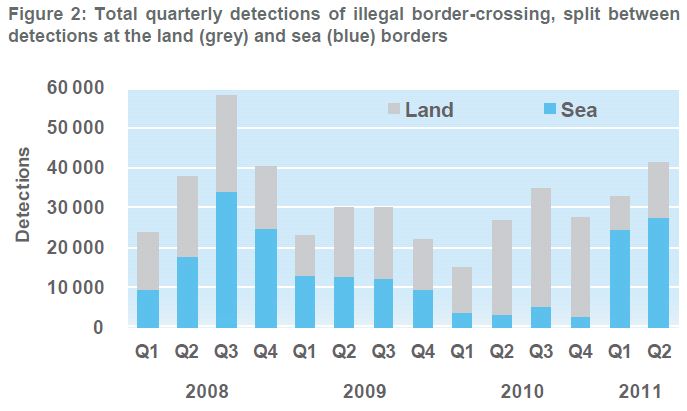
At the EU level, in Q2 2011 there were more detections of illegal border-crossing since Q3 2008. The total of 41 245 detections during this reporting period is a 25% increase compared the previous quarter and a 53% increase compared to the same period last year (Fig. 2). Without question there were major and extensive developments in illegal migration pressure at the external border of the EU, resulting from two simultaneous but independent hotspots of illegal border-crossings. The first was increased activity at the Greek land border with Turkey, where a range of Asian, north African and sub-Saharan African migrants were increasingly detected at very high levels. The second, and the undisputed hotspot for illegal border-crossing into the EU in Q2 2011, was at the Italian islands in the Central Mediterranean, where vast numbers of Tunisians, Nigerians and other sub-Saharan migrants landed in small sea vessels, the majority of which in Q2 had been forcibly departed from Libya.

Figure 2 shows the evolution of the FRAN indicator 1A – detections of illegal border-crossing, and the proportion of detections between the land and sea borders of the EU per quarter since the beginning of 2008. In Q2 2011 there were more detections of illegal border-crossing since the peak of Q3 2008 nearly three years ago. Compared to a year ago, detections at the EU land border decreased by 42% to 13 742 in Q2 2011, almost exclusively due to fewer detections of Albanian nationals following their new visa-free status; elsewhere at the land border (including Greece) trends were roughly stable. In contrast, at the sea border detections increased nine-fold to some 27 500 detections (Fig. 2), the vast majority of which (95%) were in the central Mediterranean, forming the major development in irregular migration to the EU in 2011.
[***]

At the EU level, detections of illegal border-crossing increased by 53% compared to a year ago (Fig. 3). However, this level masks a lot of variation among Member States. First, and most importantly to the current situation, was a 4 200% increase in detections of almost exclusively African migrants in Italy. Related to this central Mediterranean flow, was a concurrent and massive increase in detections reported from Malta (from 0 to 710), and also increases further west into Spain (+61%). As a result, all these countries have seen increases in other indicators such as asylum applications of the most common nationalities (see relevant sections). [***]

Routes

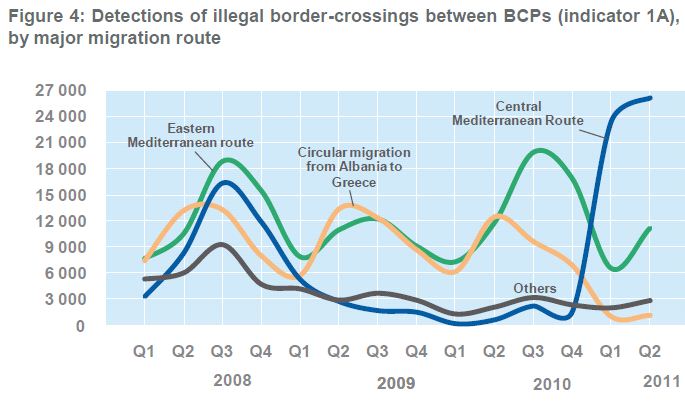
As illustrated in Figure 4, for just the second time since records began in early 2008, in Q2 2011 detections of illegal border-crossings on the Central Mediterranean route, which comprises the blue borders of Italy and Malta, exceeded those reported from both the (i) Eastern Mediterranean route of the land and sea borders of Greece, Bulgaria and Cyprus, and (ii) circular migration from Albania to Greece.
Without question, in Q2 2011 the single most important irregular-immigration route in terms of detections of illegal border-crossing was the Central Mediterranean route, where detections increased in the beginning of 2011 to previously unprecedented levels (Fig. 4). In the first quarter of 2011, and uniquely compared to previous surges of illegal immigration, this flow was restricted to a single nationality – Tunisian, most of whom were responding to civil unrest in their home country by leaving towards the Italian Island of Lampedusa. In response to this almost unmanageable influx of irregular migration at a single and isolated location, a bilateral return agreement was signed between Italy and Tunisia, which allowed for the accelerated repatriation of newly arrived individuals. Hence, during the current reporting period, the flow of Tunisian migrants fell from over 20 200 in the previous quarter to 4 300 in Q2 2011.

However, civil uprising commonly referred to as the Arab Spring, and its effects on migration in the area, was not limited to Tunisia. For example according to multiple sources, in next-door Libya, migrants from sub-Saharan countries were in Q2 2011 being coerced to move towards the EU by the Gaddafi regime in response to the NATO Operation Unified Protector which commenced on March 27 under United Nations Security Council Resolution 1973. Thus, in Q2 2011, besides some continued departures from Tunisia, the flow in the central Mediterranean was composed of a single flow of large numbers migrants from sub-Saharan countries departing Libya in small vessels. [***]

4.1.1 Eastern Mediterranean route

Detections of illegal border-crossings on this route increased seasonally and in line with previous years, from 6 504 in Q1 2011 to 11 137 in Q2 2011, almost exclusively due to a massive increase in detections at the Greek land border with Turkey, where detections increased from 6 057 to 10 582. [***]

4.1.2 Central Mediterranean route

In Q2 2011 there were 26 167 detections of illegal border-crossings on the Central Mediterranean route, a 10% increase even compared to the ‘peak’ reported during the previous quarter, and evidently a massive increase compared to the negligible detections throughout all of 2010. The vast majority of detections on this route were reported from Italy (25 500) where detections increased by 13% even compared to the ‘influx’ of migrants reported during Q1 2011. In Italy, Central African, Tunisian, Nigerian and Ghanaian were the mostly commonly detected nationalities, 90% of which were detected in the Pelagic Islands (14 300), most notably Lampedusa (Fig. 7). However, in Q2 2011 there were also more detections of illegal border-crossing reported from Sicily (2 260) than ever before; this figure is nearly three times bigger than that reported in the previous quarter and more than twenty times higher than during the same period last year (100). Compared to the previous quarter, in Sicily there were more detections of migrants from a very wide range of countries such as Egypt, Côte d’Ivoire and Tunisia. There were also over 710 detections reported from Malta, which is a sustained peak from the previous quarter (820) and extremely high compared to the negligible detections throughout 2010. In Malta there were much fewer detections of Somalis and Eritreans but there were increased detections of Nigerians and migrants from Côte d’Ivoire. However, migrants from Tunisia, Algeria and Egypt often claim to originate from sub-Saharan Africa in an attempt to appear as refugees, a fact which may render such comparisons of nationalities somewhat misleading.

In the previous FRAN Quarterly (Q1 2011) it was reported a surge of irregular immigration (20 000 detections) on the Central Mediterranean route that was almost entirely restricted to a single nationality: Tunisian (Fig. 8). As a result of this influx, on 20 February the JO EPN-Hermes Extension 2011 commenced in the central Mediterranean, and a bilateral agreement was reached between Italy and Tunisia on 5 April 2011, which resulted in the strengthening of police surveillance along the Tunisian coast and regular repatriations of Tunisian nationals from Italy. For example, according to data collected under JO Hermes 2011, some 1 696 Tunisians were repatriated between 5 April and 23 August 2011. The repatriation agreement is probably an effective deterrent, combining as it does, returns and surveillance, however some migrants have reported their boats being spotted by military patrols that did not take any action. According to the FRAN data, in Q2 2011 some 4 286 Tunisian migrants were still detected illegally crossing the border into Italy. Although a massive reduction, this still represents a very large and significant flow of irregular migrants into the EU.

In comparison to the reduction in flow from Tunisia, in Q2 2011 there was a large increase in migrants who had departed from Libya (Fig. 9). The migrants departing from Libya were mostly nationals from countries in the Horn of Africa, the sub-Saharan and Central African regions and, to a lesser extent, Asia. According to intelligence collected during JO EPN-Hermes Extension 2011, most of these migrants had already been in Libya for over a year, originally heading to Tripoli via the traditional routes for sub-Saharan and Central African migrants. In Q2 2011, migrants tended to reach Italy on large fishing vessels that had departed directly from Tripoli or the nearby ports of Medina and Janzour. Most of these deported African nationals did not want to leave the country as their standard of living in Libya was high compared to their home countries. Several even stated that they would choose to return to Libya after the war. In Q2 2011 reports suggest that some migrants were instructed to reach embarkation areas on their own but had been caught by the military or police and then detained in camps or disused barracks until they were transported to embarkation areas and onto vessels bound for Italy. In each case the migrants were searched by the military before boarding and all their belongings were confiscated. According to reports, nationals of the sub-Saharan and Central African regions as well as from Horn of African countries have been recruited by the Libyan army/police to manage their compatriot migrants at gathering places or camps. In some cases the destination of vessels from Libya was Sicily, where the flow was characterised by waves of landings. For example there were around 11 landings on 13 May and 7 between 11 and 29 June, with the majority of boats arriving from Libya and Egypt. [***]

4.1.3 Western Mediterranean route

In Q1 2011 there were 1 569 detections of illegal border-crossings on this route to Southern Spain, which is nearly double compared to the previous quarter (890), and more than a 50% increase compared to a year ago (973). Some of this increase is due to better weather conditions at this time of year, but irregular migration pressure on this route is clearly higher than it was at the same time last year. [***]

In the longer-term, irregular immigration to southern Spain has been consistently decreasing since the beginning of 2006. Commonly cited reasons are Frontex Joint Operations in the area, effective bilateral agreements and more recently rising unemployment in Spain, particularly in sectors typified by migrants.* Nationalities traditionally associated with this route were Algerian, Moroccan and Ghanaian. [***]

4.1.4 Western African route

The cooperation and bilateral agreements between Spain and the rest of the Western African countries (Mauritania, Senegal and Mali) are developing steadily. They are one of the main reasons for the decrease in arrivals on this route over the last year, as are the presence of patrolling assets near the African coast. In Q4 2010 Frontex reported a slight increase in the number of detections of illegal border-crossing at the Canary Islands, from a maximum of 50 during each of the previous 4 quarters, to 113 in Q4 2010. This increased level of detections persisted into the first quarter of this year (154), exclusively due to Moroccan nationals (152) displaced after the dismantling of migrant camps near the dispute Western Saharan region. However, during the current reporting period detections on this route decreased massively to a negligible 24 detections. [***]”

Click here for 2011 Q2 Report.

Click here for Frontex Statement regarding 2011 Q2 Report.

Click here for 2011 Q1 Report.

Click here for Frontex Statement regarding 2011 Q1 Report.
3 Comments

Filed under Aegean Sea, Algeria, Analysis, Cyprus, Data / Stats, Eastern Atlantic, Egypt, European Union, Frontex, General, Greece, Italy, Libya, Malta, Mauritania, Mediterranean, Morocco, News, Reports, Senegal, Spain, Tunisia, Turkey

Italy and Libyan NTC Take Further Steps to Reactivate Italian-Libyan Friendship Agreement

Italian Foreign Minster Franco Frattini traveled to Tripoli on 30 September for meetings with the NTC President Mustafa Abdel Jalil and Prime Minister Mahmoud Jibril.  Frattini and Jibril met one week earlier on the sidelines of the UN General Assembly Meeting.  Italy and the NTC signed a memorandum of understanding to create a joint coordination committee whose function will be to prepare for the reactivation of Italy-Libya Friendship Agreement as soon as a new Libyan government assumes office.

Click here and here for articles. (IT)

Click here for statement from Italian Foreign Ministry. (IT)

1 Comment

Filed under Italy, Libya, Mediterranean, News

Italian Appeals Court Acquits 2 Tunisian Fishing Boat Captains Who Rescued Migrants in 2007

The Court of Appeal of Palermo on 22 September formally acquitted two Tunisian fishing boat captains, Abdelbasset Zenzeri and Abdelkarim Bayoudh, who rescued 44 migrants on 8 August 2007 and brought the rescued migrants to Lampedusa despite being ordered by Italian authorities not to enter the port at Lampedusa.  Italian coast guard and Guardia boats attempted to block the entry of the fishing boats into the harbour.

The two captains and their crew members were arrested and criminally charged with facilitating illegal immigration and resisting public officers after they landed at Lampedusa to disembark the rescued migrants.  Several of the rescued migrants were seriously ill.  The migrant boat had departed from Libya, had been at sea for three days, and was carrying asylum seekers from Eritrea, Ethiopia, and Sudan.  In November 2009 the captains and their five crew members were acquitted by the Court of Agrigento of the charges relating to facilitating illegal immigration, but the two captains were convicted of charges of resisting a public officer and committing violence against a warship (“resistenza a pubblico ufficiale” e “violenza contro nave da guerra”) in connection with their refusal to turn their boats around and not enter the harbour.  The captains were required to forfeit their fishing vessels and were sentenced to prison.  Last week’s ruling by the Court of Appeal reversed the criminal convictions entered by the lower court and brings the case to an end after 4 years.  The incident inspired the movie Terraferma.  (In the movie version it is an Italian fisherman who rescues the migrants.)

Click here (IT) and here (DE) for articles.

Click here for ASGI’s statement about the ruling.  (IT)

8 Comments

Filed under Italy, Judicial, Libya, Mediterranean, News

Call for Support: Boats 4 People Project

From Migreurop:  “… thousands of migrants died in the Mediterranean this Summer in their attempts to reach Europe. Boats wandered adrift and shipwrecks took place in front of Coast Guard ships, surveillance patrols of Frontex and ships from the military coalition engaged operations in Libya under NATO command.  For the last several years, African and European organisations alike have been challenging governments about the number of deaths occurring at the borders of the European Union, but in vain. We have come to the conclusion that it is essential now to move to direct action in the light of the excessive number of shipwrecks taking place in the Mediterranean and the reluctance of Europe to concede entry to refugees. We call for a Mediterranean which is in solidarity with migrants and in opposition to repressive policies which seek to criminalise migration towards Europe more and more each day.

What are the concrete aims of the Boats 4 People initiative ?

  • To denounce the tragedy which is taking place in the Strait of Sicily
  • To exercise our right of access to the maritime regions in which these shipwrecks are taking place and to the centres in which migrants arriving in Italy are detained
  • To raise awareness about the requirements of the law of the sea in terms of assistance and to support citizens and sailors who rescue migrants and are criminalized.
  • To accuse state actors working at sea (border guards, Frontex, NATO) who are guilty of failing to assist migrants in difficulties and of refouling asylum seekers, against the provisions of the UN Convention on the Law of the Sea and the Geneva Convention
  • To strengthen Euro-African solidarity with regard to migration and the defence of migrant rights

Trip and organization of the project – The boats will leave for Spring 2012 from Rome, from where they will travel towards the south of Tunisia via Sicily, Malta, Lampedusa, Tunis, Sfax and Ben Guardane.  At the moment, we aim to use one or several motor/sail boats with a total capacity of around fifty passengers, including the crews. If you have one – or several ! – boats and would like to follow the flotilla for all or part of the journey, please contact the organisers.  The aim of the flotilla is to exert maximum pressure on the European authorities by carrying people likely to raise awareness of the situation in the Strait of Sicily and to denounce it to the greatest possible number of people. We also aim to allow the greatest number of people possible to participate by rotating passengers at each stop. If you are a Member of Parliament, journalist or artist and you wish to participate in a stage of the journey, please send your details to coord@boats4people.org. …”

Click here for full posting.

Leave a comment

Filed under European Union, Italy, Libya, Malta, Mediterranean, Statements, Tunisia

Terraferma, Emanuele Crialese’s Film About Migrants, Nominated as Italy’s Entry for Best Foreign Film Oscar Award

From Adnkronos News: “Movie director Emanuele Crialese’s new film about the plight of migrants landing on the southern Lampedusa island from Africa will be Italy’s contender for the 2012 Best Foreign Film Oscar, a jury decided Wednesday.  The film, ‘Terraferma’ (Dry Land) is Crialese’s fourth movie and won the Special Jury Prize at the 2011 Venice Film Festival earlier in September.  ‘I am very happy and honoured, it’s something I did not expect but hoped for,’ said Crialese commenting on Terraferma’s selection.  Like his 2002 film ‘Respiro’ the picture tells the story of Sicilian fishermen dealing with the influx of migrants who opt to rescue boat people from Africa and fall foul of the local coastguard.  In the movie, Crialese cast a real Ethiopian refugee, identified as Timnit T, to play the part of an illegally rescued pregnant woman, based on her real story. She now lives in northern Europe.  The Roman director has voiced public criticism of migrant deaths at sea and the response by authorities to the humanitarian crisis that has unfolded in the Mediterranean….”

Click here for link to article.

Click here for link to film’s FB page.


Leave a comment

Filed under Libya, Mediterranean, News

Gaddafi and the Mercenary Myth

An interesting article on Huff Post by Prof. Carina Ray, Assistant Professor of African and Black Atlantic History, Fordham University:

“One of the biggest headlines to emerge in the early days of the battle for Libya was that Muammar Gaddafi had unleashed Black African mercenaries to put down the revolution. This turned out to be a largely bogus claim, but it nonetheless found traction among many ordinary Libyans. Why?  The mercenary myth was successful in galvanizing popular support for the rebels because it contained a tiny of kernel of truth. More importantly, it tapped into the smoldering resentment that many Libyans harbored against Gaddafi’s gradual shift away from the Arab world in favor of Africa….”

Click here for full article.

Leave a comment

Filed under Analysis, Libya, Niger

AI: Refugees Forced Out of Libya Urgently Need Resettlement

Amnesty International released a briefing paper this morning describing the “totally inadequate response by EU states to refugees” who are stranded near Libya’s borders.  AI estimates that there are 5000 refugees currently living in limbo along the borders.

From the AI Press Release: “‘We have witnessed an abysmal response to the plight of displaced refugees on Europe’s doorstep,’ said Nicolas Beger, Director of Amnesty International’s European Institutions Office.  ‘This failure is particularly glaring given that some European countries, by participating in NATO operations in Libya, have been party to the very conflict that has been one of the main causes of the involuntary movement of people.  EU Home Affairs Ministers must urgently address the resettlement issue – they can start by putting it prominently on the agenda of the Justice & Home Affairs Council on 22 September.’… Australia, Canada and the USA have offered to resettle some of the refugees stranded at Libya’s borders.  But only eight European countries have offered to help, between them offering fewer than 700 slots. …”  “Amnesty International believes sub-Saharan Africans in Libya remain at high risk of abuse and arbitrary arrest by anti-Gaddafi forces and last week issued a major report calling on the [Libyan] NTC to do more to protect them from reprisal attacks.”

Click here for briefing paper.

Click here for press release.

Leave a comment

Filed under European Union, Libya, Mediterranean, Reports, Tunisia, UNHCR

IOM and Italy Sign Agreement to Facilitate Voluntary Returns for Migrants Recently Arrived from North Africa

Italy and IOM signed an agreement last week pursuant to which IOM will facilitate the voluntary returns of up to 600 migrants from Italy.  The agreement will be in place until the end of 2011.  The agreement is focused on assisting with the returns of migrants who have recently arrived in Italy from North Africa to their various countries of origin.

Click here for IOM statement on the programme.  (IT).

Click here for statement from the Dipartimento della Protezione Civile.  (IT).

Click here for article. (IT).

Leave a comment

Filed under Italy, Libya, Mediterranean, News, Tunisia