Category Archives: Malta

CARIM Mediterranean Migration 2008-2009 Report

Noted recently in the Newsletter of the Real Instituto Elcano:

CARIM MEDITERRANEAN MIGRATION 2008-2009 REPORT, Robert Schuman Centre for Advanced Studies, San Domenico di Fiesole (FI): European University Institute, October 2009, Edited by Philippe Fargues

MIGRATIONS MÉDITERRANÉENNES, RAPPORT 2008-2009, Octobre 2009, Sous la direction de Philippe Fargues

An excerpt:

“The period covered in this latest report, the years 2007 and 2008, is characterised by the accentuation of the migratory trends described in previous reports1: emigration from South and East Mediterranean countries (SEM) is continuing at a steady rate, while immigration to these countries is increasing, particularly in various irregular forms. [***]

Transit Migrants

Transit migrants in the SEM countries are people who cannot reach the destination of their choice (Europe) for lack of the required visa. They are waiting to find a way to reach this destination and over time their transit becomes stay. All the SEM countries, from Mauritania in the west to Turkey in the East, have, over the course of the last two decades, been transformed into transit countries for those travelling to Europe.

How many transit migrants are there in the SEM countries? The statistics in this area are even more inadequate than those for de facto refugees or irregular migrant workers. Aggregating figures provided by the police and various NGOs allows for a maximum estimation of 200,000 transit migrants in the region (Table 7).

Table 7: Transit migrants present in SEM countries around 2005

Country                        Estimated number

Algeria                           > 10,000

Turkey                           > 50,000

Libya                              > 10,000

Mauritania                   ± 30,000

Morocco                      > 10,000

Egypt, Israel, Jordan,

Lebanon, Palestine,

Syria, Tunisia              Not available

Total SEM                     < 200,000

Sources: CARIM, Irregular Migration Series http://www.carim.org/index.php?areaid=8&contentid=235&callTopic=7

According to data collected by an Italian NGO on deaths and disappearances at sea (Table 8), it would seem that the number of clandestine sea crossings from SEM countries to Europe is not increasing (in fact it may even have decreased in 2008) but the routes are changing. The most ancient route across the Straits of Gibraltar is being used less and less and has been successively replaced by that from Mauritania, or even Senegal, to the Canary Islands (on which traffic peaked in 2006), from Turkey to the Greek Islands of the Dodecanese (on which traffic peaked in 2007) and lastly from Libya to Italy on which traffic peaked in 2008).

How many transit migrants are there who attempt (sometimes successfully) the crossing to Europe? And for how many does transit in the SEM countries become a more long period of stay? The rare surveys carried out in the Maghreb or in Turkey do not allow us to assess this. With the extension of their stay in countries initially seen as a place of transit, transit migrants soon become mixed up with the more significant mass of migrant workers in irregular situation. On the other hand, it is not always possible to distinguish them from refugees. The two groups exist side by side in what the HCR calls flows of “mixed migration” where transit migrants and refugees, sometimes from the same countries of provenance, resort to the same smugglers and find themselves in the same circumstances.

Table 8: Dead and missing persons on sea routes of irregular migration from SEM to Europe 2000 – 2008

Year\ Route      Sicily +             Gibraltar +

Sardinia           Ceuta & Melilla

2000                   0                           127

2001                     8                           157

2002                     236                     106

2003                     413                     108

2004                     206                    64

2005                     437                    146

2006                     302                    215

2007                     621                    142

2008                     702                    216

Total                     2,925                1,281

Year\ Route      Canary              Aegean Sea

Islands

2000                   16                         32

2001                     40                        102

2002                     39                        94

2003                     130                      81

2004                     232                      103

2005                     185                      98

2006                     1,035                  73

2007                     745                      257

2008                      136                      181

Total                       2,558                 1,021

Year                Total All Routes

2000                 175

2001                   307

2002                   475

2003                   732

2004                   605

2005                   866

2006                   1,625

2007                   1,765

2008                   1,235

Total                  7,785

Source : http://fortresseurope.blogspot.com/

[***]”

Click here for link to full Report in both English and francais.

Leave a comment

Filed under Algeria, Data / Stats, Egypt, France, Greece, Italy, Libya, Malta, Mauritania, Mediterranean, Morocco, Portugal, Reports, Spain, Tunisia, Turkey

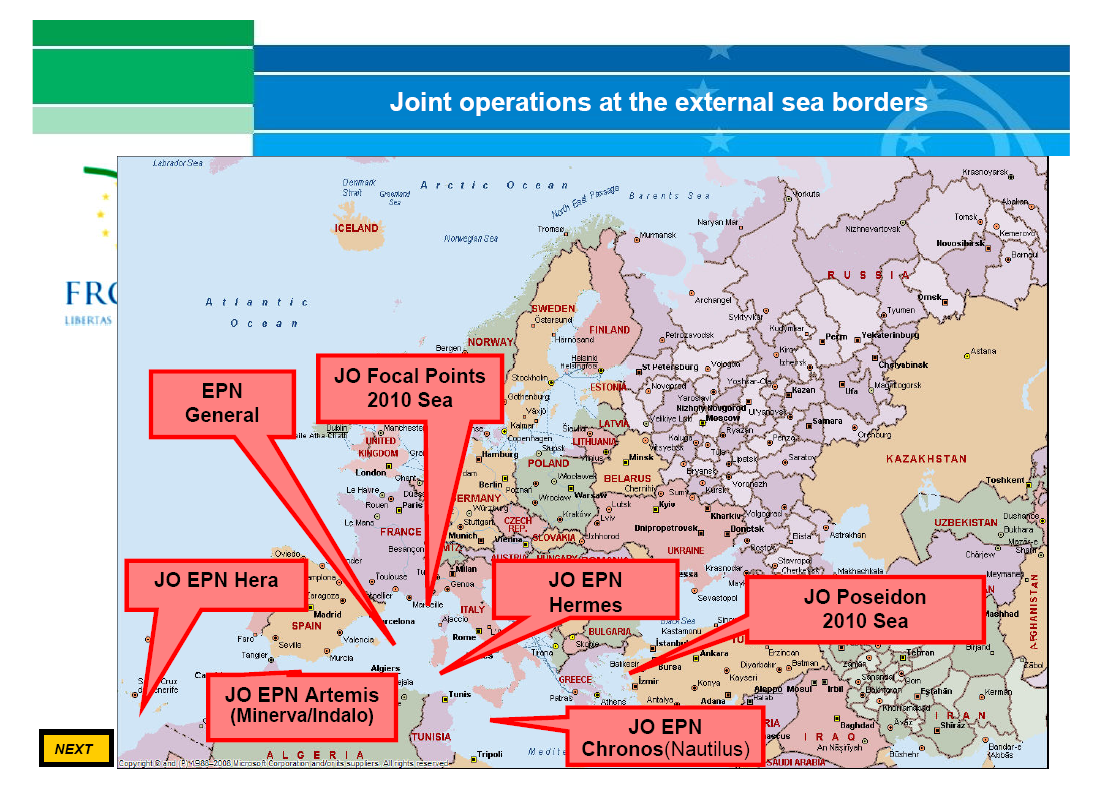
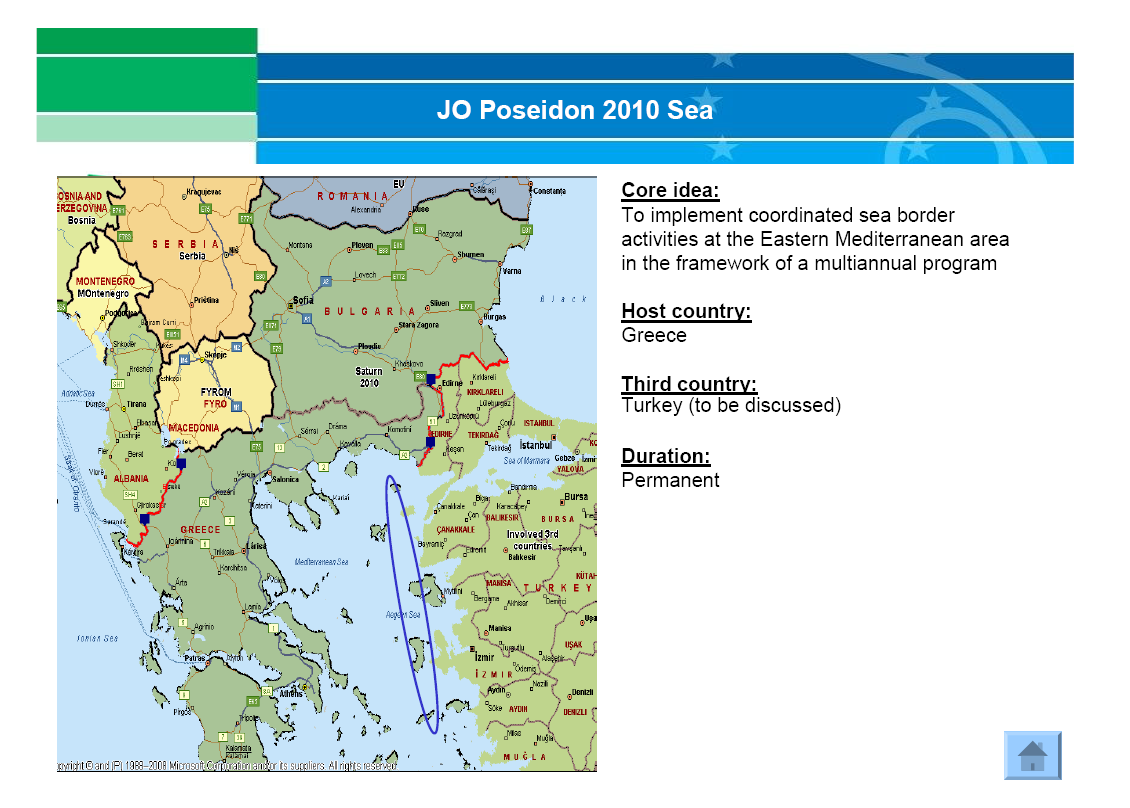
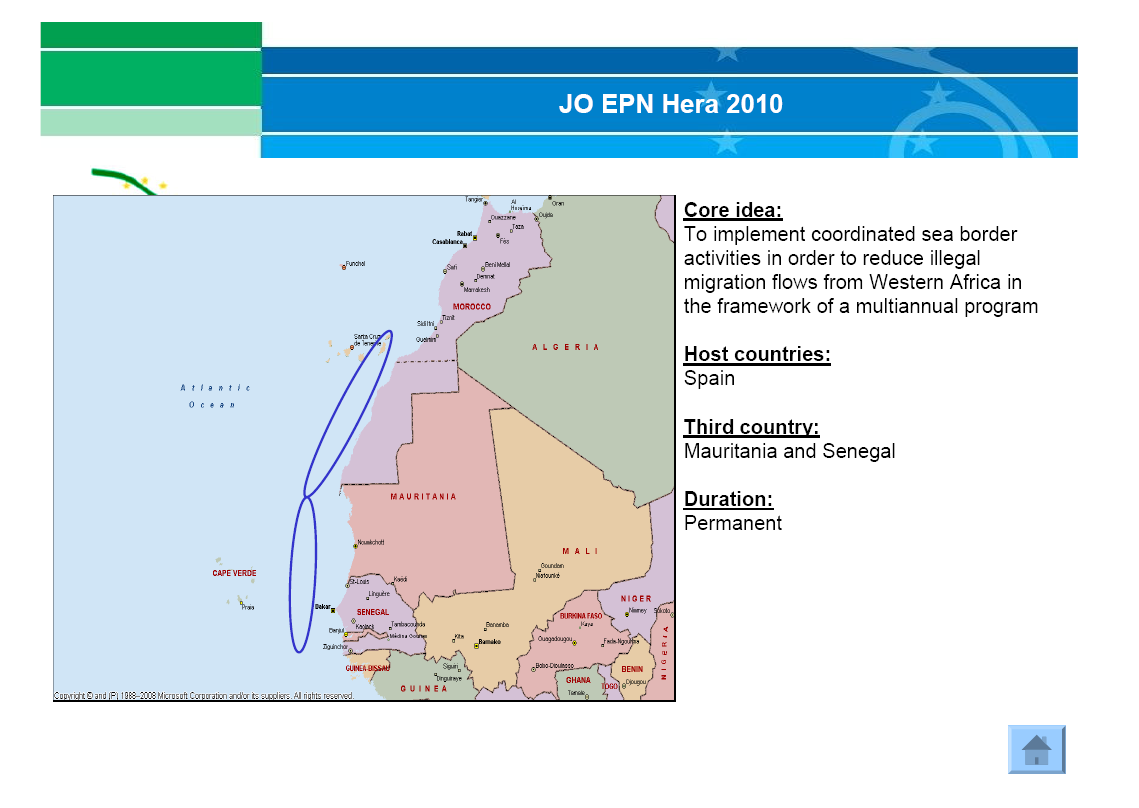
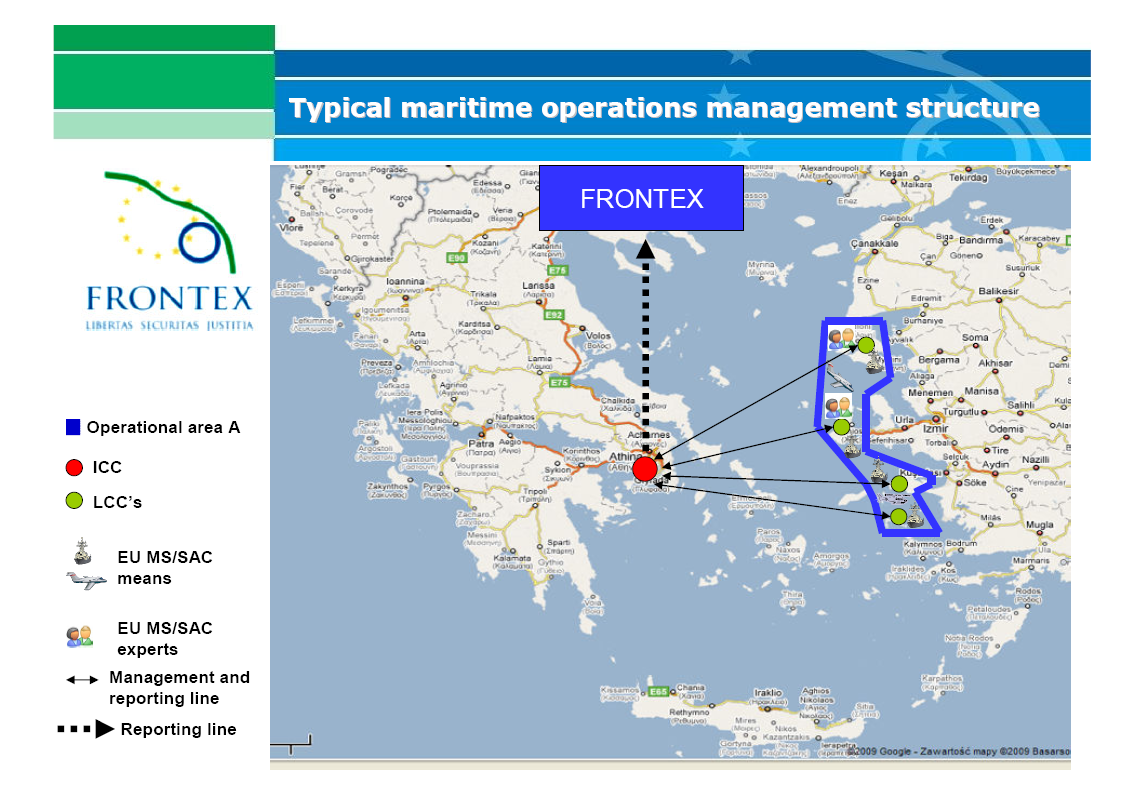
Frontex Presentation at European Defence Agency Annual Conference

Rustamas Liubajevas, Head, Frontex Joint Operations Unit, presented a lecture entitled “Frontex within integrated Border management concept – Structural approach in planning capability” at the recent Annual Conference of the European Defence Agency.

Copies of some of his slides are reproduced here.

Click here for full slide presentation.

Leave a comment

Filed under Aegean Sea, Algeria, Colloques / Conferences, Eastern Atlantic, European Union, Frontex, Greece, Italy, Libya, Malta, Mauritania, Mediterranean, Morocco, News, Senegal, Spain, Turkey

Malta: New Frontex Guidelines for Operations at Sea Could Be Ignored

The new Armed Forces of Malta Commander, Brigadier Martin Xuereb, suggested in an interview with the Times of Malta that Frontex enforcement operations are governed by operational plans that “may or may not draw from the [newly approved Frontex] guidelines”.  “‘The guidelines also state that the modalities of the operation will be agreed upon in the operational plan decided by countries that participate in the mission,’ he says, insisting the operational plan superseded the [new] guidelines.”  Xuereb also said that it was too early to say whether Malta would decline to participate in future Frontext operations.

Click here for full article.

Leave a comment

Filed under European Union, Frontex, Malta, Mediterranean, News

Somalis Were Largest Group of Irregular Migrant Arrivals in Malta

According to an article appearing in DI-VE, over 35% of the 9,554 migrants who arrived in Malta over the past 5 years were Somali.  “The second largest group [was] from Eritrea (1,259), followed by Egypt (755), Nigeria (652) and Sudan (596).”

Total Irregular Migrant Arrivals in Malta:

2005 2006 2007 2008 2009 Total
1,822 1,780 1,702 2,775 1,475 9,554

Click here for article.

Leave a comment

Filed under Data / Stats, Malta, Mediterranean, News

New Patrol Boats for Libya and Malta

Italy has delivered to Libya three patrol boats pursuant to the terms of Italy’s bi-lateral agreement with Libya to control irregular immigration.  The three boats that were turned over to Libya in a ceremony attended by Italian Interior Minister Roberto Maroni supplement three patrol boats which were delivered by Italy earlier.

Maroni spoke at the ceremony and said “Italy and Libya alone cannot carry the burden of a migration problem that touches the whole of Europe.  … [The European Commission] has not done much to date [on the migration issue].  In recent days I travelled to Ghana and Niger to sign bilateral accords and it is the first time these countries sign such agreements [on immigration] with a European state. This shows Italy is taking a leading role.”

And unrelated to the new Libyan boats, four new Armed Forces of Malta patrol boats were scheduled to arrive on Wednesday in Malta from Australia.  The new patrol boats cost €9.3m and were funded in part by the EU.

Click here and here for articles.

Leave a comment

Filed under Italy, Libya, Malta, Mediterranean, News

Background Note Pertaining to Proposed Guidelines for Frontex Operations at Sea

Given the strong objections by Malta and Italy to the proposed Guidelines for Frontex Operations at Sea, the “Note for the File” pertaining to the “Draft Council Decision supplementing the Schengen Borders Code as regards sea border surveillance in the context of operational cooperation coordinated by FRONTEX (COM(2009)658) as amended by the Council on 25 January 2010” is worth reading.

The “Note” explains the origins of the Guidelines and the additional procedures which will need to be completed before the Guidelines take effect:

“Note for the File:

The questions of who is responsible for saving people at sea and where they should be disembarked have been subject to intense debates in the context of surveillance operations concerning the EU’s sea borders coordinated by Frontex. The operations take place in a highly complex legal and political environment and touch upon international law issues and on the EU’s relations with third countries.

After long preparatory work, including a study on the relevant international law instruments completed in 2007, the Commission drafted a set of guidelines intended to

  • ensure that international rules are uniformly applied by all Member States taking part in surveillance operations coordinated by Frontex (Convention on the Law of the Sea (UNCLOS), conventions on safety at sea and search and rescue, international law on refugees and fundamental rights) and
  • create a basis in EU law enabling one Member State to carry out surveillance of another Member States’ maritime borders.

The Commission presented the draft guidelines in the form of an implementing measure, based on Article 12 (5) of the Schengen Borders Code.  This provision, together with Article 33 of the Borders Code, authorises the Commission to adopt additional measures governing border surveillance in accordance with the regulatory procedure with scrutiny as laid down in Council Decision 1999/468/EC (“comitology decision”).

After the entry into force of the Treaty of Lisbon this procedure continues to apply until the basic legal act, the Schengen Borders Code, has been aligned to the framework of the Treaty of Lisbon. Therefore, the regulatory procedure with scrutiny applies to the present draft measure.

The draft was first submitted to the Borders Code Committee. Member States’ experts failed to agree on the draft; therefore, the Committee did not issue a formal opinion. One of the controversial issues was whether the Commission’s draft went beyond its implementing powers.

On 7 December 2009, the Commission submitted a revised draft to the Council and to the Parliament, in the form of a draft Council Decision (COM(2009)658).

In accordance with the regulatory procedure with scrutiny the Council, acting by qualified majority, had the following options:

  • · oppose the proposed measure, in which case it will not be adopted; the Commission may submit an amended proposal or present a legislative proposal (option 1)
  • · envisage adopting the proposed measure, in which case it shall without delay submit it to the European Parliament (option 2)
  • · not act within the two months, in which case the Commission shall without delay submit the measures to the Parliament.

The Council had to act within a deadline of two months, i.e. before 7 February 2010.  On 25 January 2010 the Council, with Italy and Malta abstaining, decided to envisage adopting draft Council Decision and submit the draft Council Decision to the European Parliament. Furthermore, the Council agreed on an additional declaration to be adopted by the Council if Parliament does not oppose the measure, asking Frontex to report on the practical implementation of this decision.

European Parliament’s role in the procedure and deadline

In accordance with the regulatory procedure with scrutiny, Parliament has four months in total, starting from the date of referral on 7 December 2009, to scrutinise the draft measure. In practice, Parliament now has two more months to take position before 7 April 2010.

Parliament’s options in the regulatory procedure with scrutiny are limited to the following. Parliament may, acting by a majority of its component Members,

  • · oppose the adoption of the measure; in this case, Parliament must justify its opposition, stating that the proposed measure exceeds the implementing powers granted to the Commission in the basic instrument, or is not compatible with the aim or the content of the basic instrument or does not respect the principles of subsidiarity or proportionality; if Parliament opposes, the draft measure shall not be adopted; the Commission may submit an amended proposal or present a legislative proposal
  • · not oppose the adoption of the draft measure; in this case, the draft measure may be adopted by the Council or the Commission.

LIBE, as the committee responsible, will prepare Parliament’s position, in accordance with Rule 88 of the Rules of Procedure. The Member responsible in LIBE is Michael Cashman, rapporteur for the basic act, the Schengen Borders Code. Once the Council’s position, adopted on 25 February 2010, has been officially referred to the Parliament, the chairman will set a deadline for Members who wish to propose that the committee objects to the draft measure. If the committee decides to object, it shall table a motion for a resolution to the plenary for adoption before 7 April 2010.

Action undertaken by LIBE so far:

On 11 January 2010, LIBE, as the committee responsible, heard presentations of the Commission (Mr Henrik Nielsen, Head of Unit, DG JLS) and the Spanish Presidency (Mr Burgos Nieto, JHA Counsellor) and held a first exchange of views on the file.

During the debate, several Members highlighted the political importance of the decision on the guidelines (Mr Busuttil, Mrs Flautre, Mr Moraes, Mrs Hennis-Plasschaert) and the fact that this was a long-standing discussion in the Council. The Executive Director of Frontex (Mr Laitinen) underlined the swift adoption of guidelines would enhance the efficiency of Frontex’ operations.

Next steps:

The Council will refer its position, which was adopted on 25 January 2010, to the Parliament within a few days. Then it will be Parliament’s turn to take a position before the expiry of the deadline on 7 April 2010.

In order to prepare LIBE’s position, the rapporteur recommends that an opinion be requested from the Parliament’s legal service, which should answer the following questions:

1)

a) Having regard to the delineation between “rules” and “guidelines” for Member States in the draft measure as amended by the Council, could the content be considered a “non-essential element” of the final legal framework shaping the role of the Member States and Frontex?

b) Has the Commission exceeded its implementing powers under Article 12 (5) of the Schengen Borders Code by proposing the present draft measure?

2) In case the content or a part of the content of the draft measure touches upon essential elements of the basic act, could the objectives of the measure be achieved by a legislative act, notably by amending the basic act, i.e. the Schengen Borders Code?

OPERATIONAL INFORMATION:

Documents:

  • · Proposal for a Council Decision supplementing the Schengen Borders Code as regards the surveillance of the sea external borders in the context of the operational cooperation coordinated by Frontex, COM(2009)658 of 27.11.2009, as amended by the Council on 25 January 2010
  • · Commission staff working document, Study on the international law instruments in relation to illegal immigration by sea, SEC (2007)691 of 15.5.2007, available in EN and FR.

Contacts:

European Parliament:

Member responsible: Michael CASHMAN

Asisstant to Mr Cashman: Renaud-Raphaël Savignat, tel. – 47759

S&D political Advisor: Mrs Annie Lemarchal, tel. – 43057

Desk officer responsible in the LIBE Secretariat: Lotte Madlen Tittor, tel. -40785

European Commission:

Desk officer responsible in DG JLS: Ana Isabel Sanchez Ruiz, tel. 02-2998239, email: Ana-Isabel.Sanchez-Ruiz@ec.europa.eu

Head of the responsible Unit in DG JLS: Henrik Nielsen, tel. 02-2991641, email: Henrik.Nielsen@ec.europa.eu

Council General Secretariat:

Desk officer: Mr Bent Mejborn, tel. 02-2816722, email: bent.mejborn@consilium.europa.eu

Spanish Presidency:

Mr Eugenio Burgos Nieto, JHA Counsellor, email: eugenio.burgos@reper.maec.es”

Click here for link to Document.
1 Comment

Filed under Analysis, European Union, Frontex, Italy, Malta, Mediterranean

Guidelines for Frontex Operations at Sea

NB –I believe this document is the final version of the proposed guidelines approved by the Council on 25 January 2010, with Italy and Malta abstaining, and which has now been forwarded to the Parliament for scrutiny.  I will remove or amend this post if I discover this is not the final version approved by the Council.

What follows are relevant excerpts from Document COM(2009)658 (Brussels, 27.11.2009), the final Proposal for a COUNCIL DECISION supplementing the Schengen Borders Code as regards the surveillance of the sea external borders in the context of the operational cooperation coordinated by the European Agency for the Management of Operational Cooperation at the External Borders – Frontex.

As noted, Malta and Italy oppose these guidelines and have threatened to withdraw from future Frontex missions if these guidelines take effect.

Guidelines for Frontex operations at sea

1. GENERAL PRINCIPLES

1.1 Measures taken for the purpose of the surveillance operation should be conducted in a way that does not put at risk the safety of the persons intercepted or rescued as well as of the participating units.

1.2. The special needs of children, victims of trafficking, persons in need of urgent medical assistance, persons in need of international protection and other persons in a particularly vulnerable situation should be considered throughout all the operation.

1.3. These guidelines should be applied by Member States in accordance with fundamental rights. Member States should ensure that border guards participating in the surveillance operation are trained with regard to relevant provisions of human rights and refugee law, and are familiar with the international regime on search and rescue.

2. INTERCEPTION

2.1 Upon detection, the ship or other sea craft (“ship”) should be approached in order to observe its identity and nationality and, pending further measures, should be surveyed at a prudent distance. [***]

2.4. Measures taken in the course of the surveillance operation against ships or other sea craft with regard to which there are reasonable grounds for suspecting that they carry persons intending to circumvent the checks at border crossing points may include: [***]

(f) conducting the ship or persons on board to a third country or otherwise handing over the ship or persons on board to the authorities of a third country;

(g) conducting the ship or persons on board to the host Member State or to another Member State participating in the operation.

3. SEARCH AND RESCUE SITUATIONS ARISING IN THE COURSE OF THE OPERATION

3.1. Participating units shall provide assistance to any vessel or person in distress at sea. They shall do so regardless of the nationality or status of such a person or the circumstances in which that person is found.

3.2. When facing in the course of the operation a situation in which uncertainty or apprehension exists as to the safety of a ship or of any person on board, the participating unit should forward as soon as possible all available information to the Rescue Coordination Centre responsible for the search and rescue region where the situation is taking place.

In cases where the Rescue Coordination Centre of the third country responsible for the search and rescue region does not respond to the notification transmitted by the participating unit, the latter should contact the Rescue Coordination Centre of the host Member State that is geographically the closest to the emergency.

While awaiting instructions from the Rescue Coordination Centre, participating units should take all the appropriate measures to ensure the safety of the persons concerned. [***].

4. DISEMBARKATION

4.1. The operational plan should spell out the modalities for the disembarkation of the persons intercepted or rescued, in accordance with international law and any applicable bilateral agreements.

Subject to section 4.2, priority should be given to disembarkation in the third country from where the persons departed or through the territorial waters or search and rescue region of which the persons transited or, if this is not possible, to disembarkation in the geographically closest place where the safety of the persons can be ensured.

4.2. No person should be disembarked in or otherwise handed over to the authorities of a country with regard to which there are substantial grounds for believing that he or she would be subjected to persecution or to torture or to other forms of inhuman or degrading treatment or punishment, or from which there is a risk of expulsion or return towards such a country. The persons intercepted or rescued must be informed in an appropriate way so that they can express any reasons for believing that they would be subject to such treatment in the proposed place of disembarkation.

4.3. The coordination centre should be informed of the presence of persons within the meaning of paragraph 4.2, and should convey that information to the competent authorities of the host Member State.

Click here for full Document.

Click here for a “Note to the File” pertaining to the Draft Council Decision supplementing the Schengen Borders Code as regards sea border surveillance in the context of operational cooperation coordinated by FRONTEX (COM(2009)658) as amended by the Council on 25 January 2010.

1 Comment

Filed under European Union, Frontex, General, Italy, Malta, Mediterranean

Proposed Changes to Interdiction Patrol Rules Jeopardise Malta and Italian Cooperation with Frontex

The Malta Times reports that “a Frontex official said [yesterday] the new [maritime interdiction] guidelines were specifically aimed at avoiding disputes such as the ones that broke out between Malta and Italy. In the past, immigrants were stuck on the high seas as the two countries were locked in a diplomatic wrangle on who was responsible for the people rescued. ‘Everyone recalls these incidents and the Commission’s intervention. Brussels ended up as a referee in these disputes and we don’t think that’s our role. This is specifically why we needed to have a specific code of conduct to guide future Frontex missions. This will put participating member states’ minds at rest,’ the official said.”

The proposed changes would require migrants to be taken to the country hosting the Frontex mission if it was not possible to return the migrants to their country of departure and could go into effect as early as April when Frontex interdiction patrols are scheduled to resume in the central Mediterranean under the new mission name of Operation Chronos.

“Both Malta and Italy objected strongly [to the proposed changes] on the basis of the fact that the guidelines go beyond international legal obligations, which say that migrants should be taken to the nearest safe port [which in Malta’s case] often meant the Italian island of Lampedusa.”

Click here for article.

1 Comment

Filed under European Union, Frontex, Italy, Malta, Mediterranean, News

Frontex: Operation “Nautilus” to become Operation “Chronos”

During a recent briefing to the Civil Liberties Committee of the European Parliament, Frontex Executive Director Ilkka Laitinen revealed that the Frontex name for its four year old interdiction operation in the central Mediterranean will change from “Nautilus” to “Chronos” as of April 2010.

“According to figures given by Frontex [at the briefing], only 3,300 illegal immigrants reached Malta and Lampedusa last year, less than half the number registered in the previous year.  In the case of Malta, there were 2,775 arrivals in 2008 and 1,475 in 2009.”

Click here for article.

1 Comment

Filed under Data / Stats, Frontex, Malta, Mediterranean, News

Malta Objects to Proposed Changes in Frontex High-Seas Interception Guidelines

The Government of Malta has reportedly objected to proposed changes to Frontex operational guidelines and has threatened to possibly end its participation in patrols overseen by Frontex.

The proposed changes to the Frontex guidelines were made by the European Council and will be considered by the European Parliament.  The changes would require that migrants intercepted at sea be sent to the country hosting the Frontex mission if the migrants could not be returned to the country from which they last departed.  Currently intercepted migrants are to be taken to the nearest port.

“In terms of the new guidelines, should Malta host a Frontex mission, as it has done in the past two years, it will have to take all the immigrants rescued, even if they were picked up outside its search and rescue region and closer to other countries. ‘We will still continue to follow our international obligations to the letter as we’ve always done but we will not accept changes to these international obligations,’ a Malta government spokesman said.

Even if Frontex guidelines were to be changed, Italy will presumably continue its policy of forcibly returning to Libya migrants intercepted by Italian authorities.

Click here for full article.

Leave a comment

Filed under European Union, Frontex, Malta, Mediterranean, News

BLUEMASSMED: Project for Maritime Surveillance of the Mediterranean Area and the Atlantic Approaches

The Bluemassmed project is a new initiative from the European Commission designed to increase cooperation for maritime surveillance in the Mediterranean Sea and its Atlantic approaches, including surveillance of illegal immigration.  The inaugural meeting for the Project was held in Paris on 15 January 2010.

“France, Greece, Italy, Malta, Portugal and Spain [will] cooperate on this specific project to strengthen their common actions against illicit trafficking, illegal immigration and environmental pollution. It will also permit [the reinforcement of] the Search and Rescue efforts in the area. This pilot project granted by the European Commission and co-funded by 6 Member States countries (France, Greece, Italy, Malta, Portugal and Spain) is the first state-centred action to integrate such an important field between Member States countries.”

The project is a two year project “divided in two stages. The first one intends to define the requirements of the actors in terms of exchange of information and to submit a list of technical and legal proposals. The second stage will result in a demonstration, performed among partners and wider, with the help of a demonstrator prototype, connecting present information systems from partners, shaping a possible future network of State actors for maritime surveillance systems, in the framework of several realistic scenarios.”

“The [French] Secrétariat Général de la Mer is leader of the project. The Agenza Spaziale Italiana is Co-leader of the Steering group, composed by representatives from each Member States, which will define the strategic guidelines of the project.”

“BLUEMASSMED aims at being a catalyst for internal and external cooperation between Member States and maritime surveillance actors. The success of this project is directly linked to the involvement of the Partners, responsible to their governments. The prototype demonstrator will be carried out with the support of industry. Industrial involvement is considered as a key investment.”

Click here for Bluemassmed web site.

Click here for English Press Release or here for French Press Release from inaugural conference.

Click here for EC Directorate-General for Maritime Affairs and Fisheries Non-Paper on Maritime Surveillance, 13 Oct. 2008.

Leave a comment

Filed under Eastern Atlantic, European Union, France, Greece, Italy, Malta, Mediterranean, News, Portugal, Spain

African migrants and their desperate ploy for a better life – Times Online

From The Sunday Times Magazine, 22 November 2009:

“Meet the survivors, bereaved families from Gambia and Senegal, and a man who smuggles the people — at a colossal price.”

“… The routes [African migrants] take are many and varied. From west Africa, migrants trek through the pitiless Sahara to Libya, from there to brave the Mediterranean — or, more perilous yet, strike out for the Canary Islands in fragile canoes known as ‘pirogues’.  If they then cross to the Spanish mainland they will probably do so in tiny, open Spanish fishing boats. An estimated one in every eight migrants who try to travel across the ocean to Europe don’t make it, their bodies carried out into the cold Atlantic. Those who perish are identified only by chance, their skeletons dredged from the sea by Italian and Spanish trawlers, or their bodies washed on to beaches used by holidaymakers…”

Full article:  African migrants and their desperate ploy for a better life – Times Online.

Leave a comment

Filed under Eastern Atlantic, Gambia, Italy, Libya, Malta, Mediterranean, News, Senegal, Spain

Migrant Arrivals in Malta Lowest in 5 Years

Di-ve.com reports that migrant arrivals in Malta in 2009 were the lowest since 2004.

“Sources close to Frontex … believe that a number of factors helped …  Frontex’s Nautilus patrols, the strengthening of border controls in the Central Mediterranean and tighter inland measures in member states certainly discouraged movement of migrants. … The agreement between Italy and Libya for migrants to be returned to Libya also had an impact but …there are also agreements in place with Algeria and Tunisia, while Libya also reached an agreement with Niger, which is another popular transit country for migrants heading towards Europe. There has been a shift towards the eastern Mediterranean, with Turkey and the Aegean islands seeing numbers increase, the sources said.”

2002 2003 2004 2005 2006 2007 2008 2009
Boats 21 12 53 48 57 68 84 17
Migrants 1686 502 1388 1822 1780 1702 2775 1475

Click here for full article.

Leave a comment

Filed under Data / Stats, Frontex, Malta, Mediterranean, News

JRS Malta – “Do They Know? Asylum Seekers Testify to Life in Libya”

The Jesuit Refugee Service Malta released a report entitled “Do They Know? Asylum Seekers Testify to Life in Libya.”

“Since May 2009, some 1409 migrants, attempting to reach a place where they could obtain protection or the possibility to live in safety and dignity, were pushed back to Libya.  These actions were widely criticised and held by many to be a violation of international law, as Libya does not have the mechanisms in place to grant protection to those who need it and there is evidence that those returned would be at risk of harm.”

“JRS Malta believes that returning migrants to Libya, where they cannot obtain effective protection if they need it and where they face a real risk of serious harm, violates international law. We therefore call upon the government to:

• Ensure that all asylum seekers within Malta’s effective jurisdiction are allowed to apply for protection.

• Rescue migrants intercepted by the AFM if they have requested assistance, as otherwise their safety cannot be guaranteed

• Ensure that all those rescued within Malta’s Search and Rescue Area are disembarked at a safe port, where those in search of protection can seek asylum

• Refrain from actions that will result, directly or indirectly, in the return of migrants to a country where they risk suffering serious violations of their fundamental human rights.”

Click here for copy of JRS Malta statement.

Click here for the report “Do They Know? Asylum Seekers Testify to Life in Libya.”

Leave a comment

Filed under Italy, Libya, Malta, Mediterranean, Reports

Frontex Warns Malta About Refugee Resettlement Consequences

MaltaToday reported last month that Frontex officials have warned Malta that resettlement agreements between Malta and the USA and other countries are being used by organised criminal smuggling organisations to market Malta as a preferred destination.

The information was provided at a “Frontex debriefing meeting held in Caltanisetta in Sicily, where military and governmental officials from EU Member States were given details about the recent Nautilus IV mission held in the Mediterranean during this summer…  Senior military sources told MaltaToday that Frontex officials spoke of intelligence that showed how criminals behind the lucrative illegal migration trade were ‘actually marketing Malta as the right destination to direct migrants,’ given that it has now become public that the US is accepting migrants from Malta.”

Over 400 refugees have been resettled from Malta to the USA, France, and other countries.

Click here for article.

Leave a comment

Filed under Frontex, Malta, Mediterranean