Category Archives: Malta

Director Laitinen Describes Frontex Response to the 2011 Migratory Flows from North Africa

In a recent opinion article published on Publicservice.co.uk, Frontex Director Ilkka Laitinen described the challenges faced by Frontex and provided a description of Frontex’s “unprecedented” activities over the past 12 months in the operational theatre, referring to the first RABIT deployment in October 2010 and the response to the migratory flows from North Africa beginning in January 2011.

Extensive excerpts regarding the response to the migratory flows from North Africa:

“…  Since January 2011, world attention has been focused as never before on the Arab world. The ‘Arab Spring’ uprisings in North Africa and the Middle East once again redrew the European migration map, and Frontex’s operational capacity was tested again. With the arrival of almost 5,000 migrants on the tiny Italian island of Lampedusa, the agency was once more called upon to assist. However, the support required was in a very different form than that in Greece.

African exodus
The migratory flows from North Africa towards the EU external borders – predominantly to Italy and Malta – have been very different from those to Greece. Initially, almost all were economic migrants from Tunisia seeking work in Europe.

The modus operandi of the facilitation networks behind the phenomenon was a familiar one to Frontex, namely, over-packing unseaworthy vessels with inadequately experienced crews and little life-saving equipment, if any. This created a predominantly humanitarian need for search and rescue activities at sea. It also created an administrative challenge on shore, to process usually undocumented migrants, establish their nationalities and identities and take care of their immediate needs, as well as to transfer them to better equipped facilities on the mainland and start return procedures where appropriate. There was no call from Italy for a RABIT deployment, however. Italy is very well equipped for maritime border control, as well as for search and rescue activities. Where the Italian authorities requested most support was in Frontex’s other areas of specialisation – intelligence gathering, situational awareness, and the deployment of experts to the field to assist in the screening and debriefing of migrants (establishing probable nationality and gathering evidence of people smuggling respectively). Long before being called on by the Italian Ministry of Interior, Frontex’s Situation Centre and Risk Analysis Unit were busy identifying the full range of possible scenarios in Egypt, Tunisia and Libya, as well as monitoring developments in other countries in the region.

Since the first waves of migrants from Tunisia, the situation has evolved constantly, with ever more sub-Saharan migrants and refugees seeking international protection. Such changeable flows require flexibility and constant adjustment to the operational response. For each possible scenario, an appropriate operational response was planned by the Joint Operations Unit and all necessary steps were taken to ensure that a rapid response could be launched anywhere in the operational area at any time.

This is an ongoing process and a challenge to which expert staff at the agency’s Warsaw HQ, and the Frontex Operational Office in Piraeus, Athens, continue to respond. This readiness ensures operational flexibility. It also demonstrates another important area in which Frontex adds value to member states’ activities at the EU’s external borders. It must always be borne in mind that it is the member states themselves that remain at all times responsible for their own borders; Frontex’s role is to provide support when requested. Keeping member states up to date with detailed and accurate intelligence is one of the ways the agency works behind the scenes to maximise member states’ effectiveness. Another way is by providing a platform for exchange of data and other information. Equally, experts in the field debrief migrants to build up a clearer picture of the routes used, prices paid and other modi operandi of the smuggling networks involved.

The cruel sea
The maritime domain remains the most complicated for border control, not least legally. The provisions of national and international maritime law and their impact on migration management, make the seas the most challenging environment for operations. It is for this reason that for many years, Frontex has been encouraging greater coordination between the southern member states themselves through the European Patrols Network (EPN) – an initiative to increase efficiency, improve information sharing and reduce overlapping of efforts and the incumbent gaps they leave in surveillance. It was the existing EPN provisions in the Mediterranean that formed the basis of Frontex’s operational response to the migration flows from North Africa. And it is the EPN that will be strengthened as a combined surveillance response going forward. EPN will form an essential component of EUROSUR, the common European surveillance system now being developed. It will also help to enhance Europe’s search-and-rescue capacity in the Mediterranean.

But as has been said many times, border control is no panacea. It is the last line of control and rescue. Its rightful place is at the heart of a far-reaching IBM [Integrated Border Management] system that includes deterrents against illegal migration as well as incentives for legal migration, and that tackles the root causes of such migration in countries of origin and transit. To put it simply, prevention is better than cure, and by the time migrants reach the external EU border it is often too late.

The most effective way to tackle the dangers of illegal migration by sea is to deter migrants from setting out in the first place. Only when this principle is enshrined at the EU policy level can it be claimed that the Union is seriously tackling illegal migration and cross-border crime.”

Click here for link to full text of article.

Leave a comment

Filed under European Union, Frontex, Greece, Italy, Libya, Malta, Mediterranean, News, Tunisia

Reports of First Post-Gaddafi Migrant Boat [UPDATED 2345 GMT – Lampedusa “Closed” for SAR Operations]

Italian media is reporting this afternoon that a satellite telephone distress call has been received from a disabled migrant boat carrying about 50 persons from Libya.  A search in the Maltese SAR zone is being undertaken.  The boat is reportedly drifting about 70 miles south of Lampedusa.  If the report is accurate, this would appear to be the first known migrant boat to have left Libya since the overthrow of Gaddafi.

Click here and here for articles.  (IT)  Click here for article. (EN)

[UPDATE 23:45 GMT – A Malta Today report suggests, as has been the case before, there may be  disagreement between Maltese and Italian officials regarding who has responsibility for coordinating SAR operations.  Malta Today reports that Malta is now coordinating SAR operations due to the “closure” of Lampedusa by Italian officials.  Click here for article.]

Leave a comment

Filed under European Union, Frontex, Italy, Libya, Malta, Mediterranean, News

Frontex Quarterly Reports for 2011 Q1 and Q2

The Frontex Risk Analysis Unit (RAU) released its 2nd Quarter Report (April-June) for 2011 on 4 October.  The 1st Quarter Report (Jan-March 2011) was released on 21 July.  As always, while the information is a few months old, the reports contain a significant amount of information, graphs, and statistical tables regarding detections of illegal border crossings, irregular migration routes, detections of facilitators, detections of illegal stays, refusals of entry, asylum claims, and more.

Here are extensive excerpts from the Q2 Report:

“Executive summary

In Q2 2011, all Frontex irregular-migration indicators increased compared to the previous quarter. The most important indicator, detections of illegal border-crossing, increased to a level not seen since Q3 2008 and correspondingly asylum applications are now at nearly the highest level since data collection began. What’s more, migration pressure at the border from migrants attempting to enter and stay in the EU increased even more than EU-level figures suggest, as they are offset against extensive reductions in Albanian circular migration.

In 2011 there were major and extensive developments in irregular-migration pressure at the external border of the EU, resulting from two simultaneous but independent hotspots of illegal border-crossings: the first was seasonally increased activity at the Greek land border with Turkey, where a wide variety of migrants continued to be detected at very high levels. The second, and the undeniable hotspot for illegal border-crossing into the EU in Q2 2011, was in the Central Mediterranean, where vast numbers of sub-Saharan migrants landed in Italy and Malta mostly having been forcibly expelled from Libya. [***]

4. Main points Q2 2011

  • All irregular migration indicators increased relative to the previous quarter
  • Compared to a year ago, there were significant EU-level increases in several irregular migration indicators, such as detections of illegal border-crossing, clandestine entries, and refusals of entry. There were also increased asylum applications
  • Despite detections of Afghan migrants falling by a third compared to last year, they were still the most common nationality detected illegally crossing the EU external border. Most were previously resident as refugees in Iran
  • In contrast, detections of all the other highly-ranked nationalities (Tunisians, Nigerians, Pakistanis, Ghanaians) increased massively relative to the same period last year
  • In total there were over 40 000 detections of illegal border-crossings, a 50% increase compared to Q2 2010. These were the result of two simultaneous but independent routes of irregular migration: the Eastern Mediterranean and the Central Mediterranean routes:

1. In the Eastern Mediterranean:

– There were over 11 000 detections of illegal border-crossing, almost exclusively at the Greek land border with Turkey, which is comparable with the same period in 2010

– This flow currently attracts migrants from north Africa, sub-Saharan Africa and Asia

– Groups of Dominicans were detected travelling to Turkey to enter the EU via the Greek land border

– Secondary movements are assumed from detections of (i) illegal border-crossings in the Western Balkans, (ii) false documents on flights to major EU airports from Turkey as well as Greece, and (iii) landings in southern Italy from Greece, Turkey and Albania

2. In the Central Mediterranean:

– Following a bilateral return-agreement between Italy and Tunisia, the massive influx of Tunisians to Lampedusa reported in the previous quarter decreased, but remained significant

– A very wide range of sub-Saharan Africans were detected on this route, some having been forcibly departed from Libya

– Italy reported more detections of illegal border-crossing in Sicily than ever before, a three-fold increase compared to the previous quarter; the increased flow was composed of migrants from Côte d’Ivoire as well as Tunisia and a range of other nationalities

– There were also increased detections of Egyptian migrants and facilitators landing in Sicily and Southern Italy from Egypt

– Italy and Malta reported huge increases in the number of asylum applications submitted by sub-Saharan African migrants. In Italy increases were particularly marked for Nigerians and Ghanaians

  • Following their new visa-free status, fewer Albanians were detected illegally crossing the EU border, and illegally staying within the EU (both mainly in Greece). Instead they were increasingly refused entry to Greece and they were also increasingly detected at the UK border, either as clandestine entry or using false documents
  • There was an increased flow of Georgian migrants towards Belarus (air and land), with increased illegal entries and asylum applications in Poland and Lithuania
  • In Q2, Libya was the most significant source of irregular migration to the EU. However, more recently the ability of the Gaddafi regime to forcibly expel its migrant population to the EU has become compromised; the situation remains dynamic and uncertain[.]

4.1 Detections of illegal border-crossing

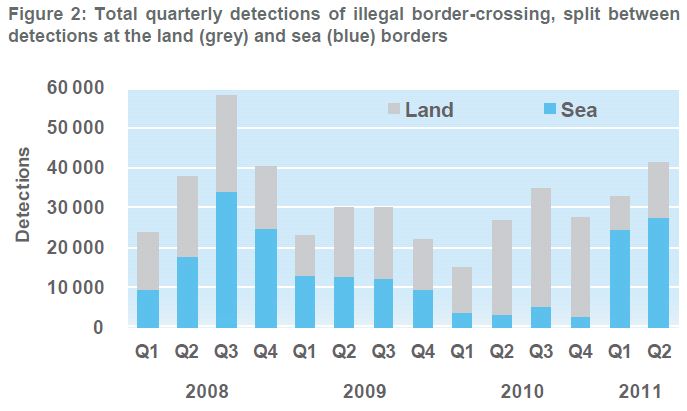
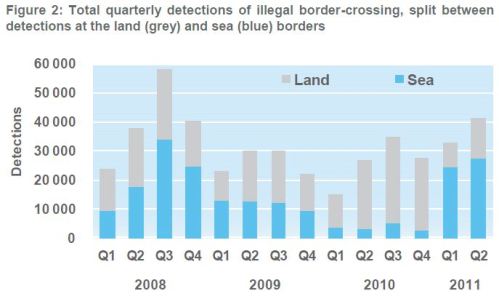
At the EU level, in Q2 2011 there were more detections of illegal border-crossing since Q3 2008. The total of 41 245 detections during this reporting period is a 25% increase compared the previous quarter and a 53% increase compared to the same period last year (Fig. 2). Without question there were major and extensive developments in illegal migration pressure at the external border of the EU, resulting from two simultaneous but independent hotspots of illegal border-crossings. The first was increased activity at the Greek land border with Turkey, where a range of Asian, north African and sub-Saharan African migrants were increasingly detected at very high levels. The second, and the undisputed hotspot for illegal border-crossing into the EU in Q2 2011, was at the Italian islands in the Central Mediterranean, where vast numbers of Tunisians, Nigerians and other sub-Saharan migrants landed in small sea vessels, the majority of which in Q2 had been forcibly departed from Libya.

Figure 2 shows the evolution of the FRAN indicator 1A – detections of illegal border-crossing, and the proportion of detections between the land and sea borders of the EU per quarter since the beginning of 2008. In Q2 2011 there were more detections of illegal border-crossing since the peak of Q3 2008 nearly three years ago. Compared to a year ago, detections at the EU land border decreased by 42% to 13 742 in Q2 2011, almost exclusively due to fewer detections of Albanian nationals following their new visa-free status; elsewhere at the land border (including Greece) trends were roughly stable. In contrast, at the sea border detections increased nine-fold to some 27 500 detections (Fig. 2), the vast majority of which (95%) were in the central Mediterranean, forming the major development in irregular migration to the EU in 2011.
[***]

At the EU level, detections of illegal border-crossing increased by 53% compared to a year ago (Fig. 3). However, this level masks a lot of variation among Member States. First, and most importantly to the current situation, was a 4 200% increase in detections of almost exclusively African migrants in Italy. Related to this central Mediterranean flow, was a concurrent and massive increase in detections reported from Malta (from 0 to 710), and also increases further west into Spain (+61%). As a result, all these countries have seen increases in other indicators such as asylum applications of the most common nationalities (see relevant sections). [***]

Routes

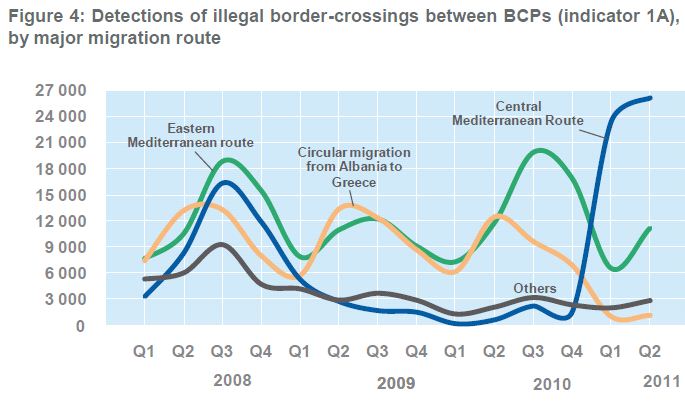
As illustrated in Figure 4, for just the second time since records began in early 2008, in Q2 2011 detections of illegal border-crossings on the Central Mediterranean route, which comprises the blue borders of Italy and Malta, exceeded those reported from both the (i) Eastern Mediterranean route of the land and sea borders of Greece, Bulgaria and Cyprus, and (ii) circular migration from Albania to Greece.
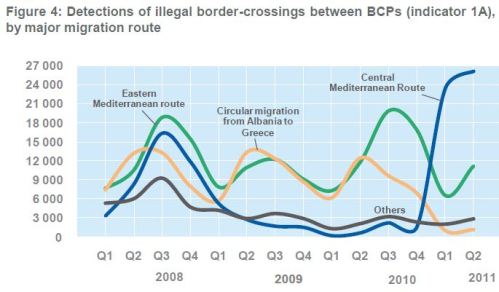
Without question, in Q2 2011 the single most important irregular-immigration route in terms of detections of illegal border-crossing was the Central Mediterranean route, where detections increased in the beginning of 2011 to previously unprecedented levels (Fig. 4). In the first quarter of 2011, and uniquely compared to previous surges of illegal immigration, this flow was restricted to a single nationality – Tunisian, most of whom were responding to civil unrest in their home country by leaving towards the Italian Island of Lampedusa. In response to this almost unmanageable influx of irregular migration at a single and isolated location, a bilateral return agreement was signed between Italy and Tunisia, which allowed for the accelerated repatriation of newly arrived individuals. Hence, during the current reporting period, the flow of Tunisian migrants fell from over 20 200 in the previous quarter to 4 300 in Q2 2011.

However, civil uprising commonly referred to as the Arab Spring, and its effects on migration in the area, was not limited to Tunisia. For example according to multiple sources, in next-door Libya, migrants from sub-Saharan countries were in Q2 2011 being coerced to move towards the EU by the Gaddafi regime in response to the NATO Operation Unified Protector which commenced on March 27 under United Nations Security Council Resolution 1973. Thus, in Q2 2011, besides some continued departures from Tunisia, the flow in the central Mediterranean was composed of a single flow of large numbers migrants from sub-Saharan countries departing Libya in small vessels. [***]

4.1.1 Eastern Mediterranean route

Detections of illegal border-crossings on this route increased seasonally and in line with previous years, from 6 504 in Q1 2011 to 11 137 in Q2 2011, almost exclusively due to a massive increase in detections at the Greek land border with Turkey, where detections increased from 6 057 to 10 582. [***]

4.1.2 Central Mediterranean route

In Q2 2011 there were 26 167 detections of illegal border-crossings on the Central Mediterranean route, a 10% increase even compared to the ‘peak’ reported during the previous quarter, and evidently a massive increase compared to the negligible detections throughout all of 2010. The vast majority of detections on this route were reported from Italy (25 500) where detections increased by 13% even compared to the ‘influx’ of migrants reported during Q1 2011. In Italy, Central African, Tunisian, Nigerian and Ghanaian were the mostly commonly detected nationalities, 90% of which were detected in the Pelagic Islands (14 300), most notably Lampedusa (Fig. 7). However, in Q2 2011 there were also more detections of illegal border-crossing reported from Sicily (2 260) than ever before; this figure is nearly three times bigger than that reported in the previous quarter and more than twenty times higher than during the same period last year (100). Compared to the previous quarter, in Sicily there were more detections of migrants from a very wide range of countries such as Egypt, Côte d’Ivoire and Tunisia. There were also over 710 detections reported from Malta, which is a sustained peak from the previous quarter (820) and extremely high compared to the negligible detections throughout 2010. In Malta there were much fewer detections of Somalis and Eritreans but there were increased detections of Nigerians and migrants from Côte d’Ivoire. However, migrants from Tunisia, Algeria and Egypt often claim to originate from sub-Saharan Africa in an attempt to appear as refugees, a fact which may render such comparisons of nationalities somewhat misleading.

In the previous FRAN Quarterly (Q1 2011) it was reported a surge of irregular immigration (20 000 detections) on the Central Mediterranean route that was almost entirely restricted to a single nationality: Tunisian (Fig. 8). As a result of this influx, on 20 February the JO EPN-Hermes Extension 2011 commenced in the central Mediterranean, and a bilateral agreement was reached between Italy and Tunisia on 5 April 2011, which resulted in the strengthening of police surveillance along the Tunisian coast and regular repatriations of Tunisian nationals from Italy. For example, according to data collected under JO Hermes 2011, some 1 696 Tunisians were repatriated between 5 April and 23 August 2011. The repatriation agreement is probably an effective deterrent, combining as it does, returns and surveillance, however some migrants have reported their boats being spotted by military patrols that did not take any action. According to the FRAN data, in Q2 2011 some 4 286 Tunisian migrants were still detected illegally crossing the border into Italy. Although a massive reduction, this still represents a very large and significant flow of irregular migrants into the EU.

In comparison to the reduction in flow from Tunisia, in Q2 2011 there was a large increase in migrants who had departed from Libya (Fig. 9). The migrants departing from Libya were mostly nationals from countries in the Horn of Africa, the sub-Saharan and Central African regions and, to a lesser extent, Asia. According to intelligence collected during JO EPN-Hermes Extension 2011, most of these migrants had already been in Libya for over a year, originally heading to Tripoli via the traditional routes for sub-Saharan and Central African migrants. In Q2 2011, migrants tended to reach Italy on large fishing vessels that had departed directly from Tripoli or the nearby ports of Medina and Janzour. Most of these deported African nationals did not want to leave the country as their standard of living in Libya was high compared to their home countries. Several even stated that they would choose to return to Libya after the war. In Q2 2011 reports suggest that some migrants were instructed to reach embarkation areas on their own but had been caught by the military or police and then detained in camps or disused barracks until they were transported to embarkation areas and onto vessels bound for Italy. In each case the migrants were searched by the military before boarding and all their belongings were confiscated. According to reports, nationals of the sub-Saharan and Central African regions as well as from Horn of African countries have been recruited by the Libyan army/police to manage their compatriot migrants at gathering places or camps. In some cases the destination of vessels from Libya was Sicily, where the flow was characterised by waves of landings. For example there were around 11 landings on 13 May and 7 between 11 and 29 June, with the majority of boats arriving from Libya and Egypt. [***]

4.1.3 Western Mediterranean route

In Q1 2011 there were 1 569 detections of illegal border-crossings on this route to Southern Spain, which is nearly double compared to the previous quarter (890), and more than a 50% increase compared to a year ago (973). Some of this increase is due to better weather conditions at this time of year, but irregular migration pressure on this route is clearly higher than it was at the same time last year. [***]

In the longer-term, irregular immigration to southern Spain has been consistently decreasing since the beginning of 2006. Commonly cited reasons are Frontex Joint Operations in the area, effective bilateral agreements and more recently rising unemployment in Spain, particularly in sectors typified by migrants.* Nationalities traditionally associated with this route were Algerian, Moroccan and Ghanaian. [***]

4.1.4 Western African route

The cooperation and bilateral agreements between Spain and the rest of the Western African countries (Mauritania, Senegal and Mali) are developing steadily. They are one of the main reasons for the decrease in arrivals on this route over the last year, as are the presence of patrolling assets near the African coast. In Q4 2010 Frontex reported a slight increase in the number of detections of illegal border-crossing at the Canary Islands, from a maximum of 50 during each of the previous 4 quarters, to 113 in Q4 2010. This increased level of detections persisted into the first quarter of this year (154), exclusively due to Moroccan nationals (152) displaced after the dismantling of migrant camps near the dispute Western Saharan region. However, during the current reporting period detections on this route decreased massively to a negligible 24 detections. [***]”

Click here for 2011 Q2 Report.

Click here for Frontex Statement regarding 2011 Q2 Report.

Click here for 2011 Q1 Report.

Click here for Frontex Statement regarding 2011 Q1 Report.
3 Comments

Filed under Aegean Sea, Algeria, Analysis, Cyprus, Data / Stats, Eastern Atlantic, Egypt, European Union, Frontex, General, Greece, Italy, Libya, Malta, Mauritania, Mediterranean, Morocco, News, Reports, Senegal, Spain, Tunisia, Turkey

Call for Support: Boats 4 People Project

From Migreurop:  “… thousands of migrants died in the Mediterranean this Summer in their attempts to reach Europe. Boats wandered adrift and shipwrecks took place in front of Coast Guard ships, surveillance patrols of Frontex and ships from the military coalition engaged operations in Libya under NATO command.  For the last several years, African and European organisations alike have been challenging governments about the number of deaths occurring at the borders of the European Union, but in vain. We have come to the conclusion that it is essential now to move to direct action in the light of the excessive number of shipwrecks taking place in the Mediterranean and the reluctance of Europe to concede entry to refugees. We call for a Mediterranean which is in solidarity with migrants and in opposition to repressive policies which seek to criminalise migration towards Europe more and more each day.

What are the concrete aims of the Boats 4 People initiative ?

  • To denounce the tragedy which is taking place in the Strait of Sicily
  • To exercise our right of access to the maritime regions in which these shipwrecks are taking place and to the centres in which migrants arriving in Italy are detained
  • To raise awareness about the requirements of the law of the sea in terms of assistance and to support citizens and sailors who rescue migrants and are criminalized.
  • To accuse state actors working at sea (border guards, Frontex, NATO) who are guilty of failing to assist migrants in difficulties and of refouling asylum seekers, against the provisions of the UN Convention on the Law of the Sea and the Geneva Convention
  • To strengthen Euro-African solidarity with regard to migration and the defence of migrant rights

Trip and organization of the project – The boats will leave for Spring 2012 from Rome, from where they will travel towards the south of Tunisia via Sicily, Malta, Lampedusa, Tunis, Sfax and Ben Guardane.  At the moment, we aim to use one or several motor/sail boats with a total capacity of around fifty passengers, including the crews. If you have one – or several ! – boats and would like to follow the flotilla for all or part of the journey, please contact the organisers.  The aim of the flotilla is to exert maximum pressure on the European authorities by carrying people likely to raise awareness of the situation in the Strait of Sicily and to denounce it to the greatest possible number of people. We also aim to allow the greatest number of people possible to participate by rotating passengers at each stop. If you are a Member of Parliament, journalist or artist and you wish to participate in a stage of the journey, please send your details to coord@boats4people.org. …”

Click here for full posting.

Leave a comment

Filed under European Union, Italy, Libya, Malta, Mediterranean, Statements, Tunisia

CoE Human Rights Commissioner Releases Report on Italy’s Treatment of Roma and Migrants

Council of Europe Commissioner for Human Rights, Thomas Hammarberg, just released a report on Italy based upon his visit to Italy on 26-27 May 2011.  The report addresses concerns relating to the treatment of the Roma and Sinti and relating to the treatment of migrants, including migrants arriving from North Africa.

Excerpts:

“Strasbourg, 7 September 2011 – CommDH(2011)26 – English only

Report by Thomas Hammarberg, Commissioner for Human Rights of the Council of Europe, following his visit to Italy from 26 to 27 May 2011

[***]

II. Protection of the human rights of migrants, including asylum seekers

Rescue operations and interceptions at sea

The Commissioner welcomes the invaluable efforts of the Italian authorities aimed at rescuing migrants on boats crossing the Mediterranean. He strongly encourages the Italian authorities to maintain their long-standing tradition of rescue, which is all the more indispensable in the current context of forced migration from Libya. He calls on the Italian authorities to ensure that in all cases where migrants are in distress at sea their rescue and safety enjoy absolute priority over all other considerations, including any lack of clarity and agreement, notably between Italy and Malta, about responsibilities for rescue. With reference to the operations carried out jointly with Libya in the central Mediterranean aimed at intercepting migrants fleeing Libya on boats and returning them there (so-called push-backs), the Commissioner urges the Italian authorities to discontinue and refrain from becoming involved in any practices in the field of interceptions at sea that may result in migrants being sent to places where they are at risk of ill treatment or onward refoulement.

[***]

II. Protection of the human rights of migrants, including asylum seekers

44. Following the political unrest in Tunisia and the armed conflict in Libya, the number of migrants, including asylum seekers, arriving on boats to Italy, and in particular Lampedusa, has increased sharply. Since mid-January, approximately 24 000 people have arrived from Tunisia. At the end of March 2011, migrants also started to arrive on boats from Libya (the biggest groups being nationals of Nigeria, Ghana, Mali, Ivory Coast, Bangladesh, Eritrea and Somalia) and by 23 June their number had almost reached 20 000. In addition to arrivals from Tunisia and Libya, some 2 000 migrants landed in southern Italy on boats coming from Egypt, Greece and Turkey. On 23 June, the total figure of arrivals by sea to Italy since January 2011 therefore stood at around 46 000.

45. It is clear that these events pose a number of challenges relating to a wide range of human rights, including the right to seek asylum and the right to life, notably in connection with rescue operations at sea. With most of the migrants from Northern Africa seeking refuge and a new life in “Europe” generally, and not specifically in the countries that they reach first, the European dimension of these challenges is equally clear. Certainly, the ongoing military operations in Libya and their impact on migratory movements bound to Europe has lent further visibility to this European and international dimension. Accordingly, the Commissioner has on many occasions called for a greater European role, in the form of solidarity and co-operation in meeting the human rights challenges relating to arrivals of migrants, including asylum seekers, from Northern Africa, but unfortunately the response has been limited. The Commissioner reiterates this call in respect of the situation with which Italy is confronted at the moment.

46. At the same time, the Commissioner wishes to stress that Italy must abide by its human rights obligations vis-à-vis all migrants, including asylum seekers, who find themselves within Italy’s jurisdiction – a responsibility which in the Commissioner’s view has not been met fully. While the Italian authorities have taken a number of steps to protect the human rights of these persons, from rescue at sea through to reception and access to asylum, concerns remain in different subject areas, some of which are highlighted below.

47. More generally, the Commissioner wishes to stress that a more objective and balanced representation of the migration movements prompted by the events in Northern Africa, and notably the conflict in Libya, would assist in ensuring a human rights compliant response to these phenomena in both Italy and Europe as a whole. In this respect, the Commissioner notes that the 20 000 arrivals from Libya to Italy mentioned above stand, at least for the moment, in stark contrast with the many times greater forecasts concerning the potential number of arrivals from Libya which had been made publicly in Italy at the beginning of the conflict. It is also sobering to note that these arrivals account for around 2% of the persons having left Libya as a result of the conflict. Indeed, 98% of the approximately 1 100 000 people who have left Libya so far have done so by crossing land borders into Tunisia, Egypt, Niger, Chad and Algeria.

a. Rescue operations and interceptions at sea

48. The Italian authorities, and particularly the coast guard and customs police, have been instrumental in saving the lives of many migrants who have attempted to reach European shores from Northern Africa on unseaworthy boats. Rescue operations have obviously intensified in recent months, reflecting the increase in departures of migrant boats from Tunisia and Libya since January 2011.

49. Over the same time period, however, at least as many as 1 500 persons have lost their lives while trying to cross the Mediterranean to seek a safe haven. The Commissioner notes that responsibilities remain to be ascertained in certain cases. For instance, in an episode which is currently being investigated by the Parliamentary Assembly of the Council of Europe, and which resulted in the death at sea of 61 persons, including over 20 women and children, a boat carrying 72 migrants was left adrift for two weeks in spite of its presence having reportedly been signalled to the authorities of Italy, Malta and NATO, and the boat itself having been spotted by a helicopter and a passing vessel of unidentified nationalities. The Commissioner notes that in some cases, lack of clarity and agreement, notably between Italy and Malta, about responsibilities for rescue may delay operations or otherwise put the lives of migrants in distress at risk. More generally, the Commissioner finds it difficult to accept that people in distress at sea can face death in one of the busiest areas of the Mediterranean, especially now with the large numbers of military and other vessels in the area.

50. The Commissioner also notes that since May 2009, and up to the beginning of the armed conflict in Libya in February 2011, the Italian authorities have carried out operations jointly with Libya in the central Mediterranean, aimed at intercepting migrants fleeing Libya on boats and returning them there (so-called respingimenti, or push-backs). The practice has been repeatedly criticised for violating international human rights law, as migrants, including asylum seekers, are returned to Libya where they risk being ill-treated or in turn deported to other countries where they are exposed to such a risk, without being given an opportunity to seek and enjoy international protection through an individual assessment of their case. Indeed, in a case that is currently pending before the Grand Chamber of the European Court of Human Rights, a group of Somali and Eritrean migrants who were travelling by boat from Libya have argued that the decision of the Italian authorities to intercept their vessels on the high seas and send them straight back to Libya exposed them to a risk of ill-treatment there, as well as to a serious threat of being sent back to their countries of origin, where they might also face ill-treatment.24

51. The Commissioner notes that the beginning of these operations started shortly after the conclusion of agreements between Italy and Libya in 2008 and 2009.25 In his 2009 report on Italy, the Commissioner expressed “his disapproval of bilateral or multilateral agreements for the forced return of irregular migrants to countries with long-standing, proven records of torture”,26 a concern which was shared by the Parliamentary Assembly in June 2010.27 In February 2011, following the beginning of the armed conflict in Libya, Italy announced that it had suspended the implementation of its agreements with Libya. However, the Commissioner also notes that on 17 June 2011, Italy signed with the Libyan National Transitional Council a Memorandum of Understanding, which refers to the commitments contained in the agreements previously signed with Libya and provides for mutual assistance and co-operation in combating irregular immigration, “including the repatriation of immigrants in an irregular situation.”28

Conclusions and recommendations

52. The Commissioner welcomes the invaluable efforts of the Italian authorities aimed at rescuing migrants on boats in the Mediterranean, which have saved thousands of lives over the past months and years. He strongly encourages the Italian authorities to maintain their long-standing tradition of rescue, a task which is all the more indispensable in the current context of forced migration from Libya.

53. At the same time, the Commissioner calls on the Italian authorities to ensure that in all cases where migrants are in distress at sea their rescue and safety enjoy absolute priority over all other considerations. The attention of the Italian authorities is drawn to the PACE resolution 1821 (2011)29 adopted in June 2011, which calls on member states to “fulfil without exception and without delay their obligation to save people in distress at sea.”30 In this connection, the Commissioner recalls that on 8 April, just two days after a boat from Libya carrying more than 220 migrants capsized near the Italian island of Lampedusa causing the death by drowning of more than 200 persons, UNHCR recommended that “[a]ny overcrowded boat leaving Libya these days should be considered to be in distress.” On the same occasion UNHCR also underlined that “[a] long-standing tradition of saving lives at sea may be at risk if it becomes an issue of contention between States as to who rescues whom.”

54. The Commissioner urges the Italian authorities to discontinue and refrain from becoming involved in any practices in the field of interceptions at sea that may result in migrants being sent to places where they are at risk of ill treatment or onward refoulement. The Commissioner wishes to highlight that when a state exercises effective control, authority or power over third-country nationals rescued or intercepted at sea (including the state’s own territorial waters, those of another state and international waters) its obligations include ensuring effective access to adequate asylum determination procedures and not returning individuals to countries where they would face a real risk of persecution or treatment contrary notably to Articles 2 (right to life) and 3 (prohibition of torture) of the ECHR.

55. In this connection, the Commissioner draws once more the attention of the Italian authorities to the PACE resolution 1821 (2011) which calls on member states to: “refrain from any practices that might be tantamount to direct or indirect refoulement, including on the high seas, in keeping with the UNHCR’s interpretation of the extraterritorial application of that principle and with the relevant judgements of the European Court of Human Rights”; and to “suspend any bilateral agreements they may have concluded with third states if the human rights of those intercepted are not appropriately guaranteed therein, particularly the right of access to an asylum procedure, and wherever these might be tantamount to a violation of the principle of non-refoulement […].”31

56. In accordance with UNHCR’s recommendations on protection with regard to people fleeing from Libya, the Commissioner strongly encourages the Italian authorities to continue to keep the country’s borders open for people who are forced to flee from Libya and are in need of international protection.32

[***]”

Click here for Report.

Click here for CoE Press Statement.

Click here for CoE Human Rights website regarding human rights of immigrants, refugees, and asylum seekers.

Leave a comment

Filed under Commissioner for Human Rights, Council of Europe, Italy, Libya, Malta, Mediterranean, News, Reports, Tunisia

PACE Rapporteur Conducts Interviews in Italy Regarding Mediterranean Migrant Deaths

Tineke Strik (Netherlands, SOC) concluded a two day fact-finding trip to Italy on 7 September as Rapporteur for the PACE Migration Committee.  She is investigating the deaths of boat people who have died in the Mediterranean since January 2011.  Strik interviewed Father Moses Zerai, an Eritrean priest, who was in satellite phone contact with several migrant boats during their voyages from Libya, including the disabled migrant boat that drifted for days in March-April this year and on which 61 persons are believed to have died.  In addition to Zerai, Strik interviewed three of the nine survivors from the boat, Italian Coastguard officials, and NGO and UNHCR staff.  Strik “is planning interviews with officials from Nato and the Maltese government, which the Italian coastguard says was alerted to the boat’s plight.”

From the PACE press statement: “‘There is an obligation to help all people in distress.  If anyone did not live up to this responsibility and deliberately did not assist them, they must not be allowed to get away with it. … The testimonies of witnesses directly involved in this incident are coherent, but we have to continue to collect more data and information on who was when and where in the area,’ Mrs Strik reported.  ‘My mission is to try to find out what went wrong, and if there was perhaps a gap in responsibility-sharing. The recommendation which will be contained in my report is aimed at establishing responsibilities and trying to determine how to deal with such incidents in the future. We have to draw the right lessons to prevent similar situations from occurring again.  … At the end of my inquiry, I expect national jurisdictions, governments and parliaments to carry on the investigations and I very much hope that the dynamic of truth … will pave the way,’ she concluded.”

Click here (EN), here (FR), and here (ES) for articles.

Click here for PACE press statement.

Click here for previous post.

2 Comments

Filed under Council of Europe, European Union, Frontex, Italy, Libya, Malta, Mediterranean, News, Tunisia, UNHCR

More Evidence that Gaddafi Government Facilitated Migrant Boat Departures from Libya

There has been evidence for many months that the Gaddafi regime was facilitating migrant boat departures from Libya towards Italy and Malta; here are two recent articles on the topic from the Los Angeles Times and the Telegraph.

LA Times: “… During its life as a military base, the impromptu camp [at Janzour / Zanzour] was heavily guarded, but in recent in months, several people from the area said, Kadafi’s government facilitated the entry of Africans hoping to migrate by boat to Europe. … The military base was run by a Kadafi operative named Zuhair, according to several people familiar with its operation. As rebels approached Tripoli, they said, Zuhair was seen taking off in a speedboat, accompanied by his top aide and two bodyguards. … [The base] is also the scene of one of Muammar Gaddafi’s most bizarre and cynical plans; an operation to flood Europe with black African illegal immigrants in revenge for Nato’s bombing campaign. For months until the uprising in Tripoli two weeks ago, men in uniform were seen around the port directing the loading of immigrants onto leaky boats bound for Italy. Africans who landed this summer on the tiny island of Lampedusa – a speck of rock south of Sicily – said they had paid nothing for their passage, in contrast to the $1,000 fee usually demanded by people smugglers. No boats have left since the rebels drove Gaddafi’s men out, but the human cargo is still stranded there; a thousand desperate black African men, women and children, clustered in the dirt under beached boats in utter squalor, hungry, scared, penniless, and desperate to escape….”

The Telegraph: “…[a] man, who would not give his name, claimed that the port [of Zanzour] had been controlled by a shadowy official called Zuhair, who had vanished when the rebels arrived. ‘He is a Palestinian originally, with several passports,’ the man said. ‘He had people under him and they sent the boats to Lampedusa.’ There seems little likelihood that the operation was being conducted without official sanction; Zanzour is located not on some remote, unpoliced stretch of coast but within an old military base, only about ten miles west of Tripoli, an area which was firmly under Gaddafi’s control until recently. … Laura Boldrini, of UNHCR, warned that illegal immigration could get much worse in the months ahead, adding that nobody knew how the new government would deal with the problem. ‘What happens depends on security,’ she said. ‘If violence explodes in Libya, there is a danger of a massive new influx of people trying to escape.’”

Click here and here for articles.

Click on these links for some previous posts on the subject:

Is Libyan Government Facilitating Migrant Boat Departures from Libya? (31/03/11)

IOM Reports Migrants Were Forced by Libyan Soldiers to Board Boats (10/05/11)

Libya: Because of NATO Aggression, We Cannot Be Guards of Europe (11/05/11)

Guardian: Libya Official Admits Migrant Ships Being Allowed to Sail as Protest Against Nato (11/05/11)

Maltese JHA Minister Doubts Migrants Are Being Pushed to Flee Libya (13/05/11)

1 Comment

Filed under European Union, Italy, Libya, Malta, Mediterranean, News, UNHCR

PACE Rapporteur to Begin Fact-Finding Mission to Italy to Investigate Mediterranean Migrant Deaths

Tineke Strik (Netherlands, SOC) will begin a two day fact-finding trip to Italy on 6 September as Rapporteur for the PACE Migration Committee (Parliamentary Assembly of the Council of Europe).  She is investigating the deaths of boat people who have died in the Mediterranean since January 2011.

From the PACE press statement of 2 September:  “Meetings are scheduled with survivors of a shipwreck, officers of Italian coastguard units, representatives of NGOs active in the field and representatives of the Office of the United Nations High Commissioner for Refugees.  During her visit the rapporteur will in particular look into the way boats are intercepted – or not intercepted – by national coastguard forces, or by military vessels under either NATO or national command.  Further to reports that migrants and refugees have perished after their distress calls were ignored, the PACE Committee on Migration, Refugees and Population appointed Ms Strik in June to conduct an inquiry into these matters.”

From the PACE press statement issued in June 2011: “‘There have been allegations that migrants and refugees are dying after their appeals for rescue have been ignored,’ said Mrs Strik. ‘Such a grave allegation must be urgently investigated.  I intend to look into the manner in which these boats are intercepted – or not – by the different national coastguards, the EU’s border agency FRONTEX, or even military vessels. I also intend to speak to witnesses directly involved in reported incidents, and put questions to national authorities, the UNHCR, FRONTEX and NATO, among others.’  On 8 May, the Guardian newspaper reported that 61 boat people escaping from Libya had died after their appeals for rescue had been ignored by armed forces operating in the Mediterranean. The following day PACE President Mevlüt Çavusoglu called for ‘an immediate and comprehensive enquiry’ into the incident.”

Presumably Ms. Strik’s investigation will also seek information from Maltese authorities.  The Maltese Rescue Coordination Centre run by the Armed Forces of Malta is in possession of relevant information pertaining to incidents within the Maltese Search and Rescue Area where many (perhaps most?) of the migrant deaths have occurred.

Click here and here for COE press statements.

Click here for link to COE’s web page regarding “PACE’s Response to Migrants and refugees arriving from North Africa.”

Click here and here for my previous posts on the topic.

1 Comment

Filed under Council of Europe, European Union, Frontex, Italy, Libya, Malta, Mediterranean, News, Reports, Tunisia

Malta Blocks Italian Navy Ship From Disembarking 334 Rescued Migrants

Malta yesterday refused permission to the Italian Navy ship Borsini to land in Malta for the purpose of disembarking 334 rescued migrants.  The migrants were rescued in the Maltese Search and Rescue Area south of Lampedusa on Saturday by several Italian coastguard patrol boats and transferred at sea to the Borsini.  The Borsini then sailed to Malta.  Malta refused permission because it said that Lampedusa or Tunisia were the closest safe locations.  The Italians sought to disembark the rescued migrants at Malta because Lampedusa was overwhelmed with the arrivals of approximately 2000 migrants over the past 36 hours.  The Borsini left Malta and is sailing to Taranto on the Italian mainland to disembark the migrants.

Click here and here for articles.

3 Comments

Filed under Italy, Libya, Malta, Mediterranean, News, Tunisia

Fortress Europe Calculates 1,931 Deaths in the Mediterranean During First 7 Months of 2011

According to calculations made by Fortress Europe, 2011 is the deadliest year in the Mediterranean since at least 1994.  1,931 people have died during the first seven months of 2011.  This number is higher than the total number of deaths in all of 2008, the year with the previous highest death toll of 1,274.  Fortress Europe estimates that 1,674 (87%) of the 1,931 deaths have occurred in the Sicilian Channel and that most of the deaths in the Sicilian Channel have involved migrants travelling from Libya towards Europe.

Click here for Fortress Europe post.  (IT)

Click here for Clandestina blog post.  (EN)

From Fortress Europe:

Vittime del Canale di Sicilia dal 2002 ai primi 7 mesi del 2011
Anno 2002 2003 2004 2005 2006 2007 2008 2009 2010 2011
Morti 236 413 206 437 302 556 1274 425 20 1674

Leave a comment

Filed under Data / Stats, European Union, Italy, Libya, Malta, Mediterranean, News, Tunisia

[Post Updated 4 August] Spanish Defence Ministry: NATO Instructed Spanish Navy to Transfer Rescued Migrants to Tunisia

A press release issued yesterday by the Spanish Ministry of Defence states that the 114 migrants who were rescued by the Spanish frigate Almirante Juan de Borbón on 11 July were transferred to Tunisian authorities on 16 July pursuant to orders issued by NATO command.

I previously have sought clarification from both NATO and the Spanish Defence Ministry regarding who made the decision to turn the rescued migrants over to Tunisian authorities and what procedures, if any, were followed to screen rescued migrants before the transfer.  NATO’s Operation Unified Protector press office informed me that all inquiries had to be directed to the Spanish Defence Ministry.  The Defence Ministry’s press office in turn has ignored my inquiries.

[Update – 4 August – I received information today from Communication Office of the Spanish Ministry of Defence reiterating that the Spanish frigate was under NATO command as an asset participating in NATO’s Operation Unified Protector.  According to the Communication Office, after the Spanish frigate commander made the decision that the migrants needed to be rescued, all of the frigate’s subsequent actions were carried out pursuant to specific commands issued by the NATO command, including the final order to transfer the migrants to Tunisian authorities.  Spanish authorities were never involved in discussions or negotiations with other countries regarding the rescued migrants.  The Communication Office referred me to NATO’s OUP Press Office for information regarding any further details of the operation.  I will try again with NATO.]

The press release issued yesterday pertains to a visit made to the Spanish  frigate Almirante Juan de Borbón by Italian Rear Admiral Filippo Maria Foffi, Commander of the NATO naval task group for Operation Unified Protector, where he praised the crew of the frigate for the rescue operation.

The press release goes on to state that after the migrants were taken on board the frigate on 11 July, “on orders from NATO command, the Juan de Borbón sailed to Malta and took a position 40 miles off the coast of that country. On 16 July, instructed by the command of NATO, the Spanish frigate headed for the coast of Tunisia to start the transfer to the Tunisian Navy patrol boat Carthage of the 106 immigrants who were still on board, after the earlier evacuation of eight persons for health and medical reasons.”

(“…siguiendo órdenes del mando de la OTAN, la ‘Juan de Borbón’ puso rumbo a Malta posicionándose a 40 millas frente a las costas de ese país.  El pasado 16 de julio, siguiendo instrucciones del mando de la Alianza, se dirigió hacia las costas de Túnez para iniciar el traslado al patrullero Carthage de la Armada tunecina, de los 106 inmigrantes que aún permanecían a bordo tras la evacuación de ocho personas por motivos médicos y de salud…”)

The Spanish government and NATO are rightfully to be praised for the rescue operation.  What is unfortunate is the lack of transparency on the part of both NATO and the Spanish Defence Ministry in regard to why the decision was made to transfer the migrants to Tunisia and what procedures, if any, were used to screen the migrants for claims to international protection.

Click here for Defence Ministry Press Release. (ES)

Click here for my last post on this topic.

2 Comments

Filed under Italy, Libya, Malta, Mediterranean, News, Spain, Tunisia

Call for a Humanitarian Flotilla to Stop Deaths in the Mediterranean

A coalition of migrants’ rights organisations, including Migeurop, Cimade, Gisti, FIDH, and others hope to organise a humanitarian “flotilla which will undertake maritime surveillance so that assistance is finally provided to people in danger. The participatory organisations call on European bodies and governments on both sides of the Mediterranean to establish relations within this common area on the basis of exchange and reciprocity. This flotilla will embark political figures, journalists, artists, and representatives of the organisations involved in the project.  Any organisation, trade-union, political representative, seafarer, journalist, artist or other individual interested in this initiative may join this mailing list : « Mediterranean Intervention ».” To subscribe to the mailing list, please send an email to migreurop07@yahoo.it.

Click here for full Migreurop statement.

Leave a comment

Filed under European Union, Frontex, Italy, Libya, Malta, Mediterranean, News, Statements, Tunisia

NATO Transfers Rescued Migrants to Tunisia

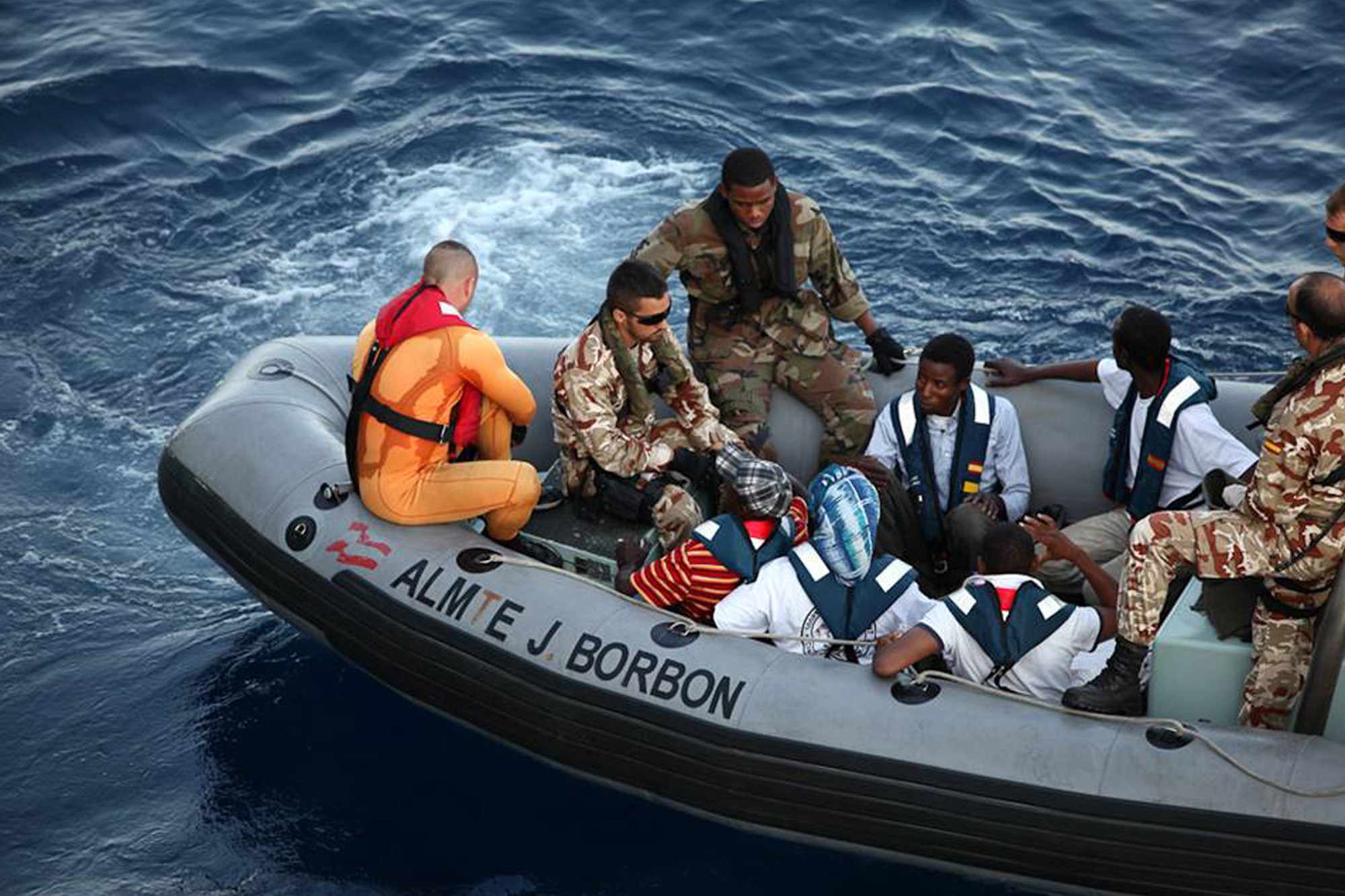
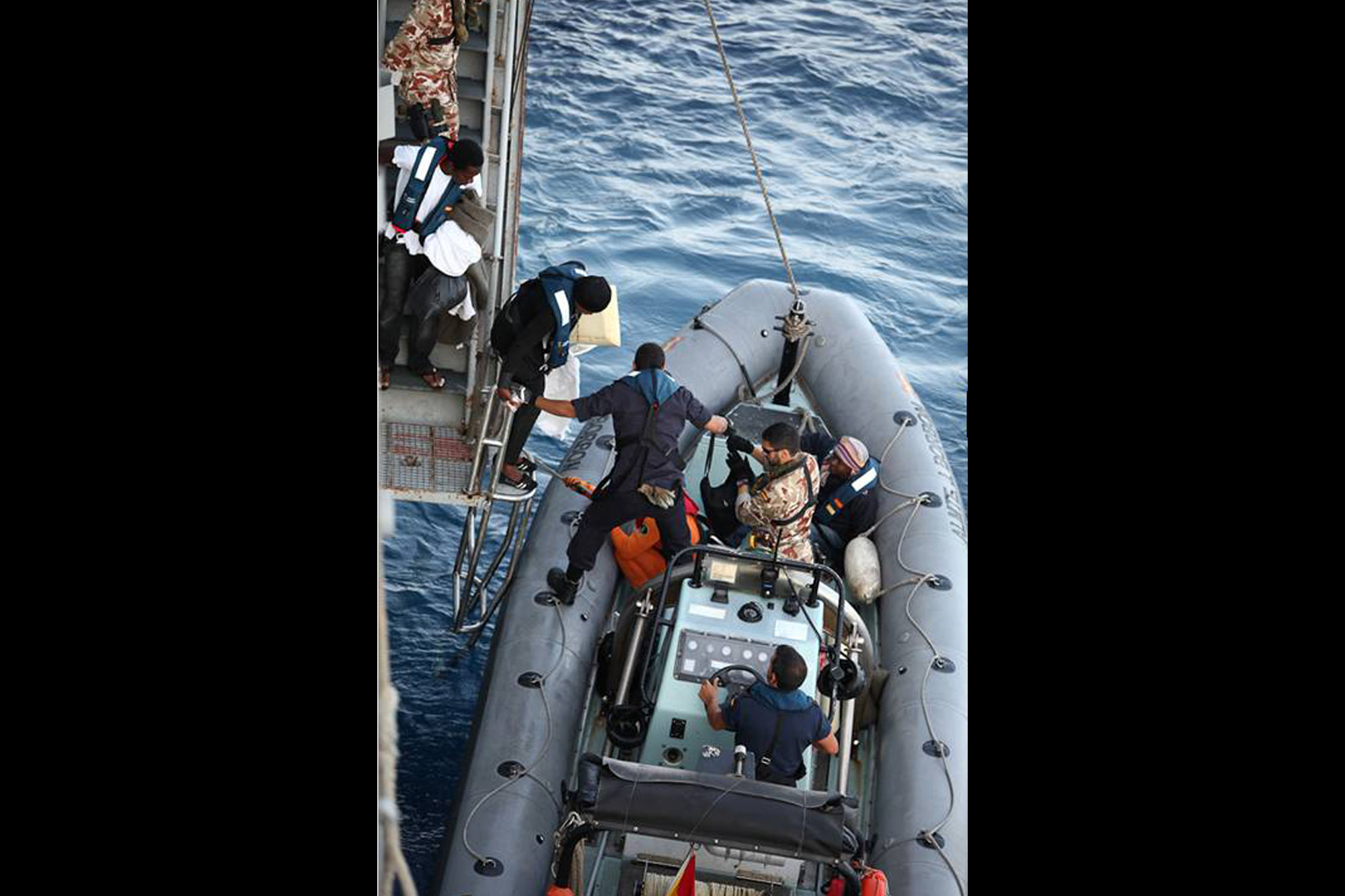
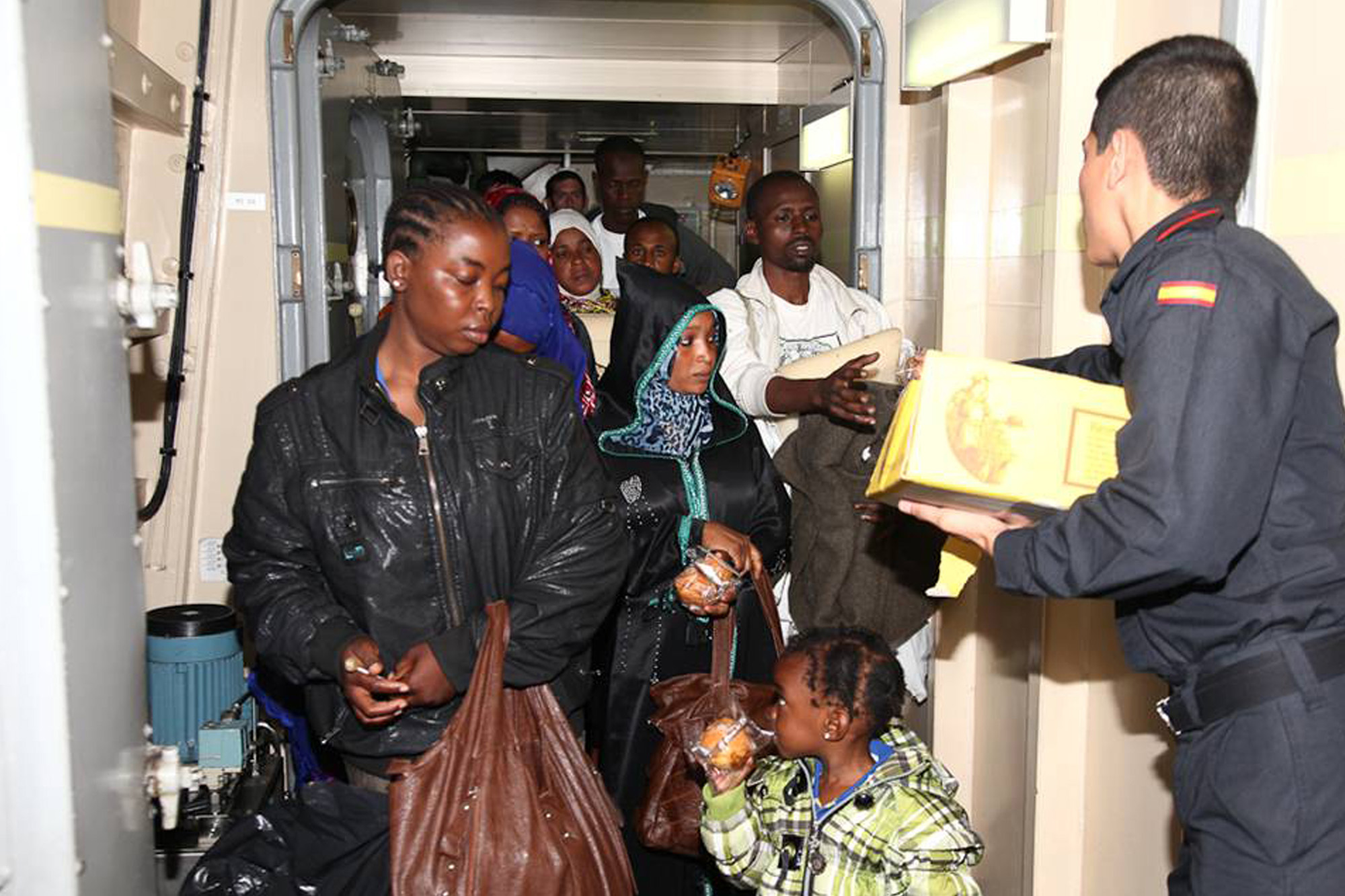
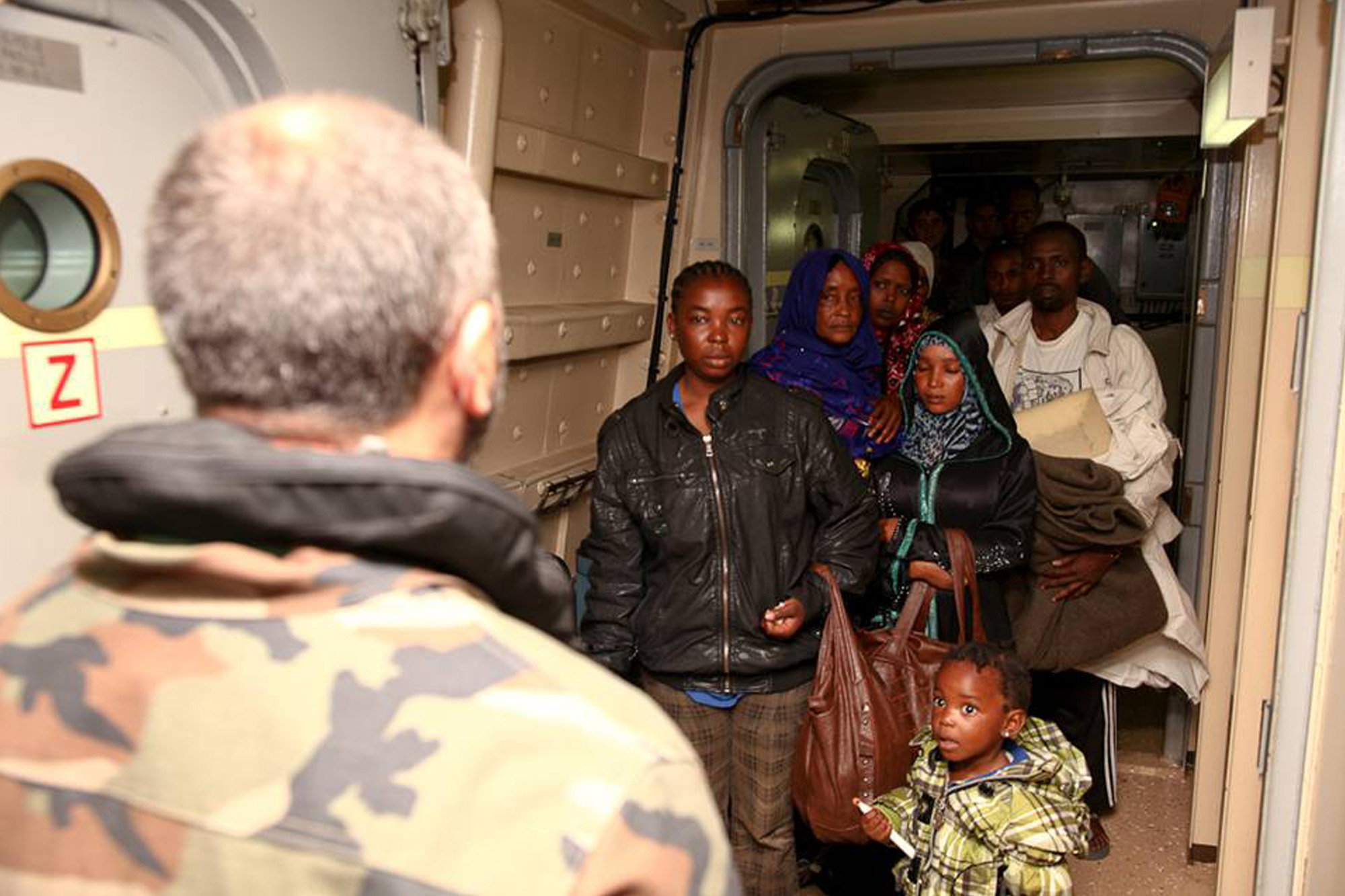
According to information provided by the Spanish Ministry of Defence, the Spanish frigate Almirante Juan de Borbón sailed to Tunisia earlier this morning (16 July) and, while remaining outside Tunisian waters near Zarzis, transferred the remaining 106 rescued migrants to the Carthage, a Tunisian naval vessel.  114 migrants were initially rescued by the Spanish ship.  5 of the migrants were airlifted to Malta for medical reasons on 13 July.  On 11 July, shortly after the initial rescue of the migrant boat, 3 migrants were evacuated and turned over to Tunisian authorities.  The original 114 consisted of 88 men, 20 women (5 of whom are pregnant), and 6 children. The Defence Ministry said that the decision to transfer the migrants to Tunisian authorities was a NATO decision.

While the decision to disembark the migrants in Tunisia is better than sending them to eastern Libya (something I was fearful would occur), Tunisia is problematic for several reasons.  The migrant boat was reportedly carrying Tunisians.  To the extent that any of them may have had claims for international protection, the claims have been effectively eliminated.   It is not known whether any efforts were made to assess whether any of the Tunisians had claims for international protection.   And to the extent that any of the non-Tunisians have claims for international protection, Tunisia is clearly less able to handle such claims and less able to provide care for asylum seekers relative to Malta, Italy, or Spain (or any of the NATO countries participating in Operation Unified Protector).

[17 July update – NATO’s OUP Press Office informed me earlier today that any questions regarding who made the decision to transfer the migrants to Tunisia and whether any of the migrants were screened for claims for international protection had to directed to the Spanish Ministry of Defence.]

Click here (EN), here (ES), and here (ES) for articles.

Click here for Spanish Ministry of Defence press statement and additional photos. (ES)

Photo Credit: Ministerio de Defensa de España (mde.es)

Photo Credit: Ministerio de Defensa de España (mde.es)

Photo Credit: Ministerio de Defensa de España (mde.es)

Photo Credit: Ministerio de Defensa de España (mde.es)

4 Comments

Filed under General, Italy, Libya, Malta, Mediterranean, News, Spain, Tunisia

Malta Says the 111 Rescued Migrants Aboard Spanish Frigate Are NATO’s Problem, Not Malta’s Problem

The stand-off between Malta, Spain, and NATO continues.  111 rescued migrants remain on board the Spanish Navy frigate, the Almirante Juan de Borbón.  Maltese authorities criticised the attempt to bring the rescued migrants to Malta and have said that the migrants should have been taken to Tunisia or Italy because both locations were closer to the original point of rescue.  Malta has now allowed a total of 5 migrants to be airlifted to Malta for medical care.  The frigate remains at sea near Malta with the 111 migrants, including women and children, and a crew of 250 sailors.

At a press conference yesterday, Maltese Interior Minister, Carmelo Mifsud Bonnici, said that while Malta decided to allow the transfer of several rescued migrants to Malta for emergency medical treatment, it has no intention of allowing the other rescued migrants to be disembarked in Malta.  According to the Times of Malta, Mifsud Bonnici said “the problem is not Malta’s, it is Nato’s.  Malta is a sovereign state and it demands that it be respected as such. This is not a standoff with Spain or Italy and we await Nato’s replies.”

It is unclear from various media reports whether Italian authorities formally refused permission to the Spanish frigate to dock in Lampedusa, but some reports suggest there was communication with Italian authorities who said that Lampedusa’s immigrant reception facilities were at capacity.  Well over a thousand migrants have landed in Lampedusa in recent days.

There are also some media reports which suggest that the Spanish government may be taking the position that since the Spanish frigate is under NATO command as part of Operation Unified Protector, NATO therefore must decide where the migrants are to be disembarked.

The head of the Armed Forces of Malta has taken the bizarre position that the Spanish ship is well-equipped to care for the rescued migrants and that therefore there is no urgency in regard to removing the migrants from the ship for humanitarian reasons.

Meanwhile, the NATO naval embargo of Libya is missing one ship.  NATO had 17 ships under its command patrolling the Central Mediterranean, now there are 16 ships.  The Spanish frigate has been effectively removed from its embargo duties as it waits for a resolution to the stand-off.  If and when another migrant boat requires rescue by a ship under NATO command, will the NATO embargo be further weakened?  The obligations of NATO ships to rescue migrant boats in distress under SOLAS are clear, and NATO has repeatedly said that it will rescue migrant boats when required, but one must be fearful of a situation arising, as it does with commercial ships, where a NATO vessel’s commander may be less willing to conclude that a migrant boat is in need of rescue knowing that the act of rescuing the migrants may result in the NATO ship being removed from its mission because it is unable to quickly disembark the rescued migrants.

Click here (EN), here (EN), here (ES), here (IT), and here (IT) for articles.

1 Comment

Filed under Italy, Libya, Malta, Mediterranean, News, Spain

Aditus Calls for Immediate Disembarkation of Stranded Migrants

A statement from Aditus, “an independent, voluntary & non-profit organisation established with a view to monitor, act & report on access to fundamental human rights by individuals & groups”, which is based in Malta:

14 July 2011

“’Once again, political discussions take precedence over human lives.  It is at times like these that our consciences are called to do what is right, to ensure a full respect for the fundamental human rights of all persons irrespectively of colour, origin and status.’

It appears that the Maltese and Italian authorities are once again disagreeing over where to disembark a group of around 100 rescued migrants.  Rescued earlier today by a Spanish frigate, the Almirante Juan de Borbón, the group of migrants seems to be largely composed of men but also includes several women and children.  According to news reports, the stranded migrants were rescued in Sunday morning yet the date of departure from Libyan shores is as yet unconfirmed.

It is important to emphasise that the rescued persons have fled a situation of civil war, and have possibly been through several harrowing experiences.  ‘It is unclear when they left Libya, yet they have definitely been out at sea for over 5 days.  This can only mean that they are probably exhausted, dehydrated and are in urgent need of physical and psychological assistance.  A warship is definitely not the place to provide this urgent assistance’, commented aditus Chairperson Dr. Neil Falzon.

aditus applauds the crew of the Juan de Borbón for rescuing the persons in distress, yet urges the Italian and Maltese authorities to immediately relieve the warship of rescued migrants, in the interests of both the latter and of the crew itself.  aditus further recalls that international maritime law requires a prompt disembarkation at a place of safety for all persons rescued at sea, and that any prolonged period spent aboard the warship poses severe security, humanitarian and human rights concerns.

aditus therefore appeals to the Italian and Maltese authorities to allow the immediate disembarkation of the rescued persons so that their safety may be guaranteed.

For the longer-term, the two States are urged to seek resolution to this on-going legal impasse that too often has resulted in these tragic incidents.  To this end, aditus strongly recommends the involvement of competent international and regional agencies particularly the European Union, the International Maritime Organisation and NATO.”

Click here for statement.

Leave a comment

Filed under Italy, Libya, Malta, Mediterranean, Spain, Statements