Category Archives: United Nations

Rescued Somali Asylum Seekers in Malta Describe Dangerous Conditions in Libya

The first group of rescued migrants for 2012 arrived in Malta on 15 January after being rescued by an Armed Forces of Malta patrol boat and an Italian cargo ship.  The 68 rescued migrants are Somali asylum seekers and had left Libya four days earlier.  Another boat carrying 72 migrants was rescued by the Italian coastguard on the 13th.  This boat is also believed to have departed from Libya.  UNHCR officials have interviewed the asylum seekers in Malta: “The new arrivals confirmed to UNHCR that the situation in Libya is still not stable and that it is particularly precarious for Sub-Saharan nationals. One Somali woman told UNHCR that they were afraid to go outside the house. Some even described the situation in parts of Libya as being similar to the lawlessness of Somalia. They explained that smugglers provided them with the only possible way out at this point.”  The Times of Malta reported that two of the asylum seekers said “they paid armed Libyan militiamen $400 each to facilitate their crossing of the Mediterranean.”

Click here, here, and here for articles.

Click here (IT) for article.

Leave a comment

Filed under Italy, Libya, Malta, Mediterranean, News, UNHCR

UNODC Issue Paper: Smuggling of Migrants by Sea

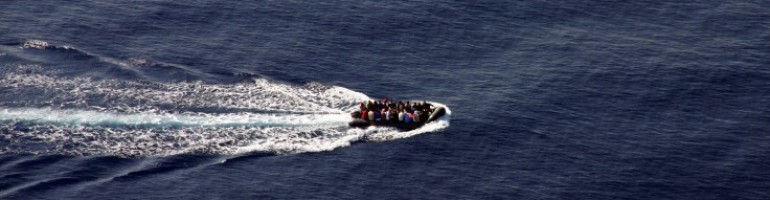
UNODC yesterday released an Issue Paper entitled “Smuggling of Migrants by Sea.” The paper, drafted by Ms Marika McAdam under the supervision of Ms Morgane Nicot (UNODC), is based largely on “answers received to questionnaires and discussions that took place in the context of an expert group meeting held in Vienna, Austria on the 13th to the 15th of September 2011.”

Excerpts from UNODC statement: “While the smuggling of migrants by sea accounts for only a small proportion of the total number of migrants smuggled worldwide, it accounts for the highest number of deaths among smuggled migrants. … The paper covers the international legal framework relating to the smuggling of migrants by sea, current responses to and challenges posed by such smuggling and recommendations to strengthen responses. … It is hoped that the practical experiences of responding to the smuggling of migrants by sea, addressed by the issue paper from the perspectives of countries of origin, countries of transit and countries of destination, will help other Member States in formulating their responses to suit their local contexts.”

Executive Summary: “Smuggling of migrants is defined by Article 3 of the Migrant Smuggling Protocol supplementing the United Nations Transnational Organized Crime Convention (UNTOC), as ‘…the procurement, in order to obtain, directly or indirectly, a financial or other material benefit, of the illegal entry of a person into a state party of which the person is not a national.’ The specific nature of the sea-based component of the smuggling journey resulted in a dedicated section on the issue in the Migrant Smuggling Protocol. While smuggling by sea accounts only for a small portion of overall migrant smuggling around the world, the particular dangers of irregular travel at sea make it a priority for response; though more migrant smuggling occurs by air, more deaths occur by sea.

The journey of the migrant smuggled by sea often starts a significant distance away from the coast of departure. Some journeys to the coast may take mere days, but others can take place over years during which the migrant must work en route to raise money for his passage. Arduous desert crossings and victimization by smugglers and other criminals en route mean that some do not survive overland journeys to the coast. Contrasted with these extreme experiences, economically empowered migrants can afford a higher level of smuggling service and may experience no particular hardship, simply travelling through various international airport hubs toward the coastal country from where their sea journey commences.

The type and size of vessel used to smuggle migrants by sea depends on the time, place and financial capacity of migrants undertaking the smuggling journey. In some countries, boats of only a handful of passengers are commonly intercepted by authorities, while in others vessels of several hundred people have been used. While voyages may be comfortable when conditions at sea are mild and the vessel is equipped with adequate food, water and sanitation, the journey is a harrowing one for the majority of migrants who report rough conditions, terrible cold and scarce food and water.

The nature of the crime and its relationship with smuggling of migrants by land and by air means that it is a successful crime type that yields high profits for smugglers with all the risks being borne by migrants. Indeed, migrant smuggling by sea can be understood as a criminal business, which is competitively run as such. Smuggling by sea is generally carried out by flexible criminal groups or individuals operating on the basis of repeated contractual arrangements, rather than by hierarchical organizations.

There are two methods used when vessels approach coasts of destination. One aims to reach land by evading detection by authorities, the other sets out to be detected and intercepted or rescued by authorities in territorial waters of destination coastal countries. In both situations, detecting smuggling vessels at sea is a key challenge for coastal states which may have limited resources and large search and rescue areas of responsibility.

Upon detecting vessels, the key challenge is to balance objectives with obligations at international law, including the Migrant Smuggling Protocol. Smugglers are generally well‐informed about states’ protection obligations and act to exploit them, instructing migrants what to do upon interception to increase their chances of gaining entry into and remaining in countries of destination. For instance, officials responsible for intercepting vessels at sea have been faced with situations of people sabotaging their own vessels to force authorities to carry out rescues. Suggestions made in respect of encountering migrant smuggling at sea include increased support of coastal states through joint patrols and provision of resources, and increased compliance with international legal standards and obligations in carrying out interceptions of smuggling vessels at sea.

While responding to the situation at hand and ensuring that persons on board are appropriately assisted, a key challenge is to seize evidentiary opportunities to investigate smuggling‐related crimes. The complex nature of migrant smuggling networks and their modus operandi means that smugglers cannot be identified purely by looking to smugglers who may be on board boats; the transnational criminal network itself must be traced from a smuggling vessel, back to the coast of embarkation, and from there back to countries of transit and origin. Suggestions made for improved investigation and prosecution of migrant smuggling by sea include harmonizing domestic legislation with the UNTOC and the Migrant Smuggling Protocol. Further it is suggested that sentences imposed for smuggling offences be publicized as a means of deterring would-be smugglers. Capacity building measures are also suggested so as to increase identification of smugglers on vessels, and to better link sea-based crimes with land-based smugglers.

Preventing migrant smuggling by sea requires states to balance their obligations in international law with their legitimate interests in protecting state sovereignty from violation by organized crime groups. But law enforcement efforts alone are not adequate to prevent migrant smuggling by sea; the Migrant Smuggling Protocol stresses that prevention efforts must address root causes that lead a person into the hands of smugglers in the first place. Suggestions made for preventing migrant smuggling at sea include raising awareness about the dangers of sea smuggling journeys and the criminality of smuggling. Suggestions are also made to raise awareness of those who influence political and policy decisions, so policies put in place protect state sovereignty, uphold international obligations, and are not vulnerable to exploitation by smugglers. Also emphasised is the responsibility of coastal states of departure to intercept smuggling vessels before they embark on sea journeys. Beyond this, comprehensive data collection, analysis and research are suggested to strengthen evidence-based responses.

Experts from countries of origin, transit and destination unanimously agree that the most essential ingredient for effective and comprehensive response to migrant smuggling by sea is strengthened international cooperation to remove areas of impunity for smugglers along smuggling routes. Suggestions made for cooperating in response to migrant smuggling at sea include aligning activities with the Migrant Smuggling Protocol and increasing the role of UNODC in facilitating cooperative response. The value of bilateral and regional cooperation arrangements is stressed, with emphasis on flexible cooperative networks for effective and efficient on-the-ground response. Regular coordination meetings and joint operations are suggested to improve strategic and operational interagency coordination, as is the empowerment of central designated authorities to address migrant smuggling by sea.

In short, while it is difficult to make generalizations about migrant smuggling by sea, two key points hold true around the world. Firstly, migrant smuggling by sea is the most dangerous type of smuggling for the migrants concerned, making it a priority concern for State response. Secondly, efforts to combat smuggling of migrants will be unsuccessful unless cooperation is strengthened not only between countries of sea departure and arrival, but also among the countries of origin, transit and destination along the entire smuggling route.”

Click here for Issue Paper.

Click here for UNODC statement.
2 Comments

Filed under Analysis, Reports, UNODC

ECRE Interview with Tineke Strik Regarding PACE Investigation into Migrants Deaths in Mediterranean

ECRE last week published an interview with Ms Tineke Strike regarding the PACE Migration Committee’s ongoing investigation into the almost 2000 migrant deaths that have occurred in the central Mediterranean this year.  The Committee is focusing in particular on the incident that occurred in late March 2011 when unknown ship(s) and aircraft observed and then failed to rescue a disabled migrant boat.  Approximately 60 persons subsequently died.

Excerpts from the ECRE interview:

“[***]  What are the main findings of your report on the death at the Mediterranean so far?

We have spoken with survivors and with the priest who received the request for assistance from the boat in distress, Italian border guards, and the Italian refugee agency, as well as the Italian Refugee Council (CIR), a Member of ECRE. We also talked to different people in Brussels, including NATO, the ambassador of the Council of Europe, Amnesty and several MEPs. Today, during the PACE hearing on November 30 in Paris, we had a discussion with a number of experts in international law, Frontex, UNHCR and ICRC. All in all a lot of information has been gathered.

We have already sent requests for information to find out via satellite maps and logs if there were boats near the distressed boat Once we know under which flags these boats were sailing, we will be able to track which governments might have been responsible and ask them whether they knew that the boat asking for help was in danger or not and how they acted upon that information.

We are actually still waiting for information for this information. It is unfortunate that it takes time to get this information but we are trying to get hold of it through different channels. We have approached High Representative Ashton and asked for her consent to provide us with information from the European Satellite Centre. We have already used this kind of information at the Council of Europe, for example to detect the illegal detention centres that the CIA was using. We therefore hope that Ashton once again will cooperate.

We also asked NATO to provide us with information and have asked all the countries who took part in the NATO action in Libya and who had ships in that region during that period to give us data on where their boats were and when. NATO has promised to request the Member States to provide us with this information, also if these boats were not under the command of NATO. If this does not succeed, we still have our own national parliamentarians that could push their governments in their own country if it is necessary to gather the information.

If countries were involved they might not want to admit that, which makes my position difficult. I am not a judge and I don’t have enforcement powers so I’m partly dependent on the cooperation of various parties.  But I think all parties can benefit from transparency on what has happened, in order to avoid such tragedies in the future.

[***]

How do you think the EU has responded to the turmoil and war in North Africa and, in particular, the following displacement of people in the region and the arrival of some of them to Europe?

In my report following the protests in North Africa, we see that by far the largest part of the people who have fled Libya went to Tunisia and Egypt. There was a lot of fuss in the EU about the 25,000 who eventually fled to Italy. Tunisia took half million, Egypt took a half a million which shows how big the contrast with the EU was, especially considering that Member States were reluctant to resettle refugees from camps in Tunisia. This while Tunisia and Egypt were in a very vulnerable position in the post-revolutionary period. If we really want to help and strengthen stability in the region, we must show these states that they are not alone. These countries generously opened their borders, they understood the situation of the people there and to a great extent we stood aside and just watched.

Then we failed to help out Italy and Malta, especially when countries like France and Denmark wanted to close their borders. This shows exactly how much we are still not politically ready for a common asylum system. We provide beautiful public statements but when it comes down to it, Member States do not want to lose their sovereignty or be troubled by developments elsewhere. I do not think you can have both: either you have a joint system and you show solidarity, or you close all the borders and reinvent the wheel.

Common policies go hand in hand with solidarity and in fact we should look beyond the European borders.  What you see now is that border controls at the external borders of the EU continue to shift to North Africa and sometimes even further. One cannot claim that our responsibilities only begin when people have reached our territory. I was therefore very disappointed when the European Commission replied to a question by MEP Hélène Flautre on this incident saying that the boat was in Libyan waters and therefore they had no power to get involved. If certain acts like push backs at high sea or bilateral agreements with unsafe third countries such as Libya, lead to death or inhumane treatment, EU member states or other countries of the Council of Europe are accountable for a violation of the European Convention on Human Rights. In that sense I have high expectations of the decision of the ECHR in the case of Hirsi and others v. Italy.

[***]

What do you think the impact of your work and the investigation will be?

I hope the report will raise the awareness of the international obligations and also the awareness of the importance of avoiding such tragedies. It is important that violating the obligation to rescue does not remain unmentioned or lead to impunity. If we succeed in proving which actors were wrong. Member States will be more careful and there will be more pressure to cooperate and share the responsibilities, and to establish practical and binding solutions. Being a parliamentary assembly of national parliamentarians, I also hope that the discussion will also take place in Member States. I find it really outrageous that such a tragedy can occur so close to our borders and that we have been so silent about it.

[***]”

Click here for full interview.

Click here for my last post on this topic.


Leave a comment

Filed under Council of Europe, European Union, Frontex, General, Italy, Libya, Malta, Mediterranean, News, Tunisia, UNHCR

EJML Article, B Nascimbene and A Di Pascale: “The ‘Arab Spring’ and the Extraordinary Influx of People who Arrived in Italy from North Africa”

The latest edition of the European Journal of Migration and Law, Volume 13, Number 4, contains an article by Bruno Nascimbene, Professor of European Union Law, Faculty of Law, University of Milan, and Alessia Di Pascale, Research Fellow, European Union Law, Faculty of Law, University of Milan, entitled “The ‘Arab Spring’ and the Extraordinary Influx of People who Arrived in Italy from North Africa”.

Abstract: “The ‘Arab spring’ which spread in early 2011 and the consequent exceptional influx of people that arrived on the Italian coasts from North Africa put the national reception and asylum systems under particular pressure, also raising the debate on the status to be attributed to these people. Faced with a situation out of the ordinary, Italy immediately addressed a request for help to the European Union, which has revealed the difference of views and mistrust existing between Member States in relation to these issues. This episode also calls into question the scope and effectiveness of the EU migration management framework, particularly in case of strong and unexpected pressure, and its implementation in a true spirit of solidarity.”

Click here for link.  (Subscription or payment required.)

1 Comment

Filed under Analysis, European Union, Frontex, Italy, Libya, Mediterranean, Tunisia, UNHCR

NATO Reportedly Agrees to Provide Additional Information to PACE Regarding Migrant Deaths in the Mediterranean

The PACE Committee on Migration, Refugees and Population, in connection with the preparation of a report by Ms Tineke Strik (Netherlands, SOC) on the deaths of boat people who have died in the Mediterranean, conducted a hearing in Paris on 29 November.  NATO officials who met with Ms Strik in Brussels before attended the hearing reportedly agreed to provide additional information, which might include satellite imagery, to the PACE Committee.

From PACE Press Statement, 30 November 2011:  “‘With 1971 boatpeople having perished in the Mediterranean Sea while trying to reach European soil from North Africa, the year 2011 sets a sad record as the deadliest year for boatpeople,’ PACE rapporteur Tineke Strik (Netherlands, SOC) said at the end of a hearing on this issue, organised by the Parliamentary Assembly of the Council of Europe (PACE) Migration Committee.  ‘Never before the Mediterranean Sea has been as closely monitored as this year because of the war in Libya and still more boat people than ever perished or disappeared,’ the rapporteur added.  ‘Is there a common understanding of a “distress situation”? Is it clear which legal framework is applicable and by whom? Do all ships, even warships, have to proceed with rescue operations even if they are situated beyond established search and rescue zones? Where does legal responsibility start and where does political responsibility end? These are some of the issues we are currently trying to clarify,’ she said.  Mrs Strik’s report will focus on an incident reported in March this year, during which 63 boat people escaping from Libya died after their appeals for rescue had allegedly been ignored. ‘The testimonies of survivors of this incident are coherent, but we have to continue to collect more data and information on who was when and where in the area and we now expect Nato and the EU to provide us with satellite imagery and other relevant information,’ she concluded.”

Click here, here, here, and here for articles.

Click here for PACE Press Statement.

Click here for my last post on the topic.

1 Comment

Filed under Council of Europe, Frontex, Italy, Libya, Malta, Mediterranean, Netherlands, News, Tunisia, UNHCR

PACE to Conduct Hearing: “Lives Lost in the Mediterranean Sea: Who is Responsible?” (Paris, 29 Nov)

The PACE Committee on Migration, Refugees and Population, in connection with the preparation of a report by Ms Tineke Strik (Netherlands, SOC) on the deaths of boat people who have died in the Mediterranean, will conduct a hearing in Paris on 29 November.  Ms Strik was appointed in June 2011 by the PACE Committee as Rapporteur to prepare a report on the deaths of boat people who have died in the Mediterranean since January 2011.

“The hearing will look at the loss of human life at sea, it will examine the right of families to receive information on the victims, and it will consider the rules applicable under international law and maritime law relevant to rescue at sea. The hearing will also examine international co-ordination regarding interception and rescue at sea, as well as the role of the national authorities, NATO and FRONTEX.  The participants include representatives of the International Committee of the Red Cross, the Office of the United Nations High Commissioner for Refugees, FRONTEX, the Italian Council for Refugees, and the International Institute of Humanitarian Law.”

The hearing seems to be open only to members of the press and will be held at the Council of Europe, 55 avenue Kléber, 75016 PARIS (Metro: Boissière).

Click here and here for more information.

Click here for my last post on this topic.

1 Comment

Filed under Council of Europe, Frontex, Italy, Libya, Malta, Mediterranean, News, Tunisia, UNHCR

Malta Rejects UNHCR Suggestion that Malta Failed to Carry Out SAR Obligations

The Times of Malta reports that the Armed Forces of Malta (AFM) and Maltese SAR authorities have rejected what they characterised as the “impression conveyed” by a UNHCR spokesperson that “Maltese SAR authorities abdicated from their responsibilities and did not cooperate with the relevant Italian authorities” in connection with the search for and subsequent rescue of 44 migrants on board a disabled boat on 9-10 November.  The migrants were rescued by the Italian Navy ship Foscari and transported to Sicily, not to Lampedusa or Malta which were the two closest ports.

The AFM statement reported by the Times of Malta outlines in detail the Maltese response to the distress call from the migrant boat and Malta and Frontex’s participation in the air and sea search.  The AFM statement said that “[t]he decision for the Italian Navy vessel Foscari to take the rescued migrants to an Italian port in Sicily was the result of Italian insistence that Lampedusa does not represent a place of safety for the disembarkation of migrants, despite it being a mere four hours from the position where the persons were rescued.  Under the relevant legal regime applicable with the Malta SRR, the persons should have been disembarked in Lampedusa which, despite declarations to the contrary, represented the nearest place of safety.”

Click here for article.

1 Comment

Filed under Frontex, Italy, Libya, Malta, Mediterranean, News, UNHCR

Chatham House Briefing Paper: Responding to Migration from Complex Humanitarian Emergencies: Lessons Learned from Libya

A new Chatham House Briefing Paper by Dr Khalid Koser entitled “Responding to Migration from Complex Humanitarian Emergencies: Lessons Learned from Libya” has been released.

Summary:

  • At its peak during the Libyan conflict, migration to Tunisia and Egypt was massive, even in the context of a region where large-scale migration has become the norm.
  • In the case of Libya, at least five categories of migration can be distinguished: evacuating migrant workers, Libyan nationals moving into Egypt and Tunisia, ‘boat people’ arriving in the EU, internally displaced persons (IDPs), and asylum-seekers and refugees.
  • The international policy response in Libya was hampered by restricted access. IDPs therefore received limited assistance and protection, and migrant workers, especially from sub-Saharan Africa, experienced harassment and abuse.
  • The policy response in neighbouring states, especially Egypt and Tunisia, was far more robust.
  • The political response in the EU to the relatively small proportion of migrants who reached Europe is considered by many commentators to have been disproportionate.
  • The crisis has highlighted a gap in the international regime for protecting IDPs, and in particular migrant workers. It has also called into question the relevance to modern humanitarian crises of a dated refugee definition. More positively, the response has demonstrated how international agencies can cooperate, and there has been unprecedented cooperation between IOM and UNHCR to respond to ‘mixed flows’ from Libya.
  • Responsibility for managing migration now falls to the new government in Libya.

Click here for paper.

1 Comment

Filed under Analysis, European Union, Libya, Mediterranean, UNHCR

Migrant Boat Rescued by Italian Navy – Migrants to be Transferred to Sicily

The Italian Navy vessel Foscari rescued 44 migrants last night from a disabled boat that is believed to have departed from Libya about 4 days ago.  Maltese media reported that the Italians wanted to disembark the rescued migrants in Malta due to the earlier decision of Italian authorities to close Lampedusa for search and rescue purposes.  However Adnkronos news is reporting that the Foscari is taking the rescued migrants to Augusta, Sicily.

The first satellite phone distress call from the migrant boat was reportedly made when the boat was located within the Libyan SAR.  The migrant boat was finally sighted by an Italian fishing boat last night within the Maltese SAR.  The Italian Navy vessel Foscari rescued the migrants.  A Somali woman and her newborn infant who was born on the migrant boat were flown by helicopter to Lampedusa for medical care.  The remaining 42 rescued persons will now apparently be disembarked in Augusta some time tomorrow.  16 August was the last time a migrant boat reached Italy from Libya.

UNHCR issued a statement saying it was “grateful that the Italian navy took this initiative despite the fact that the boat was in Maltese search and rescue waters.”

Click here (EN), here (EN), here (IT), here (IT), and here (IT) for articles.

Click here for UNHCR statement.

Leave a comment

Filed under Frontex, Italy, Libya, Malta, Mediterranean, News, UNHCR

Expert Meeting on Asylum Seekers and Migrants in Distress at Sea Begins in Djibouti

From an IOM press statement:

“IOM is taking part in a three-day meeting organized by UNHCR and the Government of Djibouti on how best to respond to the needs of migrants, asylum-seekers and refugees who find themselves in situations of distress at sea. The meeting, which opens today [8 November] in Djibouti, brings together government representatives and academics alongside experts from UNHCR, IOM, the International Maritime Organization, the ICRC and IFRC….

‘Despite the tightening of existing Conventions to reinforce the global Search and Rescue regime, gaps remain when it comes to putting these principles into practice,’ says IOM’s Irena Vojackova-Sollorano. ‘Cooperative approaches that bring together governments, the shipping industry, NGOs and international organizations are therefore urgently needed if we are to ensure the safety and protection of all people rescued at sea.’…”

Click here for full press statement.

Leave a comment

Filed under Djibouti, Gulf of Aden, Mediterranean, News, UNHCR

Trapped Migrants Face Increasing Violence at Sidi Bilal Near Tripoli

From Refugees International, 7 October:  “More than 600 migrants from sub-Saharan Africa are effectively stranded at a port just outside the Libyan capital, and have been left to fend for themselves by Libyan authorities. Despite repeated attacks, harassment, and arbitrary arrests by Libyan gangs over the course of four months, they have received no protection from the National Transitional Council (NTC). Refugees International calls on the NTC and all local authorities – including the civilian councils in Janzour and Tripoli, and the Tripoli Military Council – to intervene immediately to protect the population at Sidi Bilal port and ensure their safe relocation to a temporary site.  ‘The men in these camps are routinely harassed and accused of being pro-Gaddafi mercenaries, the women are targets of sexual abuse. All face intimidation by armed Libyan thugs who drive into the port at night firing guns into the air,’ said Matt Pennington, an advocate for Refugees International currently in Libya. ‘Of course, many migrants told us they don’t really want to leave Libya – since they have nothing to return to in their home countries. But even for those who want to stay in Libya, their situation is becoming intolerable.’  …  So far, the UN World Food Programme has delivered one food drop to the imperilled migrants, while the UN Refugee Agency and the International Organization for Migration have been attempting to negotiate safe relocation for those who want to stay and repatriation for those who want to return home. But what the population of Sidi Bilal most urgently needs is protection, and Libyan and UN authorities must act swiftly to provide it.”

Click here for full statement.

Leave a comment

Filed under Libya, Mediterranean, Reports, Statements, UNHCR

UNHCR, IOM, and Save the Children Warn that Italy’s Decision to Declare Lampedusa a Non-Safe Port Endangers Sea Rescue Operations

UNHCR, IOM, and Save the Children issued a joint statement expressing concern that Italy’s decision to declare Lampedusa an unsafe port which can no longer receive persons rescued at sea risks “undermin[ing] the entire rescue at sea system for migrants and asylum seekers and at the same time could make rescue operations  much more hazardous and complex.”

“Since it is no longer  possible to dock in Lampedusa, the ability of the Coast Guard and the “Guardia di Finanza” to carry out rescue at sea will be compromised by the distance they will have to travel to reach the next safe port, e.g Porto Empedocle, 120 nautical miles away. This would have severe implications on rescue operations when the weather is bad, or when it involves transporting people in need of urgent medical assistance, minors and other vulnerable individuals.

Therefore, the partner organizations of the Praesidium Project hope that  the  Lampedusa centre will be re-established as soon as possible to ensure adequate  reception  and swift transit for migrants who should be hosted in the centre only for a minimum period of time to allow for assistance and identification before being transferred to appropriate facilities elsewhere in Italy.

Whilst the three partner organizations understand the pressure the island has been under in recent times and the limited capacity of the reception and rescue centre, it is important that Lampedusa remains a safe harbour in order to save lives. …”

Click here (EN) or here (IT) for joint statement.

Leave a comment

Filed under Italy, Mediterranean, Statements, UNHCR

AI: Refugees Forced Out of Libya Urgently Need Resettlement

Amnesty International released a briefing paper this morning describing the “totally inadequate response by EU states to refugees” who are stranded near Libya’s borders.  AI estimates that there are 5000 refugees currently living in limbo along the borders.

From the AI Press Release: “‘We have witnessed an abysmal response to the plight of displaced refugees on Europe’s doorstep,’ said Nicolas Beger, Director of Amnesty International’s European Institutions Office.  ‘This failure is particularly glaring given that some European countries, by participating in NATO operations in Libya, have been party to the very conflict that has been one of the main causes of the involuntary movement of people.  EU Home Affairs Ministers must urgently address the resettlement issue – they can start by putting it prominently on the agenda of the Justice & Home Affairs Council on 22 September.’… Australia, Canada and the USA have offered to resettle some of the refugees stranded at Libya’s borders.  But only eight European countries have offered to help, between them offering fewer than 700 slots. …”  “Amnesty International believes sub-Saharan Africans in Libya remain at high risk of abuse and arbitrary arrest by anti-Gaddafi forces and last week issued a major report calling on the [Libyan] NTC to do more to protect them from reprisal attacks.”

Click here for briefing paper.

Click here for press release.

Leave a comment

Filed under European Union, Libya, Mediterranean, Reports, Tunisia, UNHCR

PACE Rapporteur Conducts Interviews in Italy Regarding Mediterranean Migrant Deaths

Tineke Strik (Netherlands, SOC) concluded a two day fact-finding trip to Italy on 7 September as Rapporteur for the PACE Migration Committee.  She is investigating the deaths of boat people who have died in the Mediterranean since January 2011.  Strik interviewed Father Moses Zerai, an Eritrean priest, who was in satellite phone contact with several migrant boats during their voyages from Libya, including the disabled migrant boat that drifted for days in March-April this year and on which 61 persons are believed to have died.  In addition to Zerai, Strik interviewed three of the nine survivors from the boat, Italian Coastguard officials, and NGO and UNHCR staff.  Strik “is planning interviews with officials from Nato and the Maltese government, which the Italian coastguard says was alerted to the boat’s plight.”

From the PACE press statement: “‘There is an obligation to help all people in distress.  If anyone did not live up to this responsibility and deliberately did not assist them, they must not be allowed to get away with it. … The testimonies of witnesses directly involved in this incident are coherent, but we have to continue to collect more data and information on who was when and where in the area,’ Mrs Strik reported.  ‘My mission is to try to find out what went wrong, and if there was perhaps a gap in responsibility-sharing. The recommendation which will be contained in my report is aimed at establishing responsibilities and trying to determine how to deal with such incidents in the future. We have to draw the right lessons to prevent similar situations from occurring again.  … At the end of my inquiry, I expect national jurisdictions, governments and parliaments to carry on the investigations and I very much hope that the dynamic of truth … will pave the way,’ she concluded.”

Click here (EN), here (FR), and here (ES) for articles.

Click here for PACE press statement.

Click here for previous post.

2 Comments

Filed under Council of Europe, European Union, Frontex, Italy, Libya, Malta, Mediterranean, News, Tunisia, UNHCR

More Evidence that Gaddafi Government Facilitated Migrant Boat Departures from Libya

There has been evidence for many months that the Gaddafi regime was facilitating migrant boat departures from Libya towards Italy and Malta; here are two recent articles on the topic from the Los Angeles Times and the Telegraph.

LA Times: “… During its life as a military base, the impromptu camp [at Janzour / Zanzour] was heavily guarded, but in recent in months, several people from the area said, Kadafi’s government facilitated the entry of Africans hoping to migrate by boat to Europe. … The military base was run by a Kadafi operative named Zuhair, according to several people familiar with its operation. As rebels approached Tripoli, they said, Zuhair was seen taking off in a speedboat, accompanied by his top aide and two bodyguards. … [The base] is also the scene of one of Muammar Gaddafi’s most bizarre and cynical plans; an operation to flood Europe with black African illegal immigrants in revenge for Nato’s bombing campaign. For months until the uprising in Tripoli two weeks ago, men in uniform were seen around the port directing the loading of immigrants onto leaky boats bound for Italy. Africans who landed this summer on the tiny island of Lampedusa – a speck of rock south of Sicily – said they had paid nothing for their passage, in contrast to the $1,000 fee usually demanded by people smugglers. No boats have left since the rebels drove Gaddafi’s men out, but the human cargo is still stranded there; a thousand desperate black African men, women and children, clustered in the dirt under beached boats in utter squalor, hungry, scared, penniless, and desperate to escape….”

The Telegraph: “…[a] man, who would not give his name, claimed that the port [of Zanzour] had been controlled by a shadowy official called Zuhair, who had vanished when the rebels arrived. ‘He is a Palestinian originally, with several passports,’ the man said. ‘He had people under him and they sent the boats to Lampedusa.’ There seems little likelihood that the operation was being conducted without official sanction; Zanzour is located not on some remote, unpoliced stretch of coast but within an old military base, only about ten miles west of Tripoli, an area which was firmly under Gaddafi’s control until recently. … Laura Boldrini, of UNHCR, warned that illegal immigration could get much worse in the months ahead, adding that nobody knew how the new government would deal with the problem. ‘What happens depends on security,’ she said. ‘If violence explodes in Libya, there is a danger of a massive new influx of people trying to escape.’”

Click here and here for articles.

Click on these links for some previous posts on the subject:

Is Libyan Government Facilitating Migrant Boat Departures from Libya? (31/03/11)

IOM Reports Migrants Were Forced by Libyan Soldiers to Board Boats (10/05/11)

Libya: Because of NATO Aggression, We Cannot Be Guards of Europe (11/05/11)

Guardian: Libya Official Admits Migrant Ships Being Allowed to Sail as Protest Against Nato (11/05/11)

Maltese JHA Minister Doubts Migrants Are Being Pushed to Flee Libya (13/05/11)

1 Comment

Filed under European Union, Italy, Libya, Malta, Mediterranean, News, UNHCR