Category Archives: UNHCR

UNHCR Files ECtHR Third Party Intervention in Hirsi v. Italy

The UNHCR submitted a third party intervention to the European Court of Human Rights in the case of Hirsi and others v Italy, Requête no 27765/09, which was filed on 26 May 2009 by 11 Somalis and 13 Eritreans who were among the first group of about 200 migrants interdicted by Italian authorities and summarily returned to Libya pursuant to Italy’s push-back practice.  The case was communicated by the Second Section of the Court on 17 November 2009.

The UNHCR’s intervention “addresses the practice and justification of ‘push-back’ operations by the Italian government, the conditions for reception and seeking asylum in Libya and the extraterritorial scope of the principle of non-refoulement and pursuant legal obligations concerning the rescue and interception of people at sea.”

Excerpts from the intervention:

“[***]  2.2.1  On 6 May 2009, the Italian government, in cooperation with the government of Libya, initiated the so-called “push-back policy” by intercepting people, including those who may be in need of international protection, on the high seas and returning them to Libya. This policy was a departure from the previous practice where Italian naval forces had regularly disembarked such persons in Lampedusa or Sicily. Based on UNHCR’s estimates, in 2008 some 75% of sea arrivals in Italy applied for asylum, and 50% of those who applied received some form of protection after their claims were assessed in the Italian asylum procedure.

2.2.2  According to the Italian authorities, from 6 May to 6 November 2009, a total of nine operations were carried out, returning a total of 834 persons to Libya. The precise modalities of the operations have not been made public and were not otherwise fully disclosed to UNHCR. …

4.1  The extraterritorial scope of the principle of non-refoulement under Article 33 (1) of the 1951 Convention…

4.1.2  The territorial scope of Article 33 (1) is not explicitly defined in the 1951 Convention. The meaning, purpose and intent of the provision demonstrate, in UNHCR’s view, its extraterritorial application, e.g., to situations where a state acts outside its territory or territorial waters. Furthermore, the extraterritorial applicability of human rights obligations contained in various instruments supports this position ….

4.2  The extraterritorial scope of the principle of non-refoulement in human rights law

4.2.1  The complementary and mutually reinforcing nature of international human rights law and international refugee law speak strongly in favour of delineating the same territorial scope for all expressions of the non-refoulement principle, whether developed under refugee or human rights law….

4.3  The principle of non-refoulement in the context of interception and search and rescue operations on the high seas

4.3.1  As stated earlier, the principle of non-refoulement applies whenever a state exercises jurisdiction. Jurisdiction can be based on de jure entitlements and/or de facto control. De jure jurisdiction on the high seas derives from the flag state jurisdiction.  De facto jurisdiction on the high seas is established when a state exercises effective control over persons. Whether there is effective control will depend on the circumstances of the particular case.

4.3.2  Where people are intercepted on the high seas, rescued and put on board a vessel of the intercepting state, the intercepting state is exercising de jure as well as de facto jurisdiction. While de jure jurisdiction applies when the people on board a ship are sailing under the flag of the intercepting state, it is also exercised – relevant to the case of “push-backs” – where the intercepting state has taken the persons on board its vessel, bringing them under its full (effective) control. In UNHCR’s view, as becomes clear from section 2.2 above, the Italian authorities were in full and effective control of the persons throughout the “push-back” operations until the formal hand-over to the Libyan authorities. Article 4 of the Italian Code of Navigation specifies that Italian ships on the high seas are considered as Italian territory.

4.3.3  When jurisdiction on the high seas has been established, the obligations deriving from it in relation to the principle of non-refoulement should be examined. The UNHCR’s Executive Committee has emphasized the fundamental importance of fully respecting this principle for people at sea, underlining that: ‘interception measures should not result in asylum-seekers and refugees being denied access to international protection, or result in those in need of international protection being returned, directly or indirectly, to the frontiers of territories where their life or freedom would be threatened on account of a Convention ground, or where the person has other grounds for protection based on international law.’

4.3.4  In UNHCR’s view, the situation in which a state exercises jurisdiction on the high seas over people on board its vessels requires respect for the principle of non-refoulement. It follows that states are obliged, inter alia, not to hand over those concerned to the control of a state where they would be at risk of persecution (direct refoulement), or from which they would be returned to another country where such a risk exists (indirect refoulement). The state exercising jurisdiction needs to ensure that asylum-seekers are able to access fair and effective asylum procedures in order to determine their needs for international protection….

4.3.6  For interception or rescue operations carried out by EU Member States, UNHCR has clarified that, “… disembarkation of people rescued in the Search and Rescue (SAR) area of an EU Member State should take place either on the territory of the intercepting/rescuing State or on the territory of the State responsible for the SAR. This will ensure that any asylum-seekers among those intercepted or rescued are able to have access to fair and effective asylum procedures. The disembarkation of such persons in Libya does not provide such an assurance”.

5.  Conclusion

5.1  UNHCR considers that the interception of persons on the high seas between Italy and Libya, their transfer from Italian to Libyan custody, and their return to Libya, may be at variance with the principle of non-refoulement and in contradiction to Article 3 of the ECHR. By returning persons to Libya without an adequate assessment of their protection needs, the Italian authorities appear not to have sufficiently taken into account the potential risk of refoulement, including indirect refoulement, and other possible violations of fundamental rights upon return of the affected persons to Libya. The lack of an asylum system in Libya means that there are not sufficient safeguards to ensure that persons in need of international protection will be recognized as such and accorded legal status and associated entitlements that could ensure their rights, including to protection against refoulement, are not violated. The risk of chain refoulement denying international protection, especially to Eritrea, cannot be excluded.”

Click here for the full text of the UNHCR intervention.

Click here for an earlier post on the case.

1 Comment

Filed under European Court of Human Rights, Italy, Judicial, Libya, Mediterranean, News, UNHCR

NGO Statement on Europe for UNHCR’s 47th Standing Committee Meeting

From the ICVA – International Council of Voluntary Agencies.   Excerpts from the NGO Statement:

“Executive Committee of the High Commissioner’s Programme

Standing Committee, 47th Meeting, 2-4 March 2010

NGO Statement on Europe

Agenda Item 3. (a) iii

This statement has been drafted in consultation with, and is delivered on behalf of, a wide range of NGOs and attempts to reflect the diversity of views within the NGO community.

[***] If we look at the asylum policies of the European Union (EU) and neighbouring countries, we detect a hesitation or shift away from the spirit of the 1951 Convention and 1967 Protocol.

In this statement, NGOs would like to draw attention to this trend in three policy areas. These are:

  • The limits on access to refugee protection in Europe;
  • The integration of refugees in European society; and
  • The externalisation of refugee protection.  [***]

Limits on Access to Protection in Europe

Access to territory

[***] EU border policies continue to be obsessed with security and combating irregular migration at the expense of providing access to those in need of international protection. There is now no legal way for an asylum-seeker to enter the EU. NGOs urges the Member States to collaborate with the European Commission, Parliament, Frontex, and the newly established European Asylum Support Office in developing guidelines on identifying those in need of international protection in mixed flows. UNHCR should be closely consulted in this process. [***]

Externalisation of Refugee Protection

[***] The Stockholm Programme raises the issue of external processing of asylum claims in transit countries. Careful consideration must be given to the potential role of UNHCR in joint processing and the responsibility of European countries in resettling those identified as in need of international protection. It should not be assumed that identified refugees will remain in the transit country. There remains significant concern from European NGOs regarding the legal, practical, and moral implications of such external processing if these trends continue.

Bilateral agreements, such as those between Spain and the West African countries of Senegal and Mauritania, do firmly place the burden of hosting refugees with the transit country. This trend is also visible in the agreements between Italy and Libya and the pushbacks in the Mediterranean.

What we can discern from these trends and those above, is that European policies favour refugees remaining in neighbouring regions rather than facilitating their access to Europe. These trends can only be met with condemnation as an obvious breach of human rights and States’ obligations. [***]

Closing Remark

Given the current negative trends in European refugee policies, it is important to look at initiatives that move in the opposite direction. NGOs are greatly supportive of the call in the Stockholm Programme for the EU to seek accession to the 1951 Refugee Convention and its 1967 Protocol. This is made possible through the adoption of the Lisbon Treaty that gives the EU a legal personality. As such, we look forward to the different agencies of the EU, including Frontex and European Asylum Support Office, seeking guidance from and collaborating with the UNHCR. [***]”

Click here for full Statement.

Click here for link to other related documents on ICVA web site.

Leave a comment

Filed under European Union, Frontex, Statements, UNHCR

L’exode vers le Yémen : un entretien avec le HCR, le PAM et l’OIM

Grotius.fr : “Au Yémen, l’année 2009 a été marquée par un record des flux migratoires en  provenance de la corne africaine : plus de 77.000 entrées sur le territoire, des Somaliens, mais un nombre d’Ethiopiens en forte augmentation. [***]

Et les migrants non somaliens devraient avoir beaucoup de difficultés à légaliser leur situation.  Les trois principales agences en charge de la question des migrants au Yémen, le PAM, le HCR et l’OIM, ont accepté d’aborder pour Grotius.fr ce dossier «brûlant».  Entretien réalisé à Sanaa par François-Xavier Trégan avec Gian Carlo Cirri, Directeur du Programme Alimentaire Mondial au Yémen, Samer Haddadin, Senior Protection Officer, Haut Commissariat pour les  Réfugiés au Yémen et Stefano Tamagnini, Directeur de l’Organisation Internationale pour les Migrations au Yémen.”

Cliquez ici pour l’article complet.

Leave a comment

Filed under Ethiopia, Gulf of Aden, News, Somalia, UNHCR, Yemen

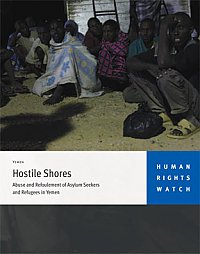
Human Rights Watch: Hostile Shores- Abuse and Refoulement of Asylum Seekers and Refugees in Yemen

Human Rights Watch has issued a new report detailing the treatment refugees arriving in Yemen from the Horn of Africa.

“This report documents the harsh treatment of refugees traveling to Yemen and calls on the Yemeni government to stop systematically arresting Ethiopian asylum seekers and forcibly returning them home. The 53-page report also calls on the United Nations High Commissioner for Refugees (UNHCR) to put more pressure on the Yemeni government to meet its obligations toward all asylum seekers and refugees.”

Click here for report.

Leave a comment

Filed under Gulf of Aden, Reports, UNHCR, Yemen

UNHCR Migration and Border Recommendations to the Incoming Spanish EU Presidency

UNHCR’s recommendations to the Spanish EU presidency include the following”

“Migration and border management

Spain has affirmed that reinforcing Frontex and ensuring that EU migration policy is accompanied by close cooperation with migrants’ countries of origin and transit will be priorities of its Presidency. A review of the Frontex mandate will take place in 2010.

UNHCR encourages the Spanish Presidency to pursue its migration agenda with due regard for international refugee and human rights norms. This includes:

a) Inclusion of refugee protection safeguards in migration control measures generally;

b) Development of clear guidance with respect to the disembarkation of persons intercepted at sea;

c) Attention to the potential protection needs of victims of trafficking;

d) With respect to the return of people found not to need international protection, measures to ensure that such return is safe, dignified and sustainable.

– calling for safeguards in border management activities, including under Frontex’s auspices, with the revision of that body’s mandate foreseen in early 2010;  a call for more focus on protection needs of victims of trafficking as part of anti-trafficking measures.”

Click here for full recommendations.

Leave a comment

Filed under European Union, Spain, Statements, UNHCR

UNHCR Estimates 74,000 Africans Crossed Gulf of Aden to Yemen in 2009

The UNHCR released its most recent estimates of the numbers of Africans who have crossed the Gulf of Aden and Red Sea to Yemen in 2009.  UNHCR believes over 74,000 people made the crossing which is estimated to be a 50% increase over last year.

Ethiopians (42,000) now make up the largest group of migrants making the crossing.  In previous years Somalis were the largest group.

“According to the latest UNHCR statistics, at least 309 people drowned or did not survive the trip this year. In 2008, some 590 people died during the crossing. Many more people went missing and are presumed dead. The mixed migration route through the Gulf of Aden and the Red Sea is presently the busiest and the deadliest one in the world.”

“While virtually all arriving Somalis approach the two, strategically positioned reception centres in Mayfaa and Ahwar, where they receive protection and assistance, only some 9,000 Ethiopians went to these venues this year. Most press on towards the Persian Gulf states in search of job opportunities.”

Click here for UNHCR press release.

Leave a comment

Filed under Data / Stats, Ethiopia, Gulf of Aden, News, Somalia, UNHCR, Yemen

New Somalia Refugee Crisis Warning From UNHCR (News)

UNHCR has issued a new warning about the steadily deteriorating situation in Somalia that is forcing thousands of Somalis to flee fighting.  250,000 Somalis have been forced out of their homes in Mogadishu since May, many are seeking shelter in internal camps and in neighboring countries.

UNHCR spokesperson Andrej Mahecic said that “[u]sing unscrupulous smugglers, thousands risk their lives and take the perilous journey across the Gulf of Aden and the Red Sea to reach Yemen or the Mediterranean Sea to get to Europe”.

“So far this year over 900 boats carrying around 47,000 people have attempted to get to Yemen from the Horn of Africa, with 322 people drowned or presumed dead, and just last week 16 people died and 49 others are thought to have drowned in the Gulf of Aden.”

Click here for UNHCR statement and here for article.

Leave a comment

Filed under Gulf of Aden, News, Somalia, UNHCR, Yemen

IOM-UNHCR Radio Campaign to Warn Somalis (News)

The IOM and UNHCR are beginning a radio campaign which will be aired on BBC Somali Service until January 2010.  The campaign will warn Somalis of the dangers of traveling through Somalia towards the Gulf of Aden and across the Gulf of Aden.

“The campaign in Somali … will target both migrants as well as host communities in Djibouti, Ethiopia, Kenya, Somalia and Yemen.”

“Funded by IOM and its partners, the campaign will comprise various components, including migrant testimonies, discussions and drama. The radio campaign is part of a broader Somali lifeline programme funded by various UN agencies including UNICEF, UNFPA and the UN’s Office at Nairobi (UNON).”

Click here for IOM Press Release.

Leave a comment

Filed under Gulf of Aden, News, UNHCR

Swiss End Financial Support for UN Refugee Programme in Libya (News)

The Swiss Foreign Ministry confirmed that it has discontinued its financial support for a UNHCR programme in Libya which provides assistance to migrants in Libya.

Switzerland had contributed SFr 520,000 between 2007 and 2009 to the programme.

Click here for article.

Leave a comment

Filed under Libya, News, Switzerland, UNHCR

Gulf of Aden Pirates Also Act As Human Smugglers (News)

Hundreds of Somalis and Ethiopians have reached Yemen since the beginning of September and according to the UNHCR many thousands of additional Somalis are waiting in northern Somalia to make the journey.

Somali pirates are also responsible for smuggling refugees and migrants from Somalia to Yemen.  They reportedly charge approximately US$100 per person.

Click here and here for articles.

1 Comment

Filed under Gulf of Aden, News, Somalia, UNHCR, Yemen

UNHCR Voices Shock at Reports of Boat Tragedy (Statements)

“’We are shocked by the accounts we heard [from the survivors],’ said Mr. Andrej Mahecic, UNHCR spokesperson. ‘It gives UNHCR cause for concern that these people report being passed by many vessels without any assistance being offered. This is contrary to the long-standing maritime tradition of rescue at sea which has been under threat and is increasingly being eroded.’”

“He added that the agency would be very concerned if the hardening of government policies towards boat people has the effect of discouraging ship masters from continuing to honour their international maritime obligations.”

Click here for statement.

Leave a comment

Filed under Italy, Malta, Mediterranean, Statements, UNHCR

Large Increase in Gulf of Aden Crossings (News)

UNHCR estimates that approximately 11,000 people crossed the Gulf of Aden from Somalia to Yemen over the most recent May-July period, the most dangerous time to cross due to weather conditions.  This compares with an estimated 4,000 who crossed in the same period in 2008 and 200 in 2007.

“Nearly 300 migrants have died or gone missing this year after being forced overboard far from shore, and more than 1,000 drowned while making the voyage in 2008, the UNHCR says.”

“[Roberta Russo, UNHCR spokeswoman from Somalia] said there were more than 5,000 people wanting to leave for Yemen who were waiting at the northern Somali port of Bossaso for the weather to improve next month.”

Click here for article.

Leave a comment

Filed under Gulf of Aden, News, Somalia, UNHCR, Yemen

UNHCR awarded Italy’s Terre e Pace peace prize (News)

The award is given to organizations and individuals deemed to have contributed to world peace.  “The prize’s organizing committee said it chose UNHCR as this year’s recipient because of its work to protect the rights of asylum seekers in Italy, many of who arrive in overcrowded boats from Libya. Accepting the award, [UNHCR Regional Representative Laurens] Jolles said 2009 had been a difficult year for UNHCR in Italy as it sought ensure individuals’ rights to international protection were upheld in the face of restrictive government policies which, in some instances, has included returning boats to Libya.”

“This award is evidence that UNHCR is not alone in its conviction that safeguards for asylum seekers must be maintained, even on the high seas,” said Jolles. “It is essential that those who seek refuge from persecution are able to access international protection and that borders are not closed to them.”

Click here for more information.

Leave a comment

Filed under Italy, News, UNHCR

UNHCR & IOM Sign Agreement with Libya (News)

Pursuant to an “agreement signed on 27 July in Tripoli, IOM and UNHCR will work with the relevant Libyan authorities and civil society to provide humanitarian assistance to concerned persons in reception and detention centres.”

“IOM and UNHCR will jointly determine those among migrants and rejected asylum seekers who are willing to return home and will assist them to return in safety and dignity.”

“The agreement further specifies that IOM and UNHCR will work as a team in the resettlement of refugees from Libya to third countries.”

Click here for IOM press release.

Leave a comment

Filed under Libya, News, UNHCR

UNHCR: 12,000 Somalis Prepare to Cross Gulf of Aden for Yemen (News)

The UNHCR reports that ongoing fighting within Somalia has pushed approximately 12,000 Somalis to the northern port town of Bossaso where most are preparing to attempt a crossing of the Golf of Aden in September when more favourable weather conditions will likely be present.

“Last year, more than 50,000 new arrivals reached Yemen’s shores a 70 percent increase from 2007. The trend has continued during the first six months of this year, with around 30,000 new arrivals the total for the whole of 2007.”

“More than 1,000 people drowned en route in 2008 as they were thrown overboard or forced to disembark too far from the shore by unscrupulous smugglers. So far this year, almost 300 have died or gone missing.”

Click here for UNHCR statement.

Click here and here for articles.

Leave a comment

Filed under Gulf of Aden, News, Somalia, UNHCR, Yemen