IOM Report on Recent Use of Cargo Ships to Transport Syrians to Italy

Excerpts from a short IOM report released on 6 January 2015 on the recent use of cargo ships, specifically the Blue Sky M and the Ezadeen, to transport Syrians towards Italy:

“IOM analysts do believe the prospect of single-nationality cargoes – on these latest voyages, migrants fleeing Syria – creates opportunities for smuggling rings to employ certain economies of scale that were not apparent in the more ‘mixed’ passenger manifests seen leaving Egypt and Libya in 2014.”

“‘The predictability of thousands now fleeing Syria every month allows smugglers to plan for a reliable stream of customers, which of course allows them to set a price point,’ explained Joel Millman, a spokesperson for IOM in Geneva. ‘So they can predict how much revenue each trip will bring, and then quickly deploy vessels and crews’. Millman added that Lebanon’s recent decision to require visas of Syrian migrants seeking to enter Lebanon may divert new migrant traffic to Turkey’s coasts, which will swell demand for smugglers’ services.”

“In the last four months of 2014 IOM learned of larger ‘mother’ ships waiting in open water to receive passengers ferried out by smugglers. Larger ships leaving Turkey loaded with migrants from Syria began appearing in greater numbers late last year in the Eastern Mediterranean.”

“Maritime experts calculate that such ships normally would be available for between USD 100,000 and USD 150,000, allowing smugglers to earn upwards of USD 3 million for voyages like the two that ended in recent days, with up to 900 migrants crammed on board.”

“‘This new route is a direct consequence of the Syrian crisis,’ added IOM’s [Federico] Soda. ‘Despite the end of the Mare Nostrum’s rescue-at-sea operations, arrivals continue because of the many crises close to Europe.’”

Click here for report.

1 Comment

Filed under Aegean Sea, Frontex, Migrants, Refugees, Reports

Turkish Coast Guard Reports Intercepting 12,872 Migrants in Aegean Sea in 2014; Some Migrants Pushed-Back into Turkish Territorial Waters

“A total of 12,872 migrants trying to cross into Greece from Turkey over the Aegean Sea were captured by Turkish Coast Guard Command teams in 524 separate incidents in 2014, while 74 people were also arrested on charges of smuggling migrants, Anadolu Agency has reported. The number of migrants who were captured in 2013 was 8,047, including 6,937 on the Aegean Sea. The total number of migrants captured by authorities across Turkey in 2012 was 2,531. The official number in 2011 was 546, which means that the number of captured migrants has increased 24-fold since then. …”

An unspecified number of the intercepted migrants were reportedly subjected to push-back practices where the affected migrants were returned to Turkish territorial waters [“Yasa dışı göçmenlerin bir kısmı da ‘geri atma olayı (gittiği ülkeden Türkiye karasularına geri gönderilme)’ olarak arz edilen olaylar sonucu yakalandı.”].

The push-backs were presumably carried out by Greek patrol boats or possibly by vessels operating pursuant to Frontex Joint Operation Poseidon Sea 2013 (which operated through 2014 Q1).

Click here (EN) and here (TR) for articles.

5 Comments

Filed under Aegean Sea, Data / Stats, European Union, Frontex, Greece, Migrants, Refugees, Turkey

Frontex: Preliminary Figures Indicate 270,000 Irregular Migrants and Asylum Seekers Reached EU in 2104 – Double Previous Record Set in 2011

In an interview with EFE, “Frontex Deputy Executive Director Gil Arias Fernandez said the numbers for 2014 nearly doubled the previous record of 141,000 that was registered in 2011 and attributed to spillovers from the Arab Spring. … [Arias Fernandez] noted that the number of immigrants fleeing their countries seeking international protection has increased. ‘A few years ago, immigration for economic reasons was estimated at 50 percent and the same percentage for political refugees, while in 2014 about 80 percent of immigrants to the EU will be asylum seekers,’ he said. Although Frontex will not reveal specific details until mid-January 2014, [Arias Fernandez] said the total figure will likely exceed 270,000 people, as about 260,000 migrants were recorded till November….”

Click here (EN) or here (ES) for articles.

1 Comment

Filed under Data / Stats, European Union, Frontex, Mediterranean, Migrants, Refugees

Record Number of Migrant Deaths at Sea Off Yemen in 2014

From Al Jazeera: the UNHCR estimates that over 82,000 people reached Yemen from the Horn of Africa in 2104, compared to 65,000 in 2013. “The number of Africans who perished off Yemen’s coast this year is bigger than the last three years combined, the UN said…. The yearly tally for 2014 reached 223, exceeding the combined total for the previous three years of 179, according to UN figures.”

Click here for article.

Leave a comment

Filed under Gulf of Aden, News, Statistics, Yemen

Frontex Update on Incident Involving Ezadeen Cargo Vessel

Frontex press statement: The cargo vessel was carrying 360 migrants and had departed from Turkey. “People smugglers began using cargo vessels like Ezadeen last summer, and it has now become a new method of bringing migrants to Europe. These decommissioned freighters, up to 75-metre long, depart from Turkey and head for the Italian cost. Some 15 incidents involving cargo ships have taken place since August 2014.”

1 Comment

Filed under European Union, Frontex, Migrants, Refugees

UNHCR: Urgent European Action Needed in Mediterranean

Statement by Vincent Cochetel, UNHCR Europe Bureau Director, on new boat arrival in Italy:

“The use of larger cargo ships is a new trend, but it is part of an ongoing and worrying situation that can no longer be ignored by European governments. We need urgent European concerted action in the Mediterranean Sea, increasing efforts to rescue people at sea and stepping up efforts to provide legal alternatives to dangerous voyages. Without safer ways for refugees to find safety in Europe, we won’t be able to reduce the multiple risks and dangers posed by these movements at sea.

UNHCR thanks the Italian authorities for their response to these latest incidents, despite the phasing down of the Mare Nostrum operation. We have expressed concerns over the ending of this operation without a similar European search-and-rescue operation to replace it. This will undoubtedly increase the risk for those trying to find safety in Europe.”

For more information on this topic, please contact:

In Geneva, William Spindler on mobile +41 79 217 3011, spindler@unhcr.org
In Geneva, Ariane Rummery on mobile +41 79 200 7617, rummery@unhcr.org

Click here for Statement.

1 Comment

Filed under Frontex, Mediterranean, Statements, UNHCR

Frontex: Update on Operation Triton; Growing Use of Larger Vessels by Smugglers

Frontex last week released updated information on Operation Triton since its launch on 1 November. Frontex also reported on the growing use by smugglers of older freighters and cargo vessels which are being obtained primarily in south-eastern Turkey and which are being used by smugglers to transport larger numbers of migrants – as occurred yesterday with the rescue of 500-700 migrants on board the Moldovan flagged Blue Sky M between Greece and Italy.

Excerpts from the Frontex statement:

“Since the launch on November 1st of Operation Triton, the Frontex-coordinated mission in the central Mediterranean, some 11,400 migrants have been rescued, about 10,000 of them in situations characterised as “distressed,” in 77 separate Search and Rescue incidents at sea. Although significantly smaller than the number recorded during the August peak – when some 28,000 migrants were detected on this route – this level of traffic is still unprecedented for wintertime….”

“In a rapid adaptation of strategy that has become their hallmark, the smugglers have started using much larger boats. These are typically decommissioned freighters, up to 75m long, procured in the ports of south-eastern Turkey, notably Mersin: a departure point still connected by ferry to the Syrian port of Latakia, making it reachable for the tens of thousands of Syrians still fleeing the conflict in their country. The freighters, repaired and manned by crews sometimes hired from as far away as Russia, are piloted via Cyprus and Crete towards Italy, which remains the EU destination of choice for refugees from the Middle East.”

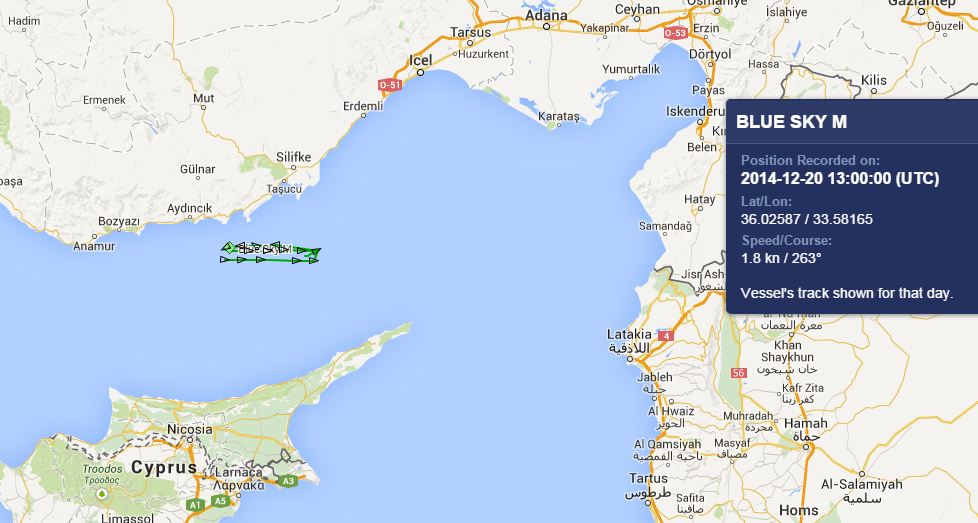
[Editor’s note: yesterday’s incident involving the rescue by Italian authorities of the Moldovan cargo ship Blue Sky M carrying hundreds of migrants would seem to be one such example; AIS tracking information from Marine Traffic shows that the Blue Sky M spent approximately five days (20-25 December) sailing in circles off the south-eastern Turkish coast before it began sailing towards western Greece. See screen capture of ship’s path from Marine Traffic below.]

“A place on a freighter from Turkey costs at least three times the price of a ticket on the usual sea route from Libya. And yet the migrants are willing to pay. Travelling this way not only circumvents the considerable danger of capsizing in a small boat in rough seas: it also avoids having to go to Libya. The departure point of choice for facilitator networks in 2014, this increasingly lawless North African nation appears to have become too dangerous an operating environment even for the criminal gangs….”

“For all its advantages, though, the new route from Turkey is not without dangers. The engines of the old ships are often highly unreliable. In the last six weeks alone, one freighter has been found drifting near Cyprus; another was rescued 30 miles off Crete; still others, off the Italian coast. The danger of shipwreck is greatly increased by the smugglers’ habit of switching off the freighter’s AIS (the Automatic Identification System with which all boats over 300 tonnes, as well as all passenger ships, are equipped). The effect is to make the boat electronically invisible to the Italian search and rescue authorities – a stratagem that buys time for the smuggling crew to escape by fast launch and thus avoid arrest.”

“Frontex has discerned another worrying recent trend: some 30% of all migrants rescued at sea in September and October were picked up by civilian shipping – the vast majority of them, 52 incidents, off the coast of Libya. The smugglers have learned to time the departure of migrant boats so that they cross the paths of merchant ships heading for the EU. When a distress call is transmitted, the merchant ship, being the nearest, is obliged by international maritime law to go to the rescue – and then disembarks them at the next port of call.”

Click here for full statement.

Screen capture from Marine Traffic showing path of Blue Sky M from 20-25 December 2014.

Screen capture from Marine Traffic showing path of Blue Sky M from 20-25 December 2014.

1 Comment

Filed under Frontex, Migrants, News, Refugees

OHCHR Releases Recommended Principles and Guidelines on Human Rights at International Borders

The Office of the High Commissioner for Human Rights yesterday issued Recommended Principles and Guidelines on Human Rights at International Borders. OHCHR, along with multiple stakeholders, has been working on the principles and guidelines since 2012.

Excerpts:
I. Introduction
A. Human rights at international borders
1. International borders are not zones of exclusion or exception for human rights obligations. States are entitled to exercise jurisdiction at their international borders, but they must do so in light of their human rights obligations. This means that the human rights of all persons at international borders must be respected in the pursuit of border control, law enforcement and other State objectives, regardless of which authorities perform border governance measures and where such measures take place.
2. Migration discourse is replete with terminology used to categorize people who migrate, such as “unaccompanied or separated children”, “migrants in irregular situations”, “smuggled migrants” or “victims of trafficking in persons”. In the complex reality of contemporary mobility it can be difficult to neatly separate people into distinct categories as people may simultaneously fit into several categories, or change from one category to another in the course of their journey. Every individual who approaches an international border has different motivations and it is important to remember that under international human rights law, States have obligations towards all persons at international borders, regardless of those motives.
3. States have legitimate interests in implementing border controls, including in order to enhance security, to protect human rights, and to respond to transnational organized crime. The Office of the High Commissioner for Human Rights (OHCHR) has therefore put together these Recommended Principles and Guidelines (“The Guidelines”) with a view to translating the international human rights framework into practical border governance measures. The Guidelines assert a human rights-based approach deriving from the core international human rights instruments and anchored in the interdependence and inalienability of all human rights, seek to establish accountability between duty-bearers and rights-holders, emphasis participation and empowerment, and focus on vulnerability, marginalization and exclusion.
4. Further, underpinning these Guidelines is a recognition that respecting the human rights of all migrants regardless of their nationality, migration status or other circumstances, facilitates effective border governance. Policies aimed not at governing migration but rather at curtailing it at any cost, serve only to exacerbate risks posed to migrants, to create zones of lawlessness and impunity at borders, and, ultimately, to be ineffective. Conversely, approaches to migration governance that adhere to internationally recognized human rights standards, serve to bolster the capacity of States to protect borders at the same time as they uphold State obligations to protect and promote the rights of all migrants. Ultimately then, these Guidelines are recommended to States and other stakeholders not only because they are obliged to put human rights at the forefront of border governance measures, but also because they have an interest in doing so.
[***]
9. These Guidelines shall not be interpreted as restricting, modifying or impairing the provisions of applicable international human rights law, international humanitarian law, international refugee law or other relevant legal instrument or rights granted to persons under domestic law. 1
Footnote 1 – In order to avoid duplication of authoritative guidance, the present Guidelines should be read in conjunction with the guidance provided by the Office of the United Nations High Commissioner for Refugees (UNHCR), including in the context of its 10-Point Plan of Action on Refugee Protection and Mixed Migration which emphasises the need for “protection sensitive entry systems” at international borders to identify, protect against non-refoulement and ensure access to asylum procedures for persons in need of international protection. For trafficked persons, the present Principles and Guidelines should be read in conjunction inter alia with OHCHR’s Recommended Principles and Guidelines on Human Rights and Human Trafficking.
[***]
II. Recommended principles on human rights at international borders
A. The primacy of human rights
1. States shall implement their international legal obligations in good faith and respect, protect and fulfil human rights in the governance of their borders.
2. States shall ensure that human rights are at the centre of the governance of migration at international borders.
3. States shall respect, promote and fulfil human rights wherever they exercise jurisdiction or effective control, including where they exercise authority or control extraterritorially. The privatisation of border governance functions does not defer, avoid or diminish the human rights obligations of the State.
[***]
B. Non-discrimination
8. The principle of non-discrimination shall be at the centre of all border governance measures. [***]
C. Assistance and protection from harm
10. States shall protect and assist migrants at international borders without discrimination. Human rights obligations, including in respect of civil, political, economic, social and cultural rights, must take precedence over law enforcement and migration management objectives.
11. States shall ensure that all border governance measures taken at international borders, including those aimed at addressing irregular migration and combating transnational organized crime, are in accordance with the principle of non-refoulement and the prohibition of arbitrary and collective expulsions.
12. States shall consider the individual circumstances of all migrants at international borders, with appropriate attention being given to migrants who may be at particular risk at international borders who shall be entitled to specific protection and individualized assistance which takes into account their rights and needs.
13. States shall ensure that all migrants who have suffered human rights violations or abuses as a result of border governance measures have equal and effective access to justice, access to effective remedies, adequate, effective and prompt reparation for harm suffered, and access to relevant information concerning violations and reparation mechanism. States shall investigate and, where warranted, prosecute human rights violations and abuses, impose sentences commensurate with the seriousness of the offence, and take measures to ensure non-repetition.
III. Recommended Guidelines on human rights at international borders
Guideline 1: Promotion and protection of human rights [***]
Guideline 2: Legal and policy framework [***]
Guideline 3: Building human rights capacity [***]
Guideline 4: Ensuring human rights in rescue and interception [***]
Guideline 5: Human rights in the context of immediate assistance [***]
Guideline 6: Screening and interviewing [***]
Guideline 7: Identification and referral [***]
Guideline 8: Avoiding detention [***]
Guideline 9: Human rights-based return or removal [***]
Guideline 10: Cooperation and coordination [***]”

 
Click here or here for Principles and Guidelines.

1 Comment

Filed under Analysis, OHCHR, Statements, United Nations

UNHCR: Significant Increase in Deaths at Sea Off Yemen Coincides with Increasing Numbers of Migrants Reaching Yemen by Boat

Excerpts from UNHCR press statement 17 Oct. 2104: “[T]here has been a sharp increase this year in the number of migrants and asylum-seekers losing their lives in attempts to get to Yemen, mainly from the Horn of Africa, with more deaths at sea in 2014 than in the last three years combined. One of the recent tragic incidents took place on 2 October when 64 migrants and three crew died when their vessel, sailing from Somalia, sank in the Gulf of Aden. Since, then five more deaths bring the yearly tally for 2014 to 215, exceeding the combined total for 2011, 2012 and 2013 of 179….

The latest deaths come amidst a dramatic increase in the number of new arrivals to Yemen by boat in September. At 12,768, it marks the single biggest month for arrivals since current records began to be kept in 2002. Most of the migrants are Somalis, Ethiopians and Eritreans.

Factors behind the surge are believed to include ongoing drought in South-Central Somalia, as well as the combined effects of conflict, insecurity, and lack of livelihood opportunities in countries of origin. Moreover, “the surge can also be attributed to a decreasing level of cooperation between the countries in the region to better manage migratory movements,” [UNHCR spokesperson James] Spindler said….”

Click here for full UNHCR statement.

1 Comment

Filed under Data / Stats, Eritrea, Ethiopia, Gulf of Aden, News, Somalia, UNHCR, Yemen

OHCHR to Issue Recommended Principles and Guidelines on Human Rights at International Borders (22 Oct-Brussels; 23 Oct-New York)

The Office of the High Commissioner for Human Rights next week will launch Recommended Principles and Guidelines on Human Rights at International Borders. The Guidelines will be released and discussed at events in Brussels on 22 October 2014 and New York on 23 October.

From OHCHR: “These Guidelines are offered by OHCHR to states and other relevant stakeholders to develop human-rights respecting border governance measures; and thus improve the respect, protection and fulfilment of migrants at international borders.”

“OHCHR has been working on these principles and guidelines since 2012, together with multiple stakeholders. They accompany the report of the Secretary-General on the Protection of Migrants (A/69/277) (also available here) and will be provided to the 69th session of the General Assembly (GA).”

“International borders are not zones of exclusion or exception of human rights obligations. States have the duty to comply with their human rights obligations and all of the safeguards and checks and balances that are embedded in national legislation. States are bound by these duties wherever they exercise their jurisdiction; including where their migration governance operations take place.”

“Policies curtailing migration often result in the diversion of migrants into irregular channels where vulnerabilities are exacerbated. Conversely, rights-based approaches to border and migration governance that adhere to internationally recognized standards bolster the capacity of the international community to mount effective and sustainable challenges to abusive migration and transnational organized crime. Developing a set of principles and guidelines on human rights at international borders would offer tools to translate the international human rights framework into practical measures for border governance, ensuring that measures taken to address migration (including irregular migration), migrant smuggling, and other cross-border phenomena do not violate human rights.”

Click here (Brussels event) and here (New York side event) for more information on the release of the Guidelines.

The Guidelines will be made available here on 21 October 2014: http://www.ohchr.org/EN/Issues/Migration/Pages/WSReportGA69.aspx.

1 Comment

Filed under OHCHR, Statements, United Nations

Guest Post: The effect of negative labelling – Why are we still talking about ‘migrants’?

By Dr Melissa Phillips

As the number of people arriving by boat to Europe continues to rise, so does the rhetoric about an influx of ‘illegal migrants’, ‘boat migrants’ , ‘migrant boats’ and just plain ‘illegals’. Academics have long written about the impact of press reporting on asylum issues and the effect of labelling on refugees and asylum seekers.(1) Their findings show the way predominantly negative labels are repeated and entrenched having a detrimental consequence for how we understand asylum issues and perceive asylum seekers. Perhaps the most pernicious of these labels has been ‘illegal’ which human rights groups, refugee advocates and media organisations have been campaigning against as inaccurate and legally incorrect.(2)

More recently commentators have been at pains to distinguish between groups of migrants and refugees arriving in Europe by boat, noting that there are technical legal arguments to guide terminology as well as familiar tropes that we encounter through the use of one term or another. As Jesper Bjarnesen notes, refugees and labour migrants are intertwined.(3) This is why terms such as ‘mixed migration’ have become one way to bridge the sometimes blurry distinction between people who leave their homes due to political persecution and those who suffer economic hardship, acknowledging that the two can be related in situations of displacement and refugee outflows.

Yet mixed migration still ties us to the word ‘migration’ which brings along with it polarising attitudes towards migration and competition over jobs. It also evokes less sympathy than refugee or asylum seeker, with migrants having fewer advocacy bodies and organisations fighting for their interests as compared to refugees.

So what do the arrival figures along the Central Mediterranean route into Europe tell us? Frontex’s FRAN quarterly for Q4, 2013 explained that “the majority of African irregular migrants detected along the Central Mediterranean route were Eritreans”. The classification of Eritreans as ‘irregular migrants’ would seem inaccurate given that around 90% of Eritrean asylum seekers successfully claimed asylum in industrialised countries in recent years.(4) Eritrea is currently the subject of a United Nations Human Rights Council Commission of Inquiry and is known to be one of the poorest and most repressive countries in the world. The next largest group of arrivals originated from Syria and Frontex acknowledges that this group of people is escaping armed conflict in their country. However the Frontex report then goes on to refer to ‘migrant interviews’, once again conflating the terms migrant and refugee and using them interchangeably.

Beyond technical distinctions over terms and language there is a lack of personalisation of the human side of asylum seekers, refugees and migrants seeking to enter Europe by sea. It can be very difficult to find individual stories behind the frenzied media headlines claiming thousands more people are potentially on their way to Europe by boat mainly departing from Libya. It is only through individual stories and nuanced accounts of why people leave their homes and their mixed motivations for departing, that we will better understand the factors driving mobility along this route which in turn can shape policy solutions. The upcoming United Nations High Commissioner for Refugees’ 2014 Protection Dialogue focuses on Protection at Sea and calls for responses that are sensitive to the specific needs of individuals and groups.(5) Assuming that all people have the same reason for leaving their homes and getting onto boats, that all people rescued at sea are migrants and that there is a one size fits all policy response misrecognises the heterogeneity of this group. Such heterogeneity includes country of origin, gender, age and family make up including pre-existing links to Europe.

It is time we stopped talking solely about migrants and start to use more technically accurate and relevant labels. Until then we cannot readily respond to a phenomenon that is one of the most pressing and challenging of our times – assisting people in need of protection at sea.

Dr Melissa Phillips is an Honorary Fellow at the University of Melbourne.

(1) See for example, Pickering, S. (2000). “The hard press of asylum.” Forced Migration Review 8: 32-33 and Zetter, R. (1991). “Labelling Refugees: Forming and Transforming a Bureaucratic Identity.” Journal of Refugee Studies 4(1): 39-62.
(2) For more on this see recent commentary by Human Rights Watch: http://www.hrw.org/news/2014/06/24/dispatches-why-we-should-outlaw-illegal and Fact Sheets produced by the Refugee Council of Australia: http://www.refugeecouncil.org.au/f/myth-long.php as well as media outlets: http://www.sbs.com.au/goback/about/factsheets/4/are-asylum-seekers-who-arrive-by-boat-illegal-immigrants and http://www.abc.net.au/news/2014-01-24/tony-abbott-incorrect-on-asylum-seekers-breaking-australian-law/5214802
(3) Bjarnesen, Jesper (2014) ‘Refugees or migrants?’, Nordic Africa Institute, http://www.nai.uu.se/news/articles/2014/06/27/104657 .
(4) Figure cited in Regional Mixed Migration Secretariat (2014), ‘Going West: contemporary mixed migration trends from the Horn of Africa to Libya & Europe.’
(5) See http://www.unhcr.org/pages/5357caed6.html .

3 Comments

Filed under Analysis

Conference: “Using Human Security as a legal framework to analyse the Common European Asylum System”, CLEER, T.M.C. Asser Instituut, The Hague, 4 July

The Centre for the Law of EU External Relations (CLEER) will hold conduct the following conference on 4 July in the Hague: ‘Using Human Security as a legal framework to analyse the Common European Asylum System.’ The event is free of charge, however registration is required. Please register here.

From the conference web page:  “The conference is the second event of CLEER’s project ‘Human Security: a new framework for enhanced human rights in the EU’s foreign security and migration policies’, implemented with the support of the Lifelong Learning Programme (LLP) of the European Union.

The project runs from 1 September 2013 until 31 August 2014 and aims at facilitating academic interaction in closely interrelated areas of EU external conduct, creating synergies between and raising awareness of global security concerns. The project will, specifically, integrate elements of EU external action in security, development and migration policies, through the paradigm of human security.

This expert conference will explore new territory in its analysis of protection under the Common European Asylum System through the prism of Human Security. In the second and final part of the CLEER Jean Monnet conferences on Human Security, this high level gathering will bring together specialists and practitioners in the area of EU asylum law. It will take stock of recent developments in legislation, jurisprudence and doctrine; proposing insightful approaches to contemporary asylum challenges.

The four thematic panels of the conference will analyse the added value of using Human Security as a legal framework for protection in Asylum law whilst assessing the prospects of legal interaction between both fields. Sessions will concentrate on the concept of Human Security as a legal tool for interpretation of EU instruments. Emphasis will be placed on the Dublin Regime along with obligations that Member States must adhere to in applying substantive protection rights for those seeking asylum. Attention will also be paid to the use of Human Security as an operational tool for border management and the consistent application of EU norms. The conference will end with a contextualisation of the debate, specifically focusing on the relations between the EU and South Mediterranean States.

The conference will be of direct interest to everyone working and studying in the Area of Freedom, Security and Justice of the EU, notably the asylum and refugee fields. In this regard practitioners, lawyers, judges, scholars, academics, students, civil servants, military and civilian authorities are all encouraged to come. Each panel will be followed by a question and answer session allowing for the audience to participate in the debate, thereby contributing to a unique perspective on EU asylum law and its protection regime.”


1 Comment

Filed under Colloques / Conferences, European Union

Panel Discussion: “Heading to Europe: Safe Haven or Graveyard?,” Radboud University Nijmegen, 16 May

From the organizers:

The Interest Group on Migration and Refugee Law of the European Society of International Law, the Centre for Migration Law of the Radboud University Nijmegen and the Amsterdam Center for International Law of the University of Amsterdam are pleased to announce ‘Heading to Europe: Safe Haven or Graveyard?’, a panel discussion on migration by sea in the Mediterranean. The panel discussion will be held on 16 May 2014 at the Radboud University Nijmegen.

The year of 2013 has demonstrated that the tragedy of thousands of migrants and refugees drowning on the shores of Europe is now a common occurrence. The fate of those who perished near the Italian island of Lampedusa has brought the urgency of the situation into focus. The aim of the panel discussion is to provide an overview of the legal rules and processes applicable to migration by sea in the Mediterranean and to reflect on their wider sociological implications.

The panel discussion consists of two panels, each followed by a plenary discussion. In the first panel, legal experts working in the field of academia and at stakeholder organizations (e.g. UN Refugee Agency, Council of Europe, European Union) focus on legal aspects of boat migration in the Mediterranean. The second panel brings together scholars and practitioners with first-hand experience from transit countries to discuss the sociological effects of the legal rules and processes. Click here for the complete program, and here for more information on the panelists.

The organizing partners cordially invite interested scholars, governments officials, practitioners and advanced students to join in the panel discussion ‘Heading to Europe: Safe Haven or Graveyard?’. Active participation in the discussion is strongly encouraged. Participation is free of charge. For participation, please register at the bottom of this page. For inquiries, please contact Lisa-Marie Komp at lisa-marie.komp@law-school.de.

Location is the CPO-zaal, Spinozagebouw at the Radboud University in Nijmegen (Montessorilaan 3).

CLICK HERE TO REGISTER

3 Comments

Filed under Colloques / Conferences, Council of Europe, European Union, Frontex, Mediterranean

“Mediterranean flows into Europe: Migration and the EU’s foreign policy” – Analysis by European Parliament DG for External Policies

The EP’s Directorate-General for External Policies just released an Analysis, “Mediterranean flows into Europe: Migration and the EU’s foreign policy,” in which it reviews the EU’s external policies and instruments relating to migration in the Mediterranean, including the Mediterranean Task Force established after 3 October 2013 tragedy at Lampedusa in which over 350 people died.

The Analysis describes the serious shortcomings of the security-driven approach that has been taken by the EU. Noting, for example, that “it is unclear whether the militarisation of EU border management (resulting from a tighter relation between the CSDP and Frontex) will actually save lives or create even more danger for migrants” and that “[t]he increasing militarisation of the issue of irregular migration was underscored in December 2013, when the European Council called for the establishment of an EU Maritime Security Strategy by June 2014 as well as for increased synergies between the EU’s Common Security and Defence Policy (CSDP) and freedom/security/justice actors to tackle illegal migration.”

The Analysis discusses possible ways in which the European Parliament might play a more significant role in the shaping of future policies:

“The coming months – which will include the European elections and the June 2014 Council – present an important opportunity for the EP to engage politically with the topic of migration in the Mediterranean. As outlined above, numerous EU external policies and instruments deal with migration in the region; […]

All should incorporate respect for human rights as a central concern and pursue the overall goals of prevention, protection and solidarity. The EP has tools at hand to contribute effectively to those objectives. The EP should use its co-decision powers to ensure the inclusion of human rights provisions in all migration-related legislation, and its power of consent to guarantee that international agreements contain effective human rights guarantees. The EP’s budgetary powers also allow the institution to link assistance to third countries to proper human rights monitoring mechanisms.

Most pressingly, the EP should advocate the implementation of the actions recommended by the Mediterranean Task Force set up by the Commission. The EP should also use the opportunities generated by inter-parliamentary relations (such as the 27th ACP-EU Joint Parliamentary Assembly in March and the EU-Africa summit in April) to engage in a dialogue about migration with third countries. This dialogue should foster cooperation in the management of regular migration and in the fight against irregular migration and trafficking networks, with special emphasis on the need to prevent migrants from embarking on dangerous journeys to the EU.

The dialogue should also seek to frame Mediterranean migration within a wider perspective, possibly in the following ways:

  • Steer away from excessively militarised and security-centred approaches. The EP should ensure that strict human rights standards are respected in the fight against organised crime and smugglers’ networks, and that a clear distinction is drawn between criminal networks and their victims. The EU should prevent the criminalisation of migrants and of humanitarian organisations supporting migrants.
  • Highlight the importance of good governance, and of good migration governance more specifically. By reinforcing the EU’s Regional Development and Protection Programmes, for example, the Union can develop a comprehensive and long-term framework to develop and enhance the capacities of migration management and national asylum systems in Mediterranean countries.
  • Demand full respect for humanitarian law, refugee protection and human rights (including the rights of non-nationals) in crisis situations, and stress that humanitarian access must be guaranteed to provide life-saving supplies.
  • Recognise the importance and challenges that South-South and intra-African migration represent for countries in the southern Mediterranean, rather than focussing solely on the (much smaller) flows towards the EU.
  • Encourage further research on the migration-development nexus and explore the positive impact of human mobility on socioeconomic development.
  • Encourage EU Member States to facilitate and speed up their procedures to grant asylum and EU protected status, whilst better differentiating between refugees and irregular migrants. The EP should respect the competence of the Member States in this regard, but could also encourage Member States – in cooperation with the UNHCR – to increase their quotas for resettling refugees not adequately protected in third countries. The EP should support the Mediterranean Task Force’s proposed feasibility study on the joint processing of protection claims outside the EU, and the Commission’s proposal to move towards a common approach for humanitarian permits and visas.

All these actions would contribute to reshaping the EU’s external action related to migration, notably in the Mediterranean. They would also enhance the EU’s credibility vis-à-vis those third countries that accept significant number of migrants and refugees, and that most directly bear the consequences of their neighbours’ conflicts. (This is the case today for Lebanon and Turkey, as a result of the Syrian civil war). A modified EU approach could also project a more nuanced and positive view of migration – a change that might, in turn, influence the way migration is perceived more broadly within the EU.”

Click here or here for the Analysis.

5 Comments

Filed under Analysis, European Union, Frontex, Greece, Italy, Libya, Malta, Mediterranean, Turkey

Interview with Frontex Director Laitinen

Several months ago the Finnish newspaper Fifi Voima published an interview with Frontex Director Ilkka Laitinen.  It is an interesting article if you read Finnish or use a translator (unfortunately Google translate does not handle Finnish well).

One interesting point from the article is Director Laitinen’s clear insistence that Frontex is not legally capable of violating human rights.  This is not a new position on the part of Frontex, but the Director is very emphatic in his position.  When asked about who could be held responsible for rights violations that might occur during Frontex coordinated joint operations, the Director indicated that Frontex is of the opinion that the operation and any potential human rights violations taking place are the responsibility of the Member States, not Frontex .

[Kenen vastuu?

Frontex koordinoi EU:n jäsenmaiden yhteisiä operaatioita maalla, merellä ja ilmassa. Käytännössä kyse on siitä, että esimerkiksi suomalaiset rajavartijat partioivat Välimerellä ja saksalaiset Kreikan ja Turkin rajalla paikallisten mukana. Kunkin operaation johdossa on yksi EU-valtio.

Frontexin kanta on, että operaatiosta ja niissä tapahtuvista mahdollisista ihmisoikeusloukkauksista ovat vastuussa jäsenmaat, ei Frontex.

Ilkka Laitinen ei esimerkiksi anna takuita siitä, etteikö hänen johtamansa viraston koordinoimissa operaatioissa ole käännytetty laittomasti siirtolaisveneitä Välimerellä. Hän perustelee tätä sillä, että vastuu toimista on jäsenmailla.]

Click here for link to article “Miehemme rajalla.”


2 Comments

Filed under Frontex, News