Security Council Negotiations Regarding EU Call for Use of Force Against Smugglers Ongoing; Russia Warns Against Repeating “Abuse” of 2011 UNSC Resolution

The Security Council Report reports that “[t]he negotiations on the EU draft aimed at tackling the smuggling of migrants on the Mediterranean were still ongoing at press time between some Council members and the Libyan authorities. (For at least one permanent member the consent of the Tobruk/al-Bayda-based government seems to be indispensable for the adoption of the resolution.) In the past, it has been difficult to get agreement on resolutions authorising the interception of vessels, whether in the context of the implementation of sanctions or counter-piracy measures. Some Council members feel strongly about not contravening the principle of freedom of navigation codified in the UN Convention on the Law of the Sea. As such, they have tended to focus their discussions in the past on such issues as the procedures to authorise interdiction, whether the consent of the flag state is required and the maritime zones where the interdiction is authorised to happen. In the informal interactive dialogue with Mogherini, some Council members inquired about the potential impact that requesting consent from Libya could have on the political process. The UK is the penholder on Libya.”

Reuters and Interfax reported that Russian Foreign Minister Sergey Lavrov said any resolution would have to describe “in the most minute detail the mandate of [an EU military] mission under [UN Charter] Chapter 7.” “‘The mandate of such an operation will have to be spelled out to the last detail because we do not want the ambiguity, which became a source of flagrant violations of the known resolution on Libya adopted in 2011, to repeat itself.’ … Lavrov said discussions in the Security Council on the new resolution against human traffickers were on hold as the EU was in talks with the internationally-recognized Libyan authorities sitting in Tobruk to work out necessary details. ‘As we have been told, European Union representatives are holding consultations with the lawful Libyan authorities recognized by the UN, these are the authorities seated in Tobruk, where the Chamber of Deputies and the government are operating’.”

1 Comment

Filed under European Union, Libya, Mediterranean, News, United Nations

European Migrant Death Database – Deaths at the Borders of Southern Europe

VU University Amsterdam has released a border death database documenting migrant deaths along the Southern European borders.

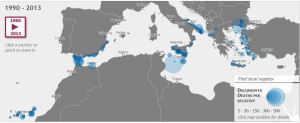
Here is a web post from DIIS (Danish Institute for International Studies) describing the project: “On 12 May 2015, researchers of VU University Amsterdam 2015-05-12_Border Deaths Org mapreleased a border death database, based on official death records of migrants who died at the Southern European borders in the years 1990-2013. They suggest that European states continue to collect such data supervised by a new European Migrant Death Observatory which is should be part of the Council of Europe.

The database contains individualized information on 3.188 people who died while attempting to reach southern EU countries from the Balkans, the Middle East, and North & West Africa, and whose bodies were found in or brought to Europe. It is unique because it includes – where known – date and place of death, cause of death, gender, age, country of origin, and whether or not the person was identified. Over the past year, 13 researchers visited 563 local civil registries in Spain, Italy, Greece, Malta and Gibraltar and collected information from death certificates. “This database underlines decades of indifference of European states. They had this information all the time, but failed to collect it”, says Professor Thomas Spijkerboer.

The database can be accessed through www.borderdeaths.org

It includes:
o Full database
o Visualization
o Documentary Counting. The Human Costs of Border Control (Pieter Boeles, 2014) about the research project
o Papers on (1) how was the data collected; (2) preliminary findings; (3) identification; (4) policy relevance”

See also: The short documentary Counting the Human Cost of Border Control, in which Thomas Spijkerboer and Tamara Last (Migration Law, VU University Amsterdam) search for traces of those who have died in the civil registries along the Mediterranean coast.

2 Comments

Filed under Analysis, Data / Stats, European Union, Maps

WikiLeaks Releases Classified Documents Describing EU Plans For Military Strikes Against Libyan Migrant Smugglers

WikiLeaks has released two documents which describe the EU plans for possible military attacks on boats used by migrant smugglers in Libya:

Document 1: “Military Advice on the “Draft Crisis Management Concept for a possible CSDP operation to disrupt human smuggling networks in the Southern Central Mediterranean””(also here)

Document 2: “PMG Recommendations on the draft Crisis Management Concept for a possible CSDP operation to disrupt human smuggling networks in the Southern Central Mediterranean” (also here)

WikiLeaks Press Statement:

“EU plan for military intervention against ‘refugee boats’ in Libya and the Mediterranean

Today, WikiLeaks is releasing two classified EU documents, outlining the planned military intervention against boats travelling from Libya to Italy. The more significant of the two documents was written by the combined military defence chiefs of the EU member states. The plan was formally approved by representatives from all 28 countries on 18 May 2015.

Importantly, one of the documents acknowledges that ‘the political End State [of the military intervention] is not clearly defined’ and recommends that the European Commission issue further guidance.

The documents lay out a military operation against cross-Mediterranean refugee transport networks and infrastructure. It details plans to conduct military operations to destroy boats used for transporting migrants and refugees in Libyan territory, thereby preventing them from reaching Europe. The EU member states’ military chiefs advice is that there is a need to:

‘[draw] on the full range of surveillance, intelligence and information capabilities available to MS [member states] and Partners, and supported by Brussels (inter alia EEAS [European External Action Service] Single Intelligence Analysis Capacity – SIAC)’.

The plan also acknowledges the possibility of EU military use of force against groups such as ISIL ‘within the Libyan sovereign area’:

‘the threat to the force should be acknowledged, especially during activities such as boarding and when operating on land or in proximity to an unsecured coastline, or during interaction with non-seaworthy vessels. The potential presence of hostile forces, extremists or terrorists such as Da’esh [ISIL] should also be taken into consideration’.

The documents mark a departure from previous EU military strategy in its overt targeting of civilian infrastructure in Libya. Numerous EU countries, including Belgium, Bulgaria, Denmark, France, Greece, Italy, the Netherlands, Romania, Spain, Sweden and the United Kingdom participated in NATO-led air strikes on Libya in 2011.

Human rights organisations have called on the EU not to put the lives of refugees and migrants at risk. The plan acknowledges that the EU risks negative publicity ‘should loss of life be attributed, correctly or incorrectly, to action or inaction by the EU force’. To manage this reputational risk, the documents recommend ‘an EU information strategy from the outset’ in order to ‘facilitate expectation management’. They also acknowledge the ‘need to calibrate military activity’ particularly within Libyan waters or ashore ‘in order to avoid destabilising the political process by causing collateral damage, disrupting legitimate economic activity or creating a perception of having chosen sides’.

Boats transporting people from Libya are the main means for refugees fleeing conflict in Syria, Eritrea, Afghanistan and the Horn of Africa to reach safety in Europe. Since the destruction of the Libyan government in 2011 there has been a sharp increase in the numbers of refugees travelling to Europe from Libya. In 2014 more than 170,000 people are estimated to have crossed the Mediterranean from Libya. In 2014, this made up 60 per cent of the entire irregular migration into the EU.”

WikiLeaks description of Document 1 -“Military Advice on the “Draft Crisis Management Concept for a possible CSDP operation to disrupt human smuggling networks in the Southern Central Mediterranean”” (also here):

“Classified EU plan, approved by EU member states defence chiefs, for a year long (at least) military operation against Mediterranean refugee transport networks and infrastructure, including the destruction of docked boats and operations within Libya’s territorial boundaries. The document is significant. It sets out the intent of EU defence chiefs: the EU will deploy military force against civilian infrastructure in Libya to stop refugee flows. Given the previous attacks on Libya by several EU NATO members and Libya’s proven oil reserves, the plan may lead to other military involvement in Libya. Formally, the document is approved Military Advice from the European Union Military Committee (EUMC) to the Political and Security Committee (PSC) on a “Draft Crisis Management Concept for a possible CSDP operation to disrupt human smuggling networks in the Southern Central Mediterranean”.

WikiLeaks description of Document 2 – “PMG Recommendations on the draft Crisis Management Concept for a possible CSDP operation to disrupt human smuggling networks in the Southern Central Mediterranean” (also here):

“This is the document of recommendations from the Politico-Military Group (PMG) and Committee for Civilian Aspects of Crisis Management (CIVCOM), who work with the support of the General Secretariat of the Council in the Council of the European Union, to the Political and Security Committee (PSC) on the “Draft Crisis Management Concept for a possible CSDP operation to disrupt human smuggling networks in the Southern Central Mediterranean”. On 5th May 2015 the PSC discussed a possible EU military CSPD operation to disrupt human trafficking networks in the Southern Central Mediterranean region, including seizure or destruction of shipping vessels, based on a Crisis Management Concept (CMC).”
2 Comments

Filed under European Union, Mediterranean, News

20 May – Informal Meeting between Members of UN Security Council and EU Political and Security Committee

From “What’s In Blue”: On 20 May, “members of the Security Council will hold an informal meeting with members of the EU Political and Security Committee (PSC). Since this is an informal meeting, it will not be held in the Security Council chamber and is not on the official programme of work of the Council. The meeting was requested by the EU and will be hosted by Lithuania, the current president of the Council, at the premises of the EU Delegation to the UN. The mutually agreed agenda for the meeting includes EU-UN peacekeeping cooperation in Africa, Libya and Ukraine.”

Among the topics that will be discussed is the proposed EU military operation in Libya:

“Libya/Migrant Smuggling – On this … issue, Council members are also expected to discuss with the members of the EU PSC the details of the EU military operation (EU NAVFOR Med) the EU decided to establish on 18 May to break the business model of the smuggling of migrants. Briefing the Council on 11 May, Mogherini presented proposals for the EU strategy to tackle the flow of migrants towards Europe. As part of this strategy, Mogherini discussed the plans for an EU military operation that would be authorised under Chapter VII to inspect, seize and dispose of vessels when there are grounds to believe that they are participating in the smuggling of migrants. Negotiations are ongoing among EU members of the Council (France, Lithuania, Spain and the UK) and China, Russia and the US on a draft resolution to authorise the EU operation. Council members are likely to be interested in the details that the EU PSC ambassadors can provide on this proposed operation, and what they are seeking from the Council, including on the appropriateness of this response to tackle this phenomenon, the protections foreseen in accordance with international refugee law, the issues associated with consent from the Libyan authorities, the geographical scope of the resolution, and consent by the flag states regarding interdictions.”

Leave a comment

Filed under European Union, Libya, Mediterranean, News, United Nations

Via Statewatch: Non-public Crisis Management Concept document – EU plan for CSDP operation to disrupt migrant smugglers in Libya

The non-public Crisis Management Concept document outlining the EU plan for a CSDP operation to disrupt migrant smugglers in Libya has been made available via Statewatch. See p. 6, Section IV, for the military operation plans. (Also available here.)

Leave a comment

Filed under European Union, Mediterranean, News

Statewatch Analysis: The EU’s Planned War on Smugglers

Statewatch has issued an Analysis, “The EU’s Planned War on Smugglers,” written by Steve Peers, Professor of EU Law, University of Essex:

“The EU’s Foreign Affairs Council is meeting today to discuss the possibility of a military operation in the Mediterranean to take actions against smuggling of migrants. Officially, at least, the purpose of the operation (as defined by EU leaders last month) is to destroy smugglers’ boats. The EU’s High Representative has stated that there will be ‘no boots on the ground’; and as she arrived at the Council meeting today, she referred to authorising an ‘EU operation at sea’. However, it is clear from the documents discussed in the EU’s Political and Security Committee last week that (unless plans have changed radically in the meantime) the High Representative is being “economical with the truth”. The EU action clearly contemplates action by ground forces. Moreover, it anticipates the possible loss of life not only of smugglers but also of Member States’ forces and refugees. In effect, the EU is planning to declare war on migrant smugglers – without thinking through the consequences. [***]”

1 Comment

Filed under Analysis, European Union, Frontex, Libya, Mediterranean

EU Foreign Affairs Council Meets 18 May – Will Discuss Destruction of Smuggler Boats

From the European Council web site: “In a joint session, foreign and defence ministers will take stock of action to tackle migration issues. They will also discuss efforts to capture and destroy the vessels of human traffickers before they are used. In addition, ministers will debate the strategic review, an ongoing analysis of the EU’s security environment, and discuss security challenges in the EU’s neighbourhood. They will also prepare the security and defence part of the June European Council.”

Foreign Affairs Council background Brief here.
Politico EU article here.

1 Comment

Filed under European Union, Mediterranean, News

German Naval Ships Participating in Mediterranean Rescue Operation Destroy Empty Migrant Boats

Two German naval ships, the Hessen and the Berlin, have been participating in Mediterranean rescue operations since 5 May and have reportedly destroyed five migrant boats (four inflatable and one wooden) after rescue operations were completed and migrants removed from the boats. The boats are destroyed because they might pose a navigational hazard to other vessels and might also be mistaken for a boat in distress. (Wir müssen die Boote zerstören, weil sie auf dem offenen Meer ein Schifffahrtshindernis für andere Boote darstellen. Zum anderen könnte es sein, dass wir ein leeres Boot aus der Luft irrtümlich als ein in Seenot befindliches Boot wahrnehmen und hinfahren, um es zu retten. Das kann wertvolle Zeit kosten, die uns bei der Rettung von besetzten Booten dann verloren geht.)

As I have noted before, there are situations such as these where the destruction of a migrant boat may be perfectly legal and appropriate. Assuming reasonable measures can be taken to avoid or minimize environmental damage, the destruction in international waters of an unflagged and unseaworthy vessel would seem to be legal.

Leave a comment

Filed under European Union, Frontex, Mediterranean, News

IOM see inherent risk that EU military action in Libya will endanger migrant lives.

In a statement IOM generally welcomed the European Commission’s proposals on migration. “IOM … supports the renewed focus on disrupting criminal smuggling networks, but has serious concerns about proposals to ‘systematically identify, capture and destroy vessels used by smugglers,’ through EU Common Security and Defense (CSDP) operations. While recognizing the need for a powerful demonstration of the EU’s determination to act, IOM sees inherent risk that military actions, however laudable, could further endanger migrant lives.”

1 Comment

Filed under European Union, Frontex, Mediterranean, United Nations

UN’s Sutherland calls on EU “not to put any refugees or migrants in the line of fire.”

Peter Sutherland, Special Representative of the UN Secretary-General for International Migration and Development in a statement welcomed the European Commission’s “European Agenda on Migration” but “urge[d] [EU] Member States not to put any refugees or migrants in the line of fire, and to design any [anti-smuggling] operation in complete conformity with international law.” Sutherland urged the EU to take steps to ensure that Frontex Operations Triton and Poseidon “are at least equal in effect to Mare Nostrum” and “to make search-and-rescue the top priority…”

Leave a comment

Filed under European Union, Frontex, Libya, Mediterranean, Statements, United Nations

NATO Ready to Assist EU With Anti-Smuggler Operations in Libya if Requested

ANSA reports that NATO Secretary-General Jens Stoltenberg said that NATO will consider any EU request for assistance in regard to EU military operations against smugglers in Libya: “’Let’s let the EU take its own decisions,’ Stoltenberg said amid mooted plans to destroy people-smuggler boats. …’If the EU makes requests of us we will consider them seriously, but so far it hasn’t,’ Stoltenberg said. According to Reuters, “U.S. Ambassador to NATO Douglas Lute “said information-sharing between NATO and the EU could be possible. Accurate intelligence pinpointing smugglers’ vessels would be key to the success of the operation.”

1 Comment

Filed under General

Guardian: “EU plan to strike Libya networks could include ground forces”

From today’s Guardian: “European plans for a military campaign to smash the migrant smuggling networks operating out of Libya include options for ground forces on Libyan territory. The 19-page strategy paper for the mission, obtained by the Guardian, focuses on an air and naval campaign in the Mediterranean and in Libyan territorial waters, subject to United Nations blessing. But it adds that ground operations in Libya may also be needed to destroy the smugglers’ vessels and assets, such as fuel dumps. … [The strategy paper] which is expected to be endorsed by European Union foreign ministers on Monday [states that] ‘[t]he operation would require a broad range of air, maritime and land capabilities. These could include: intelligence, surveillance and reconnaissance; boarding teams; patrol units (air and maritime); amphibious assets; destruction air, land and sea, including special forces units.’ … [The strategy paper states that operations] could include ‘action along the coast, in harbour or at anchor of smugglers assets and vessels before their use’…. The planning document admits that the campaign could result in innocent people being killed: ‘Boarding operations against smugglers in the presence of migrants has a high risk of collateral damage including the loss of life’.”

See full article here.

1 Comment

Filed under European Union, Mediterranean, News, United Nations

Russia May Agree to Security Council Resolution Authorising “Seizing and Arresting” Smuggler Boats and Assets – Security Council Vote Could Happen at Any Time

Politico EU reports that “Russia’s Ambassador to the EU, Vladimir Chizhov, told POLITICO the ‘EU’s proposals of destroying vessels would definitely go too far for Russia,’ but did not oppose the other key element of [HRVP Federica] Mogherini’s proposal. ‘In our opinion, seizing and arresting vessels and assets of smugglers would be an adequate measure to undermine their illegal “business model” in Libya,’ he said. Chizhov confirmed that ‘Russia is ready to work with the EU and its member states with the aim of solving the migration crisis in the Mediterranean, including on a possible UNSC resolution.’”

Politico EU suggests that “Mogherini or other EU officials may carefully shift emphasis from the boat destruction plan to the interruption of the trafficker networks” and reports that “[a] vote on a UN resolution could happen anytime in coming weeks — even before next Monday would be possible…”

See full article here.

PS – Of interest to anyone following the EU, check out Politico EU’s Brussels Playbook – a daily early morning summary of EU news and events in Brussels.

Leave a comment

Filed under European Union, Mediterranean, News, United Nations

HR/VP Federica Mogherini’s remarks at the UN Security Council, 11 May 2015

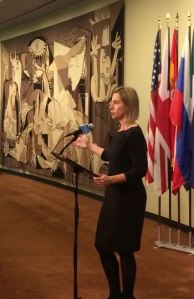
HR/VP Mogherini’s remarks earlier today to the Security Council contained very few details on the EU proposal to engage in “systematic efforts to identify, capture and destroy vessels before they are used by traffickers in accordance with international law.” Here is one excerpt from her remarks: Mogherini at UNSC

“[M]y presence here at the Security Council today is so important for us. We have in these weeks prepared for a possible naval operation in the framework of the European Union Common Security and Defence Policy. The mandate of this operation is currently being elaborated with the EU Member States in Brussels, and will be discussed by the meeting of the EU Foreign Affairs Council, in a week from now, in exactly a week from now on 18 May, with a possibility of taking decisions, the first decisions already. We want to work with the United Nations, in particular with the UNSC. …”

Full text here.

2 Comments

Filed under European Union, Frontex, Libya, Mediterranean, Statements, United Nations

UN Security Council, 11 May, Briefing and Informal Interactive Dialogue on the Smuggling of Migrants in the Mediterranean

Full text from “What’s in Blue” (published by Security Council Report):

“On Monday (11 May) the [Security] Council will receive a briefing by Federica Mogherini, the EU High Representative for Foreign Affairs and Security Policy, on the EU response to the smuggling of migrants in the Mediterranean Sea. After the briefing, Council members are expected to hold an informal interactive dialogue with her. At the request of Chad, the permanent observer of the AU to the UN, Ambassador Tete António, will also participate in these meetings.

This briefing comes after the 19 April incident in which more than 700 migrants drowned when the overcrowded boat on which they were traveling sank near Libya. According to the [International] Organization for Migration, more than 1,700 migrants have drowned since the beginning of January in the Mediterranean Sea. In a 21 April press statement, Council members expressed grave concern at the smuggling of migrants off the coast of Libya, highlighting the implications for regional stability. On 22 April, at the request of the UK, Council members exchanged views on this issue under ‘any other business”’

Mogherini is expected to brief Council members on the integrated strategy by the EU to address the smuggling of migrants in the Mediterranean Sea. The strategy includes the provision of bilateral development assistance to countries on the southern and eastern Mediterranean basin—as well as to countries of origin and transit—while tripling the financial resources available to operations Triton and Poseidon, currently existing in the territorial waters of EU member states. In a 20 April joint meeting of EU foreign and interior Ministers, chaired by Mogherini, the Home Affairs and Citizenship Commissioner Dimitris Avramopoulos of Greece presented a plan to respond to migrant smuggling in the Mediterranean, which would entail a systematic effort to capture and destroy vessels used by the smugglers, inspired by the EU Atalanta Operation deployed to fight against piracy off the coast of Somalia. The plan was endorsed in a 23 April meeting of the EU Council, and negotiations are ongoing at the EU to agree on the Crisis Management Concept, which is the basis for operational planning and conduct of any EU mission.

Since that meeting, discussions among EU members of the Council (France, Lithuania, Spain, and the UK) and Italy on a draft resolution apparently authorising such an operation have been ongoing. It seems some permanent members have been able to provide inputs. It appears the idea is for a Chapter VII resolution that will authorise an EU operation to use all necessary measures to inspect, seize and dispose of vessels when there are grounds to believe that they are participating in the smuggling of migrants. The draft may be circulated to the wider membership of the Council in the coming days.

Although most Council members have not seen the draft text, they are aware of some of its elements and are expected to seek information that might feed into any negotiations of the draft. Council members are likely to want to know more about the expected geographical scope of the resolution (whether this includes the high seas, the territorial waters of Libya or even its shore) and whether the EU is seeking Libya’s consent. In this context, Council members might inquire about Mogherini’s recent conversations in Tunisia with Libyan political actors, and the potential impact of such an operation on the political process. Some Council members might be worried that asking for the consent of the Tobruk-based government could negatively impact the talks, which are aimed at the formation of a government of national unity.

Some Council members may echo concerns regarding the protection of human rights and international refugee law that have been raised by the Secretary-General as well as the UN High Commissioners for Human Rights and Refugees. In particular, they might ask about the fate of the migrants taken into custody, and note the importance of respecting the guarantees of international law, notably the 1951 Refugee Convention and the principle of non-refoulement. When the programme of work was adopted, a briefing by the High Commissioner for Refugees, along with the head of the UN Office on Drugs and Crime, was being considered for some point in May. Some Council members may have expected these briefings to happen before engaging in discussions about the regional responses to the smuggling of migrants; however, at press time, it was unclear if and when they will be held.

In the past, it has been difficult to get agreement on resolutions authorising the interception of vessels, whether in the context of the implementation of sanctions or counter-piracy measures. Some Council members feel strongly about not contravening the freedom of navigation principle codified in the UN Convention on the Law of the Sea. As such, they have tended to focus their discussions in the past on issues such as the procedures to authorise the interdiction, whether the consent of the flag state is required, and where the interdiction is authorised to happen.”

3 Comments

Filed under African Union, European Union, Frontex, Libya, Mediterranean, News, United Nations