Tag Archives: European Union

Russia Will Veto Any UN Security Council Resolution Seeking to Authorise Destruction of Smuggling Boats in Libya

The Financial Times (paywall or answer marketing questions) reported yesterday that Russia will veto any UN Security Council resolution that would authorise the destruction of migrant boats in Libya. The FT reported that Russia might consider supporting “a more restricted mandate for any EU military mission, which could involve a search and rescue role alongside powers to stop and seize smugglers’ boats at sea.”

The Security Council’s Programme of Work for the month of May does not currently include any meetings pertaining to the EU’s desire for authorisation of military strikes on smugglers boats, but a briefing by the UN High Commissioner for Refugees on the migrant crisis in the Mediterranean might take place next week according to footnotes to the Programme of Work.

4 Comments

Filed under European Union, Libya, Mediterranean, News, United Nations

Highlights from Frontex Annual Risk Analysis 2015 – Detections of Illegal Border-Crossing Between Border Crossing Points

Frontex released its Annual Risk Analysis 2015 (also here) on 28 April. Over the next few days I will post some key points and excerpts from portions of the 70 page report which are most relevant to migration by sea. See Executive Summary and Statistical Annex. 2015-04-28_Frontex_Annual_Risk_Analysis_2015-COVER
This post contains excerpts and key points from the ARA, Section 3, Situational Picture in 2014 / Detections of illegal border-crossing between border crossing points:

• In 2014, detections of illegal border-crossing reached a new record, with more than 280 000 detections. This was twice as many as the previous record of 140 000 detections in 2011, the year of the Arab Spring;
• With a record level of migrants crossing the border illegally, resources are devoted to their immediate care, but not towards screening;
• Syrians and Eritreans did not apply for asylum in the Member States of entry but rather in other Member States;
• As in 2013 and in 2011, the Central Mediterranean route was the main area for illegal border-crossing into the EU, representing 60% of all detections in 2014;
• Around 3 400 people died or went missing at sea in 2014;
• Civilian vessels have been increasingly involved in the detection and rescue of migrants at sea. More than 600 merchant ships have been diverted from their routes to rescue persons at sea in 2014;
• An increasing number of cases have been reported of cargo vessels being used to smuggle migrants from Turkey directly to Italy. This new trend affects the Eastern Mediterranean route, as the departure area, and the Central Mediterranean area, as the arrival area;
• In 2014, 50 800 detections were reported in the Eastern Mediterranean area, representing 18% of the EU total. This was twice as many as in 2013, mostly due to a sharp increase in detections in the Aegean Sea (from 11 829 in 2013 to 43 377 in 2014);
• In 2014 there were 7 842 detections of illegal border-crossing in the Western Mediterranean region, which consists of several areas of the southern Spanish coast and the land borders of Ceuta and Melilla. This total shows an increase of 15% compared to the total of 6 838 reported in 2013.;
• Detections of illegal border-crossing on the Black Sea were extremely rare. However, since 2013, Bulgaria and Romania have reported an increasing number of detections, totalling 433 migrants in 2014.

Excerpts:

“3.3. Detections of illegal border-crossing between BCPs [along land and sea routes in 2014]

In 2014, detections of illegal border-crossing reached a new record, with more than 280 000 detections. This was twice as many as the previous record of 140 000 detections in 2011, the year of the Arab Spring. This unprecedented number of migrants crossing illegally the external border has roots in the fighting in Syria that have created the worst refugee crisis since the Second World War. Indeed, most of the detections at the borders concern migrants from Syria, who later applied for asylum within the EU. [***]

With a record level of migrants crossing the border illegally, resources are devoted to their immediate care, but not towards screening and obtaining information on basic characteristics like their nationality. As migrants quickly continue their journey to other Member States, increasing the movements of persons staying illegally within the EU, this puts the EU internal security at risk. [***]

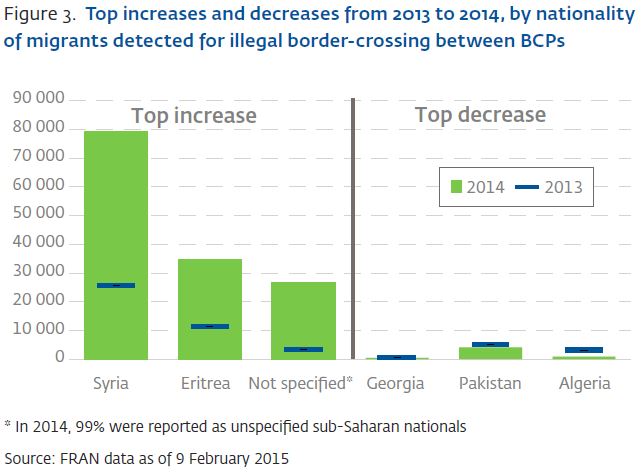
Indeed, Syrians alone (79 169) represented more than a quarter (28%) of the total as shown in Figure 3. [SEE BELOW.] They were also the top nationality for other indicators, in particular asylum applications, reflecting the dire situation in Syria and the desperate plight of Syrian asylum seekers. However, the vast majority of Syrians did not apply for asylum in the Member States of entry but rather in other Member States for many different reasons, notably because they expect to receive more attractive welfare benefits.

Regarding Eritreans, their detections in 2014 reached a record level (more than 34 500, compared to 11 300 in 2013). They were mostly arriving through Libya on the Central Mediterranean route. Like Syrians, they did not apply for asylum in the Member States of entry, but rather continued to other Member States. Many of the Eritreans stated that they had lived for some time in Libya but decided to leave because of the violence.

Detections of Afghans sharply increased from about 9 500 in 2013 to more than 22 000 in 2014. Afghans were detected on the Eastern Mediterranean route (mostly crossing the Eastern Aegean Sea), and then once again on the Western Balkan route. [***]

Central Mediterranean route

In 2014, more than 170 000 migrants arrived irregularly in the EU through the Central Mediterranean route (see Fig. 4).[SEE BELOW.] As in 2013 and in 2011, the Central Mediterranean route was the main area for illegal border-crossing into the EU, representing 60% of all detections in 2014. Detections were the largest between June and September at over 20 000 per month, but throughout the year, monthly detections were larger than in 2013. Most migrants were Syrians and Eritreans departing from the Libyan coast.

The vast majority were rescued by border-control authorities after issuing a distress call; however, despite best efforts there were many fatalities. Smugglers typically make use of frail, overcrowded boats, with limited fuel available to maximise their profits, putting migrants’ lives at considerable risk. The role of the Italian Navy and the JO Hermes/ Triton was crucial in rescuing an unprecedented number of migrants. Despite these efforts, around 3 400 people died or went missing at sea in 2014 and around 2 800 since the beginning of July according to UNHCR estimates.

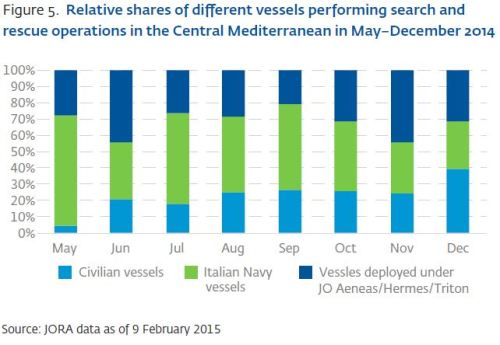
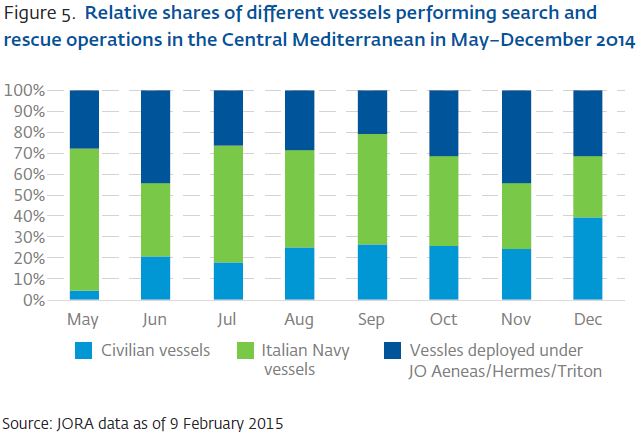
Besides naval assets, civilian vessels have been increasingly involved in the detection and rescue of migrants at sea (see Fig. 5). [SEE BELOW.] According to the International Maritime Organization (IMO), more than 600 merchant ships have been diverted from their routes to rescue persons at sea in 2014. These deviations are, in the words of the Secretary General, detrimental to shipping and are not offset by any realistic prospects of salvage awards.

In addition to migrants leaving from Libya, since September 2014, an increasing number of cases have been reported of cargo vessels being used to smuggle migrants from Turkey directly to Italy. This new trend affects the Eastern Mediterranean route, as the departure area, and the Central Mediterranean area, as the arrival area. This practice is further developed under the section related to the Eastern Mediterranean route.

As migrants were rescued in high-sea, they were reported as part of the Central Mediterranean route. Many were disembarked in Apulia and Calabria, to alleviate the burden on reception capacity in Sicily. From a statistical point of view, these disembarkations artificially inflated the number of migrants usually reported on the Apulia and Calabria route. In 2014, there were fewer migrants departing from Egypt and targeting this area of the Italian coast than in 2013. [***]

Eastern Mediterranean route

Since data collection began in early 2008, the Eastern Mediterranean has maintained its status as a hotspot of irregular migration (see Fig. 6). In 2014, 50 800 detections were reported from the area, representing 18% of the EU total. This was twice as many as in 2013, mostly due to a sharp increase in detections in the Aegean Sea (from 11 829 in 2013 to 43 377 in 2014). Detections remained comparatively much lower at the Bulgarian and Greek land borders with Turkey (12 262 in 2013 and 5 938 in 2014).

Sea border

Aegean Sea

Compared to the previous year, the sharp increase in the Aegean Sea in 2014 meant that migrants departed from more areas, and also arrived on a larger number of islands. While the islands reporting the largest number of arrivals remained Lesbos, Chios and Samos, detections were also reported from small islands from North to South, stretching capacity of surveillance. Many migrants claimed to be Syrian, and were thus handed an administrative notice allowing them to stay in Greece for up to six months, even without applying for asylum.

Screening processes of some migrants revealed a high degree of falsely claimed nationalities to avoid return. Not knowing the nationality of migrants who are illegally crossing the border and travelling within the EU is evidently a vulnerability for EU internal security. [***]

Increasing use of cargo ships

Since August 2014 the number of irregular migrants arriving in the Central Mediterranean from Turkey sharply increased compared to earlier in the year and to the same period in 2013. This sharp increase was directly related to the use of cargo ships to facilitate migrants and asylum seekers from Turkey to Italy (for example, see Fig. 7).

To date, Mersin has been the place where those wishing to travel to the EU in an irregular fashion have made contact with the smuggling networks. Wooden boats, however, have departed from various points along south-eastern Turkish coast such as Mersin, Adana and Hatay provinces to reach cargo vessels waiting off shore.

Smuggling migrants from Turkey on board large cargo vessels is extremely profitable, and such funds are likely to be an important source of income for smuggling networks also engaged in other criminal activities. This means that the criminal networks might be financing other criminal activities by exploiting and putting at risk vulnerable groups of displaced families from Syria.

Specifically, the cargo ships, which are often bought as scrap, tend to cost between EUR 150 000 and 400 000. There are often as many as 200–800 migrants on board, each paying EUR 4 500–6 000 for the trip, either in cash a few days before the departure or by Hawala payment after reaching the Italian coast. The cost is high because the modus operandi is viewed as being safe and has been demonstrated as being successful.

Hence, the gross income for a single journey can be as high as EUR 2.5 or even 4 million depending on the size of the vessel and the number of migrants on board. In some cases, the profit is likely to be between EUR 1.5 and 3 million once other overheads such as recruiters, safe houses, shuttle vessels, crew and fuel have been taken into account. Given this level of financial gain it is important to act against this modus operandi not only to stem the flow of irregular migration but also to limit the financial assets of the smuggling networks. [***]

Western Mediterranean route

In 2014 there were 7 842 detections of illegal border-crossing in the Western Mediterranean region, which consists of several areas of the southern Spanish coast and the land borders of Ceuta and Melilla. This total shows an increase of 15% compared to the total of 6 838 reported in 2013.

Like in 2013, the first half of 2014 showed most detections being reported at the land border, mostly from Melilla. Indeed, the Spanish authorities reported several violent attempts to cross the fence.

As mitigating measures, the fence has been upgraded. As a result, in the second half of the year, Spain reported more detections at the sea border than at the land border.

Once in Melilla, migrants are turned over to Spanish Police Headquarters for identification, and many are transferred to the Temporary Centre for Immigrants (CETI – Centro de Estancia Temporal de Inmigrantes). However, this centre only has a limited capacity and some migrants had to be transferred to mainland Spain.

In terms of nationality, most of the migrants are from Western Africa, in particular from Cameroon and Mali. Algerians and Moroccans have also been reported among the top ten nationalities, but mostly at the sea border.

Since November 2014, Spain also reported an increase in detections of illegal border-crossing of Syrians at the land border (more than 250 in November and December), then applying for asylum. This increase, combining with increasing detections of Syrians using forged document to enter to the EU, has prompted Spain to open asylum and international protection offices at the borders of Ceuta and Melilla in March 2015.

Black Sea route

Detections of illegal border-crossing on the Black Sea were extremely rare. However, since 2013, Bulgaria and Romania have reported an increasing number of detections, totalling 433 migrants in 2014.

These incidents still constitute isolated cases, and are possibly linked to the increased surveillance on the Eastern Mediterranean route and the increasing number of migrants waiting in Turkey to reach the EU illegally. [***]”
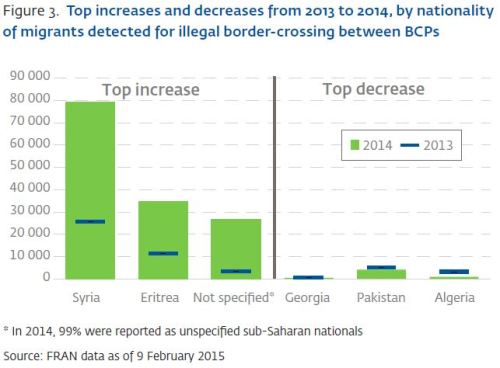
 

Figure 3


Figure 4


Figure 5

2 Comments

Filed under Aegean Sea, Black Sea, Egypt, Frontex, Greece, Italy, Libya, Malta, Mediterranean, Reports, Spain, Statistics, Syria, Tunisia, Turkey

The Detention of Asylum Seekers in the Mediterranean Region – A Global Detention Project Background Paper

The Global Detention Project just released a Background Paper, “The Detention of Asylum Seekers in the Mediterranean Region,” which “is intended to highlight some of the vulnerabilities that people seeking international protection face when they are taken into custody in Mediterranean countries and to underscore the way that European Union-driven policies have impacted the migratory phenomenon in the region.”  GDP Cover-Backgrounder Det of Asy Seekers in Med_April 2015

Summary: “With the recent tragic surge in the number of deaths at sea of asylum seekers and other migrants attempting to reach Europe, enormous public attention is being focused on the treatment of these people across the Mediterranean. An important migration policy employed throughout the region is detention, including widespread deprivation of liberty of asylum seekers and other vulnerable groups. …

The report focuses on eight key countries in Europe and North Africa. While there are clear differences in treatment from one side of the Mediterranean to the next, looked at collectively, the protection environment across all the countries in the region is bleak. Not surprisingly, the conditions of detention asylum seekers face in North African countries are often horrific and inhumane. However, in Europe, there are also serious shortcomings. In fact, as this backgrounder reports, reception and detention conditions in three of Europe’s main asylum receiving countries (Greece, Italy, and Malta) are so inadequate that many of their EU counterparts have been forced to halt returns to these countries under the Dublin III Regulation.”

1 Comment

Filed under Egypt, European Union, Greece, Italy, Libya, Malta, Morocco, Refugees, Reports, Spain, Tunisia

UN Security Council President on Mediterranean Migrant Crisis: It’s Not About Protecting Europe; It’s About Protecting the Refugees.

After meetings on Tuesday this week between HRVP Federica Mogherini and the current UN Security Council President, Jordanian Ambassador Dina Kawar (Lithuania assumes the Presidency of the Security Council on 1 May), the AP reported that “diplomats are warning that United Nations backing for any European Union plan to address the growing Mediterranean migration crisis could take longer than anyone wants.”  Ambassador Kawar said “I don’t think we’re anywhere close to having [support] now” and that the effort is “not about protecting Europe. It’s about protecting the refugees.”

Excerpts from HRVP Mogherini’s press conference on 28 April at the Security Council:

“[***] My presence here was already planned today for addressing the [NPT review] conference, but I also took the chance of following up on the European Council we had last Thursday where the Heads of State and Government of the European Union discussed the tragedies that are happening in the Mediterranean, linked to the trafficking and smuggling of people across the Mediterranean, but also all the way through Africa and, in most cases, from places of the world like Syria or the Horn of Africa where their life is put at risk. So, I have had discussions about that today with the EU Permanent representatives of the countries that are sitting in the Security Council: Lithuania that is taking the Presidency of the Security Council from Friday, Spain, UK and France. I will meet also the Italian Permanent representative later on, the Russian Permanent representative and I will meet Samantha Power tomorrow in Washington as well as Secretary Kerry – not only on this but also on this. I will be visiting China next week where this issue will also be part of my talks. [***]

Q&A:
Question: [***] And on the question of an EU mandate for military operations off of Libya, do you have any sense of when that could be pushed through at the Security Council?

HRVP Federica Mogherini: [***] On the creation of an international framework, of a legal framework for fighting traffickers and smugglers, we also had a very useful conversation with Secretary General Ban Ki-Moon together with Prime Minister Renzi yesterday in Sicily. It is not for the European Union to set the UN Security Council time framework, the EU is not sitting in the Security Council, as you know very well. So it is not for me to comment on the next steps. What I can say is that we are working in Brussels and in strong coordination with the European Union members of the Security Council to make sure that our planning, our options that are being prepared in Brussels, go hand in hand with the discussions that can be made in the Security Council, and not only with the European Union members, also with others. I think I mentioned the fact that I just met the Jordanian permanent representative, not only as President of the Council but also as an Arab country that has a lot to say when it comes to the stability and the security of the region. And also the African Union. I spoke with the President of the African Union Mrs Zuma this morning to find ways of cooperating strongly in preventing the criminal organisations to act on the African territory and to address the root causes of the phenomena. Because we know very well that we cannot focus only on one of the links of the chain, meaning the last part of the trip. But we have to address root causes; we have to address the issue of poverty, of wars, of human rights, of unequal distribution and access to resources, being it financial or other kind of resources. And we need to do it in partnership with the countries that are involved in this. Because the human trafficking and smuggling is clearly a violation of Human rights but it is also clearly a threat and a challenge for the security and the stability of all countries involved, all the way. It is not only a European issue, it is not only a Libyan issue – even if we are looking at finding ways of cooperating with all Libyans to face this threat and to find ways of working together in preventing this spreading even more in the territory. But we need to work in cooperation with our partners around the region and around the world for sure. So not for me to set up a time frame for UN Security Council to work, but for sure to make sure that the European Union work on this is coordinated and is fully in respect of international law. On this, let me also say that I spoke with António Guterres on Sunday to start coordinating even more closely, because our main objective is to save lives. Saving lives also means take care of the people we save. And on this we look for a strong partnership with the UNHCR and it would be good to see the UNHCR operating in all places through which the smuggling and trafficking of people takes place.

Question: On this migrants’ smuggling question. Can you say how soon your enforcement operations will begin? Which countries will participate? And any details on how this enforcement effort will be underway?

HRVP Federica Mogherini: I was tasked last Thursday to start preparation for possible operations by the European Union, in full respect of international law, which means that we will need in any case to have a legal basis before we start operation on a European Union level. In the meantime, we are preparing options for a mission, for an operation. The process would be, first for me to present options to the Ministers, for them to take decisions; decisions in the EU are taken by unanimity, 28. And then it will be up to single Member States to decide whether and in which way they can participate to the operation. So we have different phases: preparation has already started on Thursday, on the very same day [than the European Council]. We are having the first discussion and thinking with the Member States in these very same hours. And we are working rapidly, but still, “rapidly” in the context of the European Union, definitely means not a couple of days. Also because in the meantime, as I said, we need to make sure that we have framework of international legality, in which we want to operate. There is nothing we are going to do that is outside of the framework and we work together with the UN and/or in partnership with the Libyan authorities. I will have a meeting shortly also with Bernardino Leon to see ways in which we can even more support his efforts to find an agreement in Libya because we know we have to partner with Libya, with all Libyans in this. And let me stress it very much because I know that the messages might have been perceived in a nuanced way. I want to make it very clear that there is nothing the European Union is preparing or thinking of that is intended to be against the Libyan people or the Libyan authorities in all their complexity. What we want to do is to work with Libyans on their own security, on their own possibility of freeing the country of criminal and also terrorist networks that are proliferating at this time. So it is a partnership we are looking for.

Question: Would you please tell us whether the EU supports a resolution from the Security Council and the creation of a maritime force that deals with the issue of trafficking people across the Mediterranean and with the flow of arms inside and outside Libya?

HRVP Federica Mogherini: The content of my talks here today has been on the first part of your question, absolutely yes. How we can stop the trafficking organisations: at sea, not only at sea, let me say, because if you take 5 minutes and look at the statement of the European Council there is this task for me, but there is also the task of working on other aspects of the prevention and the fight against trafficking organisations. Namely, the work will increase with Niger, with Mali, with the other neighbouring countries of Libya – Tunisia, Egypt, Algeria. Not to focus only on the last part of the trip but also on the rest of the security we need to build. So yes, this is definitely part of my mandate, this is definitely part of my talks that for the moment have been very constructive, I would say.
[***]”

1 Comment

Filed under European Union, Libya, Mediterranean, News, Statements, United Nations

Mogherini at UN Seeking “Framework of International Legality” for Military Strikes on Smuggling Boats; Security Council Expected to Consider Issue in Coming Weeks

Federica Mogherini, the EU High Representative for Foreign Affairs and Security Policy, is currently at the United Nations and seeking support for the authorisation of EU military strikes on smuggling boats in Libya: “[The EU] need[s] to make sure we have a framework of international legality in which we want to operate. There’s nothing we’re going to do that’s outside the framework of work together with U.N. and/or in partnership with the Libyan authorities” She said that the EU was working in “strong coordination” with the EU members of the U.N. Security Council on the issue. (See also tweet from EU UN Mission: “Human trafficking is threat for security & stability for all countries & EU will work with all partners.”)

Yesterday Mogherini sought to assure Libya that whatever the EU does, should not be perceived as an attack against the Libyan people: “I want to make it very clear there is nothing the European Union is preparing or thinking of that is to be intended against Libyan people or the Libyan authorities in all their complexity.”

Bernardino León, the head of the UN Support Mission in Libya (UNSMIL), will brief the UN Security Council today (Wednesday, 29 April) regarding the dialogue between different Libyan groups that is being facilitated by the UN.

While León’s briefing is not expected to address the issue of authorising EU military strikes, according to What’s In Blue-Security Council Report, “[t]he humanitarian situation in Libya is likely to be of interest to Council members. … In a 21 April press statement, Council members expressed grave concern at the recent proliferation of the smuggling of migrants off the coast of Libya. Even though this issue exceeds the scope of the conflict in Libya and is expected to be tackled separately by the Council in the coming weeks, Council members might be interested in asking León about reactions among Libyans of the potential responses to this phenomenon which are being discussed by the European Union and others….”

2 Comments

Filed under European Union, Libya, Mediterranean, News

Frontex Releases Annual Risk Analysis 2015 Report

Frontex Press Statement regarding Annual Risk Analysis 2015 (also here):

“2015-04-28
Last year, the European Union detected the biggest number of illegal border crossings since Frontex data-collection started eight years ago. The record number of 280 000 detections was mainly fuelled by the ongoing fighting in Syria, which has caused the worst refugee crisis since the Second World War. Syrians fleeing their country were the largest group of irregular migrants seeking to enter the EU.

Most of the detections were reported as part of search and rescue operations in the Central Mediterranean area. Although border control authorities continued to save the lives of thousands of people, smugglers increasingly used unsafe boats, putting migrants in greater danger.

The unprecedented number of migrants also encouraged facilitators to use cargo ships to smuggle them at a large scale. Starting in September, such vessels took migrants directly from the Turkish coast near Mersin to Italy. This is a multi-million-euro business for organised crime groups, which is likely to be replicated in other departure countries.

Another trend explained by the Frontex risk analysis experts has been the increasing number of deliberate attempts to involve merchant ships in rescuing migrants. This has prompted the International Maritime Organization (IMO) to voice the concerns of the shipping industry over its involvement in rescuing migrants.

The profile of detected irregular migrants remained relatively unchanged compared to 2013. They are mostly adult males, although the proportion of women (11%) and children (15%) reflects the fact that many migrants intend to claim asylum.

More than 60% (170 000) of all illegal border crossings were detected in the Central Mediterranean. On the second most frequented route in the Eastern Mediterranean covering borders of Greece, Bulgaria and Cyprus, there were more than 50 000 detections. Near the end of 2014, detections increased sharply at the Hungarian land border with Serbia, making the Western Balkan route the third most important irregular migration route with more than 43 000 detections.

Detections of migrants hidden in vehicles seeking to enter the EU via regular border crossings surged to over 3 000, five times the number from the previous year. This jump was due to a tenfold increase in detections reported from the Bulgarian border crossings along the land border with Turkey.

In 2014, there were some 9 400 incidents of document fraud on entry to the EU/ Schengen area from third countries, which represented a slight decrease compared to the previous year. By contrast, cases reported on intra-EU Schengen movements showed a 27 percent increase to almost 10 000. This marked the first year where there were more fraudulent documents detected on intra-EU/Schengen movements than during border checks of passengers arriving from third countries. This was partly due to the large number of migrants undertaking secondary movements within the EU, often with fraudulent documents obtained in the country of their entry into the EU.”

1 Comment

Filed under Frontex, Mediterranean, Reports

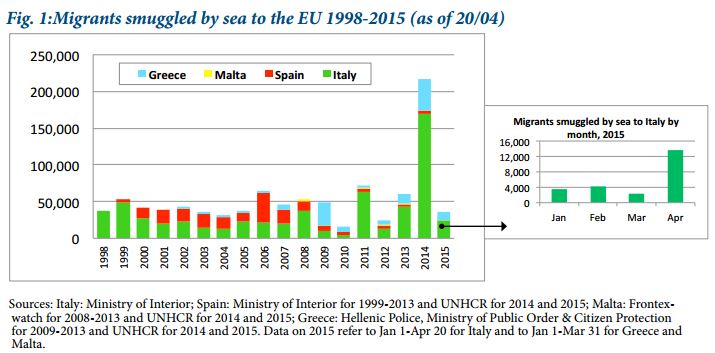
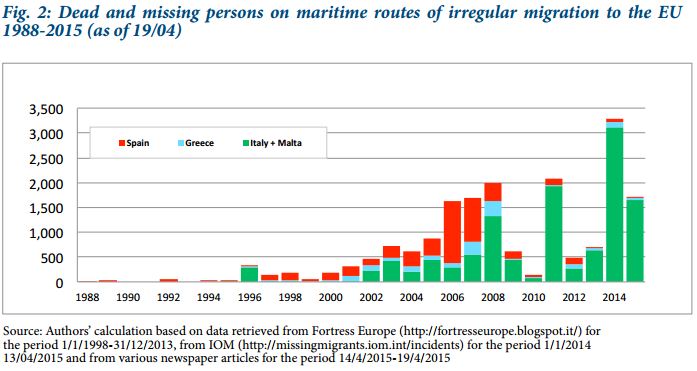
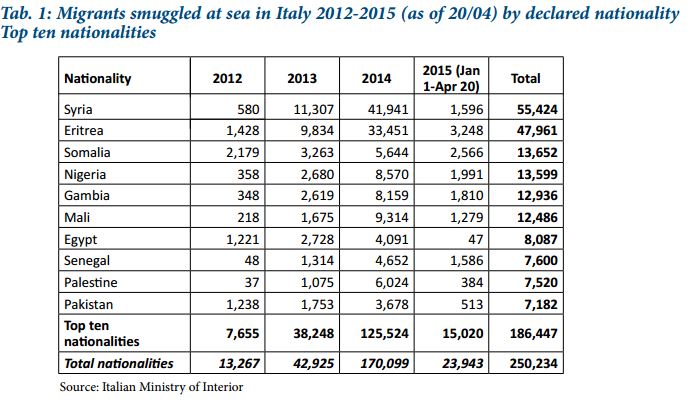
Migration Policy Centre – Policy Brief: “Drowned Europe”

Drowned Europe“, policy brief by Philippe FARGUES and Anna DI BARTOLOMEO, Migration Policy Centre at the European University Institute, Florence.

ABSTRACT:
The drowning of 800 migrants, 19 April 2015, after the capsizing of a smuggling boat, triggered responses from across Europe. But when EU leaders met four days later, the news-cycle had moved on and the European Council, 23 April, gave a disappointing response. The 28 agreed to scale up their joint search-and-rescue efforts at sea to the more substantial efforts of what Italy has achieved alone in the last year. There were, also, a handful of other minor actions. Mr Junker, President of the Commission, lamented that the EU should be more ambitious. He was right, in as much as the EU meeting will not sustainably curb the deadly trends we have seen in the Mediterranean in recent years.

2015-April_MPI Policy Brief_Drowned Europe_Fig 12015-April_MPI Policy Brief_Drowned Europe_Fig 22015-April_MPI Policy Brief_Drowned Europe_Tab 1

2 Comments

Filed under Analysis, European Union, Frontex, Italy, Libya, Mediterranean

If the EU Attacks Migrant Boats in Zuwara, Libya, How Will It Select from Among the 100s of Boats?

Italy and other EU States are clearly in possession of information regarding the specific locations in Libya from where migrant boats depart. The Guardian’ s Patrick Kingsley has been reporting from Libya in recent days, interviewing smugglers and observing a migrant boat depart on at least one recent occasion from the port of Zuwara located west of Tripoli.

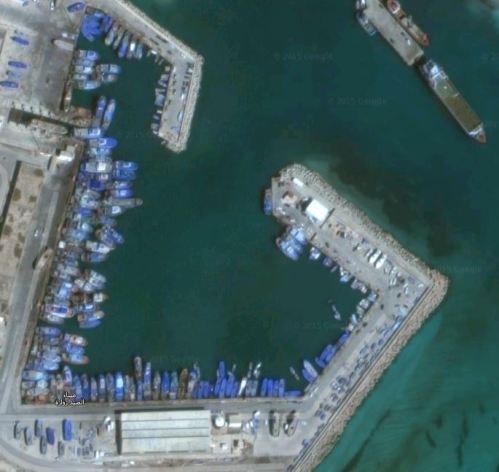
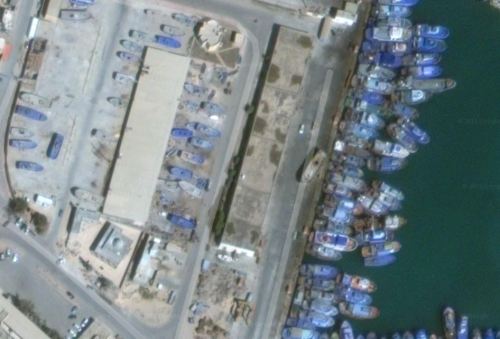
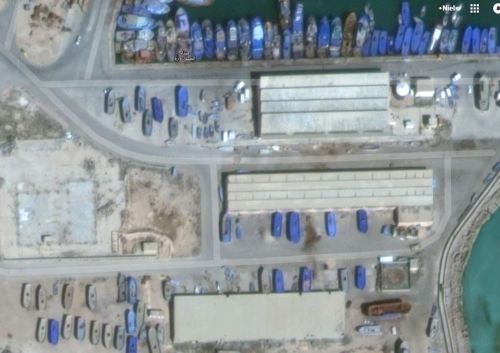
If the EU does press forward with its stated intention of destroying boats that may be used by smugglers, how will the EU select the boat or boats to be destroyed? Google Earth imagery dating from early this year shows approximately 125 large fishing boats moored in the harbour and another 100 boats on land immediately adjacent to the harbour. Dozens of smaller boats are also in the water and on land. (See screen shots below.) Additionally, the harbour is surrounded by at least five large warehouses, each approximately 100 metres in length. The Google Earth imagery suggests that additional boats may be located within some of the warehouses.

There is no effective and safe (or legal) means by which a particular smuggling boat can be identified and destroyed without destroying multiple other boats. As the Guardian’s Kingsley wrote, “smugglers do not maintain a separate, independent harbour of clearly marked vessels, ready to be targeted by EU air strikes. They buy them off fishermen at a few days’ notice. To destroy their potential pool of boats, the EU would need to raze whole fishing ports.”

UN Secretary General Ban Ki Moon on Sunday criticised the EU plan to use military force, telling La Stampa (as reported by Reuters), “[t]here is no military solution to the human tragedy playing out in the Mediterranean. It is crucial that we take a holistic approach that looks at the root causes, at security and the human rights of migrants and refugees, and have legal and regulated immigration networks.”

See previous posts on this topic: The EU’s Proposed Plan to Destroy Migrant Boats in Libya Must be Rejected by the European Council and UK and France to Seek UN Security Council Authorisation for Military Action Against Smuggler Boats.

Zuwara Harbour 2015 Via Google Earth

Zuwara Harbour.

Zuwara Harbour West Side Warehouses via Google Earth

Storage area and warehouses on west side of Zuwara Harbour.

Zuwara Harbour South Warehouses South 2015 via Google Earth

Storage area and warehouses on south side of Zuwara Harbour.

1 Comment

Filed under European Union, Libya, Mediterranean, News

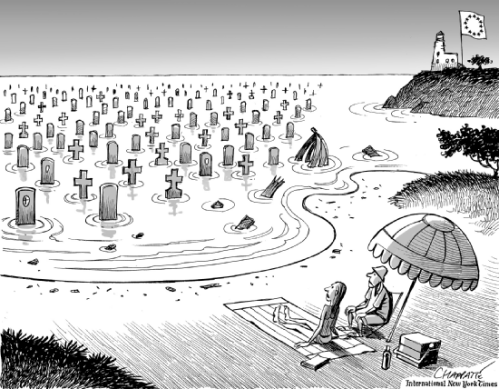
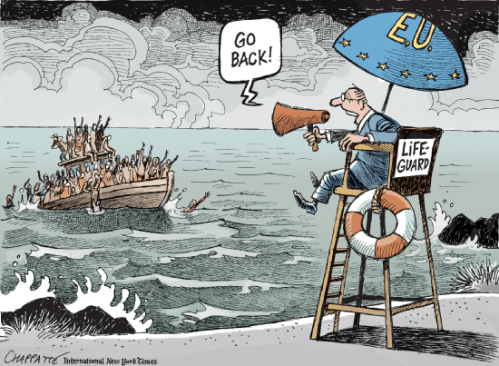
Chappatte on the situation in the Mediterranean

© Chappatte – http://www.globecartoon.com – Used by Migrants At Sea with permission.

© Chappatte – http://www.globecartoon.com – Used by Migrants At Sea with permission.

© Chappatte – http://www.globecartoon.com – Used by Migrants At Sea with permission.

© Chappatte – http://www.globecartoon.com – Used by Migrants At Sea with permission.

2 Comments

Filed under Cartoon, European Union, Frontex, Mediterranean

Very Few Migrants Reaching Italy Apply for Asylum

While roughly 170,000 migrants over the past 14 months have reached Italy or been rescued and brought to Italy, according to UNHCR and Eurostat figures, very few of them are applying for asylum in Italy. Eurostat data through November 2014 indicate approximately 25,200 asylum applications from all nationalities were filed in Italy during the first six months of 2014; the number increased to approximately 27,000 during the period July-November 2014.

Eurostat data further show that only 455 asylum applications were submitted by Syrians in Italy during the January-November 2014 period, whereas over the same period over 28,000 Syrian asylum applications were submitted in Germany.

According to Italian press reports, “[n]ew figures from the UN’s refugee agency showed 25,077 people applied for asylum in Italy during the first six months of 2014. The highest number in Europe was recorded in Germany, which received 77,109 applications, followed by France (54,131) and Sweden (38,792).”

Click here for Eurostat “Asylum and new asylum applicants – monthly data”.

Click here for Eurostat “Asylum and new asylum applicants by citizenship, age and sex Monthly data (rounded)”. (Conduct search by modifying “+Citizen” option at upper right.)

Or click here for main Eurostat website and search for “asylum.”

Click here for news article.

7 Comments

Filed under Data / Stats, Germany, Italy, Migrants, Refugees, Syria

Turkish Coast Guard Reports Intercepting 12,872 Migrants in Aegean Sea in 2014; Some Migrants Pushed-Back into Turkish Territorial Waters

“A total of 12,872 migrants trying to cross into Greece from Turkey over the Aegean Sea were captured by Turkish Coast Guard Command teams in 524 separate incidents in 2014, while 74 people were also arrested on charges of smuggling migrants, Anadolu Agency has reported. The number of migrants who were captured in 2013 was 8,047, including 6,937 on the Aegean Sea. The total number of migrants captured by authorities across Turkey in 2012 was 2,531. The official number in 2011 was 546, which means that the number of captured migrants has increased 24-fold since then. …”

An unspecified number of the intercepted migrants were reportedly subjected to push-back practices where the affected migrants were returned to Turkish territorial waters [“Yasa dışı göçmenlerin bir kısmı da ‘geri atma olayı (gittiği ülkeden Türkiye karasularına geri gönderilme)’ olarak arz edilen olaylar sonucu yakalandı.”].

The push-backs were presumably carried out by Greek patrol boats or possibly by vessels operating pursuant to Frontex Joint Operation Poseidon Sea 2013 (which operated through 2014 Q1).

Click here (EN) and here (TR) for articles.

5 Comments

Filed under Aegean Sea, Data / Stats, European Union, Frontex, Greece, Migrants, Refugees, Turkey

Frontex: Preliminary Figures Indicate 270,000 Irregular Migrants and Asylum Seekers Reached EU in 2104 – Double Previous Record Set in 2011

In an interview with EFE, “Frontex Deputy Executive Director Gil Arias Fernandez said the numbers for 2014 nearly doubled the previous record of 141,000 that was registered in 2011 and attributed to spillovers from the Arab Spring. … [Arias Fernandez] noted that the number of immigrants fleeing their countries seeking international protection has increased. ‘A few years ago, immigration for economic reasons was estimated at 50 percent and the same percentage for political refugees, while in 2014 about 80 percent of immigrants to the EU will be asylum seekers,’ he said. Although Frontex will not reveal specific details until mid-January 2014, [Arias Fernandez] said the total figure will likely exceed 270,000 people, as about 260,000 migrants were recorded till November….”

Click here (EN) or here (ES) for articles.

1 Comment

Filed under Data / Stats, European Union, Frontex, Mediterranean, Migrants, Refugees

UNHCR: Urgent European Action Needed in Mediterranean

Statement by Vincent Cochetel, UNHCR Europe Bureau Director, on new boat arrival in Italy:

“The use of larger cargo ships is a new trend, but it is part of an ongoing and worrying situation that can no longer be ignored by European governments. We need urgent European concerted action in the Mediterranean Sea, increasing efforts to rescue people at sea and stepping up efforts to provide legal alternatives to dangerous voyages. Without safer ways for refugees to find safety in Europe, we won’t be able to reduce the multiple risks and dangers posed by these movements at sea.

UNHCR thanks the Italian authorities for their response to these latest incidents, despite the phasing down of the Mare Nostrum operation. We have expressed concerns over the ending of this operation without a similar European search-and-rescue operation to replace it. This will undoubtedly increase the risk for those trying to find safety in Europe.”

For more information on this topic, please contact:

In Geneva, William Spindler on mobile +41 79 217 3011, spindler@unhcr.org
In Geneva, Ariane Rummery on mobile +41 79 200 7617, rummery@unhcr.org

Click here for Statement.

1 Comment

Filed under Frontex, Mediterranean, Statements, UNHCR

Conference: “Using Human Security as a legal framework to analyse the Common European Asylum System”, CLEER, T.M.C. Asser Instituut, The Hague, 4 July

The Centre for the Law of EU External Relations (CLEER) will hold conduct the following conference on 4 July in the Hague: ‘Using Human Security as a legal framework to analyse the Common European Asylum System.’ The event is free of charge, however registration is required. Please register here.

From the conference web page:  “The conference is the second event of CLEER’s project ‘Human Security: a new framework for enhanced human rights in the EU’s foreign security and migration policies’, implemented with the support of the Lifelong Learning Programme (LLP) of the European Union.

The project runs from 1 September 2013 until 31 August 2014 and aims at facilitating academic interaction in closely interrelated areas of EU external conduct, creating synergies between and raising awareness of global security concerns. The project will, specifically, integrate elements of EU external action in security, development and migration policies, through the paradigm of human security.

This expert conference will explore new territory in its analysis of protection under the Common European Asylum System through the prism of Human Security. In the second and final part of the CLEER Jean Monnet conferences on Human Security, this high level gathering will bring together specialists and practitioners in the area of EU asylum law. It will take stock of recent developments in legislation, jurisprudence and doctrine; proposing insightful approaches to contemporary asylum challenges.

The four thematic panels of the conference will analyse the added value of using Human Security as a legal framework for protection in Asylum law whilst assessing the prospects of legal interaction between both fields. Sessions will concentrate on the concept of Human Security as a legal tool for interpretation of EU instruments. Emphasis will be placed on the Dublin Regime along with obligations that Member States must adhere to in applying substantive protection rights for those seeking asylum. Attention will also be paid to the use of Human Security as an operational tool for border management and the consistent application of EU norms. The conference will end with a contextualisation of the debate, specifically focusing on the relations between the EU and South Mediterranean States.

The conference will be of direct interest to everyone working and studying in the Area of Freedom, Security and Justice of the EU, notably the asylum and refugee fields. In this regard practitioners, lawyers, judges, scholars, academics, students, civil servants, military and civilian authorities are all encouraged to come. Each panel will be followed by a question and answer session allowing for the audience to participate in the debate, thereby contributing to a unique perspective on EU asylum law and its protection regime.”


1 Comment

Filed under Colloques / Conferences, European Union

Panel Discussion: “Heading to Europe: Safe Haven or Graveyard?,” Radboud University Nijmegen, 16 May

From the organizers:

The Interest Group on Migration and Refugee Law of the European Society of International Law, the Centre for Migration Law of the Radboud University Nijmegen and the Amsterdam Center for International Law of the University of Amsterdam are pleased to announce ‘Heading to Europe: Safe Haven or Graveyard?’, a panel discussion on migration by sea in the Mediterranean. The panel discussion will be held on 16 May 2014 at the Radboud University Nijmegen.

The year of 2013 has demonstrated that the tragedy of thousands of migrants and refugees drowning on the shores of Europe is now a common occurrence. The fate of those who perished near the Italian island of Lampedusa has brought the urgency of the situation into focus. The aim of the panel discussion is to provide an overview of the legal rules and processes applicable to migration by sea in the Mediterranean and to reflect on their wider sociological implications.

The panel discussion consists of two panels, each followed by a plenary discussion. In the first panel, legal experts working in the field of academia and at stakeholder organizations (e.g. UN Refugee Agency, Council of Europe, European Union) focus on legal aspects of boat migration in the Mediterranean. The second panel brings together scholars and practitioners with first-hand experience from transit countries to discuss the sociological effects of the legal rules and processes. Click here for the complete program, and here for more information on the panelists.

The organizing partners cordially invite interested scholars, governments officials, practitioners and advanced students to join in the panel discussion ‘Heading to Europe: Safe Haven or Graveyard?’. Active participation in the discussion is strongly encouraged. Participation is free of charge. For participation, please register at the bottom of this page. For inquiries, please contact Lisa-Marie Komp at lisa-marie.komp@law-school.de.

Location is the CPO-zaal, Spinozagebouw at the Radboud University in Nijmegen (Montessorilaan 3).

CLICK HERE TO REGISTER

3 Comments

Filed under Colloques / Conferences, Council of Europe, European Union, Frontex, Mediterranean