Tag Archives: Greece

Migreurop Report: European borders- Controls, detention and deportations

Migreurop has released its second report on Europe’s borders: “European borders- Controls, detention and deportations.”  Migreurop describes the report as a “[denunciation of] the « externalization » process of the European union migratory policy [which] shows how third countries are obliged, through the threat of the reconsideration of cooperation agreements and development aid, not only to readmit the migrants chased from Europe, but also to keep them on their own territory from travelling towards its doors.   From Calais area in France to the edge of Turkey and the Adriatic sea, from the surroundings of Gibraltar to the Sahel Saharan desert and the new member states of eastern Europe, a subcontracting of migratory control is carried out in series, sometimes very far away from the Union but also within its territory, especially when it deals with sending asylum seekers from country to country considered as unwanted. A large population of exiles, from both sides of the European borders, is subjected to arbitrary incarceration, wandering, and the constant humiliation of a hostile environment….”

Here is the Table of Contents:

Introduction

  • What have migrants become 3

Ceuta, a gilded prison

  • A murderous border 7
  • A legal limbo 8
  • The situation of migrants in detention 8
  • The situation of migrants in the CETI (open centre) 9
  • Deportations and expulsions 12
  • Surviving without resources 14

Sahel-Saharan countries, Europe’s new sentries

  • I – European interference in inter-African migrations – the case of Mauritania 18
    • The “crisis of the cayucos” 18
    • 1. Cooperation instigated by Europe 18
    • 2. Mauritania tramples on its own principles and conforms 21
    • 3. Subcontracting repression and endangering foreigners 22
  • II – Bargaining between Libya and Europe: migrants as an exchange currency –the case of Niger 33
    • 1. A reciprocal exploitation 34
    • 2. An increasingly repressive control of borders 37
    • 3. Arrests and detention in Libyan territory 39
    • 4. A deadly expulsion policy 42
  • Conclusion: the real face of Kadhafi’s pan-Africanism 44

Poland, Romania: how to be good state members in the enlarged EU

  • I – At the new frontiers: the screening of migration 47
    • 1. Reducing the transit and deserving Schengen 48
    • 2. The border police, Frontex and cooperation with other European states 48
  • II – Reception and detention centres 52
    • 1. The detention of foreigners 52
    • 2. Reception centres: isolating asylum seekers 60
    • 3. “Dublinized” asylum seekers 61
  • III – Returns 63
  • IV – Intolerance towards migrants and refugees 66
  • V – Embryonic mobilizations 70

The Ionian and Adriatic seas: forced returns between Italy and Greece

  • A new migration route at Europe’s gates 73
  • I – Controlling and blocking 75
    • 1. Controls in Greece 75
    • 2. Controls at sea 77
    • 3. Controls in Italian ports 78
  • II – Turning back and readmission 82
    • 1. Arbitrary practices and violation of rights 82
    • 2. The port of Venice: collective returns 83
    • 3. The port of Ancona 86
    • 4. Forced return to Greece 86
  • III – Detention 88
    • 1. At the borders and at sea: areas beyond legality 88
    • 2. Detention in Italy 89
    • 3. Detention in Greece 90
  • IV – Some cruel situations 93
    • 1. In Greece 93
    • 2. In Italy 96
  • V – Mobilizations 97
    • 1. In Venice 97
    • 2. In Ancona 97
    • 3. In Greece 98

Ping-pong at the Greco-Turkish border

  • Selective expulsions and random readmissions 106
  • Reactions to a degrading and sometimes murderous situation 107
  • Assistance, support, resistance 108

Dismantling the Calais jungle: a deceptive operation

  • I – The declared objectives of the 22 September 2009 operation 112
  • II – The real objectives of dismantling the jungle 113
  • III – The Modus Operandi: brutality and trickery 115
  • IV – What next? 116

Migreurop network 121

Annexes 122

  • Knocking down walls and defending the right to migrate 122
  • UNHCR-Libya : the bid is rising, migrants pay the price 124
  • All for the closure of camps for migrants, in Europe and beyond 125
  • Italia and Libya: hand in hand 127
  • Roma people victims of the French government xenophobia 128

Click here for the report (EN), or  here (FR), or here (ES).

Click here for article (ES) in Periodismo Humano about the report.

1 Comment

Filed under Aegean Sea, Eastern Atlantic, English Channel / La Manche, European Union, France, Frontex, Italy, Libya, Mauritania, Mediterranean, Morocco, Niger, Reports, Spain, Turkey, UNHCR

Erika Feller’s Comments Regarding Boat People and Irregular Secondary Movements

During her annual address to the UNHCR’s Executive Committee on 6 October, Assistant High Commissioner for Protection Erika Feller reviewed significant protection issues over the past year, noting also that 2010 marks the 60th anniversary of the founding of the UNHCR in December 1950 and the 59th anniversary of the Refugee Convention.

Among the topics she addressed were the challenges posed by the arrival of irregular secondary movements of migrants, including boat people.  She is critical of interdiction practices being carried out throughout the world and makes the strong point that “[t]he evidence suggests that tough sea policies have not solved, just changed and indeed complicated the dynamics, of irregular movements.”  While Ms. Feller does not identify countries by name, she is apparently referencing increased maritime interdiction in the Aegean Sea and the resulting surge in irregular crossings along Greece’s land borders.  The point could also be made in regard to the Italian push-back practice.

Excerpts from her address:

“Arrivals of undocumented migrants continue to test the capacity of States, with the problem of so-called “irregular secondary movement” exacerbated in recent years by boat arrivals. The Pacific, the Mediterranean, the Caribbean or the Gulf of Aden are all regular theatres, with ‘boatpeople’ being interdicted, intercepted, turned around, ignored by passing ships, shot at, or denied landing. Even when rescued, disembarkation somewhere has no guarantees attached, as an incident currently playing out off the Somalia/Djibouti coasts starkly reminds us.

All this is seriously at odds not only with protection principles but also with the reality that when they manage to gain access to territory and asylum processes, a large percentage of asylum-seekers who come by boat are actually found to be refugees. …

Boat arrivals can provoke fears and high emotions which may be difficult for Governments to manage. However, in our experience, an approach built predominantly around closing borders and trying to prevent movement is not the answer, as it does not work. In fact it can make situations even more difficult to deal with. Developments in relation to one country that has pursued a tough policy towards boats are actually quite revealing. While arrivals by sea are dramatically down, arrivals by land have basically doubled. In addition, while sea arrivals had been able to be concentrated through being channeled to one main reception point, land arrivals now come through multiple crossing points and have been able to disperse more effectively and rapidly through the community, below any radar screen. The evidence suggests that tough sea policies have not solved, just changed and indeed complicated the dynamics, of irregular movements….

The phenomenon of refugees on the move for non-protection reasons is also growing. Numbers and categories vary with the regions but the concern is global. On the African continent, where camps are more the norm than the exception, it is preoccupying that camp environments are starting to be compromised by a form of transit migration to and through them, with refugees, and others, seeking to use their facilities for R&R en route to a more distant destination. Just as concerning has been the misuse of reception centers as way-stations, or even lucrative recruitment opportunities for smugglers and traffickers. These facts are not a rationale for abandoning camps or centers. They are, though, a solid reason to rethink how better to manage them within a burden sharing framework….”

Click here for full address.

2 Comments

Filed under Aegean Sea, European Union, Greece, Italy, Libya, Mediterranean, News, Statements, UNHCR

Increased Human Smuggling to Cyprus

According to an article in the Turkish newspaper Today’s Zaman, Turkish Interior Ministry data indicates that human smuggling in Turkey has decreased since 2007, but that one consequence of increased enforcement within Turkey has been a diversion of human smuggling to the Turkish controlled northern portion of Cyprus.

“According to the ministry, the total number of illegal immigrants, asylum seekers and immigrants caught at land and sea borders with Syria, Iran, Iraq, Georgia, Greece and Bulgaria declined to 28,355 in 2009.”  This number is in contrast to the 50,800 migrants reportedly arrested in 2008 and 7,465 arrested over the first six months of 2010.

The Ministry also reported a decline in known deaths: “In line with the drop in the number of immigrants trying to get to the West through Turkey, there has been a decline in the number of illegal immigrant deaths. In 2007, 82 immigrants died in accidents on the Aegean Sea and 102 went missing. The number of deaths dropped to 76 in 2008 and to 43 in 2008. The number of deaths in the first half of 2010 was nine.”

According to the article, there has been a diversion of smuggling operations towards Turkish controlled Cyprus and as a result the “KKTC [the self-declared Turkish Republic of Northern Cyprus] [is] facing the biggest migration move ever in its history.”  “In 2008, the number [of irregular migrants] doubled and increased to 568. It continued to increase in 2009. According to estimates, 750 migrants entered the island in 2009. … Illegal immigrants are brought by ships to Cyprus during the night and left in places that are far from settlement areas in Dipkarpaz and the İskele region. In addition to the KKTC, a similar number of immigrants are brought to Greek Cyprus.  It is believed that illegal immigrants pay between $2,000-$3,000 on average to human smugglers to enter the KKTC. In the latest smuggling cases in Turkey, they pay $5,000-$10,000.”

Click here for article.

Click here Turkish Ministry of Foreign Affairs web site on Illegal Migration.

1 Comment

Filed under Aegean Sea, Cyprus, Data / Stats, Greece, Mediterranean, News, Turkey

EUROSTAT Q1 2010 Asylum Statistics for EU27 Countries

EUROSTAT released updated data on 15 July for the First Quarter of 2010.  The report is entitled: Asylum applicants and first instance decisions on asylum applications in Q1 2010 (Doc. 32/2010).

Notable statistics include reductions of over 50% in the number of asylum applicants in three countries, Malta, Italy, and Greece, relative to the First Quarter of 2009.  Malta had the largest reduction of approximately 95%.

The reductions in Malta and Italy are almost certainly due to Italy’s push-back practice.  Though the first migrant arrivals in Malta in 2010 occurred this past weekend, 17 July, when 55 migrants on a sinking vessel were intercepted by Maltese and Libyan patrol boats.  The Times of Malta reported that the migrants were “shared out” between the Maltese and Libyan patrol boats.  28 migrants were brought to Malta and 27 were apparently taken to Libya.

Click here for the full EUROSTAT document.

Click here for Times of Malta article.

3 Comments

Filed under Aegean Sea, Data / Stats, Eastern Atlantic, European Union, Greece, Italy, Libya, Malta, Mediterranean, News

Greek – Turkish Migration Agreement

Greece and Turkey signed a series of agreements on 14 May, including a new agreement on immigration.  Turkish Prime Minister Recep Tayyip Erdogan traveled to Athens to sign the agreements.

The immigration agreement will facilitate Greece’s ability to return irregular migrants who enter Greece from Turkey.  Pursuant to the agreement Turkey will designate a port in or near Izmir within three months as the location to which irregular migrants may be returned by Greece.  Turkey also agreed to accept up to 1,000 readmission requests per year.

Click here (EL) for Press Release from Greek Ministry of Citizen Protection.

Click here (EN) for article.

1 Comment

Filed under Aegean Sea, Greece, News, Turkey

Exchange of Letters Between COE HR Commissioner and Greece

COE Human Rights Commissioner Thomas Hammarberg has released copies of the correspondence between his office and the Greek government concerning his February visit to Greece and his concerns over a variety of issues, including Greece’s treatment of asylum seekers.  According to the Commissioner’s web site “[t]he letters focus on the human rights of migrants, especially asylum seekers, minorities, and the conduct of members of law enforcement agencies.  In view of long-standing, serious shortcomings in the field of asylum, the Commissioner highlights the urgent need for the authorities to support the ongoing reform in this field with the necessary institutional capacity and tools for implementation. The Commissioner also urges the authorities to address the situation of unaccompanied or separated migrant children.”

Click here for link to the statement and the letters.

Leave a comment

Filed under Aegean Sea, Commissioner for Human Rights, Greece, News

IMO Biannual Reports on “Unsafe Practices Associated with the Trafficking or Transport of Migrants by Sea”

The International Maritime Organization (IMO) has been collecting data on “unsafe practices associated with the trafficking or transport of illegal migrants by sea” since 1999.

Two times a year it releases a biannual report regarding incidents which are reported to the IMO by Member Governments.  The IMO describes the basis for the reporting as follows: “The Maritime Safety Committee, at its seventieth session (7 to 11 December 1998), in approving MSC/Circ.896 on Interim measures for combating unsafe practices associated with the trafficking or transport of illegal migrants by sea, invited Member Governments to promptly convey to the Organization reports on relevant incidents and measures taken to enable the updating or revising of the circular.”

In recent years (and perhaps since 1999), by far most of the reported incidents are provided by Greece.  Italy and Turkey have only reported a small number of incidents in recent years.  It is clear that most Member Governments do not routinely provide data for these biannual reports.

Even though a substantial number of incidents are not being reported and are therefore not documented in the reports, the biannual reports do contain an extensive amount of information dating back to 1999 regarding 2,030 incidents where 77,853 migrants were rescued or intercepted.

The reported data, when provided, include:

  • Ship’s name or description
  • Date and time of incident
  • Position of incident
  • Description of incident
  • Measures taken
  • Migrants (number and nationality; gender; adults/minor)

Click here for the Biannual Report issued 18 February 2010.

Click here for the Biannual Report issued 2 November 2009.

Leave a comment

Filed under Data / Stats, Greece, Italy, Reports, Turkey

COE Human Rights Commissioner Expresses Concern to ECtHR Over Greece’s Treatment of Asylum Seekers

Council of Europe Human Rights Commissioner Thomas Hammarberg has made public the third party intervention he submitted to the European Court of Human Rights on 10 March.  The intervention was made at the invitation of the ECtHR pursuant to Article 36, paragraph 2 of the ECHR, and is the first such submission of its kind by the Commissioner.

The intervention was submitted in case 26494/09 AHMED ALI v. the Netherlands and Greece, and thirteen related cases.  The cases all deal with the return of asylum seekers from the Netherlands to Greece pursuant to the EC Dublin Regulation.

The Commissioner’s Office notes in a Press Statement that “[w]ith the entry into force of Protocol No. 14 to the [ECHR], the Commissioner will [now] have the right to intervene proprio motu as third party in the Court’s proceedings.”

Excerpts from the Commissioner’s intervention before the ECtHR:

“Introduction – [***]

3. The protection of the human rights of asylum seekers and refugees is a priority theme of the Commissioner’s present work concerning all Council of Europe member states. The Commissioner has repeatedly stressed the importance of guaranteeing the individual right to seek and enjoy asylum and has addressed a number of relevant recommendations to member states. [***]

I. Observations on the current framework of refugee protection in Greece

6. The Commissioner is fully cognisant of the considerable, mixed migration (immigrants and asylum seekers) flow pressures that have been exerted on Greece, as is the case for other Mediterranean Council of Europe member states, for many years. The increase of irregular migration into Greece that has occurred particularly in the last five years has further strained this country’s resources. Nonetheless, the complex international phenomenon of migration should be dealt with by Greece and all other Council of Europe member states concerned in a manner which is not only efficient but also effectively respectful of the Council of Europe human rights standards.

7. Greece received the sixth largest number of refugee applicants in the EU during the first half of 2009 (9 800 applications).

8. In 2009, a total of 15 928 asylum applications were lodged in Greece; there were 11 recognitions of Convention refugee status and 18 grants of humanitarian status or subsidiary protection. The Commissioner has noted with concern that in 2009 the recognition rate at first instance was 0,04% for Convention refugee status and 0,06% for the other two statuses. The pending applications at first instance in 2009 reached 3 122. As regards asylum appeals in 2009, there were 12 095 appeals, 25 recognitions of Convention refugee status and 11 grants of humanitarian or subsidiary protection. The respective recognition rates on appeal were 2,87% and 1,26%. On 10 February 2010 the Commissioner was informed by the Minister of Citizen Protection of the fact that the total of pending asylum claims in early February 2010 was as high as 44 560, and found this to be worrying.

9. The Commissioner noted that during the first ten months of 2009 Greece received 7 857 applications from other EU member states to receive back refugee applicants under the Dublin Regulation. Of these applications, 2 770 were accepted and 106 rejected. The final transfers to Greece during that period totalled 995. [***]

II. Major issues concerning the asylum procedure in Greece and human rights safeguards

Legal framework  [***]

Asylum seekers’ access to domestic and international remedies

23. The Commissioner recalls his Recommendation concerning the rights of aliens wishing to enter a Council of Europe member State and the enforcement of expulsion orders, where he stresses the need for the right of judicial remedy within the meaning of Article 13 of the Convention not only to be guaranteed in law but also to be granted in practice when a person alleges that the competent authorities have contravened or are likely to contravene a right guaranteed by the Convention. [***]

27. In view of the above, the Commissioner is worried that asylum seekers in Greece face a serious, real risk of being deprived of their right to an effective remedy in respect of the violations of the Convention of which they allege to be victims, which is guaranteed under Article 13 of the Convention and Article 39 of the Directive 2005/85/EC. The notion of an effective remedy under Article 13 requires a scope of review conducted by a domestic court able to address the key elements of whether there has been a violation of the Convention.

28. As regards access to the European Court of Human Rights, although this is guaranteed in principle for every individual within Greece’s jurisdiction, lodging an application before the Court appears to be very difficult in practice. The same applies for requests made under Rule 39 of the Rules of the Court (interim measures): the number of such requests introduced from and against Greece seems to be quite low compared to other state parties, and can be linked to difficulties, described in other parts of the present written submission, in accessing interpretation services and lawyers, in particular for people in detention, and to the lack of proper legal information available in general.

Protection of asylum seekers from refoulement

29. During both his visits the Commissioner was informed by migrants he met and by Greek refugee lawyers about instances of non registration by the Police of asylum claims and of instances of refoulement, especially from Greece to Turkey. Such forced returns have occasionally taken place before the migrants were able to apply for asylum, but also concern ‘pink card’ holders registered as asylum seekers in Greece. Characteristically, during the Commissioner’s discussions with migrant detainees at the Feres border guard station in December 2008, one of them reported that of the group of 65 persons who were arrested in 2008, having crossed the Evros river, 50 of them were ‘immediately deported’. [***]

31. In this context, it is noted that despite the Commissioner’s recommendations, Greece has not as yet acceded to the 1963 Protocol No. 4 to the European Convention on Human Rights which, inter alia, proscribes the collective expulsion of aliens, while Turkey still adheres to the geographical limitation of the 1951 UN Refugee Convention, thus excluding from refugee status persons coming from outside of Europe.

32. During his visit to Greece in February 2010 the Commissioner was informed of and concerned at another reported case of refoulement concerning a group of 43 Kurds who had arrived at the town of Chania, Crete on 18 July 2009; 17 of them applied for refugee status. According to NGO reports, on 27 July 2009 they were all transferred to the aliens’ detention centre of Venna (North East Greece) from where they were subsequently expelled to Turkey. A series of other collective expulsions of migrant groups, ranging from 30 to 120 persons, to Turkey (through the land border of the Evros department) from various eastern Aegean islands were reported by Greek refugee lawyers to have occurred in July and August 2009. The Commissioner was informed by Greek refugee lawyers of more similar collective expulsions that have reportedly occurred in December 2009, January and February 2010.

33. The Commissioner underlines that such practices are not compatible with member states’ obligations recalled by the Committee of Ministers Twenty Guidelines on Forced Returns (especially Guideline 3 – prohibition of collective expulsion) and with the states’ fundamental obligation under the Convention not to return a person to a country where they would face a real risk of being subjected to treatment contrary to Article 3, or even Article 2. The Commissioner is concerned that asylum seekers returning to Greece by virtue of the Dublin Regulation may face such risks, jeopardising the enjoyment by them of their human rights enshrined in the Convention. [***]

Conclusions

47. In conclusion, the Commissioner considers that current asylum law and practice in Greece are not in compliance with international and European human rights standards. In particular:

– access to refugee protection remains highly problematic, notably due to the non-functioning of the first instance Advisory Refugee Committees, lack of proper information on asylum procedures and legal aid that should be available to potential or actual asylum seekers, widely reported instances of refoulement or non-registration of asylum claims;

– the quality of asylum decisions at first instance is inadequate, notably because of structural deficiencies and lack of procedural safeguards, in particular concerning the provision of legal aid and interpretation;

– existing domestic remedy against negative asylum applications is not effective;

– asylum seekers, including persons transferred under the Dublin Regulation, face extremely harsh living conditions in Greece.

48. Since the beginning of his mandate, the Commissioner has been following developments relating to migration, and especially asylum, in Greece. The Commissioner is pleased to note the new Greek government’s decision and willingness, shown to him during his visit in February 2010, to overhaul the refugee protection system and overcome its current serious, chronic and structural deficiencies.

49. The Commissioner fully supports these efforts and has urged the Greek authorities to proceed and engage with determination and commitment in the necessary legislative and administrative changes that would bring the Greek asylum system in line with international and European human rights standards.”

Click here for full submission to ECtHR.

Click here for the Commissioner’s Press Statement.
Leave a comment

Filed under Aegean Sea, European Court of Human Rights, Greece, Judicial, Statements

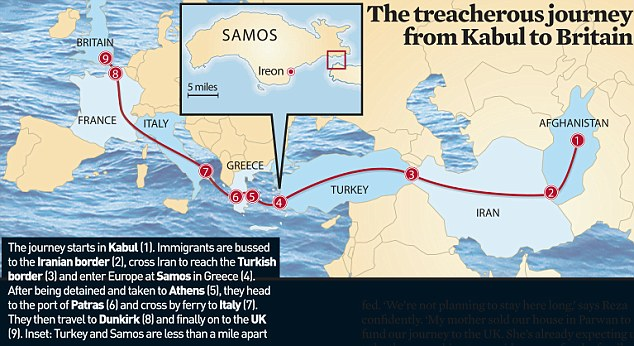
Daily Mail: from Kabul to the UK by way of Samos

The Daily Mail has a special report detailing the experiences and routes of irregular Afghan migrants traveling from Afghanistan to the UK by way of Turkey and Greece.

Click here for the full article.

Leave a comment

Filed under Aegean Sea, Greece, News, UK

First “Frontex Operational Office” to be Based in Greece

The Frontex Management Board has taken the decision to establish Frontex’s first Operational Office (“FOO”) in Piraeus, Greece.  According to the Frontex press release, the purpose of the office is to provide regionally-based support for Frontex coordinated activities such as joint operations and enhanced situational awareness.  If this pilot project is successful, it is expected that future FOOs would be established elsewhere such as the Western Mediterranean, the Western Balkans and Black Sea, and Eastern land borders.

According to the Frontex press release, Frontex Executive Director Laitinen said the establishment of this FOO “supports the possible enhancement of [the] Frontex mandate highlighted in the Stockholm Programme … I can even say this decision anticipates potential enlargement of the EU and Schengen zone. It gives Frontex a possibility to offer more support for the operational involvement of third countries, something that is essential for effective border management.”

Click here for Frontex statement.

Click here for the Final Report on the “Study on the feasibility of establishing specialised branches of Frontex.”  The specific functions of the new FOO are based in part on this feasibility study which was prepared in 2009.

Leave a comment

Filed under Aegean Sea, Frontex, Greece, Mediterranean, News, Turkey

Greece Seeks Talks With Turkey Over Migrants

Greek Citizen Protection Minister Michalis Chryssohoidis has written to Turkish Interior Minister Beşir Atalay asking for talks within the next month on the illegal immigration issue.

“ ‘Only systematic and close cooperation between Greece and Turkey can curb the flow of illegal immigration to the European Union,’ Chrysochoidis reportedly wrote in the letter. According to sources, Chrysochoidis has invited Atalay to Athens to discuss a set of proposals. These include the closer cooperation of Greek and Turkish coast guard officials to ensure that a bilateral pact for the repatriation of migrants is enforced. Turkish vessels currently make no effort to stop smuggling ships, the Greek coast guard says.”

Click here, here, and here for articles.

Leave a comment

Filed under Aegean Sea, Greece, News, Turkey

Besson appelle l’UE à accélérer le renforcement de l’agence européenne Frontex et la surveillance des frontières européennes

“Les corps de neuf migrants morts noyés en tentant de gagner la Grèce à partir de la Turquie ont été découverts depuis cinq jours au large du port grec d’Alexandroupolis….

“Alors que les frontières extérieures de l’Union Européenne sont soumises en Grèce à une pression sans précédent des filières d’immigration irrégulière, plus de la moitié des entrées illégales dans l’espace Schengen ayant été enregistrées en 2009 à la frontière turco-grecque, Eric BESSON appelle l’Union Européenne à renforcer la surveillance des frontières européennes notamment en Méditerranée.

“Eric BESSON interviendra dans les prochains jours auprès du Commissaire européen chargé de l’immigration pour demander que les décisions prises par les Chefs d’Etat et de Gouvernement européens pour le renforcement de l’agence européenne Frontex soient mises en oeuvre sans délai.

“Ces décisions, adoptées sur proposition de la France par le Conseil européen du 30 octobre 2009, portent en particulier sur :

  • L’adoption de règles d’engagement claires pour les opérations de contrôle maritimes.
  • Une coopération opérationnelle accrue entre Frontex et les pays d’origine et de transit, notamment la Libye et la Turquie.
  • La possibilité d’affréter régulièrement des vols conjoints financés par Frontex pour des opérations groupées d’éloignement au niveau européen.

“Eric BESSON demandera également que la coopération de la Turquie dans la lutte contre les filières d’immigration irrégulière soit placée au centre des relations entre l’Union Européenne et ce pays.

“Eric BESSON proposera enfin à la présidence espagnole de l’Union Européenne que la prochaine réunion des Ministres européens en charge de l’immigration, le 21 janvier à Tolède, permette de définir une feuille de route précise pour l’application des décisions du Conseil européen et les relations avec la Turquie dans le domaine de la circulation des personnes.”

Click here for full Statement.

Leave a comment

Filed under Aegean Sea, European Union, France, Frontex, Greece, Mediterranean, Statements, Turkey

Workshop: “The Human Costs of Border Control in the Context of EU Maritime Migration Systems”

VU University Amsterdam held a three day Exploratory Workshop in October 2009 on “The Human Costs of Border Control in the Context of EU Maritime Migration Systems.”

Executive Summary of the Workshop’s Goals:

“The ongoing European harmonisation of migration and border control policies has as a side-effect unclear, but definitely rising numbers of fatalities at European borders (different estimates suggest anything between 1.000 and 10.000 annually). This process has considerable consequences for EU institutions, governments, the administrations of EU Member States, for migrants and people assisting migrants, and neighbouring countries. The consequences are diverse in nature, concerning policy, institutions, social cohesion and conflict, and law. However, while these consequences of the Europeanisation of migration policy are the subject of numerous academic studies, until now, the human costs of border control has received only isolated academic attention. There are insufficient data, and a comprehensive analysis is lacking. This workshop aims at bringing together leading European academics from different disciplines working on this issue. The immediate aim of the workshop is to integrate the analyses of those academics, with a view to developing a comprehensive analysis. The ultimate aim is to create a network engaging in comprehensive data gathering and analysis, leading to concrete suggestions to limit the undesirable side-effects of European migration policies.”

Draft workshop papers (which are not to be quoted or cited to without prior consent of the author) included the following:

Martin Baldwin-Edwards
The Human Costs of Border Control: Greece

Anat Ben-Dor
The un-checked dangers of the Israeli-Egyptian Sinai border

Hein de Haas
Trans-Saharan and Trans-Mediterranean migration – Questioning the transit hypothesis

María Hernández-Carretero
Boat migrants’ perspectives on risk

Ernesto Kiza
The Human Costs of Border Control at the External EU Borders between 1999 and 2004

Silja Klepp
A double bind: Malta and the rescue of unwanted migrants at sea

Mehdi Lahlou
The Human and Political Costs of Irregular Migration: Morocco case

Jorrit J. Rijpma
Frontex: successful blame shifting of the Member States?

Click here for more of the Workshop’s working materials.

Leave a comment

Filed under Colloques / Conferences

Frontex to Expand Operations in Aegean Sea in 2010

Frontex’s director, Ilkka Laitinen, met with Greek Citizens’ Protection Minister Michalis Chrysochoidis and reportedly said that Frontex enforcement operations in the eastern Aegean Sea will be further expanded in 2010.

Minister Chrysochoidis stated that 75% of the arrests for illegal entry from the EU’s sea borders in 2009 year took place in the Aegean.

Director Laitinen said that “[Frontex Operation] Poseidon continues to be our most important operation” and that Frontex’s largest border monitoring operation will take place in the eastern Aegean in 2010.

Click here for article.

Leave a comment

Filed under Aegean Sea, Frontex, Greece, News, Turkey

EC Spokesperson Says Turks Did Not Warn Frontex Helicopter (News)

EU Commission spokesperson Amadeu Altafaj Tardio responded to Greek media reports earlier in the week that Turkey had interfered with or warned a Frontex helicopter operating on a patrol from Greek territory during Frontex’s ongoing Operation Poseidon 2009.

The statement said that the Frontex helicopter had  “never violated Turkish airspace” and that it “had never received threats from Turkish authorities.”  The statement said the Turkish radar controller “had tried to establish contact with the [Frontex] helicopter pilot and had been unable to do so due to the use of different radar frequencies.”

The spokesperson “added that the EU is still continuing negotiations with Turkey over a joint framework in operational cooperation in border management and that it had informed Turkish officials about operation Poseidon 2009.”

Click here for article

Leave a comment

Filed under Aegean Sea, Frontex, Greece, News, Turkey