Tag Archives: Maritime Surveillance

Details from Frontex General Report 2009 (Post 2 of 2)

Last week I posted a summary of the first part of Frontex’s 2009 General Report.  This second post summarizes the portion of the Report pertaining to Frontex’s sea operations.

The General Report 2009 provides selective information regarding the six major Joint Operations conducted at the sea borders.  With only one exception, no information or data is provided regarding the specific numbers of intercepted migrants or vessels.

Instead of numbers, the Report provides various descriptive terms which could mean almost anything.  For example, Operation Hera led to a “drastic decrease of migrants,” during Operation Nautilus there was a “remarkable decrease” in migrants, and during Operation Hermes, the numbers of migrants arriving and dying at sea “decreased dramatically.” The one exception is for Operation Indalo where the Report states that 750 irregular migrants and 10 facilitators were detected.

When desired, the Report provides details and numbers.  For example, Operation Poseidon utilized 4 open sea vessels, 6 coastal patrol vessels, 13 coastal patrol boats, six airplanes, 4 helicopters, and 152 experts who delivered 2680 man days of operational activities, but no data regarding the total number of irregular migrants intercepted at sea is provided.

Here is a summary of the information provided in the Report for each of the six major Joint Operations:

Poseidon 2009, Eastern Mediterranean (365 Days)

Poseidon was conducted along land borders as well as at sea.  Interpreters were deployed on board ships to facilitate the identification process of intercepted migrants.  Less than 10% of the interviewed migrants claimed their original nationality.  There was an overall reduction in migrant flow of 16% (land and sea) compared to 2008.  “The main operational objectives of the joint operation were achieved but there is a clear need for closer cooperation between local authorities.”

Hera 2009, Atlantic Ocean waters between North Western African countries and Canary Islands (365 Days)

Due to the permanent implementation of Joint Operation Hera and better cooperation from “involved African countries”, there was a notable reduction in migrants reaching the Canary Islands, 2280 in 2009 compared with 9200 in 2008.  Aerial and maritime surveillance conducted close to the territory of Senegal and Mauritania and local cooperation from police led to the decrease in migrants.  “Despite these clear successes, participation of more member States would greatly increase effectiveness and outcomes.”  [NF- While the Report does provide migrant arrival data for the Canary Islands, it is silent on the number of migrants intercepted at sea or within Senegal or Mauritania.]

Nautilus 2009, Central Mediterranean (172 Days)

There was a remarkable decrease in migrant arrivals in Malta.  A “significant obstacle to the effectiveness of the Joint Operation lay in the contrasting interpretations of the International Law of the Sea by Member States….”  The effectiveness of the operation compared with 2008 was not improved.

Hermes 2009, Central Mediterranean (184 Days)

“Due to the bilateral agreement between Italy and Libya, the number of people arriving from Libya, as well as the number of migrants died at sea, decreased dramatically….”  “In addition, the first examples of co-operation with Algeria should also be considered as promising.”  As with Nautilus, “differing interpretations of the International Law of the Sea led to a limited contribution by the Member States to the joint operation by maritime surface means.”  The effectiveness of the operation compared with 2008 can be considered as increased.

Minerva 2009, Western Mediterranean (39 Days)

The launch of the operation was delayed in 2009.  Its effectiveness compared with 2008 has remained the same.

Indalo 2009, Western Mediterranean (50 Days)

The lack of cooperation from Algeria is an obstacle for operational activities.  10 Facilitators and 750 irregular migrants were identified.

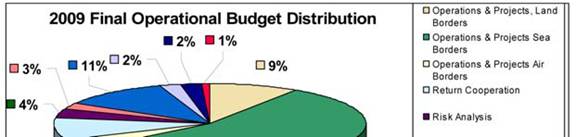
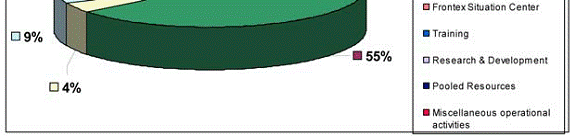
And as I noted in my earlier post, Frontex continued to devote the biggest single portion of its expenditures to maritime enforcement.  Almost 40% of Frontex’s total budget, over € 34 million, was spent on sea operations in 2009, constituting 55% of the operational budget.

This chart from the Report (p 23) shows the breakdown of expenditures within the 2009 Operational Budget (which was 71% of the total 2009 Frontex budget).
Click here for previous post.

Click here for the Frontex General Report 2009.

2 Comments

Filed under Aegean Sea, Algeria, Data / Stats, Eastern Atlantic, Frontex, Greece, Italy, Libya, Malta, Mauritania, Mediterranean, Reports, Senegal, Spain

Details from Frontex General Report 2009 (Post 1 of 2)

There is nothing really unexpected in the Frontex General Report for 2009.  If anything, it disappoints with its limited information.

The number of illegal border crossings at EU borders was smaller by a third in 2009 compared to 2008 and Frontex’s budget increased by 25% to € 88.3 million.

Frontex continued to devote the biggest single portion of its expenditures to maritime enforcement.  Almost 40% of Frontex’s total budget, over € 34 million, was spent on sea operations in 2009.  This constitutes 55% of the operational budget.  The Report notes that this cost is due to the high operating costs of ships and surveillance aircraft.

Expenditures for Frontex facilitated return operations sharply increased by 500% in 2009 to almost € 5.5 million.

Limited Information in the Report – The Report explains that Frontex made a decision in 2008 to decrease the level of detail provided in the General Report.  Frontex’s justification is that the Report “is mainly directed towards the general public” and the reduced level of detail “is more suited to this audience.”  This practice was unfortunately continued in the 2009 Report.

General Statistics – Overall there were 106,200 “detections of illegal border-crossings” at EU external land and sea borders in 2009.  This represents a 33% decrease in overall detected crossings relative to 2008, with a 23% reduction of detections at sea and a 43% reduction at land borders.

The reductions are attributed by Frontex to the economic crisis and to bilateral “collaboration agreements with third countries of departure” such as Libya, Senegal, and Mauritania.

Applications for international protection within the EU were 2% fewer in number than in 2008 and were approximately 50% of the 2001-2002 peak when 420,000 applications for international protection were filed.

Cooperation with Non-EU / Non-Schengen Countries – The Report states that cooperation with third countries, including neighbouring countries and countries of origin, is the critical element in “integrated border management.”   It describes Operation HERA as Frontex’s most successful joint operation due to close cooperation with West African countries, particularly Senegal and Mauritania.  On other fronts, “considerable progress” was made with Turkey consisting of Turkey’s appointment of a “first point of contact for Frontex related coordination issues” and preparation of a draft text of a possible Working Arrangement agreement.  “Ad hoc operational co-operation” was pursued when a targeted country was not willing or able to enter into a formal Working Arrangement with Frontex.  An “overriding priority” for Frontex in 2010 is the development of “structured operational co-operation with neighbouring Mediterranean countries.”  The Report acknowledges the existence of the bilateral migration agreement between Italy and Libya, but says nothing about its provisions other than to say that there were “contrasting interpretations of the International Law of the Sea” between Member States.  There is no criticism in the Report whatsoever of the Italian push-back practice.  It is obviously difficult for Frontex to criticise Italy, but was it not possible to note that most people and organizations who have considered the push-back practice have concluded that the practice violates international law?

New Partner Organisations – Frontex formalised a co-operation plan with Europol in October, a Working Arrangement with Interpol in May, a co-operation plan with IOM in February, and made a tripartite agreement with the European Maritime Safety Agency (EMSA) and the Community Fisheries Control Agency (CFCA) relating to maritime surveillance.

More to follow: I will post a second summary with additional information from the General Report pertaining to the specific sea operations for which information is provided within the next day or two.

Click here for the Report.

2 Comments

Filed under Aegean Sea, Data / Stats, Eastern Atlantic, European Union, Frontex, Greece, Italy, Libya, Malta, Mauritania, Mediterranean, Reports, Senegal, Spain, Turkey

Icelandic Coast Guard-Frontex Ship Delivers Charity Supplies to Senegal

The Icelandic Coast Guard ship Ægir will be participating in Frontex patrols off the Senegalese coast from May to October.  Iceland will also provide at least one surveillance plane, a TF-SIF, to the Frontex mission. While not an EU member (at least not yet), Iceland is a Schengen country.  The Coast Guard will reportedly use funds paid by Frontex for the mission to also partially fund helicopter rescue services in Iceland.

Before starting its Frontex patrols, the ship delivered charitable donations from Iceland for ABC Children’s Aid, an Icelandic charity with programmes in Dakar.

Click here, here, and here for articles.

Leave a comment

Filed under Eastern Atlantic, Frontex, Iceland, News, Senegal

LIBE Vote Scheduled for 10 May re Challenge to Frontex Sea Border Surveillance Rule

LIBE members are scheduled to vote on Monday, 10 May, regarding a request to the JURI committee to approve an ECJ challenge to the new Frontex sea border surveillance rules.  Draft Agenda item 4: “Comitology measure on sea border surveillance (FRONTEX): Request to JURI concerning referral to European Court of Justice.”  The vote is scheduled to follow a report by Commissioner Cecilia Malmström to LIBE regarding the Commission’s work since its entry into office.

Click here for draft agenda.

1 Comment

Filed under European Union, Frontex, News

EDA Report on Maritime Surveillance in Support of CSDP

The “Wise Pen Team” Final Report to the EDA Steering Board on Maritime Surveillance in Support of the Common Security and Defence Policy (CSDP) was released on 26 April.

The EDA Press Release states: “the Ministerial Steering Board received the report of the Wise Pen Team of five retired admirals on Maritime Surveillance in support of CSDP. The central message of the report is the need for linking national and international military and civilian assets in order to create a federated maritime surveillance network. The report contains concrete recommendations and will provide an important contribution to the activities on Integration of Maritime Surveillance, led by the European Commission.  ‘The Wise Pen Team’s report has already had a major impact. It has brought different actors together, civilian and military, which will be crucial for developing effective Integrated Maritime Surveillance’, Catherine Ashton stated. She added: ‘My dual-hat capacity as High Representative and Vice-President of the Commission has exactly been created to realise the synergies we need in the EU between the civilian and military sides in areas like Maritime Surveillance.’”

Executive  Summary: “[***] Increasing maritime insecurity, not least terrorism, piracy and illegal immigration, has highlighted the need to improve European security by integrating maritime policy making, sharing information more effectively and transparently and coordinating a collective response to security challenges. Many useful initiatives are already underway, but there is the need to make graduated improvements in co-ordination and integration which are affordable and not technologically difficult. [***]”

I have not attempted to read this 50+ page document yet, but it may of interest to some.

Here is the Table of Contents:

  • Introduction: Trends in the Economy and Maritime Security Context
  • The Interim Conclusions of the Intermediate Report
  • Changes Since the Issue of the Intermediate Report
  • Maritime Surveillance. Its Aims and Purposes
  • Naviesʼ Contribution to Maritime Surveillance
  • Tools and Networks
  • Alternative Organisational Approaches
  • Data, Information, Knowledge
  • Preferable Approaches
  • Conclusions and Recommendations

Click here for the Report.

Click here for EDA Press Release.

Leave a comment

Filed under European Union, Reports