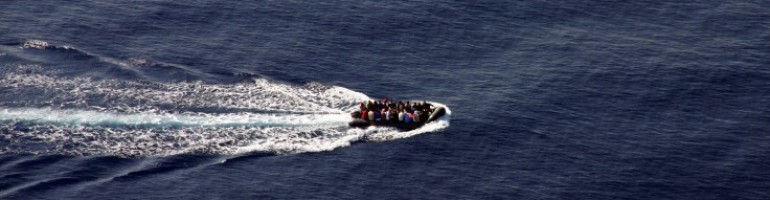
A Royal Navy mine counter-measures vessel, the HMS Brocklesby, last week located and destroyed a mine containing 100 kg of high explosives outside of the Misrata harbour.
Click here for Royal Navy press statement.
A Royal Navy mine counter-measures vessel, the HMS Brocklesby, last week located and destroyed a mine containing 100 kg of high explosives outside of the Misrata harbour.
Click here for Royal Navy press statement.
Filed under Libya, Mediterranean, News, UK
From an AP story about the sinking of the migrant boat that left Tripoli last week, killing hundreds of persons:
“… International agencies say some recent migrants report being forced onto dangerously packed ships at gunpoint by Libyan soldiers. A spokesman for Moammar Gadhafi suggested that increased illegal immigration was the price European nations would pay for their military and political support of the rebels trying to topple Libya’s strongman. ‘Because of the NATO aggression against our country and because our coastal border guard is being hit daily … we are unable to deal with this situation and that is why Europe is being flooded with illegal immigration,’ government spokesman Moussa Ibrahim said. ‘We cannot be the guards of Europe at this moment.’…
The U.N. said migrants’ boats started leaving Libya for Europe again on March 25, the day NATO took over military operations. About 14,800 since have made the gruelling journey across the Mediterranean in rickety ships run by smugglers who rarely provide enough food and water. At least 800 people had been lost at sea in three boat sinkings before the latest ship went down with 600 aboard off Tripoli on Friday, the U.N. said. Five boats carrying 2,400 people have arrived in recent days on the Italian island of Lampedusa, the closest European point to Libya. Every one of those boats needed to be rescued by the Italian coast guard and police, the U.N. said.
‘We know that the people running the boats are smugglers. But obviously you cannot have over 2,000 people leaving in a few short days without the government knowing and allowing it,’ U.N. refugee agency spokeswoman Sybella Wilkes said. ‘That port of Tripoli is under government control.’…”
Click here for full text of article.
Filed under European Union, Italy, Libya, Mediterranean, News, UNHCR
Full Text:
“Strasbourg, 09.05.2011 – Mevlüt Çavusoglu, President of the Parliamentary Assembly of the Council of Europe (PACE), today expressed his distress and deep concern following reports that 61 boat people have died after their appeals for rescue were ignored. Reportedly, their boat was left to drift in the Mediterranean for 16 days.
‘If this grave accusation is true – that, despite the alarm being raised, and despite the fact that this boat, fleeing Libya, had been located by armed forces operating in the Mediterranean, no attempt was made to rescue the 72 passengers aboard, then it is a dark day for Europe as a whole,’ he declared.
‘I call for an immediate and comprehensive inquiry into the circumstances of the deaths of the 61 people who perished, including babies, children and women who – one by one – died of starvation and thirst while Europe looked on,’ he added.
‘At the same time, we have also witnessed acts of solidarity: over 400 boat people were rescued yesterday by the Italian coastguard, with the help of Lampedusa’s inhabitants,’ he said. ‘This is something Europe should be proud of.’
‘Finally, Europe should stop exaggerating the impact of these arrivals. Libya’s neighbouring countries, mainly Egypt and Tunisia, are dealing with over 650 000 refugees who have fled the conflict there. In a spirit of solidarity and of burden-sharing, the 27 EU member states should at least be able to deal, in a humane way and in compliance with their international obligations, with the arrival by boat of several thousand,’ Mr Çavusoglu added.
‘Our Assembly will be sending a delegation to Lampedusa on 23-24 May 2011 to evaluate the situation there, ahead of two major debates – possibly in June – on the rescue of boat-people and the need for Europe to share responsibility. The Assembly has produced a string of critical reports on these matters, and will continue to urgently insist on the humane and lawful treatment of asylum-seekers, refugees and irregular migrants coming to Europe.'”
Click here for link to statement.
Filed under Council of Europe, Mediterranean, News, Statements
The Guardian on Sunday reported many more details about an incident that began on 25 March when a migrant boat left Libya carrying 72 asylum seekers and which ended 16 days later on 10 April when the disabled vessel washed ashore in Libya with only 11 survivors. The survivors have described several incidents where military ships and planes ignored their pleas for rescue. It is clear from the survivors’ descriptions that their disabled vessel was sighted because at one point a military helicopter dropped bottles of water and emergency food rations on the migrant boat.
The UNHCR and Father Mussie Zerai, an Eritrean priest in Rome who runs the refugee rights organisation Habeshia, have called for further investigations into why the boat’s passengers were not rescued.
From the Guardian article: “The Guardian’s investigation into the case of the boat of 72 migrants which set sail from Tripoli on 25 March established that it carried 47 Ethiopians, seven Nigerians, seven Eritreans, six Ghanaians and five Sudanese migrants. Twenty were women and two were small children, one of whom was just one year old. The boat’s Ghanaian captain was aiming for the Italian island of Lampedusa, 180 miles north-west of the Libyan capital, but after 18 hours at sea the small vessel began running into trouble and losing fuel. Using witness testimony from survivors and other individuals who were in contact with the passengers during its doomed voyage, the Guardian has pieced together what happened next. The account paints a harrowing picture of a group of desperate migrants condemned to death by a combination of bad luck, bureaucracy and the apparent indifference of European military forces who had the opportunity to attempt a rescue….
The Guardian has made extensive inquiries to ascertain the identity of the Nato aircraft carrier, and has concluded that it is likely to have been the French ship Charles de Gaulle, which was operating in the Mediterranean on those dates. French naval authorities initially denied the carrier was in the region at that time. After being shown news reports which indicated this was untrue, a spokesperson declined to comment.
A spokesman for Nato, which is co-ordinating military action in Libya, said it had not logged any distress signals from the boat and had no records of the incident. ‘Nato units are fully aware of their responsibilities with regard to the international maritime law regarding safety of life at sea,’ said an official. ‘Nato ships will answer all distress calls at sea and always provide help when necessary. Saving lives is a priority for any Nato ships.’”
Click here for full Guardian article.
Click here (IT) for earlier article.
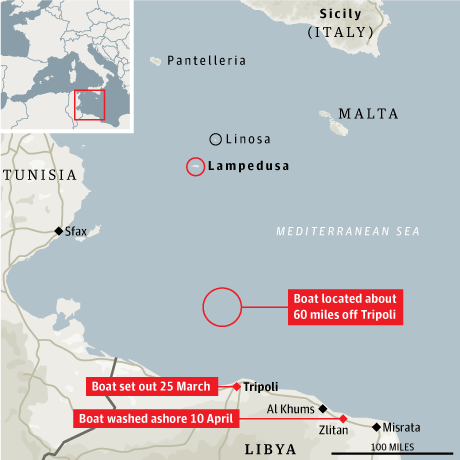
The route of the boat - from guardian.co.uk
Migrant boats carrying over 2500 persons arrived in Lampedusa over the weekend. The boats are all believed to have departed from Libya. Improving sea conditions are thought to be responsible for the new surge in migrant boats. Italy has said it will lodge a formal diplomatic complaint with Malta over what it says was Malta’s failure to rescue a migrant boat in distress. The migrant boat in question was apparently closer to Lampedusa than to Malta, but was within the Maltese SAR zone when a distress call was made. Maltese authorities said they were unable to send their patrol boats to the boat that was in distress due to bad sea conditions. Italian coast guard boats eventually provided assistance while NATO and Armed Forces of Malta aircraft provided air surveillance.
Click here (IT), here (EN), here (EN) and here (EN) for articles.
Northern League leader Umberto Bossi has issued an ultimatum to Silvio Berlusconi demanding a parliamentary vote to set a date certain by which Italy would halt its involvement with NATO operations against Libya. The Northern League’s basic argument is that ongoing NATO attacks against Libya will lead to larger numbers of migrants and asylum seekers fleeing to Italy. Interior Minister Roberto Maroni (Northern League) repeated yesterday his belief that up to 50,000 people may soon flee Libya towards Italy.
Click here (FR), here (IT), and here (IT) for articles.
Filed under Italy, Libya, Mediterranean, News
UNHCR issued a statement on Friday, 8 April, calling “on the European Union to urgently put into place more reliable and effective mechanisms for rescue-at-sea” in the aftermath of last week’s disaster that saw “[m]ore than 220 Somali, Eritrean and Ivorian refugees drowned early on Wednesday morning when their boat capsized some 39 nautical miles south of the Italian island of Lampedusa. This is the worst such incident in the Mediterranean in recent years. ‘It is hard to comprehend that at a time when tens of thousands are fleeing the Libyan conflict and pouring across the land borders into Tunisia and Egypt where they enjoy safety and receive shelter and aid, the protection of people fleeing via Libya’s maritime border does not appear to have the same priority’ said Assistant High Commissioner for Protection Erika Feller.” “‘We also appeal to shipmasters to continue to render assistance to those in distress at sea. Any overcrowded boat leaving Libya these days should be considered to be in distress’ [, said Feller.]”
While NATO was not mentioned in the UNHCR statement, the call for improved measures to save the lives of migrants who flee North Africa by boat should also be heard and considered by the NATO Maritime Command Naples which is conducting the maritime embargo of Libya known as Operation Unified Protector. NATO has a significant naval force patrolling the area through which migrant boats leaving Libya are passing and this force should be actively engaged in protecting fleeing civilians. (Click here for earlier post regarding NATO’s maritime embargo.)
While UN Security Council Resolution 1973 does not speak directly to this issue, it does call for the protection of civilians. Relevant portions from Security Council Resolution 1973:
As with UNHCR’s call to EU states, NATO ships should also render assistance to any migrant boat detected by NATO forces – any overcrowded boat leaving Libya should be considered to be in distress.
Click here for UNHCR statement.
Click here for article.
Filed under European Union, Italy, Libya, Malta, Mediterranean, News, UNHCR
Italian Interior Minister Maroni has criticised Malta for failing to immediately deploy rescue ships to assist the migrant boat that sank near Lampedusa. The Armed Forces of Malta said that the migrant boat did not capsize until after two Italian coast guard boats had responded and were on scene attempting to render assistance. The AFM said the first call for assistance was received Wednesday at 0025, the Rescue Co-ordination Centre of the AFM notified Italian Coast Guard headquarters in Rome and NATO headquarter in Naples at 0120, two Italian coast guard boats and an Italian fishing vessel, the Cartagine, were on scene by 0416, and the migrant boat capsized around 0535. The migrant boat was closer to Italian territory than to Malta, but was located within Malta’s large Search and Rescue Area. Italy and Malta have had past disputes over the boundaries of the SAR with Italy calling for the Maltese SAR to be reduced in size.
The Secretary-General of International Maritime Organization, Efthimios E. Mitropoulos, issued a statement saying that “[i]t was ironic that the devastating news of this latest tragedy reached us while we were holding a [Legal Committtee] meeting with representatives of Italy and Spain to consider what measures countries in the Mediterranean Basin should take to deal with the increasing number of persons leaving north African and eastern Mediterranean countries to seek refuge in Europe.”
The statement also said that “IMO is in contact with Italy, Malta and the UN High Commissioner for Refugees (UNHCR). The [Legal Committee] meeting mentioned above was hosted by IMO and held against a background of increasing movement of persons by sea for political and socio-economic reasons or as a result of armed conflict. It was part of an on-going process aimed at improving existing provisions for rescuing migrants at sea and disembarking them at a place of safety, in accordance with the International Convention on Maritime Search and Rescue (SAR Convention) and the International Convention for the Safety of Life at Sea (SOLAS Convention).”
Click, here, here, here, and here for articles. (EN)
Click here for article. (IT)
Click here for map the SARs.
Click here for IMO Statement.
Here is a short AFP article about Father Mussie Zerai who is in frequent contact by satellite phone with African refugees in Libya and with those who are in the process of leaving Libya: “A few steps away from St Peter’s Basilica, an Eritrean Catholic priest is on the phone with boats in the middle of the Mediterranean filled with African refugees fleeing Libya. Mussie Zerai receives calls from satellite phones on the boats and co-ordinates the arrival of hundreds of Eritreans, Ethiopians and Somalis with Italy’s coast guard and the NATO warships imposing a naval embargo on Libya….”
Click here for article.
Father Zerai’s organisation’s blog: habeshia.blogspot.com/
UPDATE: If you have information about a family member or friend who may be on a boat or if you are seeking information, please consider contacting the Agenzia Habeshia per la Cooperazione allo Sviluppo in Italy at this email address: agenzia_habeshia@yahoo.it .
UPDATE: Click here for 19 April 2011 BBC article.
Filed under Eritrea, Italy, Libya, Mediterranean, News
I posed several questions to NATO Maritime Command Naples asking what NATO’s policy is in regard to encounters between NATO ships and migrant boats leaving Libya. NATO Maritime Command Naples is responsible for enforcing the maritime embargo of Libya known as Operation Unified Protector. I also asked for more information about the encounter on 25-26 March between the Canadian navy ship, HMCS Charlottetown, and what was probably the first recent migrant boat from Libya. This particular migrant boat was subsequently taken to Linosa by the Italian Coast Guard.
Today’s response from NATO’s public affairs office is fairly straightforward and states that NATO ships will respond to vessels or persons in distress. The response suggests that NATO ships will otherwise not interfere with the passage of migrant boats unless a boat is suspected of carrying arms or mercenaries. Presumably NATO would also seek to stop and board migrant vessels suspected of carrying any persons of particular interest to NATO, e.g. Libyan officials.
Here are my questions and the responses from the Public Affairs Office at NATO Maritime Command Naples:
Q: Does Operation Unified Protector have plans or procedures in place regarding what to do in the situation where a NATO vessel encounters a boat or inflatable that is carrying irregular migrants or asylum seekers out of Libya and attempting to reach another country, e.g. Italy or Malta?
NATO: Operation Unified Protector is part of the broad international effort to protect civilians and civilian-populated areas under threat of attack. The maritime portion of the operation foresees NATO warships and aircraft patrolling the approaches to Libyan territorial waters to reduce the flow of arms, related material and mercenaries to Libya as called for in UN Security Council Resolution 1973. Issues of migration or asylum seekers are not within the mandate of this specific NATO operation.
Q: If there are plans or procedures for encounters with migrant boats, what do they provide for?
NATO: A master of a ship at sea which is in a position to be able to provide assistance on receiving information from any source that persons are in distress at sea, is bound to proceed with all speed to their assistance, if possible informing them or the search and rescue service that the ship is doing so. This obligation to provide assistance applies regardless of the nationality or status of such persons or the circumstances in which they are found.
Q: Additionally, can you provide details regarding what HMCS Charlottetown did on/about 26 March when it encountered a migrant boat carrying approximately 350 African migrants from Libya? Did HMCS Charlottetown request assistance in connection with this encounter from the Italian Coast Guard or Navy or from Frontex? What assistance, if any, was provided to the migrant boat?
NATO: On 25 and 26 of March 2011, NATO ships patrolling in International Waters attended a boat to ensure there was not a case of Safety of Life at Sea (SOLAS). Assistance was offered in the form of technical expertise and supplies. NATO ships monitored the situation constantly throughout the stated period. For action taken by Italy with regard to this event we recommend you contact the appropriate authorities.
Q: Does NATO anticipate that there may at some point be large numbers of non-Libyans or Libyans attempting to leave Libya by sea?
NATO: We do not feel that we can speculate on this matter.
Click here for link to NATO Maritime Command Naples and here for link to Operation Unified Protector.
Filed under Italy, Libya, Malta, Mediterranean, News
A boat carrying approximately 350 African migrants or asylum seekers from Libya has been intercepted and is being diverted to the Italian island of Linosa between Malta and Lampedusa. There have been reports over the past several days that the migrant boat was at sea. A Canadian navy ship, probably the frigate HMCS Charlottetown, first intercepted and boarded the migrant boat to determine whether the passengers required immediate rescue or not and to provide a pump. The migrant boat was allowed to proceed. An Italian navy helicopter later rescued a woman who gave birth on the boat. The woman, the newborn baby, the father, and a second pregnant woman were removed from the migrant boat and taken to hospitals on Lampedusa and Sicily. The Italian navy said that the migrant boat will be taken to Linosa rather than Lampedusa. UNHCR spokeswoman Laura Boldrini is quoted by AFP as saying that “[t]his is the first boat coming from Libya with people fleeing the military escalation, the vendettas and the retaliation attacks and that “the people on board the boat required ‘international protection’”. AFP also reported that “Mussie Zerai, an Eritrean Catholic priest in Italy who has been in direct contact with the vessel via a satellite phone, said conditions on the boat were extremely difficult with around 10 children and 20 women on board. He said the people were mostly Eritreans, Ethiopians and Somalians.” Zerai also “said four or five other boats carrying African migrants had … left Libyan shores carrying around 1,000 people.”
Click here (EN) and here (IT) for articles.
The assets dedicated to Joint Operation Hermes Extension continue to increase, although at present there are only two coastal patrol boats (Italian) participating in the Frontex mission. Ten surveillance aircraft will soon be deployed. See the table with the list of resources below.
While the naval assets dedicated to JO Hermes Extension are minimal, there is a growing number of EU and NATO naval ships in the Central Mediterranean. Nicolas Gros-Verheyde (writing on the Bruxelles2 blog (FR)) has counted 14 naval ships from EU states that are present in the waters near Libya; the ships consist of destroyers, frigates, electronic surveillance ships, and supply and support ships. Additionally, Turkey has two naval ships in the area.
Some of the naval ships have already been used to evacuate European and other non-Libyan nationals from Libya. What additional activity the EU ships may engage in remains to be seen. They may become involved in military activities (presumably with UN authority (?)) and/or they may play a yet undetermined role should there be a sudden flow of migrants and asylum seekers from Libya. If there is a sudden and significant migratory flow, the naval ships should function in a search and rescue manner, but there is always the possibility that if faced with large numbers of migrants, the navy vessels may be used to interdict, blockade, or otherwise to try to prevent migrants from leaving Libya.
Click here for link to Frontex update regarding deployed assets.
Click here and here for Bruxelles2 postings. (FR)
Table: Resources available to JO Hermes Extension 2011 as of February 25, 2011.
| Italy (HMS) | 2 Coastal Patrol Vessel, 1 aircraft, 5 experts, 2 cultural mediators |
| Austria | 1 expert |
| Belgium | 2 experts |
| Denmark | 3-5 experts |
| France | 10 experts, 1 aircraft |
| Germany | 2 experts, 2 aircrafts |
| Hungary | 2 experts |
| the Netherlands | 1 aircraft, 2 experts |
| Portugal | 7 experts, 1 aircraft |
| Romania | 6 experts |
| Sweden | 1 expert |
| Switzerland | 2 experts |
| Spain | 4 experts, 1 aircraft (at a later stage) |
Filed under Algeria, Data / Stats, European Union, Frontex, General, Italy, Libya, Malta, Mediterranean, News, Tunisia


 MIGRANTS AT SEA