Tag Archives: Push-Back Practice

Eritreans Diverted from Libya Held by Human Smugglers at Egypt-Israel Border

Several organizations, including Gruppo EveryOne, are making an appeal on behalf of a group of 80 Eritreans who are reportedly being held by traffickers at the Egypt-Israel border. The Eritreans apparently departed Tripoli en route to Israel.  This incident provides anecdotal evidence that African asylum seekers are attempting to enter Israel because the Central Mediterranean sea route to Europe has for all practical purposes been closed by the Italian-Libyan push-back practice in effect since May 2009.

Click here (EN) or here (IT) for the Gruppo EveryOne appeal.

1 Comment

Filed under Egypt, Eritrea, Israel, Italy, Libya, Mediterranean, News

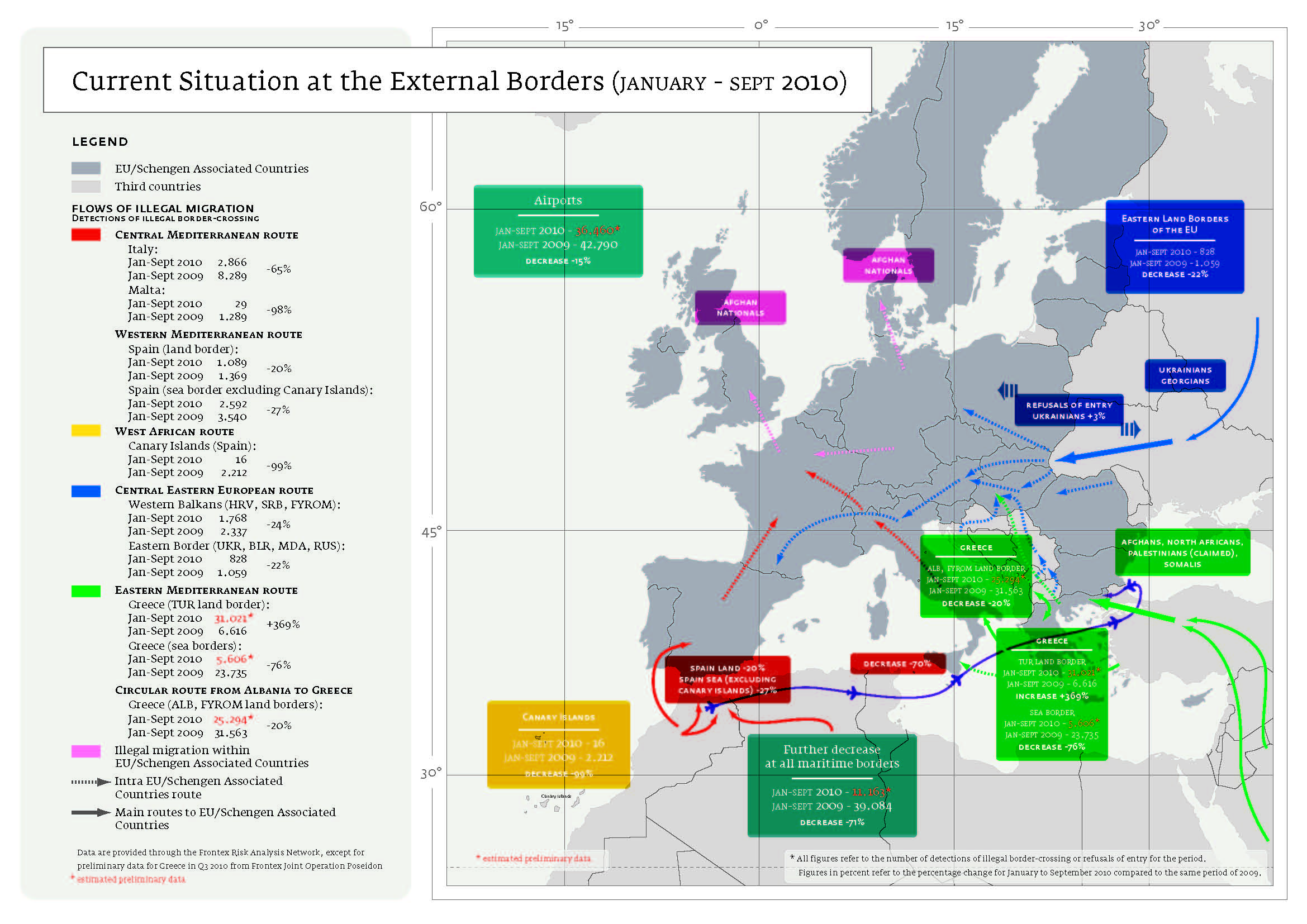
Frontex Map: Current Situation at the External Borders (JANUARY – SEPT 2010)

Frontex has released an updated Third Quarter map, January-September 2010, showing data regarding the situation at the external borders.   Note the information on the map pre-dates the deployment of the Frontex RABIT forces to the Greek border in October/November.  The data shows a 369% increase in detected irregular crossings along the Greek-Turkey land border over the first three quarters of 2010 compared to 2009.

The significant reduction in migrants detected at maritime borders continues:

  • Jan-Sept 2010:   11.163 (estimated preliminary data)
  • Jan-Sept 2009:   39.084
  • 71% reduction

Data by route:

Central Mediterranean route

  • Italy:
    • Jan-Sept 2010:     2.866
    • Jan-Sept 2009:    8.289
    • 65% reduction
  • Malta:
    • Jan-Sept 2010:    29
    • Jan-Sept 2009:    1.289
    • 98% reduction

Western Mediterranean route

Spain (land border):

  • Jan-Sept 2010:   1.089
  • Jan-Sept 2009:   1.369
  • 20% reduction

Spain (sea border excluding Canary Islands):

  • Jan-Sept 2010:   2.592
  • Jan-Sept 2009:   3.540
  • 27% reduction

West African route – Canary Islands (Spain):

  • Jan-Sept 2010:   16
  • Jan-Sept 2009:   2.212
  • 99% reduction

Eastern Mediterranean route

Greece (TUR land border):

  • Jan-Sept 2010:   31.021 (estimated preliminary data)
  • Jan-Sept 2009:   6.616
  • 369% increase

Greece (sea borders):

  • Jan-Sept 2010:   5.606 (estimated preliminary data)
  • Jan-Sept 2009:   23.735
  • 76% decrease

Click here to view Jan-Sept 2010 Map.

Click here for link to Jan-June 2010 Map.

Click here for link to 2009 Map.

1 Comment

Filed under Aegean Sea, Data / Stats, Eastern Atlantic, European Union, Frontex, Greece, Italy, Libya, Malta, Mediterranean, News, Spain, Turkey

Migreurop Report: European borders- Controls, detention and deportations

Migreurop has released its second report on Europe’s borders: “European borders- Controls, detention and deportations.”  Migreurop describes the report as a “[denunciation of] the « externalization » process of the European union migratory policy [which] shows how third countries are obliged, through the threat of the reconsideration of cooperation agreements and development aid, not only to readmit the migrants chased from Europe, but also to keep them on their own territory from travelling towards its doors.   From Calais area in France to the edge of Turkey and the Adriatic sea, from the surroundings of Gibraltar to the Sahel Saharan desert and the new member states of eastern Europe, a subcontracting of migratory control is carried out in series, sometimes very far away from the Union but also within its territory, especially when it deals with sending asylum seekers from country to country considered as unwanted. A large population of exiles, from both sides of the European borders, is subjected to arbitrary incarceration, wandering, and the constant humiliation of a hostile environment….”

Here is the Table of Contents:

Introduction

  • What have migrants become 3

Ceuta, a gilded prison

  • A murderous border 7
  • A legal limbo 8
  • The situation of migrants in detention 8
  • The situation of migrants in the CETI (open centre) 9
  • Deportations and expulsions 12
  • Surviving without resources 14

Sahel-Saharan countries, Europe’s new sentries

  • I – European interference in inter-African migrations – the case of Mauritania 18
    • The “crisis of the cayucos” 18
    • 1. Cooperation instigated by Europe 18
    • 2. Mauritania tramples on its own principles and conforms 21
    • 3. Subcontracting repression and endangering foreigners 22
  • II – Bargaining between Libya and Europe: migrants as an exchange currency –the case of Niger 33
    • 1. A reciprocal exploitation 34
    • 2. An increasingly repressive control of borders 37
    • 3. Arrests and detention in Libyan territory 39
    • 4. A deadly expulsion policy 42
  • Conclusion: the real face of Kadhafi’s pan-Africanism 44

Poland, Romania: how to be good state members in the enlarged EU

  • I – At the new frontiers: the screening of migration 47
    • 1. Reducing the transit and deserving Schengen 48
    • 2. The border police, Frontex and cooperation with other European states 48
  • II – Reception and detention centres 52
    • 1. The detention of foreigners 52
    • 2. Reception centres: isolating asylum seekers 60
    • 3. “Dublinized” asylum seekers 61
  • III – Returns 63
  • IV – Intolerance towards migrants and refugees 66
  • V – Embryonic mobilizations 70

The Ionian and Adriatic seas: forced returns between Italy and Greece

  • A new migration route at Europe’s gates 73
  • I – Controlling and blocking 75
    • 1. Controls in Greece 75
    • 2. Controls at sea 77
    • 3. Controls in Italian ports 78
  • II – Turning back and readmission 82
    • 1. Arbitrary practices and violation of rights 82
    • 2. The port of Venice: collective returns 83
    • 3. The port of Ancona 86
    • 4. Forced return to Greece 86
  • III – Detention 88
    • 1. At the borders and at sea: areas beyond legality 88
    • 2. Detention in Italy 89
    • 3. Detention in Greece 90
  • IV – Some cruel situations 93
    • 1. In Greece 93
    • 2. In Italy 96
  • V – Mobilizations 97
    • 1. In Venice 97
    • 2. In Ancona 97
    • 3. In Greece 98

Ping-pong at the Greco-Turkish border

  • Selective expulsions and random readmissions 106
  • Reactions to a degrading and sometimes murderous situation 107
  • Assistance, support, resistance 108

Dismantling the Calais jungle: a deceptive operation

  • I – The declared objectives of the 22 September 2009 operation 112
  • II – The real objectives of dismantling the jungle 113
  • III – The Modus Operandi: brutality and trickery 115
  • IV – What next? 116

Migreurop network 121

Annexes 122

  • Knocking down walls and defending the right to migrate 122
  • UNHCR-Libya : the bid is rising, migrants pay the price 124
  • All for the closure of camps for migrants, in Europe and beyond 125
  • Italia and Libya: hand in hand 127
  • Roma people victims of the French government xenophobia 128

Click here for the report (EN), or  here (FR), or here (ES).

Click here for article (ES) in Periodismo Humano about the report.

1 Comment

Filed under Aegean Sea, Eastern Atlantic, English Channel / La Manche, European Union, France, Frontex, Italy, Libya, Mauritania, Mediterranean, Morocco, Niger, Reports, Spain, Turkey, UNHCR

UNHCR Issues Protection Policy Paper: Maritime Interception Operations and the Processing of International Protection Claims

The UNHCR has issued a Protection Policy Paper: “Maritime interception operations and the processing of international protection claims: legal standards and policy considerations with respect to extraterritorial processing.” (Nov. 2010).

The “paper outlines UNHCR’s views on extraterritorial processing of claims for international protection made by persons who are intercepted at sea.”  UNHCR’s position is that it is not possible to conduct a full and adequate RSD onboard a ship and therefore intercepted persons should in most circumstances be disembarked in the territory of the intercepting state to have their claims for protection considered in regular in-country RSD procedures.

The paper should be read in its entirety (17 pages).  Here are some excerpts (with most footnotes omitted):

“1. Governments in some regions have adopted, or are considering, measures to process certain claims for international protection outside of their territory.  This is particularly the case following maritime interception operations, 2  where asylum-seekers and migrants are prevented from reaching their destination while on the high seas or in the territorial waters of a third State. …

(Ftnt 2 There is no internationally accepted definition of interception, and its meaning is largely informed by State practice. A working definition is provided in Executive Committee Conclusion No. 97 (LIV) (2003) on Protection Safeguards in Interception Measures, available at http://www.unhcr.org/41b041534.html .)

4. If extraterritorial processing is part of a comprehensive or cooperative strategy to address mixed movements, the location of reception and processing arrangements is only one relevant element. With its 10-Point Plan on Refugee Protection and Mixed Migration, (‘10-Point Plan’), UNHCR has developed a tool that provides suggestions across a number of areas, … This paper should be read in conjunction with the 10-Point Plan, and related strategies for comprehensive State cooperation in this field.

[…]

9. The existence of jurisdiction triggers State responsibilities under international human rights and refugee law.  It is generally recognized that a State has jurisdiction, and consequently is bound by international human rights and refugee law, if it has effective de jure and/or de facto control over a territory or over persons….

(Ftnt 10 Some governments have argued that an intercepting State may not have jurisdiction under international law over persons located on parts of its territory that have been excised under domestic law (e.g. declared ‘international’ or ‘transit’ areas in airports, ports and border areas, or other parts of State territory including remote territories or islands), on high seas, or on the territory of a third State that is under the control of the intercepting State (e.g. because the intercepting State is responsible for a military base or reception centre). Such arguments are inconsistent with the notion of jurisdiction under international law. Domestic law is not determinative of the existence of jurisdiction as a matter of fact under international law: The Vienna Convention on the Law of Treaties, 1155 U.N.T.S. 331, 8 I.L.M. 679, entered into force 27 January 1980, Article 27 (providing that a State may not invoke the provisions of its internal law as a justification for its failure to perform a treaty); see also Article 3 of ILC, Draft Articles on the Responsibility of States for International Wrongful Acts with Commentaries (2001).)

55. Processing onboard maritime vessels is generally not appropriate. In exceptional circumstances, that would need to be defined further, initial profiling or prescreening onboard the maritime vessel by the intercepting State may be one solution to ensure that persons with international protection needs are identified and protected against refoulement. Following profiling, those persons identified as having potential protection needs would need to be disembarked in the territory of the intercepting State to have their international protection claims considered in regular in-country RSD procedures….

56. In general the carrying out of full RSD procedures onboard maritime vessels will not be possible, as there can be no guarantee of reception arrangements and/or asylum procedures in line with international standards….”

(My thanks to Dr. Neil Falzon, former Head of UNHCR’s Malta Office, for bringing this to my attention over a week ago – and my apologies for being behind in email and updates. –nwf)

Click here for complete Paper.
Leave a comment

Filed under Analysis, Statements, UNHCR

New Paper: M Tondini, “Fishers of Men? The Interception of Migrants in the Mediterranean Sea and Their Forced Return to Libya”

A new legal paper by Dr Matteo Tondini entitled “Fishers of Men? The Interception of Migrants in the Mediterranean Sea and Their Forced Return to Libya” is available.  This paper should be read by anyone with any interest in Italy’s current push-back practice with Libya.  Dr Tondini is currently a post-doctoral researcher at the Vrije Universiteit AmsterdamFaculty of Social SciencesDepartment of Governance Studies.  The paper has been produced as part of the INEX Project, financed by the EC under the FP7 (http://www.inexproject.eu).

The paper refers to some unpublished material and interviews. Here is the abstract:

“This paper presents an extensive account and assesses the legality of the recent naval constabulary operations – undertaken by Italian and Libyan military vessels – in the central Mediterranean Sea, aimed at intercepting boat people in international waters and returning them to the Northern African coasts. If considered as a border control operation, the interception of migrants and their debarkation in a third country often lacks a valid legal basis. The latter is easier to be found under maritime law, by ‘labelling’ interceptions as rescue missions. Nevertheless, such operations must be conducted according to state obligations under human rights law and refugee law (especially the non-refoulement rule), which only allow Italian vessels to disembark boat people to a ‘safe third country’. The paper concludes that since Libya cannot be considered a ‘safe third country’ in this sense, the interception of migrants on the high seas and their forced return to Tripoli may entail violations of maritime, human rights, migration and refugee law at both an international, European and domestic level.”

Click here or here to access the paper.

(Thank you to Dr Tondini for bringing this paper to my attention.)

Leave a comment

Filed under Analysis, European Union, Frontex, Italy, Libya, Mediterranean

Erika Feller’s Comments Regarding Boat People and Irregular Secondary Movements

During her annual address to the UNHCR’s Executive Committee on 6 October, Assistant High Commissioner for Protection Erika Feller reviewed significant protection issues over the past year, noting also that 2010 marks the 60th anniversary of the founding of the UNHCR in December 1950 and the 59th anniversary of the Refugee Convention.

Among the topics she addressed were the challenges posed by the arrival of irregular secondary movements of migrants, including boat people.  She is critical of interdiction practices being carried out throughout the world and makes the strong point that “[t]he evidence suggests that tough sea policies have not solved, just changed and indeed complicated the dynamics, of irregular movements.”  While Ms. Feller does not identify countries by name, she is apparently referencing increased maritime interdiction in the Aegean Sea and the resulting surge in irregular crossings along Greece’s land borders.  The point could also be made in regard to the Italian push-back practice.

Excerpts from her address:

“Arrivals of undocumented migrants continue to test the capacity of States, with the problem of so-called “irregular secondary movement” exacerbated in recent years by boat arrivals. The Pacific, the Mediterranean, the Caribbean or the Gulf of Aden are all regular theatres, with ‘boatpeople’ being interdicted, intercepted, turned around, ignored by passing ships, shot at, or denied landing. Even when rescued, disembarkation somewhere has no guarantees attached, as an incident currently playing out off the Somalia/Djibouti coasts starkly reminds us.

All this is seriously at odds not only with protection principles but also with the reality that when they manage to gain access to territory and asylum processes, a large percentage of asylum-seekers who come by boat are actually found to be refugees. …

Boat arrivals can provoke fears and high emotions which may be difficult for Governments to manage. However, in our experience, an approach built predominantly around closing borders and trying to prevent movement is not the answer, as it does not work. In fact it can make situations even more difficult to deal with. Developments in relation to one country that has pursued a tough policy towards boats are actually quite revealing. While arrivals by sea are dramatically down, arrivals by land have basically doubled. In addition, while sea arrivals had been able to be concentrated through being channeled to one main reception point, land arrivals now come through multiple crossing points and have been able to disperse more effectively and rapidly through the community, below any radar screen. The evidence suggests that tough sea policies have not solved, just changed and indeed complicated the dynamics, of irregular movements….

The phenomenon of refugees on the move for non-protection reasons is also growing. Numbers and categories vary with the regions but the concern is global. On the African continent, where camps are more the norm than the exception, it is preoccupying that camp environments are starting to be compromised by a form of transit migration to and through them, with refugees, and others, seeking to use their facilities for R&R en route to a more distant destination. Just as concerning has been the misuse of reception centers as way-stations, or even lucrative recruitment opportunities for smugglers and traffickers. These facts are not a rationale for abandoning camps or centers. They are, though, a solid reason to rethink how better to manage them within a burden sharing framework….”

Click here for full address.

2 Comments

Filed under Aegean Sea, European Union, Greece, Italy, Libya, Mediterranean, News, Statements, UNHCR

EUROSTAT Q1 2010 Asylum Statistics for EU27 Countries

EUROSTAT released updated data on 15 July for the First Quarter of 2010.  The report is entitled: Asylum applicants and first instance decisions on asylum applications in Q1 2010 (Doc. 32/2010).

Notable statistics include reductions of over 50% in the number of asylum applicants in three countries, Malta, Italy, and Greece, relative to the First Quarter of 2009.  Malta had the largest reduction of approximately 95%.

The reductions in Malta and Italy are almost certainly due to Italy’s push-back practice.  Though the first migrant arrivals in Malta in 2010 occurred this past weekend, 17 July, when 55 migrants on a sinking vessel were intercepted by Maltese and Libyan patrol boats.  The Times of Malta reported that the migrants were “shared out” between the Maltese and Libyan patrol boats.  28 migrants were brought to Malta and 27 were apparently taken to Libya.

Click here for the full EUROSTAT document.

Click here for Times of Malta article.

3 Comments

Filed under Aegean Sea, Data / Stats, Eastern Atlantic, European Union, Greece, Italy, Libya, Malta, Mediterranean, News

Italy and Malta Question Need for Frontex Sea Patrols

Italy and Malta held a one day summit yesterday that focused on “Strategic Mediterranean” themes.  The two countries are calling for a reassessment of Frontex’s role in the Mediterranean, suggesting that Frontex may be best suited for repatriation operations and not for sea patrols.  Maltese Foreign Minister Tonio Borg said that even Italy questioned the need for ongoing Frontex missions fearing that such missions might upset the Italy-Libya migration agreement which has almost eliminated irregular migration from Libya.  A statement issued by the Italian Foreign Ministry described the Italy-Libya migration agreement as a model that is “exemplary for extension to other African countries.”

Malta also reaffirmed that it would not reconsider its decision not to host Frontex missions unless the Frontex rule addressing where intercepted migrants are to be taken is changed.

Click here and here for articles.

Click here for Italian Foreign Ministry statement.

1 Comment

Filed under Frontex, Italy, Libya, Malta, Mediterranean, News

Libya Confirms It Is Detaining “Pushed Back” Eritreans

Reuters reported that the Libyan Foreign Ministry confirmed there are approximately 400 Eritreans being held in detention centres in Libya and that 245 of these Eritreans were turned over to Libyan authorities after being intercepted at sea by Italian authorities.   Italian officials have previously questioned whether any of the Eritreans in question had been subjected to the Italian push-back practice.

Click here for article.

Leave a comment

Filed under Italy, Libya, Mediterranean, News

Libya May Allow Eritreans to Remain – Italy Claims Credit for Decision

Libya has reportedly agreed to allow approximately 400 Eritreans to remain in Libya, though they will not be given refugee protection as Libya is not a signatory to the Refugee Convention.

ANSAmed reported that Italian officials have claimed credit for Libya’s decision, though the Italians have questioned whether any of the Eritreans have been mistreated and whether any of the Eritreans were subjected to Italy’s push-back practice.  Italian Foreign Ministry Undersecretary Stefania Craxi stated that ”the Italian government never backed away from raising awareness with[] Libyan authorities on the topic of human rights.”  Craxi said ”it is thanks to the Italian government [that] the UNHCR activities in Tripoli have started again, albeit in an informal and conditioned way.”  Foreign Minister Franco Frattini said ”it is unbelievable that Brussels did not even make a press release.  [Italy] worked in silence, without proclamations, sadly with the total and absolute absence of Europe. We asked for a compromise, a mediation and the result came.”

While it is good if the Italian Government did indeed work to arrive at a temporary and imperfect solution for this particular group of Eritreans and it is good that the Italian ministers speak of respecting human rights in Libya, the Italians should be equally if not more concerned with the human rights implications of their push-back practice in the Mediterranean.

Click here for article.

Leave a comment

Filed under European Union, Italy, Libya, Mediterranean, News, UNHCR

ECRE and CIR: Ill-treatment of Refugees in Libya: the EU, a Silent Accomplice

ECRE and CIR released a statement on 7 July criticising Italy and the EU in regard to the plight of over 200 Eritrean refugees, some of whom may have been subject to Italy’s push-back practice and who are now detained under dangerous conditions in Libya.

The two organisations “call upon all authorities involved to ensure that refugees are not repatriated to Eritrea where they are at risk of torture and ill- treatment. … ‘We strongly repeat our plea to the Italian Government to resettle the refugees to Italy’, says Christopher Hein, Director of the Italian Council for Refugees (CIR). ‘Some of those who are being mistreated now by the Libyan authorities have been pushed back there by Italy one year ago. Refugees are suffering the consequences of Italy’s violation of its legal obligations and EU Member States’ consenting silence’, added Bjarte Vandvik, ECRE’s Secretary General.”

Click here for the full statement.

Leave a comment

Filed under European Union, Italy, Libya, Mediterranean, Statements

1 Year Anniversary of Italy’s Push-Back Practice

This month marks the first anniversary of the implementation of Italy’s push-back practice with Libya.  The practice is based primarily on the Italy-Libya Treaty of Friendship, August 2008, and the Supplementary Protocol of 4 February 2009.

The first push-back operation occurred on 6 May.  As a reminder, here is the European Committee for the Prevention of Torture’s (CPT) description of the first operation:

Operation of 6 May 2009

According to data provided by the Italian authorities, 231 migrants (191 men and 40 women) were aboard three vessels in distress. The information collected from other sources indicates that among the migrants there were unaccompanied minors and four pregnant women. Following the interception of the boats by two Coast Guard vessels and one vessel of the Guardia di Finanza, the migrants were transferred onto the three Italian vessels and returned to Libya. The CISOM [Order of Malta Italian Relief Corps] personnel and a journalist, who was aboard the vessel of the Guardia di Finanza, indicated that they were not aware that the migrants would be pushed back to Libya, and that the captains of the Italian vessels only received an order to do so in the course of the operation.

The delegation was unable to interview the migrants pushed back to Libya or, given the authorities’ refusal to provide their names, the captains of the Italian vessels involved in the operation. However, reliable information collected by the delegation would indicate that, during the operation, which lasted around 12 hours, the 74 persons on the Guardia di Finanza vessel were provided insufficient water and no food or blankets; further, physical violence, in particular with kicks, punches and blows with an oar, was allegedly used against a number of migrants by Libyan police at the harbour in Tripoli, to force them to disembark from the two Coast Guard vessels.

Click here (IT) for article and podcast from AMISnet: “Un anno di respingimenti.”

Click here for earlier post.

Click here for the full CPT Report.

Click here for the Response of the Italian Government.

1 Comment

Filed under European Committee for the Prevention of Torture and Inhuman or Degrading Treatment or Punishment, Italy, Libya, Mediterranean, News

Int’l Law Observer: Italy’s Asylum Policy Violates Int’l Law

Some additional comments on the Council of Europe CPT’s condemnation of Italy’s push-back practice in the Mediterranean can be found in a post by Michèle Morel on International Law Observer.

The “conclusion of the CPT is highly important in the light of the coming decision of the European Court of Human Rights on Italy’s asylum policy. It is a powerful signal, not only towards Italy but also towards other European countries carrying out the practice of intercepting and returning migrants without human rights guarantees, such as Spain and Greece.”

Click here for the complete post.

1 Comment

Filed under Analysis, Council of Europe, European Committee for the Prevention of Torture and Inhuman or Degrading Treatment or Punishment, Italy, Libya, Mediterranean

Maroni: Italy’s Push-Back Agreement with Libya Has Resolved Italy’s Migrant Problem

Roberto Maroni, Italy’s Interior Minister, speaking to the Italian Parliament’s Schengen Committee, said that as a result of Italy’s 2009 push-back agreement with Italy, migratory flows have been mostly diverted to the west to Spain and to the east to Greece.  According to Maroni, to the extent that migrants are reaching Italy by sea, they are doing so by routes from Tunisia and other countries, but not from Libya.  Maroni said that “this resolves Italy’s problem, but not Europe’s problem.” [“Questo risolve i problemi dell’Itala, ma non dell’Europa.”]

According to Maroni there has been a 96% decrease in the arrival of irregular migrants in Italy over the first three months of 2010 compared with the same period last year: from 1 January to 4 April there have reportedly been 170 arrivals compared with 4,573 arrivals over the same period in 2009.

Maroni praised the push-back agreement by saying “We’ve had 28,000 fewer arrivals [since its May 2009 implementation] and we’ve saved countless lives. It’s an unprecedented and concrete achievement which is the result of Berlusconi’s diplomacy and the agreement he struck with Libya.”.

Click here (IT) and here (EN) for articles.

Leave a comment

Filed under Data / Stats, Greece, Italy, Libya, Mediterranean, News, Spain, Tunisia