Tag Archives: Refugees

Commission Report on Asylum Procedures Directive

The European Commission issued on 8 September 2010 a periodic Report on the Asylum Procedures Directive (Council Directive 2005/85/EC of 1 December 2005, on minimum standards on procedures in Member States for granting and withdrawing refugee status).  The Report identified numerous “shortcomings in existing common standards” according to the Commission Press Release which accompanied the Report.

One purpose of the report is to “give[] an overview of the transposition and implementation of the Directive in Member States, including possible problematic issues.”  While the report includes a short section (Sect. 5.2.7.) discussing application procedures at Member State borders, it does not address application procedures beyond borders, e.g. in international waters.

The report concludes as follows:  “This evaluation confirms that some of the Directive’s optional provisions and derogation clauses have contributed to the proliferation of divergent arrangements across the EU, and that procedural guarantees vary considerably between Member States. This is notably the case with respect to the provisions on accelerated procedures, ‘safe country of origin’, ‘safe third country’, personal interviews, legal assistance, and access to an effective remedy. Thus, important disparities subsist. A number of cases of incomplete and/or incorrect transposition and flaws in the implementation of the Directive have also been identified. The cumulative effect of these deficiencies may make procedures susceptible to administrative error. It is noteworthy, in this regard, that a significant share of first instance decisions is overturned on appeal.

“The present report shows that the objective of creating a level playing field with respect to fair and efficient asylum procedures has not been fully achieved. The Commission will continue to examine and pursue all cases where problems of transposition and/or implementation have been identified, so as to facilitate the correct and consistent application of the Directive, and to ensure full respect for the principle of non-refoulement and other rights enshrined in the EU Charter. Procedural divergences caused by the often vague and ambiguous standards could only be addressed by legislative amendment. Accordingly, and on the basis of a thorough evaluation of the implementation of the Directive, the Commission adopted on 21 October 2009 a proposal to recast the Directive in order to remedy the deficiencies identified.”

Click here for the Report.

Click here for the Commission Press Release.

Leave a comment

Filed under European Union, News, Reports

IMO Information Resources on Stowaways/Illegal Migrants/Treatment of Persons Rescued at Sea – update

The International Maritime Organization’s (IMO) Maritime Knowledge Centre updated in August its  Information Resources document on “Stowaways / Illegal Migrants / Treatment of Persons Rescued at Sea.”

The document contains information, citations, and links to IMO documents, publications, circulars, and reports, as well as non-IMO citations and / or links to many other resources, including relevant UN reports, resolutions, and treaties.

Click here for the document.

Leave a comment

Filed under General, Reports

ECJ Invites Council to Submit Statement of Defence re EP Challenge to Frontex Sea Borders Rule

In an Order issued on 28 July, the European Court of Justice invited the European Council to submit a statement of defence in:  Case No. C-355/10, European Parliament v. Council of European Union (Application under Article 263 TFEU for annulment of Council Decision 2010/252/EU).

Here are the relevant portions of the Order (several footnotes omitted):

“1. By application under Article 263 TFEU, notified to the Council on 26 July 2010, the European Parliament asked the Court to annul Council Decision 2010/252/EU of 26 April 2010 supplementing the Schengen Borders Code as regards the surveillance of the sea external borders in the context of operational cooperation coordinated by the European Agency for the Management of Operational Cooperation at the External Borders of the Member States of the European Union.

2. In support of its action for annulment, the European Parliament argues that the Council in adopting the contested decision exceeded the implementing powers set out in Article 12(5) of the Schengen Borders Code to adopt additional measures governing border surveillance.

3. The Council is invited to submit a statement of defence, in accordance with Article 40(1) and Article 81(2) of the Rules of Procedure of the Court of Justice.

[***]”

(Thank you to the editor at Blogging Portal.EU for bringing this new development to my attention – and now back to my vacation break.)

Click here for the full document from the ECJ.

Click here for previous post (with links to earlier posts).

4 Comments

Filed under European Union, Frontex, Judicial, Mediterranean

DIIS Working Paper: Sovereignty at Sea: The Law and Politics of Saving Lives in the Mare Liberum

DIIS (Danish Institute for International Studies) has published a paper by Thomas Gammeltoft-Hansen and Tanja Aalberts, Sovereignty at Sea: The Law and Politics of Saving Lives in the Mare Liberum (DIIS Working Paper 2010:18).

The paper addresses “the complicated politics and law of ‘rescue at sea’, and the legal duty to render assistance to migrants in distress at sea that falls upon all sovereign states. Yet, exactly because this takes in international waters, the precise division and content of this sovereign responsibility remains contested and subject to varying interpretations. As a result, ‘the drowning migrant’ finds herself subject to an increasingly complex field of governance, in which participating states may successfully barter off and deconstruct responsibility by reference to traditional norms of sovereignty and international law. …  The … paper was presented at the first international workshop in this framework titled ‘Sovereignty, Territory and Emerging Geopolitics’ held at DIIS, 3-4 May 2010.”

Click here for the Paper.

Leave a comment

Filed under Analysis, Mediterranean

EUROSTAT Q1 2010 Asylum Statistics for EU27 Countries

EUROSTAT released updated data on 15 July for the First Quarter of 2010.  The report is entitled: Asylum applicants and first instance decisions on asylum applications in Q1 2010 (Doc. 32/2010).

Notable statistics include reductions of over 50% in the number of asylum applicants in three countries, Malta, Italy, and Greece, relative to the First Quarter of 2009.  Malta had the largest reduction of approximately 95%.

The reductions in Malta and Italy are almost certainly due to Italy’s push-back practice.  Though the first migrant arrivals in Malta in 2010 occurred this past weekend, 17 July, when 55 migrants on a sinking vessel were intercepted by Maltese and Libyan patrol boats.  The Times of Malta reported that the migrants were “shared out” between the Maltese and Libyan patrol boats.  28 migrants were brought to Malta and 27 were apparently taken to Libya.

Click here for the full EUROSTAT document.

Click here for Times of Malta article.

3 Comments

Filed under Aegean Sea, Data / Stats, Eastern Atlantic, European Union, Greece, Italy, Libya, Malta, Mediterranean, News

ECRE’s Recommendations to the Belgian EU Presidency

ECRE issued last week a letter and memorandum setting forth its recommendations to the Belgian EU Presidency in regard to the Common European Asylum System (CEAS), the European Asylum Support Office (EASO), and other related legislative files that will be considered during the Belgian Presidency.

Among the several important recommendations made by ECRE are the following:

“Access to protection – … [C]ooperation between the EASO, FRA and FRONTEX provide opportunities to develop mechanisms at EU level to guarantee that border control mechanisms are protection-sensitive in practice. The recently adopted guidelines for joint sea operations coordinated by FRONTEX restate the international human rights framework governing interception at sea and reaffirm the obligation of Member States to ensure that “no person shall be disembarked in, or otherwise handed over to the authorities of a country in contravention of the principle of non-refoulement, or from which there is a risk of expulsion or return to another country in contravention of that principle.”  They also explicitly require that “the person intercepted or rescued shall be informed in an appropriate way so that they can express any reasons for believing that disembarkation in the proposed place would be in breach of the principle of non-refoulement”. Whereas the guidelines merely restate these principles, they need to be implemented in practice. Given that the actual disembarkation of persons intercepted or rescued in the context of FRONTEX operations is dealt with in the non-binding part of the guidelines, it remains to be seen how effective this tool will be in order to ensure effective access to protection.

Recently the Commission proposed the third substantive revision of FRONTEX’ mandate. The Commission proposal unambiguously asserts that relevant EU standards, as well as international human rights and refugee law, are applicable to all border operations carried out by Member States under the auspices of Frontex and to all other activities entrusted to the Agency, which ECRE welcomes.

At the same time, while the intention of the Commission is to further clarify the role and responsibilities of FRONTEX vis-à-vis the Member States, the fundamental ambiguities about accountability for possible human rights violations during border control operations coordinated by FRONTEX are not resolved. ECRE believes that the respective roles and responsibilities of Member States’ guest officers, host Member State border officers, observers from third countries and FRONTEX personnel in those operations must be clearly established to avoid “accountability shifting” between the various actors involved. The enhanced role of FRONTEX in coordinating joint operations necessarily adds to FRONTEX’ responsibility and therefore further amendments to the Commission proposal are required to reinforce the Agency’s accountability.

Moreover, the proposed expansion of the role of FRONTEX in cooperating with third countries in border management, including through the posting of Immigration Liaison Officers, raises a number of concerns from a fundamental rights perspective, in particular regarding the ability of individuals to flee and find protection from persecution. Consequently, ECRE believes that additional safeguards are needed to ensure that FRONTEX activities will indeed not “prevent access to protection systems by persons in need of international protection” as required by the Stockholm Programme.

ECRE calls upon the Council and the European Parliament in particular to:

  • Support the proposed amendments to the FRONTEX Regulation reasserting the obligations under EU law and fundamental rights which are incumbent upon Member States when taking part in the Agency’s operations.
  • Establish mechanisms to reinforce FRONTEX accountability in view of the increasing responsibilities placed on the Agency.
  • Introduce the necessary safeguards to ensure that FRONTEX enhanced capacity to cooperate with third countries does not prevent access to protection systems by persons in need of international protection.”

Click here for the ECRE Memorandum.

Click here for the ECRE Letter to the Belgian EU Presidency.

Leave a comment

Filed under Belgium, Communiqués, European Union, Frontex, Statements

Frontex 2010 Annual Risk Analysis

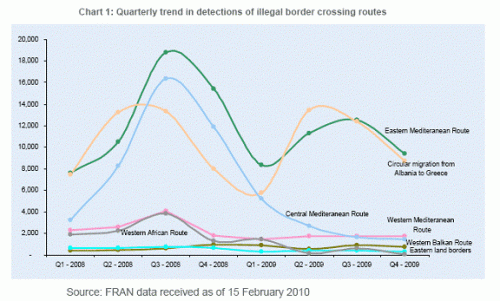
Frontex’s Annual Risk Analysis (ARA) for 2010 was prepared in March 2010 and was posted to the Frontex web site on 7 July.  The public document only contains certain portions of the full ARA as recommendations and other “operationally sensitive details” have been redacted. While some of the ARA’s contents have previously been released by Frontex, this 35 page document contains a lot of data regarding irregular migration by land, sea, and air, and is worth a read.

Excerpts from the ARA relating to maritime migration include:

“Detections of illegal border crossing – In 2009, the [EU] Member States and Schengen Associated Countries reported a total of 106,200 detections of illegal border crossings at the sea and land borders of the EU. This represented a 33% decrease compared to 2008. The decrease is comprised of both a strong decrease reported from the sea borders (-23%), and land borders (-43%).”

“The bilateral collaboration agreements with third countries of departure on the Central Mediterranean route (Italy with Libya) and the Western African route (which Spain signed with Senegal and Mauritania) had an impact on reducing departures of illegal migrants from Africa.”

“The agreements were made at a time when the economic crisis decreased the labour demand in the EU, thus simultaneously reducing the pull factor. The synchronisation of these events probably explains why no displacement has so far been noticed from the Central Mediterranean and Western African routes to other illegal migration routes in the statistics for detections.”

“However, intelligence suggests that the risk of displacement remains high, either with the emergence of new routes or the exploitation of existing ones by nationalities which used to be detected along the Central Mediterranean or the Western African routes.”

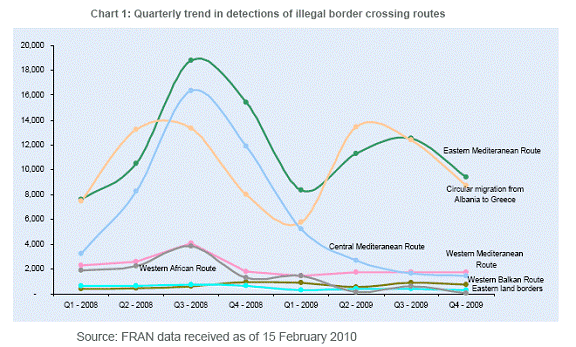
“As a corollary to the sharp decreases registered in Italy and Spain, the number of detections of illegal border crossing in Greece rose from 50% of the total EU detections to 75% of the total. In 2009, the Greek land border sections with Albania and FYROM represented the largest share of the EU total, with 36,600 detections (34% of the EU total), followed by 22,000 detections in the Aegean Sea with (21% of the EU total).”

“Eastern Mediterranean route – The Eastern Mediterranean route is the route taken by illegal migrants transiting through Turkey and entering the EU through eastern Greece, southern Bulgaria or Cyprus. Turkey, due to its geographical position near the EU, is the main nexus point on this route. From Istanbul, illegal migrants may reach the Greek islands in the Aegean Sea, or cross the land borders to Greece or to Bulgaria.”

“In 2009, illegal border crossing on the Eastern Mediterranean route totalled 41,500, or 39% of all EU detections. Most of the detections were reported from the Aegean Sea, followed by detections along the land border between Turkey and Greece. The number of detections reported by Bulgaria and Cyprus were considerably lower.”

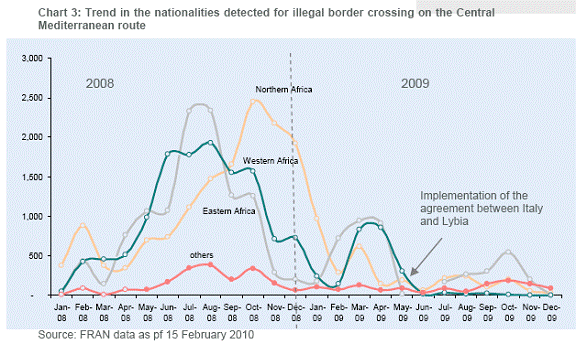
“Central Mediterranean route – The Central Mediterranean route refers to illegal migration from northern Africa to Italy and to Malta. For the past two years, Libya has been a nexus point where migrants from the Horn of Africa and Western African routes and a small proportion of Asian nationals met before embarking.”

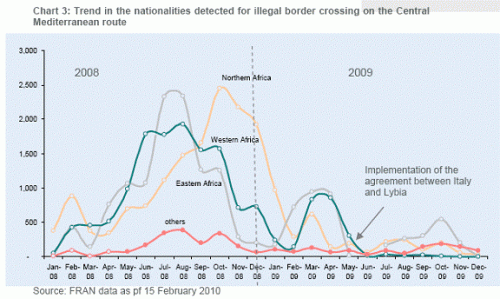
“Since the signing of a bilateral agreement with Libya, joint patrols by Libya and Italy have had a clear and measurable deterrent effect, with 3,200 detections in the seven months after the joint patrols (June to December), compared to 7,200 detections in the five months before the joint patrols (January to May), and almost 40,000 detections in the whole of 2008.”

“Western African route – The Western African route is primarily through Western African countries to Spain via the Canary Islands. The main embarkation points are in Senegal and Mauritania and the main countries of origin are Mali, Mauritania, Guinea Conakry and Senegal. Other African nationals have also been reported, and occasionally migrants from Asia. This route is now less favoured since the Spanish collaboration agreements with Senegal and Mauritania. The Frontex coordinated Joint Operation Hera plays a major role in maintaining effective surveillance in the area.”

“The Western Mediterranean route includes the sea route from Northern Africa to the Iberian Peninsula, and the land route through Ceuta and Melilla. It is mostly used by Northern African nationals (Algerian and Moroccan) travelling to Spain, France and Italy.”

“Maritime detections between Northern Africa and Spain are rising, with increasing detections of Algerian and to a lesser extent Sub Saharan nationals. Moroccan nationals are also regularly detected on this route. The lack of employment opportunities for the growing population of young people in Morocco continues to increase the incentives of migrating to the EU. The Spanish authorities recently reported an increasing number of attempts by Moroccan minors to get on the ferry link between Tanger and Spain. These cases do not seem connected with criminal networks; rather individual attempts are driven by poor employment prospects in Morocco.”

Click here for the ARA.

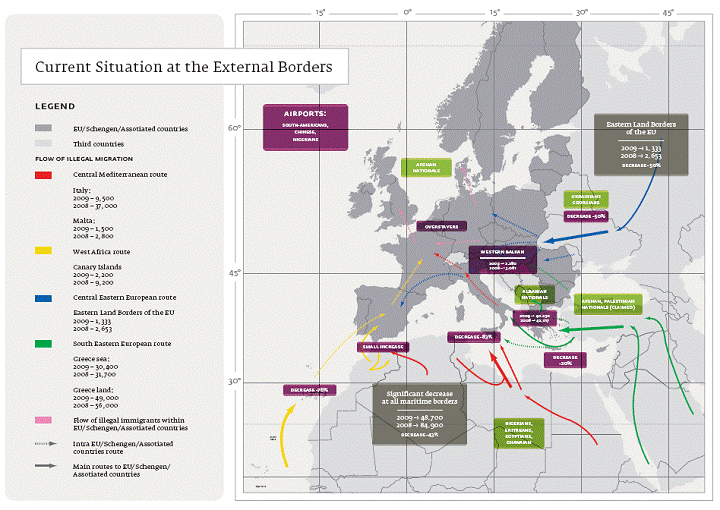
Click here for link to Frontex Map showing situation at External Borders.
[ARA page 18]

[ARA page 13]

1 Comment

Filed under Aegean Sea, Data / Stats, Eastern Atlantic, European Union, Frontex, Greece, Italy, Libya, Malta, Mauritania, Mediterranean, Morocco, Reports, Senegal, Spain, Turkey

Frontex Map: 2009 Situation at External Borders

Frontex posted this map to its web site earlier this week.  The map “describes the … situation [as of the end of 2009] at the external borders of the EU, including the main entry routes of irregular migration into the European Union: West African route, via Canary islands, Central Mediterranean, including Italy and Malta, South Eastern European route (including Greek land and sea borders) as well as the Eastern land borders.”

Click here for link to the map.

1 Comment

Filed under Data / Stats, European Union, Frontex, News

Italy and Malta Question Need for Frontex Sea Patrols

Italy and Malta held a one day summit yesterday that focused on “Strategic Mediterranean” themes.  The two countries are calling for a reassessment of Frontex’s role in the Mediterranean, suggesting that Frontex may be best suited for repatriation operations and not for sea patrols.  Maltese Foreign Minister Tonio Borg said that even Italy questioned the need for ongoing Frontex missions fearing that such missions might upset the Italy-Libya migration agreement which has almost eliminated irregular migration from Libya.  A statement issued by the Italian Foreign Ministry described the Italy-Libya migration agreement as a model that is “exemplary for extension to other African countries.”

Malta also reaffirmed that it would not reconsider its decision not to host Frontex missions unless the Frontex rule addressing where intercepted migrants are to be taken is changed.

Click here and here for articles.

Click here for Italian Foreign Ministry statement.

1 Comment

Filed under Frontex, Italy, Libya, Malta, Mediterranean, News

Libya Confirms It Is Detaining “Pushed Back” Eritreans

Reuters reported that the Libyan Foreign Ministry confirmed there are approximately 400 Eritreans being held in detention centres in Libya and that 245 of these Eritreans were turned over to Libyan authorities after being intercepted at sea by Italian authorities.   Italian officials have previously questioned whether any of the Eritreans in question had been subjected to the Italian push-back practice.

Click here for article.

Leave a comment

Filed under Italy, Libya, Mediterranean, News

Libya May Allow Eritreans to Remain – Italy Claims Credit for Decision

Libya has reportedly agreed to allow approximately 400 Eritreans to remain in Libya, though they will not be given refugee protection as Libya is not a signatory to the Refugee Convention.

ANSAmed reported that Italian officials have claimed credit for Libya’s decision, though the Italians have questioned whether any of the Eritreans have been mistreated and whether any of the Eritreans were subjected to Italy’s push-back practice.  Italian Foreign Ministry Undersecretary Stefania Craxi stated that ”the Italian government never backed away from raising awareness with[] Libyan authorities on the topic of human rights.”  Craxi said ”it is thanks to the Italian government [that] the UNHCR activities in Tripoli have started again, albeit in an informal and conditioned way.”  Foreign Minister Franco Frattini said ”it is unbelievable that Brussels did not even make a press release.  [Italy] worked in silence, without proclamations, sadly with the total and absolute absence of Europe. We asked for a compromise, a mediation and the result came.”

While it is good if the Italian Government did indeed work to arrive at a temporary and imperfect solution for this particular group of Eritreans and it is good that the Italian ministers speak of respecting human rights in Libya, the Italians should be equally if not more concerned with the human rights implications of their push-back practice in the Mediterranean.

Click here for article.

Leave a comment

Filed under European Union, Italy, Libya, Mediterranean, News, UNHCR

ECRE and CIR: Ill-treatment of Refugees in Libya: the EU, a Silent Accomplice

ECRE and CIR released a statement on 7 July criticising Italy and the EU in regard to the plight of over 200 Eritrean refugees, some of whom may have been subject to Italy’s push-back practice and who are now detained under dangerous conditions in Libya.

The two organisations “call upon all authorities involved to ensure that refugees are not repatriated to Eritrea where they are at risk of torture and ill- treatment. … ‘We strongly repeat our plea to the Italian Government to resettle the refugees to Italy’, says Christopher Hein, Director of the Italian Council for Refugees (CIR). ‘Some of those who are being mistreated now by the Libyan authorities have been pushed back there by Italy one year ago. Refugees are suffering the consequences of Italy’s violation of its legal obligations and EU Member States’ consenting silence’, added Bjarte Vandvik, ECRE’s Secretary General.”

Click here for the full statement.

Leave a comment

Filed under European Union, Italy, Libya, Mediterranean, Statements

Hammarberg Makes Urgent Request of Italy for Information on Eritreans in Libya

COE Human Rights Commissioner Thomas Hammarberg has made an urgent request to the Italian Government for information on alleged human rights violations of Eritrean migrants in Libya, including Eritreans who may have been among persons intercepted at sea by Italy and forcibly returned to Libya without being afforded an opportunity to seek international protection.

In a letter to the Italian Foreign Minister, Commissioner Hammarberg wrote “[g]iven the recent decision of the Libyan authorities to discontinue UNHCR’s activities in the country, it is increasingly difficult to confirm the exact accuracy of these reports. However, given their consistency and the seriousness of the allegations, I hope that I can count on your cooperation to urgently clarify the situation with the Libyan authorities and be kept informed about the results of your investigations.”

The Foreign Minister and Interior Minister have written a joint letter to the Il Foglio newspaper where they say that the Italian Government “was mediating with Tripoli to identify the Eritreans and try to find them employment in Libya so that they would not be forcibly repatriated.”  According to Reuters, the ministers also said “it was necessary to respect Libyan sovereignty and [they] called for an international approach, involving the United Nations and other organizations” and that the “fate of these Eritrean citizens cannot be resolved only through our bilateral relationship (with Libya).”

Click here for the Commissioner’s letter to the Italian Foreign Minister.

Click here for the Commissioner’s letter to the Italian Interior Minister.

Click here for article.

Click here (IT) for Italian Ministers’ Reply to Il Foglio.

Leave a comment

Filed under Commissioner for Human Rights, Italy, Libya, Mediterranean, News, UNHCR

EP Refers Frontex Sea Borders Rule to ECJ

On 23 June the JURI committee (Committee on Legal Affairs) voted in camera to refer the question of the validity of the Frontex rule regarding the surveillance of the sea external borders to the European Court of Justice (Council Decision 2010/252/EU (“Frontex / Sea borders”)).  The referral requests the Court “to preserve the effects of the measure until a new legislative act has been adopted.”

Maltese MEP Simon Busuttil, the EPP Coordinator in the Civil Liberties Committee, was quoted as saying: “we have given notice to the Commission that not all is fine with these Frontex guidelines and it is time for a rethink. We want to ensure that Parliament’s role is defended and that we can have our say. We want these rules to be fair. In their current version they are not.”

Both the LIBE and JURI committees believe that the European Commission exceeded its power when it presented the new Frontex rule under the comitology procedure as opposed to using the ordinary legislative procedure which would have given the Parliament the ability to amend the rule.  Malta has strongly objected to provisions within the rule.  Malta has said that its decision not to host Frontex’s Central Mediterranean enforcement operation this year, Operation Chronos, was due to the disembarkation provisions contained in the new Frontex rule.  Malta believes that the rule would require intercepted migrants to be taken to Malta.

Click here for article.

Click here for statement on MEP Simon Busuttil’s web site.

Click here for EPP Group press release.

Click here and here for earlier posts.

4 Comments

Filed under European Union, Frontex, Judicial, Malta, Mediterranean, News

Libya to Permit UNHCR to Resume Limited Activities

The UNHCR announced on Friday that it has received permission to resume some activities in Libya.  The UNHCR said that “its operations will be restricted to only its current caseload” in Libya.

Libyan officials have offered several reasons for why the Libyan government ordered UNHCR to cease operations several weeks ago, including complaints that UNHCR entered into cooperation agreements with local NGOs within Libya without authorisation, rented office space without permission, displayed the UNHCR logo improperly, and, most recently, that one or more persons associated with UNHCR accepted bribes and/or sexual favours from persons in exchange for refugee status.

“UNHCR spokesperson Adrian Edwards stressed that the Libyan allegations remain unsubstantiated. He told journalists in Geneva that talks on the agency’s future in the country will resume shortly and that the expulsion order has not yet been formally lifted. ‘UNHCR does take very seriously any accusation against any UNHCR staff member from whatever source,’ he said. ‘We have a zero tolerance policy for misconduct. We have asked the Libyan Government to substantiate these particular claims. If and when we receive these indications, we will be in a position to investigate through our normal procedures.’”

Click here for UN statement.

Click here, here, here (EN) and here (AR) for articles.

Leave a comment

Filed under Libya, Mediterranean, News, UNHCR