Tag Archives: Refugees

Updated CARIM Overview of Migration Developments in Libya

CARIM just issued a short paper, Libya: The Migration Scene – Which implications for migrants and refugees?: “In the light of UNHCR’s announcement of the 8th of June 2010 that it was requested to close its offices in Libya, CARIM provides an overview of migration developments in Libya from sociopolitical, legal and demographic-economic perspectives.”

Click here for the document.

Leave a comment

Filed under Analysis, European Union, Libya, Mediterranean, UNHCR

Amnesty Int’l Report on Libya Criticises Libya and EU on Refugee Treatment

Amnesty International has released a comprehensive report on Libya entitled “Libya of Tomorrow – What Hope for Human Rights?”  The report covers a range of matters including the criminal justice system and the use of the death penalty.   Section 5 of the report (beginning at p 91) addresses the rights of refugees, asylum-seekers and migrants.  The report was finalised before the recent decision of the Libyan government to close the UNHCR office in Tripoli.

In regard to refugee issues, Amnesty is very critical of both Libya and the EU and calls upon EU member states to “ensure that any bilateral agreements with Libya in the area of migration and asylum, including the EU-Libya Framework Agreement currently being negotiated, are based on full respect for the rights of asylum-seekers, refugees and migrants.”

Excerpts from Section 5, “Rights of refugees, asylum-seekers and migrants”:

Members of the EU have been actively seeking the collaboration of Libya in controlling the flow of migrants to European shores – turning a blind eye to Libya’s dire human rights record, the absence of a functioning asylum system in Libya, and persistent reports of the abuse and ill-treatment of refugees, asylum-seekers and migrants.  The Treaty of Friendship, Partnership and Co-operation signed in August 2008 between Italy and Libya includes provisions for bilateral efforts to combat “illegal migration”, facilitated by the joint patrolling of the sea agreed upon in December 2007 in the “Protocol” and the “Additional Technical-Operational” Protocol”.

As part of the agreements, Italy promised to compensate Libya for its occupation of the country between 1911 and 1943. The Treaty of Friendship, Partnership and Co-operation involves a US$5bn package for construction projects, [and other items].  In return, Libya agreed, among other things, to tighten control of its territorial waters and accept disembarkation on its soil of individuals intercepted at sea by Italian vessels. Italy was also reported to have undertaken to provide resources, including technology, to control migrant flows through the southern borders of Libya. In fact, Italy has provided Libya with six motor patrol boats since the Treaty entered into force.

In the framework of these agreements, from May 2009 onwards Italy started returning refugees, asylum-seekers and migrants intercepted in international waters to Libya. On 6 May 2009, distress calls were sent from three vessels with an estimated 230 third-country nationals on board. Italian coastguard vessels intervened but transported the individuals to Tripoli, without stopping in an Italian port and without checking whether any individuals on board were in need of international protection or basic humanitarian assistance. Further interceptions and returns occurred in the subsequent months: according to official information from the Italian Ambassador to Libya, between 6 May and 3 September 2009, over 1,000 individuals were returned to Libya. They included nationals from Eritrea, Somalia and other sub-Saharan African countries. The Italian Minister of the Interior Roberto Maroni was reported to have called this action “an historic achievement after one year of bilateral negotiations with Libya”….

Despite these pleas by UNHCR and consistent reports of abuses suffered by refugees, asylum-seekers and migrants in Libya, the Italian authorities continue to intercept vessels at sea and send them back to other countries most notably Libya.  In January 2010, Italian Minister of the Interior Roberto Maroni stated that the number of migrants arriving to Italian shores was reduced by 74 per cent in 2009 compared to 2008, attributing the reduction to Italy’s bilateral agreements with Libya.

Italy is not alone in seeking Libya’s cooperation to control the flow of migrants to European shores. Negotiations between Libya and the EU over a Framework Agreement started in November 2008 covering the control of migration, among other issues, including potential readmission agreements for third-country nationals who have transited through Libya on their way to Europe….

UNHCR [prior to its recent expulsion from Libya] and its partners have also been involved in screening individuals pushed back to Libya from Italy. UNHCR declared that by October 2009, it had been able to screen 890 people and had registered 206 of them as refugees and secured their release from detention.  UNCHR also registered 80 individuals pushed back from Italy in November 2009, granting 40 of them refugee status. The remainder were awaiting their interviews for refugee status determination at the time of writing. UNHCR confirmed that a total of 685 individuals determined to be refugees or asylum-seekers were released from detention from 2008 to February 2010, including 450 Eritreans and 150 Somalis…..

Click here for the Report.

Click here for AI Press Release regarding the Report.

Leave a comment

Filed under European Union, Italy, Libya, Mediterranean, Reports, UNHCR

EUROSTAT: 2009 EU27 Asylum Statistics and Characteristics of Asylum Seekers

Excerpts from the EUROSTAT asylum statistics press release issued on 18 June 2010:

The EU27 Member States granted protection to 78 800 asylum seekers in 2009 compared with 75 100 in 2008.

The largest groups of beneficiaries of protection status in the EU27 were citizens of Somalia (13 400 persons or 17% of the total number of persons granted protection status), Iraq (13 100 or 17%) and Afghanistan (7 100 or 9%).

In 2009, 317 500 decisions on asylum applications were made in the EU27, of which 228 600 were first instance decisions and 88 900 final decisions on appeal. Decisions made at the first instance resulted in 61 700 persons being granted protection status, while a further 17 100 received protection status on appeal.

The rate of recognition of asylum applicants, i.e. the share of positive decisions in the total number of decisions, was 27% for first instance decisions and 19% for final decisions on appeal.

In 2009, the highest number of persons granted protection status was registered in the United Kingdom (12 500), followed by Germany (12 100), France (10 400), Sweden (9 100), Italy (8 600) and the Netherlands (8 100). These Member States accounted for more than three quarters of all those granted protection status in the EU27.

The rate of recognition varies considerably among Member States…. The highest rates of recognition in the first instance were recorded in Malta (66%), Slovakia (56%), Portugal (51%), the Netherlands and Denmark (both 48%), and the lowest in Greece (1%), Ireland (4%), Spain (8%), France (14%) and Slovenia (15%).

Somalis were the single largest group of persons granted protection status in the EU27.

[M]inors accounted for 60 500 of the applicants [in 2009], of which 12 200 were unaccompanied.

Click here for the EUROSTAT Asylum Statistics document.

Click here for EUROSTAT Characteristics of asylum seekers in Europe report.

Click here for EU Commissioner for Home Affairs Cecilia Malmström’s statement on the EUROSTAT reports.

Leave a comment

Filed under Data / Stats, European Union, News

World Refugee Day 2010

UNHCR World Refugee Day 2010

Leave a comment

Filed under UNHCR

CEAR Releases 2010 Annual Report: La situación de las personas refugiadas en España

CEAR (Comisión Española de Ayuda al Refugiado) has released its 2010 annual report: “La situación de las personas refugiadas en España – INFORME 2010.”  The report is 350+ pages long.  I will try to review it and do an additional post on some portions of the Report in the coming days.

From CEAR’s web page: “Presentamos el octavo Informe Anual en un momento de grave preocupación por la garantía efectiva del derecho de asilo en España y en el mundo. En el año 2009 poco más de 3.000 personas solicitaron asilo en nuestro país, la cifra más baja desde que se contabilizan estos datos. Por el contrario, las demandas de protección internacional han aumentado en el ámbito de la Unión Europea y otros países industrializados. La pregunta clave es: ¿por qué no llegan refugiados a España? Pregunta que cobra aún más importancia si tenemos en cuenta que la situación en los países de origen de los solicitantes de asilo no ha mejorado, tal y como se analiza a lo largo de este Informe, como la situación de la R.D. Congo, América latina o Sri Lanka. La respuesta a este descenso de las solicitudes de asilo se desvela a lo largo del documento.

La publicación de este Informe Anual coincide con los primeros pasos para la puesta en práctica de la nueva Ley de Asilo, aprobada en octubre de 2009. CEAR volcó todos sus esfuerzos para hacer llegar a los grupos parlamentarios y a la sociedad sus propuestas para fortalecer el derecho de asilo como institución en España.

Uno de los mayores recortes de la nueva ley es la supresión de la vía diplomática para el acceso al asilo, por eso desde estas páginas CEAR realiza un recorrido por las últimas solicitudes por esta vía. También hace especial hincapié en el análisis de las demandas en frontera y de los Centros de Internamiento para Extranjeros (CIE). Por otro lado, la edición del octavo Informe coincide con la Presidencia española de la Unión Europea, por lo que se analizan las líneas políticas de actuación que ya se establecieron en el Pacto Europeo sobre Inmigración y Asilo de 2008. Este Informe presenta un completo recorrido desde la solicitud de asilo hasta la resolución de los casos, acompañado de un completo apéndice estadístico, sin prescindir de todo lo referente a la acogida, integración social e inserción sociolaboral de las personas refugiadas en España.”

Click here for the report (ES).

Leave a comment

Filed under Eastern Atlantic, European Union, Mediterranean, Reports, Spain

Frontex: Collaboration With African Countries Contributed to Reduction in Irregular Migrants in 2009

Speaking at a press conference in Athens earlier this week, Gil Arias Fernandez, Frontex’s deputy executive director, credited the global recession as the key factor in 2009 for the reduced numbers of migrants seeking to enter the EU.  He also credited “good collaboration from the African countries where immigrants usually depart[,]” referring to measures taken by Libya, Mauritania and Senegal to prevent migrants from leaving the countries.

Click here and here for articles.

Click here and here for earlier posts on Frontex’s 2009 General Report.

Leave a comment

Filed under Data / Stats, European Union, Frontex, Libya, Mauritania, News, Senegal, Statements

ECRE: Can EU Trust Libya With Refugee Protection?

ECRE issued a press release last week regarding Libya’s decision to expel the UNHCR:

“Bjarte Vandvik, Secretary General of the European Council on Refugees and Exiles (ECRE) said: ‘UNHCR’s expulsion from Libya will hopefully be temporary but it does reveal the unreliability of this regime, as well as its understanding of refugee protection. How will the EU ensure that Libya keeps its word regarding commitments towards human rights? How can the EU trust such a partner?’”

“ECRE calls on the EU to seriously reconsider its cooperation on asylum and refugee issues with Libya, a country that is not a party to the 1951 Geneva Refugee Convention. In particular, negotiations on an EU – Libya framework agreement must now be reviewed, as should any EU funding that supports Libyan authorities in intercepting refugees along their Southern border…. While UNHCR”s presence does not make Libya a safe place for refugees, the decision to prevent UNHCR from operating in the country once again illustrates the real intentions of the Libyan authorities when it comes to refugee protection. The EU cannot simply continue to ignore this reality but should make clear that the protection of refugees is still a fundamental value of the EU.”

(HT to Ana Lopez, ECRE’s Media and Information Officer).

Click here for full ECRE statement.

1 Comment

Filed under European Union, Libya, Mediterranean, Statements, UNHCR

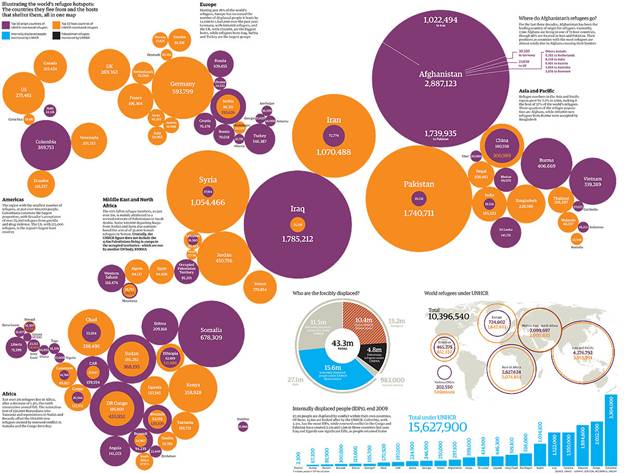
UNHCR Report: 2009 Global Refugee Trends & Guardian Data Map

The UNHCR released its annual report this week for last year: “2009 Global Trends- Refugees, Asylum-seekers, Returnees, Internally Displaced and Stateless Persons.”

The UNHCR estimates that approximately 43.3 million people were forcibly displaced at the end of 2009.  South Africa continued in 2009 to be the destination country receiving the largest number of new asylum seekers (222,000).  The US and France were second and third with less than 50,000 new asylum seekers.

The Guardian’s Data Blog published an interesting graphic with the UNHCR statistics.

Click here for UNHCR web article.

Click here for link to the UNHCR Report.

Click here for link to the Guardian’s map.

[UNHCR refugee statistics mapped. Illustration: Paul Scruton for the Guardian.]

Leave a comment

Filed under Data / Stats, Reports, UNHCR

Side Meeting on Boat People at Upcoming UNHCR-NGO Consultations

The annual UNHCR-NGO consultations will take place beginning 29 June (registration is closed).  Various side-meetings will also be held, including one on 1 July: “A hearing on Boat People: Different people, different needs and rights to protection.” Palais des Nations, Geneva, 13h15 – 14h45, Room XXII

“A hearing on Boat People: Different people, different needs and rights to protection.

Brief description: What are the needs of today’s boat people—and how can these needs be differentiated and matched to rights and practical responses of protection and assistance—among boat people arriving in Europe or Yemen from Africa; in the US from Haiti; in various parts of south and southeast Asia and Australia from Burma or Sri Lanka, or following other sea crossings? This session is organized as a hearing, not a series of presentations. It will begin with a brief introduction of the importance of differentiating needs and rights to protection and assistance among all the people arriving, (i.e., refugees, victims of human trafficking and smuggling, victims of torture, children, etc.) Conclusions from an experts roundtable in Tunis last year will then be offered as a reference, which participants will be invited to comment upon and at the end of the session, consider supporting. During the bulk of the session however, panelists from UNHCR, IOM, IFRC and UNODC will serve as a hearing board: listening, probing and recording the experience, concrete practices and recommendations of NGO participants who respond to boat people, either in Europe or in other parts of the world. Input will then be organized and submitted to the international organizations and to government policy makers, including the European Union and Council of Europe through the new EU-funded NGO partnership “DRIVE” (Differentiation for Refugee Identification and Vulnerability Evaluation).”

Click here for full Side Meeting agenda.

Leave a comment

Filed under Colloques / Conferences, UNHCR

EU-Libya Resume Partnership Talks

The seventh round of negotiations on the EU-Libya partnership accord began on 8 June in Tripoli.  According to the AFP, EU negotiators hope to have a final agreement with Libya signed by the end of 2010.  The current EU delegation is led by Hugo Mingarelli, deputy head of the European Commission for foreign affairs.  The negotiations have been slow for a variety of reasons, one of them being disagreement over immigration topics and the reported pressure on Libya by the EU to sign the UN Refugee Convention.  (See my previous post on Libya’s sudden decision to close the UNHCR office in Tripoli.)

Click here and here (AR) for articles.

Click here for EC External Relations web page on Libya.

Leave a comment

Filed under European Union, Libya, Mediterranean, News

Libya Orders UNHCR Office Closed – Possible Link to EU-Libya Talks on Partnership Accord

The Libyan government has ordered the UNHCR office in Libya to halt all activities and to close it office.  UNHCR has been working in Libya since 1991 even though Libya is not a signatory to the UN Refugee Convention.

The UNHCR said it was not given a reason for the Libyan decision.  Reuters reported that Libya’s Foreign Ministry considers the UNHCR presence within Libya to be illegal since Libya is not a signatory to the Refugee Convention.  Reuters also says that JANA, the Libyan news agency, accused a UNHCR official of carrying out an unspecified illegal activity.

The Libyan newspaper Oya and other reports say that the EU is pressuring Libya in the ongoing EU-Libya Partnership Talks to sign the Refugee Convention and that illegal immigration is one of the main areas of disagreement in the current negotiations.

The UNHCR said in a press release “[i]n the absence of a national asylum system, UNHCR has carried out registration and refugee status determination, visiting detention facilities and providing medical and humanitarian assistance to detainees.”  Among the asylum seekers detained in Libya over the past year are persons who were forcibly returned to Libya by Italian authorities pursuant to the Italy-Libya migration agreement.

Click here for UNHCR press release.

Click here for Oya article (AR).

Click here, here, and here for articles (EN).

2 Comments

Filed under European Union, Libya, Mediterranean, News, UNHCR

UNHCR Criticises Delay by Italy and Malta in Launching Search and Rescue of Migrant Boat

“UNHCR is concerned about delays in a search-and-rescue operation on Sunday and Monday [6-7 June]  involving a boat carrying more than 20 people, mostly Eritreans, near Malta. Distress calls were received on Sunday evening, including by UNHCR, and passed to Maltese and Italian maritime authorities. It is unclear which country had search-and-rescue responsibility when the distress calls were first sent. According to information made available to UNHCR, the boat was only rescued late on Monday, and by Libyan vessels.”

The persons on board the boat have reportedly been taken to Libya.

Click here for UNHCR statement.

Click here and here for articles.

Leave a comment

Filed under Italy, Libya, Malta, Mediterranean, News, UNHCR

Article: Overview of North African Bilateral Cooperation on the Removal of Unauthorized Migrants

The May 2010 publication by the Middle East Institute (Washington DC), Viewpoints- Migration and the Maghreb, contains several articles including “An Overview of North African Countries’ Bilateral Cooperation on the Removal of Unauthorized Migrants: Drivers and Implications” by Jean-Pierre Cassarino.

Excerpts from the article (at page 34):

“Since 1965, when Bourguiba’s Tunisia signed with Austria its first bilateral agreement on the repatriation of its own nationals, North African countries’ patterns of cooperation on readmission or removal have changed dramatically….

“[R]eadmission agreements are … one of the many ways to consolidate a broader bilateral cooperative framework, including other strategic, and perhaps more crucial, policy areas such as security, energy, development aid, and police cooperation….

“Faced with the uncertainty surrounding the concrete implementation of the cooperative agreements, some EU Member States, particularly those affected by migration flows originating in North Africa (e.g., France, Spain, Italy), set out to devise flexible arrangements while opting for different ways of dealing with readmission. These include exchanges of letters, memoranda of understanding, or other types of arrangements (e.g., police cooperation agreements and pacts)….

“Readmission is embedded in power relations that can shape the intensity of the quid pro quo. Following their proactive involvement in the reinforced police control of the EU external borders, North African countries have become gradually aware that they could play the efficiency card in the field of migration and border management, while gaining further international credibility….”

Click here for link to publication (see p. 34 for this article.)

Click here for the MIREM Project Inventory of Agreements Linked to Readmission.

Leave a comment

Filed under Analysis, European Union

EU-Turkey Readmission Agreement Negotiations Continuing

The Turkish paper, Today’s Zaman, reported that Turkey and the EU have reached agreement on 19 articles of a draft readmission agreement, but have been unable to reach agreement on 5 articles.

The news article states that Turkey wants “the readmission agreement [to include] strong funding from the EU, mirroring similar funding that is available to member states under the “resettlement policies” within the European Refugee Fund (ERF), which was established to support and improve the efforts of member states to grant refugee or asylum status to beneficiaries.”

“The [Turkish] government also fears that, without a strong and clear readmission agreement in place, vetting thousands of immigrants and asylum seekers in reception centers while awaiting deportation will open a Pandora’s box for Turkey in the European Court of Human Rights (ECtHR). Turkey ranks second after Russia in terms of the number of cases ending up in the ECtHR and is trying to reduce them by introducing constitutional changes on fundamental rights, due to be submitted to a referendum on Sept. 12.”

“In April, for example, the ECtHR decided in three out of four cases involving refugees recognized by the UN High Commissioner for Refugees (UNHCR) that Turkey would violate Article 3 of the European Convention on Human Rights (ECHR) if the expulsion orders were enforced. The court also criticized the unlawfulness and the conditions of their detention in a police station and in some of the detention centers where they had been held awaiting deportation.”

Click here for article.

Leave a comment

Filed under Aegean Sea, European Court of Human Rights, European Union, Greece, News, Turkey

Malta: Italian Sea Patrols are Secretive But Effective

A Malta Today article quotes an unidentified source within the Armed Forces of Malta as saying that Italy’s anti-migrant operations are effective but are veiled in a suspicious secrecy:

“‘Nothing is happening [in regard to migrants], because the Italians are effective with joint patrolling, donations of sea vessels, and hands-on training,’ an informed officer said.  Developments on the Libyan sea-front, where the Italian army is engaged in joint repatriations of migrant traffic, seem to be veiled in a suspicious secrecy. The same officer said ‘we don’t know what the Italians are doing’, and as the first months of 2010 saw no significant migrant arrivals, observers feel the situation may not alter radically.  There seems to be consensus that the deal forged between the Italian and Libyan leaders has stemmed the migrant tide in the Mediterranean.”

Click here for article.

Leave a comment

Filed under Italy, Libya, Malta, Mediterranean, News