Monthly Archives: January 2011

Goodwin-Gill Lecture: “Right to Seek Asylum: Interception at Sea and the Principle of Non-Refoulement” (16 Feb., Brussels)

Professor Guy Goodwin-Gill will give the Chaire W.J. Ganshof Van Der Meersch lecture in Brussels, 16 February 2011, 17:00, at the Académie Royale des Sciences, des Lettres et des Beaux-Arts de Belgique, salle Albert II.

The lecture will address “The Right to Seek Asylum: Interception at Sea and the Principle of Non-Refoulement ” – The right to seek asylum is continuously challenged by the fight against irregular migration. In particular, the European Union and its Member States take measures to intercept boats on the sea in order to prevent irregular migration: patrols at sea, treaties with countries of origin or transit to readmit the concerned persons, agreements regarding the place of disembarkation,… The problem comes from the fact that asylum seekers are traveling together with undocumented migrants, what is called “mixed flows”. Even if the applicability of the principle of non-refoulement is often reaffirmed, the way to implement it represents a real difficulty in such a context.”

RSVP by 11 Feb.:

Votre réponse est attendue au plus tard le 11 février 2011

Tél: +32(0)2 650 27 16 (9h00 à 12h00)

Fax : +32(0)2 650 39 57

Courriel : fwa@ulb.ac.be

Click here for more information.

1 Comment

Filed under Belgium, Colloques / Conferences, European Union, News

EP Adopts Recommendation to Council on EU-Libya Framework Agreement

On 20 January 2011 the European Parliament adopted a slightly watered down recommendation to the Council regarding the negotiations on the EU-Libya Framework Agreement.  The adopted text is similar in most, but not all respects to the Draft Proposal prepared 23 November 2010 by the Committee on Foreign Affairs and Rapporteur MEP Ana Gomes.  One substantive difference between the draft proposal and the final adopted text is a weakening of the language addressing the negotiation of the readmission agreement with Libya.  The final adopted text is also critical of the secrecy of the Council/Commission negotiations with Libya.

The Draft Proposal prepared by MEP Ana Gomes in Nov. 2010 called for an end to negotiations on the readmission agreement with Libya given the poor human rights conditions in Libya.  (Click here (pdf) or here for ECRE interview with MEP Gomes.)  The final text eliminated the call for an end to negotiations on readmission and replaced the language with a call for the respect of the rights of persons subjected to a future readmission agreement.

The Draft Proposal’s language stated:

“(d)  [the Council is urged] to cease pursuing a readmission agreement with Libya, as sending individuals back to a country with a record of continuous human rights violations and the use of the death penalty would be in breach of EU legal obligations;”

The final adopted text now states:

“(d)  [the Council and the Commission are reminded] of their obligations to ensure full compliance of the EU’s external policy with the Charter of Fundamental Rights, particularly its Article 19, which prohibits collective expulsion and grants the principle of ‘non-refoulement’;

[***]

(f)  [the Council and the Commission are urged] to ensure that a readmission agreement with Libya could only be envisaged for irregular immigrants, excluding therefore those who declare themselves asylum-seekers, refugees or persons in need of protection, and reiterates that the principle of ‘non-refoulement’ applies to any persons who are at risk of the death penalty, inhumane treatment or torture;”

The final adopted text is critical of the secrecy surrounding the Commission’s negotiations with Libya:

“(a) [The Parliament] [n]otes the recent Council decision to finally allow a limited number of Members of Parliament to read the mandate given to the Commission to negotiate a Framework Agreement between the EU and Libya; regrets however the delay in this decision and calls for the EP to be granted access to the mandates of all international agreements under negotiation, in accordance with Article 218(10) TFEU, which states that Parliament shall be immediately and fully informed at all stages of the procedure;”

The final text urges the Council and Commission to take steps to encourage Libya to ratify and implement various international agreements and to allow the UNHCR to work within the country.  For example, the Council and Commission are urged-

  • “to strongly recommend that Libya ratify and implement the Geneva Convention on Refugees of 1951 and its 1967 Protocol, including full cooperation with UNHCR so as to guarantee adequate protection and rights for migrants, and adopt asylum legislation that recognises refugees‘ status and rights accordingly, notably the prohibition of collective expulsion and the principle of ’non-refoulement‘;”
  • “to request that the Libyan authorities sign a Memorandum of Understanding granting UNHCR a legal presence in the country, with a mandate to exercise its full range of access and protection activities;”
  • “to encourage Libya to fully respect its pledges given when acceding to the UNHRC and thus urges Libya to issue standing invitations to those appointed under UN special procedures such as the UN Special Rapporteur on extrajudicial, summary or arbitrary executions, the Special Rapporteur on torture, the Special Rapporteur on freedom of expression and the Special Rapporteur on contemporary forms of racism, racial discrimination, xenophobia and related intolerance as well as the Working Group on enforced and involuntary disappearances and the Working Group on arbitrary detentions, as requested in the recent Universal Periodic Review on Libya; calls in the same spirit for unfettered access to the country for independent scrutiny of the overall human rights situation;”

Click here for final adopted text.

Click here for draft proposal.

Click here for link to EP’s Procedure File – Negotiations on EU-Libya Framework Agreement.

Click here (pdf) or here for ECRE interview with MEP Ana Gomes.

Leave a comment

Filed under Analysis, European Union, Libya, News, UNHCR

Frontex Signs Cooperation Agreement with Cape Verde

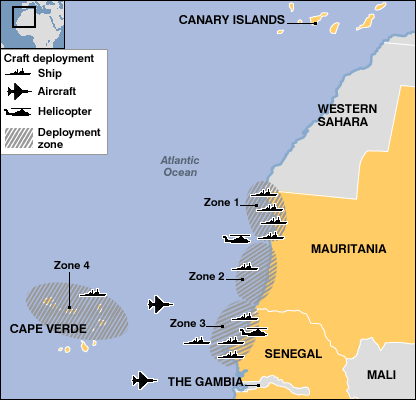
2006 BBC Map of Frontex Deployment

Frontex and Cape Verde signed a “Working Arrangement” on 14 January.  According to the Frontex press release, “the arrangement aims at promoting the development of broad cooperation on operational and technical border security/management matters between the Agency and the competent authorities of Cape Verde, with a view to working toward sustainable partnership. The intended cooperation in areas related to border security and management include exchange of best practices and strategic information, training, capacity-building and collaboration on relevant technologies as well as participation in joint operations. Information sharing regarding people-smuggling and trafficking in human beings is also foreseen as part of the arrangement.”

Frontex has coordinated operations with Cape Verde for many years pursuant to the provisions of bi-lateral agreements between Spain and Cape Verde.  In a September 2010 interview with EurAsylum, Frontex Director Laitinen said:  “In West Africa, Senegal, Mauritania and Cape Verde have all been integrated into Frontex operations for many years with good results, always demonstrating a willingness and capacity to work for the same aims and goals as their European colleagues. Although we do not have formal working arrangements in place yet with these countries, we are able to work together on the basis of their existing bi-lateral provisions with Spain. This cooperation has had measurable results in reducing people smuggling via the Canary Islands and in preventing the loss of human lives at sea.”

Click here for Frontex Press Release.

1 Comment

Filed under Eastern Atlantic, Frontex, News

PACE President Çavusoglu: ECtHR Decision “explodes myth that Europe is able to protect the rights of refugees”

PACE President Mevlüt Çavusoglu issued a statement regarding today’s Grand Chamber decision in the CASE OF M.S.S. v. BELGIUM AND GREECE (Application no. 30696/09) (also FR):

“‘The European Court of Human Rights today delivered a milestone judgment damning how Europe is protecting its refugees, asylum seekers and irregular migrants,’ today said Council of Europe Parliamentary Assembly (PACE) President Mevlüt Çavusoglu.

‘While the M.S.S. v. Belgium and Greece judgment is only against two member states, the implications of the judgment will be rippling through the capitals of Europe,’ he added. ‘The myth that European Union member states are safe places to return asylum seekers has been exploded by the European Court of Human Rights.’

The President stated that the Court had found massive deficiencies in detention conditions in Greece and in the procedures and remedies designed to safeguard the rights of asylum seekers, refugees and irregular migrants in Europe. He commented that Greece was not alone in failing on detention safeguards and that the Assembly had recently addressed recommendations to all member states on steps to improve detention facilities in Europe.

‘What is also clear from this judgment is that the so-called EU ‘Dublin system’ for determining the state responsible for deciding an asylum decision has to be changed as a matter of urgency. It is based on the false premise that EU member states are all safe and able to cope. They are not, and the ‘Dublin system’ creates enormous burdens on front-line states, such as Greece,’ the President declared.

He called on the EU to work with the Council of Europe, UNHCR and others, to solve the problem of returns under the “Dublin system” and reiterated a concern repeatedly highlighted by the Assembly that Europe needs to make its asylum systems fairer (see PACE Resolution 1695 (2009)) and needs clear rules on detention of irregular migrants and asylum seekers (see PACE Resolution 1707 (2010)).

‘Europe has European Prison Rules applying to criminals, but we still do not have similar rules for irregular migrants and asylum seekers who have committed no crime,’ he concluded.”

2 Comments

Filed under Belgium, Council of Europe, European Court of Human Rights, European Union, Greece, News, Statements

Decision from Grand Chamber of ECtHR: Returning Asylum Seekers to Greece Violates European Conv. on Human Rights

The Grand Chamber of the European Court of Human Rights issued a decision today in the CASE OF M.S.S. v. BELGIUM AND GREECE (Application no. 30696/09) (also FR) and concluded that Belgium should not have returned an Afghan asylum seeker to Greece under the Dublin II regulation which mandates that asylum claims are to be considered in the state where the asylum seeker first entered Europe.

This is the first decision from the ECtHR addressing the application of the Dublin II regulation.  According to European Voice, the “Court [currently] has around 960 cases pending that relate to the Dublin regulation, against the Netherlands, Finland, Belgium, the United Kingdom and France, most of them concerning expulsions to Greece.”

I have not had a chance to read the decision closely yet, but here is some basic information about today’s decision (more to follow in a subsequent post):

Excerpts from the Court’s Press Release (click here for FR):

“In today’s Grand Chamber judgment in the case M.S.S. v. Belgium and Greece (application no. 30696/09), which is final, the European Court of Human Rights held, by a majority, that there had been:

A violation of Article 3 (prohibition of inhuman or degrading treatment or punishment) of the European Convention on Human Rights by Greece both because of the applicant’s detention conditions and because of his living conditions in Greece;

A violation of Article 13 (right to an effective remedy) taken together with Article 3 by Greece because of the deficiencies in the asylum procedure followed in the applicant’s case;

A violation of Article 3 by Belgium both because of having exposed the applicant to risks linked to the deficiencies in the asylum procedure in Greece and because of having exposed him to detention and living conditions in Greece that were in breach of Article 3;

A violation of Article 13 taken together with Article 3 by Belgium because of the lack of an effective remedy against the applicant’s expulsion order.”

ECRE released a statement describing the decision as a “major blow to the Dublin system.”  Excerpts from the ECRE statement:

“Bjarte Vandvik, ECRE Secretary General, stated: ‘This judgment is a major blow to the Dublin system. The assumption that all EU Member States respect fundamental rights and that it is therefore safe to automatically transfer asylum seekers between EU countries no longer stands. Europe must seriously rethink the Dublin system and replace it with a regime that ensures the rights of asylum seekers are respected’.

This judgment will affect many asylum seekers in Europe. In 2010 alone, EU countries requested Greece to examine the applications of almost 7,000 asylum seekers who had entered the EU through Greece. Their situation will now need to be re-examined in light of this ruling.

Bjarte Vandvik [also] stated: ‘European countries must comply with the Court’s ruling, stop sending asylum seekers back to Greece, and examine asylum applications themselves until a fair asylum system is in place in Greece’.

The Dublin system fails refugees and Member States and needs to be changed.  This ruling reflects the serious shortcomings in the asylum procedure in Greece and in Belgium and it also highlights the flaws in the Dublin system itself. ECRE has long stressed that Dublin shifts responsibility for asylum seekers to states at Europe’s frontiers. Also, it allows refugees to be sent back to European countries where their fundamental rights are not respected.

As a first step in the right direction, ECRE supports the Commission proposal to review the Dublin Regulation, as it introduces significant humanitarian reforms and important procedural safeguards. For example, the proposal makes it easier for asylum seekers to join family members living in Europe, protects the rights of children who have arrived alone and ensures the continuity of care for vulnerable persons.

However, these are only temporary measures that do not solve the sometimes devastating impact of the Dublin system on asylum seeker’s human rights. Ultimately the Dublin Regulation should be abolished and replaced by a more humane and equitable system that considers the connections between individual asylum seekers and particular Member States.”

Click here for full ECRE Statement on the decision.

Click here (ECHR Blog) and here (Free Movement Blog) for some initial additional thoughts about the decision.

Click here, here, and here for articles.

3 Comments

Filed under Belgium, Commissioner for Human Rights, European Court of Human Rights, European Union, Frontex, Greece, Judicial, News

Greece May Use Dutch “Ships” to Detain Migrants

Following its announcement that it was considering building a wall along portions of its land border with Turkey, Greek officials announced earlier this month that they are considering the acquisition of two floating migrant detention centres from the Netherlands.  The two vessels would be leased and would have the capacity to hold approximately 1000 persons.  Greece reportedly was considering using passenger ships to detain migrants, but decided that floating detention centres used by Dutch authorities in Rotterdam are a better option.  The floating detention centres would be used in conjunction with prefabricated detention facilities that are being constructed on land to detain the large numbers of migrants being detained by Greek and Frontex authorities along the Greek-Turkish land border.

Click here and here for articles. (EL)  (Read with Google translate)

1 Comment

Filed under Aegean Sea, European Union, Frontex, Greece, Netherlands, News, Turkey

New Blog to Follow EASO

Earlier this month, Dr. Neil Falzon launched a new blog, the EASO Monitor, which will be focused on the European Asylum Support Office (EASO).   Falzon is based in Malta and lectures International Human Rights Law at the Faculty of Laws and EU Migration and Asylum Law at the European Documentation and Research Centre at the University of Malta. 

(I have been off line for more than a month and am just getting back to work now that a new semester has begun here in all too warm Los Angeles.  A belated Happy 2011 to all.  -nwf)

2 Comments

Filed under European Union, Malta, News