Monthly Archives: April 2015

UN Security Council President on Mediterranean Migrant Crisis: It’s Not About Protecting Europe; It’s About Protecting the Refugees.

After meetings on Tuesday this week between HRVP Federica Mogherini and the current UN Security Council President, Jordanian Ambassador Dina Kawar (Lithuania assumes the Presidency of the Security Council on 1 May), the AP reported that “diplomats are warning that United Nations backing for any European Union plan to address the growing Mediterranean migration crisis could take longer than anyone wants.”  Ambassador Kawar said “I don’t think we’re anywhere close to having [support] now” and that the effort is “not about protecting Europe. It’s about protecting the refugees.”

Excerpts from HRVP Mogherini’s press conference on 28 April at the Security Council:

“[***] My presence here was already planned today for addressing the [NPT review] conference, but I also took the chance of following up on the European Council we had last Thursday where the Heads of State and Government of the European Union discussed the tragedies that are happening in the Mediterranean, linked to the trafficking and smuggling of people across the Mediterranean, but also all the way through Africa and, in most cases, from places of the world like Syria or the Horn of Africa where their life is put at risk. So, I have had discussions about that today with the EU Permanent representatives of the countries that are sitting in the Security Council: Lithuania that is taking the Presidency of the Security Council from Friday, Spain, UK and France. I will meet also the Italian Permanent representative later on, the Russian Permanent representative and I will meet Samantha Power tomorrow in Washington as well as Secretary Kerry – not only on this but also on this. I will be visiting China next week where this issue will also be part of my talks. [***]

Q&A:
Question: [***] And on the question of an EU mandate for military operations off of Libya, do you have any sense of when that could be pushed through at the Security Council?

HRVP Federica Mogherini: [***] On the creation of an international framework, of a legal framework for fighting traffickers and smugglers, we also had a very useful conversation with Secretary General Ban Ki-Moon together with Prime Minister Renzi yesterday in Sicily. It is not for the European Union to set the UN Security Council time framework, the EU is not sitting in the Security Council, as you know very well. So it is not for me to comment on the next steps. What I can say is that we are working in Brussels and in strong coordination with the European Union members of the Security Council to make sure that our planning, our options that are being prepared in Brussels, go hand in hand with the discussions that can be made in the Security Council, and not only with the European Union members, also with others. I think I mentioned the fact that I just met the Jordanian permanent representative, not only as President of the Council but also as an Arab country that has a lot to say when it comes to the stability and the security of the region. And also the African Union. I spoke with the President of the African Union Mrs Zuma this morning to find ways of cooperating strongly in preventing the criminal organisations to act on the African territory and to address the root causes of the phenomena. Because we know very well that we cannot focus only on one of the links of the chain, meaning the last part of the trip. But we have to address root causes; we have to address the issue of poverty, of wars, of human rights, of unequal distribution and access to resources, being it financial or other kind of resources. And we need to do it in partnership with the countries that are involved in this. Because the human trafficking and smuggling is clearly a violation of Human rights but it is also clearly a threat and a challenge for the security and the stability of all countries involved, all the way. It is not only a European issue, it is not only a Libyan issue – even if we are looking at finding ways of cooperating with all Libyans to face this threat and to find ways of working together in preventing this spreading even more in the territory. But we need to work in cooperation with our partners around the region and around the world for sure. So not for me to set up a time frame for UN Security Council to work, but for sure to make sure that the European Union work on this is coordinated and is fully in respect of international law. On this, let me also say that I spoke with António Guterres on Sunday to start coordinating even more closely, because our main objective is to save lives. Saving lives also means take care of the people we save. And on this we look for a strong partnership with the UNHCR and it would be good to see the UNHCR operating in all places through which the smuggling and trafficking of people takes place.

Question: On this migrants’ smuggling question. Can you say how soon your enforcement operations will begin? Which countries will participate? And any details on how this enforcement effort will be underway?

HRVP Federica Mogherini: I was tasked last Thursday to start preparation for possible operations by the European Union, in full respect of international law, which means that we will need in any case to have a legal basis before we start operation on a European Union level. In the meantime, we are preparing options for a mission, for an operation. The process would be, first for me to present options to the Ministers, for them to take decisions; decisions in the EU are taken by unanimity, 28. And then it will be up to single Member States to decide whether and in which way they can participate to the operation. So we have different phases: preparation has already started on Thursday, on the very same day [than the European Council]. We are having the first discussion and thinking with the Member States in these very same hours. And we are working rapidly, but still, “rapidly” in the context of the European Union, definitely means not a couple of days. Also because in the meantime, as I said, we need to make sure that we have framework of international legality, in which we want to operate. There is nothing we are going to do that is outside of the framework and we work together with the UN and/or in partnership with the Libyan authorities. I will have a meeting shortly also with Bernardino Leon to see ways in which we can even more support his efforts to find an agreement in Libya because we know we have to partner with Libya, with all Libyans in this. And let me stress it very much because I know that the messages might have been perceived in a nuanced way. I want to make it very clear that there is nothing the European Union is preparing or thinking of that is intended to be against the Libyan people or the Libyan authorities in all their complexity. What we want to do is to work with Libyans on their own security, on their own possibility of freeing the country of criminal and also terrorist networks that are proliferating at this time. So it is a partnership we are looking for.

Question: Would you please tell us whether the EU supports a resolution from the Security Council and the creation of a maritime force that deals with the issue of trafficking people across the Mediterranean and with the flow of arms inside and outside Libya?

HRVP Federica Mogherini: The content of my talks here today has been on the first part of your question, absolutely yes. How we can stop the trafficking organisations: at sea, not only at sea, let me say, because if you take 5 minutes and look at the statement of the European Council there is this task for me, but there is also the task of working on other aspects of the prevention and the fight against trafficking organisations. Namely, the work will increase with Niger, with Mali, with the other neighbouring countries of Libya – Tunisia, Egypt, Algeria. Not to focus only on the last part of the trip but also on the rest of the security we need to build. So yes, this is definitely part of my mandate, this is definitely part of my talks that for the moment have been very constructive, I would say.
[***]”

1 Comment

Filed under European Union, Libya, Mediterranean, News, Statements, United Nations

Mogherini at UN Seeking “Framework of International Legality” for Military Strikes on Smuggling Boats; Security Council Expected to Consider Issue in Coming Weeks

Federica Mogherini, the EU High Representative for Foreign Affairs and Security Policy, is currently at the United Nations and seeking support for the authorisation of EU military strikes on smuggling boats in Libya: “[The EU] need[s] to make sure we have a framework of international legality in which we want to operate. There’s nothing we’re going to do that’s outside the framework of work together with U.N. and/or in partnership with the Libyan authorities” She said that the EU was working in “strong coordination” with the EU members of the U.N. Security Council on the issue. (See also tweet from EU UN Mission: “Human trafficking is threat for security & stability for all countries & EU will work with all partners.”)

Yesterday Mogherini sought to assure Libya that whatever the EU does, should not be perceived as an attack against the Libyan people: “I want to make it very clear there is nothing the European Union is preparing or thinking of that is to be intended against Libyan people or the Libyan authorities in all their complexity.”

Bernardino León, the head of the UN Support Mission in Libya (UNSMIL), will brief the UN Security Council today (Wednesday, 29 April) regarding the dialogue between different Libyan groups that is being facilitated by the UN.

While León’s briefing is not expected to address the issue of authorising EU military strikes, according to What’s In Blue-Security Council Report, “[t]he humanitarian situation in Libya is likely to be of interest to Council members. … In a 21 April press statement, Council members expressed grave concern at the recent proliferation of the smuggling of migrants off the coast of Libya. Even though this issue exceeds the scope of the conflict in Libya and is expected to be tackled separately by the Council in the coming weeks, Council members might be interested in asking León about reactions among Libyans of the potential responses to this phenomenon which are being discussed by the European Union and others….”

2 Comments

Filed under European Union, Libya, Mediterranean, News

Frontex Releases Annual Risk Analysis 2015 Report

Frontex Press Statement regarding Annual Risk Analysis 2015 (also here):

“2015-04-28
Last year, the European Union detected the biggest number of illegal border crossings since Frontex data-collection started eight years ago. The record number of 280 000 detections was mainly fuelled by the ongoing fighting in Syria, which has caused the worst refugee crisis since the Second World War. Syrians fleeing their country were the largest group of irregular migrants seeking to enter the EU.

Most of the detections were reported as part of search and rescue operations in the Central Mediterranean area. Although border control authorities continued to save the lives of thousands of people, smugglers increasingly used unsafe boats, putting migrants in greater danger.

The unprecedented number of migrants also encouraged facilitators to use cargo ships to smuggle them at a large scale. Starting in September, such vessels took migrants directly from the Turkish coast near Mersin to Italy. This is a multi-million-euro business for organised crime groups, which is likely to be replicated in other departure countries.

Another trend explained by the Frontex risk analysis experts has been the increasing number of deliberate attempts to involve merchant ships in rescuing migrants. This has prompted the International Maritime Organization (IMO) to voice the concerns of the shipping industry over its involvement in rescuing migrants.

The profile of detected irregular migrants remained relatively unchanged compared to 2013. They are mostly adult males, although the proportion of women (11%) and children (15%) reflects the fact that many migrants intend to claim asylum.

More than 60% (170 000) of all illegal border crossings were detected in the Central Mediterranean. On the second most frequented route in the Eastern Mediterranean covering borders of Greece, Bulgaria and Cyprus, there were more than 50 000 detections. Near the end of 2014, detections increased sharply at the Hungarian land border with Serbia, making the Western Balkan route the third most important irregular migration route with more than 43 000 detections.

Detections of migrants hidden in vehicles seeking to enter the EU via regular border crossings surged to over 3 000, five times the number from the previous year. This jump was due to a tenfold increase in detections reported from the Bulgarian border crossings along the land border with Turkey.

In 2014, there were some 9 400 incidents of document fraud on entry to the EU/ Schengen area from third countries, which represented a slight decrease compared to the previous year. By contrast, cases reported on intra-EU Schengen movements showed a 27 percent increase to almost 10 000. This marked the first year where there were more fraudulent documents detected on intra-EU/Schengen movements than during border checks of passengers arriving from third countries. This was partly due to the large number of migrants undertaking secondary movements within the EU, often with fraudulent documents obtained in the country of their entry into the EU.”

1 Comment

Filed under Frontex, Mediterranean, Reports

Migration Policy Centre – Policy Brief: “Drowned Europe”

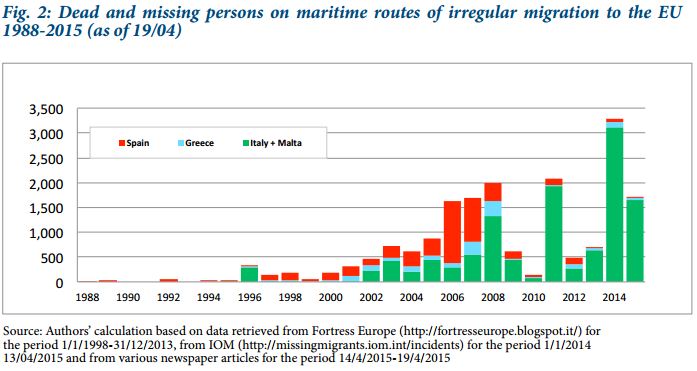
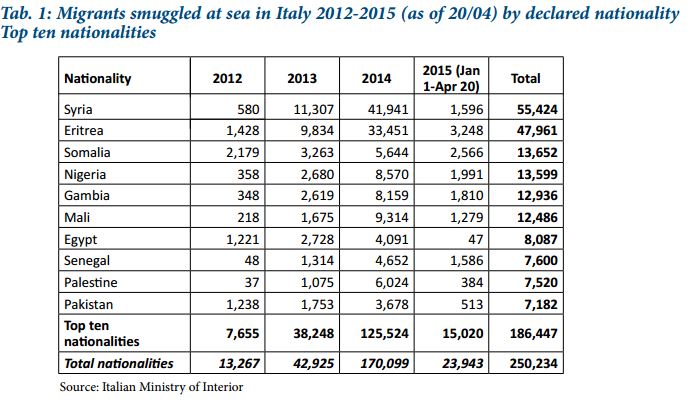
Drowned Europe“, policy brief by Philippe FARGUES and Anna DI BARTOLOMEO, Migration Policy Centre at the European University Institute, Florence.

ABSTRACT:
The drowning of 800 migrants, 19 April 2015, after the capsizing of a smuggling boat, triggered responses from across Europe. But when EU leaders met four days later, the news-cycle had moved on and the European Council, 23 April, gave a disappointing response. The 28 agreed to scale up their joint search-and-rescue efforts at sea to the more substantial efforts of what Italy has achieved alone in the last year. There were, also, a handful of other minor actions. Mr Junker, President of the Commission, lamented that the EU should be more ambitious. He was right, in as much as the EU meeting will not sustainably curb the deadly trends we have seen in the Mediterranean in recent years.

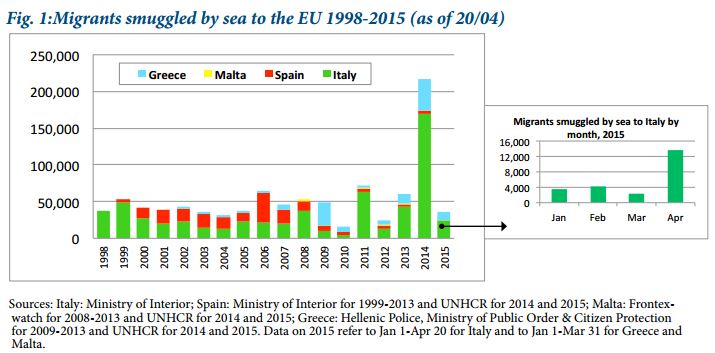
2015-April_MPI Policy Brief_Drowned Europe_Fig 12015-April_MPI Policy Brief_Drowned Europe_Fig 22015-April_MPI Policy Brief_Drowned Europe_Tab 1

2 Comments

Filed under Analysis, European Union, Frontex, Italy, Libya, Mediterranean

UNHCR Assisting 1200+ Migrants in Libya Intercepted by Libyan Coast Guard Over Past 10 Days

Full Text of UNHCR Press Statement, 28 April 2015:

“In Libya, UNHCR and its partners have been assisting some of the 1,242 people rescued at sea from unseaworthy boats or intercepted by the Libyan Coast Guard in waters near Tripoli over the past 10 days, who have mostly been sent to immigration detention centres.

This includes a group of more than 200 people from the Horn of Africa intercepted at Tajura (16 km east of Tripoli) four of whom had serious burn injuries from a gas explosion two weeks ago at an unknown location where they were held by smugglers before boarding a boat bound for Europe. The group was taken to an immigration detention centre in Tripoli where medical staff from UNHCR’s partner on the ground treated burns and arranged the transfer to hospital of four seriously injured people. This included a 20-year-old mother with extensive burns to her arms and legs and her two-year-old son with extensive burns to his face.

UNHCR is aware of at least 2,663 migrants or asylum-seekers (including women and children) spread across eight immigration detention facilities across Libya run by the Department for Combatting Illegal Migration (DCIM) – a significant increase from the 1,455 people in detention a month ago. The main nationalities in the centres are Somalis, Eritreans, Ethiopians and Sudanese as well as people from various West African countries. UNHCR understands that 15 immigration centres are now operational across the country. Foreigners in Libya can be arrested for lack of lawful immigration status and can spend anything from one week to 12 months in detention. UNHCR can generally organize the release of refugees and asylum-seekers registered with our office within a few days, although our capacity to register new arrivals to Libya is limited in the current security environment. We also advocate for the release of very vulnerable people, like pregnant women and also for alternatives to detention, if possible.

Our local staff and partners who visit immigration detention centres say conditions are poor, with urgent needs for more medical help, improved ventilation and sanitation as well as relief items. With the rate of detention on the rise, overcrowding compounds already tough conditions. In some centres, more than 50 people are crowded into rooms designed for 25. Temperatures are on the rise, as are the mosquitos which combined with poor ventilation could spread disease. At the request of local authorities, UNHCR is helping to ease the dire conditions. We are giving out soap, underwear, clothes and other items to detainees in the eight centres we can currently access.

There are some 36,000 refugees and asylum-seekers registered with UNHCR in Libya (though some of these may have moved on), who are affected by the growing violence and lawlessness in the country. Among these, the largest group (18,000) are Syrians while Palestinians, Eritreans, Iraqis, Somalis, Sudanese make up significant groups.

Despite the volatile situation in Libya, UNHCR continues to help refugees and asylum-seekers through our national staff and NGO partners. We run two community development centres in Tripoli and Benghazi and have also expanded outreach this year through a mobile medical and social team in Tripoli. We also run dedicated hotlines to help people get registered, receive cash assistance, renew documents, or who are in detention. We are setting up another hotline with the Libyan Coast Guard to receive search and rescue updates.

Meanwhile, UNHCR continues to deliver aid like mattresses, blankets, clothing and kitchen utensils to thousands of internally displaced Libyans, and is supporting municipal authorities to track displacement and assess needs. Some 400,000 Libyans have been displaced by various waves of violence, according to UN figures.

For more information on this topic, please contact:
• In Tunis (covering Libya), Marwa Baitelmal on +216 228 344 31
• In Geneva, Ariane Rummery on +41 79 200 76 17”

1 Comment

Filed under Libya, Mediterranean, News, UNHCR

If the EU Attacks Migrant Boats in Zuwara, Libya, How Will It Select from Among the 100s of Boats?

Italy and other EU States are clearly in possession of information regarding the specific locations in Libya from where migrant boats depart. The Guardian’ s Patrick Kingsley has been reporting from Libya in recent days, interviewing smugglers and observing a migrant boat depart on at least one recent occasion from the port of Zuwara located west of Tripoli.

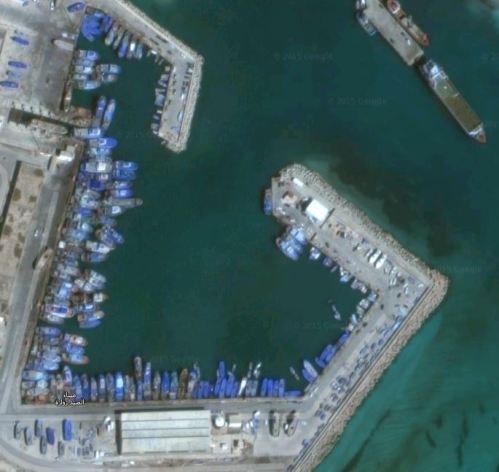
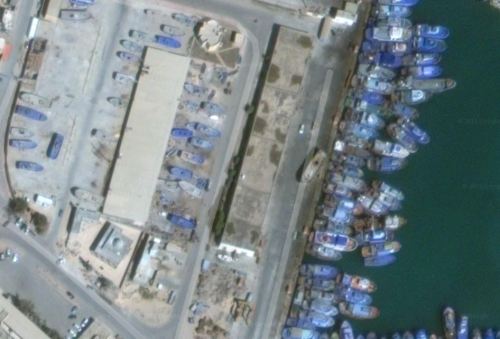
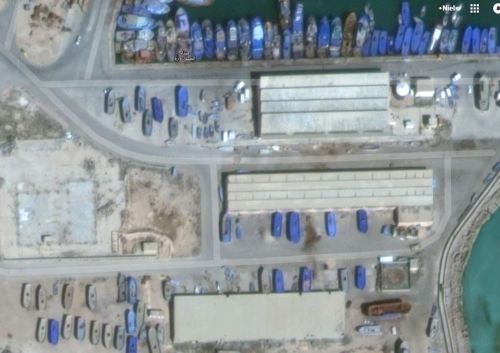
If the EU does press forward with its stated intention of destroying boats that may be used by smugglers, how will the EU select the boat or boats to be destroyed? Google Earth imagery dating from early this year shows approximately 125 large fishing boats moored in the harbour and another 100 boats on land immediately adjacent to the harbour. Dozens of smaller boats are also in the water and on land. (See screen shots below.) Additionally, the harbour is surrounded by at least five large warehouses, each approximately 100 metres in length. The Google Earth imagery suggests that additional boats may be located within some of the warehouses.

There is no effective and safe (or legal) means by which a particular smuggling boat can be identified and destroyed without destroying multiple other boats. As the Guardian’s Kingsley wrote, “smugglers do not maintain a separate, independent harbour of clearly marked vessels, ready to be targeted by EU air strikes. They buy them off fishermen at a few days’ notice. To destroy their potential pool of boats, the EU would need to raze whole fishing ports.”

UN Secretary General Ban Ki Moon on Sunday criticised the EU plan to use military force, telling La Stampa (as reported by Reuters), “[t]here is no military solution to the human tragedy playing out in the Mediterranean. It is crucial that we take a holistic approach that looks at the root causes, at security and the human rights of migrants and refugees, and have legal and regulated immigration networks.”

See previous posts on this topic: The EU’s Proposed Plan to Destroy Migrant Boats in Libya Must be Rejected by the European Council and UK and France to Seek UN Security Council Authorisation for Military Action Against Smuggler Boats.

Zuwara Harbour 2015 Via Google Earth

Zuwara Harbour.

Zuwara Harbour West Side Warehouses via Google Earth

Storage area and warehouses on west side of Zuwara Harbour.

Zuwara Harbour South Warehouses South 2015 via Google Earth

Storage area and warehouses on south side of Zuwara Harbour.

1 Comment

Filed under European Union, Libya, Mediterranean, News

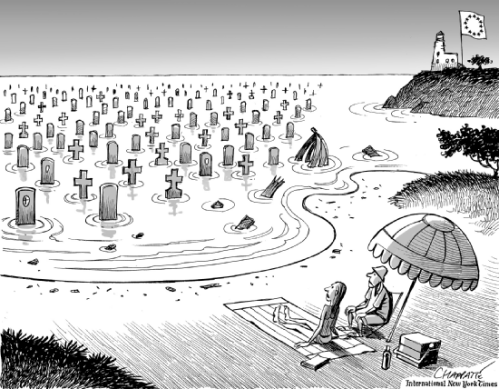
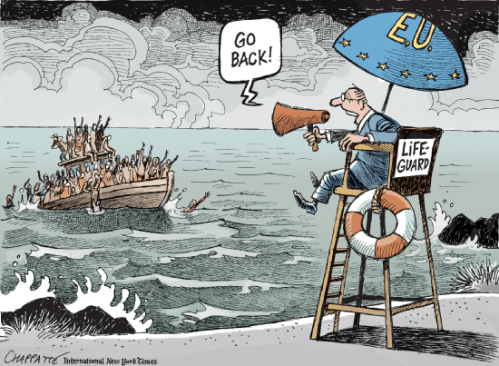
Chappatte on the situation in the Mediterranean

© Chappatte – http://www.globecartoon.com – Used by Migrants At Sea with permission.

© Chappatte – http://www.globecartoon.com – Used by Migrants At Sea with permission.

© Chappatte – http://www.globecartoon.com – Used by Migrants At Sea with permission.

© Chappatte – http://www.globecartoon.com – Used by Migrants At Sea with permission.

2 Comments

Filed under Cartoon, European Union, Frontex, Mediterranean

UK and France to Seek UN Security Council Authorisation for Military Action Against Smuggler Boats

From Malta Today: “The United Kingdom and France, members of the United Nations Security Council, will kick off discussions in an attempt to obtain a UN resolution mandating the destruction of boats used by smugglers.”

From AFP: “Italian Prime Minister Matteo Renzi added that leaders from France and Britain, both permanent members of the UN Security Council, had ‘committed to get a resolution from the United Nations for an intervention in Libya.’”

Earlier today the Security Council released a short Presidential Statement regarding the “The Impact of the Humanitarian Crisis in Syria on the Neighbouring Countries.” Here are some excerpts from the PRST with bearing on the migrant and refugee flows in the region:

“[***] The Security Council expresses grave alarm at the significant and rapid deterioration of the humanitarian situation in Syria, including at the fact that over 220,000 people have been killed, including well over 10,000 children since the beginning of the conflict ; around half of the population has been forced to flee their homes, including over 3.9 million who have sought refuge in neighbouring countries, among which are nearly 2.1 million children ; and that more than 12.2 million people in Syria require urgent humanitarian assistance including 440,000 civilians in besieged areas.[***]

The Security Council is alarmed that the Syrian crisis has become the largest humanitarian emergency crisis in the world today, threatening peace and security in the region with diverse implications on the neighbouring countries and the displacement of millions of Syrians into those countries, and calls to address further spill-over of the conflict in Syria into the neighbouring countries. [***]

The Security Council underlines the risk of further regional destabilization if the conflict, refugee crisis and the needs of the host countries are not adequately addressed. The Security Council stresses the importance of funding the humanitarian and development responses to the refugee crisis, providing support for national response plans, addressing the humanitarian needs of refugees, in particular women and children, both in camps and urban areas and through capacity building and technical support, strengthening the resilience of host countries and communities as components of stabilizing the region, preventing radicalization and countering the threat of terrorism and foreign terrorist fighters.

The Security Council notes with concern that the international response to the Syrian and regional crisis continues to fall short of meeting the needs as assessed by host governments and the United Nations, and urges all Member States, based on burden-sharing principles, to support the United Nations and the countries of the region, including by adopting medium and long-term responses to alleviate the impact on communities, providing increased, flexible and multi-year predictable funding as well as increasing resettlement efforts, and taking note in this regard of the Berlin Communiqué of 28 October 2014. [***]”

See also “Security Council Press Statement on Recent Maritime Tragedy in Mediterranean Sea” of 21 April 2015 – Full Text:

“The members of the Security Council deplored the recent maritime tragedy in the Mediterranean Sea that resulted in hundreds of casualties, and extended their deepest condolences to all those affected and to their families.

The members of the Security Council expressed their grave concern at the recent proliferation of, and endangerment of lives by, the smuggling of migrants in the Mediterranean Sea, off the coast of Libya.

The members of the Security Council expressed their concern at the implications for regional stability posed by transnational organized crime and illicit activities such as the smuggling of migrants, condemned and deplored the said acts and underlined the need to bring the perpetrators of these acts to justice.

The members of the Security Council called for the full implementation by State Parties of the Protocol against the Smuggling of Migrants by Land, Sea and Air, supplementing the United Nations Convention against Transnational Organized Crime.

The members of the Security Council expressed their strong support to countries in the region affected by the smuggling of migrants and emphasized the need to step up coordination of international efforts in order to strengthen a global response to this common challenge, and in order to protect these vulnerable migrants from being victimized by human traffickers.

The members of the Security Council urged all Member States, including countries of origin and transit, to cooperate with each other and with relevant international and regional organizations, including the IOM [International Organization for Migration], in addressing illicit migration flows, and dismantling smuggling networks in the region.

In that regard, the members of the Security Council urged all States to comply with their applicable obligations under international law, including international human rights law, international humanitarian law, and refugee law.”

3 Comments

Filed under European Union, Libya, Mediterranean, Migrants

Official Statement: Special meeting of the European Council, 23 April 2015

Full text:

“1. The situation in the Mediterranean is a tragedy. The European Union will mobilise all efforts at its disposal to prevent further loss of life at sea and to tackle the root causes of the human emergency that we face, in cooperation with the countries of origin and transit. Our immediate priority is to prevent more people from dying at sea.

2. We have therefore decided to strengthen our presence at sea, to fight the traffickers, to prevent illegal migration flows and to reinforce internal solidarity and responsibility. Given that instability in Libya creates an ideal environment for the criminal activities of traffickers, we will actively support all UN-led efforts towards re-establishing government authority in Libya. We will also step up efforts to address conflict and instability as key push factors of migration, including in Syria.

3. We today commit to:

Strengthening our presence at sea

a) rapidly reinforce EU Operations Triton and Poseidon by at least tripling the financial resources for this purpose in 2015 and 2016 and reinforcing the number of assets, thus allowing to increase the search and rescue possibilities within the mandate of FRONTEX. We welcome the commitments already made by Member States which will allow to reach this objective in the coming weeks;

Fighting traffickers in accordance with international law

b) disrupt trafficking networks, bring the perpetrators to justice and seize their assets, through swift action by Member State authorities in co-operation with EUROPOL, FRONTEX, the European Asylum Support Office (EASO) and EUROJUST, as well as through increased intelligence and police-cooperation with third countries;

c) undertake systematic efforts to identify, capture and destroy vessels before they are used by traffickers;

d) at the same time, the High Representative is invited to immediately begin preparations for a possible CSDP operation to this effect;

e) use EUROPOL to detect and request removal of internet content used by traffickers to attract migrants and refugees, in accordance with national constitutions;

Preventing illegal migration flows

f) increase support to Tunisia, Egypt, Sudan, Mali and Niger among others, to monitor and control the land borders and routes, building on current CSDP operations in the region, as well as on regional cooperation frameworks (Rabat and Khartoum processes); step up dialogue with the African Union at all levels on all these issues;

g) reinforce our political cooperation with African partners at all levels in order to tackle the cause of illegal migration and combat the smuggling and trafficking of human beings. The EU will raise these issues with the African Union and the key countries concerned, with whom it will propose the holding of a summit in Malta in the coming months;

h) step up cooperation with Turkey in view of the situation in Syria and Iraq;

i) deploy European migration liaison officers in key countries to gather information on migratory flows, co-ordinate with national liaison officers, and co-operate directly with the local authorities;

j) work with regional partners in building capacity for maritime border management and search and rescue operations;

k) launch Regional Development and Protection programmes for North Africa and the Horn of Africa;

l) invite the Commission and the High Representative to mobilise all tools, including through development cooperation and the implementation of EU and national readmission agreements with third countries, to promote readmission of unauthorised economic migrants to countries of origin and transit, working closely with the International Organisation for Migration;

m) while respecting the right to seek asylum, set up a new return programme for the rapid return of illegal migrants from frontline Member States, coordinated by FRONTEX;

Reinforcing internal solidarity and responsibility

n) rapid and full transposition and effective implementation of the Common European Asylum System by all participating Member States, thereby ensuring common European standards under existing legislation;

o) increase emergency aid to frontline Member States and consider options for organising emergency relocation between all Member States on a voluntary basis;

p) deploy EASO teams in frontline Member States for joint processing of asylum applications, including registration and finger-printing;

q) set up a first voluntary pilot project on resettlement across the EU, offering places to persons qualifying for protection.

4. The EU institutions and the Member States will work immediately on the full implementation of these orientations. The Presidency and the Commission will present next week a roadmap setting out work up to June.

5. The European Council looks forward to the Commission Communication on a European Agenda for Migration, in order to develop a more systemic and geographically comprehensive approach to migration. The European Council will remain seized of the situation and will closely monitor the implementation of these orientations. The Council and the Commission will report to the European Council in June.”

1 Comment

Filed under European Union, Frontex, Mediterranean, Statements

Libya Group With Control Over Tripoli and Libya’s Western Coast Says It Will “Confront” Unilateral EU Attacks on People Smuggler Sites

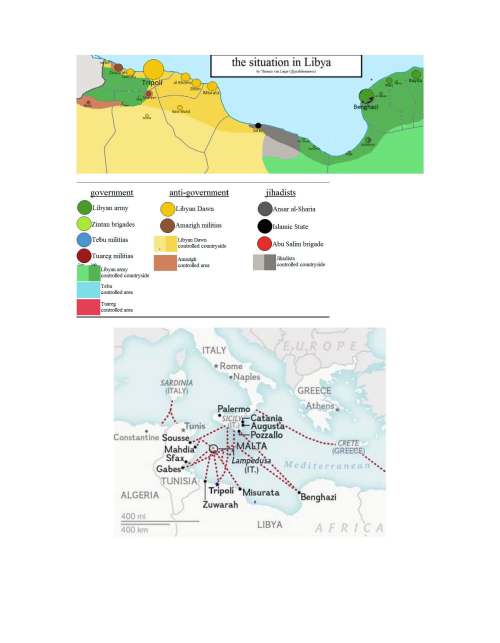
Libya Dawn, “[t]he group controlling Libya’s coastal capital Tripoli [and the Mediterranean coastal areas to the east and west of Tripoli] says it will ‘confront’ any unilateral European Union moves to attack sites used by people smugglers, urging the [EU] to consult it over plans to deal with the migration crisis.” (Click here for Guardian article-reporting based on Times of Malta interview with the group’s foreign minister.)

The political and security situation in Libya is complicated. And while migrant boats tend to depart from areas around Tripoli because the area is closer to Lampedusa and Malta, boats leave from eastern areas of Libya as well. If the EU does end up taking military action in Libya, it will necessarily engage with different militias and political groups.

Libya Situation Map mid-April 2015 – Map by @arabthomness.

2015-April Libya Situation Map

Leave a comment

Filed under European Union, Italy, Libya, Malta, Maps, Mediterranean, News

Post Meeting Remarks from Council President Tusk: EU to destroy smugglers’ boats in line with int’l law; triple resources for Frontex Operation Triton; seek better co-operation with countries of origin and transit; coordinate resettlement of more refugees

Remarks by President Donald Tusk following the special European Council meeting on migratory pressures in the Mediterranean – 23/04/2015, 22:00

Full Text:

“Good evening. Today, we discussed the dramatic situation in the Mediterranean at the highest political level. Saving the lives of innocent people is the number one priority. But saving lives is not just about rescuing people at sea. It is also about stopping the smugglers and addressing irregular migration.

Let me be clear. Europe did not cause this tragedy. But that does not mean we can be indifferent. We are facing a difficult summer and we need to be ready to act.

Therefore, leaders have agreed four priority areas for action.
First, leaders have asked the High Representative to propose actions in order to capture and destroy the smugglers’ vessels before they can be used. Naturally, this will be in line with international law and respect for human rights. We will step up co-operation against smuggling networks by working through Europol, and by deploying immigration officers to third countries.

Second, we have agreed to triple the resources available to Triton, our border mission in the Central Mediterranean, and to enhance its operational capability. The mission will continue to carry out its mandate and respond to distress calls where necessary. I am happy to announce that leaders have already pledged significantly greater support, including many more vessels, aircraft and experts, and money.

Third, we need to limit irregular migration flows and to discourage people from putting their lives at risk. This means better co-operation with the countries of origin and transit, especially the countries around Libya.

Finally, we will do more on refugee protection. The European Union will help front-line Member States under pressure and co-ordinate the resettlement of more people to Europe on a voluntary basis, and with an option for emergency relocation. For those who do not qualify as refugees, we will operate an effective returns policy.
Leaders had no illusions that we would solve this international human emergency today. Therefore, we have tasked the Commission, the Council and the High Representative to step up their work based on what we have now agreed. This issue remains our priority and the European Council will come back to it in June.

As a final remark, let me repeat that the European Union is completely opposed to the death penalty. It cannot be the answer to drug trafficking. I am referring here to Mr Atlaoui, the French citizen who has been condemned by the Indonesian authorities. Thank you.”

3 Comments

Filed under European Union, Frontex, Mediterranean, Statements

Frontex Prepared to Immediately Expand Air Surveillance

Frontex Press Statement:

“Frontex is looking forward to implement the conclusions of the European Council to be held this afternoon in Brussels and has already started preparing the implementation of the Home Affairs/Foreign Affairs Council held in Luxemburg on Monday, 20 April, Frontex Executive Director Fabrice Leggeri said.

‘My proposal is to increase as an immediate step air surveillance in the Mediterranean Sea south of Italy and Malta in addition to the vessels currently deployed, which is aimed at enhancing search and rescue capacities in the area,’ Leggeri said.

Leggeri has suggested increasing the aerial assets taking part in the Frontex-coordinated Triton operation also following two incidents when people smugglers have used weapons to reclaim boats following search and rescue operations in which vessels taking part in Triton were involved.

‘Assets co-funded by the agency have helped save thousands of lives in the Mediterranean. Frontex will continue within its mandate to do everything it can to fulfil this responsibility,’ Leggeri said.”

1 Comment

Filed under General

US Accidentally Kills Italian and American Hostages in Carefully Targeted Surgical Drone Strike; EU Poised to Approve “Surgical” Military Strikes in Libya to Save Migrants

President Obama admitted today that the US had accidentally killed two Al Qaeda hostages, an Italian and an American, in a drone strike earlier this year. Obama said that before the military strike was authorised the US had conducted “hundreds of hours of surveillance on an al-Qaeda compound that led officials to believe there were no civilians present.”Giovanni Lo Porto and Warren Weinstein were killed in January. The information was only made public today.

The European Council’s pending approval of “surgical” and carefully planned strikes in Libya on boats that could be used by people smugglers, if approved and carried out, will in all likelihood result in the killing of innocent persons as today’s admission by Obama demonstrates.

2 Comments

Filed under General

Text of Draft European Council Statement (via Statewatch)

From Statewatch, here is the text of the Draft European Council Statement that will be considered today:

DRAFT EUROPEAN COUNCIL STATEMENT

1. The situation in the Mediterranean is a tragedy. The European Union will mobilise all efforts at its disposal to prevent further loss of life at sea and to tackle the root causes of the human emergency that we face, in cooperation with the countries of origin and transit. Our immediate priority is to prevent more people from dying at sea.

2. We have therefore decided to strengthen our presence at sea, to fight the traffickers, to prevent illegal migration flows and to reinforce internal solidarity. Given that instability in Libya creates an ideal environment for the criminal activities of traffickers, we will actively support all UN-led efforts towards re-establishing government authority in Libya. We will also step up efforts to address conflict and instability as key push factors of migration, including in Syria.

3. We today commit to:

Strengthening our presence at sea

a)rapidly reinforce EU Operations Triton and Poseidon by at least doubling the financial resources for this purpose in 2015 and 2016 and reinforcing the number of assets, thus allowing to increase the search and rescue possibilities within the mandate of FRONTEX; [p.m.: welcome pledges]

Fighting traffickers

b) disrupt trafficking networks, bring the perpetrators to justice and seize their assets, through swift action by Member State authorities in co-operation with EUROPOL, FRONTEX, the European Asylum Support Office (EASO) and EUROJUST, as well as through increased intelligence and police-cooperation with third countries;

c) undertake systematic efforts to identify, capture and destroy vessels before they are used by traffickers. The High Representative is invited to immediately begin preparations for a possible CSDP operation to this effect, in accordance with international law;

d) use EUROPOL to detect and request removal of internet content used by traffickers to attract migrants and refugees, in accordance with national constitutions;

Preventing illegal migration flows

e) increase support to Tunisia, Egypt, Sudan, Mali and Niger among others, to monitor and control the land borders and routes in order to prevent potential migrants from gaining access to Mediterranean shores, building on current CSDP operations in the region, as well as on regional cooperation frameworks (Rabat and Khartoum processes); step up dialogue with the African Union at all levels on all these issues;

f) deploy European migration liaison officers in key countries to gather information on migratory flows, co-ordinate with national liaison officers, and co-operate directly with the local authorities;

g) work with regional partners in building capacity for maritime border management and search and rescue operations;

h) launch Regional Development and Protection programmes for North Africa and the Horn of Africa;

i) invite the Commission and the High Representative to mobilise all tools, including through development cooperation, to promote readmission of unauthorised economic migrants to countries of origin, working closely with the International Organisation for Migration;

j) set up a new return programme for the rapid return of irregular migrants from frontline Member States, coordinated by FRONTEX;

Reinforcing internal solidarity

k) set up a first voluntary pilot project on resettlement, offering at least 5,000 places to persons qualifying for protection;

l) increase emergency aid to frontline Member States and consider options for organising emergency relocation between Member States;

m) deploy EASO teams in frontline Member States for joint processing of asylum applications, including registration and finger-printing.

4.The EU institutions and the Member States will work immediately on the full implementation of these orientations. The European Council looks forward to the Commission Communication on a European Agenda for Migration, in order to develop a more systemic and geographically comprehensive EU approach to migration. The European Council will remain seized of the situation and will closely monitor the implementation of these orientations. The Council and the Commission will report to the European Council in June.

3 Comments

Filed under European Union, Frontex, Mediterranean, News

Recent UN Security Council Statements on Libya and Migrants

The special meeting of the European Council will occur later today. Based on various press reports, it seems that the EU will decide to pursue several courses of actions in response to the situation in the Mediterranean, including taking steps – presumably by military force – to identify, capture and destroy migrant boats in Libya before the boats are used by smugglers. HR Federica Mogherini will reportedly be instructed to seek authorisation for the military strikes from the UN. (Click here (IT) and here (EN) for articles)  (Here is the Draft European Council Statement via Statewatch.)

The most recent UN Security Council resolution on Libya (Resolution 2213) was adopted on 27 March 2015; the Resolution extended the mandate of the United Nations Support Mission in Libya (UNSMIL) until 15 September 2015. The Resolution also took note of, among other matters, the dire situation faced by migrants in Libya and called on the Libyan government to promote and protect “the human rights of all persons in Libya, particularly those of African migrants and other foreign nationals.”

On 21 April, after the most recent migrant boat accident, the Security Council released a Press Statement regarding the boat accident and “expressed their concern at the implications for regional stability posed by transnational organized crime and illicit activities such as the smuggling of migrants…”

The press statement is not a formal statement from the Security Council, but may provide some limited insight into how members of the Security Council view the relationship between the flow of migrant boats and a possible threat to international peace and security and how the Security Council might respond to the EU request.

Full Text of the 21 April 2015 Press Statement:

“Security Council Press Statement on Recent Maritime Tragedy in Mediterranean Sea

The following Security Council press statement was issued today by Council President Dina Kawar (Jordan):

The members of the Security Council deplored the recent maritime tragedy in the Mediterranean Sea that resulted in hundreds of casualties, and extended their deepest condolences to all those affected and to their families.

The members of the Security Council expressed their grave concern at the recent proliferation of, and endangerment of lives by, the smuggling of migrants in the Mediterranean Sea, off the coast of Libya.

The members of the Security Council expressed their concern at the implications for regional stability posed by transnational organized crime and illicit activities such as the smuggling of migrants, condemned and deplored the said acts and underlined the need to bring the perpetrators of these acts to justice.

The members of the Security Council called for the full implementation by State Parties of the Protocol against the Smuggling of Migrants by Land, Sea and Air, supplementing the United Nations Convention against Transnational Organized Crime.

The members of the Security Council expressed their strong support to countries in the region affected by the smuggling of migrants and emphasized the need to step up coordination of international efforts in order to strengthen a global response to this common challenge, and in order to protect these vulnerable migrants from being victimized by human traffickers.

The members of the Security Council urged all Member States, including countries of origin and transit, to cooperate with each other and with relevant international and regional organizations, including the IOM [International Organization for Migration], in addressing illicit migration flows, and dismantling smuggling networks in the region.

In that regard, the members of the Security Council urged all States to comply with their applicable obligations under international law, including international human rights law, international humanitarian law, and refugee law.

For information media. Not an official record.”

Leave a comment

Filed under Mediterranean