Author Archives: Niels Frenzen

Niels Frenzen's avatar

About Niels Frenzen

Clinical Professor of Law, Gould School of Law, University of Southern California, Los Angeles, USA. Contact: frenzen@usc.edu; @migrantsatsea

Italy’s “Africa Campaign”: Stop Migrants in Countries of Origin

Italian Interior Minister Roberto Maroni has completed a visit to Ghana and is now in Niger.  A trip to Senegal will occur soon.  In Ghana he signed an agreement to increase cooperation on combating illegal immigration, human trafficking, and other forms of organized crime.

Maroni is quoted as saying ”We have excellent bilateral agreements with the African countries of the Mediterranean region, from Morocco to Egypt. However, these are often transit countries for illegal immigrants who in reality originate in sub-Saharan African states. This is why now, while awaiting action from Europe, we want to extend security measures to that area not only regarding immigration, but also regarding the issues of drug trafficking and terrorism.”

ANSAmed reported that Maroni said Italy’s agreement with Libya has reduced the numbers of illegal migrants arriving in Italy and that “[n]ow the focus is to completely eliminate their arrival by blocking the departure of these ‘journeys of hope’.”

Click here and here for articles.

Leave a comment

Filed under Ghana, Italy, Libya, Mediterranean, News, Niger, Senegal

Haitians Prepare for Boat Journey to US

The Los Angeles Times reports on the construction of a boat in Cap Haitien, Haiti and preparations being made by some earthquake survivors to flee the country for the US.

“When builders finish the boat in a few days, it will set sail with … at least 40 others for the United States. If they survive the 600-mile crossing, and aren’t intercepted by the U.S. Coast Guard, they’ll soon be walking the streets of opportunity.  …  The boat is being built on a narrow, secluded waterway that feeds into the bay, out of sight of Haitian coast guard patrols and U.S. ships that [the ship’s builder] said he’s spotted on the shimmering blue sea just outside the bay.”

Click here for article and here for photos and audio.

Click here for Christian Science Monitor article regarding recent US preparations for possible surge of Haitian boat people.

Leave a comment

Filed under Caribbean - West Indies, Haiti, News, Turks and Caicos, United States

First “Frontex Operational Office” to be Based in Greece

The Frontex Management Board has taken the decision to establish Frontex’s first Operational Office (“FOO”) in Piraeus, Greece.  According to the Frontex press release, the purpose of the office is to provide regionally-based support for Frontex coordinated activities such as joint operations and enhanced situational awareness.  If this pilot project is successful, it is expected that future FOOs would be established elsewhere such as the Western Mediterranean, the Western Balkans and Black Sea, and Eastern land borders.

According to the Frontex press release, Frontex Executive Director Laitinen said the establishment of this FOO “supports the possible enhancement of [the] Frontex mandate highlighted in the Stockholm Programme … I can even say this decision anticipates potential enlargement of the EU and Schengen zone. It gives Frontex a possibility to offer more support for the operational involvement of third countries, something that is essential for effective border management.”

Click here for Frontex statement.

Click here for the Final Report on the “Study on the feasibility of establishing specialised branches of Frontex.”  The specific functions of the new FOO are based in part on this feasibility study which was prepared in 2009.

Leave a comment

Filed under Aegean Sea, Frontex, Greece, Mediterranean, News, Turkey

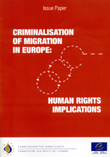
Hammarberg: Criminalising migration is the wrong answer to a complex social phenomenon

“‘Criminalising the irregular entry and presence of migrants in Europe corrodes established international law principles and causes many human tragedies without achieving its purpose of genuine control’ said Thomas Hammarberg, the Council of Europe Commissioner for Human Rights, presenting today in Brussels an Issue Paper on this topic.

‘I have observed with increasing concern this trend as part of a policy of migration management’ he said. ‘States have a legitimate interest to control their borders, but criminalisation is a disproportionate measure which causes further stigmatisation and marginalisation of migrants. Immigration offences should remain administrative in nature.’

This Issue Paper builds upon these concerns and examines systematically the human rights implications of the criminalisation of migration in Europe. It analyses the external border crossing, migrants’ residence and protection of their social rights including employment, as well as asylum and detention.

It concludes with a number of recommendations to Council of Europe member states, as a starting point to ensure the correct intersection of human rights standards and the treatment of foreign nationals.

Issue Papers are commissioned and published by the Commissioner for Human Rights for the purpose of contributing to debate or further reflection on a current and important human rights matter. The full text is available on the Commissioner’s web-site.”

Click here for Issue Paper.

Leave a comment

Filed under Council of Europe, Reports, Statements

Background Note Pertaining to Proposed Guidelines for Frontex Operations at Sea

Given the strong objections by Malta and Italy to the proposed Guidelines for Frontex Operations at Sea, the “Note for the File” pertaining to the “Draft Council Decision supplementing the Schengen Borders Code as regards sea border surveillance in the context of operational cooperation coordinated by FRONTEX (COM(2009)658) as amended by the Council on 25 January 2010” is worth reading.

The “Note” explains the origins of the Guidelines and the additional procedures which will need to be completed before the Guidelines take effect:

“Note for the File:

The questions of who is responsible for saving people at sea and where they should be disembarked have been subject to intense debates in the context of surveillance operations concerning the EU’s sea borders coordinated by Frontex. The operations take place in a highly complex legal and political environment and touch upon international law issues and on the EU’s relations with third countries.

After long preparatory work, including a study on the relevant international law instruments completed in 2007, the Commission drafted a set of guidelines intended to

  • ensure that international rules are uniformly applied by all Member States taking part in surveillance operations coordinated by Frontex (Convention on the Law of the Sea (UNCLOS), conventions on safety at sea and search and rescue, international law on refugees and fundamental rights) and
  • create a basis in EU law enabling one Member State to carry out surveillance of another Member States’ maritime borders.

The Commission presented the draft guidelines in the form of an implementing measure, based on Article 12 (5) of the Schengen Borders Code.  This provision, together with Article 33 of the Borders Code, authorises the Commission to adopt additional measures governing border surveillance in accordance with the regulatory procedure with scrutiny as laid down in Council Decision 1999/468/EC (“comitology decision”).

After the entry into force of the Treaty of Lisbon this procedure continues to apply until the basic legal act, the Schengen Borders Code, has been aligned to the framework of the Treaty of Lisbon. Therefore, the regulatory procedure with scrutiny applies to the present draft measure.

The draft was first submitted to the Borders Code Committee. Member States’ experts failed to agree on the draft; therefore, the Committee did not issue a formal opinion. One of the controversial issues was whether the Commission’s draft went beyond its implementing powers.

On 7 December 2009, the Commission submitted a revised draft to the Council and to the Parliament, in the form of a draft Council Decision (COM(2009)658).

In accordance with the regulatory procedure with scrutiny the Council, acting by qualified majority, had the following options:

  • · oppose the proposed measure, in which case it will not be adopted; the Commission may submit an amended proposal or present a legislative proposal (option 1)
  • · envisage adopting the proposed measure, in which case it shall without delay submit it to the European Parliament (option 2)
  • · not act within the two months, in which case the Commission shall without delay submit the measures to the Parliament.

The Council had to act within a deadline of two months, i.e. before 7 February 2010.  On 25 January 2010 the Council, with Italy and Malta abstaining, decided to envisage adopting draft Council Decision and submit the draft Council Decision to the European Parliament. Furthermore, the Council agreed on an additional declaration to be adopted by the Council if Parliament does not oppose the measure, asking Frontex to report on the practical implementation of this decision.

European Parliament’s role in the procedure and deadline

In accordance with the regulatory procedure with scrutiny, Parliament has four months in total, starting from the date of referral on 7 December 2009, to scrutinise the draft measure. In practice, Parliament now has two more months to take position before 7 April 2010.

Parliament’s options in the regulatory procedure with scrutiny are limited to the following. Parliament may, acting by a majority of its component Members,

  • · oppose the adoption of the measure; in this case, Parliament must justify its opposition, stating that the proposed measure exceeds the implementing powers granted to the Commission in the basic instrument, or is not compatible with the aim or the content of the basic instrument or does not respect the principles of subsidiarity or proportionality; if Parliament opposes, the draft measure shall not be adopted; the Commission may submit an amended proposal or present a legislative proposal
  • · not oppose the adoption of the draft measure; in this case, the draft measure may be adopted by the Council or the Commission.

LIBE, as the committee responsible, will prepare Parliament’s position, in accordance with Rule 88 of the Rules of Procedure. The Member responsible in LIBE is Michael Cashman, rapporteur for the basic act, the Schengen Borders Code. Once the Council’s position, adopted on 25 February 2010, has been officially referred to the Parliament, the chairman will set a deadline for Members who wish to propose that the committee objects to the draft measure. If the committee decides to object, it shall table a motion for a resolution to the plenary for adoption before 7 April 2010.

Action undertaken by LIBE so far:

On 11 January 2010, LIBE, as the committee responsible, heard presentations of the Commission (Mr Henrik Nielsen, Head of Unit, DG JLS) and the Spanish Presidency (Mr Burgos Nieto, JHA Counsellor) and held a first exchange of views on the file.

During the debate, several Members highlighted the political importance of the decision on the guidelines (Mr Busuttil, Mrs Flautre, Mr Moraes, Mrs Hennis-Plasschaert) and the fact that this was a long-standing discussion in the Council. The Executive Director of Frontex (Mr Laitinen) underlined the swift adoption of guidelines would enhance the efficiency of Frontex’ operations.

Next steps:

The Council will refer its position, which was adopted on 25 January 2010, to the Parliament within a few days. Then it will be Parliament’s turn to take a position before the expiry of the deadline on 7 April 2010.

In order to prepare LIBE’s position, the rapporteur recommends that an opinion be requested from the Parliament’s legal service, which should answer the following questions:

1)

a) Having regard to the delineation between “rules” and “guidelines” for Member States in the draft measure as amended by the Council, could the content be considered a “non-essential element” of the final legal framework shaping the role of the Member States and Frontex?

b) Has the Commission exceeded its implementing powers under Article 12 (5) of the Schengen Borders Code by proposing the present draft measure?

2) In case the content or a part of the content of the draft measure touches upon essential elements of the basic act, could the objectives of the measure be achieved by a legislative act, notably by amending the basic act, i.e. the Schengen Borders Code?

OPERATIONAL INFORMATION:

Documents:

  • · Proposal for a Council Decision supplementing the Schengen Borders Code as regards the surveillance of the sea external borders in the context of the operational cooperation coordinated by Frontex, COM(2009)658 of 27.11.2009, as amended by the Council on 25 January 2010
  • · Commission staff working document, Study on the international law instruments in relation to illegal immigration by sea, SEC (2007)691 of 15.5.2007, available in EN and FR.

Contacts:

European Parliament:

Member responsible: Michael CASHMAN

Asisstant to Mr Cashman: Renaud-Raphaël Savignat, tel. – 47759

S&D political Advisor: Mrs Annie Lemarchal, tel. – 43057

Desk officer responsible in the LIBE Secretariat: Lotte Madlen Tittor, tel. -40785

European Commission:

Desk officer responsible in DG JLS: Ana Isabel Sanchez Ruiz, tel. 02-2998239, email: Ana-Isabel.Sanchez-Ruiz@ec.europa.eu

Head of the responsible Unit in DG JLS: Henrik Nielsen, tel. 02-2991641, email: Henrik.Nielsen@ec.europa.eu

Council General Secretariat:

Desk officer: Mr Bent Mejborn, tel. 02-2816722, email: bent.mejborn@consilium.europa.eu

Spanish Presidency:

Mr Eugenio Burgos Nieto, JHA Counsellor, email: eugenio.burgos@reper.maec.es”

Click here for link to Document.

1 Comment

Filed under Analysis, European Union, Frontex, Italy, Malta, Mediterranean

Guidelines for Frontex Operations at Sea

NB –I believe this document is the final version of the proposed guidelines approved by the Council on 25 January 2010, with Italy and Malta abstaining, and which has now been forwarded to the Parliament for scrutiny.  I will remove or amend this post if I discover this is not the final version approved by the Council.

What follows are relevant excerpts from Document COM(2009)658 (Brussels, 27.11.2009), the final Proposal for a COUNCIL DECISION supplementing the Schengen Borders Code as regards the surveillance of the sea external borders in the context of the operational cooperation coordinated by the European Agency for the Management of Operational Cooperation at the External Borders – Frontex.

As noted, Malta and Italy oppose these guidelines and have threatened to withdraw from future Frontex missions if these guidelines take effect.

Guidelines for Frontex operations at sea

1. GENERAL PRINCIPLES

1.1 Measures taken for the purpose of the surveillance operation should be conducted in a way that does not put at risk the safety of the persons intercepted or rescued as well as of the participating units.

1.2. The special needs of children, victims of trafficking, persons in need of urgent medical assistance, persons in need of international protection and other persons in a particularly vulnerable situation should be considered throughout all the operation.

1.3. These guidelines should be applied by Member States in accordance with fundamental rights. Member States should ensure that border guards participating in the surveillance operation are trained with regard to relevant provisions of human rights and refugee law, and are familiar with the international regime on search and rescue.

2. INTERCEPTION

2.1 Upon detection, the ship or other sea craft (“ship”) should be approached in order to observe its identity and nationality and, pending further measures, should be surveyed at a prudent distance. [***]

2.4. Measures taken in the course of the surveillance operation against ships or other sea craft with regard to which there are reasonable grounds for suspecting that they carry persons intending to circumvent the checks at border crossing points may include: [***]

(f) conducting the ship or persons on board to a third country or otherwise handing over the ship or persons on board to the authorities of a third country;

(g) conducting the ship or persons on board to the host Member State or to another Member State participating in the operation.

3. SEARCH AND RESCUE SITUATIONS ARISING IN THE COURSE OF THE OPERATION

3.1. Participating units shall provide assistance to any vessel or person in distress at sea. They shall do so regardless of the nationality or status of such a person or the circumstances in which that person is found.

3.2. When facing in the course of the operation a situation in which uncertainty or apprehension exists as to the safety of a ship or of any person on board, the participating unit should forward as soon as possible all available information to the Rescue Coordination Centre responsible for the search and rescue region where the situation is taking place.

In cases where the Rescue Coordination Centre of the third country responsible for the search and rescue region does not respond to the notification transmitted by the participating unit, the latter should contact the Rescue Coordination Centre of the host Member State that is geographically the closest to the emergency.

While awaiting instructions from the Rescue Coordination Centre, participating units should take all the appropriate measures to ensure the safety of the persons concerned. [***].

4. DISEMBARKATION

4.1. The operational plan should spell out the modalities for the disembarkation of the persons intercepted or rescued, in accordance with international law and any applicable bilateral agreements.

Subject to section 4.2, priority should be given to disembarkation in the third country from where the persons departed or through the territorial waters or search and rescue region of which the persons transited or, if this is not possible, to disembarkation in the geographically closest place where the safety of the persons can be ensured.

4.2. No person should be disembarked in or otherwise handed over to the authorities of a country with regard to which there are substantial grounds for believing that he or she would be subjected to persecution or to torture or to other forms of inhuman or degrading treatment or punishment, or from which there is a risk of expulsion or return towards such a country. The persons intercepted or rescued must be informed in an appropriate way so that they can express any reasons for believing that they would be subject to such treatment in the proposed place of disembarkation.

4.3. The coordination centre should be informed of the presence of persons within the meaning of paragraph 4.2, and should convey that information to the competent authorities of the host Member State.

Click here for full Document.

Click here for a “Note to the File” pertaining to the Draft Council Decision supplementing the Schengen Borders Code as regards sea border surveillance in the context of operational cooperation coordinated by FRONTEX (COM(2009)658) as amended by the Council on 25 January 2010.

1 Comment

Filed under European Union, Frontex, General, Italy, Malta, Mediterranean

Sarkozy: On ne laissera pas de nouvelles filières d’immigration se développer en France

Le président Sarkozy, en déplacement en Corse, a dit “[L]a France ne peut donner une prime aux organisations mafieuses. Les côtes de la Corse sont une des frontières de l’Europe … ceux qui ont fait ça seront retrouvés et seront punis. … Mais surtout que les mafias sachent que nous laisserons pas faire cela.”

Click here and here for articles.

Leave a comment

Filed under France, Mediterranean, News

Spanish EU Presidency: Frontex Needs More Resources and Clearer Rules

Spanish Interior Minister Alfredo Pérez Rubalcaba speaking at the 26th Frontex Management Board Meeting in Madrid called for providing Frontex with “more resources, clearer rules and specialist offices. … We are planning to promote FRONTEX, to equip it with more resources, its own resources, because when FRONTEX becomes more independent it will become more efficient; to provide it with mechanisms for jointly managing maritime operations, mechanisms that respect the laws and rights and clearly establish each country’s obligations. … FRONTEX has shown that it is probably the best tool we have for ensuring shared and jointly responsible border control.”

Click here for summary from Spanish EU Presidency web site.

Leave a comment

Filed under Aegean Sea, Eastern Atlantic, European Union, Frontex, Mediterranean, News, Spain

Proposed Changes to Interdiction Patrol Rules Jeopardise Malta and Italian Cooperation with Frontex

The Malta Times reports that “a Frontex official said [yesterday] the new [maritime interdiction] guidelines were specifically aimed at avoiding disputes such as the ones that broke out between Malta and Italy. In the past, immigrants were stuck on the high seas as the two countries were locked in a diplomatic wrangle on who was responsible for the people rescued. ‘Everyone recalls these incidents and the Commission’s intervention. Brussels ended up as a referee in these disputes and we don’t think that’s our role. This is specifically why we needed to have a specific code of conduct to guide future Frontex missions. This will put participating member states’ minds at rest,’ the official said.”

The proposed changes would require migrants to be taken to the country hosting the Frontex mission if it was not possible to return the migrants to their country of departure and could go into effect as early as April when Frontex interdiction patrols are scheduled to resume in the central Mediterranean under the new mission name of Operation Chronos.

“Both Malta and Italy objected strongly [to the proposed changes] on the basis of the fact that the guidelines go beyond international legal obligations, which say that migrants should be taken to the nearest safe port [which in Malta’s case] often meant the Italian island of Lampedusa.”

Click here for article.

1 Comment

Filed under European Union, Frontex, Italy, Malta, Mediterranean, News

“Un échec total’’ – Trois tentatives de traverser la Méditerrané

“Oumar Baldé, [un sénégalais] de 36 ans, fait partie des candidats à à l’émigration revenus dans son Fouladou natal après avoir, comme il le dit, ‘’essuyé un échec total’’ dans sa tentative de rejoindre l’Espagne.  Parti du Sénégal par voie terrestre en 2000, en passant par le Mali, le Burkina Faso, le Niger, traversant le Sahara pour se retrouver en Libye…. “Ce fut un échec total’’, souligne Baldé, précisant avoir travaillé pendant 18 mois en Lybie avant de se retrouver en Algérie, puis au Maroc où il est resté pendant six ans, avec trois tentatives de traverser la Méditerranée, sans succès.”

“’On payait 8000 dirhams (500 000 francs CFA) [ €750 ] par traversée, poursuit-il, à des Arabes pour nous faire traverser la rive, ils nous amenaient jusqu’en pleine mer et on se perdait, il ne nous rester qu’à retourner et d’être pris par les gardes côtes marocaines qui nous jeter à la frontière algérienne’.  De guère lasse et ne disposant plus de moyens … Oumar Baldé s’est résigné à rentrer [en Sénégal]…”

“D’après le président du Conseil de la jeunesse de Dioulacolon, Abdoulaye Baldé, l’exemple de Oumar Baldé, n’est qu’une goutte d’eau dans l’océan. … ‘Il arrive qu’une famille dépêche deux à trois enfants pour tenter l’aventure. Et deux ou trois mois après, elles sont informées qu’ils sont tous morts en mer, entre la Mauritanie et l’Espagne’, se désole Abdoulaye Baldé.”

Click here for full article.

Leave a comment

Filed under Algeria, Libya, Mediterranean, Morocco, News, Senegal, Spain

Greece Seeks Talks With Turkey Over Migrants

Greek Citizen Protection Minister Michalis Chryssohoidis has written to Turkish Interior Minister Beşir Atalay asking for talks within the next month on the illegal immigration issue.

“ ‘Only systematic and close cooperation between Greece and Turkey can curb the flow of illegal immigration to the European Union,’ Chrysochoidis reportedly wrote in the letter. According to sources, Chrysochoidis has invited Atalay to Athens to discuss a set of proposals. These include the closer cooperation of Greek and Turkish coast guard officials to ensure that a bilateral pact for the repatriation of migrants is enforced. Turkish vessels currently make no effort to stop smuggling ships, the Greek coast guard says.”

Click here, here, and here for articles.

Leave a comment

Filed under Aegean Sea, Greece, News, Turkey

Frontex: Operation “Nautilus” to become Operation “Chronos”

During a recent briefing to the Civil Liberties Committee of the European Parliament, Frontex Executive Director Ilkka Laitinen revealed that the Frontex name for its four year old interdiction operation in the central Mediterranean will change from “Nautilus” to “Chronos” as of April 2010.

“According to figures given by Frontex [at the briefing], only 3,300 illegal immigrants reached Malta and Lampedusa last year, less than half the number registered in the previous year.  In the case of Malta, there were 2,775 arrivals in 2008 and 1,475 in 2009.”

Click here for article.

1 Comment

Filed under Data / Stats, Frontex, Malta, Mediterranean, News

France: Le droit d’asile à nouveau bafoué

“Les organisations soussignées dénoncent l’arrestation et les mesures d’expulsion (reconduite à la frontière) prises à l’encontre de la centaine d’exilés débarqués le 22 janvier à Bonifacio (Corse). Dès leur prise en charge dans un gymnase de la ville réquisitionné, ils ont été détenus, sans pouvoir recevoir devisite, hormis les personnes introduites par la police pour une assistance humanitaire, jusqu’à leur transfert – certains d’entre eux menottes aux mains – par autocar le lendemain, 23 janvier, vers des avions qui les ont conduits dans des centres de rétention administrative (CRA) – éparpillés sur le continent, où ils étaient toujours privés de liberté. Les demandeurs d’asile ont droit au séjour provisoire le temps qu’il soit répondu à leur demande. La France est signataire de la Convention de Genève sur les réfugiés, qui la lie, et interdit les mesures de renvoi dans leur pays d’origine qui ont pourtant été immédiatement prononcées. …”

Signataires : L’ADDE, Amnesty International France, L’ANAFÉ, European Legal Network for Asylum (ELENA), Le GISTI, La LDH, Le SAF, Le SM

Click here for full statement.

Leave a comment

Filed under France, Mediterranean, Statements

Oxford Refugee Studies Centre: International Summer School in Forced Migration

International Summer School in Forced Migration: 5 – 23 July 2010

The Refugee Studies Centre’s International Summer School fosters dialogue between academics, practitioners and policymakers working to improve the situation of refugees and other forced migrants. It provides the time and space for them to reflect on their experiences and to think critically about some of the aims and assumptions underlying their work.

Who is the summer school for?

Policy makers and practitioners involved with humanitarian assistance and policy making for forced migrants. Participants typically include host government officials, intergovernmental and non-governmental agency personnel engaged in planning, administering and co-ordinating assistance.

Researchers specialising in the study of forced migration.

Click here for link.


Leave a comment

Filed under General, UK

Malta Objects to Proposed Changes in Frontex High-Seas Interception Guidelines

The Government of Malta has reportedly objected to proposed changes to Frontex operational guidelines and has threatened to possibly end its participation in patrols overseen by Frontex.

The proposed changes to the Frontex guidelines were made by the European Council and will be considered by the European Parliament.  The changes would require that migrants intercepted at sea be sent to the country hosting the Frontex mission if the migrants could not be returned to the country from which they last departed.  Currently intercepted migrants are to be taken to the nearest port.

“In terms of the new guidelines, should Malta host a Frontex mission, as it has done in the past two years, it will have to take all the immigrants rescued, even if they were picked up outside its search and rescue region and closer to other countries. ‘We will still continue to follow our international obligations to the letter as we’ve always done but we will not accept changes to these international obligations,’ a Malta government spokesman said.

Even if Frontex guidelines were to be changed, Italy will presumably continue its policy of forcibly returning to Libya migrants intercepted by Italian authorities.

Click here for full article.

Leave a comment

Filed under European Union, Frontex, Malta, Mediterranean, News