Author Archives: Niels Frenzen

Niels Frenzen's avatar

About Niels Frenzen

Clinical Professor of Law, Gould School of Law, University of Southern California, Los Angeles, USA. Contact: frenzen@usc.edu; @migrantsatsea

German Shipowners’ Association (VDR) Criticises Growing Reliance on Merchant Vessels to Conduct Mediterranean Sea Rescue – Calls for Expansion of SAR Boundaries

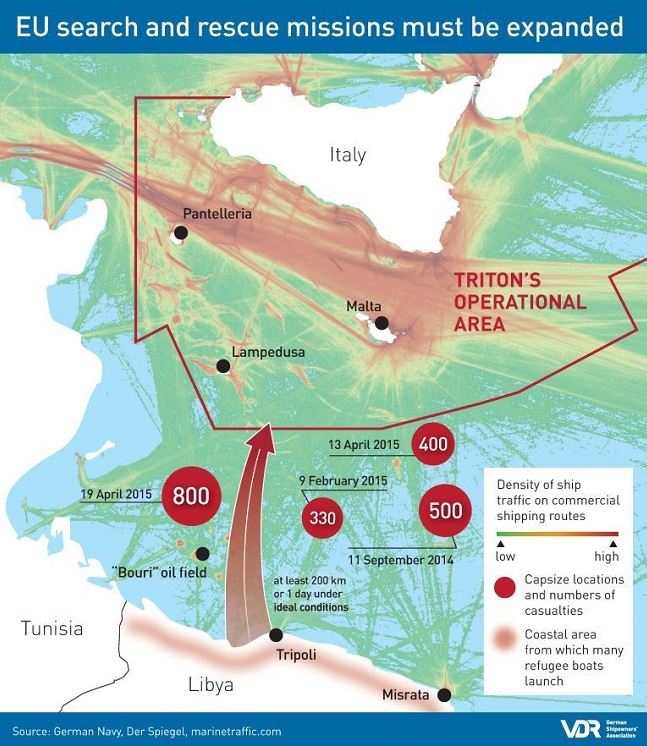
Ralf Nagel, the Chief Executive Officer of the German Shipowners’ Association (VDR), last week called on Germany to deploy Navy vessels outside of the Frontex Triton operation zone and closer to the coast of Libya where private merchant ships are often the first to encounter migrant boats in distress. At least two German Navy ships were in Crete last week waiting for deployment instructions. “Deploying the [German] Navy in that part of the Mediterranean would not only send a strong political signal to Brussels, it would also be an important message for the shipping industry, which is doing all it can. And above all else: it would save the lives of innumerable refugees. Rescuing people at sea ought to be the responsibility of navy and coast guard vessels as a rule. … [W]e therefore demand that the boundaries within which maritime rescues are conducted by government forces be expanded beyond the Triton zone.”

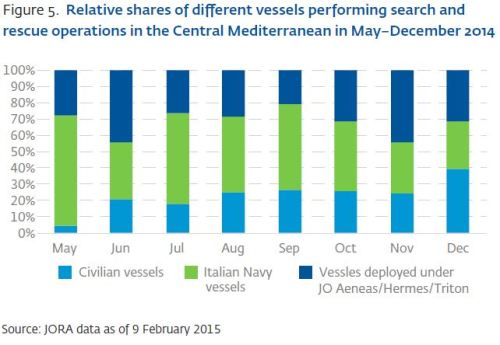
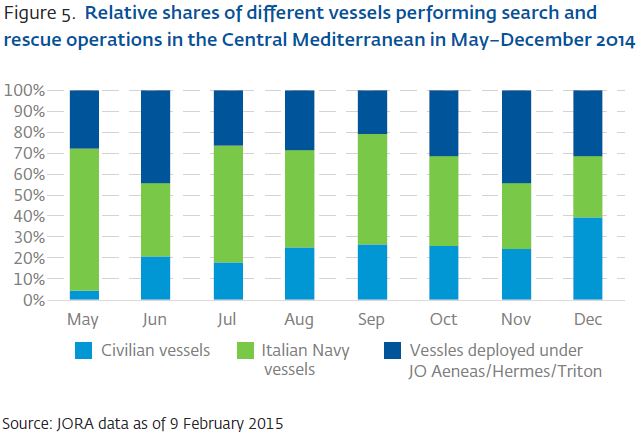
According to the Frontex Annual Risk Analysis 2015, private merchant ships have been conducting an ever increasing number of search and rescue operations in the Mediterranean. In December 2014, merchant vessels accounted for just under 40% of the SAR operations. (See graph below map.)

Source: Verband Deutscher Reeder (VDR) / German Shipowners' Association (VDR)

Source: Verband Deutscher Reeder (VDR) / German Shipowners’ Association (VDR)


Figure 5

2 Comments

Filed under European Union, Frontex, Germany, Libya, Maps, Mediterranean, News, Statements

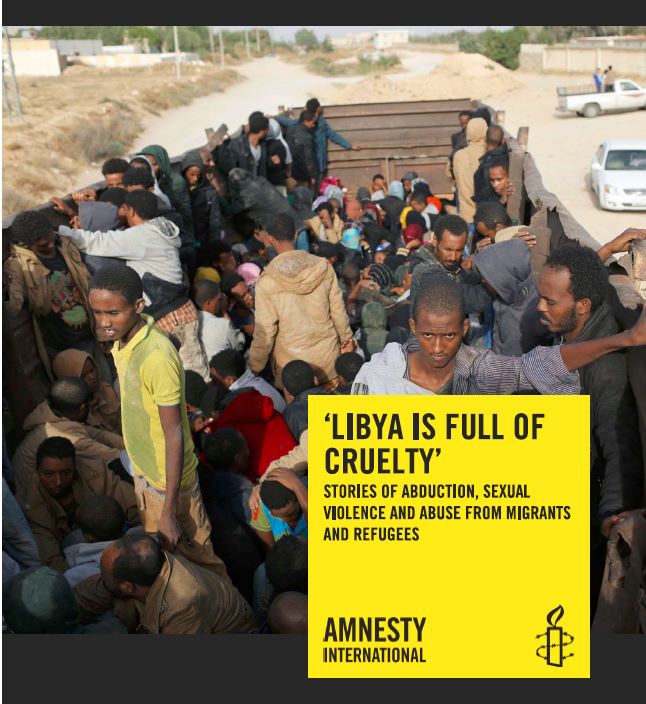
Amnesty International Report: ‘Libya is Full of Cruelty’ – Stories of Abduction, Sexual Violence and Abuse from Migrants and Refugees

Amnesty International has released a new report entitled: “’Libya is Full of Cruelty’ – Stories of Abduction, Sexual Violence and Abuse from Migrants and Refugees.” (also available here.)  2015-05-11_Amnesty Intl_Report_Libya_Libya_is_full_of_cruelty COVER

Key points include (see formal AI recommendations below):

  • “Widespread abuses by armed groups, smugglers, traffickers and organized criminal groups in Libya as well as systematic exploitation, lawlessness and armed conflicts are pushing hundreds of thousands of migrants, asylum-seekers and refugees to risk their lives by attempting to cross the Mediterranean Sea”;
  • “In many cases, migrants and refugees attempting to cross the Mediterranean Sea have been subjected to prolonged beatings in [detention] facilities following their interception and arrest by the Libyan coastguard or militias acting on their own initiative in the absence of strong state institutions”;
  • “While Amnesty International welcomes the EU’s commitment to increase resources for search and rescue operations, it is also concerned that some of the proposed measures, in particular plans to ‘systematically identify, capture and destroy vessels before they are used by traffickers’ would effectively contribute to migrants and refugees being trapped in Libya and expose them to a risk of serious human rights abuses”;
  • “As more people are drowning in the Mediterranean Sea, the priority for the international community must be to dramatically expand search and rescue operations and take effective steps to urgently address human rights abuses and serious violations of international humanitarian law in Libya. EU governments must also increase the number of resettlement places, humanitarian admissions and visas for people in need of international protection”.

Amnesty International makes the following recommendations:

To European governments

  • Urgently ensure the deployment of naval and aerial resources at a scale commensurate with foreseeable departure trends and which should patrol the high seas along the main migration routes. Whether such deployment occurs within the framework of Frontex Joint Operation Triton or through other agreements, it is crucial that ships and aircraft are delivered promptly and deployed in the area where most of calls for assistance come from and a great number of shipwrecks occurs;
  • To reduce the numbers of those risking their lives at sea, increase the number of resettlement places, humanitarian admissions and visas for people in need of international protection and ensure that refugees have effective access to asylum at land borders;
  • Ensure that any action against smugglers and traffickers is addressed through law enforcement measures, governed by human rights law and standards, and that it does not contribute to migrants and refugees being trapped in Libya without any means of escaping the violence;
  • Ensure that human rights abuses and violations of international humanitarian law, including against migrants, asylum-seekers and refugees in Libya, are addressed as part of the political dialogue aimed at ending the ongoing conflicts, and that a mechanism is put in place to monitor the human rights situation on the ground following any subsequent settlement. EU governments must also insist that Libyan authorities, armed groups and militias end the systematic indefinite detention of migrants and refugees based on their immigration status; all refugees and asylum-seekers and migrants detained for immigration purposes must be released.;
  • Investigate and bring to justice in fair trials those involved in trafficking of persons.

To the governments of Tunisia, Egypt and Algeria:

  • Keep the borders open to all individuals in need of international protection regardless of whether they have valid travel documents or meet visa requirements.

To governments along the smuggling route:

  • Ensure that any regional co-operation aimed at addressing irregular migration and dismantle smuggling networks fully complies with international law and standards, and does not infringe upon the rights and safety of asylum-seekers and refugees, with particular regard to the right to freedom of movement, the right to asylum, and the absolute prohibition on refoulement.

To militias, armed groups and Libyan authorities:

  • Release anyone detained solely on the basis of their immigration status, nationality, race, religion or ethnicity;
  • Make clear to all those under your command that torture or other ill-treatment, rape and sexual assault will not be tolerated under any circumstances. Remove from the ranks anyone suspected of such abuses;
  • Facilitate visits by independent organizations to immigration detention centres and other places of detention;
  • Ensure that all those deprived of their liberty can communicate regularly with their families and have access to adequate medical care.”

Leave a comment

Filed under Analysis, European Union, Frontex, Libya, Mediterranean, Reports, United Nations

New York Times Editorial: UN Security Council Should Reject Military Intervention in Libya

The NY Times in an editorial on Sunday called upon the UN Security Council to reject the EU request for a resolution authorising military intervention against smugglers in Libya:

“Military intervention would be a grave mistake. … It is, in fact, a cynical strategy, born of Europe’s panic over a tide of foreign migrants. … Destroying all the boats would condemn migrants to exile. A far better (and obvious) way to put the smugglers out of business is to make migration from Libya to Europe safe and legal. … The Security Council should tell [Federica Mogherini] that no military intervention is needed — just compassion and common sense.”

Leave a comment

Filed under Analysis, European Union, Libya, Mediterranean, United Nations

UN Security Council Draft Resolution on Use of Force in Libya to Call for “Use of All Means to Destroy the Business Model of the Traffickers”

The Guardian reports that the UK has prepared a draft UN Security Council resolution on behalf of the EU “that is believed to call for the ‘use of all means to destroy the business model of the traffickers’.” According to the Guardian the resolution would authorise the use of military force in Libyan territorial waters; the military force “would come under Italian command, have the participation of around 10 EU countries, including Britain, France, Spain, and Italy…” EU naval vessels would be authorised to enter into Libyan territorial waters and helicopter gunships would be used “to ‘neutralise’ identified traffickers’ ships.”

The Security Council meets tomorrow, Monday, 11 May, to consider the situation in the Mediterranean and will receive a briefing from HRVP Federica Mogherini. The Libyan government in Tobruk has said it opposes any such resolution.

3 Comments

Filed under Mediterranean, News, United Nations

Libyan Government (Tobruk) Will Not Support Proposed UN Security Council Authorisation of Use of Force Against Smuggler Boats

Libyan UN ambassador Ibrahim Dabbashi (representing the Libyan government based in Tobruk) told AP that Libya rejects the EU plan that may soon be considered by the Security Council to authorise the use of force to seize or destroy smugglers boats within Libya.

According to AP, the current Security Council president said that the Council expected that Libya would support the EU proposal, but Dabbashi said that his government “hasn’t even been consulted and rul[ed] out EU forces on Libyan soil ‘at this stage’. … ‘We will not accept any boots on the ground’.” Dabbashi also criticised expanded rescue operations: “He called the idea of deploying more boats to the waters off Libya to save migrants a ‘completely stupid decision’ because it would encourage even more migrants to come to his country, further burdening local authorities.”

3 Comments

Filed under European Union, Mediterranean, News, United Nations

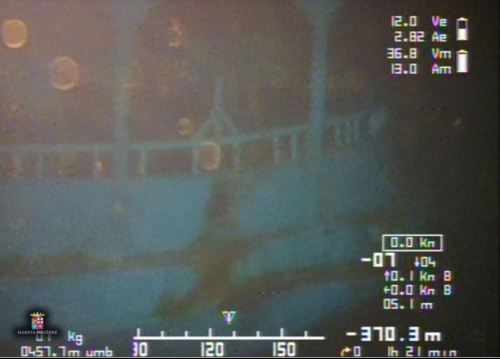
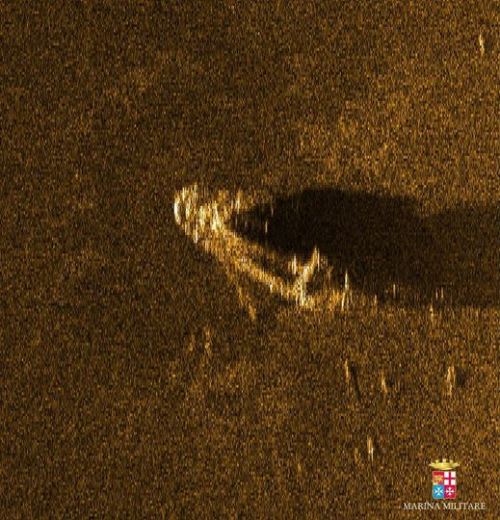
700-800 Bodies Believed To Be Inside 18 April Migrant Boat Wreck

An Italian prosecutor on Friday said that “more than 700, maybe 800” bodies are contained within the wreckage of the migrant boat that sank 85 miles off the coast of Libya on 18 April. The boat has been located by the Italian Navy and an effort may be made to recover the bodies. It is at a depth of 375 metres. Fewer than 30 people were rescued at the time of the accident and only 24 bodies have been recovered so far.

Marina Militare / Italian Navy

Marina Militare / Italian Navy – Image by underwater remotely operated vehicle (ROV)

Marina Militare / Italian Navy

Marina Militare / Italian Navy – sonar image

1 Comment

Filed under European Union, Italy, Libya, Mediterranean, News

Notable Comments – Italy’s Navy Chief, Admiral Donato Marzano: “I intervene to help people at sea”

Italy is hosting on 8 May a high level meeting of European naval forces. In response to questions from AFP about calls for a resumption of push backs in the Mediterranean, Admiral Marzano said: “There are several countries that apply a policy of expulsion, even by force of arms, others apply the international right to rescue. I am a sailor who has spent 20 years on boats. If I find a boat adrift, I’m sorry but I don’t turn away. I intervene to help people at sea. I don’t know if this reflects my Italian culture but I do know it is international law. A vessel in difficulty, whether it is a boat full of migrants or a merchant ship, has to be assisted.”

See also ANSA: Amm.Marzano, Non mi volterò mai dall’altra parte.

1 Comment

Filed under European Union, Mediterranean, News

UN Security Council to Meet on 11 May to Consider Mediterranean Migrant Situation

The UN Security Council will meet on Monday, 11 May, to consider the situation in the Mediterranean. HRVP Federica Mogherini will brief the Security Council. Italy has circulated a draft resolution among European members of the Security Council. ANSA reports that the European members of the UN Security Council have reached an agreement and are “very close” to being able to circulate a draft resolution. Italian Foreign Minister Paolo Gentiloni said the goal is to get “a legal framework” to “perform individual operations against traffickers.” Gazzetta Del Sud reports that “European sources said next Monday’s Security Council meeting will be a ‘first step’ to assess what kind of mandate might be needed for European operations against migrant traffickers. It is not likely that meeting will come up with a resolution, the sources said. European High Foreign Representative Federica Mogherini will present a May 18 council of EU foreign ministers with various security and defense options.” Russia has already said that it would veto a resolution authorising military strikes, but that it might consider supporting “a more restricted mandate for any EU military mission, which could involve a search and rescue role alongside powers to stop and seize smugglers’ boats at sea.”

1 Comment

Filed under European Union, Italy, Libya, Mediterranean, News, United Nations

Russia Will Veto Any UN Security Council Resolution Seeking to Authorise Destruction of Smuggling Boats in Libya

The Financial Times (paywall or answer marketing questions) reported yesterday that Russia will veto any UN Security Council resolution that would authorise the destruction of migrant boats in Libya. The FT reported that Russia might consider supporting “a more restricted mandate for any EU military mission, which could involve a search and rescue role alongside powers to stop and seize smugglers’ boats at sea.”

The Security Council’s Programme of Work for the month of May does not currently include any meetings pertaining to the EU’s desire for authorisation of military strikes on smugglers boats, but a briefing by the UN High Commissioner for Refugees on the migrant crisis in the Mediterranean might take place next week according to footnotes to the Programme of Work.

4 Comments

Filed under European Union, Libya, Mediterranean, News, United Nations

Approximately 40 Migrants Reported Dead After Merchant Ship Approached Migrant Boat

Reuters and other news agencies report that rescued survivors arriving today in Sicily told Save the Children that about 40 persons died – other survivors reported that “lots” of people died – after “dozens of people fell into the sea when they saw the merchant ship approach” their overloaded rubber dinghy. The migrant boat left Libya and was rescued on Sunday south of Sicily.

1 Comment

Filed under European Union, Frontex, Italy, Libya, News, Operation Triton

UK Delays Deployment of Navy Ship in Mediterranean Until Italy Agrees to Accept Rescued Migrants

Another example of why ships, commercial and military, may sometimes avoid rescuing migrant boats: the Guardian reported yesterday that the UK has kept the HMS Bulwark at anchor in Sicily “amid a diplomatic spat over where rescued people should be disembarked and processed. … Involvement was held up by deliberations between the Italian and British foreign ministries. Britain, which agreed to send the ship after emergency EU talks last month, sought guarantees that the migrants rescued by HMS Bulwark could be taken to Italian ports once they are saved from the high seas.”

1 Comment

Filed under Frontex, Mediterranean, News

Highlights from Frontex Annual Risk Analysis 2015 – Detections of Illegal Border-Crossing Between Border Crossing Points

Frontex released its Annual Risk Analysis 2015 (also here) on 28 April. Over the next few days I will post some key points and excerpts from portions of the 70 page report which are most relevant to migration by sea. See Executive Summary and Statistical Annex. 2015-04-28_Frontex_Annual_Risk_Analysis_2015-COVER
This post contains excerpts and key points from the ARA, Section 3, Situational Picture in 2014 / Detections of illegal border-crossing between border crossing points:

• In 2014, detections of illegal border-crossing reached a new record, with more than 280 000 detections. This was twice as many as the previous record of 140 000 detections in 2011, the year of the Arab Spring;
• With a record level of migrants crossing the border illegally, resources are devoted to their immediate care, but not towards screening;
• Syrians and Eritreans did not apply for asylum in the Member States of entry but rather in other Member States;
• As in 2013 and in 2011, the Central Mediterranean route was the main area for illegal border-crossing into the EU, representing 60% of all detections in 2014;
• Around 3 400 people died or went missing at sea in 2014;
• Civilian vessels have been increasingly involved in the detection and rescue of migrants at sea. More than 600 merchant ships have been diverted from their routes to rescue persons at sea in 2014;
• An increasing number of cases have been reported of cargo vessels being used to smuggle migrants from Turkey directly to Italy. This new trend affects the Eastern Mediterranean route, as the departure area, and the Central Mediterranean area, as the arrival area;
• In 2014, 50 800 detections were reported in the Eastern Mediterranean area, representing 18% of the EU total. This was twice as many as in 2013, mostly due to a sharp increase in detections in the Aegean Sea (from 11 829 in 2013 to 43 377 in 2014);
• In 2014 there were 7 842 detections of illegal border-crossing in the Western Mediterranean region, which consists of several areas of the southern Spanish coast and the land borders of Ceuta and Melilla. This total shows an increase of 15% compared to the total of 6 838 reported in 2013.;
• Detections of illegal border-crossing on the Black Sea were extremely rare. However, since 2013, Bulgaria and Romania have reported an increasing number of detections, totalling 433 migrants in 2014.

Excerpts:

“3.3. Detections of illegal border-crossing between BCPs [along land and sea routes in 2014]

In 2014, detections of illegal border-crossing reached a new record, with more than 280 000 detections. This was twice as many as the previous record of 140 000 detections in 2011, the year of the Arab Spring. This unprecedented number of migrants crossing illegally the external border has roots in the fighting in Syria that have created the worst refugee crisis since the Second World War. Indeed, most of the detections at the borders concern migrants from Syria, who later applied for asylum within the EU. [***]

With a record level of migrants crossing the border illegally, resources are devoted to their immediate care, but not towards screening and obtaining information on basic characteristics like their nationality. As migrants quickly continue their journey to other Member States, increasing the movements of persons staying illegally within the EU, this puts the EU internal security at risk. [***]

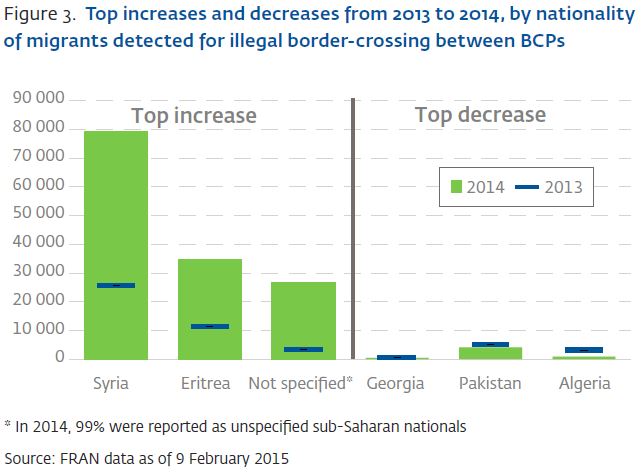
Indeed, Syrians alone (79 169) represented more than a quarter (28%) of the total as shown in Figure 3. [SEE BELOW.] They were also the top nationality for other indicators, in particular asylum applications, reflecting the dire situation in Syria and the desperate plight of Syrian asylum seekers. However, the vast majority of Syrians did not apply for asylum in the Member States of entry but rather in other Member States for many different reasons, notably because they expect to receive more attractive welfare benefits.

Regarding Eritreans, their detections in 2014 reached a record level (more than 34 500, compared to 11 300 in 2013). They were mostly arriving through Libya on the Central Mediterranean route. Like Syrians, they did not apply for asylum in the Member States of entry, but rather continued to other Member States. Many of the Eritreans stated that they had lived for some time in Libya but decided to leave because of the violence.

Detections of Afghans sharply increased from about 9 500 in 2013 to more than 22 000 in 2014. Afghans were detected on the Eastern Mediterranean route (mostly crossing the Eastern Aegean Sea), and then once again on the Western Balkan route. [***]

Central Mediterranean route

In 2014, more than 170 000 migrants arrived irregularly in the EU through the Central Mediterranean route (see Fig. 4).[SEE BELOW.] As in 2013 and in 2011, the Central Mediterranean route was the main area for illegal border-crossing into the EU, representing 60% of all detections in 2014. Detections were the largest between June and September at over 20 000 per month, but throughout the year, monthly detections were larger than in 2013. Most migrants were Syrians and Eritreans departing from the Libyan coast.

The vast majority were rescued by border-control authorities after issuing a distress call; however, despite best efforts there were many fatalities. Smugglers typically make use of frail, overcrowded boats, with limited fuel available to maximise their profits, putting migrants’ lives at considerable risk. The role of the Italian Navy and the JO Hermes/ Triton was crucial in rescuing an unprecedented number of migrants. Despite these efforts, around 3 400 people died or went missing at sea in 2014 and around 2 800 since the beginning of July according to UNHCR estimates.

Besides naval assets, civilian vessels have been increasingly involved in the detection and rescue of migrants at sea (see Fig. 5). [SEE BELOW.] According to the International Maritime Organization (IMO), more than 600 merchant ships have been diverted from their routes to rescue persons at sea in 2014. These deviations are, in the words of the Secretary General, detrimental to shipping and are not offset by any realistic prospects of salvage awards.

In addition to migrants leaving from Libya, since September 2014, an increasing number of cases have been reported of cargo vessels being used to smuggle migrants from Turkey directly to Italy. This new trend affects the Eastern Mediterranean route, as the departure area, and the Central Mediterranean area, as the arrival area. This practice is further developed under the section related to the Eastern Mediterranean route.

As migrants were rescued in high-sea, they were reported as part of the Central Mediterranean route. Many were disembarked in Apulia and Calabria, to alleviate the burden on reception capacity in Sicily. From a statistical point of view, these disembarkations artificially inflated the number of migrants usually reported on the Apulia and Calabria route. In 2014, there were fewer migrants departing from Egypt and targeting this area of the Italian coast than in 2013. [***]

Eastern Mediterranean route

Since data collection began in early 2008, the Eastern Mediterranean has maintained its status as a hotspot of irregular migration (see Fig. 6). In 2014, 50 800 detections were reported from the area, representing 18% of the EU total. This was twice as many as in 2013, mostly due to a sharp increase in detections in the Aegean Sea (from 11 829 in 2013 to 43 377 in 2014). Detections remained comparatively much lower at the Bulgarian and Greek land borders with Turkey (12 262 in 2013 and 5 938 in 2014).

Sea border

Aegean Sea

Compared to the previous year, the sharp increase in the Aegean Sea in 2014 meant that migrants departed from more areas, and also arrived on a larger number of islands. While the islands reporting the largest number of arrivals remained Lesbos, Chios and Samos, detections were also reported from small islands from North to South, stretching capacity of surveillance. Many migrants claimed to be Syrian, and were thus handed an administrative notice allowing them to stay in Greece for up to six months, even without applying for asylum.

Screening processes of some migrants revealed a high degree of falsely claimed nationalities to avoid return. Not knowing the nationality of migrants who are illegally crossing the border and travelling within the EU is evidently a vulnerability for EU internal security. [***]

Increasing use of cargo ships

Since August 2014 the number of irregular migrants arriving in the Central Mediterranean from Turkey sharply increased compared to earlier in the year and to the same period in 2013. This sharp increase was directly related to the use of cargo ships to facilitate migrants and asylum seekers from Turkey to Italy (for example, see Fig. 7).

To date, Mersin has been the place where those wishing to travel to the EU in an irregular fashion have made contact with the smuggling networks. Wooden boats, however, have departed from various points along south-eastern Turkish coast such as Mersin, Adana and Hatay provinces to reach cargo vessels waiting off shore.

Smuggling migrants from Turkey on board large cargo vessels is extremely profitable, and such funds are likely to be an important source of income for smuggling networks also engaged in other criminal activities. This means that the criminal networks might be financing other criminal activities by exploiting and putting at risk vulnerable groups of displaced families from Syria.

Specifically, the cargo ships, which are often bought as scrap, tend to cost between EUR 150 000 and 400 000. There are often as many as 200–800 migrants on board, each paying EUR 4 500–6 000 for the trip, either in cash a few days before the departure or by Hawala payment after reaching the Italian coast. The cost is high because the modus operandi is viewed as being safe and has been demonstrated as being successful.

Hence, the gross income for a single journey can be as high as EUR 2.5 or even 4 million depending on the size of the vessel and the number of migrants on board. In some cases, the profit is likely to be between EUR 1.5 and 3 million once other overheads such as recruiters, safe houses, shuttle vessels, crew and fuel have been taken into account. Given this level of financial gain it is important to act against this modus operandi not only to stem the flow of irregular migration but also to limit the financial assets of the smuggling networks. [***]

Western Mediterranean route

In 2014 there were 7 842 detections of illegal border-crossing in the Western Mediterranean region, which consists of several areas of the southern Spanish coast and the land borders of Ceuta and Melilla. This total shows an increase of 15% compared to the total of 6 838 reported in 2013.

Like in 2013, the first half of 2014 showed most detections being reported at the land border, mostly from Melilla. Indeed, the Spanish authorities reported several violent attempts to cross the fence.

As mitigating measures, the fence has been upgraded. As a result, in the second half of the year, Spain reported more detections at the sea border than at the land border.

Once in Melilla, migrants are turned over to Spanish Police Headquarters for identification, and many are transferred to the Temporary Centre for Immigrants (CETI – Centro de Estancia Temporal de Inmigrantes). However, this centre only has a limited capacity and some migrants had to be transferred to mainland Spain.

In terms of nationality, most of the migrants are from Western Africa, in particular from Cameroon and Mali. Algerians and Moroccans have also been reported among the top ten nationalities, but mostly at the sea border.

Since November 2014, Spain also reported an increase in detections of illegal border-crossing of Syrians at the land border (more than 250 in November and December), then applying for asylum. This increase, combining with increasing detections of Syrians using forged document to enter to the EU, has prompted Spain to open asylum and international protection offices at the borders of Ceuta and Melilla in March 2015.

Black Sea route

Detections of illegal border-crossing on the Black Sea were extremely rare. However, since 2013, Bulgaria and Romania have reported an increasing number of detections, totalling 433 migrants in 2014.

These incidents still constitute isolated cases, and are possibly linked to the increased surveillance on the Eastern Mediterranean route and the increasing number of migrants waiting in Turkey to reach the EU illegally. [***]”
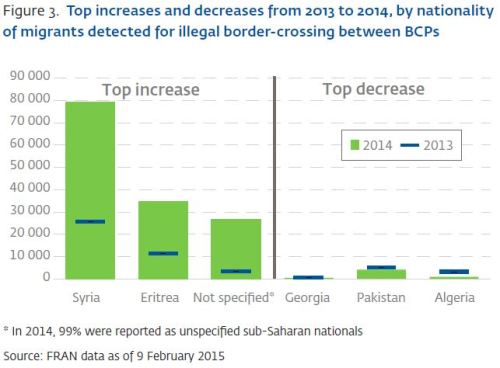
 

Figure 3


Figure 4


Figure 5

2 Comments

Filed under Aegean Sea, Black Sea, Egypt, Frontex, Greece, Italy, Libya, Malta, Mediterranean, Reports, Spain, Statistics, Syria, Tunisia, Turkey

The Detention of Asylum Seekers in the Mediterranean Region – A Global Detention Project Background Paper

The Global Detention Project just released a Background Paper, “The Detention of Asylum Seekers in the Mediterranean Region,” which “is intended to highlight some of the vulnerabilities that people seeking international protection face when they are taken into custody in Mediterranean countries and to underscore the way that European Union-driven policies have impacted the migratory phenomenon in the region.”  GDP Cover-Backgrounder Det of Asy Seekers in Med_April 2015

Summary: “With the recent tragic surge in the number of deaths at sea of asylum seekers and other migrants attempting to reach Europe, enormous public attention is being focused on the treatment of these people across the Mediterranean. An important migration policy employed throughout the region is detention, including widespread deprivation of liberty of asylum seekers and other vulnerable groups. …

The report focuses on eight key countries in Europe and North Africa. While there are clear differences in treatment from one side of the Mediterranean to the next, looked at collectively, the protection environment across all the countries in the region is bleak. Not surprisingly, the conditions of detention asylum seekers face in North African countries are often horrific and inhumane. However, in Europe, there are also serious shortcomings. In fact, as this backgrounder reports, reception and detention conditions in three of Europe’s main asylum receiving countries (Greece, Italy, and Malta) are so inadequate that many of their EU counterparts have been forced to halt returns to these countries under the Dublin III Regulation.”

1 Comment

Filed under Egypt, European Union, Greece, Italy, Libya, Malta, Morocco, Refugees, Reports, Spain, Tunisia

UN Security Council President on Mediterranean Migrant Crisis: It’s Not About Protecting Europe; It’s About Protecting the Refugees.

After meetings on Tuesday this week between HRVP Federica Mogherini and the current UN Security Council President, Jordanian Ambassador Dina Kawar (Lithuania assumes the Presidency of the Security Council on 1 May), the AP reported that “diplomats are warning that United Nations backing for any European Union plan to address the growing Mediterranean migration crisis could take longer than anyone wants.”  Ambassador Kawar said “I don’t think we’re anywhere close to having [support] now” and that the effort is “not about protecting Europe. It’s about protecting the refugees.”

Excerpts from HRVP Mogherini’s press conference on 28 April at the Security Council:

“[***] My presence here was already planned today for addressing the [NPT review] conference, but I also took the chance of following up on the European Council we had last Thursday where the Heads of State and Government of the European Union discussed the tragedies that are happening in the Mediterranean, linked to the trafficking and smuggling of people across the Mediterranean, but also all the way through Africa and, in most cases, from places of the world like Syria or the Horn of Africa where their life is put at risk. So, I have had discussions about that today with the EU Permanent representatives of the countries that are sitting in the Security Council: Lithuania that is taking the Presidency of the Security Council from Friday, Spain, UK and France. I will meet also the Italian Permanent representative later on, the Russian Permanent representative and I will meet Samantha Power tomorrow in Washington as well as Secretary Kerry – not only on this but also on this. I will be visiting China next week where this issue will also be part of my talks. [***]

Q&A:
Question: [***] And on the question of an EU mandate for military operations off of Libya, do you have any sense of when that could be pushed through at the Security Council?

HRVP Federica Mogherini: [***] On the creation of an international framework, of a legal framework for fighting traffickers and smugglers, we also had a very useful conversation with Secretary General Ban Ki-Moon together with Prime Minister Renzi yesterday in Sicily. It is not for the European Union to set the UN Security Council time framework, the EU is not sitting in the Security Council, as you know very well. So it is not for me to comment on the next steps. What I can say is that we are working in Brussels and in strong coordination with the European Union members of the Security Council to make sure that our planning, our options that are being prepared in Brussels, go hand in hand with the discussions that can be made in the Security Council, and not only with the European Union members, also with others. I think I mentioned the fact that I just met the Jordanian permanent representative, not only as President of the Council but also as an Arab country that has a lot to say when it comes to the stability and the security of the region. And also the African Union. I spoke with the President of the African Union Mrs Zuma this morning to find ways of cooperating strongly in preventing the criminal organisations to act on the African territory and to address the root causes of the phenomena. Because we know very well that we cannot focus only on one of the links of the chain, meaning the last part of the trip. But we have to address root causes; we have to address the issue of poverty, of wars, of human rights, of unequal distribution and access to resources, being it financial or other kind of resources. And we need to do it in partnership with the countries that are involved in this. Because the human trafficking and smuggling is clearly a violation of Human rights but it is also clearly a threat and a challenge for the security and the stability of all countries involved, all the way. It is not only a European issue, it is not only a Libyan issue – even if we are looking at finding ways of cooperating with all Libyans to face this threat and to find ways of working together in preventing this spreading even more in the territory. But we need to work in cooperation with our partners around the region and around the world for sure. So not for me to set up a time frame for UN Security Council to work, but for sure to make sure that the European Union work on this is coordinated and is fully in respect of international law. On this, let me also say that I spoke with António Guterres on Sunday to start coordinating even more closely, because our main objective is to save lives. Saving lives also means take care of the people we save. And on this we look for a strong partnership with the UNHCR and it would be good to see the UNHCR operating in all places through which the smuggling and trafficking of people takes place.

Question: On this migrants’ smuggling question. Can you say how soon your enforcement operations will begin? Which countries will participate? And any details on how this enforcement effort will be underway?

HRVP Federica Mogherini: I was tasked last Thursday to start preparation for possible operations by the European Union, in full respect of international law, which means that we will need in any case to have a legal basis before we start operation on a European Union level. In the meantime, we are preparing options for a mission, for an operation. The process would be, first for me to present options to the Ministers, for them to take decisions; decisions in the EU are taken by unanimity, 28. And then it will be up to single Member States to decide whether and in which way they can participate to the operation. So we have different phases: preparation has already started on Thursday, on the very same day [than the European Council]. We are having the first discussion and thinking with the Member States in these very same hours. And we are working rapidly, but still, “rapidly” in the context of the European Union, definitely means not a couple of days. Also because in the meantime, as I said, we need to make sure that we have framework of international legality, in which we want to operate. There is nothing we are going to do that is outside of the framework and we work together with the UN and/or in partnership with the Libyan authorities. I will have a meeting shortly also with Bernardino Leon to see ways in which we can even more support his efforts to find an agreement in Libya because we know we have to partner with Libya, with all Libyans in this. And let me stress it very much because I know that the messages might have been perceived in a nuanced way. I want to make it very clear that there is nothing the European Union is preparing or thinking of that is intended to be against the Libyan people or the Libyan authorities in all their complexity. What we want to do is to work with Libyans on their own security, on their own possibility of freeing the country of criminal and also terrorist networks that are proliferating at this time. So it is a partnership we are looking for.

Question: Would you please tell us whether the EU supports a resolution from the Security Council and the creation of a maritime force that deals with the issue of trafficking people across the Mediterranean and with the flow of arms inside and outside Libya?

HRVP Federica Mogherini: The content of my talks here today has been on the first part of your question, absolutely yes. How we can stop the trafficking organisations: at sea, not only at sea, let me say, because if you take 5 minutes and look at the statement of the European Council there is this task for me, but there is also the task of working on other aspects of the prevention and the fight against trafficking organisations. Namely, the work will increase with Niger, with Mali, with the other neighbouring countries of Libya – Tunisia, Egypt, Algeria. Not to focus only on the last part of the trip but also on the rest of the security we need to build. So yes, this is definitely part of my mandate, this is definitely part of my talks that for the moment have been very constructive, I would say.
[***]”

1 Comment

Filed under European Union, Libya, Mediterranean, News, Statements, United Nations

Mogherini at UN Seeking “Framework of International Legality” for Military Strikes on Smuggling Boats; Security Council Expected to Consider Issue in Coming Weeks

Federica Mogherini, the EU High Representative for Foreign Affairs and Security Policy, is currently at the United Nations and seeking support for the authorisation of EU military strikes on smuggling boats in Libya: “[The EU] need[s] to make sure we have a framework of international legality in which we want to operate. There’s nothing we’re going to do that’s outside the framework of work together with U.N. and/or in partnership with the Libyan authorities” She said that the EU was working in “strong coordination” with the EU members of the U.N. Security Council on the issue. (See also tweet from EU UN Mission: “Human trafficking is threat for security & stability for all countries & EU will work with all partners.”)

Yesterday Mogherini sought to assure Libya that whatever the EU does, should not be perceived as an attack against the Libyan people: “I want to make it very clear there is nothing the European Union is preparing or thinking of that is to be intended against Libyan people or the Libyan authorities in all their complexity.”

Bernardino León, the head of the UN Support Mission in Libya (UNSMIL), will brief the UN Security Council today (Wednesday, 29 April) regarding the dialogue between different Libyan groups that is being facilitated by the UN.

While León’s briefing is not expected to address the issue of authorising EU military strikes, according to What’s In Blue-Security Council Report, “[t]he humanitarian situation in Libya is likely to be of interest to Council members. … In a 21 April press statement, Council members expressed grave concern at the recent proliferation of the smuggling of migrants off the coast of Libya. Even though this issue exceeds the scope of the conflict in Libya and is expected to be tackled separately by the Council in the coming weeks, Council members might be interested in asking León about reactions among Libyans of the potential responses to this phenomenon which are being discussed by the European Union and others….”

2 Comments

Filed under European Union, Libya, Mediterranean, News