Category Archives: Eastern Atlantic

NGOs Urge EU to Respect Refugee Rights

ECRE, CEAR, and Amnesty International have released a joint statement urging EU governments to respect refugee rights as efforts are made to strengthen Frontex.

“Bjarte Vandvik, ECRE Secretary General said: ‘States have a legitimate right to control their borders, but this is not an excuse to ignore the fact that persons fleeing war or persecution are entitled to protection under international, European and national laws. As Frontex is being strengthened, its operations need to be monitored to ensure that human rights are respected’.”

“Regardless of where border controls take place and of who implements them, methods to prevent unauthorized entry must leave room for the identification of persons in need of international protection so they are not returned to any country where they will face persecution. Member States’ obligations under international and European refugee and human rights law do not stop at the physical boundaries of the EU. This responsibility is not only moral and political but also legal. EU Member States cannot abdicate their principles, values and commitments by doing outside their borders what would not be permissible in their territories.”

Click here for full statement.

Leave a comment

Filed under Aegean Sea, Eastern Atlantic, European Union, Frontex, Mediterranean, Statements

Malmström: Expand Frontex Powers and Respect Rights

On the eve of the 25-26 February meeting of the Council of Justice and Home Affairs, EC Home Affairs Commissioner Cecilia Malmström in her first press conference as Commissioner presented the Commission’s proposal to expand Frontex’s powers in several areas including giving it the authority to co-lead enforcement operations with member states.  The proposal would also introduce “an explicit requirement for all border guards taking part in operations to have been trained in fundamental rights, with the aim to safeguard that all immigrants are met with full respect of fundamental rights and in particular the principle of non-refoulement.”

Speaking of Italy’s forcible migrant return policy, Malmström said “I don’t exclude at all that errors were committed in the past, that’s why I’m so keen to really reinforce that all the people involved in Frontex operations have the adequate education and know exactly what to do. Because of course, these people [the migrants] are not criminals, they are in the search for a better life and they have the right to be treated in a dignified way.”

Click here and here for articles.

Click here for JHA Council 25-26 February Meeting Agenda.

Click here for JHA Council Meeting Background Note.

Leave a comment

Filed under Aegean Sea, Eastern Atlantic, European Union, Frontex, Italy, Libya, Mediterranean, News

El SIVE sólo detectó cuatro de quince pateras

“El Gobierno ha reconocido en una respuesta parlamentaria en el Senado que el Sistema de Vigilancia Exterior -SIVE- sólo detectó cuatro de las quince pateras y embarcaciones de traficantes que llegaron a Alicante hasta Navidad.  …  El Gobierno recuerda que el SIVE ha sido diseñado para conseguir “una vigilancia más eficaz de la costa” mediante una red de radares y cámaras con sensores de infrarrojos. “Este sistema, no obstante, presenta también alguna limitación como la derivada del alcance de sus sensores y la existencia de zonas de sombra en ciertos puntos próximos a la costa, debido a la accidentalidad geográfica (que no se detallan por motivos de seguridad)”, apunta la respuesta.”

Click here for full article.

Leave a comment

Filed under Eastern Atlantic, Mediterranean, News, Spain

Frontex Programme of Work 2010

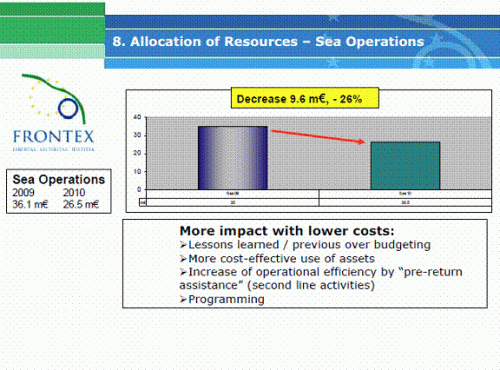
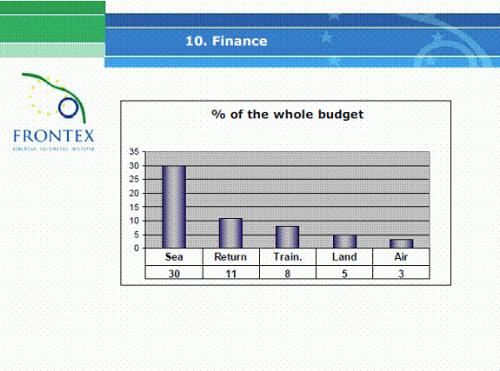
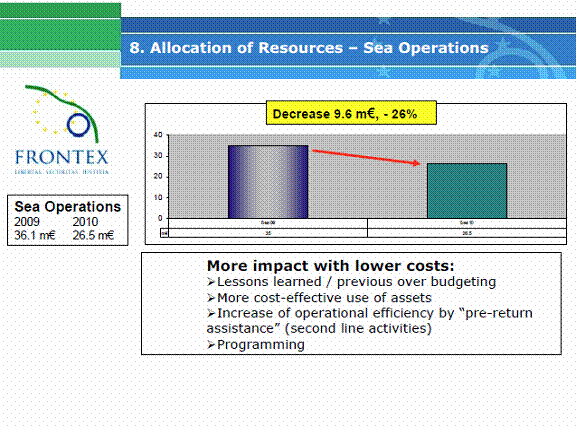
Frontex issued its 2010 Work Programme some time in late 2009.  I have not taken the time to closely read the full 90 page document, but it is worth noting that Frontex sea operations continue to constitute the largest share of the Frontex operational budget, over 26.5 M €.  Due to delayed payments from member states, Frontex is planning on cutting its sea operation budget by 9.7 M € in 2010.

Here are some excerpts from the Programme for Work relevant to sea operations:

“Executive Summary – Frontex’ Programme of Work 2010, as the output of a cyclical planning process, is the operative plan of the Agency to be used as reference for the governance process of assessing and evaluating operational activities carried out during 2010. Frontex’ Programme of Work also seeks to ensure the highest possible level of transparency towards the citizen of the European Union. [***]

Sea Borders has the biggest share of the budget for operational activities: 26.5 M €. This is a decrease of 9.7 M €. Based on experiences from 2007 and 2008 the budget allocated to Sea Borders has been reduced as payments have been lagging seriously behind and it seems logical that the level of ambition has to be (at least temporarily) adjusted downward. However, the presently foreseen budget does give sufficient room for 7 to 9 projects within the EPN European Patrols Network and 6-7 joint operations in different geographical areas to decrease the illegal immigration flows and to detect facilitators (26.3 M €). Other activities carried out by Sea Borders will be:

– Improved working conditions and improved operational value of interrogation experts (0.1 M €);

– Improved level of awareness in ICCs and regional centers during JOs. (0.1 M €). [***]”

“1.6. Outlook for the situation at the external borders in 2010

General trends –  [***] In May 2009 Libya agreed to direct repatriation of illegal migrants, increasing in the process the deterrent effect of Frontex coordinated Joint Operations in the area. Likewise, Joint Operation Poseidon 2009 has introduced pilot measures to gauge the magnitude of the phenomenon of nationality swapping. When extended and systematized, this measure will facilitate return, determination of illegal migration routes correctly and spotting any displacement in a more timely manner. [***]”

“External maritime borders of the Member States – With significantly lower number of migrants departing from Libya and a decreasing trend of arrivals in the Canary Islands, the relative importance of Algeria, Morocco, Tunisia and possibly Egypt as departure points is likely to grow throughout 2009 and 2010. Efforts by authorities there against illegal migration will be crucial for limiting the flow towards Italy and Spain.  Gambia is expected to take over from Senegal the role of a major embarkation point on the West African coast. That said, in absolute numbers the Aegean Sea (at the border between Turkey and Greece) is expected to remain the main entry point at external sea borders in 2010 should cooperation with Turkey continue to be limited. With the strengthening of the southern EU maritime borders, migrants who initially considered sea crossing might opt for alternative way of entry. One of them might be the use of air borders, either with forged documents or after obtaining visa on false pretence.  At the moment, such a shift has not yet been detected and the risk is considered rather low for 2010, but the situation at the air border should nevertheless continue to be monitored with vigilance. [***]”

“1.7.1. Priority locations by border type

(1) At the external sea borders, operational cooperation should continue to focus on the southern maritime areas where large number of illegal migrants have been detected and where migrants’ life is most at risk, namely the maritime areas leading to: the Canary Islands, the Spanish south-eastern Mediterranean coast, the Island of Lampedusa, Malta—taking into account possible displacement to Sicily and/or Crete—, Sardinia and the Greek Islands close to the Turkish coasts (Lesvos, Chios, Samos, Patmos, Leros and Kos).

Even though decreases detections of illegal border crossing have been reported during the first semester 2009 on the West African and Central Mediterranean routes, operational cooperation should continue to include these areas, on the one hand because the decrease might only be temporary, and on the other because Frontex coordinated Joint Operations in these areas as one factor have contributed to the decrease. [***]”

“1.7.2.2. Recommendations for operational cooperation at the sea borders

(18) All efforts, from diplomatic to technical ones, should continue to be explored to break the deadlock situation of illegal migrants, as advised by facilitators, purposely turning sea surveillance patrols into rescue operations, thereby using surveillance measures as part of their modus operandi. As of mid-2009, such situation was still prevailing in the Aegean Sea.

(19) Joint Operations at the sea borders should aim at developing a permanent linguistic expertise pool, combined with debriefing techniques. Alternatively, language expertise could be outsourced to vetted private sector.

(20) At the sea borders where migrants arrive in big groups, special attention should be given to the rapid identification of victims of THB, especially women and children, with a view to gaining information leading to the identification and prosecution of the traffickers. In this process victim protection should be paramount. [***]”

Click here for a link to the full document.  Note that the document is 90 pages in length but for some reason the 90 page document available at this link is in triplicate, i.e. it is 270 pages in length.  But it is the same 90 page document thrice.

Click here for a link to Slides used by Frontex to summarize some aspects of the Programme.

Leave a comment

Filed under Aegean Sea, Eastern Atlantic, Frontex, Mediterranean, News, Reports

Frontex Presentation at European Defence Agency Annual Conference

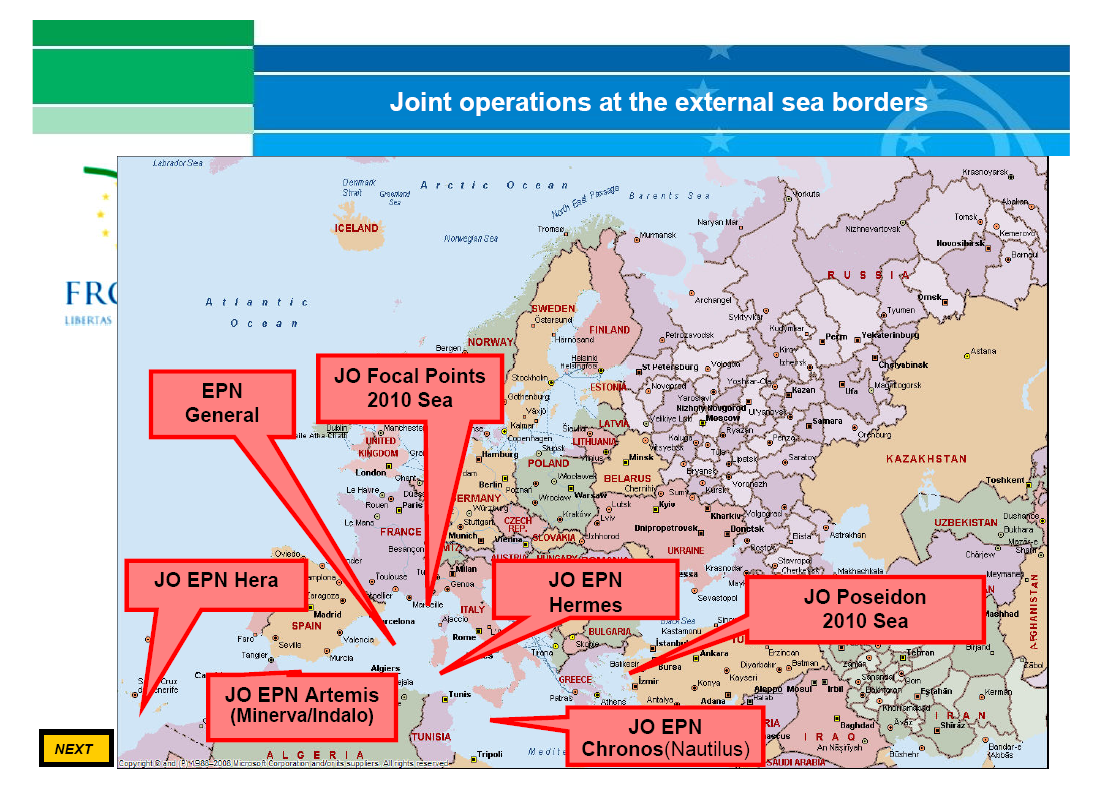
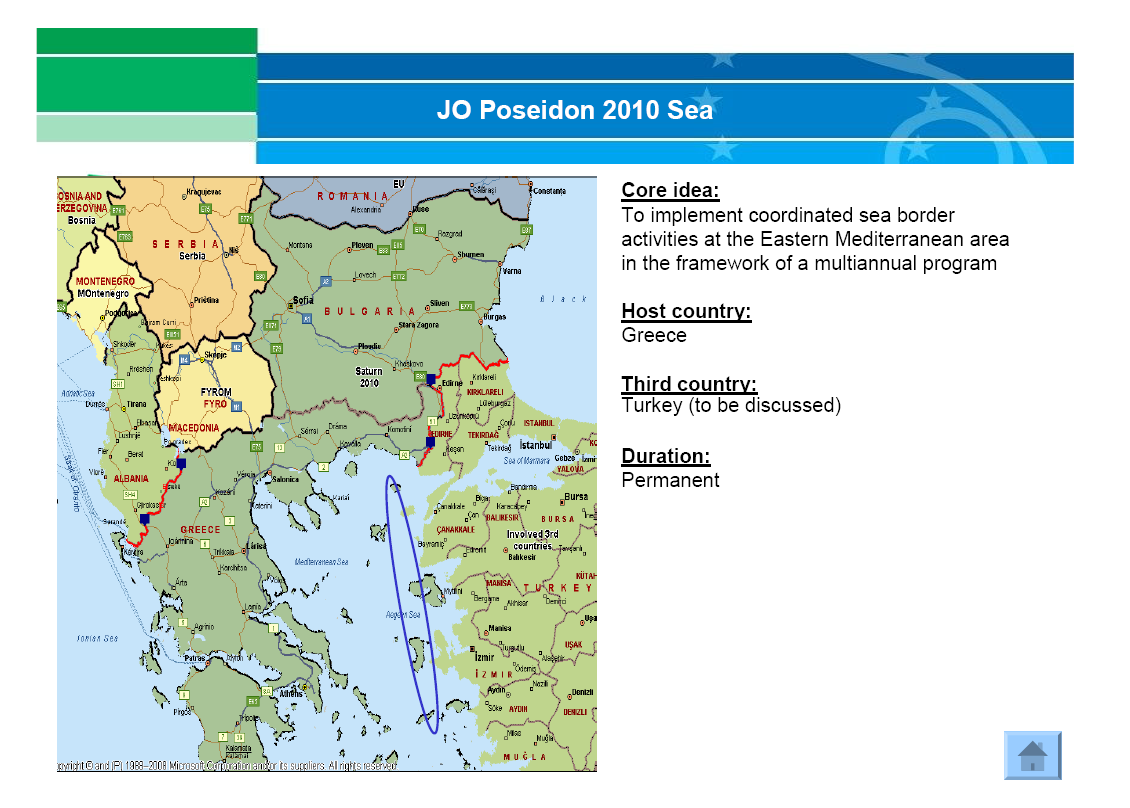
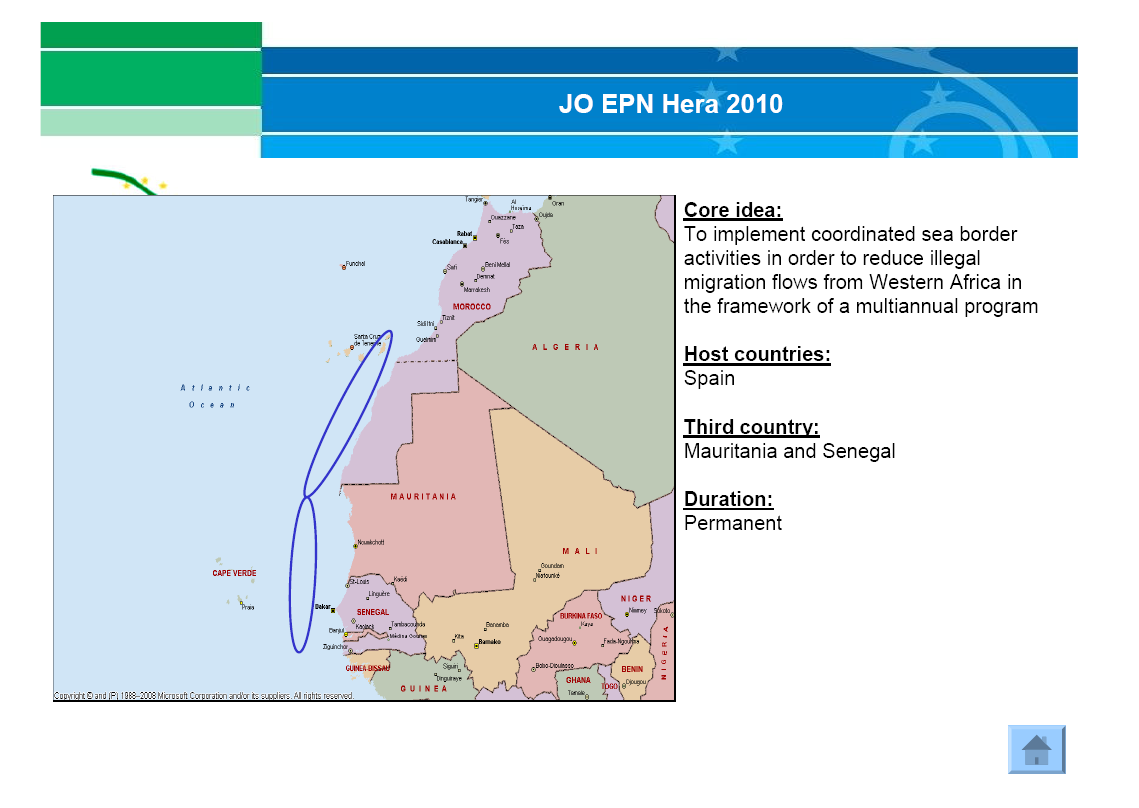
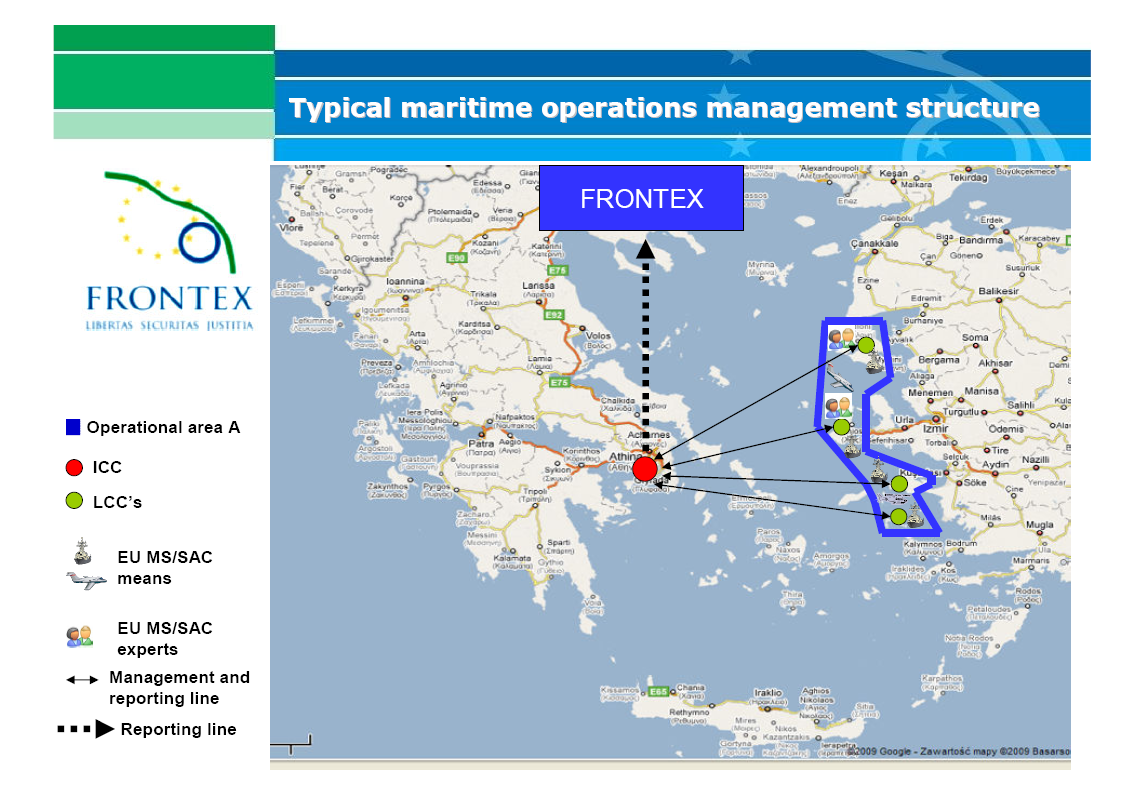
Rustamas Liubajevas, Head, Frontex Joint Operations Unit, presented a lecture entitled “Frontex within integrated Border management concept – Structural approach in planning capability” at the recent Annual Conference of the European Defence Agency.

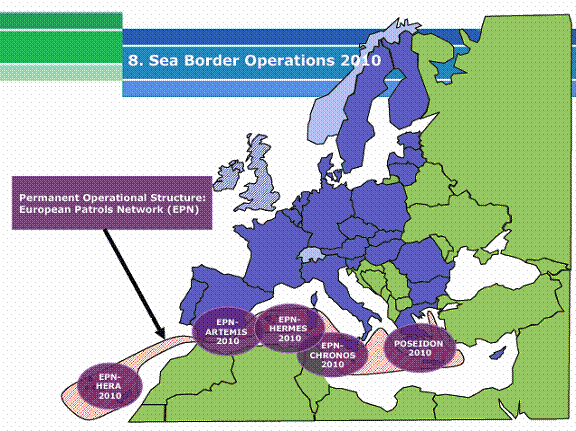
Copies of some of his slides are reproduced here.

Click here for full slide presentation.

Leave a comment

Filed under Aegean Sea, Algeria, Colloques / Conferences, Eastern Atlantic, European Union, Frontex, Greece, Italy, Libya, Malta, Mauritania, Mediterranean, Morocco, News, Senegal, Spain, Turkey

Conference de l’Ucad: «Migrations entre le Sénégal et l’Espagne: défis et opportunités»

“Les premières journées hispano-sénégalaises qui portaient sur le thème « Migrations entre le Sénégal et l’Espagne : défis et opportunités » ont été clôturées, … à Dakar. Une occasion saisie par le Pr. Saïdou Nourou Tall, vice doyen de la Faculté des Sciences juridiques et politiques de l’Ucad, par ailleurs coordonnateur du Master du droit des migrations pour faire le diagnostic du dispositif du Frontex (dispositif de lutte contre l’émigration clandestine)…. le Pr. Saïdou Nourou Tall a déclaré …« On a fait un diagnostic, beaucoup de choses ont été faites. Mais il existe un certain nombre de problèmes dans ce dispositif du Frontex qui nous interpelle tous », a-t-il précisé. Est-ce que les milliards que reçoivent nos gouvernants dans la lutte contre cette émigration clandestine atteignent les cibles », s’est-il interrogé. Pour lui, le constat illustre la recrudescence du phénomène de l’émigration clandestine. La solution, de l’avis du coordonnateur du Master des Migrations de la faculté de Droit, est de « promouvoir l’unité africaine ». Pour cela, a-t-il dit, « il faut faire de l’Afrique un grand marché où les Africains trouveront du travail sans être obligés de risquer leur vie sur des pirogues de fortune ».”

Cliquez ici pour l’article complet.

Leave a comment

Filed under Colloques / Conferences, Eastern Atlantic, Frontex, Senegal, Spain

Más patrullas para prevenir llegada de barcas neumáticas a la costa andaluza

“El Ministerio del Interior ha intensificado las patrullas de la Guardia Civil y las tareas de inteligencia para prevenir la llegada de embarcaciones neumáticas que cruzan el Estrecho de Gibraltar hasta las costas andaluzas, según consta en una respuesta aportada por el Gobierno al senador Eugenio Jesús Gonzalvez (PP), a la que tuvo acceso Europa Press….”

“Por otra parte, recuerda que en los meses de septiembre y octubre se puso en marcha el dispositivo Indalo, coordinado por la Agencia Europea de Fronteras (Frontex), consistente en el despliegue de medios marítimos y aéreos, complementado con personal de varios países en distintos puntos de la costa, entre las provincias de Murcia y Granada.”

“Asimismo, Interior indica que el Sistema Integral de Vigilancia Exterior (SIVE) se mantiene a la “máxima operatividad” en toda la costa del Mediterráneo, donde también continúa la realización de patrullas mixtas marítimas….”

Click here and here for articles.

Leave a comment

Filed under Eastern Atlantic, Frontex, Mediterranean, News, Spain

La primera embarcación de “sin papeles” que arriba a Canarias del año

“Un grupo de cuatro inmigrantes de origen africano arribó ayer a la isla de Gran Canaria a bordo de una pequeña lancha ….  Es la primera embarcación de «sin papeles» que arriba a Canarias en lo que llevamos de este año 2010, y llegó a las costas del Archipiélago sin ser detectada.”

“[L]a embarcación … no fue detectada por el Sistema Integrado de Vigilancia Exterior (SIVE)…”

Click here and here for articles.

Leave a comment

Filed under Data / Stats, Eastern Atlantic, News, Spain

Le Temps d’Algérie: Les maffias de l’immigration clandestine en Afrique de l’ouest se tournent vers le narcotrafic

“Les ministres de l’Intérieur des pays d’Afrique occidentale se réunissent aujourd’hui [14 février] à Dakar avec leurs homologues de France et d’Espagne pour examiner la délicate question de l’ouverture, dans cette région située dans le prolongement direct du Sahel, d’une «nouvelle route» spécialisée dans le narcotrafic. … Cette région était jusque-là considérée, exclusivement, comme la «route» de l’immigration clandestine vers l’Europe. … Près de 40 000 Subsahariens ont pu atteindre les côtes espagnoles. Mais le dispositif mis en place par l’Espagne dès 2007, avec le concours les unités du Frontex …a sensiblement découragé ce phénomène. Cette «route» a progressivement cessé d’être rentable pour ces maffias de l’immigration clandestine en Afrique de l’Ouest. … Les maffias de l’immigration clandestine auraient alors choisi de se tourner vers une activité plus risquée mais beaucoup plus rentable, le narcotrafic.”

Cliquez ici pour l’article complet.

Cliquez ici pour un autre article: “Lutte contre la drogue en Afrique de l’ouest : La France met sa marine à la disposition de la sous-région.”

Leave a comment

Filed under Eastern Atlantic, France, News, Senegal, Spain

New Statewatch Report: NeoConOpticon- The EU Security-Industrial Complex

Statewatch and the Transnational Institute have published a comprehensive new report.

The report, “NeoConOpticon, The EU Security-Industrial Complex”, is a “follow-up [to Arming Big Brother, 2006] [and] contains new research showing how the European Security Research Programme [ESRP] continues to be shaped by prominent transnational defence and security corporations and other vested interests. Though technically a Research and Development (R&D) programme, the ESRP is heavily focused on the application of security technologies (rather than objective research per se), and is increasingly aligned with EU policy in the fields of justice and home affairs (JHA, the ‘third pillar’), security and external defence (CFSP, the ‘second pillar’).”

The Report includes a discussion of maritime immigration enforcement.  Excerpt:

“Having fortified many of the traditional entry points to Europe, the focus of the ‘war on migration’ has shifted to the islands of the Mediterranean and the coastlines of Africa and the Middle East. For FRONTEX, the newly created EU border management agency, this ‘southern maritime frontier’ is the ‘first line of defence’ of ‘Europe’s borders’. Since 2003 FRONTEX has coordinated a host of joint police and naval missions to combat ‘illegal’ immigration by sea and is now in the process of setting up a permanent European Patrols Network for the Mediterranean and a corps of Rapid Border Intervention Teams (RABITs) for deployment to ‘illegal immigration hotspots’.

This militarised approach to immigration control is part of a broader EU maritime security and defence strategy. In 2005, following the lead of the USA’s ‘SeaPower21’ strategy, the Chiefs of European Navies (CHENS) launched a 20-year ‘Vision for the Future Role of European Maritime Forces’ to meet the demands of the European Security Strategy (2003) and enhanced NATO Maritime Joint Operations. The rationale behind the CHENS strategy is that the sea: ‘has already been used for terror attacks by boats armed with rockets and small arms’ and ‘for logistic support to terrorism’. The sea is also a potential conduit for CBRN material and “criminal activity including narcotics, human trafficking and piracy’, all of which is ‘increasing in sophistication and volume.’ …”

Click here for Executive Summary.

Click here for full report.

Leave a comment

Filed under Eastern Atlantic, European Union, Frontex, Mediterranean, Reports

Analysis of the Real Instituto Elcano: Controlling Migration in Southern Europe

Analysis of the Real Instituto Elcano: Controlling Migration in Southern Europe, Part 1: Fencing Strategies and Part 2: Gate-keeping Strategies by Anna Triandafyllidou.

“Part 1 Summary: Dealing with irregular migration has emerged as a policy priority at both the national and the EU level, although EU countries are not all affected by this phenomenon in the same way. Countries at the geographical periphery of the Union, and, in particular, southern EU member states that are close to important migration source and transit countries, face significant inflows from their land and sea borders.

This ARI discusses critically the policies adopted by different countries in southern Europe (Italy, Spain and Greece) for managing irregular migration, with a view to showing that reducing irregular migration cannot be achieved by tougher border controls only. Discourses of politicians and the media in announcing ‘floods’ or ‘waves’ of irregular migrants crossing the EU’s external borders and, on the basis of these ‘floods’, considering or indeed approving tougher border enforcement measures as the main means to effectively combat irregular migration need to be questioned by voters as well as by experts.”

Excerpt: “It is interesting to note that while sea-border patrolling and the related FRONTEX operation in the Atlantic Ocean in 2006 did not have substantial results (Triandafyllidou, 2007), the Spanish government’s diplomatic ‘offensive’ in West Africa did. Thus, during the last two years Spain has managed to sign re-admission agreements with Cape Verde, Mali, Guinea Conakry, Guinea Bissau and Nigeria and varied forms of cooperation agreements with other states in the region, with the result of a notable improvement in border management and hence a notable decrease of irregular arrivals from Africa (González Enríquez, 2009). Apprehensions of irregular migrants arriving at the Canary Islands have fallen from over 30,000 in 2006 to approximately 12,000 in 2007 (data from the Spanish Ministry of the Interior cited in Arango & Finotelli, 2008). This decrease is to some extent attributable to the intensification of sea-border patrols and joint FRONTEX operations in the area which led migrants and smugglers to try alternative routes.”

Click here for Part 1 and here for Part 2.

Leave a comment

Filed under Aegean Sea, Analysis, Eastern Atlantic, Greece, Italy, Mediterranean, Spain

Spanish EU Presidency: Frontex Needs More Resources and Clearer Rules

Spanish Interior Minister Alfredo Pérez Rubalcaba speaking at the 26th Frontex Management Board Meeting in Madrid called for providing Frontex with “more resources, clearer rules and specialist offices. … We are planning to promote FRONTEX, to equip it with more resources, its own resources, because when FRONTEX becomes more independent it will become more efficient; to provide it with mechanisms for jointly managing maritime operations, mechanisms that respect the laws and rights and clearly establish each country’s obligations. … FRONTEX has shown that it is probably the best tool we have for ensuring shared and jointly responsible border control.”

Click here for summary from Spanish EU Presidency web site.

Leave a comment

Filed under Aegean Sea, Eastern Atlantic, European Union, Frontex, Mediterranean, News, Spain

BLUEMASSMED: Project for Maritime Surveillance of the Mediterranean Area and the Atlantic Approaches

The Bluemassmed project is a new initiative from the European Commission designed to increase cooperation for maritime surveillance in the Mediterranean Sea and its Atlantic approaches, including surveillance of illegal immigration.  The inaugural meeting for the Project was held in Paris on 15 January 2010.

“France, Greece, Italy, Malta, Portugal and Spain [will] cooperate on this specific project to strengthen their common actions against illicit trafficking, illegal immigration and environmental pollution. It will also permit [the reinforcement of] the Search and Rescue efforts in the area. This pilot project granted by the European Commission and co-funded by 6 Member States countries (France, Greece, Italy, Malta, Portugal and Spain) is the first state-centred action to integrate such an important field between Member States countries.”

The project is a two year project “divided in two stages. The first one intends to define the requirements of the actors in terms of exchange of information and to submit a list of technical and legal proposals. The second stage will result in a demonstration, performed among partners and wider, with the help of a demonstrator prototype, connecting present information systems from partners, shaping a possible future network of State actors for maritime surveillance systems, in the framework of several realistic scenarios.”

“The [French] Secrétariat Général de la Mer is leader of the project. The Agenza Spaziale Italiana is Co-leader of the Steering group, composed by representatives from each Member States, which will define the strategic guidelines of the project.”

“BLUEMASSMED aims at being a catalyst for internal and external cooperation between Member States and maritime surveillance actors. The success of this project is directly linked to the involvement of the Partners, responsible to their governments. The prototype demonstrator will be carried out with the support of industry. Industrial involvement is considered as a key investment.”

Click here for Bluemassmed web site.

Click here for English Press Release or here for French Press Release from inaugural conference.

Click here for EC Directorate-General for Maritime Affairs and Fisheries Non-Paper on Maritime Surveillance, 13 Oct. 2008.

Leave a comment

Filed under Eastern Atlantic, European Union, France, Greece, Italy, Malta, Mediterranean, News, Portugal, Spain

Canary Islands – Migrant arrivals at 10 year low

2,242 migrants arrived in the Canary Islands in 2009 compared with approximately 9,000 in 2008.  This was the lowest number of migrant arrivals since 1999 when 2,165 migrants arrived. There were 32 confirmed migrant deaths in 2009 compared to 45 in 2008.

The largest number of migrant arrivals took place in 2006 when 31,859 migrants arrived.  Coordinated Frontex operations were expanded beginning in May 2006.  Since 1994 there have been over 96,000 recorded arrivals.

Click here (EN), here (FR) and here (ES) for articles.

Leave a comment

Filed under Data / Stats, Eastern Atlantic, Frontex, News, Spain

Le nombre de clandestins arrivés en Espagne soit retombé à 7.000

“Le chef du gouvernement espagnol José Luis Rodriguez Zapatero s’est félicité … que le nombre de clandestins arrivés en Espagne soit retombé à 7.000 en 2009 contre 14.000 en 2008, estimant être en train de ‘gagner le combat’ contre l’immigration illégale.”

“Selon des statistiques encore provisoires, le nombre des clandestins subsahariens arrivés cette année dans des embarcations de fortune sur le seul l’archipel espagnol des Canaries, au large de l’Afrique, est retombé à environ 2.250, contre plus de 9.000 en 2008 et un record de 31.600 en 2006.  Le nombre de clandestins arrivés cette année sur les côtes d’Andalousie, en provenance notamment du Maghreb, a en revanche augmenté.”

Zapatero “a attribué cette baisse globale aux accords de coopération conclus avec les pays d’origine en Afrique et au renforcement des moyens de lutte contre l’immigration clandestine, notamment le dispositif européen Frontex au large des côtes africaines.”

Click here for article.

Leave a comment

Filed under Data / Stats, Eastern Atlantic, Frontex, Mediterranean, News, Spain