Category Archives: Data / Stats

Increased Human Smuggling to Cyprus

According to an article in the Turkish newspaper Today’s Zaman, Turkish Interior Ministry data indicates that human smuggling in Turkey has decreased since 2007, but that one consequence of increased enforcement within Turkey has been a diversion of human smuggling to the Turkish controlled northern portion of Cyprus.

“According to the ministry, the total number of illegal immigrants, asylum seekers and immigrants caught at land and sea borders with Syria, Iran, Iraq, Georgia, Greece and Bulgaria declined to 28,355 in 2009.”  This number is in contrast to the 50,800 migrants reportedly arrested in 2008 and 7,465 arrested over the first six months of 2010.

The Ministry also reported a decline in known deaths: “In line with the drop in the number of immigrants trying to get to the West through Turkey, there has been a decline in the number of illegal immigrant deaths. In 2007, 82 immigrants died in accidents on the Aegean Sea and 102 went missing. The number of deaths dropped to 76 in 2008 and to 43 in 2008. The number of deaths in the first half of 2010 was nine.”

According to the article, there has been a diversion of smuggling operations towards Turkish controlled Cyprus and as a result the “KKTC [the self-declared Turkish Republic of Northern Cyprus] [is] facing the biggest migration move ever in its history.”  “In 2008, the number [of irregular migrants] doubled and increased to 568. It continued to increase in 2009. According to estimates, 750 migrants entered the island in 2009. … Illegal immigrants are brought by ships to Cyprus during the night and left in places that are far from settlement areas in Dipkarpaz and the İskele region. In addition to the KKTC, a similar number of immigrants are brought to Greek Cyprus.  It is believed that illegal immigrants pay between $2,000-$3,000 on average to human smugglers to enter the KKTC. In the latest smuggling cases in Turkey, they pay $5,000-$10,000.”

Click here for article.

Click here Turkish Ministry of Foreign Affairs web site on Illegal Migration.

1 Comment

Filed under Aegean Sea, Cyprus, Data / Stats, Greece, Mediterranean, News, Turkey

Frontex 2nd Quarter Report

The Frontex Risk Analysis Unit has released its Report for the Second Quarter of 2010 (April-June).  It is a 30+ page report containing data, charts, and graphs detailing entry routes, detections of migrants, detections of facilitators, and other information.

Excerpts from the Report’s Executive Summary:

Illegal migration pressure in the EU underwent a foreseeable seasonal increase during the second quarter of 2010, but is still clearly in a period of decline.…

The widespread decline in illegal migration pressure is probably due to two key factors. The first is decreased employment opportunities in the EU …  [and the] second is stricter migration and asylum policies in Member States, supported by much more effective collaboration with key third countries. For example, stricter migration and asylum policies in Norway and the UK have reduced the number of applications in these Member States…. Similarly, bilateral agreements between Italy and Libya, and between Spain and both Senegal and Mauritania, continue to control, for the time being at least, most illegal migration via the Central Mediterranean and West African routes, respectively.

Notwithstanding the general decline in detections, there were two emerging trends in the second quarter (Q2) of 2010: a continued and intensified shift from the Greek sea border to the Greek land border with Turkey….  In the beginning of 2009 illegal crossings of the EU external border between Greece and Turkey were divided roughly equally between the land and sea borders.  However, there has been a gradual and recently intensified shift to the land border. Reasons for this shift from sea to land borders are linked to the effectiveness of the Frontex activities in the Aegean Sea, combining surveillance activities with identification of illegal migrants, and opening the possibility of return to origin countries for detected migrants. ….

Main trends:

  • There is a general decline in illegal migration to the EU compared to a year ago;
  • For the time being, Turkey is the main transit country for illegal migration to the EU….;
  • In the Eastern Mediterranean route, there has been a gradual and recently intensified shift from the Greek-Turkish sea border to the land border, where 90% of detections were made….   At the Greek-Turkish land border around 60% of detections were made at the Border Control Unit (BCU) Orestiada which is under the biggest pressure. Air connections to Turkey are increasingly used by migrants from North Africa, who then illegally cross the EU external border with Turkey. As well as effective Frontex-coordinated joint operations at the sea border, potential explanations for this shift include cheaper facilitation costs, a lower risk crossing, lower detection rates…;
  • There were increased detections on the Central Mediterranean route, probably due to the recent re-organisation of criminal groups in response to effective bilateral agreements in the area. In June 2010 Libya expelled the United Nations High Commissioner for Refugees (UNHCR), with whom 9,000 refugees and 4,000 asylum-seekers were registered and who, in the absence of protection, may now attempt entry to the EU.

Click here for the 2nd Quarter Report.

Click here for the 1st Quarter Report.

2 Comments

Filed under Aegean Sea, Analysis, Data / Stats, Eastern Atlantic, European Union, Frontex, Greece, Italy, Libya, Malta, Mauritania, Mediterranean, News, Reports, Senegal, Spain, Turkey

Frontex: Current Situation at the External Borders (JANUARY – JUNE 2010)

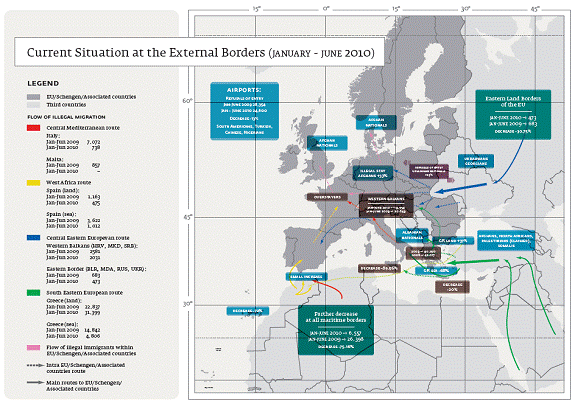
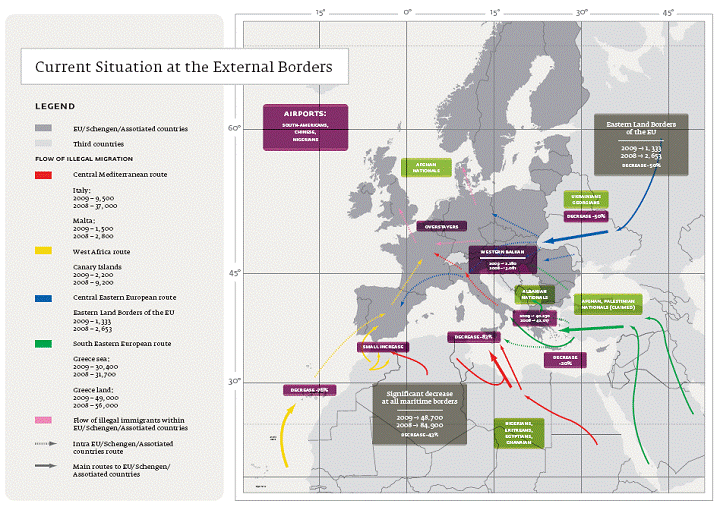
Frontex posted this map to its web site this week.  According to Frontex, “[t]he map describes the current migratory situation at the external borders of the EU, including the main entry routes of irregular migration into the European Union.”

Note the significant reductions in migrants detected at all maritime borders:

  • Jan-June 2010 – 6.557
  • Jan-June 2009 – 26.398
  • Decrease of 75%

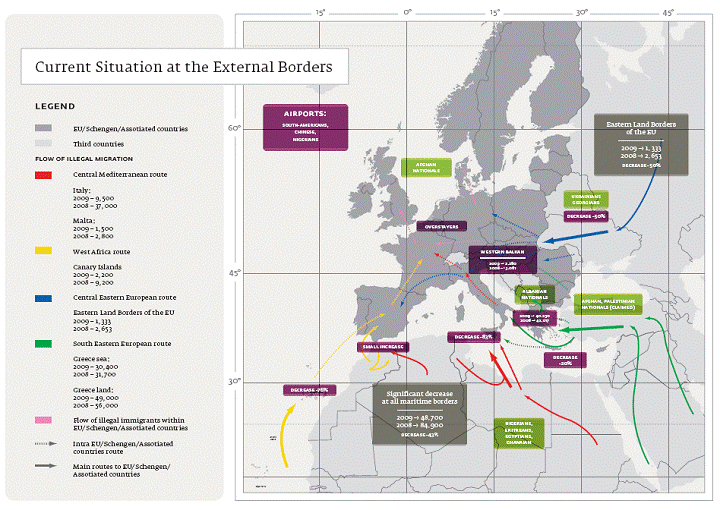
This 75% decrease over the first six months of 2010 compared with the first six months of 2009 is on top of the 43% reduction in migrants detected at maritime borders in 2009 relative to 2008:

  • 2009 – 48.700
  • 2008 – 84.900
  • Decrease of 43%

Note the further breakdown of the figures in the Legends of the two maps.  You probably need to click on the links to view higher quality images of the maps.

Click here for link to Jan-June 2010 Map.

Click here for link to 2009 Map.

Current Situation at the External Borders (January - June 2010)

Current Situation at the External Borders (January - June 2010)

Situation at the External Borders (2009)

Situation at the External Borders (2009)

1 Comment

Filed under Aegean Sea, Data / Stats, Eastern Atlantic, European Union, Frontex, Mediterranean, News

INTERSOS Update on Mixed Migration in the Gulf of Aden

INTERSOS has released a short report on the movement of migrants from the Horn of African to Yemen during the first half of 2010.  The report notes a more than 50% reduction in the number of Somalis arriving in Yemen compared with the same period in 2009.  The number of non-Somalis (mostly Ethiopians) arriving in Yemen has remained the same compared to the same period last year.  The report observes that increased efforts by Puntland authorities to halt traffickers and the increased turmoil within Somalia making movement within the country difficult may partially explain the reduced numbers.  The report notes that a reduction in the outward migration flow of Somalis into Kenya has also occurred, though there has been in increase in the numbers of Somalis entering Ethiopia.

Click here for the Report.

Leave a comment

Filed under Data / Stats, Ethiopia, Gulf of Aden, News, Somalia, Yemen

CARIM: Updated migration profile for Senegal

CARIM has published an updated migration profile for Senegal.  CARIM profiles are “[d]ivided into three parts – the demographic-economic, legal, and socio-political frameworks [and] portray key trends and dynamics as well as legal and policy developments crucial to acquiring a general picture of outward and inward migration in the country.”

Click here for the July 2010 profile.

Leave a comment

Filed under Analysis, Data / Stats, Senegal

EUROSTAT Q1 2010 Asylum Statistics for EU27 Countries

EUROSTAT released updated data on 15 July for the First Quarter of 2010.  The report is entitled: Asylum applicants and first instance decisions on asylum applications in Q1 2010 (Doc. 32/2010).

Notable statistics include reductions of over 50% in the number of asylum applicants in three countries, Malta, Italy, and Greece, relative to the First Quarter of 2009.  Malta had the largest reduction of approximately 95%.

The reductions in Malta and Italy are almost certainly due to Italy’s push-back practice.  Though the first migrant arrivals in Malta in 2010 occurred this past weekend, 17 July, when 55 migrants on a sinking vessel were intercepted by Maltese and Libyan patrol boats.  The Times of Malta reported that the migrants were “shared out” between the Maltese and Libyan patrol boats.  28 migrants were brought to Malta and 27 were apparently taken to Libya.

Click here for the full EUROSTAT document.

Click here for Times of Malta article.

3 Comments

Filed under Aegean Sea, Data / Stats, Eastern Atlantic, European Union, Greece, Italy, Libya, Malta, Mediterranean, News

Frontex 2010 1st Quarter Report: Irregular Migration at Sea Borders Less Than 10% of Peak Levels

Frontex has released information from its 2010 First Quarter report by the Frontex Risk Analysis Network (FRAN).  A copy of the report itself has apparently not been released.  According to the summary provided, there have been significant reductions in irregular migration:

  • “[D]etections of irregular immigrants at [all EU] sea borders … were less than one-tenth of the peak level (for the third quarter of 2008) when roughly 33,600 detections were reported.”
  • “[D]etections at the Spanish and Italian sea borders became negligible…”
  • “[D]etections at the dominant Eastern Aegean Sea border between Greece and Turkey also fell by more than 60% to just under 2,300.”
  • “Detections at the Greek-Turkish land border were for the first time greater than those at the countries’ sea border.”
  • There were “only 150 detections of illegal border-crossing [in the Central Mediterranean], compared to 5,200 detections in the first quarter of 2009…”
  • There were “only 500 irregular immigrants detected [in the Western Mediterranean] (almost 72% down on the fourth quarter of 2009 …).”
  • There were “only five detections over the first three months of 2010 [on the West African/Canary Island route], in contrast to 31,700 detections in 2006…”

Click here for full statement.

Leave a comment

Filed under Aegean Sea, Algeria, Analysis, Data / Stats, Eastern Atlantic, European Union, Frontex, Greece, Italy, Libya, Malta, Mauritania, Mediterranean, Morocco, News, Reports, Senegal, Spain, Turkey

Frontex 2010 Annual Risk Analysis

Frontex’s Annual Risk Analysis (ARA) for 2010 was prepared in March 2010 and was posted to the Frontex web site on 7 July.  The public document only contains certain portions of the full ARA as recommendations and other “operationally sensitive details” have been redacted. While some of the ARA’s contents have previously been released by Frontex, this 35 page document contains a lot of data regarding irregular migration by land, sea, and air, and is worth a read.

Excerpts from the ARA relating to maritime migration include:

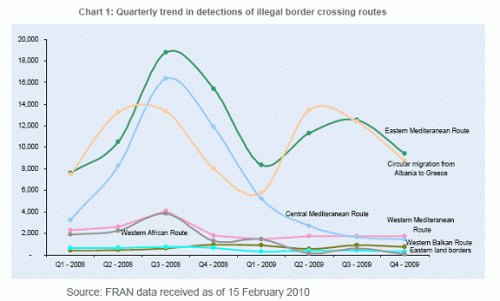
“Detections of illegal border crossing – In 2009, the [EU] Member States and Schengen Associated Countries reported a total of 106,200 detections of illegal border crossings at the sea and land borders of the EU. This represented a 33% decrease compared to 2008. The decrease is comprised of both a strong decrease reported from the sea borders (-23%), and land borders (-43%).”

“The bilateral collaboration agreements with third countries of departure on the Central Mediterranean route (Italy with Libya) and the Western African route (which Spain signed with Senegal and Mauritania) had an impact on reducing departures of illegal migrants from Africa.”

“The agreements were made at a time when the economic crisis decreased the labour demand in the EU, thus simultaneously reducing the pull factor. The synchronisation of these events probably explains why no displacement has so far been noticed from the Central Mediterranean and Western African routes to other illegal migration routes in the statistics for detections.”

“However, intelligence suggests that the risk of displacement remains high, either with the emergence of new routes or the exploitation of existing ones by nationalities which used to be detected along the Central Mediterranean or the Western African routes.”

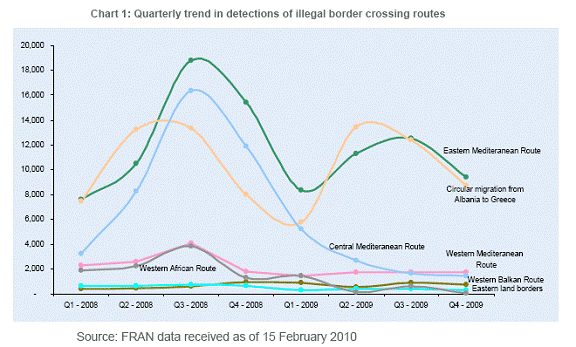
“As a corollary to the sharp decreases registered in Italy and Spain, the number of detections of illegal border crossing in Greece rose from 50% of the total EU detections to 75% of the total. In 2009, the Greek land border sections with Albania and FYROM represented the largest share of the EU total, with 36,600 detections (34% of the EU total), followed by 22,000 detections in the Aegean Sea with (21% of the EU total).”

“Eastern Mediterranean route – The Eastern Mediterranean route is the route taken by illegal migrants transiting through Turkey and entering the EU through eastern Greece, southern Bulgaria or Cyprus. Turkey, due to its geographical position near the EU, is the main nexus point on this route. From Istanbul, illegal migrants may reach the Greek islands in the Aegean Sea, or cross the land borders to Greece or to Bulgaria.”

“In 2009, illegal border crossing on the Eastern Mediterranean route totalled 41,500, or 39% of all EU detections. Most of the detections were reported from the Aegean Sea, followed by detections along the land border between Turkey and Greece. The number of detections reported by Bulgaria and Cyprus were considerably lower.”

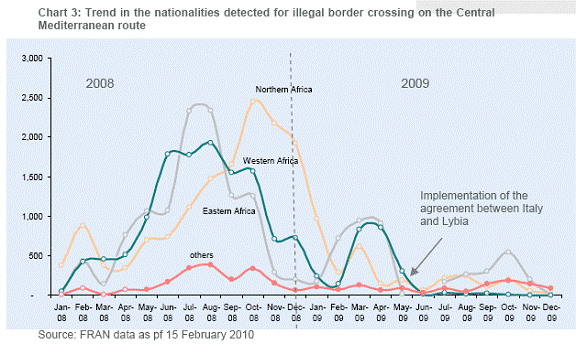
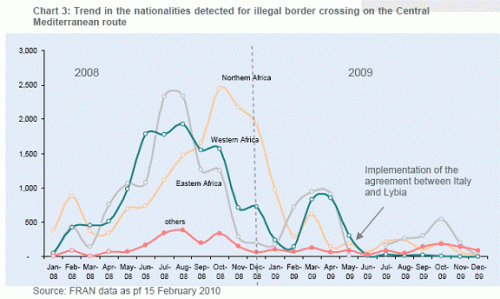
“Central Mediterranean route – The Central Mediterranean route refers to illegal migration from northern Africa to Italy and to Malta. For the past two years, Libya has been a nexus point where migrants from the Horn of Africa and Western African routes and a small proportion of Asian nationals met before embarking.”

“Since the signing of a bilateral agreement with Libya, joint patrols by Libya and Italy have had a clear and measurable deterrent effect, with 3,200 detections in the seven months after the joint patrols (June to December), compared to 7,200 detections in the five months before the joint patrols (January to May), and almost 40,000 detections in the whole of 2008.”

“Western African route – The Western African route is primarily through Western African countries to Spain via the Canary Islands. The main embarkation points are in Senegal and Mauritania and the main countries of origin are Mali, Mauritania, Guinea Conakry and Senegal. Other African nationals have also been reported, and occasionally migrants from Asia. This route is now less favoured since the Spanish collaboration agreements with Senegal and Mauritania. The Frontex coordinated Joint Operation Hera plays a major role in maintaining effective surveillance in the area.”

“The Western Mediterranean route includes the sea route from Northern Africa to the Iberian Peninsula, and the land route through Ceuta and Melilla. It is mostly used by Northern African nationals (Algerian and Moroccan) travelling to Spain, France and Italy.”

“Maritime detections between Northern Africa and Spain are rising, with increasing detections of Algerian and to a lesser extent Sub Saharan nationals. Moroccan nationals are also regularly detected on this route. The lack of employment opportunities for the growing population of young people in Morocco continues to increase the incentives of migrating to the EU. The Spanish authorities recently reported an increasing number of attempts by Moroccan minors to get on the ferry link between Tanger and Spain. These cases do not seem connected with criminal networks; rather individual attempts are driven by poor employment prospects in Morocco.”

Click here for the ARA.

Click here for link to Frontex Map showing situation at External Borders.
[ARA page 18]

[ARA page 13]

1 Comment

Filed under Aegean Sea, Data / Stats, Eastern Atlantic, European Union, Frontex, Greece, Italy, Libya, Malta, Mauritania, Mediterranean, Morocco, Reports, Senegal, Spain, Turkey

UNODC Publication: Smuggling of Migrants into, through and from North Africa

UNODC has issued a new publication entitled “Smuggling of Migrants into, through and from North Africa: A thematic review and annotated bibliography of recent publications.”  Most of the reviewed literature and data are from 2008 and earlier dates and therefore the publication does not include references to more recent events, e.g. the Italy-Libya migration agreement.  But it is a comprehensive and useful publication.  The 16 page Annotated Bibliography is a very good resource.

According to the UNODC web site, the publication “focuses primarily on the patterns and dynamics of migrant smuggling, as it concerns the North African region. Recognizing, however, that irregular migration and smuggling flows are transnational in nature, the review goes beyond North Africa, to also cover sub- Saharan African and European countries affected along the various smuggling routes.  The aim of the review is twofold: to describe major findings on smuggling of migrants; into, through and from North Africa, and to highlight the need for further research on specific issues that have not yet been studied.”

Table of Contents:

  • I. Introduction
  • II. Quantifying irregular migration and smuggling of migrants
  • III. Migrant smuggling routes
  • IV. Profiles and characteristics of smuggled migrants
  • V. Smuggler-migrant relationships
  • VI. Organizational structures of migrant-smuggling networks
  • VII. Modus operandi of migrant smuggling
  • VIII. Smuggling fees
  • IX. The human and social costs of smuggling
  • X. Summary of findings
  • XI. Annotated bibliography

Click here for the publication.

Leave a comment

Filed under Aegean Sea, Algeria, Analysis, Data / Stats, Eastern Atlantic, Egypt, France, Greece, Italy, Libya, Malta, Mauritania, Mediterranean, Morocco, Reports, Senegal, Spain, Tunisia, Turkey, UNODC

Frontex Map: 2009 Situation at External Borders

Frontex posted this map to its web site earlier this week.  The map “describes the … situation [as of the end of 2009] at the external borders of the EU, including the main entry routes of irregular migration into the European Union: West African route, via Canary islands, Central Mediterranean, including Italy and Malta, South Eastern European route (including Greek land and sea borders) as well as the Eastern land borders.”

Click here for link to the map.

1 Comment

Filed under Data / Stats, European Union, Frontex, News

EUROSTAT: 2009 EU27 Asylum Statistics and Characteristics of Asylum Seekers

Excerpts from the EUROSTAT asylum statistics press release issued on 18 June 2010:

The EU27 Member States granted protection to 78 800 asylum seekers in 2009 compared with 75 100 in 2008.

The largest groups of beneficiaries of protection status in the EU27 were citizens of Somalia (13 400 persons or 17% of the total number of persons granted protection status), Iraq (13 100 or 17%) and Afghanistan (7 100 or 9%).

In 2009, 317 500 decisions on asylum applications were made in the EU27, of which 228 600 were first instance decisions and 88 900 final decisions on appeal. Decisions made at the first instance resulted in 61 700 persons being granted protection status, while a further 17 100 received protection status on appeal.

The rate of recognition of asylum applicants, i.e. the share of positive decisions in the total number of decisions, was 27% for first instance decisions and 19% for final decisions on appeal.

In 2009, the highest number of persons granted protection status was registered in the United Kingdom (12 500), followed by Germany (12 100), France (10 400), Sweden (9 100), Italy (8 600) and the Netherlands (8 100). These Member States accounted for more than three quarters of all those granted protection status in the EU27.

The rate of recognition varies considerably among Member States…. The highest rates of recognition in the first instance were recorded in Malta (66%), Slovakia (56%), Portugal (51%), the Netherlands and Denmark (both 48%), and the lowest in Greece (1%), Ireland (4%), Spain (8%), France (14%) and Slovenia (15%).

Somalis were the single largest group of persons granted protection status in the EU27.

[M]inors accounted for 60 500 of the applicants [in 2009], of which 12 200 were unaccompanied.

Click here for the EUROSTAT Asylum Statistics document.

Click here for EUROSTAT Characteristics of asylum seekers in Europe report.

Click here for EU Commissioner for Home Affairs Cecilia Malmström’s statement on the EUROSTAT reports.

Leave a comment

Filed under Data / Stats, European Union, News

Frontex: Collaboration With African Countries Contributed to Reduction in Irregular Migrants in 2009

Speaking at a press conference in Athens earlier this week, Gil Arias Fernandez, Frontex’s deputy executive director, credited the global recession as the key factor in 2009 for the reduced numbers of migrants seeking to enter the EU.  He also credited “good collaboration from the African countries where immigrants usually depart[,]” referring to measures taken by Libya, Mauritania and Senegal to prevent migrants from leaving the countries.

Click here and here for articles.

Click here and here for earlier posts on Frontex’s 2009 General Report.

Leave a comment

Filed under Data / Stats, European Union, Frontex, Libya, Mauritania, News, Senegal, Statements

UNHCR Report: 2009 Global Refugee Trends & Guardian Data Map

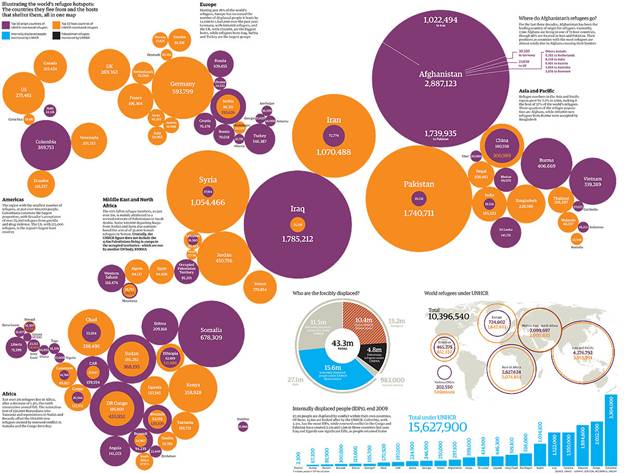
The UNHCR released its annual report this week for last year: “2009 Global Trends- Refugees, Asylum-seekers, Returnees, Internally Displaced and Stateless Persons.”

The UNHCR estimates that approximately 43.3 million people were forcibly displaced at the end of 2009.  South Africa continued in 2009 to be the destination country receiving the largest number of new asylum seekers (222,000).  The US and France were second and third with less than 50,000 new asylum seekers.

The Guardian’s Data Blog published an interesting graphic with the UNHCR statistics.

Click here for UNHCR web article.

Click here for link to the UNHCR Report.

Click here for link to the Guardian’s map.

[UNHCR refugee statistics mapped. Illustration: Paul Scruton for the Guardian.]

Leave a comment

Filed under Data / Stats, Reports, UNHCR

Spain and Senegal Renew Agreement Permitting Frontex to Operate From Dakar

Spain and Senegal have renewed a bi-lateral agreement permitting Frontex to operate from a base in Dakar for another year.

The Frontex mission in Senegal currently consists of two Spanish Guardia Civil patrol boats, a Spanish National Police helicopter, and a private airplane leased by the Spanish Defence Ministry.  One Frontex patrol boat also operates from Nuadibú, Mauritania.

Spanish Interior Minister Alfredo Pérez Rubalcaba said that France and Italy will soon be deploying additional assets and personnel to the Frontex mission in Senegal consisting of a ship and plane from Italy and a French security force team.  Rubalcaba stated that this new assistance demonstrates that “Spain is not alone” in the fight against the mafias responsible for the illegal boat arrivals to the coast this country. (“España no está sola” en la lucha contra las mafias responsables de las llegadas de embarcaciones irregulares a las costas de este país.)

Senegalese Interior Minister Ousmane Ngom, said that so far this year a total of 101 canoes from the coast of Senegal with 450 people aboard have been identified by the patrols. In 2006, the figures were 901 boats, with 35,490 irregular migrants.

Click here for article.  (ES)

1 Comment

Filed under Data / Stats, Eastern Atlantic, France, Frontex, Italy, Mauritania, News, Senegal, Spain

Large Drop in Irregular Algerian Migrants Arriving in Italy in 2009

Italy’s Ambassador to Algeria, Giampaolo Cantini, held a press conference this week and said that the number of harragas, irregular migrants, who were found attempting to enter Italy from Algeria dropped from 1599 in 2008 to 804 in 2009.  The press coverage described the reduction as a 70% reduction, but given the cited numbers, it seems the drop is about 50%.  Cantini noted that not a single migrant departing Algeria for Italy has been detected since 30 April 2010.

Cantini attributed the reduction to the increased level of bilateral cooperation between Italy and Algeria on the migration issue and the increased surveillance of the Algerian coast by Algerian authorities.

Click here and here for articles (both FR).

Leave a comment

Filed under Algeria, Data / Stats, Italy, Mediterranean, News