Category Archives: Reports

UNODC Report: The Role of Organized Crime in the Smuggling of Migrants from West Africa to the EU

UNODC released a report on 30 May: The Role of Organized Crime in the Smuggling of Migrants from West Africa to the European Union.  From the UNODC web page: “… The new report by the United Nations Office on Drugs and Crime (UNODC) investigates the involvement of organized criminal groups in the smuggling of migrants from West Africa towards the European Union (EU).  The involvement of organized crime in the smuggling of migrants is a sensitive and controversial issue in West African countries, as the report discusses at various points. The publication contributes to better understand the underlying mechanisms and actors involved in this criminal process as a basis for policy reforms in countries affected.

Information in the report was compiled by a team of researchers from West Africa and Europe using both documentary studies and field research conducted in Mali, the Niger, Nigeria and Spain. …  UNODC, as guardian of the Protocol against the Smuggling of Migrants by Land, Sea and Air, supplementing the United Nations Convention against Transnational Organized Crime, possesses specific expertise and experience that could be put at the service of all countries affected to support them in matters linked to prevention, legislation, operations or prosecution.”

From the Report’s Summary:  “The United Nations Office on Drugs and Crime (UNODC), through the European Union-funded ‘Law enforcement capacity-building to prevent and combat smuggling of migrants in the ECOWAS region and Mauritania (Impact)’, undertook to investigate the role played by organized criminal groups in the smuggling of migrants from West Africa to Europe.

The present report is aimed primarily at decision makers, law enforcement and judicial officials, but also at a wider audience interested in irregular migration. It contributes to a better understanding of the underlying mechanisms and actors involved in this criminal process as a basis for policy reforms in the West African countries concerned.  This report was prepared through desk and field research, conducted in Mali, Morocco, the Niger, Nigeria, Senegal and Spain. Interviews were conducted with over 200 people in Africa and Europe belonging to three main groups: migrants, national authorities and non-governmental organizations, and smugglers.

Four main findings can be mentioned:

• Transnational organized criminal groups are generally involved in the smuggling of migrants from West Africa to Europe. However, there are important differences among them in terms of specialization and professionalism. With regard to trafficking in persons and the smuggling of non-African irregular migrants, criminal groups are clearly well organized and structured, and keep close contacts with operatives in several countries. On the other hand, other would-be migrants in West Africa have to deal with loose networks that are not permanently structured. Various groups of actors usually collaborate for one particular operation, and there are no exclusive relationships between those criminal groups.

• Specialization and the building of transnational criminal networks usually come as a result of increased efficiency in border interdiction. Within West Africa, freedom of movement gives little incentive, if any, to engage in the smuggling of migrants. However, the situation changes when there are natural obstacles, such as the sea, or man-made obstacles, such as surveillance

• In most cases, smugglers are migrants themselves. Realizing that their knowledge acquired through (often painful) experience may be used by other migrants in exchange for remuneration, some migrants decide to enter the business of smuggling of migrants. They may then become specialized professional smugglers, or they use their knowledge to finance the completion of their journey to Europe.

• Irregular migrants generally do not see themselves as victims, and smugglers do not see themselves as criminals. A complex relationship exists between irregular migrants and smugglers. The latter have an interest in maintaining the flow and feeding youngsters with dreams of success. These dreams are also kept alive in some West African countries by families and circles where important social value is attached to those who decide to leave, as well as by those who have made it to Europe, be it legally or illegally, even though their situation in Europe is often worse than it was at home….”

Click here for Report.

Click here for article on UNDOC web page.

Leave a comment

Filed under Analysis, Eastern Atlantic, European Union, Mauritania, Mediterranean, Morocco, Niger, Reports, Senegal, Spain, United Nations, UNODC

European Commission: Annual Report on Immigration and Asylum for 2010

The Commission released its second Annual Report on Immigration and Asylum for 2010 on 24 May (COMMUNICATION FROM THE COMMISSION TO THE EUROPEAN PARLIAMENT AND THE COUNCIL).  Accompanying the 12 page Report is an 82 page Staff Working Paper.  Excerpts from the Commission press release regarding the Report:

“On Asylum:

  • Negotiations on all asylum legislative proposals must be finalised by the end of 2012, as agreed by the European Council.
  • The recent events in the Southern Mediterranean confirm the necessity of having in place a common asylum system at EU level. This implies better EU legislation, strengthened practical cooperation coordinated by the European Asylum Support Office (EASO), concrete solidarity between Member States and increased cooperation with third countries.
  • Agreement must be reached by the European Parliament and the Council on the EU joint resettlement scheme.
  • The EU relocation pilot project with Malta, the legislative reforms adopted by Greece and the ongoing support the country has received in the implementation of the Action Plan are concrete examples of the combination of responsibility and solidarity that are needed to build the Common European Asylum System.”

“On preventing irregular migration:

  • Member States must fully transpose the Employer Sanctions Directive by July 2011, which is essential for preventing irregular migration and for the credibility of legal migration.
  • Member States must step up measures against trafficking in human beings, including assistance given to victims under Directive 2004/81/EC with a view to dismantling networks of traffickers while strengthening rights of the victims.
  • Member States must fully transpose and implement the Return Directive and continue to make use of the opportunity offered by this Directive to foster voluntary departure as the preferred return option.
  • The use of joint return flights should be continued, by making full use of the European Return Fund and FRONTEX coordination, and including the presence of forced return monitors as required under the Return Directive.
  • Member States should systematically add entry bans in the Schengen Information System in order to give full effect to the European dimension of entry bans issued under the Return Directive.”

“On effective Border Control:

  • The European Parliament and the Council must agree on the proposed amendment to the FRONTEX Regulation as soon as possible, to provide a proper legal basis to strengthen the functioning of the agency.
  • All Schengen border-crossing points should be properly equipped, border surveillance properly ensured, and border guards trained to use new IT tools, as stipulated in the Schengen Border Code.
  • The feasibility of setting up a European Borders Guard System should be considered.
  • Local Schengen cooperation must be fully exploited in order to ensure a fully harmonised and streamlined visa procedure, in particular for the benefit of bona fide travellers.
  • Member States should continue to prepare the ground for establishing EUROSUR, the entry/exit system and the registered traveller programme.
  • To better coordinate the checks at the external borders the Commission will present proposals in 2012, in order to improve interagency cooperation between FRONTEX, EUROPOL, national customs and police authorities.”

I have reproduced about half of the Annual Report here, but have not had time to begin reading the Staff Working Paper.

Excerpts from Annual Report on Immigration and Asylum (2010):

“[***]

The present Annual Report is presented in response to the request made by the European Council when adopting the 2008 Pact on Immigration and Asylum[1] and covers the developments during 2010 in the implementation of the Pact and the relevant priorities of the Stockholm Programme adopted in 2009[2], both at the EU and the national level. The report has been prepared on the basis of Member States’ contributions and other information, in particular reports from the National Contact Points (NCPs) of the European Migration Network (EMN).

The report summarises and assesses developments at the EU and the national level[3], and puts forward recommendations for future action.

II. Entering and Residing in the EU

[***]

1. Legal migration – ensuring a legal way to enter the EU

[***]

2. Asylum – granting international protection and ensuring solidarity

In 2009 Member States recorded 266 400 asylum applications, the number in 2010 was 257 815, a slight decrease of 3%. While Poland, Italy, Hungary and Malta received less asylum-seekers in 2010 than in 2009, significant increases were recorded in Germany, Belgium and Sweden.

In 2010, the most important countries of citizenship of asylum-seekers in the EU were, in order: Afghanistan (20 580), Russia (18 500), Serbia (17 715, excluding Kosovo*[4]), Iraq (15 800) and Somalia (14 350).

In 2010, 55 095 asylum-seekers received a protection status in the EU at first instance (refugee, subsidiary protection or humanitarian). Protection was therefore granted in 25% of decisions taken in first-instance procedures.

In 2009, 7 147 refugees were resettled in the EU from third countries. The figure for 2010 was [until Q3] 3 848.

Legislative progress was slow and difficult in the field of asylum in 2010. The co-legislators agreed on the extension of the scope of the Long-Term Residents Directive to beneficiaries of international protection, and made some progress on the Dublin and Eurodac Regulations as well as on the Qualification Directive. To give an impulse to the stalled negotiations on the Reception Conditions and Asylum Procedures Directives, the Commission will adopt modified proposals on these two instruments in June 2011.

The adoption in 2010 of the Regulation for the creation of the European Asylum Support Office (EASO) was a significant development. The Commission is working actively so that the EASO becomes operational in June this year in view of boosting practical cooperation.

Solidarity among Member States is needed as one of the components of the Common European Asylum System (CEAS). A pilot project for the relocation from Malta to ten Member States of approx. 250 beneficiaries of international protection is running and will be extended beyond its originally intended duration so as to facilitate the relocation of recently-arrived migrants in need of international protection.

Following the submission of an Action Plan to the European Commission in August 2010, Greece has embarked on a comprehensive overhaul of its asylum and migration system, and has received support from the Commission, the Member States, Norway, the UNHCR and other EU partners. Asylum Expert Teams coordinated by the EASO are now deployed there. Important new legislation has already been adopted by Greece in 2010, and its implementation is underway.

Existing Regional Protection Programmes (RPPs) in Tanzania and Eastern Europe continued; the implementation of a new RPP in the Horn of Africa region started in September, in close cooperation with the UNHCR; and work advanced on the development of another RPP in North-Eastern Africa (Egypt, Libya and Tunisia).

Resettlement is equally essential in this context. Negotiations on the creation of a Joint EU Resettlement Programme must come to an operational and positive end. A strategic approach and political steering on the use of resettlement is needed.

  • Negotiations on all asylum legislative proposals must be finalised by the 2012 deadline.
  • The recent events in the Mediterranean and the need to restructure the asylum systems of some Member States confirm the necessity of creating a common procedure and a uniform status at EU level. This implies better EU legislation, strengthened practical cooperation coordinated by the EASO, a concrete multifaceted commitment to solidarity and an increased investment in cooperation with third countries.
  • Agreement must be reached by the European Parliament and the Council on the EU Joint resettlement scheme.
  • The EU relocation pilot project with Malta, the legislative reforms which have been adopted by Greece and the ongoing support it has received in the implementation of the Action Plan are concrete examples of the combination of responsibility and solidarity that are needed to build the CEAS.

3. Integration – a key element both for migrants and receiving societies

[***]

III. Addressing irregular migration to facilitate regular migration

In 2009, the number of irregularly staying third country nationals apprehended in the EU-27 was about 570 000 (7% less than in 2008). Member States returned about 253 000 third country nationals (4.7% more than in 2008).

In 2010 63% (i.e. about 20 000 detections) of illegal border-crossings into the EU were detected in 3Q2010 at the Greek/Turkey land border.

Effective measures aimed at preventing irregular immigration and at securing safe borders are an essential component of a coherent and credible EU immigration policy, but this policy must be fair and human rights must be respected.

1. Instruments for fighting irregular migration

Two legal key instruments have been adopted in recent years – the Return Directive 2008/115/EC and the Employer Sanctions’ Directive 2009/52/EC. They are in place now, but their state of transposition is far from satisfactory, in particular with respect to the Return Directive, where the implementation deadline passed on 24 December 2010. That is why its full and timely transposition is essential. Those provisions, which directly confer rights on migrants, may be, and already are, invoked in proceedings before national courts, and directly applied at the national level, regardless of whether national transposition legislation is in place.

Reinforced border control and cooperation with third countries, notably via readmission agreements, have already proved their effectiveness, as demonstrated in some Member States which have reported on their deterrent effect and on better-functioning return arrangements. However, there remains room for improving the effectiveness of readmission agreements at the EU level, as set out in the Commission’s Communication on the Evaluation of EU Readmission Agreements (COM(2011)76). It is also clear that the higher number of joint return flights coordinated by Frontex in 2010 have been a success, earning the agency further support and increased financial means. Moreover, the 29 measures agreed by the Council to reinforce the protection of the external borders and combating illegal immigration are now being implemented. In its Staff Working Document[5] on the fulfilment of these 29 measures, the Commission reported in detail on progress achieved with regard to each measure, putting a special emphasis on the role played by Frontex, the development of EUROSUR and the ongoing dialogue on migration with main countries of origin and transit as part of the implementation of the Global Approach. These measures need to be accelerated and given priority.

The Directive on preventing and combating trafficking in human beings, and protecting victims, the EU Anti-Trafficking Coordinator appointed by the Commission and a website on fight against trafficking in human beings[6] launched in 2010 have equipped the EU with new powers and ways to fight against this modern form of slavery. The recently adopted implementation report on Directive 2004/81/EC[7] on residence permits for victims of trafficking also called for their more effective protection, which should also help to dismantle networks of traffickers.

  • Member States must fully transpose the Employer Sanctions Directive by July 2011, essential for fighting irregular migration and for the credibility of legal migration.
  • Member States must step up measures against trafficking in human beings, including assistance given to victims under Directive 2004/81/EC with a view to dismantling networks of traffickers while strengthening rights of the victims.
  • The Return Directive must be fully transposed and implemented by the Member States who should continue to make use of the opportunity offered by this Directive to foster voluntary departure as the preferred return option.
  • The use of joint return flights should be continued, by making full use of the European Return Fund and FRONTEX coordination, and including the presence of forced return monitors as required under the Return Diretcive.
  • Member States should systematically add entry bans in the SIS in order to give full effect to the European dimension of entry bans issued under the Return Directive.

2. Effective border control

In 2010 the Commission proposed a Regulation on the establishment of an evaluation mechanism to verify the correct application of the Schengen acquis. In the light of recent experiences, its adoption must be a priority, so that the EU is better equipped to enforce a uniform application of the rules and take the appropriate measures if this would not be the case. Development of the Visa Information System (VIS) continued with the completion of the second and third major testing phases out of a total of four. Final agreement was reached on the technical specifications for the interaction of SIS II with the national systems. Member States continued to prepare the ground for establishing EUROSUR in line with the roadmap. EUROSUR will gradually establish a mechanism whereby Member States’ authorities carrying out border surveillance can cooperate and share operational information with each other and with Frontex, in order to reinforce the control of the external border of the Schengen area, especially its southern maritime and eastern land borders, and step up the fight against irregular migration and cross border crime. During the past year, the EU has faced critical situations at its borders, where it was confronted with high inflows of irregular migrants. This has been, and continues to represent, a major a test for the EU’s ability to react quickly and efficiently, while the Member States most directly concerned by migratory movements have required assistance in a spirit of solidarity. The achievements of Frontex are now broadly recognised and there is widespread agreement on the need to upgrade its role in order to enable it to be more effective.

The results of concerted EU action to tackle border-related crises have been mixed. On the one hand, the EU and the Member States have demonstrated that they are capable of responding decisively to address specific challenges faced by a Member State in effectively controlling its external borders. For the first time, following a request made by Greece related to the pressure on its land borders with Turkey, use was made of Frontex’s Rapid Border Intervention Teams (RABIT). The swift deployment of the RABIT, strongly supported by participating Member States, stabilised the situation and brought down the number of arrivals compared to the peaks in 2010. Malta has recently requested deployment of the RABIT in view of the situation in the southern Mediterranean.

On the other hand, one of the lessons learnt from these events is that both increased cooperation and uniform application of the acquis must be better and more effectively ensured by all Member States. Coordinated preventive EU action vis à vis countries of origin is still slow and weak.

  • The European Parliament and the Council must agree on the proposed amendment to the FRONTEX Regulation as soon as possible, to provide a proper legal basis to strengthen the functioning of the agency.
  • All Schengen border-crossing points should be properly equipped, border surveillance properly ensured, and border guards trained to use new IT tools, as stipulated in the Schengen Borders Code.
  • The proposed Schengen evaluation mechanism must be adopted, in order to foster mutual trust between Member States and EU institutions on the correct, uniform and coherent application of the Schengen Acquis.
  • The feasibility of setting up a European Border Guard System should be considered.
  • Local Schengen cooperation must be fully exploited in order to ensure a fully harmonised and streamlined visa procedure in particular for the benefit of bona fide travellers.
  • With a view to developing a fully reliable system of EU border control, Member States should continue to prepare the ground for establishing EUROSUR, and explore the desirability of putting in place an entry/exit system and a registered traveller programme.
  • To better coordinate the checks at the external borders the Commission will present proposals in 2012, in order to improve interagency cooperation between FRONTEX, EUROPOL, national customs and police authorities.

IV. Unaccompanied minors – a specific challenge

[***]

V. The External Dimension of EU migration Policy – The Global Approach

[***]

[1]               http://register.consilium.europa.eu/pdf/en/08/st13/st13440.en08.pdf.

[3]               A Commission Staff Working Paper provides more detail.

[4]               * Under UNSCR 1244/1999.

[5]               SEC (2010) 1480 final of 26.11.2010.

[7]               COM(2010) 493.”

Click here for Annual Report on Immigration and Asylum (2010)

Click here for Staff Working Paper.

Click here for Press Release.

Click here for 2009 Annual Report on Immigration and Asylum.

Leave a comment

Filed under European Union, Frontex, Reports

PACE Delegation Completes Visit to Lampedusa

A delegation from the PACE Committee on Migration, Refugees and Population has just completed a two day visit to Lampedusa.  The members of the delegation were Christopher Chope (United Kingdom, EDG), Chair of the Migration Committee, Giacomo Santini (Italy, EPP/CD), First Vice-Chair of the Migration Committee, Tineke Strik (Netherlands, SOC), Chair of the Sub-Committee on Refugees, Tina Acketoft (Sweden, ALDE), and Annette Groth (Germany, UEL).  The delegation reported that while the situation in Lampedusa in regard to newly arriving migrants is under control when compared with the situation earlier in the year, the “reception facilities on Lampedusa were inadequate for longer stays – especially for vulnerable groups such as unaccompanied children – and that transfers to better-equipped centres elsewhere in Italy should be carried out within days: ‘In particular, the situation of the Tunisians that have been on the island in detention-like conditions for almost three weeks should be dealt with as soon as possible.’”

The delegation also said that “[t]he arrivals to Lampedusa are not the sole responsibility of a tiny island. There have been enough calls for responsibility-sharing and for solidarity. It is time that Europe acted on them. … Too many have already died at sea trying to reach Europe.  …  Europe must try to protect asylum seekers and refugees in a way that they are not forced to risk their lives first.”

Click here for PACE statement.

Click here for earlier announcement of the visit.

1 Comment

Filed under Council of Europe, Italy, Libya, Mediterranean, News, Reports, Tunisia

Frontex Issues 2011 Annual Risk Analysis

Frontex posted its 2011 Annual Risk Analysis to its web site yesterday. [Update 9 May 2012: 2011 Annual Risk Analysis also available here: frontex_annual_risk_analysis_2011 ]

From the Frontex web page: “Frontex’s Annual Risk Analysis 2011 records the main trends in regular and irregular migration into the European Union in 2010 and offers predictions for the coming year’s trends. Regarding irregular migration, the sharp decrease reported in 2009 (of around a third on 2008) stabilised in 2010; Member States and Schengen Associated Countries reported a total of 104,049 detections of illegal border crossing at the sea and land external borders, a total almost identical to the 2009 figure of 104,599….”

Executive Summary:  “Irregular migration represents a small proportion of the total movement of persons across the borders, three quarters of which are EU nationals. Over 100 nationalities require a visa to enter the EU, accounting for more than 80% of the non-EU population, while about 1 billion nationals from 37 countries do not require a visa. As yet, there are no precise statistics available on passenger flows for 2010, but it is widely regarded to have recovered somewhat from the decline of 2009.

Regarding irregular migration, the sharp decreasing trend reported in 2009 stabilised in 2010; Member States and Schengen Associated Countries reported 104 049 detections of illegal border-crossing at the sea and land external borders, a total almost identical to 2009.

Irregular migration through western African, western Mediterranean and central Mediterranean routes continued to decrease, thus reducing the overall detection of irregular migration of West Africans who, in the past, used to be the most commonly detected migrants on those routes. By contrast, there was an abrupt increase in detections of illegal border-crossing at the land border between Turkey and Greece. Consequently, in 2010 the eastern Mediterranean route became the main channel of irregular migration into the EU, and Turkey – the main transit country for irregular migrants.

The sudden increase in detections of illegal border-crossings along a small section of the Greek-Turkish land border in October 2010 was due to facilitators exploiting variations in the vulnerability of the external border. This development triggered the first deployment of the Rapid Border Intervention Team (RABIT) in November 2010.

At EU level, refusals of entry decreased marginally in 2010; however, trends differed extensively between nationalities. Ukrainians continued to be the main nationality refused entry at EU Member States’ external borders in 2010, mostly at the Ukrainian border with Poland which is one of the busiest border sections along the EU’s external borders. Furthermore, Serbians became the second most frequently refused nationality at the external land borders, with more than an 80% increase, following the visa liberalisation process in the Western Balkans. At the external air borders, Brazilians continued to be the nationality most often refused despite the fact that these refusals declined by more than 20% compared to 2009.

At the end of 2010, the detection of false documents at entry points to the EU reached their highest level since data collection began in early 2009. Apart from this increase, there are reports of widespread abuse of authentic documents by unauthorised users known as impostors.

Looking ahead, regular passenger flows across the external borders will increase due to rising global mobility, possible visa-liberalisation procedures for the EU’s eastern European partners and new local border-traffic agreements along the eastern borders. These developments will increase the workload of border-control authorities in preventing the use of legal channels for overstaying. In addition, Europe will host two major sporting events – the Olympic Games in London and the UEFA Euro 2012 in Poland/Ukraine.

Consistent with the increasing flow of passengers, the growing number of registered traveller programmes (RTP) should further facilitate bona fide passenger flows and will put additional emphasis on risk analysis-driven border checks in order to ensure the smooth flow of legitimate passengers.

There might be changes in the external Schengen and EU borders in 2011 or 2012, with the possible entry of Romania and Bulgaria into the Schengen area and Croatia’s possible accession to the EU.

The most likely high-pressure points for illegal border-crossings in 2012 will be along the Mediterranean coast and the land border with Turkey. Migrants with relatively easy access to Turkey or North Africa will continue to typify the flow.”

Click here for the Frontex statement.

Click here for the 2011 Annual Risk Analysis.  [Update 9 May 2012: 2011 Annual Risk Analysis also available here: frontex_annual_risk_analysis_2011 ]

2 Comments

Filed under Analysis, Data / Stats, European Union, Frontex, News, Reports

ICJ Publishes New Practitioners Guide –“Migration and International Human Rights Law”

The International Commission of Jurists has just published its sixth Practitioners Guide entitled Migration and International Human Rights Law: Practitioners Guide No. 6.  The Guide was researched and written by Massimo Frigo and edited by Róisín Pillay.

“The Practitioners Guide on Migration and International Human Rights Law analyses the protection afforded to migrants by international law and the means to implement it at national and international levels. The Guide synthesises and clarifies international standards on key issues, in particular: the rights and procedures connected to the way migrants enter a country and their status in the country of destination; human rights and refugee law constraints on expulsion; the human rights and refugee law rights linked to expulsion procedures; the rights and guarantees for administrative detention of migrants; rights connected to work and labour; and rights to education, to the highest attainable standard of health, to adequate housing, to water, to food, and to social security.”

The 300 page Guide includes Chapters or Annexes on Human Rights Impediments to Expulsion, Detention, ESC Rights in Migration, and International Legal Remedies, among other subjects.

Click here or on this link  PGNo6-ElectronicDistribution for the Practitioners Guide.

(Thanks to Massimo Frigo for bringing this to my attention.)

Leave a comment

Filed under Books, Judicial, Reports

Europol 2011 Organised Crime Threat Assessment – Illegal Immigration and THB

Europol just issued its 2011 Organised Crime Threat Assessment (OCTA) (OCTA_2011-1).  The report contains Europol’s assessments regarding “current and expected trends in organised crime affecting the European Union.”  Among the topics discussed are the facilitation of illegal immigration and trafficking in human beings.

The report notes that the increased control of the external borders of the EU, combined with other immigration controls, has resulted in irregular migrants turning to organised crime groups to facilitate their entry to the EU.  The report notes that increased enforcement activities which successfully reduce illegal immigration in certain areas may result in substantial increases in illegal immigration in other areas.

The report indicates that organised criminal groups are exploiting and will continue to exploit the social and political unrest in North Africa and that organised crime groups are responsible for facilitating the movement of the thousands of Tunisians who have entered Italy.

The report notes that the accession of Bulgaria and Romania to the Schengen zone “may yield increased illicit traffic through these countries and the possible displacement of illegal immigration flows from the Turkish-Greek border.”

Excerpts from the 38 page report pertaining to the facilitation of illegal immigration:

“[I]ncreasing control of external borders, the introduction of higher quality travel documents and other protective measures implemented by destination countries are making illegal immigration more difficult for individual migrants, forcing them to seek the services of organised crime groups.

International agreements and coordinated law enforcement activities have a significant impact on the flows of illegal immigrants along established routes. In 2010, a sharp reduction in the use of sea routes was accompanied by a substantial increase in illegal overland entries, overwhelmingly concentrated on the Turkish-Greek border.

Besides being the natural gateway for immigrants from the Middle East and Asia, Turkey is now the final step towards the EU for migrants with many other origins, including North and West Africans. Its geographical position, the presence of historical smuggling routes and the comparative ease with which entry visas may be obtained have transformed Turkey into the main nexus point for illegal immigrants on their way to Europe.

[***]

Legislation aimed at safeguarding certain inalienable individual or social rights is manipulated by organised crime groups with specialist expertise. Political asylum requests, and family reunions following marriages of convenience with EU citizens, are among the most frequently abused procedures. In addition, a prevalent tactic is to exploit loopholes and the lack of harmonisation in current legislation.

[***]

Criminal Groups

Organised crime groups involved in the facilitation of illegal immigrants tend to be structured in loose networks of smaller groups with ethnic or other cultural connections to customers. By the same token, illegal immigrants tend to be recruited by, or approach facilitators from, the same ethnic background. However, few criminal groups have the capacity to manage all stages from source to destination country. The further migrants get from their country of origin, the greater the chance that their facilitators will be of an ethnic origin different from their own. Along the route, small local criminal groups receive and house transiting illegal immigrants, facilitating their passage to the next stage. In the often extended time between stages, transiting migrants are frequently exploited in illicit labour, thus marking a point of contact between illegal immigration and trafficking in human beings (THB).

Organised crime groups in destination countries play a fundamental role in the smuggling of migrants. Criminals, often legitimately resident in the EU, facilitate the last step of the migrants’ journey, in some cases collecting final instalments of transportation fees, and are in an ideal position to profit from newly arrived migrants, sometimes employing forms of exploitation typical of THB.

The most widely reported organised crime groups involved in the facilitation of illegal immigration are of Chinese, Turkish, Albanian, Indian, Iraqi, and Russian origin. Chinese, Vietnamese, Indian, Pakistani, and some West African groups are among the most capable, managing all successive phases of illegal immigration from source to destination countries. Although these groups may sub-contract part of the transportation or the production of falsified documents, they maintain effective control over the illegal immigrants throughout.

The growing importance of Turkey as a nexus point for migrants is likely to be further exploited by Turkish organised crime groups already extremely skilled in managing routes for illicit commodities and will make the most of their resources and contacts in the EU to maximise profits from this lucrative criminal market….

[***]

Criminal hubs

Political and legislative initiatives impact on regional dynamics, resulting in frequent shifts between hubs and preferred nexus points outside the EU.

Migrant flows across the Mediterranean Sea and illicit entries at the Eastern land borders have both significantly decreased. Greece is now the focus for illegal entry to the EU, and while levels of illegal migration connected with seasonal work patterns between Albania and Greece have decreased in the last year, illicit entries of migrants from Turkey have increased by over 500 per cent between 2009 and 2010

The South East criminal hub is therefore under the heaviest pressure. As a result also of its proximity to the Western Balkans, the hub’s centre of gravity for this criminal problem is currently Greece.

[***]

The Southern criminal hub is a landing zone for many immigrants who have entered the EU through Greece, and who either remain in Italy or proceed to other MS. Illegal immigrants are often exploited or employed by organised crime groups active in the hub.

Emerging and Future Issues

The social and political unrest pervading North Africa since January 2011 is likely to have a significant impact on the internal security of Southern Europe. By exploiting the present political vacuum and the diminution of police capability to maintain public order and combat criminal activity, organised crime groups are facilitating several thousands of illegal immigrants, mainly of Tunisian origin, in their attempt to cross the Mediterranean and reach Europe. This carries an inherent risk to the internal security of the EU.

The large and growing number of illegal immigrants from countries and regions in which Islamist terrorist groups are active – such as Chechnya, Afghanistan, Iraq, Pakistan and Somalia – raises the possibility that channels for illegal immigration will be used increasingly by those seeking to engage in terrorist activity in the EU.

In the absence of any significant harmonisation of standards with regards to visa issue for a variety of purposes (including settlement for marriage and family reunions) a further increase in the abuse of legitimate migration procedures is likely.

The possible accession of Romania and Bulgaria to the Schengen Zone will greatly widen the Eastern green and blue borders. This has the potential to release the pressure on the Turkish-Greek border, and lead to increased targeting of Bulgaria and the Black Sea coast by illegal immigrants and their facilitators.

Turkish organised crime groups, currently in a dominant position at the biggest nexus point for migrants, will exploit further opportunities for delivering illegal immigrants to the EU by means of the Black Sea and the flourishing Turkish diaspora in Bulgaria….

[***]

… The role of the Western Balkans as a logistical hub will be sustained and may even grow further, while the proposed accession of Bulgaria and Romania to the Schengen zone may yield increased illicit traffic through these countries and the possible displacement of illegal immigration flows from the Turkish-Greek border. In this event, Member States in South East Europe may require additional operational support. In light of the continued prominence throughout the EU of Albanian speaking criminal groups, strategic and operational partnerships with authorities in the Western Balkans will be increasingly important.

Ongoing political instability in countries close to the borders of the EU and transit areas for illicit commodities has the potential to alter trafficking routes and create new illegal migration flows. In countries such as Tunisia and Egypt the process by which serving regimes are replaced may result in power and investment vacuums in both the public and private sectors. Some of these could be filled by those with sufficient resources to exploit the instability for criminal ends, including EU organised crime groups. In politically fragile environments organised crime can also prosper by providing essential services such as transport infrastructure, and food and fuel supply. The effects of illegal immigration as a result of instability in North Africa – already experienced by Italy – are likely to spread if levels of unrest persist or increase. Should living conditions deteriorate in the longer term, the EU is likely to see an increase also in victims of THB from this region….

[***]”

Click on this link OCTA_2011-1 for OCTA report.

Click here for Europol press release.

Leave a comment

Filed under Aegean Sea, Analysis, Black Sea, Eastern Atlantic, European Union, Mediterranean, News, Reports

New Study: Implementation of Article 80 TFEU on the principle of solidarity between MS in the field of border checks, asylum and immigration

The European Parliament’s Directorate-General for Internal Policies, Policy Department C, Citizens’ Rights and Constitutional Affairs, released a 120+ page study in April entitled “The Implementation of Article 80 TFEU on the principle of solidarity and fair sharing of responsibility, including its financial implications, between the Member States in the field of border checks, asylum and immigration.

The study was made by Prof. Dr. Dirk Vanheule, Project Director, Dr. Joanne van Selm, and Dr. Christina Boswell and was prepared at the request of the LIBE committee.

ABSTRACT:  “The study assesses the scope and implications of Article 80 TFEU, which relates to the principle of solidarity in the field of Border Checks, Asylum and Immigration. The study analyses primary and secondary sources of European law in order to identify the implications of Article 80 TFEU in terms of obligations and jurisdiction. It also discusses the results of a questionnaire that was administered to senior public officials in the EU, collecting their views on the scope and possible mode of implementation of Article 80 TFEU. The study’s conclusions outline some practical solutions for the implementation of new solidarity mechanisms in the field of EU immigration and asylum policies.”

Click here for the full study.

Leave a comment

Filed under Analysis, European Union, News, Reports

Tunisian Migrant Boats Stop Arriving in Italy (for the time being) – Amnesty Int’l Criticises “Collective Summary Removals”

Italy has been continuing to deport newly arriving Tunisian migrants pursuant to the terms of its new agreement with Tunisia, the terms of which have not been made public.  Under the agreement, Tunisia has apparently agreed to the expedited returns of its nationals from Italy.  300 Tunisians were flown to Tunisia from Italy last week.

The mayor of Lampedusa, Bernardino De Rubeis, declared that the “immigration crisis” on Lampedusa is over (only 27 migrants remain on the island as of 26 April). The mayor called for the 500 extra police and military personnel who were brought to the island to deal with the migrants to leave as soon as possible so that tourists can use the hotel rooms currently occupied by the security personnel.

Amnesty International issued a Briefing Paper on 21 April: “Amnesty International findings and recommendations to the Italian authorities following the research visit to Lampedusa and Mineo.”  Amnesty is highly critical of the expedited return practices that have been implemented by Italy.

Excerpts from the Briefing Paper:

“Collective summary removals, reportedly of Tunisian nationals, from Lampedusa, from 7 April 2011 onwards, following the signing of an agreement between the Italian and Tunisian authorities.

Amnesty International is extremely concerned by the enforced removal that began on 7 April from Lampedusa, following the recent signing of an agreement between the Tunisian and Italian authorities. At the time of writing these forcible returns were ongoing and had reportedly been carried out twice a day by air since 11 April.

On 6 April, the Italian Ministry of Interior announced that Italy had signed an agreement with Tunisia pursuant to which the latter committed itself to strengthening border controls with a view to preventing departures, and to accepting the speedy readmission of people who had recently arrived and who will be arriving in Italy. Amnesty International is particularly concerned that, according to the above-mentioned announcement, Tunisian migrants arriving onto Italian shores may be “repatriated directly” and with “simplified procedures”.

In the light of this announcement, and given, in particular, Amnesty International’s findings in relation to the total inadequacy of asylum procedures on Lampedusa, the organization believes that those people who have been subjected to “direct repatriations” following “simplified procedures” have been victims of collective summary removals.

As far as Amnesty International could ascertain, people have been removed from the island within one or two days of arrival. Thus, it appears highly unlikely that they would have had access to any meaningful or adequate opportunity to assert that they should not be returned to Tunisia on international protection or other grounds. In the circumstances those removals would amount to summary expulsions (cf. the judgments of the European Court of Human Rights in the case of Hassanpour-Omrani v Sweden and Jabari v Turkey). Such practices are strictly prohibited under international, regional and domestic human rights and refugee law and standards. Additionally human rights and refugee law and standards require that the removing state must provide an effective remedy against removal. Removing people without giving them the chance of exercising their right to challenge their removal through an effective procedure gives rise per se to a human rights violation. This is independent of whether removal would place the individuals concerned at a real risk of serious human rights violations, which, in turn, would constitute a breach of the non-refoulement principle.

Amnesty International calls on the government of Italy to:

  • disclose the agreement reached with the Tunisian authorities;
  • immediately desist from any further summary removals;
  • ensure that anyone arriving on Italian shores is adequately screened to assess any potential protection needs, and that they are provided with adequate information about their right to challenge removal on international protection or other human rights grounds; and
  • ensure access to fair and effective asylum procedures as well as access to procedures to challenge removal on other grounds.”

Click here and here for articles. (IT)

Click here for Amnesty’s Briefing Paper.

Leave a comment

Filed under Italy, Mediterranean, News, Reports, Tunisia

UNHCR Report: “2010 Asylum Levels and Trends in Industrialized Countries”; Levels Fall to Half of 2001 Levels

From UNHCR’s statement summarizing the report which was released this morning:

“Asylum figures fall in 2010 to almost half their 2001 levels-

GENEVA – The number of asylum-seekers in the industrialized world continued to fall in 2010, bringing the figure down to nearly half the level at the start of the millennium.

This was among the main findings as the UN refugee agency today released its 2010 statistical overview of asylum applications in 44 industrialized countries. The report deals with new asylum claims and does not show how many individuals were granted refugee status.

According to the report, 358,800 asylum applications were lodged in industrialized countries last year – down 5 per cent from 2009, and some 42 per cent lower than the decade’s peak in 2001, when almost 620,000 asylum applications were made…

Numbers fall in most regions

Last year’s total number of new asylum claims was the fourth lowest in the last decade. Year-on-year decreases were reported in most regions, including in Europe, North America and North Asia. Within Europe, the largest decline was seen in southern Europe, where claims fell by 33 per cent compared to 2009. This was mainly because fewer people requested protection in Malta, Italy and Greece. However, this decline was offset by increases elsewhere, especially in Germany (49%), Sweden (32%), Denmark (30%), Turkey (18%), Belgium (16%) and France (13%). In the Nordic countries, the increases in Denmark and Sweden were offset by substantial declines in Norway (-42 per cent) and Finland (-32 per cent)….

US tops recipient list

Among individual countries, the United States remained the largest asylum recipient for the fifth consecutive year, accounting for one out of every six asylum applications in the industrialized countries covered in the report. The US saw an increase of 6,500 applications, partly due to a rise in the number of Chinese and Mexican asylum-seekers.

France maintained its position as host to the second-largest number of new applications, with 47,800 in 2010, largely from Serbian, Russian and Congolese asylum-seekers. Germany became the third-largest recipient country with a 49-percent rise. The increases can partly be attributed to a rise in asylum seekers from Serbia and the former Yugoslav Republic of Macedonia. That development is widely attributed to the introduction of visa-free entry to the European Union for nationals of these two countries since December 2009.

Sweden and Canada ranked fourth and fifth respectively. Together, the top five countries of asylum accounted for more than half (56 per cent) of all asylum applications covered in this report.

Most claims from Serbia

In terms of places of origin, the largest group of asylum-seekers in 2010 were from Serbia (28,900, including Kosovo). The country saw a 54 per cent increase compared to 2009, when it ranked sixth. Interestingly, the number of asylum applications in 2010 was comparable to 2001, soon after the Kosovo crisis.

Afghanistan slid to second place with a decrease of 9 per cent compared to the previous year. Unlike in 2009, when Afghan claims were mainly lodged in Norway and the United Kingdom, in 2010 more claims were filed in Germany and Sweden. Chinese asylum-seekers made up the third-largest asylum group in 2010, partly due to a substantial drop in the number of new applications from Iraq and Somalia. For the first time since 2005, Iraq was not one of the top two countries of origin of asylum-seekers. It dropped to fourth place, followed by the Russian Federation. Somalia, which occupied the third spot in 2009, fell to sixth in 2010….”

Click here for full report.

Click here for key graphs from report.

Leave a comment

Filed under Data / Stats, European Union, News, Reports, UNHCR

UN OCHA Situation Report 3 on Libya

OCHA Situation Report 3 on Libya.  HIGHLIGHTS/KEY PRIORITIES:

  • On 1 March, an estimated 12,000 people were evacuated from the Tunisia-Libya border to Egypt by air and sea;
  • A United Nations joint rapid assessment mission is currently in eastern Libya proceeding to Benghazi to assess humanitarian needs;
  • The United Nations Emergency Relief Coordinator has allocated some US$5 million from the Central Emergency Response Fund to kick-start emergency efforts to help people fleeing violence in Libya.

Click here for Report.

Leave a comment

Filed under Egypt, Libya, Mediterranean, News, OCHA, Reports, Tunisia

España ha destinado al menos un 5% de la ayuda en África Occidental a control de fronteras e intereses comerciales

A new report from Entreculturas and Alboan:

“Casi 25 millones de euros de un total de 466 es la Ayuda Oficial al Desarrollo destinada a países de África Occidental cuestionada por contribuir más a intereses de la política de migraciones que al desarrollo humano y lucha contra la pobreza durante el periodo 2004-2008. Es una de las conclusiones del informe “Políticas de control migratorio y de cooperación al desarrollo entre España y África Occidental durante la ejecución del primer Plan África” presentado por Entreculturas y Alboan….”

Resumen: “En el marco de la coherencia de políticas a favor del desarrollo, y con el objetivo de investigar si la cooperación bilateral española está condicionada por intereses de control de los flujos migratorios, las ONG Alboan y Entreculturas presentan el informe Políticas de control migratorio y de cooperación al desarrollo entre España y África Occidental durante la ejecución del primer Plan África que analiza el destino de la ayuda oficial al desarrollo (AOD). España  durante los años 2004 – 2008 ha destinado 25 millones de euros de AOD a proyectos que tienen más relación con el control de fronteras e intereses comerciales que con el desarrollo humano y lucha contra la pobreza. Esto supone un 5,2% de del total de la ayuda de AOD bilateral en África Occidental.”

Click here (ES) or here (ES) for full report.

Click here (ES) for news article.

Leave a comment

Filed under Eastern Atlantic, ECOWAS, News, Reports, Senegal, Spain

Frontex Work Programme for 2011

Frontex’s 139 page work programme for 2011 is available on its web site.  I have not reviewed it yet.  It was presented to the JHA Council earlier in the week.

Click here for the document.

Leave a comment

Filed under European Union, Frontex, News, Reports

Network Euro Mediterraneo per i Diritti dell’Uomo: Missione di raccolta informazioni in Tunisia e Italia e Raccomandazioni

From CIR:  “…[I]l Network Euro Mediterraneo per i Diritti dell’Uomo ha organizzato una missione di raccolta informazioni, che si è svolta dal 18 al 24 febbraio prima in Tunisia e poi in Italia. La missione era composta da rappresentanti di organizzazioni membro del Network e di partner e da esperti del Nord e del Sud del Mediterraneo. La missione ha potuto raccogliere testimonianze e informazioni dirette, tanto in Tunisia che in Italia.

La missione ha permesso di smentire sia la tesi della presenza massiva tra i migarnti arrivati in Italia di delinquenti di diritto comune evasi dalle carceri, sia quella di un complotto migratorio che sarebbe stato ordito dalla Libia e dai nostalgici di Ben Ali.

Nel corso della missione, le preoccupazione legate agli avvenimenti drammatici che sconvolgono la Libia hanno, in qualche maniera, soppiantato gli interrogativi che circondano i migranti tunisini.

Al termine di questa missione, il Network formula le seguenti raccomandazioni:

Alle autorità italiane:

  • Rispettare la dignità di tutti i migranti, quali che siano le loro motivazioni.
  • Sospendere l’applicazione dell’accordo bilaterale di riammissione con la Tunisia sotto il concluso con il regime di Ben Ali. Sospendere tutte le misure di espulsione forzata individuale o collettiva verso la Tunisia.
  • Richiedere all’Unione Europea l’attivazione del meccanismo di protezione temporanea.
  • Nell’attesa della protezione temporanea, accordare ai migranti una forma di protezione umanitaria che si traduca in un titolo di soggiorno legale in Italia. Misura che deve essere indicata dalle autorità centrali e che non deve essere in alcun modo delegata alla discrezionalità delle singole Questure e Commissioni Territoriali per il riconoscimento della protezione internazionale
  • Migliorare e razionalizzare le condizioni d’accoglienza, il ricorso allo stato d’urgenza umanitaria non può tradursi in un abbassamento degli standard di accoglienza.
  • Astenersi dal mettere in opera il progetto di raggruppamento del Villaggio Mineo, in Sicilia, di tutti i richiedenti asilo in corso di procedura in Italia, misura         che può provocare una situazione di ghetto ed esclusione sociale
  • Assicurare ai migranti che hanno fatto domanda d’asilo un esame individuale della domanda di protezione nel pieno rispetto delle direttive “procedure” e “qualifiche”
  • Astenersi da dichiarazioni allarmistiche e incendiarie che assimilano migranti, delinquenti e terroristi

Alle autorità tunisine

  • Garantire la libertà di tutte le persone di lasciare qualsiasi paese compreso il proprio ( Articolo 12, 2 del Patto internazionale relativo ai diritti civili e politici). Di conseguenza, astenersi di tutte le procedure penali per le persone fermate nel tentativo di lasciare la Tunisia via mare o per quanti sono rimpatriati forzatamente verso il Paese
  • Rispettare pienamente le obbligazioni marittime internazionali relative alla ricerca e al salvataggio in mare.
  • Aprire una inchiesta approfondita e imparziale sulle condizioni nelle quali una barca è affondata l’11 febbraio, in un incidente che è costato la vita ad almeno 5 persone, e perseguirne i responsabili
  • Sospendere l’applicazione dell’accordo bilaterale sul controllo dell’Immigrazione concluso con l’Italia. Esigerne la rinegoziazione e, nel futuro, escludere la possibilità di rimpatri massivi e la sua applicazione a cittadini di paesi terzi.

Alle autorità europee

  • Accompagnare gli Stati dell’Africa del Nord nel processo di transizione in corso, poiché la democrazia è la sola a poter garantire una reale stabilità nella regione, e quindi offrire ai giovani la possibilità di costruire il loro futuro in un paese nel quale possono progettare un avvenire.
  • Aiutare l’Egitto e la Tunisia che, contrariamente all’Europa, sono già stati chiamati ad accogliere rifugiati libici e stranieri, in provenienza dalla Libia. La solidarietà a cui si appellano gli Stati del Sud dell’Unione Europea deve esprimersi innanzitutto nei confronti di questi Stati in transizione
  • Astenersi da tutte le operazioni che avrebbero come conseguenza la dissuasione o l’impedimento dell’arrivo in Europa di persone che avrebbero bisogno di protezione
  • Prepararsi all’attivazione della direttiva sulla “protezione temporanea” nel caso si producano arrivi massivi dal Nord Africa.”

Click here (IT) for full CIR post.

See also CIR “Emergenza Nord Africa”.

Leave a comment

Filed under European Union, General, Italy, Libya, Mediterranean, Reports, Statements, Tunisia

Frontex 3rd Quarter Report

On 16 January the Frontex Risk Analysis Unit released its Report for the Third Quarter of 2010 (July-Sept.).  The report contains data, charts, and graphs detailing detections of migrants, asylum seekers, false document use, detections of facilitators, and other information.  The deployment of Frontex’s RABIT force to the Greek-Turkey border did not begin until 2 November 2010, so the effects of the RABIT deployment do not appear in the Third Quarter.

The Report notes that the “unprecedented peak in illegal border-crossings at the Greek land border with Turkey is the result of a shift from the sea to the land border” coupled with a “large increase in the absolute number of migrants” using Turkey as an EU entry point.  The Report states that there has been an eight-fold increase in the number Maghreb nationals detected at the Greek land border which “is thought to be the result of a displacement effect from the West Africa and Western Mediterranean routes.”

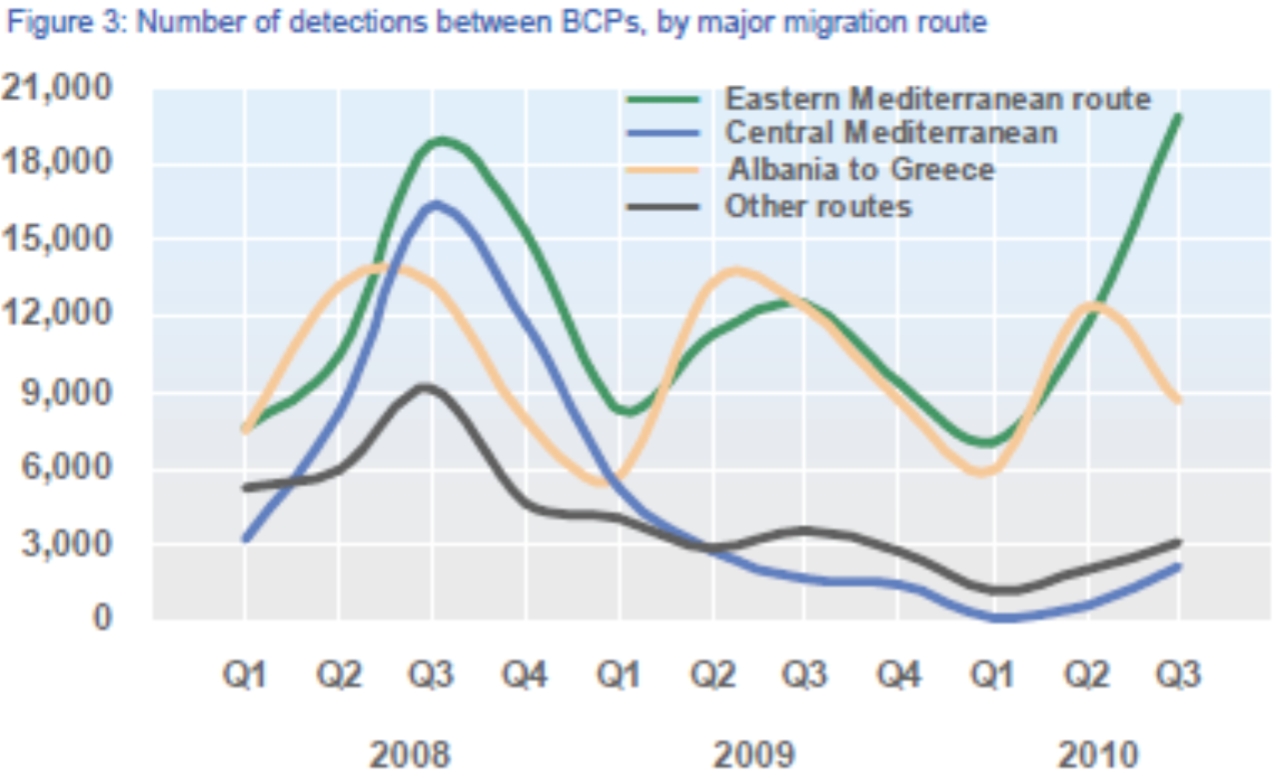
The Report also notes an increase in the number of detections on the Central and Western Mediterranean sea routes compared to Q2 which may be attributable to seasonal variations or “may be indicative of reorganized modi operandi in these areas in response to Frontex Joint Operations, more effective border controls and bilateral agreements implemented in 2008.”  See Figure 3 below.

Excerpts from the Report:

“Detections of illegal border-crossing”

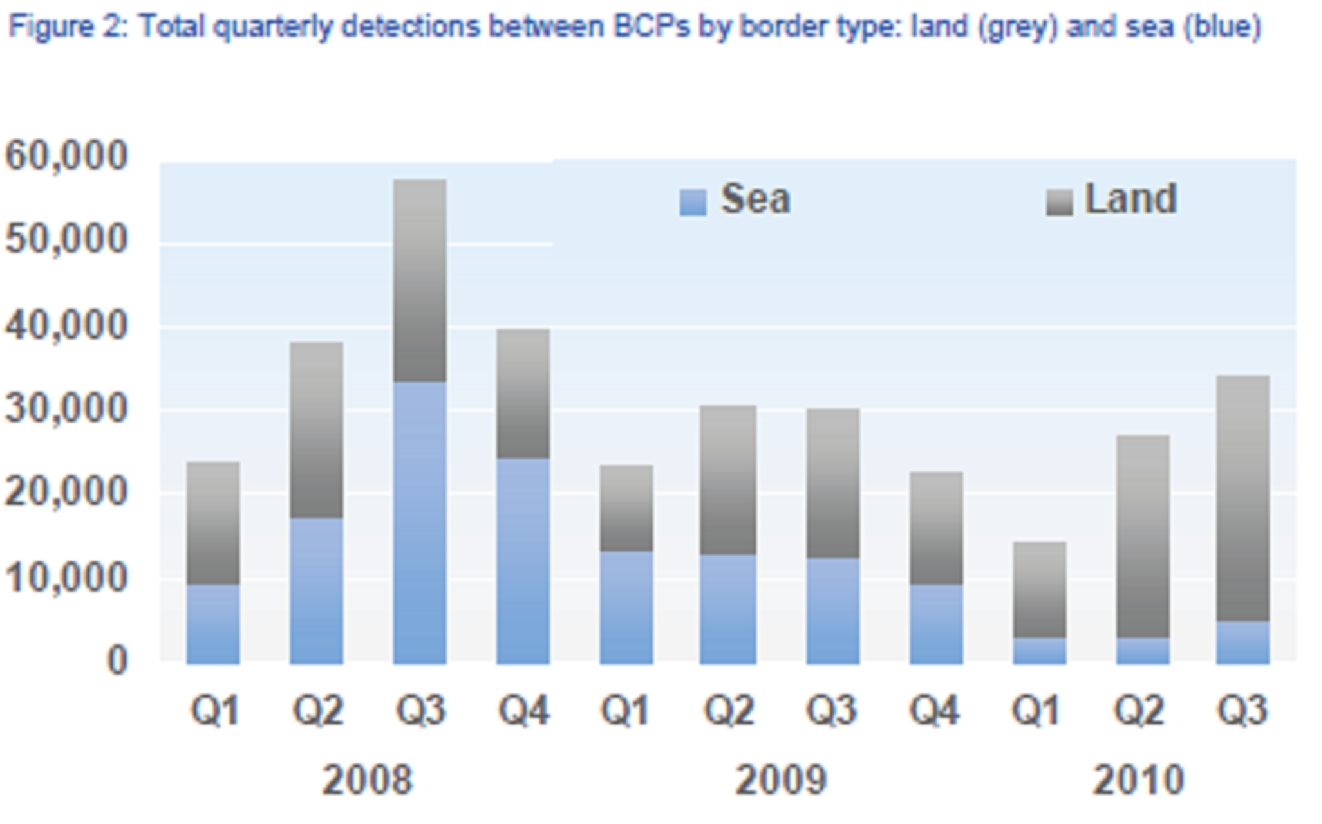
“…  Fig. 2 [see below] shows quarterly detections at the land and sea borders of the EU since the beginning of 2008. The 30% increase in the number of detections between the previous and present quarters is comprised of a 60% increase at the sea borders (although from a lower base) and a 23% increase at the land borders. This means that the shift from sea to land borders has not continued to same extent as in the previous quarters.  Nevertheless in Q3 2010, there were some 29 000 detections of illegal border-crossing at the external land border of the EU, which constitutes 85% of all the detections at the EU level, and the highest number of detections at the land border since data collection began in early 2008….”

“Eastern Mediterranean route”

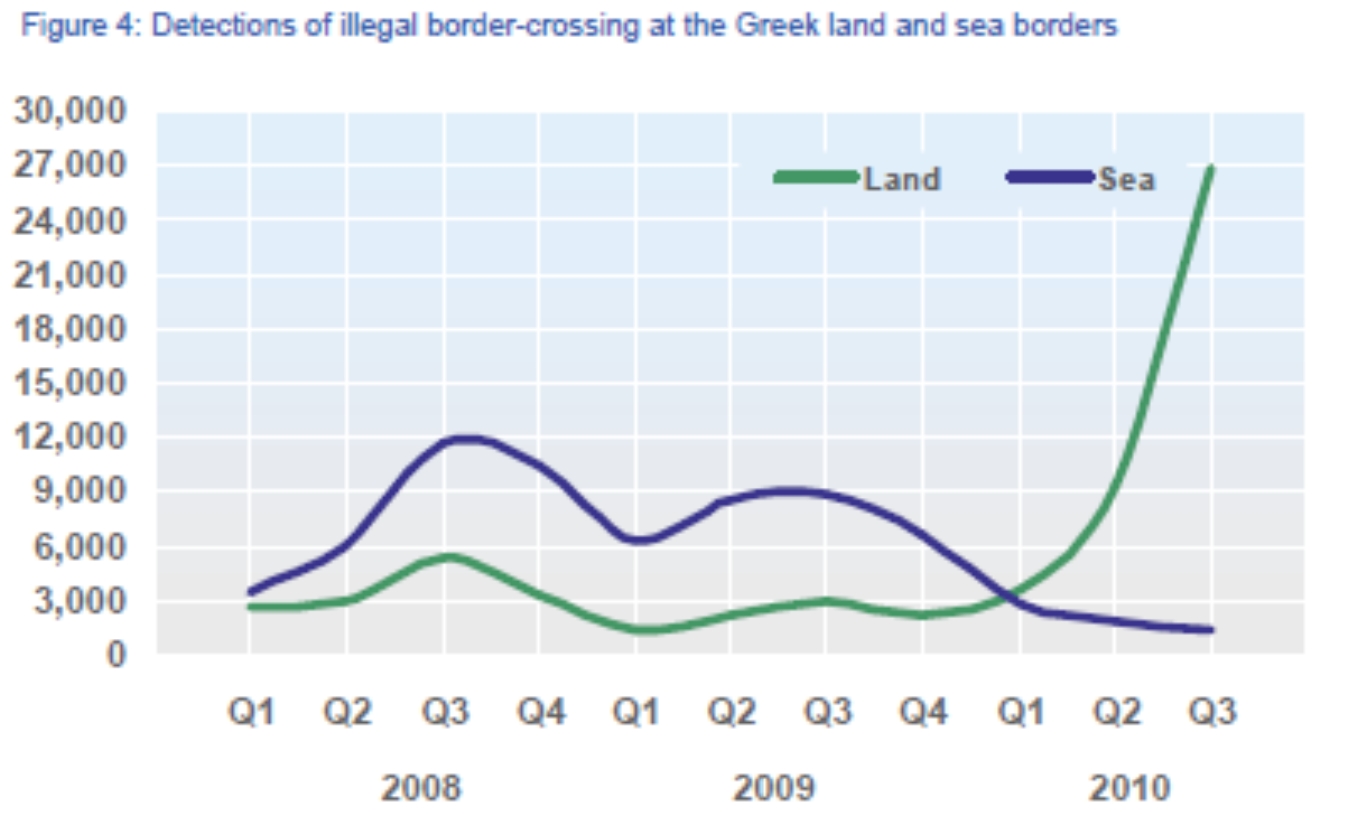
The Report observes that there has been a shift in illegal crossings from the Greece-Turkey maritime border to the Greece-Turkey land border and notes an increase in the number of nationals from Maghreb countries apprehended at the Greece-Turkey land border.  “This route [being taken by Maghreb nationals] is very indirect, but is thought to be the result of a displacement effect from the West Africa and Western Mediterranean routes….”

See Figure 4 below which shows that detections of illegal border crossers at the land border of Greece have exceeded detections at the sea border since Q1 of 2010.

“Central Mediterranean route”

“There were 2 157 detections of illegal border-crossing during Q3 2010. This is more than a three-fold increase compared to the previous quarter and a third higher than the same period last year. However despite this apparently large increase, detections still remain massively reduced compared to the peak of around 16 000 during the same period in 2008 (Fig. 3)….”

“The JO Hermes 2010 which was operational between June and October 2010, focused on illegal migratory flows departing from Algeria to the southern borders of the EU, specifically to Sardinia. In 2010, there were fewer detections than in previous years….”

“Departures from Libya also remained low. In June 2010, a new law was implemented to serve more severe punishments for facilitating illegal immigration. Ambassadors of the countries of origin were called into the Ministry of Foreign Affairs in Tripoli to be informed about the consequences of the new law, which suggests that this may be a serious implementation.”

“Western Mediterranean route”

“In general, irregular immigration to southern Spain has decreased massively since the beginning of 2006. However, in Q3 2010 there were 2 200 detections of illegal border crossing in the Western Mediterranean, more than twice that of the previous quarter and around a third higher than the same period in 2009. There is growth in the number of detections of a wide range of African nationalities, nine of which more than doubled in number between Q2 and Q3 2010. The most detected nationalities were Algerian, Moroccan, Cameroonian and Guinean.”

“Western Africa route”

“The cooperation and bilateral agreements between Spain and the rest of the Western African countries (Mauritania, Senegal and Mali) are developing steadily, and are one of the main reasons for the decrease in arrivals, as is the presence of patrolling assets near the African coast.”

“According to data collected during JO Hera, the numbers of arrivals in the Canary Islands and detections in West Africa are very low compared to the same time last year. The main nationality and place of departure is from Morocco, to where migrants are returned within a few days.”

Click here for the 3rd Quarter 2010 Report.

Click here for the 2nd Quarter 2010 Report.

Click here for the 1st Quarter 2010 Report.

Click here for my previous post regarding the 2nd Quarter Report.


Leave a comment

Filed under Aegean Sea, Algeria, Data / Stats, Eastern Atlantic, European Union, Frontex, General, Greece, Italy, Libya, Malta, Mauritania, Mediterranean, Morocco, News, Reports, Senegal, Spain, Tunisia, Turkey

INEX Report and Interview with Frontex Director Laitinen

A final report prepared as part of the INEX Work Package 3 “Value Dilemmas of Security Professionals” has just been released.  The Report is entitled “Ethical Security in Europe? Empirical Findings on Value Shifts and Dilemmas across European Internal-External Security Policies.”  The report’s authors are Dr. Matteo Tondini and Dr. Isabelle Ioannides.  The report contains extensive empirical findings and policy recommendations that are based primarily on two case studies: “the recent interception of migrants in the Central Mediterranean Sea undertaken by the Italian authorities” and “the implementation of anti-terrorism/radicalisation measures in the Netherlands and the UK.”

The report contains a significant amount of information which will be of interest to anyone concerned with migrant interdiction practices in the Mediterranean (and elsewhere).  I will try to post a few summaries of some portions of the report in the coming days, but in the meantime I wanted to call attention to an interview that was conducted in May of this year by Dr. Tondini with Frontex Executive Director Ilkka Laitinen as part of the research project.  A transcript of the interview is included in the report. [INEX Laitinen Interview 12May2010]

In the interview Mr Laitinen said that contrary to the information contained in the Human Rights Watch Report of 21 September 2009, Frontex had no involvement in the 18/19 June 2009 incident where Italian and Libyan authorities jointly intercepted and returned a group of migrants to Libya.  He noted that the recent agreements between Libya and Italy had closed the central Mediterranean migration route and that it is therefore now “the right moment for the Agency to intervene, with the aim of consolidating the results achieved so far … The only way of doing this is to cooperate with neighbouring countries such as Libya.”  And while Mr Laitinen stated that the “respect of fundamental rights is a crucial part of the European border control service” he also stated that “the right of boat people to claim asylum or other forms of protection outside [Member States’] territorial waters is not yet acknowledged Europe-wide.”  In response to this latter point, Dr. Tondini pointed out that it is the position of the Italian government that if an asylum claim is made on board an Italian vessel, the asylum seeker is supposed to be transported to Italy for the purpose of making a formal claim.

(Thank you to Matteo Tondini for sharing the Report.)

Click here for the final Report.

Click on this link- INEX Laitinen Interview 12May2010 -for the transcript of the Interview.

1 Comment

Filed under Analysis, Data / Stats, European Union, Frontex, Italy, Libya, Mediterranean, Reports